Can Jason Kenney throw a rope around Alberta’s unruly Right? Delacourt

Good column by Susan Delacourt on Kenney’ s move to Alberta politics and his many strengths, with a nice shout out to my books:

One of the events obliged panelists to give quick answers to provocative questions posed by the audience. “Who’s the best cabinet minister in Ottawa right now?” someone asked. I didn’t even have to pause for thought: “Jason Kenney,” I said. Many others on stage and in the audience shared that view.

It wasn’t just his reputation for hard work, although that certainly was a factor. Kenney was everywhere in the old Conservative government, building his clout on the political front (with those cultural communities and others) but also on the policy front. I was told once that Kenney had a representative at every meeting in Ottawa, keeping tabs on all kinds of decision-making processes, even those beyond his ministerial brief.

open quote 761b1bKenney does have strong views (no one’s going to mistake him for a Red Tory) but the caricatures ignore his practical side. And party mergers need practical politicians.

For a sense of what kind of minister Kenney was, I tend to urge people to take a look at books published by Andrew Griffith, a former director general in Kenney’s old department of Multiculturalism. Griffith has written revealingly of a public service coming to grips with a minister who had definite ideas about how to blend policy and politics, evidence and anecdote.

And where many ministers hewed to the PMO diktat and avoided contact with the media, Kenney was eminently approachable. I don’t think he ever said no when I asked him for comment on one thing or another. (Though he hasn’t replied to a message I sent him today as I was writing this article.)

For years he held annual Christmas parties at which reporters were not only welcome, but positively encouraged. The reward for attending was getting to hear Kenney tell funny, behind-the-scenes stories about the Harper government — nothing headline-making, just anecdotes that presented his political workplace as a little less stuffy and aloof.

And it was never hard to find opposition MPs during the Harper years willing to say that Kenney (along with John Baird) was one of the more co-operative ministers in cabinet, willing to occasionally drop the hyper-partisan posture that characterized so much of that government’s style.

This version of Jason Kenney is at odds, naturally, with the caricature painted by his critics — of a rigid, even scary, ideologue. Kenney does have strong views (no one’s going to mistake him for a Red Tory) but the caricatures ignore this high-energy politician’s practical side.

And party mergers need practical politicians. Harper was a pragmatist when he set about uniting the old federal PC party with the Canadian Alliance back in 2003.

Still, I will concede that I’m finding it hard to square the more nuanced Kenney I saw with the politician who tweeted out his support for the Brexit vote a couple of weeks ago. Given that much of Brexit’s support came from hostility towards immigrants, it seemed odd, to say the least, to see a former immigration minister — a courter of cultural communities — on that side of the question.

Interim Conservative Leader Rona Ambrose, I noticed, also seemed at a loss to explain the support for Brexit from the likes of Kenney and Tony Clement in an interview last weekend on CBC’s The House — suggesting vaguely that it might have something to do with friendships they’ve forged abroad.

Perhaps it was just Kenney keeping things interesting, blurring the tidy lines of the boxes people want to throw around him. If he is going to seek the leadership of the Alberta PCs, that in itself is a bit of a surprise; many people expected to see him seek the leadership of the federal Conservatives.

It may not be a good sign for those federal Conservatives that Kenney sees his future elsewhere right now. He became pretty adept — as his old boss would attest — at figuring out where there was room for growth in the conservative movement.

Could he pull off a merger in Alberta? I wouldn’t put it past him. Kenney has developed a knack for doing — and being — the unexpected.

Source: Can Jason Kenney throw a rope around Alberta’s unruly Right?

A response to Candice Malcolm’s Losing True North – Policy Options

For those interested, please find below the links for Candice Malcolm’s summary of her book, Losing True North: Justin Trudeau’s Assault on Canadian Citizenship, and my critique,  A response to Candice Malcolm’s Losing True North – Policy Options.

My conclusion:

As other reviewers have noted, there is a need for a strong conservative perspective in citizenship, immigration and multiculturalism policies to inform debates, discussion and policy choices. Otherwise, governments risk not considering the impact of their preferred approach. But this conservative perspective should be rigorous and evidence-based, enriched by anecdotes, and not merely a polemic. The same of course applies to liberals.

While it may be cathartic for her and other Conservative party members and supporters to criticize the Liberal government’s changes in this manner, it does not help the Conservative Party in its reflections on the lessons of the 2015 election. Even though Jason Kenny spent most of his weekends in ridings with large populations of new Canadians, the Liberals were victorious in 30 of the 33 ridings where visible minorities are the majority. Furthermore, her book does little to advance our understanding and knowledge of the challenges in ensuring the ongoing success of the Canadian model of the immigrant-to-citizen process.

Donald Trump Is Mainstreaming Anti-Semitism and White Supremacy | Nicole Hemmer

All too true and worrisome:

The friendly relationship between Trump and the alt-right represents a genuine reversal of conservative and Republican politics. In the 1950s, conservatives at the journal National Review made a concerted effort to expel anti-Semites from their ranks, banning anyone from the magazine who wrote for anti-Semitic publications. A decade later the magazine extended its ban to members of the John Birch Society, which, while not primarily an anti-Semitic organization, welcomed a number of prominent anti-Semites as spokespeople.

Conservative leaders believed this sort of distancing was necessary in order to gain respectability, and thus political power, in mid-century America. And by and large, that has been true ever since. It’s why code words and dog-whistles became so important – because open anti-Semitism and racism had become so disqualifying.

As a candidate, Trump has dropped the dog whistle and started speaking in openly prejudiced terms. His decision to do so did not keep him from winning the Republican nomination. Some have argued that he won because of his racism; I think it’s more complicated than that. But either way, he has become the Republican nominee, thus legitimating his decision to un-code his language.

Trump certainly sees no reason to change course. Since capturing the nomination, he has doubled-down on political racism and anti-Semitism. There’s the Star of David tweet, the attacks on Judge Gonzalo Curiel’s Mexican heritage. And there’s a telling incident that unfolded a few days ago on the campaign trail, when an audience member asked Trump to fire TSA workers wearing “heebee-jabis” and give their jobs to veterans. Trump said he was looking into it.

The incident was useful not only because Trump expressed openness to religious discrimination, but because the incident had a close parallel to the 2008 campaign. Then, John McCain fielded a question from a woman who said she could not trust Obama because she had heard he was an Arab. McCain visibly blanched, shaking his head and defending Obama as a “decent family man” and “citizen.”


How times have changed.

There are no longer the sort of gatekeepers that can keep groups like the alt-right far on the fringes of American politics. Republican leaders tried to stop Trump. They failed. National Review came out hard against him. It failed, too.

And political journalists, who have cataloged the many incidents of racism and anti-Semitism in the Trump campaign, now face a tough choice. Because Trump is the nominee, there is going to be tremendous pressure to air “both sides” of these controversies in order to appear balanced. CNN, for instance, gave former Trump campaign manager Corey Lewandowski, who it has hired as a commentator, airtime to call criticism of Trump’s Star of David tweet “political correctness run amok.”

If that’s the kind of coverage that dominates this campaign season – rank anti-Semitism met with largely unquestioned “on the one hand, on the other” reporting – then the mainstreaming of prejudice will continue unabated over the next several months. And if that happens, win or lose, Trump’s legacy will be secure: making America hate again.

Source: Donald Trump Is Mainstreaming Anti-Semitism and White Supremacy | US News Opinion

Two-thirds failed new Danish citizenship test – Al Jazeera

Appears deliberately designed to encourage a high failure rate rather than encouraging knowledge of Danish history, government and society, let alone integration:

Compared to the test in place under the previous government, the new exam focuses more on Danish history. The earlier test required 22 correct answers out of 30, and a much larger share of test takers passed that exam.

Five of the 40 questions are related to Danish current affairs. For the rest of the questions, some 200 pages of study materials in Danish language are provided for free – ranging from the history of the vikings to Danish architecture and holidays.

Mattias Tesfaye, an MP of the opposition Social Democrats, attended a meeting about the test with the integration minister on Tuesday. In his opinion, the answer options provided are too similar.

For example, the alternatives to answer the question about the lifespan of Danish composer Carl Nielsen are 1865-1931, 1870-1940 and 1892-1965.

“This doesn’t test their ability to understand Danish culture, but only if they are able to remember precise years,” Tesfaye told Al Jazeera.

His party supports a test for citizenship, but is asking that the style of questions be reconsidered.

Another question included in the June test asked which year the first movie about the Olsen Gang, a fictional criminal gang, premiered.

When Danish Radio put the question to one of the lead actors in the film, Morten Grunwald, he replied: “That I can’t even answer myself.”

However, when given the three alternatives – 1968, 1970 and 1971 – he did remember.

The test also asked which Danish restaurant has three Michelin stars.

Other questions test respondents’ knowledge of the Danish laws and political system; for example, the requirements to change the constitution and to participate in elections.

Stojberg of the Liberal party defended the test on Tuesday.

“There are simply too many who haven’t studied enough or followed news in Denmark,” she told Danish Radio.

About 2,400 people took the new test in June. Those who failed will get a new chance to take a test with a new set of questions in December.

Source: Two-thirds failed new Danish citizenship test – News from Al Jazeera

Charter for Inclusive Communities: NCCM

The latest and praiseworthy initiative of the NCCM: call to stand against Islamophobia in the broader context of anti-discrimination, anti-racism and shared values for all Canadians and communities.

Of course, like all charters and principles, the challenge arises in putting them into practice and the dialectic of balance of rights, but these provide a baseline to assist such debate and discussion:

By signing this Charter, we commit to standing up for the rights and dignity of everyone in order to promote inclusive, just, and respectful communities in Canada.

  • We strongly affirm that:Islamophobia, like all other forms of racism, hate, xenophobia, and bigotry, has no place in Canadian society.

  • Discrimination and acts of hate against anyone, marginalize individuals and communities and exclude them from participating fully in society and fulfilling their potential.

  • The dignity of every person in Canada is essential to a healthy and vibrant society.

  • Everyone in Canada has a role to play in creating safe environments for us all.

  • All levels of government, civil society, communities, and public officials have a duty to work together in developing policies, programs and initiatives to reduce and eliminate Islamophobia in all of its forms.

  • By working together, we can nurture inclusive communities and strengthen our shared commitment to Canada’s values of equality, respect, justice, and the dignity of all persons.

Source: NCCM – National Council of Canadian Muslims

Federal officials wrestling with gender neutral ID issues for more than a year

There is a complexity in the embedded links between various identity documents that does need time to sort out, given how central gender has been in the various identity cards and systems.

But clearly coming and expect the 2021 Census will include an “other” category and gender-based analysis will similarly need to be broadened:

Documents from June 2015 show officials from Citizenship and Immigration Canada were looking into what they called “identity management” issues should someone from a country that allows a third sex designation on their passports apply for Canadian immigration documents.

Internationally, there is a “growing recognition of a third sex/gender category…for those who identify as intersex, indeterminate, or unspecified,” officials from ESDC wrote as part of a presentation last year with Citizenship and Immigration Canada counterparts.

Seven countries allow a third sex designation on their passports – Australia, Bangladesh, Germany, India, Nepal, New Zealand and Pakistan.

Passport standards from the International Civil Aviation Organization, which Canada adheres to, allow governments to allow a third sex or gender category, usually marked with an ‘X,’ officials wrote in the documents obtained by The Canadian Press under the Access to Information Act.

Citizenship and Immigration Canada said it would respond Tuesday to questions posed to it on Monday.

At the same time, changing the use of sex designations in the registry of social insurance numbers would cause issues for agencies that rely on the information as part of their programs, like Employment and Social Development Canada and the Canada Revenue Agency that use the detail for gender-based analysis on income distribution, job data and even student loan recipients.

In May, the department told The Canadian Press the sex designation data from the registry is used primarily for gender-based analysis and not for determining eligibility for benefits. Federal and provincial agencies that use the information to validate identities raised concerns over the complete removal of sex information from the registry.

Source: Federal officials wrestling with gender neutral ID issues for more than a year – Macleans.ca

Robyn Urback: How can Black Lives Matter claim ‘victory’ when Pride has left so many divided?

One of the better commentaries:

BLMTO’s leaders and their allies claim their interruption was a necessary reminder that social movements often work in the interests of their wealthy white members first — early feminism is an obvious example — leaving its communities of colour to pick up the slack behind. And they’re not wrong. BLMTO can claim, with some credibility, that its disruption of the parade was important, or necessary, but it will have a hard time making the case that it did more good than bad, especially as hundreds of simultaneous Facebook fights about “pinkwashing” and “anti-blackness” enter their second day. And surely it would not tolerate a similar protest by Pride Toronto members at the Toronto Caribbean Carnival parade later this month.

Ian Willms/Getty Images

The question of future police participation in subsequent Pride events has only compounded the mess, with many accusing BLMTO of undermining recent progress made between the LGBT community and Toronto police, which included an historic apology offered by Police Chief Mark Saunders last month for a string of raids made on gay bathhouses in 1981. They claim, rightfully, that to ban future police participation in Pride events would be a step in the wrong direction, and would only alienate gay members of the Toronto Police Service, including Const. Chuck Krangle who penned on open letter urging the organization to reconsider its promise to BLMTO, arguing that “exclusion does not promote inclusion.”

Indeed, the tens of thousands of onlookers who have watched Toronto’s annual Pride Parade march down Yonge Street have surely noted the diversity of its participants: there are Liberals, Conservatives, church groups, unions, Arabs and Jews, all marching to support inclusiveness, diversity and the freedom for people to love who they love. That’s what this year’s event, and all Pride events, should be about. Instead, this year’s Pride parade left supposed allies fuming from separate corners, while BLMTO’s leaders proudly claimed victory for a job well done. It’s hard to see how starting a fight between groups that are working toward the same goals is really a cause for celebration.

Source: Robyn Urback: How can Black Lives Matter claim ‘victory’ when Pride has left so many divided?

Ontario facing ‘epidemic of Islamophobia’ survey finds

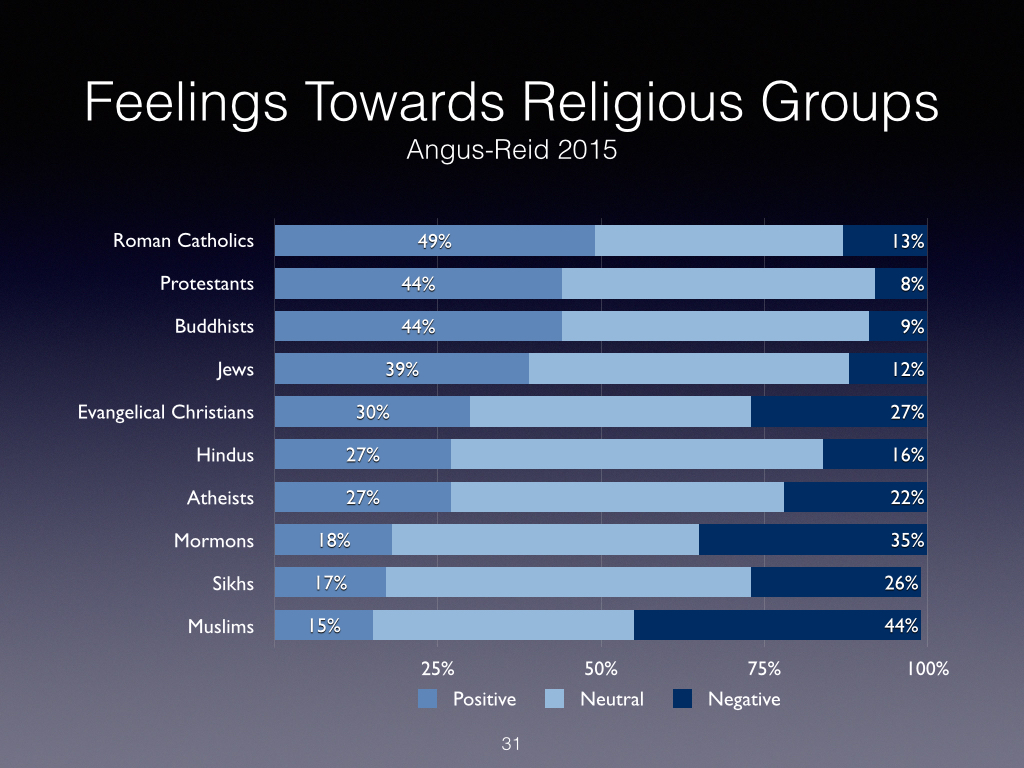
Angus Reid Religon Poll 2015 - Feelings Towards.001Consistent with most other surveys I have seen although labelling it as an ‘epidemic’ compared to other biases and prejudices appears to be an exaggeration (see chart above from 2015 Angus Reid survey):

The survey by polling firm MARU/VCR&C measured public perceptions of ethnicity and immigration in Ontario in the wake of the recent influx of thousands of Syrian refugees — almost 12,000 to this province alone.

“There is an epidemic of Islamophobia in Ontario. Only a third of Ontarians have a positive impression of the religion and more than half feel its mainstream doctrines promote violence (an anomaly compared to other religions),” said the 51-page survey to be released this week by the Ontario Council of Agencies Serving Immigrants and advocacy group Mass Minority. “These sentiments are echoed with Syrian refugees in Ontario where acceptance often coincides with acceptance of Islam.”

Ontario has seen a number of recent incidents targeting Muslims. A woman wearing a hijab was attacked at a supermarket in London in June and a Western University student from Iran was beaten by two men who taunted him and told him to go back to his country. Also, in June, an anti-immigrant group rooted in Germany held an anti-Muslim protest in Toronto.

While the survey’s respondents agreed that immigrants play a valuable role in society (72 per cent) and are an important part of our cultural identity (71 per cent), three-quarters of the survey participants said we need to focus on taking care of the people “here” instead of spending resources on refugees.

“Taken together, this suggests that Ontarians see non-immigrants as more entitled to social care. This entitlement is, in some ways, a contradiction given the inherent value that immigration offers,” said the poll of 1,009 Ontarians conducted between May 11 and 16.

The survey was funded by the province and the City of Toronto for its recently launched public awareness campaign on Islamophobia, which has sparked heated debate over its provocative posters, seen by some as reinforcing stereotypes and fuelling tensions.

The research was commissioned to take a snapshot of Ontario residents’ attitudes and perception towards immigrants and ethnic minorities as a benchmark to assess the effectiveness of the multimedia campaign. A followup survey is planned after 12 months.

While 46 per cent of Ontarians feel Canada admits too many immigrants, 45 per cent said they welcomed the right amount.

“Higher and lower levels of acceptance are associated with distinct demographic profiles,” the report said. “Less educated and rural Ontarians over-index on feelings that Canada accepts too many immigrants.”

Three-in-five residents in the province supported Ottawa’s decision to accept Syrian refugees while one-fifth of all respondents said they have participated in welcoming Syrians to Canada in various ways from donating money to furniture, volunteering and participating in a sponsorship group.

Comparing Canada’s six major mainstream religions, Islam is the most likely to be viewed by the respondents as a promoter of violence, followed by Sikhism, Christianity, Hinduism, Judaism and Buddhism.

Three-quarters of Ontarians said they feel Muslim immigrants have fundamentally different values, largely due to perceived gender inequality, the survey found.

“Opposition to Syrian refugees is higher among those with unfavourable impressions of Islam,” said the report. “Opposition is mainly because of concerns that Syrian immigration will mean less help at home. Those opposed see Canadians as needing support first and foremost.”

Source: Ontario facing ‘epidemic of Islamophobia’ survey finds | Toronto Star

Tasha Kheiriddin’s commentary seems to be unaware of the many activities by moderate Canadian Muslims to counter the narrative:

And all the public education campaigns in the world, such as those currently playing out across Toronto, won’t change the fact that fundamentalist practitioners of Islam maintain a worldview very different not only from those held by non-Muslims, but from those held by moderate Muslims as well.

As with any extremist religion-based movement, it’s the latter group that holds the key to transforming the faith and the way it is perceived. Moderate Muslims need to speak out against extremism, from the mosque to Main Street. Otherwise, radicals and their actions will continue to feed the fires of prejudice, help elect Donald Trump to the White House, and undermine the very principles of tolerance and equality which Western countries — including the millions of Muslims who call them home — hold dear.

http://ipolitics.ca/2016/07/04/are-we-becoming-more-islamophobic/

Australia: Hanson’s views on Islam take centrestage

One of the more toxic forces in Australia, elected to their Senate:

Pauline Hanson says Islam is not a religion of peace. In fact she doesn’t believe it’s a religion at all.

The One Nation leader, who’s set to return to the federal parliament after almost 20 years, insists she’s not out to offend Australian Muslims.

But she says it’s time to turn the spotlight on Islam, and what’s being preached in Australia’s mosques and taught in local Islamic schools.

She’s demanding a royal commission into whether Islam is a religion or a political ideology.

She wants to stop further Muslim immigration and halt the intake of Muslim refugees.

She wants surveillance cameras in all mosques and Islamic schools and for their teachings to be opened up to public scrutiny.

She advocates a ban on the construction of new mosques, and on the burqa and niqab being worn in public.

And she’s calling for a referendum on changing the part of the constitution that offers protection for the free practice of religion.

“You have our values, our culture, and our way of life. You don’t have a full burqa, you don’t keep putting up mosques,” she told reporters on Monday after learning she’ll take a seat in the new Senate.

“I’d like to know what they are teaching in those mosques. You can’t deny the fact that in these mosques they’ve been known to preach hate towards us.

“Is this a society we want to live in? I don’t believe it is. Do you want to see terrorism on our streets here? Do you want to see our Australians murdered?”

Ms Hanson said she didn’t want her views on Islam to dominate her first major press conference since the election.

Source: Hanson’s views on Islam take centrestage | SBS News

Housing prices: Singling out ethnicity of buyers is unhelpful | Yuen Pau Woo

While his first and third points are largely valid, the nature of Vancouver ethnic demographics and that those from China are the main source of foreign investment is a reality.

Similar to having a conversation about extremism and terrorism without making any reference at all to the link with religion and Islam in particular.

Finding a vocabulary to have an open discussion, and finding a way to respectfully but honestly debate the issues, is always a challenge.

But silence on the ethnic origin ignores the main driver:

First, most accounts of the role of Chinese buyers do not distinguish between non-residents and residents, or indeed between Canadian citizens, landed immigrants and foreign nationals. The vast majority of homes owned by Chinese people in the Lower Mainland belong to folks who have residency status in Canada — in other words, they are Canadians, not foreigners. There are hundreds of thousands of people with last names spelled in the fashion of mainland Chinese who are Canadian citizens or landed immigrants. [note I would not call those with Permanent Residents status Canadians, that term should be reserved for citizens]

Second, even if one is able to identify Chinese buyers who are truly “foreigners”, there has been little consideration given to their economic contribution to the local economy. Housing affordability, after all, is a function of both prices and income. Are these buyers connected to the international student population in B.C. that contributes about $1.5 billion a year to the local economy? How many local businesses have benefited from the investments of these high net worth individuals? The much-cited study identifying Chinese buyers of local condos looks at the numerator in the affordability equation, but totally ignored the denominator. Where is the equivalent study of their impact on jobs and incomes?

Third, and most importantly, singling out Chinese buyers is irrelevant when it comes to a public policy response. There may be a case for surcharges on foreign purchases of residential real estate and on property speculators, but any such policy would surely apply without regard to country of origin or ethnicity. After all, while China may be this year’s source of hot capital outflows, some other region could assume that role next year. Indeed, that may already be happening with the tightening of capital controls in China, the appreciation in the U.S. dollar, and heightened political uncertainty in much of the rest of the world.

So why this parlour game of pointing the finger at Chinese buyers? I don’t doubt that many researchers and writers on the subject have good intentions, but they are naive to think that singling out an ethnic group is nothing more than dispassionate analysis and a crusade against political correctness. On the contrary, they are unwittingly giving voice to darker sentiments in the populace and normalizing the language of chauvinism.

You see, I find out about their well-meaning articles and quotes when I get nasty spam messages from groups that actually don’t like Chinese people, or immigrants in general, and who gleefully hold up these articles as vindication of their beliefs. In the same way that the Brexit vote has given voice to racists in the U.K., the incessant focus on Chinese buyers as villains in Vancouver’s affordability crisis is propagating prejudice and promoting distrust.

None of the above is a dodge from discussing and dealing with the challenges of housing affordability in Vancouver. But there are no solutions to be found in singling out the ethnicity of buyers, and no winners in the divisive game of race baiting.

Source: Opinion: Singling out ethnicity of buyers is unhelpful | Vancouver Sun