Statscan fails to keep pace with seniors’ living arrangements

Valid concerns given the aging of the population:

In the wake of the 2016 census, researchers say they’re increasingly worried about limited data on a key segment of Canada’s booming senior population.
For the latest census distributed in May, Statistics Canada allowed administrators of nursing and retirement homes to complete a short-form census on behalf of residents. The agency also omitted the long-form census for all “collective dwellings,” which include hospitals, work camps and correctional institutions.

The move has irked some seniors and sparked calls from researchers for Statistics Canada to revise the 2021 census delivery as new models of senior living crop up.

“It’s something I’m concerned about with the aging of our population,” said Doug Norris, chief demographer at Environics Analytics and a census expert. “The data on our elderly population needs more attention than it’s gotten.”

Last year marked the first time that Canada had more people aged 65 and over – 16.1 per cent, or 5.8 million Canadians – than those 14 and under.

Without long-form results, Mr. Norris said researchers will lack crucial data about seniors’ income, ethnicity and education, among other findings. The data would be able to pinpoint demographic trends that have health implications, and shape myriad social policies, including seniors’ housing.

“Depending on the research and topic, it could be very important to include that group [of seniors], especially if you were doing anything health-related,” said Mr. Norris, who spent nearly 30 years at Statscan.

In the 2011 census, 378,000 people were counted in nursing and retirement homes classified as collective dwellings. This year, as in 2011, the short-form census – which captures age, gender, marital status and languages spoken – was distributed only to administrators of such homes.

Many questions on the long-form census, such as employment information, would not apply to seniors in nursing and retirement homes, said Geoff Bowlby, Statscan’s director-general of collection and regional services.
http://www.theglobeandmail.com/news/national/statscan-fails-to-keep-pace-with-seniors-living-arrangements/article31305272/ 

Not just anti-Semitism: New boss seeks to broaden ADL’s reach

Overdue, both on substantive grounds – bias, discrimination and prejudice happen to many groups – as well as political and tactical, given the ongoing demographic growth of minorities.

For more than a century, the Anti-Defamation League has been known as a group that combats anti-Semitism. But one year after taking the group’s helm, Jonathan Greenblatt wants it to focus on more than just the Jews.
Greenblatt’s predecessor as ADL national director, Abraham Foxman, became known during his decades at ADL’s helm, as an arbiter of what was and was not anti-Semitic, as well as a pro-Israel advocate who did not hesitate to criticize Jewish groups he saw as damaging Israel. Upon his retirement in July 2015, some called him “the Jewish Pope.”

But to woo millennials to the ADL, Greenblatt wants to stress the group’s work among other minority communities, which has long been a part of its agenda. This emphasis comes as the Jewish community’s relations with minority groups has become strained by anti-Israel sentiment among many left-wing activists. Just this week, the main movement opposing police violence against black communities, Black Lives Matter, released a platform accusing Israel of genocide against the Palestinians.

While the ADL focuses on many issues Black Lives Matter addresses, it has not collaborated with Black Lives Matter, and called the genocide accusation “repellent and completely inaccurate” in a blog post on Medium on Thursday.

As part of its renewed outspokenness on issues beyond those directly impacting Jews, the ADL has emerged in the past year as the only legacy Jewish organization to consistently criticize Republican presidential nominee Donald Trump by name when he makes controversial statements about Mexicans, Muslims or other groups. And Greenblatt wants the ADL to take a leading role in addressing mass incarceration and police violence in black communities.

“By delivering great programs and making an impact in the communities that we serve, by speaking up and using our voice to call out intolerance in any form, I think those things, I hope, will appeal to younger people,” Greenblatt said in an interview in his Manhattan office Wednesday. “This is one of those institutions with the scale and the scope where you really, truly can make a dent in the universe.”

http://www.timesofisrael.com/not-just-anti-semitism-adl-boss-seeks-to-broaden-groups-reach/

Nothing illegal about birth tourism at B.C. hospitals

More on birth tourism – numbers cited still small in relation to overall live births (about 44,000 in British Columbia 2014/15 ) but the local impact on the Richmond Hospital and residents being turned away should raise some concerns (according to the reporter, Pamela Fayerman, Richmond has the highest numbers of such births).

The relatively small numbers involved do not support the elimination of birthright citizenship but it is valid to question whether governments should regulate or prohibit birth tourism agencies or brokers.

For the overall numbers, see my earlier piece, What happened to Kenney’s cracking down on birth tourism? Feds couldn’t do it alone | hilltimes.com:

Federal authorities say foreign nationals coming to Vancouver to have babies aren’t breaking any laws as long as they can show they have money to pay for their medical care.

Birth tourism is becoming increasingly popular, especially in Richmond, where non-resident births are steadily rising, from just 18 in 2010 to 339 in the past fiscal year. Women primarily from China are seeking labour and delivery services at Richmond Hospital. Canada Border Services spokeswoman Sarah Lawley-Wakelin said pregnancy is “not a reason in itself to not admit a tourist.

“But if a foreigner is seeking entry to Canada for the express purpose of undergoing medical treatment and can’t show they have the money to pay for it, then that could be deemed by a CBSA officer as a potential excessive demand on health service, thus making that individual inadmissible.”

Chinese nationals must have a temporary (tourist/visitor) resident visa (TRV) to enter Canada and must state the purpose of travelling to Canada, said Nancy Caron, spokeswoman for Immigration, Refugees and Citizenship Canada (IRCC).

“People should always be honest about the purpose of their visit when applying to come to Canada. It is a serious crime to lie or to provide false information or documents when dealing with (IRCC). Lying on an application or during in an interview with an IRCC officer is fraud and it is a crime,” Caron said.

 Asked if there have been any investigations, charges or convictions against foreigners who didn’t admit they were coming to Canada to have a baby, she said:

“Immigration, Refugees and Citizenship Canada isn’t aware of any investigations into foreigners who didn’t admit they were entering Canada solely for the purpose of giving birth to a baby.”

Vancouver immigration lawyer Steven Meurrens said the increasing popularity of birth tourism would appear to be so mothers can obtain Canadian citizenship, passports, birth certificates and other documents for their newborns. “You’ve got women who do it to help their child and those who think it will give them a leg up on their own immigration efforts. So these are so-called anchor babies, yes.”

Since 1947, the Citizenship Act has guaranteed Canadian citizenship for those born here, Meurrens said, and although the previous Conservative government under Stephen Harper explored changes to the Act, nothing was done.

Meurrens said while birth tourism may “leave a bad taste in some people’s mouths” Canada has forever been a “settler society” and birth on soil citizenship is “central to our laws.”

“Where the real problems arise is when people skip out on their medical bills,” he said.

Freedom of information documents supplied to Postmedia by the B.C. government show that half of non-resident bills related to births are paid. Meurrens said since there are agencies or birth tourism brokers running birth houses — 26 at last count that the government is aware of — it may be possible for authorities to collect funds from them.

Meanwhile, more than a dozen pregnant Richmond residents were turned away from their local hospital in the past 18 months because it was too full to accommodate them.

Source: Nothing illegal about birth tourism at B.C. hospitals | Vancouver Sun

Eight ways to help your child deal with racial discrimination

Not a bad list:

[Samantha] Kemp-Jackson offered the following suggestions on how to prepare your children to face racial discrimination and how to teach them to be racially sensitive:

Don’t sugarcoat. “Lay the ground rules out and say, ‘It’s an ugly discussion, but it’s a real discussion. And the sooner I tell you about these facts of life, in terms of being people of colour or people who are minorities, the sooner you’ll be able to deal with it,’” she says. “I don’t know one person of colour – not just black, but South Asian, Asian, it doesn’t matter – I don’t know one minority person who has not dealt with some level of racism, whether it’s subtle or overt.”

Talk to them at their level. “You know your child best … and you know what your child can handle,” she says. “It may be very facile and very simplistic when you speak to them if they’re young. As they get older you can get more complex about it.” Young children, for instance, may express questions about differences in people’s skin colour. That can be an opportunity to talk to them about diversity.

Be upfront about your own feelings. “As a parent, you want to seem like a super-person. You don’t want to reveal to your kids that you’re vulnerable.” But, she says, when her own children saw her cry after her encounter with the store employee, “I couldn’t hide it. I had to give them an explanation.”

Give them strategies and specific tactics. “It’s not wholly a bad idea to maybe go through situations with your children, and say, ‘Okay, if somebody called you this name, what would you do? How would you respond to it?’ ” she says. It also helps to talk to your children about who they can turn to for support – for instance, teachers or principals – if an incident occurs at school.

Encourage them to have an open mind. “I always give people the benefit of the doubt. I assume that people are good unless they show me otherwise,” Kemp-Jackson says, explaining she extends this to how she talks to her children about police and other authority figures. “I’ve taught my kids that the police are there to help you,” she says. But, she notes, if her children feel they are not being treated in a fair manner, she wants them to know they have the right to stand up for themselves and to ask questions, such as, “Is there a reason why you’re asking me to do this? Or is there a reason why you’re speaking to me like that?”

Expose them to different cultures. It’s important to explicitly tell your children that every culture brings something positive from which they can learn. But, she adds, “I think it’s important to immerse them in the different cultures as much as you can.” For instance, Kemp-Jackson brings her children to various cultural fairs and neighbourhoods and introduces them to foods from around the world.

Lead by example. “We have friends of all different cultures, backgrounds, ethnicities, religious backgrounds. So when your kids see it, they will replicate it and think it’s the norm,” she says.

Address any discriminatory comments or behaviours from your children right away. “Say, ‘What did you mean by that?’ or ‘Why are you asking about that person?’ or ‘Do you think it’s strange that that person is wearing a sari? That’s not strange, that’s how people in India dress and this is why,’ ” she says. “Really confront it right when it happens and normalize the fact that people might look different and people might have different cultures but there are positive, rich and good things that can be taken from every culture.”

Source: Eight ways to help your child deal with racial discrimination – The Globe and Mail

Is Diversity on TV Really Getting Better? – The Daily Beast

More on diversity and minority representation in the entertainment industry:

And there is the hope—at the very least, a passionate desire—that the experience of a minority American has been universalized. The success of black-ish hints at that, as does the anecdotal experience of its cast. “I really love that we’ve brought family television back,” Ross said. “It’s a multigenerational comedy that makes people laugh and think all at the same time.”

Still, too, we may be far from fully realizing the idea of normalization—at least, to lend credence to Barris and Ross’s points, to the degree that “diversity” ceases to be a defining word in a conversation about one of TV’s best and most popular sitcoms.

A highlight, and perhaps the most incisive presence of the diversity panel, was actress Tichina Arnold, who, as she said, began acting at age 11 “during a time where there were glass ceilings everywhere.”

Mahoney, sitting next to her, laughed at the undersell: “Glass walls, glass floors, glass doors…”

But, now a star on Survivor’s Remorse, she’s been able to witness the progress and experience the immediacy of the change as it’s happening. And she has an interesting idea for what’s been behind the evolution.

“I thank God for social media,” she said. “I do. It could be a gift and a curse if not used correctly, but I think social media is one of the reasons why we’re all here on this stage, because social media has opened us up. It’s forced show business to listen, to pay attention to so many types of people and individuals out there.”

Mahoney is ready for the attention. And she’s ready to work for it.

“So there’s a line in the sand, and what my job is now is that I have to move that line in the sand,” she said. “And I have to walk in, and I have to confront people who are very comfortable in old, old ways of thinking.”

She paused.

“It’s exhausting,” she concluded. “It’s boring. But, as I often say, we’re built for it.”

Source: Is Diversity on TV Really Getting Better? – The Daily Beast

New gender-neutral Ontario health cards make it harder to get a passport

Inexcusable lack of communication and due diligence by the Ontario government. While I know that OHIP cards are not intended for identification purposes, the reality suggests otherwise.

Systems are linked and it is the responsibility of officials to make the necessary checks:

Ontario’s decision to issue gender-neutral health cards is making it more difficult for some of the province’s residents to get a passport, since the federal government wasn’t consulted on the switch.

….The province announced in June that it will start issuing health cards that no longer display information about a person’s gender on the front of the card.

Changes made to be fair and equitable, province says

Beginning in early 2017, drivers will also have the option on their licences to select X, instead of an M for male or F for female.

The province’s Liberal government said it is making the changes “to ensure the fair, ethical and equitable treatment of people with trans and non-binary gender identity.”

Bestard maintains this is a positive step for non-binary people, and one that she has absolutely no problem with. “I do understand the nuances of the LGBTQ community, and the challenges they face,” she said.

The issue, she says, is the headache that has been created by the two levels of government not working together.

“The lack of communication is quite surprising,” she said.

Immigration, Refugees and Citizenship Canada spokesperson Lindsay Wemp told CBC News that “IRCC was not consulted as part of this initiative from the government of Ontario.”

Christine Burke, spokesperson for Ontario’s Ministry of Government and Consumer Services, says ServiceOntario has been working with the federal government to address this situation.

“No consultations took place with the federal government prior to the change, as we were unaware that the photo health card was being used and accepted as an identity document by Passport Canada,” she said in an email.

Kwok Wong, spokesperson for the Ministry of Transportation of Ontario, told CBC News that the ability to just mark an X for gender on an Ontario licence complies with the International Civil Aviation Organization (ICAO) standards for machine-readable official travel documents.

“In various other countries, X is used in place of M or F when gender is not specified,” he said in an email.

“Ministry of Transportation officials discussed this proposal with the federal government counterparts including Passport Canada and Canada Border Service Agency.”

It appears that a licence marked with an X would not be able to be used to obtain a passport, as proof of gender is still one of the requirements.

Source: New gender-neutral Ontario health cards make it harder to get a passport – Hamilton – CBC News

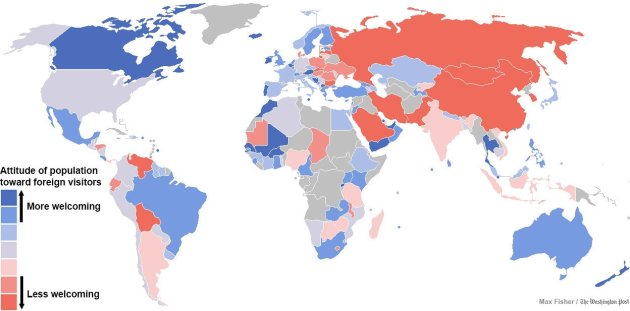
Neat map: Attitudes towards foreign visitors

Map attitudes foreign visitors

Latest Apple diversity report claims US pay equity, modest changes in gender and race

Latest numbers:

As of June, the company was 68 percent male and 32 percent female, Apple said on its website. That’s a shift of a single percentage point in favor of women.

In the U.S., the company was 56 percent white, 19 percent Asian, 12 percent Hispanic, 9 percent black, and 2 percent multiracial, another 1 percent being gathered into an “other” category. Notably the company actually increased the percentage of white employees 2 points, although Asian and Hispanic numbers were up 1 point apiece.

Less than 1 percent of American staff were undeclared, something Apple credits to “stronger internal processes and employees properly identifying themselves.” Most of the people who were previously undeclared turned out to be white, possibly explaining the above demographic shift.

On the pay equity front Apple claims that it has achieved total equity in the U.S. as of August, but is still working on the problem worldwide — this includes scrutinizing salaries, bonuses, and stock grants. There are no statistics on the company’s pay gaps elsewhere.

Like other tech companies Apple has sometimes come under criticism for being predominantly white and male in the U.S. In the past several years, though, the company has tried to adjust its hiring practices at all tiers. Its VP of Worldwide Human Resources, Denise Young Smith, is a black woman, and its retail head is former Burberry CEO Angela Ahrendts.

Source: Latest Apple diversity report claims US pay equity, modest changes in gender & race

Why Atlantic Canada risks losing its seat on the Supreme Court bench

David McLaughlin’s concerns on regional representation, where the comparative lack of diversity among Atlantic judges comes up against overall objectives for a more diverse Supreme Court):

The requirement that the Atlantic provinces have a guaranteed Supreme Court seat is a clear matter of convention, custom, practice, and tradition. How do we know? Because it has been the case since Canada existed. It is not an explicit legal obligation. A convention, with higher legal consequence, is not a custom, which may simply be a long-standing practice or tradition. A convention is not sacrosanct. Political actors can change it. That is how societies evolve.

Under the failed 1992 Charlottetown accord, the federal government would have been required to name judges from lists submitted by provinces and territories. This was a contemporary recognition of what might be termed the “regionalization” requirement of Supreme Court representation. It hewed closely to the original precepts of Confederation. The accord also called for formal consultation by provinces and territories with aboriginal peoples in the preparation of such lists.

Mr. Trudeau’s process inserts a more explicit “diversification” requirement for Supreme Court representation. The court should mirror Canadian society more visibly and directly as it pronounces on law that affects people.

This is all to the good. Except when it is not. This new process contemplates a clear tradeoff between historic convention and contemporary correctness. Since this convention is well known and established, there is no question that Mr. Trudeau is being deliberate, if not exactly forthright, about his intentions.

Justice Cromwell has not yet been replaced. Another judge from Atlantic Canada may yet be named. But this is no longer guaranteed. And that should exercise residents and governments in those four provinces.

Source: Why Atlantic Canada risks losing its seat on the Supreme Court bench – The Globe and Mail

And Konrad Yakabuski notes, I think correctly, that diversity is likely not to include much ideological or philosophical diversity (although I would not characterize it in the dark tones he does – really, seeing discrimination “lurking in every crevice of society”):

Canadians are lucky that, in Jody Wilson-Raybould, Mr. Trudeau has the most qualified Justice Minister in recent memory. As an aboriginal and former adviser to the B.C. Treaty Commission overseeing treaty negotiations between First Nations and the Crown, she is sensitive to the balancing act involved in governing and not prone to political pandering. She can be counted on to recommend judges of the highest calibre, regardless of their origins.

Just don’t expect Mr. Trudeau’s definition of diversity on the bench to include ideological or philosophical variety. The process he has put in place pretty much ensures the selection of liberal judges. Three of the advisory body’s seven members are Liberal appointees. Even if you might expect former Progressive Conservative prime minister Kim Campbell to argue for ideological diversity on the court, it’s an argument she’s likely to lose.

To be sure, the Liberal government has an interest in appointing judges that will uphold its laws, including its controversial legislation on assisted dying. But Mr. Trudeau has a greater political interest in naming judges that tick off his diversity boxes.

And with a majority of his advisory body’s members chosen directly by the legal profession – with the Canadian Bar Association, the Canadian Judicial Council, the Federation of Law Societies of Canada and the Canadian Council of Law Deans each getting to pick a member – the short list of potential top court judges Mr. Trudeau receives will reflect a liberal activist bent that sees discrimination lurking in every crevice of society.

 Diversity yes, but don’t expect big changes on Supreme Court 

Ahmadiyyas find place as Islam sect in census | The Indian Express

Significant:

The Ahmadiyyas, one of the most persecuted sects in the Muslim community, have finally managed find a place in India as a sect of Islam in the 2011 census. With a large section of Muslim clerics deeming the community to be heretics, successive governments in previous years had refrained from including them as a sect of Islam in the census report. This happened despite successive High Court judgments upholding their legal status as Muslims.

The community, which was recently lauded by Prime Minister Narendra Modi for its “religious tolerance and universal brotherhood”, has found its name included in the “Details of Sects/Religions clubbed under specific religious community” data released by the government last week. In earlier census reports, only Sunnis, Shias, Bohras and Agakhanis were identified as sects of Islam.

Conservative estimates of the community’s population in India, which originated in Qadiyan in Punjab, is pegged at 1 lakh. “It is a welcome move by the government,” said Mahmood Ahmed, former president of the Ahmadiyya Muslim Jamaat, Mumbai.

The sect’s origins lie in Qadian in Punjab. Mirza Ghulam Ahmad founded the movement in 1889. Rejecting orthodox Muslim beliefs, he preached that he was the promised messiah with the divinely inspired task of bringing God’s teaching into harmony with the present-day world. He said he was the messiah whose advent was awaited by Muslims, Christians and Jews alike, as well as the incarnation of Krishna.
Since its inception, the sect has been opposed by hardline Muslim clerics. This opposition culminated in a constitutional amendment in 1974 in Pakistan, declaring the Ahmadiyyas to be non-Muslims in the eyes of law. Soon after, there was widespread violence and persecution against the community in Pakistan.

Source: Ahmadiyyas find place as Islam sect in census | The Indian Express