A good long read by James Bagnall regarding Shared Services Canada and the failure of officials and politicians to anticipate, understand and manage the risks involved. Sobering read:
But Shared Services and Phoenix have something in common — a botched introduction caused, it appears, by deep flaws in how government operates. In both cases, cabinet ministers and bureaucrats underestimated complexity and risk. In this, they were hardly unique — it was the scale of the misjudgment that set the federal IT agenda apart.
Standish Group, a Boston-based consulting firm, has been tracking the performance of IT projects since the mid-1990s — with surprisingly little variation in results. The consultants last year examined 50,000 projects worldwide, including government and private sector. About 30 per cent of these efforts succeeded — that is, they were on time, on budget and produced a payoff. Roughly half the projects ran into difficulty and nearly 20 per cent failed outright. The larger and more complex the project, the higher the rate of failure.
Carol Bellringer, the auditor general for the B.C. government, last month offered three key reasons why IT projects fail: Government departments, she said, lack in-house expertise; they attempt “overly ambitious” programs; they justify the latter through “incomplete” business cases.
All three elements were present at the launch of Shared Services. Most of the responsible bureaucrats were not trained in IT, yet were tasked with remaking on the country’s electronic infrastructure. Many also lacked experience in project management with a heavy IT component.
“I don’t know how many times I heard from deputy ministers that they didn’t understand information technology,” said a senior Shared Services official, “They didn’t like IT and they hoped never to see anything to do with IT for the rest of their career.”
Yet it is a group of deputy ministers — the ones in charge of the most IT-intensive departments — who determine the shape and scope of large IT projects. And when it came to launching Shared Services — the centrepiece of the government’s online renewal — the already high risks were exacerbated by a political agenda that stripped it of the capital necessary to get the job done.
It will likely end up costing taxpayers a fortune to set things right again.
Detail from one of the many legacy data centres in the National Capital Region.JULIE OLIVER / POSTMEDIA
It had seemed so simple in the beginning. The idea for Shared Services emerged from the Conservatives’ fifth budget, tabled March 4, 2010. The themes were clear: The economic recession was over; it was time to regain control of government spending.
One aspect of the strategy — little noticed at the time — was the launch of a “comprehensive review” of government spending on administration and overhead expenses. This should have offered easy pickings: Federal government employment was near high tide; and most departments and agencies had expanded rapidly.
Daniel Jean, the deputy secretary to the cabinet of the Privy Council Office, was picked to run the review, making it a big deal. The PCO is home to 950 bureaucrats who provide advice to cabinet and the Prime Minister’s Office, and oversee the development of the civil service.
Jean reported directly to Wayne Wouters (pronounced “Waters”) — the clerk of the privy council and the government’s top bureaucrat. Among the members of the review helping out Jean were Benoit Long, a senior manager seconded from the office of the government’s chief technology officer, and Liseanne Forand, then chief operating officer of Service Canada. The latter department offers Canadians online access to pensions and employment insurance.
The administrative services review was carried out in secret, typical PCO modus operandi. Its members roamed the bureaucracy, collecting information and searching for ways to consolidate or standardize how things were done. Some departments were already moving down this path.
…Information technology offered an even richer vein of potential savings. For half a century, computer networks and software applications had multiplied willy-nilly as individual departments and agencies looked after their own needs. The result was a patchwork of incompatible, higher-cost systems. Standardizing common, basic technologies such as email, data storage and telecommunications seemed logical.
It had been tried before. But attempts to centralize the buying of high-tech gear and services had failed, largely because federal departments were allowed to opt out. Most did so. They did want to give up control of their IT networks to a central agency.
The PCO determined this time would be different. The prime minister had the authority to create a new federal department through a simple cabinet approval known as an order-in-council. Most departments, including a reluctant Canada Revenue Agency and Department of National Defence, would be forced to carve out a significant portion of their IT groups and budgets — about 40 per cent on average — and hand them over to Shared Services.
Crucially, the move would not be subject to scrutiny by Parliament. And so Shared Services was born on Aug. 3, 2011.
Speed was demanded of the agency from the start. Minutes of meetings involving senior Shared Services staff are studded with references to “tight schedules” and the “urgency” of getting projects done.
Part of that had to do with the sheer age of the government’s infrastructure. The hardware was in danger of breaking down and the underlying software for many applications was so old that suppliers such as Microsoft, PeopleSoft and Adobe had stopped supporting it.
The faster Shared Services could install new networks, the less money it would be forced to throw at solving the problems caused by older technology.
But that wasn’t the only reason Shared Services was pressed for time. Senior Shared Services officials said the Conservatives were eager to see cost savings, and impressed upon them the importance of securing an early win.
The PCO framed the upgrade in simple terms: Consolidate, modernize and reap the savings. And Shared Services would have nearly a decade to get it done. By 2020, the thinking went, the government of Canada would be able to offer its citizens secure, online services that would be the envy of the world; and Shared Services would be a magnet for attracting the best and the brightest employees in government.
But cabinet — and to some extent the PCO — failed to account for the complexity. They were proposing to create a new organization using bits and pieces from other departments and loading it up with a series of mandates on a tight schedule. The entire production was fraught with risk.
“They had articulated the problem and come up with an organizational response (in the form of Shared Services),” an independent adviser to the PCO said in an interview, “but they completely underestimated the scale.”
Expected but still sad. During my cancer treatments and recovery, his words and music provided one of the anchors that keep me going, particularly these words from Anthem:
Ring the bells that still can ring
Forget your perfect offering
There is a crack in everything
That’s how the light gets in.
Later, as I adapted to my “new normal,” Come Healing became another anchor:
O let the heavens hear it
The penitential hymn
Come healing of the spirit
Come healing of the limb
The operative paragraph on diversity, including reporting:
To promote diversity, the new JACs will be mandated with identifying outstanding jurists from a wide range of backgrounds and practice areas, with a view to having a judiciary that reflects the diversity of Canadian society. JACs will be supported in this task by the diversity-related training provided to members noted above. The collection and publication of statistical data on judicial applicants and appointees will provide transparency and enhance accountability with respect to progress towards a more diverse bench.
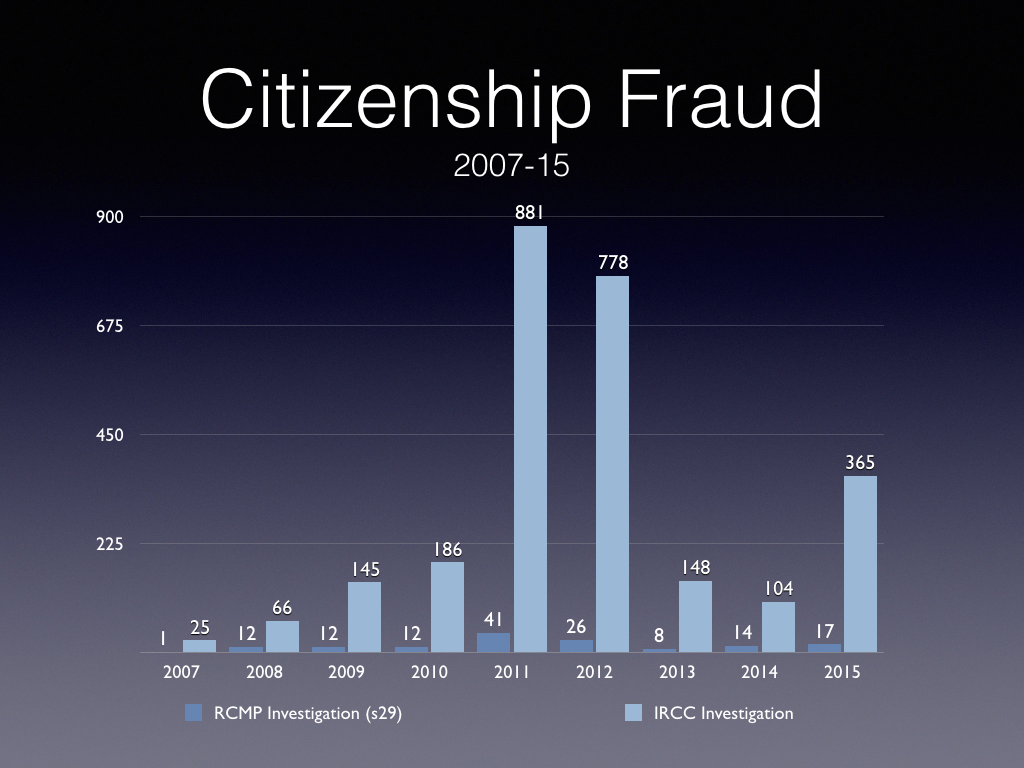
There is a distinction between fraud cases investigated by the RCMP and those investigated by IRCC. The Minister seems to be referring to only the latter. In general, if I recall correctly, the RCMP cases deal more with massive fraud (e.g., consultants submitted multiple fraudulent applications) whereas IRCC deal more with individual cases.
IRCC data shows the vast majority of fraud cases are a result of IRCC internal investigations, not RCMP, as the chart below indicates:
The federal government is trying to revoke the citizenship of fraudsters, and that’s why it won’t agree to a moratorium on citizenship revocation, says Immigration Minister John McCallum.
“We have large numbers of a criminal element unveiled by the RCMP, and reported on by the auditor general. It was actually under the previous government that [investigations began that] we are now dealing with…and those people have really, truly abused our citizenship. So it would not be right to have a moratorium, and let them off the hook,” he said in a phone interview Thursday.
…. He [immigration lawyer Lorne Waldman] is part of a group bringing a constitutional challenge against a law brought in by the previous Conservative government, known as it was as C-24, that means a person who’s received notice of citizenship revocation doesn’t have a right to an appeal or court hearing.
Mr. Waldman and another lawyer said they’re representing clients in similar circumstances to Ms. Monsef where their citizenship is in jeopardy because another family member is accused of misrepresentation.
Mr. McCallum (Markham-Thornhill, Ont.) acknowledged that the lack of an appeals mechanism needs to be fixed, but wouldn’t go as far as to instruct his department to stop revoking citizenships until one is set up, preferring instead to allow it to be developed through a change to a citizenship bill, C-6, currently at second reading in the Senate.
The bill aims to reverse parts of the Conservative legislation, C-24, that allowed the government to pull citizenship from dual nationals convicted of terrorism, expanded the age range of immigrants subject to language testing, and more.
Mr. McCallum told the Senate during an appearance Oct. 4 for Question Period that he would welcome a Senate amendment to C-6 to put in place an appeals process for new Canadians who had their citizenship revoked for providing false information on their citizenship application.
However, he wavered on whether he would pause revocations while C-6 went through Parliament when asked by Senate Liberal Art Eggleton, saying “no,” then saying he would “consider” it. The federal Justice Department confirmed the government would not impose such a moratorium in a letter to the Federal Court last week, the Canadian Press reported.
The government has increased the rate of citizenship revocations for fraud since the Liberals took power. That includes 104 revocations in the first eight months of this year, compared with 132 in all of last year and just 30 in the previous two years combined, the CBC reported.
‘Never entitled’ to citizenship
Mr. McCallum said the government is not trying to revoke the citizenship of the alleged fraudsters before an amended C-6 could bring in an appeals mechanism.
“Those two are not linked,” he said.
“As a result of that RCMP investigation, they are pursuing cases, which we fully support. It takes a while to pursue those cases, and some of them are just coming to the revocation point now. It wasn’t an effort for any particular reason, except that they were ready. And we are definitely supporting efforts to go after the criminal element and remove citizenship where it was clearly done for fraudulent or criminal reasons,” he said.
In a written statement provided to The Hill Times, Mr. McCallum’s office said “the recent increase in citizenship revocations is the result of large-scale fraud investigations led by our RCMP and [Canada Border Services Agency] partners that began under the former Conservative government.
“These investigations led to criminal convictions of several immigration consultants, and notices of intent to revoke citizenship were sent to their clients who had provided fraudulent documents to suggest they were living in Canada when they were living abroad, in order to gain citizenship. Others changed their identity in order to hide criminal backgrounds.
With these appointments, the overall DM diversity numbers for the 39 appointments are: 43.6 percent women, 7.7 percent visible minorities:
Prime Minister Justin Trudeau shook up the senior ranks of Canada’s public service with another sweep of promotions for younger executives who are poised to take over as the leaders of the next decade.
The latest round of appointments reflects Privy Council Clerk Michael Wernick’s push to rejuvenate the top ranks of the bureaucracy with a better mix of youth and experience. The prime minister is responsible for all senior appointments but they are typically made on the advice of the clerk.
Wernick has said managing a “generational turnover” is his top priority as the last wave of baby boomers, who dominated the face and character of public service for decades, retires. In speeches, he has exhorted the baby boomers to “move on” and make way for the next generation of leaders.
Friday’s shakeup included three promotions into the ranks of deputy minster and three assistant deputy ministers into associate deputy minister jobs. All are about age 50 — either in their late 40s or early 50s — positioning them for the top posts over the decade. Last year, the average age of deputy ministers was about age 58.
As one senior bureaucrat said, “It looks like 50 is the new 60.” The public service has aged over the years, including its senior executives compared to the 1970s and ‘8os when the public service grew rapidly and it wasn’t unusual for executives to get their first deputy appointments in their 40s.
The Trudeau government has made more than 30 senior public service appointments, and a significant number have been younger appointments than in previous years or were recruited from outside the public service.
This round of promotions includes: Paul Glover, the associate deputy minister of health, becomes president of the Canadian Food Inspection Agency; Timothy Sargent, associate deputy minister of Finance, is promoted to deputy minister at International Trade; and James Meddings, assistant deputy minister at Western Economic Diversification Canada, moves to the top job at Federal Economic Development Agency for Southern Ontario.
Glover replaces CFIA president Bruce Archibald, who is retiring. Sargent is taking over from Christine Hogan, who was recently named the new World Bank Group executive director for Canada, Ireland, nine Caribbean countries, Belize and Guyana.
Similarly, Meddings replaces Nancy Horsman, who is the new International Monetary Fund executive director for Canada, Ireland, nine Caribbean countries and Belize.
Doug Nevison becomes the European Bank for Reconstruction and Development executive director for Canada, Morocco, Tunisia and Jordan.
The Trudeau government’s appointment of two women — Horsman and Hogan — to the world’s main economic boards is part of its push to ensure Canada’s representatives abroad reflect gender parity and the wide diversity of Canada. About 45 per cent of Canada’s diplomatic postings are now held by women.
Other moves in the Friday round of appointments included Chris Forbes, the associate deputy minister at Agriculture who moves to Finance as one of the department’s two associate deputy ministers. Rob Stewart, assistant deputy minister at Finance, moves up to the associate deputy minister position responsible for G7 and G20.
Nada Semaan, executive vice-president at Canada Border Services Agency (CBSA), moves to Agriculture as associate deputy minister, and Kristina Namiesniowski, an assistant deputy minister at Agriculture, takes over Semaan’s position at CBSA.
Today, more than one-third of the executive cadre are over age 55, with 400 of them over 60. About 46 per cent of all public service executives are over age 50. The average deputy minister is 58; associate deputy minister 54, assistant deputy minister 53.7 and directors and directors-general 50.
Along with the drive to infuse more young talent into the executive jobs, Treasury Board president Scott Brison is committed to making the public service more millennial-friendly to attract more youth.
Joy Kogawa has noticed reviewers of her new bookof memoirs have not touched arguably the most controversial section of her intimate exploration of betrayal and hope.
Reviewers have focused instead on the way the Vancouver-raised author of Obasan and The Rain Descends dealt with her Japanese-Canadian family being sent to an internment camp, the bombing of Nagasaki and how her father was a pedophile.
However, Kogawa, 81, has been publicly forthright for decades about those shame-filled realities.
The most cutting-edge section of her book, titled Gently to Nagasaki, digs into horrors most Canadians and ethnic Japanese want to deny — Japan’s war atrocities.
The peace activist’s memoirs describe her painful relatively recent discovery of the extent of the slaughters and mass rapes committed by the Imperial Japanese army.
It was while Japanese troops were killing millions of Asians and others that Canadian governments in 1942 sent many Japanese-Canadians, most of them from B.C., to internment camps.
Following her family’s ordeal in camps in the Kootenays and Alberta, Kogawa gained wide attention for helping lead the campaign that culminated in Ottawa’s 1988 apology and compensation to 20,000 Japanese-Canadians.
The many honours eventually bestowed upon Kogawa included the 2006 establishment of Vancouver’s Kogawa House, where the family had lived until 1942. It’s now a residence for writers.
But Kogawa has not allowed adoration to stop her pursuit of the authentic. Her mission seems to be to move beyond denial on all fronts: regarding internment camps, racism, global warming, her priest-father’s sexual crimes and her relatively recent discovery of Japanese war monstrosities.
“Love and truth are indivisible,” Kogawa says.
Her wise aphorism has had unpleasant consequences, though. Since most Canadians who don’t want to offend ignore Japan’s grisly war history, Kogawa acknowledged in an interview from her residence in Toronto that she’s had to “face the rage” of many.
“It’s cost me some really good friendships.”
Whether in Toronto, Vancouver or Japan, Kogawa said, many people, including ethnic Japanese, “just don’t believe” the atrocities occurred. They’d “rather die” than have the reality exposed.
“Or they feel I’m betraying them by talking about it. But it takes the truth to get to reconciliation.”
Finally, the announcement of the new process for selecting federally-appointed judges. No real surprise given the ministerial mandates letters. Still nothing (yet) and regular reporting:
The Liberal government has announced a new judicial appointment process that emphasizes gender and racial diversity.
One of the key changes unveiled on Thursday specifies that governments and independent legal groups that pick the members of the committees that screen candidates “will be asked to take into account the need to ensure [the committees] are representative of the diversity of Canada,” according to a justice department backgrounder. All members of the screening committees will get training on diversity, unconscious bias and assessment of merit, the backgrounder says. A federal agency will keep track of the demographic makeup of applicants. Until now, applications have been tabulated only by gender, not race.
As part of the process, applicants will have to fill out more detailed application forms than they do now. In these forms, applicants will detail their abilities in Canada’s two official languages, and they may be tested on their proficiency.
Another set of modifications will undo changes the Harper government made to the process. The Conservatives had put a police representative on the judicial advisory committees that screen judges for federally appointed courts (such as provincial superior courts, the Federal Court and Tax Court). They had also taken away the vote of a judge on those committees, which had given the federal appointees a voting majority. And the Conservatives had taken away the judicial advisory committees’ ability to “highly recommend” applicants; they could only recommend (or not). The government will remove the police representative, return the vote to the judge and re-establish the “highly recommended” category.
Applicants who applied under the previous process will have to re-apply, but on Thursday, the government announced the appointments of 24 judges under the existing process.
The Liberals have come under fire from the legal community because they appointed just 15 judges in their first year in power, during which judicial vacancies reached 61. That’s more than at any time during Stephen Harper’s decade in power, records show. When Mr. Harper stopped appointing judges in the summer of 2015, before the federal election, there were a little more than a dozen vacancies.
Backlogs in criminal, civil and family cases have risen in some provinces, especially in Alberta and Nova Scotia.
After months of criticism for not acting fast enough to appoint much-needed judges across the country, Justice Minister Jody Wilson-Raybould announced 24 judicial appointments Thursday.
“We have moved to fill urgent judicial vacancies by drawing on existing lists of recommended candidates,” the minister said in a statement. “The government is confident in the outstanding quality of these appointees and their dedication to delivering just outcomes for Canadians.”
Justice system can’t wait for judicial appointments review, say judges
Trudeau government has backlog of more than 300 appointments
Of the 24 new appointees, 14 are women and two are Indigenous. (No visible minorities are mentioned but need to doublecheck).
The focus on immigration of note. 450,000 would be about 1.3 percent (current level for 2016 is 305,000).
The upcoming immigration levels plan, expected next month, will provide an indication whether or not the government will support this recommendation and if so, to what extent, as there appears to be a lively debate within the government.
Equally significant will be the mix of economic, family and refugee classes. The report’s recommendation essentially means that any increase should be with respect to the economic class of immigrants, not family or refugee class:
A group of external advisers to Finance Minister Bill Morneau will call on the government this week to dramatically increase the level of immigration and foreign investment coming in to Canada to stimulate a sluggish economy in future years.
Their recommendations include increasing immigration by 50 per cent to 450,000 people annually over five years while easing the process for high-skilled and entrepreneurial foreigners to come here; building a new department to entice foreign direct investment into Canada; and creating an arm’s length infrastructure bank. The recommendations were confirmed by several senior sources who spoke with The Globe and Mail.
…The 14-member Advisory Council on Economic Growth, chaired by Dominic Barton, global managing director of the consultancy McKinsey & Co., will deliver its first three recommendations to Mr. Morneau in Ottawa on Thursday. The council, which includes venture capitalists, institutional investors, business executives and academics, plans to present up to 20 ideas in the coming months intended to help Canada boost economic growth beyond forecast levels of less than 2 per cent annually through 2030.
The minister is expected to announce plans to act on at least one of the recommendations in his fall fiscal update, sources said. “My sense is [the government is] keen to receive these recommendations as soon as possible,” said one source close to the council. “That probably tells you they want to do something.”
…Expanding and improving the immigration process would address a key concern raised by fast-growing Canadian tech companies. Many say visa approval times for foreigners with high-level executive experience or in-demand skills can drag on for up to a year, and that coveted recruits who would otherwise move to Canada are not willing to put their lives on hold for so long when they have multiple opportunities. As a result, many tech firms say they have either lost out on key hires, or been forced to have such people work for them outside Canada.
“The current immigration process is overwhelmingly convoluted – even Kafkaesque,” said Tobi Lutke, CEO of Ottawa-based retail software firm Shopify, Inc., which is hiring hundreds of people this year and has lost recruits because of immigration delays. “The people we need to bring to Canada are not building widgets that Canadians otherwise would. The people we are recruiting … are the teachers that help us scale [up]. If we want to build the best companies in the world here, we need to allow the best people in the world to move here.”
Such thinking has guided panel members, who believe that increasing immigration and making it easier for skilled foreigners to move to Canada can increase the pool of people with the training, ambition and drive to create substantial economic value and help support Canada’s aging population. For example, a recent study by the National Foundation for American Policy said more than half of Silicon Valley startups valued at $1-billion (U.S.) or more were founded by immigrants.
The panel is calling for employers in technology and other expanding sectors to be exempt from the time-consuming process of proving no Canadian could do a job they want to offer to foreigners for senior positions or specialized roles, such as data science or digital marketing. Foreign students who have studied in Canada should have an easier time immigrating, the council also believes.
….The council and government officials are anticipating some resistance to the recommendations.
Immigration Minister John McCallum and Innovation Minister Navdeep Bains say they support more immigration, but acknowledge facing some opposition from within the government. Several recent polls – including one conducted for Mr. McCallum’s department – found little support for increased immigration.
Mr. McCallum said in an interview on Tuesday that he is not prepared to go as high as 450,000. But he suggested the number will rise from current levels of 300,000 when the government releases its 2017 immigration targets by Nov. 1. “This is a somewhat controversial issue, especially when you talk about numbers that high,” he said. The minister said no final decisions have been made.
Interesting piece (have seen earlier articles on Gould’s influence at Apple but not with this angle to the current Canadian innovation strategy policy discussions):
Institutionalizing the nebulous concept of innovation won’t be easy. Jobs himself faced a similar challenge when he was diagnosed with a cancerous tumour in his pancreas in 2004, forcing him to contemplate a day when he would no longer be able to terrorize Apple’s designers and engineers. In 2008, he quietly began laying the groundwork for Apple University by hiring Joel Podolny, the dean of Yale’s school of management. “The idea was to take what is unique about Apple and create a forum that can impart that DNA to future generations of Apple employees,” a former Apple executive told the Los Angeles Times in 2011. “No other company has a university charged with probing so deeply into the roots of what makes the company so successful.”
[Joshua] Cohen’s presentation on Gould is just one of several he gives at the university, where he’s now employed full-time. It’s part of a series called “The Best Things”—a reference to a remark that Jobs once made about “trying to expose yourself to the best things that humans have done, and then try to bring those things into what you’re doing.” His first presentation in the series was about New York’s Central Park, which was designed by landscape architect Frederick Law Olmsted to show that America could create beautiful, natural public spaces that rivalled the best of Europe. Gould, by contrast, created a thing of beauty by reinterpreting the baroque work of a German composer who was widely seen as a touch old fashioned, even by his contemporaries.
Equally as compelling for Apple employees is Gould’s forward thinking attitude about technology. Gould once told an interviewer in 1966 that live audiences were a “force of evil” because pleasing them took precedence over his pursuit of perfection. “I really thank God that I’m able to sit in a studio with enormous concentration and do things many times, if necessary,” he said. “I think a whole new role has been opened in this way.” Bob Ezrin, the Canadian music producer known for his work with Pink Floyd, Lou Reed and Taylor Swift among others, (and, to a different demographic, for sparking a Twitter war earlier this year with rapper Kanye West), says Gould was way ahead of his time. “He was the first guy to edit classical performances,” he says. “That was just anathema to the classical world. Edit multi-track recordings? This was stuff that was only beginning to happen in popular recording because performers couldn’t do it all in one take.”
If it all sounds a touch pedantic for a company that builds smartphones, recall that Jobs credited part of the original Mac’s success on his decision to study calligraphy at Reed College in Portland, OR. “If I had never dropped in on that single course in college, the Mac would have never had multiple typefaces or proportionally spaced fonts,” he said during a 2005 commencement address at Stanford. “And since Windows just copied the Mac, it’s likely that no personal computer would have them.” This is also a man who once said, shortly before his death, that great technology by itself wasn’t sufficient to make great products: “It’s technology married with the liberal arts, married with the humanities, that yields us the results that make our hearts sing.”
At its core, Cohen says Apple’s mission is indeed to develop products that should be built, not finding a way to shoehorn every piece of new technology into people’s lives, wanted or not. “They [Apple products] enable people to do things that are good to do,” he says, adding it’s not all that different from Gould’s effort to create a moment of pure musical bliss. “You’re trying to do something that’s great and animated by a big idea,” says Cohen. “But what makes it great is there’s an important human good at stake in it.”
It sounds straightforward enough. But it’s remarkable how many tech firms allow the cord to wag the computer. Google, for all its success, is frequently guilty of packing unnecessary functions into its products, making them unnecessarily difficult to use. An Apple University professor apparently once used a Google TV remote control as an example of what not to do at Apple, according to the Times. It had no fewer than 78 buttons. Meanwhile, other up-and-coming tech giants often seem more interested in disrupting entrenched industries than they are in serving their customers. The increasingly heated debate over short-term rental platform Airbnb is a case in point, with some arguing it’s contributing to a housing crisis by convincing landlords it’s more profitable to rent to tourists than tenants.
So what, if anything, can Ottawa learn from Gould as it seeks to implement its “Innovation Agenda?” He obviously didn’t have much to say about the value of “innovation clusters” or the appropriate tax policy when it comes to stock options. But, Cohen says, he’s confident Gould wouldn’t think much of trying to replicate, pixel for pixel, Silicon Valley’s stunning success. “Gould himself would say, almost in these words, ‘There’s no point performing something that’s been performed a thousand times before unless you do it differently,’” Cohen says. At the same time, however, the secret to Gould’s success was his dogged insistence to make sure what he did was worth doing, and that he did it to the best of his abilities—even if some thought he was being completely unreasonable in the process. Says Cohen: “That kind of comes with the territory of doing something that’s different and truly great.”