Ottawa softens stand on stripping citizenship over false papers

More on revocation for fraud and misrepresentation, and the Minister’s openness to suspend revocation pending changes to the Citizenship Act that restore some measure of greater procedural protections to those accused of fraud:

Immigration Minister John McCallum says he is open to granting a moratorium on the revocation of citizenship from Canadians who misrepresented themselves in their applications, an issue that has been thrust into the spotlight by the circumstances of cabinet minister Maryam Monsef’s citizenship.

Mr. McCallum’s comments come a week after the British Columbia Civil Liberties Association and the Canadian Association of Refugee Lawyers filed a legal action with the Federal Court asking the government to put a stop to all revocations until it could fix a law that allows citizenship to be stripped without a hearing.“I will consider that moratorium. I won’t rule it out unconditionally,” Mr. McCallum told Senate Question Period on Tuesday. “What I am saying is that we would welcome a reform to the system.”

The Federal Court application made headlines when lawyers on the case said that Ms. Monsef, Democratic Institutions Minister, could have her citizenship revoked under the current law for having an incorrect birthplace listed on her citizenship papers. Ms. Monsef said she only learned that she was born in Iran, not Afghanistan as she had believed, after an inquiry from The Globe and Mail last month. She said her mother never told her and her sisters they were born in Iran because she did not think it mattered.

While Ottawa is considering the moratorium on revocations, the government says it is committed to eventually reinstating the right to a hearing for Canadians who face losing their citizenship because they misrepresented themselves in their citizenship and permanent residency applications.

Independent Senator Ratna Omidvar said she is going to propose an amendment to the government’s citizenship Bill C-6 to reverse the Conservative law that took away the long-standing right.

“I am hopeful that they will allow this amendment to be tabled,” Ms. Omidvar said. “Everybody’s hoping they’re able to do it in this bill at the Senate. But if not, I’ve been told that it will be fixed through legislation.”

MPs tried to table the amendment to Bill C-6 at the House immigration committee earlier this year, but was it declared to be out of scope by the committee chair. Ms. Omidvar noted that the Senate procedure rules are different, so the amendment still has a chance in the Red Chamber.
Source: http://www.theglobeandmail.com/news/politics/ottawa-softens-stand-on-stripping-citizenship-over-false-papers/article32254296/

Trudeau may change law to protect Monsef | Malcolm

Malcolm conveniently ignores that Minister McCallum during the spring committee hearings on C-6 committed to reviewing the revocation process in light of testimony regarding the lack of procedural protections in C-24 for those accused of fraud or misrepresentation: “less protection than for parking tickets.”

So while the Monsef case may have accelerated this review, it was already underway.

And calling C-6 “comprehensive changes” is incorrect. C-24, the 2014  changes of the Conservative government, were comprehensive; C-6 is a relatively surgical set of changes, significant to be sure, but limited in scope:

The Trudeau Liberals have spun themselves into a corner when it comes to Maryam Monsef.

It now looks as if Prime Minister Justin Trudeau is willing to change Canada’s citizenship and immigration laws to protect one of his own.

Monsef says her mother recently told her she was born in Iran, not Afghanistan, as she had previously been told.

If her immigration application, when she was a child, included false information about her birthplace, then it is possible her immigration application was fraudulent.

The penalty for providing false representation to immigration officials is steep.

In similar cases where a parent provided untrue information on behalf of a child, it has led to the stripping of citizenship and even deportation from Canada.

As I pointed out in my last column, the Trudeau government recently stripped citizenship from an Egyptian national who became a Canadian citizen at age eight.

In that case, the woman’s parents lied on her application, and therefore, as per Canadian law, she risks being deported.

But when it comes to their own star cabinet minister, Monsef, the Trudeau Liberals are scrambling to deal with the controversy.

On Tuesday, Immigration Minister John McCallum testified in front of a Senate committee discussing Bill C-6, the Trudeau government’s controversial citizenship bill.

Under pressure from Liberals in the Senate, McCallum suggested that his government would consider placing a moratorium on the practice of citizenship revocation.

How convenient.

“I will consider that moratorium. I won’t rule it out unconditionally,” McCallum told the Senate committee. “What I am saying is that we would welcome a reform to the system.”

The Trudeau government had no problem imposing this law during its first eleven months in office. None at all.

During the last session of Parliament, Trudeau and McCallum introduced comprehensive changes to Canada’s citizenship and immigration laws through Bill C-6.

On the issue of citizenship revocation, Bill C-6 halted the government’s ability to strip citizenship from convicted terrorists and those who commit treason against Canada.

As Trudeau said famously during the last election campaign, after all, “a Canadian is a Canadian is a Canadian.” Even if that Canadian is a foreign-born terrorist.

But when it came to cases of fraud and misrepresentation, no changes were made under Bill C-6.

Quite the opposite, in fact, as Trudeau said he supported citizenship revocation under these circumstances.

On the campaign trail last September, Trudeau less-famously said that, “revocation of citizenship can and should happen in situations of becoming a Canadian citizen under false pretences.”

At the time, this statement contradicted Trudeau’s own position that Canadian citizenship is an absolute and inalienable right.

Now, that contradiction is catching up on him.

Until the Monsef scandal surfaced, the Trudeau government had no problem in stripping citizenship away from those who committed fraud and those who lied on their applications.

They had no issue with the process of revocation — determined by the relevant cabinet minister and not through lengthy court proceedings.

They agreed with the law, and implemented it routinely.

But suddenly, this law threatens to damage the Trudeau government’s reputation and punish a Liberal insider.

And all of the sudden, they’re willing to change course.

The Trudeau government is now suggesting it would rather change Canada’s longstanding immigration law, ad hoc, than face the inconvenient fact that, based on the story she’s provided, Monsef’s immigration application may have been fraudulent.

Source: Trudeau may change law to protect Monsef | Malcolm | Columnists | Opinion | Toro

CBC-Angus Reid Institute poll: Canadian millennials hold off on their love of country

And this poll, showing young Canadians have less pride in Canada, again suggesting less local citizenship:

According to the results of a national polling partnership between CBC and the Angus Reid Institute, those aged 18 to 34 have a much cooler relationship to Canada than older Canadians.

Overall, the majority of Canadians polled said they were proud of Canada. Those 65 and over were the most proud, with 65 per cent saying they were very proud of Canada.

However, pride diminished with the age of the respondents. The poll revealed that only 40 per cent of Canadians aged 18 to 34 said they were very proud of Canada.

“It’s a stark finding, and one that certainly jumps out and isn’t something we’ve seen before,” said Shachi Kurl, executive director of the Angus Reid Institute.

One possible reason for this changing relationship, Kurl said, is that a global technological revolution has made this generation more globally connected in real time than any previous group.

“This is the first generation of watching movies or TV from other parts of the world. It’s not just what they’re reading from a local newspaper but consuming from the internet, from the pipeline of communication and information that’s coming at them, and shaping their views and thoughts.”

Trust issues

But this “pipeline of information” has profound consequences for how millennials think and act.

A clue lies in another key finding in the poll.

While the majority of people over 34 said the news media do a good job presenting the facts, 64 per cent of those 18 to 34 said the opposite — that most of the stories you see in the news can’t be trusted.

Source: CBC-Angus Reid Institute poll: Canadian millennials hold off on their love of country – British Columbia – CBC News

Theresa May criticized the term ‘citizen of the world.’ But half the world identifies that way. – The Washington Post

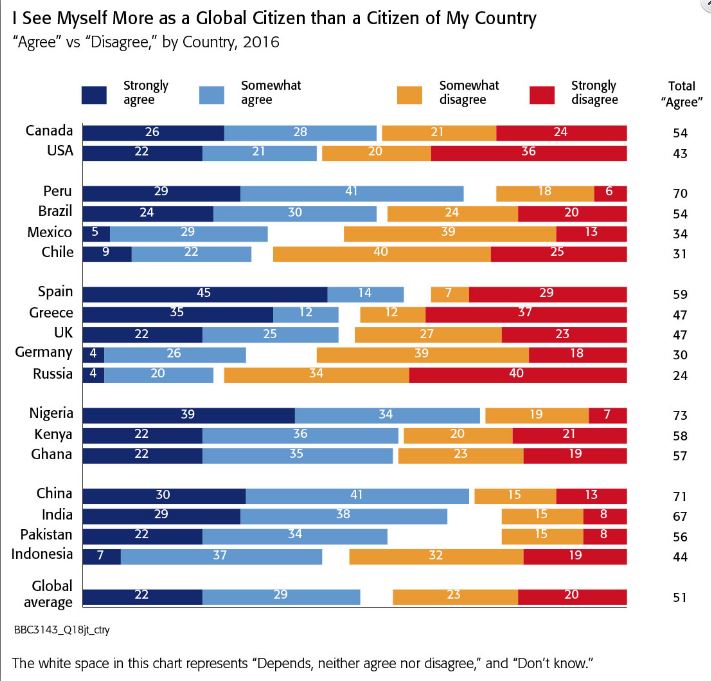
global-citizenInteresting poll showing the relative identity balance between local and global citizenship:

In defense of the Brexit decision she now must implement, British Prime Minister Theresa May said Sunday that no “divisive nationalists” would hold up the process of exiting the European Union, and she firmly asserted that all four of Britain’s constituent “nations” — England, Wales, Scotland and Northern Ireland — would Brexit together.

But the Brexit decision was fueled in many ways by nationalist sentiments, centering on perceived threats to Britain’s sovereignty and many of its citizens’ desires to prevent the supposed dilution of their national identity by immigrants crossing the European Union’s open borders.

Just three days after her comment about “divisive nationalists,” at her Conservative Party’s annual conference, May espoused her own brand of nationalism — one that seems to encompass all of Britain, but excludes those who may feel as though they have multiple nationalities, or identities.

“Today, too many people in positions of power behave as though they have more in common with international elites than with the people down the road, the people they employ, the people they pass on the street,” she said. “But if you believe you are a citizen of the world, you are a citizen of nowhere. You don’t understand what citizenship means.”

As it turns out, about half of the people “down the road” or whom one might “pass on the street” identify with the very phrase May disparaged — being a “citizen of the world” or global citizen.

In an 18-nation survey conducted by GlobeScan in conjunction with the BBC World Service that was released just over a month ago, 47 percent of Britons said they somewhat or strongly agreed that they considered themselves more as global citizens than citizens of the United Kingdom.

That number is just slightly below the 51 percent of all respondents who felt the same way. Below is a look at how respondents from each of the 18 surveyed countries responded. It is worth noting that “urban-only” samples were used in Brazil, China, Indonesia and Kenya.

Source: Theresa May criticized the term ‘citizen of the world.’ But half the world identifies that way. – The Washington Post

Where is the love: How tolerant is Canada of its interracial couples?

Minelle Mahtani’s study of mixed couples:

Is love the last frontier of racial bigotry in Canada?

It’s a question that intrigues Minelle Mahtani, who has dared to ask whether interracial couples and their families still test the limits of tolerance in this country.In her recent book Mixed Race Amnesia: Resisting the Romanticization of Multiraciality in Canada, Mahtani, an associate professor in human geography and journalism at the University of Toronto Scarborough, questions whether we’ve not just put rose-coloured glasses on our multiculturalism, especially where mixed-race families are concerned.

While interracial relationships are on the rise in Canada (we had 360,000 mixed-race couples in 2011, more than double the total from 20 years earlier), the numbers remain slim. Just 5 per cent of all unions in Canada were between people of different ethnic origins, religions, languages and birthplaces in 2011, the last year Statistics Canada collected such data. That figure rises only marginally in urban areas: Just 8 per cent of couples were in mixed-race relationships in Toronto, 10 per cent in Vancouver.

How do people in interracial relationships experience that multiculturalism on the ground, when they introduce their boyfriends and girlfriends to family, or hold hands on a date? How do mixed-race families and their children feel about it, in their communities and in their schools?

Mahtani was the keynote speaker at last month’s Hapa-palooza, an annual festival celebrating mixed heritage in Vancouver, and she will present at the next Critical Mixed Race Studies Conference in California in February. She spoke with The Globe and Mail about the daily realities of mixed-race families.

How tolerant are Canadians of interracial relationships today?

It’s an early kind of euphoria around celebrating multiracialism in Canada. We’ve romanticized this notion far too quickly. All the numbers from Statistics Canada show that yes, we are seeing more interracial relationships, but it doesn’t necessarily mean that the racism is decreasing. People who are in interracial relationships are still experiencing a lot of racism.

What kind of criticism do mixed-race people in this country still get for their dating choices?

So much depends on where the relationship is happening and the class background of the people who are getting involved. Even though there’s a greater tolerance of interracial relationships, some researchers talk about this as a kind of “repressive tolerance”: it’s not quite acceptance but a kind of toleration.

So many of the mixed-race people I interviewed spoke about the challenges that their own parents faced as interracial couples. We’re talking about kids whose parents met in the seventies and earlier when there was much more outright, blatant racism experienced by interracial couples.

Source: http://www.theglobeandmail.com/life/relationships/where-is-the-love-how-tolerant-is-canada-of-its-interracial-couples/article32206930/

India’s Debate on Citizenship Continues

Of interest:

The Indian Citizenship Act of 1955 outlined the ways in which individuals may acquire citizenship in India and specifically denies it to undocumented migrants. The Citizenship (Amendment) Bill of 2016 attempts to remedy this but does so peculiarly. It looks into granting Hindu, Sikh, Buddhist, Jain, Parsi, and Christian minorities from Afghanistan, Bangladesh and Pakistan citizenship after 6 years of residence in India (as opposed to 11 years, as is the status quo) even without documentation. The Bill draft has been made available online and a Joint Parliamentary Commission with members of both parliamentary houses is examining it — and was open for comments until September 30.

Public discussion about the Citizenship (Amendment) Bill of 2016 follows two lines. First it has been criticized for delineating citizenship on purely religious lines. Although this is not new in a country like India, which was partitioned along religious lines, in this case the bill allows citizenship to undocumented migrants from most major Indian religious groups except for Muslims, at about half the duration currently required. In so many ways, this brings to mind the ruling Bharatiya Janata Party’s (BJP) campaign promise of providing a ‘natural home’ for Hindus in India as this policy is mostly directed towards Hindus from these countries.After facing the kind of opposition that resulted in the deputation of the Joint Parliamentary Committee, government officials attempted to clarify accusations of religious discrimination. They discussed a plan to change the term “religious minorities” in the Bill to “discriminated religious minorities.” However that still does not encompass discriminated Islamic minorities like the Ahmadiyya populations in Pakistan, who will not qualify for Indian citizenship under the relaxed rules should they migrate.

Activists in New Delhi held a protest rally on September 30 to decry this Bill, calling it communally motivated. Activist Kavita Krishnan, for instance, declared that the government needed to remember that India was not, in fact, a Hindu state and could not therefore provide a right of return to populations. They also questioned the need for singling out these specific categories of people, ignoring the persecution of several other groups – like atheists within these nations or potential climate refugees.

Source: http://thediplomat.com/2016/10/indias-debate-on-citizenship-continues/

Tests d’immigration [citizenship] plus chers en français : le commissaire aux langues officielles blâme Ottawa

This should provoke some broader reflection within IRCC about the overall cost of citizenship and the related impact on the naturalization rate. Not just an issue of differential costs for francophones and anglophones:

Le commissaire aux langues officielles est catégorique : le gouvernement fédéral manque à son devoir et nuit peut-être même à l’immigration francophone en acceptant des tests de compétence linguistique en français plus chers et moins accessibles que les tests en anglais.

Après un an d’enquête, Graham Fraser présente un rapport préliminaire qui donne raison aux francophones qui s’étaient plaints de la différence de tarifs entre les tests en français et en anglais. Pour devenir résident permanent, il faut prouver qu’on maîtrise l’une des deux langues officielles, en réussissant, par exemple, un examen reconnu par Immigration, Réfugiés et Citoyenneté Canada (IRCC).
Le problème, c’est que les évaluations en français coûtent souvent des centaines de dollars de plus.
Résultat : pour économiser, des immigrants francophones optent plutôt pour l’examen en anglais. Un choix déchirant pour certains.
Pourquoi cette différence de prix?
Les tests de français offerts au pays sont tous conçus et corrigés en France, soit par la Chambre de commerce et d’industrie de Paris ou par le Centre international d’études pédagogiques. Pour recevoir leur correction finale, les examens doivent être renvoyés outre-mer par la poste.
Autre coût : le salaire des examinateurs. Chaque candidat qui passe le test doit être examiné par deux personnes, ce qui n’est pas le cas pour l’un des tests d’anglais.
Même si les organisations désignées pour administrer les tests sont des tierces parties, insiste Graham Fraser, ces services doivent être « disponibles et de qualité égale » en français comme en anglais, en vertu de l’article 25 de la Loi sur les langues officielles.
IRCC n’a pris aucune mesure pour s’assurer que les candidats aient accès de manière égale aux services d’évaluation linguistique. L’égalité réelle comprend l’égalité d’accès, d’usage, de qualité et de statut.
En plus d’être plus chers, écrit le commissaire, les tests sont aussi plus difficile d’accès pour les francophones. Le Test d’évaluation de français (TEF) n’est d’ailleurs pas du tout offert à l’Île-du-Prince-Édouard, ni à Terre-Neuve-et-Labrador, ni dans les territoires.

Graham Fraser cite en exemple le cas d’un francophone de Whitehorse, au Yukon, qui a dû se rendre à Vancouver, en Colombie-Britannique, pour passer son TEF. Une fois la partie écrite de son test complétée, il a dû attendre quatre jours sur place avant qu’on évalue ses compétences en compréhension orale.
Une fois le test complété, note Fraser, les francophones attendent souvent plus longtemps avant d’obtenir les résultats. Par exemple, en Colombie-Britannique et en Nouvelle-Écosse, « le délai d’attente [pour s’inscrire] pouvait respectivement atteindre trois et cinq mois. »
Le commissaire recommande au gouvernement fédéral « d’entreprendre immédiatement des démarches » pour mettre fin à cette situation qui dure depuis des années, et qui pourrait avoir des conséquences négatives sur l’accueil d’immigrants francophones et, ultimement, sur la vitalité du français au pays.

Source: http://ici.radio-canada.ca/regions/ontario/2016/09/27/001-tests-immigrants-plus-chers-francais-commissaire-fraser.shtml

Facing opponents of an updated sex ed curriculum: Michael Coren

Coren on those opposed to Ontario’s updated sex-ed curriculum:

Recently I covered my second demonstration against Ontario’s new sex education curriculum. Standing outside of Queen’s Park were the usual suspects — fundamentalist Protestants speaking of “sodomites,” ultra-conservative Catholics disgusted at Pope Francis’ ostensible liberalism and various angry people holding clumsy posters. The last time I was here an Elvis Presley impersonator with a dog collar loudly condemned me from the platform. Not this day alas. Elvis had obviously left the building.

As bizarre as it may sound, this is serious stuff and has led to parents removing their children from school and even to the previous provincial government withdrawing this acutely necessary and entirely reasonable curriculum. So who are these perennially outraged men and women who think we’re all doomed and damned?

I know quite a few of them and their leaders; hardly surprising in that it’s always the same people and the same faces. One prominent regular is a leading anti-abortion campaigner who once made up and then spread the rumour that our youngest daughter, who was still at school at the time, was gay. She happens to be straight but her sexuality is irrelevant to us. Thing is, it was done to try to hurt her and by extension hurt me because I had become increasingly vocal in my support for same-sex marriage. The person in question is a devout Catholic.

Others were from a group who had worked successfully to have me fired as a columnist from a Christian newspaper because I had written that a 10-year-old Paraguayan girl raped by her stepfather had the right to an abortion. So, as I say, I know them well and they’re hardly representative of mainstream Canadian society.

Yet in spite of, or perhaps because of, their extremism these zealots do have a following. More than this, they are trying to co-opt minority communities — principally Chinese Christians and South Asian Muslims — into their coalition.

Their anchors are hysteria, paranoia, fear and ignorance. The apocryphal is wrapped up as established fact and what is gossip becomes ironclad information. At their demonstrations and in their literature they quote the curriculum severely out of context and speak of teachers — always unnamed — who are “perverting” children. There are frequent references to pedophilia and the smog of homophobia is seldom far away.

This latter point needs to be understood, because there has been a deliberate effort on the part of the antisex ed leadership to publicly, if not privately, play down or deny the anti-gay prejudice that was so prominent in earlier demonstrations and in their attitudes toward Kathleen Wynne.

While hardline evangelicals are part of the leadership, the central figures are traditionalist Roman Catholics who reject Pope Francis’ moves toward dialogue and have adopted Cardinal Robert Sarah from Guinea as their champion.

This senior cleric’s name is peppered on antisex ed websites and in their conversations. Sarah has denounced what he calls “Western homosexual and abortion ideologies” as being “demonic” and compared them to Nazism. He has described equal marriage as “part of a new ideology of evil” and supports African anti-gay laws, many of which are hideously punitive and lead to the arrest and assault of gay men and women. This is the reality of the antisex ed movement.

What the activists refuse to say is that it is not this particular curriculum they oppose but any attempt by the state to teach children realistically about sex and sexuality, and certainly any approach that embraces the full equality of the LGBTQ community. Many of them oppose birth control and virtually all of them vehemently oppose reproductive choice and premarital sex. This is not, as they claim, “ordinary parents defending their children.”

At the root of much of all this is a denial of sex as a loving, pleasurable, invariably harmless and entirely natural act. They don’t oppose sex in itself but view it primarily, if not exclusively, as a means of procreation rather than as a method of enjoyment. They also refuse to realize that children, even their children, will be and are sexually active. An acidic nostalgia for a time that never was.

Regrettably, the conversation is not over and neither is the opposition. As for the Elvis impersonator, I fear he will be back to sing again.

Source: https://www.thestar.com/opinion/commentary/2016/10/03/facing-opponents-of-an-updated-sex-ed-curriculum.html

Monsef case brings calls to strengthen appeal rights for those facing citizenship revocation

More on citizenship revocation for fraud or misrepreasentation, provoked by Monsef and the upcoming Senate review of C-6:

Not having a connection to Iran is a good thing, according to Sen. Omidvar.

“Once you get Iranian citizenship, it’s with you for the rest of your life whether you want it or not,” said the Indian-born Senator, who is an internationally recognized expert on immigration, diversity and inclusion named to the Senate by Prime Minister Justin Trudeau (Papineau, Que.) earlier this year. “I was an Iranian citizen by marriage, and so when I went to Iran, the only way I could stay there was if I relinquished my passport from India and was issued an Iranian identity.”

Although she left Iran and came to Canada in 1981, and subsequently became a Canadian citizen, she would still be considered an Iranian citizen were she to return to Iran. “That is why I never want to go back,” Sen. Omidvar said in an interview.

Last week, she moved the second reading of C-6 and hopes the Senate will be able to amend the bill to provide “an avenue for an appeal or a hearing” for Canadians whose citizenship is being revoked based on misrepresentation or fraud.

Sen. Omidvar explained that in the case of Ms. Monsef—who at the age of 11 came to Canada with her widowed mother and two younger sisters as refugees—she and her siblings “would be held accountable” if her mother told Canadian immigration officials her children were born in Afghanistan and not Iran.

Under the current system, Ms. Monsef could get a letter from a Citizenship and Immigration Canada official stating that her Canadian citizenship was being revoked based on misrepresentation, and she would have 60 days to respond to the same official who sent the letter. Ms. Monsef could then seek leave to appeal to the Federal Court for a judicial review, but only after she lost her citizenship.

Even then, the court only grants leave on about 15 per cent of citizenship revocation cases, according to Toronto-based immigration and refugee lawyer Lorne Waldman, who is representing the British Columbia Civil Liberties Association and the Canadian Association of Refugee Lawyers in a constitutional challenge to the citizenship revocation regime in C-24 that was filed with the Federal Court last Monday.

He explained that if someone was found to have lied when applying to become a permanent resident and later became a Canadian citizen, that individual could lose both status and face automatic deportation.

What is known about Ms. Monsef’s case “is an example of that scenario,” said Mr. Waldman, who is in court next month on a similar case involving two people who came to Canada as children and whose citizenship is imperilled because of their father’s alleged misrepresentation on his permanent resident application.

Mr. Waldman said he doesn’t believe Ms. Monsef will be stripped of her Canadian citizenship. If the misrepresentation in her case involves where she was born rather than her citizenship at birth “it is not likely that would be relevant” in raising questions about the minister’s status in Canada, said Mr. Waldman.

http://www.hilltimes.com/2016/10/03/monsef-case-brings-calls-strengthen-appeal-rights-facing-citizenship-revokation/82379?ct=t(RSS_EMAIL_CAMPAIGN)&goal=0_8edecd9364-032584e435-90755301&mc_cid=032584e435&mc_eid=685e94e554

CBC-Angus Reid poll: Canadians want minorities to do more to ‘fit in’

The latest survey on attitudes towards integration. Questions not that nuanced, and the usual contradiction between two-thirds being satisfied “with how well immigrants are integrating” and an equal number who believe “minorities should do more to fit in better with mainstream Canadian society.”

The online survey was conducted in early September from a sample of 3,904 Canadians. The results have a 2.5 per cent margin of error 19 times out of 20.

The poll was conducted in the wake of a series of issues that dogged politicians as they contested last year’s federal election: a proposed ban on niqabs in public service; the Syrian refugee crisis; and terrorist attacks both in Europe and on Parliament Hill.

The results also hint at why Conservative leadership candidate Kellie Leitch believes she may be onto a winning issue by asking supporters their thoughts on vetting would-be immigrants and refugees for “anti-Canadian values.”

According to the poll, two-thirds of Canadians say they’re “satisfied” with how well new immigrants are integrating into their communities.

That figure seems to fly in the face of another result, because an equal number said they believe “minorities should do more to fit in better with mainstream Canadian society.”

‘Unthinking or mindless multiculturalism’

Former B.C. premier and Liberal cabinet minister Ujjal Dosanjh has written and spoken extensively about the need to address concerns about equality, race and culture in the face of blind devotion to multiculturalism.He said the poll shows Canada’s political leadership needs to pay attention.

“What you want is creative multiculturalism, generous multiculturalism, but not unthinking or mindless multiculturalism where everything anybody brings to this country is acceptable,” he said.

“Diversity is great if we can begin to live with each other in equality, in understanding … but we also understand our collective obligations to building a better society. If we can’t live together with each other properly and make concessions to each other, then this phrase that politicians use — that diversity is a strength — is nonsensical.”

http://www.cbc.ca/amp/1.3784194