Kellie Leitch misses the point about immigration: Vic Satzewich

Worth reading in its entirety. Point regarding some of weaknesses of standardized language testing also relevant to citizenship:

It is gratifying to know that Kellie Leitch has read my book Points of Entry: How Canada’s Visa Officers Decide Who Gets In, holding it up and referring to it in Wednesday night’s Conservative leadership debate and featuring it on her website. She focuses on two of several findings from my research: that visa officers conduct very few face-to-face interviews and that they are under pressure to meet processing targets. But she missed the broader point of the book, which is pro-immigration.

Her interest in creating policy to screen immigrants for Canadian values sounds like a return to a time when visa officers assigned points for what was then called “personal suitability.” But there was little consistency in how immigration officers assigned such points.

Not surprisingly, applicants and their immigration lawyers and consultants appealed refusals because they felt those points were inappropriately assigned and, during the 1980s and 90s, the Federal Court was clogged with hundreds of appeals.

By 2002, the difficulty of defending those appeals was so high that judgments about personal suitability were taken out of the assessment. Senior officials within the immigration department were also uncomfortable with the lack of consistency and transparency by which those points were applied. There is little reason to believe that Immigration, Refugees and Citizenship Canada will be better positioned to standardize what they look for when it comes to screening for conformity with “Canadian values.”

Even if it were practical to screen for “Canadian values,” coming up with a universal set of our nation’s values would be impossible.

The French had considerable difficulty doing this in 2009 when Nicholas Sarkozy launched a “national identity” debate. After three months of divisive debate that involved more than 100 townhall-style meetings, no consensus emerged. The only concrete policy recommendation that resulted from the debate was that the French flag ought to be flown in schools.

Likewise, interviewing every applicant for a visa would bring our immigration system to a grinding halt because interviews take time and resources. The immigration processing system is already slow, and to interview the 1.3 million people who apply every year for a visa to test for Canadian values would be a logistical nightmare.

Do I think we need more and better screening of immigrants and should we do more interviews with visa applicants?

In my research I did find it surprising that we do not interview many visa applicants any more. In some cases, more interviews would be useful, but not as a blanket policy, and not as a way to screen for Canadian values.

One place where interviews might be useful is with language assessment. The immigration department has yet to find the perfect mechanism to assess language skills. Today, it uses standardized language tests administered by third parties. Whether a passing grade on such a test gives a true indication of English or French language abilities is of some debate. Language skills make an obvious difference in terms of how successfully individuals make out in the job market and in school. Can interviews with applicants be used to help inform decisions about an individual’s language abilities? Perhaps, but even that has its pitfalls when it comes to transparency and consistency of decision-making.

One thing that the immigration department does not do very well, however, is to prepare newcomers for life in Canada, particularly in terms of how difficult the first few years will be.

We select immigrants for high levels of education and training and they come already prepared to work hard to achieve their dreams, but we do a woefully bad job telling them how difficult it will be to get a job that they are trained to do once in Canada.

Interviews with skilled worker applicants could have value if those interviews focused on giving detailed and practical advice and directions about how to negotiate the credential recognition process and the vagaries of the Canadian job market.

What Ms. Leitch is proposing is a solution in search of a problem. I would encourage her to read more academic research by social scientists, and even “commit sociology.” If she does, she will find that there is considerable evidence that immigrants do actually integrate into Canadian society.

Source: Kellie Leitch misses the point about immigration – The Globe and Mail

And a good interview with Satzewich in iPolitics:

Author cited by Leitch torpedoes her pitch for immigrant ‘values’ screening

Canadian officials preparing for potential flood of Mexican migrants after Trump wins presidency – Politics – CBC News

Appropriate analysis and preparations, along with the note by Lorne Waldman of the need to see exactly what policies a Trump administration enacts (assume this kind of policy work is a focus across government these days):

The federal government is preparing for a potential surge in Mexican migrants coming to Canada after Donald Trump’s election victory, CBC News has learned.

Sources confirm high level meetings took place this week with officials at Immigration, Refugees and Citizenship Canada and in other departments.

The news comes as Canada prepares to loosen rules for Mexicans to enter the country by lifting a visa requirement on Dec. 1. That restriction has been in place since 2009.

Talks on a plan to cope with a possible spike in asylum-seekers have been ongoing for some time, but were accelerated this week after Trump’s surprise win.

Trump campaigned on promises to build a wall along the U.S.-Mexico border and to swiftly deport undocumented workers and illegal residents.

Lawyer predicts ‘significant impact’

Toronto-based immigration lawyer Lorne Waldman expects an increase in refugee claims from Mexicans once the visa requirement is lifted. He also predicts a “significant impact” from Trump’s election.

“The government was very concerned about the potential for a large number of new claims coming from Mexico, and that’s why they hesitated for so long before announcing that they were going to remove the visa,” he said.

“And that announcement was made before anyone knew that Donald Trump, with his very different immigration policies from those of the current administration, won the election.”

But Waldman cautioned it’s too early to tell exactly how the situation may unfold, saying it will depend on whether Trump follows through on his campaign pledges.

Source: Canadian officials preparing for potential flood of Mexican migrants after Trump wins presidency – Politics – CBC News

Douglas Todd: Canada’s public guardians have failed Vancouver [investor immigration and housing]

Good long read by Todd on some of the major policy and operational failures that have contributed to housing prices in Vancouver:

The main dereliction of duty by Immigration Canada has been its refusal, until it was too late, to properly assess the Business Immigrant Program (BIP).

Started in the mid-1980s, the BIP has arguably been the most crucial factor driving up Metro housing prices. UBC geographer David Ley estimates it has brought more than 400,000 well-off immigrants to Metro.

The first problem with the BIP, say Ley and others, is that it had extremely low standards.

It began by requiring an immigrant entrepreneur to invest only $150,000 in a business and hire one Canadian. The U.S., at the same time, was demanding business immigrants invest at least four times more money and hire at least 10 Americans.

One of the few high-level government officials to sound a warning about BIP applicants, whose first choice is to pour money into “safe” real estate, was David Mulroney, Canada’s former ambassador to China.

Asia-Pacific-trade boosters like Yuen Pau Woo, recently named a senator, have long said Canada should do everything it can to attract rich immigrants, calling them “the best and brightest.”

But Mulroney counters that liberally handing out passports “devalues the importance of Canadian citizenship.” And Justin Fung, with HALT (Housing Action for Local Taxpayers), concurs: “We’re practically giving away passports for free, and little benefit.”

In the meantime, Immigration Canada officials have not properly monitored the BIP. Their lax approach went on for decades as wealthy trans-nationals avoided being tested for compliance with even the BIP’s low standards.

A forensic auditor for the World Bank ended up called Canada’s BIP “a massive sham.”

The Conservatives finally killed it in 2014, which Fung called “years too late.”

Fung also worries a form of the BIP lives on in Quebec’s stand-alone immigrant-investor plan, which each year brings thousands more moneyed arrivals to Vancouver.

In addition, the federal Liberals are considering reviving a pilot program similar to the BIP.

Canada Revenue Agency

It gets worse.

While Canadian passports were being sold at bargain-basement prices, the Canada Revenue Agency has been ignoring another red flag — that many BIP newcomers and other owners of Metro mansions have been reporting strangely low incomes.

Even though the tax department had been warned, the politicians responsible did not want to face the reality that thousands of BIP investors and others were hiding most of their assets, which should have been taxed.

Officials have not wanted to admit to the widespread phenomenon of “astronaut” fathers who leave wives and student children in expensive homes in Metro to return to their homelands to do business — without declaring their offshore assets to Canadian tax officials.

An early attempt to bring in a national law requiring residents of Canada to disclose their foreign assets was opposed and not only by centre-right politicians, says Ley. B.C.’s centre-left NDP government of the 1990s also expressed concern such a law would be “culturally insensitive” and decrease B.C.’s attractiveness as a place for migrants to invest.

And even when a national foreign-assets disclosure tax law was finally brought into effect, it has often gone unenforced.

In the midst of Vancouver’s escalating housing crisis, in 2014, former Conservative prime minister Stephen Harper chopped 262 experienced tax auditors.

One of the first people to publicly expose ongoing tax avoidance by the trans-national elite was former Richmond Mayor Greg Halsey-Brandt.

In 2015 Halsey-Brandt directed Postmedia to data showing residents of one of Richmond’s most expensive neighbourhoods, where most of the population is foreign-born, were reporting poverty-level incomes — and thus putting themselves in position to pay virtually no taxes.

Another revelation came in the fall of 2015 when statistician Jens von Bergmann and UBC geographer Dan Hiebert independently unveiled census statistics showing high portions of mansion owners in ritzy Vancouver neighbourhoods were declaring almost no income.

The figures from von Bergmann and Hiebert showed several neighbourhoods, in which houses were selling in the $5-million to $7-million range, that were generally populated by immigrants, particularly ethnic Chinese.

In 2016, South China Morning Post journalist Ian Young broke open the tax department’s failures. The Hong-Kong-based newspaper revealed Canada Revenue Agency officials had been aware for decades of such tax-avoidance schemes.

CRA officials had admitted, in internal documents, they were not willing to devote auditors to catching these “highly sophisticated” tax-avoiding schemes by Metro Vancouver mansion owners and others.

‘They were scared,” the source said, “of being labelled racist.’”

In addition, a common real-estate scam has gone largely undetected as a direct result of the failure of Canada’s tax and immigration departments to share their information.

Because of the absence of cooperation, many Metro house owners have been avoiding paying capital gains taxes. They have been falsely claiming they are residents of Canada for tax and immigration purposes when they are actually mostly living outside the country and not disclosing their foreign income.

Unfortunately, it turns out that Canada’s immigration and tax departments have not been the only ones turning a blind eye to such unfairness and cheating in Vancouver’s exploding housing market.

Source: Douglas Todd: Canada’s public guardians have failed Vancouver | Vancouver Sun

Shared Services Canada: How politics sabotaged the government’s grand IT plans | Ottawa Citizen

A good long read by James Bagnall regarding Shared Services Canada and the failure of officials and politicians to anticipate, understand and manage the risks involved. Sobering read:

But Shared Services and Phoenix have something in common — a botched introduction caused, it appears, by deep flaws in how government operates. In both cases, cabinet ministers and bureaucrats underestimated complexity and risk. In this, they were hardly unique — it was the scale of the misjudgment that set the federal IT agenda apart.

Standish Group, a Boston-based consulting firm, has been tracking the performance of IT projects since the mid-1990s — with surprisingly little variation in results. The consultants last year examined 50,000 projects worldwide, including government and private sector. About 30 per cent of these efforts succeeded — that is, they were on time, on budget and produced a payoff. Roughly half the projects ran into difficulty and nearly 20 per cent failed outright. The larger and more complex the project, the higher the rate of failure.

Carol Bellringer, the auditor general for the B.C. government, last month offered three key reasons why IT projects fail: Government departments, she said, lack in-house expertise; they attempt “overly ambitious” programs; they justify the latter through “incomplete” business cases.

All three elements were present at the launch of Shared Services. Most of the responsible bureaucrats were not trained in IT, yet were tasked with remaking on the country’s electronic infrastructure. Many also lacked experience in project management with a heavy IT component.

“I don’t know how many times I heard from deputy ministers that they didn’t understand information technology,” said a senior Shared Services official, “They didn’t like IT and they hoped never to see anything to do with IT for the rest of their career.”

Yet it is a group of deputy ministers — the ones in charge of the most IT-intensive departments — who determine the shape and scope of large IT projects. And when it came to launching Shared Services — the centrepiece of the government’s online renewal — the already high risks were exacerbated by a political agenda that stripped it of the capital necessary to get the job done.

It will likely end up costing taxpayers a fortune to set things right again.

A government data centre in Ottawa.
Detail from one of the many legacy data centres in the National Capital Region.JULIE OLIVER /  POSTMEDIA

It had seemed so simple in the beginning. The idea for Shared Services emerged from the Conservatives’ fifth budget, tabled March 4, 2010. The themes were clear: The economic recession was over; it was time to regain control of government spending.

One aspect of the strategy — little noticed at the time — was the launch of a “comprehensive review” of government spending on administration and overhead expenses. This should have offered easy pickings: Federal government employment was near high tide; and most departments and agencies had expanded rapidly.

Daniel Jean, the deputy secretary to the cabinet of the Privy Council Office, was picked to run the review, making it a big deal. The PCO is home to 950 bureaucrats who provide advice to cabinet and the Prime Minister’s Office, and oversee the development of the civil service.

Jean reported directly to Wayne Wouters (pronounced “Waters”) — the clerk of the privy council and the government’s top bureaucrat. Among the members of the review helping out Jean were Benoit Long, a senior manager seconded from the office of the government’s chief technology officer, and Liseanne Forand, then chief operating officer of Service Canada. The latter department offers Canadians online access to pensions and employment insurance.

The administrative services review was carried out in secret, typical PCO modus operandi. Its members roamed the bureaucracy, collecting information and searching for ways to consolidate or standardize how things were done. Some departments were already moving down this path.

…Information technology offered an even richer vein of potential savings. For half a century, computer networks and software applications had multiplied willy-nilly as individual departments and agencies looked after their own needs. The result was a patchwork of incompatible, higher-cost systems. Standardizing common, basic technologies such as email, data storage and telecommunications seemed logical.

It had been tried before. But attempts to centralize the buying of high-tech gear and services had failed, largely because federal departments were allowed to opt out. Most did so. They did want to give up control of their IT networks to a central agency.

The PCO determined this time would be different. The prime minister had the authority to create a new federal department through a simple cabinet approval known as an order-in-council. Most departments, including a reluctant Canada Revenue Agency and Department of National Defence, would be forced to carve out a significant portion of their IT groups and budgets — about 40 per cent on average — and hand them over to Shared Services.

Crucially, the move would not be subject to scrutiny by Parliament. And so Shared Services was born on Aug. 3, 2011.

Speed was demanded of the agency from the start. Minutes of meetings involving senior Shared Services staff are studded with references to “tight schedules” and the “urgency” of getting projects done.

Part of that had to do with the sheer age of the government’s infrastructure. The hardware was in danger of breaking down and the underlying software for many applications was so old that suppliers such as Microsoft, PeopleSoft and Adobe had stopped supporting it.

The faster Shared Services could install new networks, the less money it would be forced to throw at solving the problems caused by older technology.

But that wasn’t the only reason Shared Services was pressed for time. Senior Shared Services officials said the Conservatives were eager to see cost savings, and impressed upon them the importance of securing an early win.

The PCO framed the upgrade in simple terms: Consolidate, modernize and reap the savings. And Shared Services would have nearly a decade to get it done. By 2020, the thinking went, the government of Canada would be able to offer its citizens secure, online services that would be the envy of the world; and Shared Services would be a magnet for attracting the best and the brightest employees in government.

But cabinet — and to some extent the PCO — failed to account for the complexity. They were proposing to create a new organization using bits and pieces from other departments and loading it up with a series of mandates on a tight schedule. The entire production was fraught with risk.

“They had articulated the problem and come up with an organizational response (in the form of Shared Services),” an independent adviser to the PCO said in an interview, “but they completely underestimated the scale.”

Source: Shared Services Canada: How politics sabotaged the government’s grand IT plans | Ottawa Citizen

Leonard Cohen RIP

Expected but still sad. During my cancer treatments and recovery, his words and music provided one of the anchors that keep me going, particularly these words from Anthem:

Ring the bells that still can ring
Forget your perfect offering
There is a crack in everything
That’s how the light gets in.

Later, as I adapted to my “new normal,” Come Healing became another anchor:

O let the heavens hear it
The penitential hymn
Come healing of the spirit
Come healing of the limb


Source: Leonard Cohen’s death strikes chord around the world – Montreal – CBC News

Vacation Break

While will continue to tweet stories of interest, no posts until mid-November.

Reforms to the Superior Courts Judicial Appointments Process: Diversity element

The operative paragraph on diversity, including reporting:

To promote diversity, the new JACs will be mandated with identifying outstanding jurists from a wide range of backgrounds and practice areas, with a view to having a judiciary that reflects the diversity of Canadian society. JACs will be supported in this task by the diversity-related training provided to members noted above. The collection and publication of statistical data on judicial applicants and appointees will provide transparency and enhance accountability with respect to progress towards a more diverse bench.

Source: Reforms to the Superior Courts Judicial Appointments Process – Canada News Centre

McCallum doesn’t want to let fraudsters ‘off the hook’ through moratorium on citizenship revocation

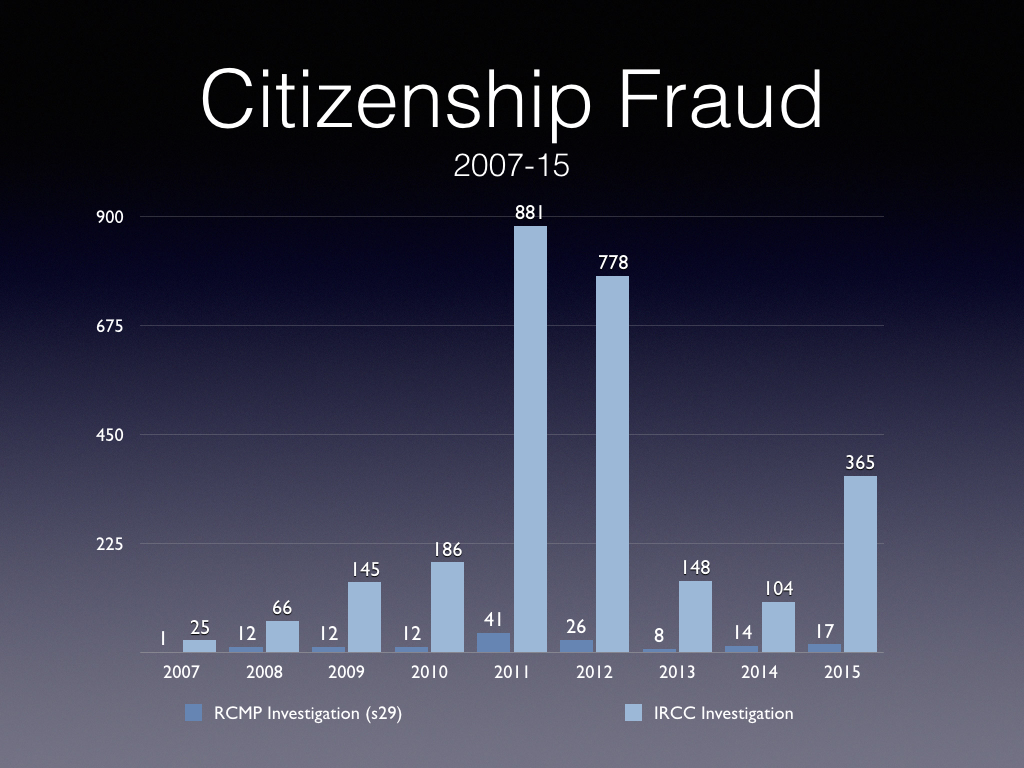
There is a distinction between fraud cases investigated by the RCMP and those investigated by IRCC. The Minister seems to be referring to only the latter. In general, if I recall correctly, the RCMP cases deal more with massive fraud (e.g., consultants submitted multiple fraudulent applications) whereas IRCC deal more with individual cases.

IRCC data shows the vast majority of fraud cases are a result of IRCC internal investigations, not RCMP, as the chart below indicates:

citizenship-data-slides-2015-026

The federal government is trying to revoke the citizenship of fraudsters, and that’s why it won’t agree to a moratorium on citizenship revocation, says Immigration Minister John McCallum.

“We have large numbers of a criminal element unveiled by the RCMP, and reported on by the auditor general. It was actually under the previous government that [investigations began that] we are now dealing with…and those people have really, truly abused our citizenship. So it would not be right to have a moratorium, and let them off the hook,” he said in a phone interview Thursday.

…. He [immigration lawyer Lorne Waldman] is part of a group bringing a constitutional challenge against a law brought in by the previous Conservative government, known as it was as C-24, that means a person who’s received notice of citizenship revocation doesn’t have a right to an appeal or court hearing.

 Mr. Waldman and another lawyer said they’re representing clients in similar circumstances to Ms. Monsef where their citizenship is in jeopardy because another family member is accused of misrepresentation.

Mr. McCallum (Markham-Thornhill, Ont.) acknowledged that the lack of an appeals mechanism needs to be fixed, but wouldn’t go as far as to instruct his department to stop revoking citizenships until one is set up, preferring instead to allow it to be developed through a change to a citizenship bill, C-6, currently at second reading in the Senate.

The bill aims to reverse parts of the Conservative legislation, C-24, that allowed the government to pull citizenship from dual nationals convicted of terrorism, expanded the age range of immigrants subject to language testing, and more.

Mr. McCallum told the Senate during an appearance Oct. 4 for Question Period that he would welcome a Senate amendment to C-6 to put in place an appeals process for new Canadians who had their citizenship revoked for providing false information on their citizenship application.

However, he wavered on whether he would pause revocations while C-6 went through Parliament when asked by Senate Liberal Art Eggleton, saying “no,” then saying he would “consider” it. The federal Justice Department confirmed the government would not impose such a moratorium in a letter to the Federal Court last week, the Canadian Press reported.

The government has increased the rate of citizenship revocations for fraud since the Liberals took power. That includes 104 revocations in the first eight months of this year, compared with 132 in all of last year and just 30 in the previous two years combined, the CBC reported.

‘Never entitled’ to citizenship

Mr. McCallum said the government is not trying to revoke the citizenship of the alleged fraudsters before an amended C-6 could bring in an appeals mechanism.

“Those two are not linked,” he said.

“As a result of that RCMP investigation, they are pursuing cases, which we fully support. It takes a while to pursue those cases, and some of them are just coming to the revocation point now. It wasn’t an effort for any particular reason, except that they were ready. And we are definitely supporting efforts to go after the criminal element and remove citizenship where it was clearly done for fraudulent or criminal reasons,” he said.

In a written statement provided to The Hill Times, Mr. McCallum’s office said “the recent increase in citizenship revocations is the result of large-scale fraud investigations led by our RCMP and [Canada Border Services Agency] partners that began under the former Conservative government.

“These investigations led to criminal convictions of several immigration consultants, and notices of intent to revoke citizenship were sent to their clients who had provided fraudulent documents to suggest they were living in Canada when they were living abroad, in order to gain citizenship. Others changed their identity in order to hide criminal backgrounds.

Source: McCallum doesn’t want to let fraudsters ‘off the hook’ through moratorium on citizenship revocation – The Hill Times – The Hill Times

Trudeau shakes up PS top ranks with more young blood (diversity numbers)

With these appointments, the overall DM diversity numbers for the 39  appointments are: 43.6 percent women, 7.7 percent visible minorities:

Prime Minister Justin Trudeau shook up the senior ranks of Canada’s public service with another sweep of promotions for younger executives who are poised to take over as the leaders of the next decade.

The latest round of appointments reflects Privy Council Clerk Michael Wernick’s push to rejuvenate the top ranks of the bureaucracy with a better mix of youth and experience. The prime minister is responsible for all senior appointments but they are typically made on the advice of the clerk.

Wernick has said managing a “generational turnover” is his top priority as the last wave of baby boomers, who dominated the face and character of public service for decades, retires. In speeches, he has exhorted the baby boomers to “move on” and make way for the next generation of leaders.

Friday’s shakeup included three promotions into the ranks of deputy minster and three assistant deputy ministers into associate deputy minister jobs. All are about age 50 — either in their late 40s or early 50s — positioning them for the top posts over the decade. Last year, the average age of deputy ministers was about age 58.

As one senior bureaucrat said, “It looks like 50 is the new 60.”  The public service has aged over the years, including its senior executives compared to the 1970s and ‘8os when the public service grew rapidly and it wasn’t unusual for executives to get their first deputy appointments in their 40s.

The Trudeau government has made more than 30 senior public service appointments, and a significant number have been younger appointments than in previous years or were recruited from outside the public service.

This round of promotions includes: Paul Glover, the associate deputy minister of health, becomes president of the Canadian Food Inspection Agency; Timothy Sargent, associate deputy minister of Finance, is promoted to deputy minister at International Trade; and James Meddings, assistant deputy minister at Western Economic Diversification Canada, moves to the top job at Federal Economic Development Agency for Southern Ontario.

Glover replaces CFIA president Bruce Archibald, who is retiring. Sargent is taking over from Christine Hogan, who was recently named the new World Bank Group executive director for Canada, Ireland, nine Caribbean countries, Belize and Guyana.

Similarly, Meddings replaces Nancy Horsman, who is the new International Monetary Fund executive director for Canada, Ireland, nine Caribbean countries and Belize.

Doug Nevison becomes the European Bank for Reconstruction and Development executive director for Canada, Morocco, Tunisia and Jordan.

The Trudeau government’s appointment of two women — Horsman and Hogan — to the world’s main economic boards is part of its push to ensure Canada’s representatives abroad reflect gender parity and the wide diversity of Canada. About 45 per cent of Canada’s diplomatic postings are now held by women.

Other moves in the Friday round of appointments included Chris Forbes, the associate deputy minister at Agriculture who moves to Finance as one of the department’s two associate deputy ministers. Rob Stewart, assistant deputy minister at Finance, moves up to the associate deputy minister position responsible for G7 and G20.

Nada Semaan, executive vice-president at Canada Border Services Agency (CBSA), moves to Agriculture as associate deputy minister, and Kristina Namiesniowski, an assistant deputy minister at Agriculture, takes over Semaan’s position at CBSA.

Today, more than one-third of the executive cadre are over age 55, with 400 of them over 60. About 46 per cent of all public service executives are over age 50. The average deputy minister is 58; associate deputy minister 54, assistant deputy minister 53.7 and directors and directors-general 50.

Along with the drive to infuse more young talent into the executive jobs, Treasury Board president Scott Brison is committed to making the public service more millennial-friendly to attract more youth.

Source: Trudeau shakes up PS top ranks with more young blood | Ottawa Citizen

Douglas Todd: Joy Kogawa’s many shades of Japanese-Canadian shame

Interesting and disturbing:

Joy Kogawa has noticed reviewers of her new bookof memoirs have not touched arguably the most controversial section of her intimate exploration of betrayal and hope.

Reviewers have focused instead on the way the Vancouver-raised author of Obasan and The Rain Descends dealt with her Japanese-Canadian family being sent to an internment camp, the bombing of Nagasaki and how her father was a pedophile.

However, Kogawa, 81, has been publicly forthright for decades about those shame-filled realities.

The most cutting-edge section of her book, titled Gently to Nagasaki, digs into horrors most Canadians and ethnic Japanese want to deny — Japan’s war atrocities.

The peace activist’s memoirs describe her painful relatively recent discovery of the extent of the slaughters and mass rapes committed by the Imperial Japanese army.

It was while Japanese troops were killing millions of Asians and others that Canadian governments in 1942 sent many Japanese-Canadians, most of them from B.C., to internment camps.

Following her family’s ordeal in camps in the Kootenays and Alberta, Kogawa gained wide attention for helping lead the campaign that culminated in Ottawa’s 1988 apology and compensation to 20,000 Japanese-Canadians.

The many honours eventually bestowed upon Kogawa included the 2006 establishment of Vancouver’s Kogawa House, where the family had lived until 1942. It’s now a residence for writers.

But Kogawa has not allowed adoration to stop her pursuit of the authentic. Her mission seems to be to move beyond denial on all fronts: regarding internment camps, racism, global warming, her priest-father’s sexual crimes and her relatively recent discovery of Japanese war monstrosities.

“Love and truth are indivisible,” Kogawa says.

Her wise aphorism has had unpleasant consequences, though. Since most Canadians who don’t want to offend ignore Japan’s grisly war history, Kogawa acknowledged in an interview from her residence in Toronto that she’s had to “face the rage” of many.

“It’s cost me some really good friendships.”

Whether in Toronto, Vancouver or Japan, Kogawa said, many people, including ethnic Japanese, “just don’t believe” the atrocities occurred. They’d “rather die” than have the reality exposed.

“Or they feel I’m betraying them by talking about it. But it takes the truth to get to reconciliation.”

Source: Douglas Todd: Joy Kogawa’s many shades of Japanese-Canadian shame | Vancouver Sun