USA: Time to Eliminate Diversity Visas?

It is a weird system:

There has been too little public debate about legal immigration, however, beyond the affirmation by many that amnesty for illegal aliens is unfair to those immigrants who abided by law or remain overseas waiting for their turn.

Sure, there has been some debate about who the United States should welcome: refugees fleeing Syria? Family reunification? Birthright citizenship? Those with special technical ability or willing to invest vast sums in the American economy?

One of the strangest categories of legal American immigration is the “diversity visa,” sometimes known as the green card lottery. The concept of the lottery is simple: Citizens of countries from which fewer than 50,000 people have immigrated to the United States over the previous five years are eligible to apply to a lottery, from which 55,000 immigrants to the United States are chosen. Russians, Poles, Guatemalans, and Taiwanese can apply, for example, but Haitians, Colombians, and Mexicans cannot. Here, it gets more complicated: The State Department and Department of Homeland Security divide the world into six regions for the purpose of the lottery and seek to privilege lottery applicants from those regions which have sent fewer immigrants than other regions. Hence, for 2017, Africa has been allotted 20,400 slots, while Europe receives 14,000. Five lucky Bahamians will win spots reserved just for them.

The green card lottery is a relatively new phenomenon, a legacy of three Democratic congressmen—Howard Berman, Brian Donnelly, and Bruce Morrison—during the Reagan administration. The Immigration Act of 1990, sponsored by Chuck Schumer, formalized the program in more or less its current form. The bar for green card lottery winners is low—no criminal history, a high school education, and be in generally good health. There is no ideological bar, however. Pakistanis, Uzbeks, or Yemenis who win the lottery might be sympathizers to radical causes, but so long as they don’t have a criminal history they are good to go.

Given the fact that winners often bring their families, there are now well over a million Americans—probably twice that—who can attribute their citizenship to the lottery. But is that a wise way to welcome citizens? Does diversity really mean bringing people from East Timor to East LA or from South Sudan to South Dakota? Is there anything wrong with cynically seeking to benefit not only the immigrant but in a more immediate sense the United States by choosing the best educated, best able to immediately integrate into society and contribute to the economy? This isn’t mean to suggest that humanitarian concerns shouldn’t come into play, but the lottery doesn’t alleviate suffering; it is just random.

Many liberals and even many conservatives may feel unease as President-elect Trump’s populist rhetoric about immigration but that does not mean the system isn’t broken or outdated and can’t be reformed. When that debate comes—and it is looming—the notion that the United States should still have a visa lottery should certainly be on the agenda.

Source: Time to Eliminate Diversity Visas? | commentary

Author cleared of slander for saying Muslim school’s teachings go against Quebec values | National Post

While I find such aggressive language unnecessary (there are other ways to make the same points), the judge appears to have made the right call based upon the facts as reported:

The criticism Djemila Benhabib leveled against a private Muslim school during a 2012 radio interview was harsh. The school was providing small children indoctrination worthy of a military camp in Afghanistan, she said. It was grooming “fundamental activists.” It offered as a model a society “where men are probably going to commit honour crimes against their sisters.”

But in what her lawyer called an important victory for free speech, a judge cleared Benhabib of slander Tuesday, ruling her comments were neither erroneous nor made in bad faith.

“Certainly, these remarks are severe and could have been hurtful,” Superior Court Justice Carole Hallée wrote. “However they have a place in a democratic society like ours.”

Benhabib, an author and outspoken critic of Islamic fundamentalism, had begun looking into the Muslim School of Montreal after seeing a brochure in which the female students all wore hijabs. She learned on the school’s web site that children were memorizing Qur’anic passages that spoke of beautiful virgins awaiting male believers in the afterlife, while non-believers endured the fires of hell.

She told radio host Benoît Dutrizac of 98.5FM that the school was instituting a “sexual apartheid” and that it was “very far from the values of our society.”

The school sued for defamation, seeking $95,000 in damages from Benhabib. It claimed the interview had led students to fear for their safety, necessitating additional security measures and provoking a drop in enrollment.

At the trial last September, Benhabib insisted her criticism was justified. “The school’s societal model is not the Quebec societal model. It is not Quebec values,” she said.

Ahmed Khebir, president of the school’s board of directors, said her interview, linking its curriculum to military camps, sparked fears within the school that it would be targeted by anti-Muslim fanatics.

“I was devastated, appalled, horrified, insulted and worried,” he testified. “How was it possible that someone who had never set foot inside our school could make such damaging and insulting statements?”

In her ruling, Hallée questioned Khebir’s credibility and said the school had presented no evidence that its reputation suffered as a result of the interview. She accepted Benhabib’s testimony that when she spoke of military camps she was not referring to terrorist-training camps but simply to a rigid military mindset.

Hallée found that enrollment figures did not support the claim of a drop, and it seems more likely that security improvements made in 2015 were the result of terror attacks in Paris, not an interview three years earlier.

More importantly, she ruled that Benhabib had not slandered the school or its students. The issues she was raising – the wearing of the hijab and memorization of religious passages in school – were matters of public interest.

“Everyone must be allowed to express themselves as freely as possible on these questions,” Hallée wrote.

Benhabib’s remarks, she continued, “are at the heart of freedom of expression’s raison d’être, that is to favour active participation in debates on subjects of public interest.”

If criticism like Benhabib’s were silenced, the judge wrote, society would suffer.

“If this protection is not given to freedom of expression in the context of a debate of interest to the public, it is society that will suffer enormous harm in that many debates will no longer be moved forward, many subjects will no longer be raised and, in the end, everyone will stop talking about it,” she wrote.

Source: Author cleared of slander for saying Muslim school’s teachings go against Quebec values | National Post

‘It may go unnoticed’: Why Canada is ripe for immigration scams

One of the more recent scams to have emerged but no indication that any of the fraudulent applications resulted in the granting of permanent residency (and story doesn’t answer the headline question):

Imagine that your business name is used as bait to scam foreign workers hoping to come to Canada or that your stolen personal identity is used as the contact for the scheme.

It is happening to some of Canada’s best-known companies, including Bell Canada, Via Rail, Scotiabank and Bombardier and to a Montreal businessman, CBC News has learned.
Those companies and the Montreal man were unaware that someone had used them as a front to defraud foreign job seekers out of thousands of dollars until CBC News told them.

“This is the first we have heard of Giant Tiger being mentioned in this capacity,” said Alison Scarlett, manager of brand communications for Giant Tiger Stores Ltd.

“We are absolutely appalled that our trusted name would be used in such a scheme.”

The CBC investigation began after hearing from two Canadians whose family members were trying to immigrate to Canada from India.

The relatives in India were working through a contact who claimed to be a lawyer named Daniel Philip Bornstein and who would help them obtain a Canadian job and documentation.

Once offered a job in this country, the prospective immigrants would pay a fee. The catch: the job offers turned out to be bogus.

How the scheme worked

The lawyer claiming to be Daniel Philip Bornstein approached a third party consultant in India who had clients wishing to immigrate to Canada.
Documents obtained from the Indian consultant show that he then provided job postings from a number of Quebec-based companies, including SNC Lavalin, Via Rail, Golder Associates, Siemens Canada, Scotiabank, Bell, Brookfield Global, Giant Tiger, Systemex Automation and Bombardier. The job postings all appeared to be real positions from the companies’ websites.

Bell Bombardier

Companies such as Bell, Bombardier and Scotiabank were unaware their names had been used in the immigration scheme. (Shutterstock)

He would then arrange a phone interview with someone he said was a company representative. Applicants would then receive a job offer letter and contract, often using the company’s real logo and contact details.
Once the contracts were signed, he provided them with what looked like government documents including visas and Labour Market Impact Assessments.
The clients would pay more than $3,000 by transferring money through a pre-arranged bank account or online money transfer site.

The real Daniel Bornstein

To establish his credibility, the fraudster told prospective victims that he is a lawyer registered with the Law Society of Upper Canada with no complaints against him.
A quick search of the law society online database does list information for a Daniel Philip Bornstein and does show no complaints.

There is no current contact information or company association listed, making it harder for clients to verify his identity and making it easier for anyone to just use that name.

CBC News tracked down the real Daniel Bornstein, who confirmed that he is registered with the law society and spent two years practising tax and estate law in Montreal but is now a partner at a linen supply company.

He said had no idea his name was being used for fraudulent activity and found it “very alarming” to know that his name could be easily lifted from a legal directory.

The Canadian Anti-Fraud Centre confirmed that it received three separate complaints against someone named Daniel Philip Bornstein dating back to 2012 from Nepal, Kazakhstan and Singapore.

CBC tried repeatedly to contact the man claiming to be Daniel Bornstein, however, the Montreal business address he provided to the clients was not valid and no one answers at the phone number he listed.

C-33 Election Act Amendments: Expatriate Voting, Minister Monsef’s Rationale for No Restrictions

Given my opposition to the proposed indefinite expansion of voting rights to Canadian expatriates who had lived at any time, no matter how short in Canada, I was curious to listen to Minister Monsef explain the government’s rationale for proposing an approach at PROC (Procedure and House Affairs Committee).

Monsef spent more time on the proposed indefinite granting of voting rights to Canadians who have lived once in Canada than the other provisions in the Bill.

This proposed approach undermines the value and meaningfulness of Canadian citizenship and does not appear as a specific commitment  in Minister Monsef’s mandate letter unlike the other provisions of C-33.

However, and arguably, it fits philosophically, within “repeal the elements of the Fair Elections Act which makes it harder for Canadians to vote” (the five year limit on expatriate voting dates from 1993 under the Chrétien government but was only enforced by the Harper government).

Her main arguments, similar to those made by advocates, were that ongoing globalization meant more Canadians, particularly youth, were living and working abroad, sharing Canadian values and bringing Canadian ways of doing things to the world, along with bringing the world back to Canada.

The right to vote was a fundamental right as “a Canadian is a Canadian is a Canadian,” but noted that the current case before the Supreme Court will still be heard.

The Minister stated that she had received many emails from expatriate Canadians who pay attention to what is happening in Canada and who want to participate in elections.

The government believes it is neither right nor fair to limit the vote to expatriates who have spent five years or less abroad. Granting the right to vote to the “over one million” Canadians abroad was only fair.

There was no real questioning on this provision by Committee members.

Bizarrely, she raised the issue about extending voting rights to the children of Canadians who had never lived in Canada, as an area that should be discussed in Committee.

It is hard to tell whether the floating of voting rights for Canadian citizens who have never lived in Canada is serious or is a trial balloon. In either case, it should be shot down, as it makes a complete mockery of our democratic system and citizenship to have such an extreme disconnect between residency and voting.

Nor should this trial balloon detract from the substantive issues regarding granting indefinite voting rights without any requirements, either time limits, declarations, or visits to Canada.

In terms of those plaintiffs in the Supreme Court case, either the Australian or New Zealand approach (declarations or visits) would address their concerns given their personal and active connection to Canada. But opening this to all, many if not most to not have this ongoing connection, is a mistake.

Sigh …

Donald Trump’s sharp contrast from Obama and Bush on Islam has serious implications – The Washington Post

Well-worth reading, William McCants assessment of the risks of Trump and his team, providing historical context:

President-elect Donald Trump and his top political and security advisers are convinced Islam’s moral rules, the sharia, not only imperil the safety of Americans but their very way of life. They break sharply with Presidents Obama and George W. Bush who refused to equate traditional Islam with terrorism. The rupture view could ultimately serve as a boon to jihadist recruitment.

The president-elect has called for an “ideological screening test” for immigrants “who believe that sharia law should supplant American law.” His chief political strategist, Steve Bannon, has said that the Roman Catholic Church and the “Judeo-Christian West” have to “struggle against Islam” just as their ancestors did. He is reportedly taking advice from the notorious sharia conspiracy theorist Frank Gaffney, whose team briefed Trump on the dangers of sharia during the campaign.

Trump’s national security adviser, Michael Flynn, called Islam a “cancer” and a “political ideology” that “hides behind this notion of it being a religion.” (Flynn regularly promotesfalse stories of sharia law taking over in the United States.) And Trump’s nominee for the nation’s chief law enforcement officer, Sen. Jeff Sessions, has said that the true threat confronting the United States is “the toxic ideology of Islam” and has proposed screening out immigrants who “believe in sharia law.”

Suspicion of Sharia is not confined to Trump and his advisers. It permeates mainstream Republican politics. More than half Fox viewers believe American Muslims want to impose sharia. Former House Speaker Newt Gingrich, a front-runner in the previous election cycle, described sharia as “a mortal threat to the survival of freedom in the United States and in the world as we know it.” (He upped the ante during Trump’s campaign, calling for deporting every Muslim citizen who believes in it.)

The content of the sharia alone cannot explain fears of it. Many of its controversial rules, like death for blasphemy and apostasy, have parallels in the Hebrew Bible, a book revered by many Americans. Most Muslim countries to do not impose the sharia in total — they either limit its application to family law or ignore it entirely. And most of the 1 percent of Americans who are Muslim believe the sharia is just ethical personal guidelines that should not supersede the Constitution — even according to the crudest online polls promulgated by the right. Like any faith community in the United States, American Muslims can practice the Sharia as long as it does not violate American law.

So whence the worry? It arises from deeper fears of physical and cultural death. The physical fear is a consequence of the 9/11 attacks, which deeply scarred the psyche of a nation that is not used to war on its soil. The attacks shattered Americans’ sense of security and invulnerability. Because the attackers justified their atrocity on the basis of Islamic scripture, the religion and its adherents became objects of suspicion blame — never mind that the kind of Sharia jihadists want is not the kind most American Muslims want.

That paranoia has grown following a series of lone wolf attacks claimed by the so-called Islamic State: San Bernardino, Orlando, St. Cloud. In some ways the fear is worse now than after 9/11 because the attacks are carried about by Americans acting on their own and not by foreigners directed by an organization. When I was promoting my book on ISIS in small towns, I was stunned to hear audience members expressing their terror that their local mall or Walmart could be next. If it can happen in San Bernardino, it can happen here, they suggested.

The paranoia is stoked by jihadist organizations like the Islamic State, who claim attacks in its name even if the attacker has no connection to the organization. It wants non-Muslims to distrust their Muslims neighbors, hoping they will become alienated and more susceptible to recruitment. Even lone-wolf attackers deliberately foster distrust. “Btw, every single Muslim who disapproves of my actions is a sleeper cell, waiting for a signal,” wrote the Ohio State attacker on Facebook.

That the Ohio State attacker was a refugee from Somalia plays into the related fear that immigrants from non-Western countries are a threat to the American way of life, especially immigrants from Muslim-majority countries. Notice that condemnations of sharia as a security threat almost always accompany peaens to America’s Judeo-Christian heritage. The sharia is presented as the inverse of everything America stands for — the shadow that offsets the light.

The distant fathers of American law, the Romans, would have empathized with this strain of America’s cultural anxiety. In their day, the Roman elite worried about Jewish law subverting Roman culture, including those who were particularly concerned about Romans who converted to Judaism. The senator Tacitus scorned “those who come over to their religion adopt the practice, and have this lesson first instilled into them, to despise all gods, to disown their country, and set at nought parents, children, and brethren.”

The fear of Jews, which a historian of the ancient world dubbed Judeophobia, continued on in the Christian empires that replaced Rome for many of the same reasons. Jews were deemed a people apart, worshiping a law that God had annulled when he sent his only begotten son. “I advise that their rabbis be forbidden to teach henceforth on pain of loss of life and limb,” Martin Luther wrote, because “they wantonly employ the poor people’s obedience contrary to the law of the Lord.”

There was some anti-Semitism in early American history, but there weren’t enough Jews in America to worry about until the mid-19th century when Jewish immigration began to sharply increase. Because Jews were associated with international banking in the public imagination, they were blamed for the financial downturns in the late nineteenth century that triggered spasms of populist rage.

When global anti-Semitism reached a fevered pitch in the run-up to World War II, Christians and Jews combated it together by portraying Judaism as part of a common American patrimony. To that era we owe the phrase, “Judeo-Christian heritage.” The national guilt for failing to protect the Jews from the Holocaust forever enshrined the phrase in the America’s political lexicon.

Jews are again the target of populist rage in the United States. Hundreds of journalists received anti-Semitic death threats on Twitter during the election. But to those who consider minority faiths to be a threat, Jews have been eclipsed by Muslims, who, in the popular imagination, threaten to destroy the white Christian West physically with terrorism and immigration and culturally with alien laws.

A classically American approach that protects the many religious streams running together to form the American cultural heritage rather than damming one in favor of another. As historian Denise Spellberg observes of Thomas Jefferson’s view of Islam, “In the formation of the American ideal and principles of what we consider to be exceptional American values, Muslims were, at the beginning, the litmus test for whether the reach of American constitutional principles would include every believer, every kind, or not.” Jefferson didn’t care for Islam (or any organized religion, for that matter). But he understood that America would be stronger if citizens favoring one stream of its heritage vigorously argued its merits without seeking to place legal limits on those arguing for the merits of a different stream.

In the short term, Jefferson’s approach will not alleviate the fear behind the laws contemplated by Trump and his team. But by refusing to put unfair restrictions on Muslims, we rebuff the jihadist recruiters and ensure that our roiling cultural heritage, energized by passionate debate, can continue to adapt to the ever-changing demographic landscape.

Demonizing and repressing a religious minority because it has different moral rules than the majority can have unintended consequences. Just ask the pagan Romans who scorned Jews because of their religious laws. Some of those Jews reacted by changing how they practiced their religion, arguing that one could be faithful to the spirit of Judaism without obeying Jewish law and faithful to Roman law without disobeying God. The change made it easier for those Jews — known as Christians — to proselytize among the Gentiles, which ultimately paved the way for their takeover of the empire. Presumably that’s not the outcome Trump and his advisers have in mind for the restrictions they are contemplating.

Source: Donald Trump’s sharp contrast from Obama and Bush on Islam has serious implications – The Washington Post

As Trumplethinskin lets down his hair for tech, shame on Silicon Valley for climbing the Tower in silence – Recode

Quite an amazing take-down by Kara Swisher:

When I call these top leaders — of course, it has to be off the record — I get a running dialogue in dulcet tones about needing to cooperate and needing to engage and needing to be seen as willing to work together. Also that Trump means very little of what he says out loud — which I will now officially dub the Peter Thiel take-it-seriously-not-literally defense. And they assure me that they will say what they really think behind closed doors where no one can hear it but each other.

This, even though it will be a certainty that Trump will tweet the whole thing with his doubtlessly warped take of the proceedings. My only hope is that often-erupting Tesla and SpaceX’s Elon Musk — who is also now attending — will also erupt when he realizes the farce he has agreed to be part of.

Or maybe I don’t get it because I am of the old school that when something smells fishy, there is probably a dead fish somewhere to be found. But to my ear, it’s a symphony of compromise, where only now and then a sour note sounds from someone who breaks from the platitudes they are spewing.

Like one tech leader who suddenly stopped mid-sentence about how to really make deals, Kara, because the truth just had to be out. “Trump is just awful, isn’t he? It makes me sick to my stomach,” the leader agonized, as a real thinking person would. “What are we going to do?”

Well, to start, realize again that you have the smarts and invention and the innovative spirit to do whatever you like. Realize you have untold money and power and influence and massive platforms to do what you think is right. Realize that you are inventing the frigging future.

Instead, you’re opting to sit in that gilded room at Trump Tower to be told fake news is a matter of opinion and that smart people aren’t so smart and that you need to sit still and do what they say and take that giant pile of repatriated income with a smile.

Or you can say no — loudly and in public. You can resist the forces that are against immigrants, because it is immigrants who built America and immigrants who most definitely built tech. You can defend science that says climate change is a big threat and that tech can be a part of fixing it. You can insist we invest in critical technologies that point the way to things like new digital health inventions and transportation revolutions. You can do what made Silicon Valley great again and again.

When I could get no really substantive on-the-record statements from the tech leaders, I pinged investor Chris Sacca, because I knew he would not let me down.

“It’s funny, in every tech deal I’ve ever done, the photo op comes after you’ve signed the papers,” he said. “If Trump publicly commits to embrace science, stops threatening censorship of the internet, rejects fake news and denounces hate against our diverse employees, only then it would make sense for tech leaders to visit Trump Tower.”

He added: “Short of that, they are being used to legitimize a fascist.”

The fascist line is vintage Sacca, who always likes to kick up a shitstorm. But thank god someone is willing to do it, because that is what I thought Silicon Valley was all about.

Not any longer, it seems. Welcome to the brave new world, which is neither brave nor new. But it’s now the world we live in, in which it’s Trump who is the disrupter and tech the disrupted.

Source: As Trumplethinskin lets down his hair for tech, shame on Silicon Valley for climbing the Tower in silence – Recode

From Chinese to Canadian: Gordon Chong

More on the Chinese Canadian Archive Project and Gordon Chong’ take on the lessons learned:

The Archive Project is a long-awaited and worthy endeavour that will be bolstered by additional family papers and photographs.

Equally important are the lessons derived from this chronicling of the Chinese community’s collective history.

Successive generations have entered every sphere of Canadian life, making significant contributions in the professions and business.

These accomplishments were made without teachers or role models who remotely resembled us.

Our parents (and extended families) were our role models, providing stability and instilling confidence.

By the time we graduated from elementary school, our formal education had exceeded most of theirs.

While supportive, they were not the contemporary and widely satirized “Tiger Moms” or fathers described by Amy Chua, the Yale Law school professor.

Our parents simply recognized the value of higher education in providing socio-economic stability.

There have also been successful politicians produced from our ranks – Art Lee, Gary Mar, C.S. Leung, Michael Chong, Ying Hope, Denzil Minnan-Wong, Kristyn Wong-Tam and many others across the country.

Many were elected before Chinese Canadians became a significant voting bloc.

Indeed, they were devoid of identity politics and forged mutually respectful bonds with their eclectic white communities.

The message is clear: Canadians are more than willing to welcome immigrant families into our great, blended family, if they unconditionally throw their lot in with us.

The Chinese Canadian odyssey has been instructive!

Source: From Chinese to Canadian | CHONG | Columnists | Opinion | Toronto Sun

Opinion: Why did Canada increase immigration targets? | Grubel

The standard contrarian view of current levels of immigration by Herbert Grubel, with some valid points (on the process and spin) and some exaggerated (his figures on the immigrant ‘burden’ are exaggerated as Pendakur and others have indicated, and viewing children of economic class as another potential burden is bizarre):

How does mass immigration serve the interests of political parties? It brings financial and electoral support from employers who profit from being able to employ low-skilled and high-skilled labour at wages that are lower than what they would have to pay for Canadian workers. Electoral support also comes from the owners of real estate, developers and brokers, construction workers and mortgage brokers who gain much from the increased business immigrants bring.

Parties also gain support from immigrant communities who expect to gain political and economic clout, enjoy having family members join them, and benefit from larger markets for ethnic products and media. Support also comes from the large “immigration industry” of social workers, lawyers and language teachers who are paid by the government.

These groups benefiting from mass immigration lobby the government effectively, while the general public is unorganized and does not. To the contrary, the public is lobbied by the government, which issues a constant flow of propaganda about the alleged economic and social benefits from mass immigration and suppresses the distribution of fact-based accounts of the negative effects.

The government also issues highly misleading information about the 172,500 “economic migrants” who will be selected in 2017 for their likely economic success. In fact, assuming an average family size of four, only 43,125 of them will be truly economic immigrants, the rest will be their spouses and children. Many will later be joined by their parents and grandparents, who will number 20,000 in 2017 and contribute very little to the economy.

…Information about many negative effects of mass immigration is kept from the public. For example, recent immigrants, even after many years in Canada, have lower incomes and pay lower taxes while they absorb the same government services as Canadians. As result, immigrants impose a fiscal burden of $30 billion a year on taxpayers, which will grow all the time with the arrival of new immigrants. For a perspective on this figure, consider that there is much debate over the affordability of spending $30 billion to renew the Canadian navy over the next 30 years!

Canadians suffer from the effects immigrants have on the cost of housing and the levels of congestion, pollution and overcrowding in schools, universities and hospitals, the latter especially as the many parents and grandparents of immigrants near the end of their lives and add to the ever-growing wait lists for medical treatment experienced by all Canadians.

….Immigrants raise the total size of national income but not of individual Canadians since immigrants’ pay matches their contribution to output. The gains from the so-called “opportunities to trade” are very small, as are the claimed gains due to economies of scale in production since manufacturers and mining companies already access world markets enabled by free trade and low transportation costs.

Immigrants increase Canada’s cultural diversity, but the benefits from it have reached diminishing returns and the development of ethnic enclaves threatens national harmony and security.

These and other facts about the detrimental effects of mass immigration on the well being of Canadians are well documented by government statistics and academic research. Unfortunately, governments and the beneficiaries of mass immigration have prevented these facts from reaching wide audiences and allowing political parties to continue to use mass immigration policies for their narrow self-interest.

However, the election of President Donald Trump shows that there is a limit to these policies. At some point, suffering workers and taxpayers will vote for politicians who promise to put their interests above those of a political party, business and other groups. Voters in many countries of Europe have already done so. Could McCallum’s announced higher immigration levels have the same result in Canada?

Source: Opinion: Why did Canada increase immigration targets? | Vancouver Sun

New task force aims for diverse public service where everyone feels welcome

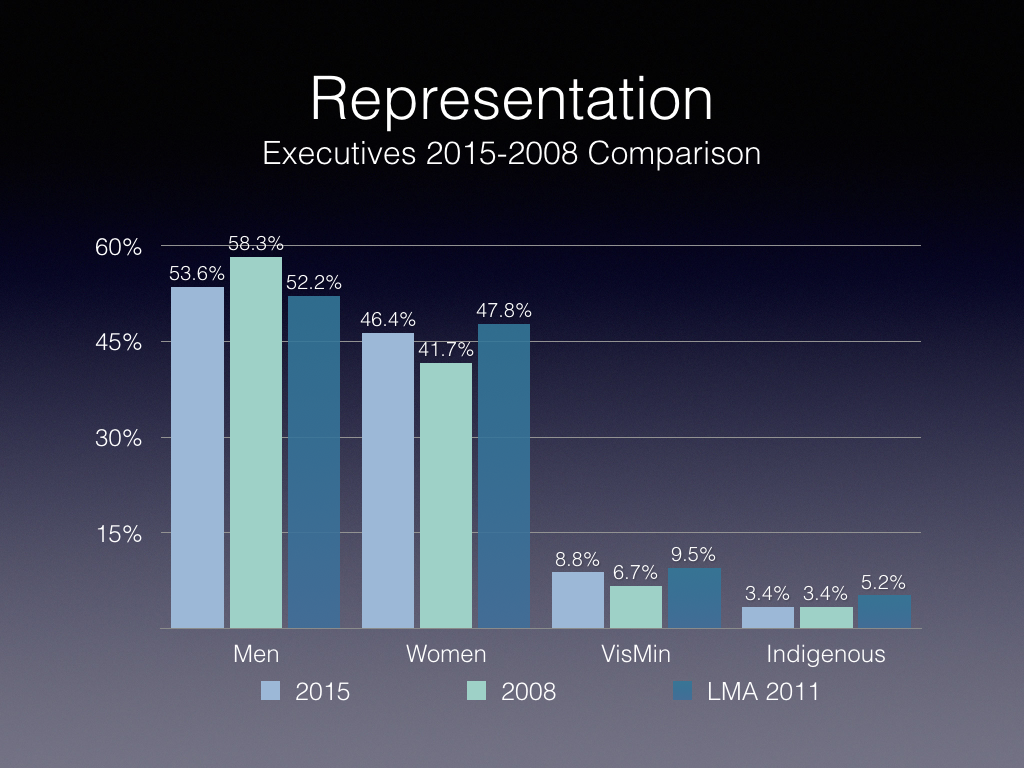
tbs-ee-2015-analysis-007Above slide shows how diversity has changed 2008-15 for executives, slide below for non-executives.

tbs-ee-2015-analysis-006Would be interesting to see the agenda and how it evolves over time, particularly expanding diversity beyond the four employment equity groups:

It’s important not only for the federal public service to be comprised of a fair representation of Canada’s various kinds of people, but also that these employees feel comfortable in their surroundings, says the head of Canada’s largest public service union.

Robyn Benson, president of the Public Service Alliance of Canada (PSAC), said this is among the reasons the Joint Union/Management Task Force on Diversity and Inclusion has been established.

“We, as a union, have great concerns about our workplaces and whether the workplaces are safe for our members, whether or not they are harassment-free, whether or not there is violence in the workplace,” she said. “We wanted to make sure we were part of ensuring that the workplace was safe.”

She added: “While we strive to hire individuals who fall within the equity groups (aboriginals, visible minorities, people with disabilities, and women), you need to not just hire them; you need to provide a workplace where they are safe, where there is no harassment, where there is no violence, where they can be engaged in all levels of the public service, and certainly where there’s accommodation for people with disabilities.”

The new task force includes representation from the following unions: PSAC, the Professional Institute of the Public Service of Canada (PIPSC), the Canadian Association of Professional Employees (CAPE), and the Professional Association of Foreign Service Officers (PAFSO). It also has members from management of the Treasury Board of Canada Secretariat, Correctional Services, Public Safety, Agriculture, and Public Services, as well someone from the Association of Professional Executives of the Public Service of Canada (APEX).

Larry Rousseau, PSAC’s vice-president for the national capital region and co-chair of the task force’s steering committee, echoed the idea that it’s not just about quotas, but making sure those working for the government are comfortable in their surroundings.

“The way to make sure that people feel respected is that they feel included in the processes, in the decision-making, and just the overall work of the public service,” he said. “It’s one thing to have diversity in the workforce. It’s what you do with it that is going to be very, very important.”

Margaret Van Amelsvoort-Thoms, the Treasury Board’s executive director of people management and the other co-chair of the task force’s steering committee, said: “We want every employee to be able to bring their whole self to work, and so [the task force] is the strategy that says, ‘How do we do that and make this an inclusive workplace.’ ”

Mr. Rousseau said one of the task force’s objectives will be defining what diversity is. The federal government already has policies intended to ensure that women, aboriginals, visible minorities, and people with disabilities are adequately represented in the public service. He said preventing discrimination and harassment of people in the LGBTQ community is another issue that has emerged as something all employers should strive for.

Ms. Van Amelsvoort-Thoms added that other demographic factors, such as age, where people are from geographically, and their family structure, can also be part of the conversation about diversity.

The task force was modelled on the Mental Health Joint Task Force that was established in March 2015 under the former Conservative government and continues to function.

Ms. Benson described the roots of this newer Task Force on Diversity: “[Treasury Board President Scott] Brison and I had a discussion several, several months ago about the work around diversity and inclusion. We thought it would be good to construct committees that look like our Mental Health [Task Force],” she said, adding that the Mental Health Task Force “has worked really well.”

While the government didn’t officially announce the Task Force on Diversity until late November, it’s been quietly in operation since September.

Ms. Van Amelsvoort-Thoms said part of the work so far has been doing an “environment scan” of what various employers, in both the private and public sectors, are doing in terms of diversity and inclusiveness. She said the federal government is behind some sectors in its approach to this issue, while it’s ahead of others.

Mr. Rousseau made note of the technology sector, which he said during the 1990s boom years realized the practical benefits of staff diversity and how it brings an array of different perspectives to achieving business goals.

Source: New task force aims for diverse public service where everyone feels welcome – The Hill Times – The Hill Times

What happened to Canada’s support of democratic rights in Hong Kong? [expatriate voting aspect] – David Mulroney

Good column by former colleague and former Ambassador to China David Mulroney on Hong Kong and support for democratic rights.

And appropriate put-down of the Government’s Bill C-33, and its provision to grant indefinite voting rights without any corresponding commitment and responsibility:

Mr. Patten was particularly scathing in his commentary about independence advocates, whose campaign, he said, “dilutes support for democracy.” This was interpreted as criticism of two lawmakers, supporters of independence, who have been forced to vacate their seats. The duo had refused to take the official oath of office, substituting wording that could be considered offensive to China. Their actions sparked legal intervention by China’s government even before Hong Kong’s own courts could consider the issue.

It’s hard to argue with Mr. Patten’s assessment. Pushing for Hong Kong’s independence is wildly unrealistic and, given China’s sensitivity and volatility, irresponsible. But it is also an understandable expression of local frustrations given how little effort has been devoted to exploring more moderate options for democratic governance. If Hong Kong’s leaders, and friends such as Britain and Canada, had remained true to the vision of one country, two systems, the city’s residents would today have at least some say in charting their future. Instead, they are condemned to a form of governance in which they are asked to take up the responsibilities of citizenship without the corresponding rights.

The reverse is true for that fortunate minority among Hong Kong’s seven million residents who also happen to be Canadian citizens. The recently-introduced Bill C-33, which amends the Canada Elections Act, would offer the right to vote to all Canadians residing overseas, as long as they have lived in Canada at some point. It eliminates a previous provision that restricted voting rights to expatriates who had been absent for fewer than five years. The bill is big news in Hong Kong, where a Canadian community of roughly 300,000 includes emigrants to Canada who have since returned, and Canadian-born expats lured by Hong Kong’s low-tax, business-friendly environment.

Passage of the bill will encourage much chest-thumping about Canada’s support for democracy, but it is hard not to see in this something slightly different. Ottawa is offering up one of the most important rights of citizenship, the right to vote in elections back home, without reference to any corresponding responsibilities. This is politically astute, but not particularly courageous. Real support for democracy requires more ambition and more honesty.

Britain, Canada and other democracies have not lived up to their 1997 commitments, failing to follow up with the training programs, institutional exchanges and official encouragement that could have assisted the gradual emergence of healthy democratic institutions in Hong Kong. And they neglected to hold China accountable for its own commitments.

Source: What happened to Canada’s support of democratic rights in Hong Kong? – The Globe and Mail