Why Mixed-Race Americans Will Not Save The Country : NPR

Interesting and useful discussion on whether an increased percentage of mixed race reduces bias and discrimination, with some compelling examples and notes of caution:

“What Biracial People Know,” a recent op-ed in The New York Times, argues that the growing multiracial population may act as a “vaccine” to the bigotry that buoyed Trump’s campaign, granting America “immunity” to the longstanding politics of exclusion shaped by racism.

But this hope that a mixed-race future will result in a paradise of interracial and ethnically-ambiguous babies is misleading. It presents racism as passive — a vestigial reflex that will fade with the presence of interracial offspring, rather than as an active system that can change with time. A 2015 study by Pew Research Center concluded that mixed-race Americans describe experiences of discrimination in the form of slurs, poor customer service, and police encounters. These figures were highest among people of black-white and black-Native American descent.

In their personal lives, mixed-race people may feel pressure to identify with one group or the other. They may have their sense of identity or belonging dismissed by the groups to which they belong, or by the dominant society.

Diana Sanchez, an associate professor in psychology at Rutgers University and a scholar of multiracial identity and experiences, says mixed-race individuals may face subtle forms of aggression in their daily interactions. “People have trouble putting multiracial people in a box … and have opinions about how they should be racially categorized,” she explained. In such instances, mixed-race people may not seamlessly blend in with others’ perceptions, but rather be told that they do not belong to a group, or that they must choose only one, contrary to their personal identity. For some, this disconnect between their sense of self and how the world identifies them can be difficult to navigate.

But when it comes to systemic barriers, experts point out that instances of racial discrimination for mixed-race people may not be very different from the experiences of people who identify as belonging to a single race. Tanya Hernandez, professor of law at Fordham University and the author of the forthcoming book Multiracials and Civil Rights, points out that in legal cases covering a wide-range of contexts, including education, employment, public accommodations, and criminal justice, “people who identify as mixed-race … describe … strikingly binary, black/white or White/non-white forms of discrimination.” Hernandez adds that many mixed-race people find themselves discriminated against, not explicitly because of their mixed-ness, but because of their belonging to a non-white group. She explained that in most of these cases, “the individual…is lumped together in stark contrast to whites, so it’s a white/non-white racial hierarchy.”

The fact that mixed-race people who present as non-white face discrimination because of their proximity to a non-white group reinforces the idea of racial discrimination emphasizing categorization with one group, rather than hybridity. As Sanchez notes, regardless of personal identity, “a lot of research points [out that] mixed-race people tend to be perceived along the lines of their minority identity.”

But what happens to those who aren’t easily categorized?

While not all mixed-race people are considered racially ambiguous, and not everyone perceived as racially ambiguous is of mixed parentage, there is evidence that the inability to categorize people as one race or the other may itself present new forms of bias. Sanchez’s research suggests that white people from less-diverse neighborhoods have more difficulty processing the faces of mixed-race individuals, and that this may result in bias. White people with less exposure to non-whites “have more discomfort trying to make decisions about mixed-race people…and that has consequences for their beliefs around those groups,” she notes.

The upshot, according to Sanchez, is that “the more [people] are exposed to racially-ambiguous individuals, the more likely they are to see race as a social construct, not a biological one.” That realization, that race is a social fiction, “would be a step in the right direction … in terms of trying to reduce racial prejudice and social inequalities,” she says. If people are willing to accept that race is a human fabrication, they may also be more willing to shift their attitudes and perceptions about other groups.

Acknowledging that mixed-race people may experience discrimination and that institutional racism, along with individual prejudice can take forms that target mixed-race people is central to developing policies that address the dynamic face of racism and the effects it has on our communities. But realizing that a mixed-race society can also uphold racism is crucial to a nuanced understanding of the challenge of recognizing and overcoming racism and bias.

Ultimately, the narrative that imagines mixed-race people as a panacea for racism is a flawed one that reinforces ideas around the very existence of race. Instead, we might want to refocus our conversation around how the collective fiction of race is weaponized to limit access to equality and justice for some groups and not others, then maybe we’re onto something.

Source: Why Mixed-Race Americans Will Not Save The Country : Code Switch : NPR

Some permanent residents of Canada can be barred from U.S. under Trump order

Too early to tell, but stories will emerge about the extent whether the waiver is being consistently applied or not (and important that Canada is appears to be the only country to have obtained such a waiver):

Permanent residents of Canada with citizenship from any of six Muslim-majority countries can be denied entry to the United States under the new version of U.S. President Donald Trump’s travel ban.

After Trump issued the first version of the 90-day ban in January, federal Immigration Minister Ahmed Hussen said he had been assured by the White House that permanent residents could go to the U.S. as usual. But the language of the second version is not nearly so straightforward.

The revised ban, signed by Trump on Monday, explicitly says that a “landed immigrant” from Canada needs to apply for a “waiver” that “may” be granted, on a “case-by-case basis,” at the discretion of a consular officer or another official from U.S. Customs and Border Protection.

It is not yet clear how strict or generous the U.S. government will be in giving such waivers to people applying at consulates in Canadian cities — or whether there will be any consistent policy at all.

“Canada will work with its counterparts in the United States to clarify the impacts of this order on Canadian citizens and Canadian temporary and permanent residents,” a spokesperson for the immigration ministry said Monday.

Public Safety Minister Ralph Goodale told reporters Monday that the waiver requirement “would not substantially change the process” for permanent residents from the six countries, since they already had to apply for a visa to enter the U.S. A top Canadian immigration lawyer, though, said other kinds of waivers often take much longer to obtain than visas.

Waivers for Canadians with criminal records, for example, currently take about six months to process, said lawyer Lorne Waldman. While the U.S. might create a faster process for this new kind of waiver, he said, the existing process is the best guide for now.

Trump’s order says waivers “could” be granted. The general requirement: “the foreign national has demonstrated to the officer’s satisfaction that denying entry during the suspension period would cause undue hardship, and that his or her entry would not pose a threat to national security and would be in the national interest.”

Despite the waiver requirement, Canada is still getting privileged treatment in the new order. There is no explicit waiver provision allowing entry by permanent residents of Australia or the United Kingdom.

The new order bans all refugees for 120 days and visitors from Syria, Sudan, Iran, Somalia, Libya and Yemen for 90 days. It does not affect dual citizens of Canada and the affected countries, such as Iranian-Canadians and Syrian-Canadians, who are still allowed to travel to the U.S. with their Canadian passports.

The revised ban was immediately blasted by civil liberties and human rights groups as bigoted and unconstitutional; the American Civil Liberties Union called it “Muslim Ban 2.” But it represents a major concession from a president who had mocked a “so-called judge” for putting it on hold, then defiantly promised in a tweet to “SEE YOU IN COURT” after he lost on appeal.

“The president has capitulated on numerous key provisions that we contested in court about a month ago,” Washington state attorney general Bob Ferguson, who challenged the original order, told reporters. “It bears pointing out that the administration, since that tweet, has done everything in its power to avoid seeing anyone in court when it comes to the original executive order.”

The new order is an attempt to impose a ban that can be seen to satisfy Trump’s campaign promises — first a “total and complete shutdown” on Muslim entry, then something he called “extreme vetting” — while also withstanding scrutiny from federal judges. Legal analysts said it has a much better chance in court than the vague and hastily imposed order of a month ago.

Unlike the original order, which took effect without any warning, this one is being introduced with a 10-day grace period — though Trump had defended the rapid introduction of the original order by saying that, “If the ban were announced with a one week notice, the ‘bad’ would rush into our country during that week.”

The new order excludes Iraq, whose inclusion in the first order was especially controversial because it harmed military interpreters and others risking their lives to work with the U.S. military. While the initial order singled out Syrian refugees for an indefinite ban, the revised version subjects them to the same four-month ban as other refugees.

Attempting to weaken the case that the policy amounts to anti-Muslim discrimination, the new order eliminates special treatment for refugees who are religious minorities in their home countries, a provision widely seen to be aimed at Christians.

Source: Some permanent residents of Canada can be barred from U.S. under Trump order | Toronto Star

Trump’s administration will be making it harder to get H-1B visas starting in April – Recode

Great opportunity for Canada:

United States Immigration and Customs Services has announced that, starting in April, it will no longer offer its 15-day “premium processing” program for applicants of H-1B visas.

H-1B visas allow employers to temporarily hire non-U.S. born workers to take highly skilled positions at U.S. companies. These visas are frequently used at large technology companies to bring top engineering talent to their U.S. offices. The U.S. only allows 85,000 people per year to enter the country on H-1B visas.

The announcement means that new H-1B visa applications could take months to process. With premium processing, U.S. immigration services offered a 15-day expedited service for a $1,225 filing fee, but come April that will no longer be an option.

“I’ve seen these applications take anywhere from 8-12 months,” said Tahmina Watson, a Seattle-based immigration lawyer, in an interview. “Even though the advertised processing time is four months, I’ve never seen anything take four months.”

This will not only affect new workers coming to the country on the H-1B program, but those who already hold an H-1B visa and are changing jobs within the country too, says Watson, like if an engineer who had an H-1B visa with Microsoft is taking a new position at Google, for example.

The suspension of the premium processing may last up to six months, according to the USICS website.

USICS says that it’s suspending premium processing in order to catch up on “long-pending petitions” — which the agency says has been difficult because of the large number of H-1B applications and requests for premium processing it receives.

Google, Apple, Amazon, Facebook and many other tech companies condemned Trump’s immigration and refugee ban that was issued by executive order in January, which blocked people from seven primarily Muslim countries from entering the U.S.

Dozens of companies, mostly in technology, signed onto a brief that claimed the ban inflicted “substantial harm on U.S. companies.”

Although that executive order was suspended after review from a panel of federal judges, Trump says his administration is working on a new version of the immigration ban.

Growing number of migrants renouncing Canadian immigrant status | Vancouver Sun

Solid rationale for many of these permanent residents doing so, but does beg the broader question of how this benefits Canada, beyond more pressure on the housing market and increased school and university enrolment.

To give context, the total number of Permanent Residents for the period 2006-15 is:

  • India: 323,785
  • China: 290,933
  • South Korea: 53,785

Thousands of permanent residents are renouncing their opportunity to immigrate to Canada — for reasons ranging from a dislike of the cold to a desire to avoid Canadian taxes.

More than 21,000 people with permanent resident cards who had the opportunity to become Canadian citizens have turned their back on the quest in the past two years. The highest number of  “renunciations” are from citizens of China, India and South Korea.

People who renounce their permanent resident status no longer have to prove they’re spending significant time in Canada when they cross the borders or fly into an airport, say immigration lawyers in Vancouver.

Nor do Canadian immigration process dropouts have to give up the passport of their homelands, where many continue to work or run businesses. And they are not expected to declare their foreign assets to Canada Revenue Agency.

“Renunciations are growing in number and will likely remain high,” says an internal report from Canada’s immigration office in Shanghai, China, the largest source country for immigrants to B.C.

“Many people are renouncing five years after landing (in Canada), rather than renewing their permanent cards, as they are working in China and do not meet residency requirements,” says the internal report, published in the Vancouver newsletter Lexbase.

“Their children often remain in Canada to complete school and to begin their careers.”

According to three Vancouver immigration lawyers, many people who renounce their permanent resident cards continue to return to gateway cities such as Vancouver and Toronto to visit their families as temporary visitors, especially on the increasingly popular 10-year visas.

“They were getting picked off at Vancouver airport for failure to meet residency requirements. This way they can avoid that problem and still come here,” said B.C. immigration lawyer Sam Hyman, noting the strong majority of migrants to Metro Vancouver are from Asia.

People with permanent resident status in Canada are required to spend two years out of every five in the country.

Vancouver immigration lawyer Jeffrey Lowe said many people who renounce their permanent status are breadwinners who cannot meet Canada’s two-year-residency requirement because they hold down jobs elsewhere, typically earning more money in their homeland than they believe they could in Canada.

A large number of these are so-called astronaut parents, who work offshore while their spouses and school-attending children remain in Canada, usually in urban centres, and own residential property, say the immigration lawyers.
The rapid rise in renunciations began in 2015 after then-immigration minister Chris Alexander, of the Conservatives, changed the rules to make it easier to voluntarily withdraw from the immigration process.

In the two years up to September of 2016, Citizenship and Immigration Canada figures show there were 5,407 renunciations by citizens of China, 2,431 by citizens of India, 1,681 by South Koreans, 1,416 by Britons and 1,129 by Taiwanese.

“A lot of people with permanent resident status have wanted to get their family and wealth transferred into Canada,” said Hyman.

“Some have bought multiple properties. By renouncing their permanent resident status they can stay below the radar and avoid Canadian taxes,” he said.

“They can visit Canada whenever they want on a 10-year visa. Why would they want anything else?”

Another reason foreigners renounce the Canadian immigration process, according to Hyman, is so family breadwinners won’t have to give up their passport and citizenship privileges in economically vibrant homelands like China and South Korea.

China and India do not allow their citizens to hold two passports, and South Korea only in rare cases.

Lowe says he expects renunciations to jump even more since the federal government in November began requiring a new customs document for some travellers, called ETA, or electronic travel authorization.

Foreign nationals from certain countries can’t obtain an ETA if they are a permanent resident or if they are non-compliant with the terms of their residency card, Lowe said. As a result they’re not allowed to board a plane to come to Canada.

Given that problem, Lowe said many would-be immigrants choose to renounce their residency status and instead simply apply for temporary visas to Canada.

Richard Kurland, author of the Lexbase newsletter, said it’s become common for breadwinners to bring their entire family to B.C. as permanent residents and then to decide “either it’s too cold or there’s no way I’m going to file an income tax return and report my global interests and property and pay taxes in Canada on that. I’m returning to my country of origin.”

In many cases, Kurland said, just the spouse and children who physically stay in Canada for five years end up being the ones who become Canadian citizens.

Source: Growing number of migrants renouncing Canadian immigrant status | Vancouver Sun

John Ivison: Immigration focus should be on outcomes, not values

While I agree with Ivison (and Anglin) on focusing on outcomes, not meaningless values declarations, his characterization of the repeal of revocation from dual nationals convicted of terrorism or treason can hardly be called “pandering,” given that polling indicated strong support for the Conservatives on this issue.

In fact, the Conservatives “pandered” by making revocation part of C-24 when available evidence indicates revocation would not be a deterrent and that revocation would most likely be found to violate the Charter, given different treatment for dual (or multiple) nationals compared to Canadian nationals only (and the list of those convicted and charged includes both categories).

While the other changes could be labelled as “pandering,” they could also labelled as “responding” to the concerns of new Canadian voters, irrespective of the merits or not of the original policies and subsequent changes:

The Conservatives reformed the system over their time in power, so that family class immigration was on the decline (down 18 per cent in 2014), while economic immigration was on the rise (up 11 per cent). New programs such as the Express Entry system were introduced to speed the application process for people with the skills Canada needs.

But the 2015 election meant a change of emphasis. The Liberals promised to prioritize family reunification, granting points under the Express Entry system to applicants with siblings in Canada and doubling the number of applications allowed for parents and grandparents.

Immigration targets have been raised to 300,000; visa requirements on Mexico have been lifted; language requirements have been watered down for younger and older applicants; while the residency requirement for citizenship has been reduced to three years from four, one of the lowest among peer countries.

Perhaps the most egregious example of political pandering was the repeal of the law that revoked citizenship for dual citizens convicted of terrorism or treason. If you can have your citizenship revoked for misrepresentation, does it make sense that you are able to keep it after being caught planning to explode truck bombs in downtown Toronto, as was the case with Zaharia Amara, ringleader of the Toronto 18 terror group, who recently saw his citizenship reinstated?

Justin Trudeau’s pledges on immigration had the desired impact — a shift in allegiance of a number of visible minority communities to the Liberals.

But they made no sense from a policy perspective. Their adoption has created an opportunity for the Conservative Party to make a pitch to voters who agree that immigration is a necessity for economic growth, yet do not believe parties should use bad policy in a bidding war for votes.

The idea to increase the number of face-to-face interviews for immigrants is a good one, but the rest of Leitch’s plan is unworkable. As Howard Anglin, a former chief of staff to Jason Kenney when he was immigration minister, wrote recently in iPolitics, the Conservatives considered a values pledge for new citizens. After looking at examples from Australia and the Netherlands, they concluded such pledges were “empty exercises.”

“Even assuming one could agree on a list of values that newcomers would pledge to uphold (would Conservatives trust Trudeau to draft this? Would Liberals have trusted Stephen Harper to?), it would be about as meaningful as clicking ‘accept’ on a computer program’s ‘terms of use’ and, in practice, even less enforceable.”

A more sensible immigration policy would forget about “values” and concentrate on outcomes — where the focus is on attracting smart workers who will help Canada navigate an age of automation and job displacement.

As author Peter C. Newman once noted: “When a nation’s elite is three generations removed from steerage, it cannot afford too many pretensions.”

Source: John Ivison: Immigration focus should be on outcomes, not values | National Post

Je suis un « sale multiculturaliste » – La Presse+

Jack Jedwab critiques some of the myths in Quebec about multiculturalism:

Dans un texte percutant, M. Cardinal trouve curieux l’emploi débridé de cette « insulte », car, selon lui, le multiculturalisme n’existe tout simplement pas à proprement parler au Québec. Il constate entre autres que l’ensemble des partis représentés à l’Assemblée nationale rejette le multiculturalisme, que les spécialistes en sciences sociales du Québec rejettent le multiculturalisme presque à l’unanimité, que la commission Bouchard-Taylor a rejeté le modèle multiculturaliste canadien parce qu’il aurait été « non adapté » à la réalité québécoise et que « la quasi-totalité des intervenants qui se sont exprimés lors des consultations Bouchard-Taylor rejette le multiculturalisme ».

Les deux derniers arguments de François Cardinal témoignent d’une certaine méconnaissance de l’opinion des dites « minorités ethnoculturelles et linguistiques » du Québec.

Un survol des mémoires présentés à la commission Bouchard-Taylor par les organismes issus des communautés culturelles révèle en effet que peu d’entre elles rejettent le multiculturalisme.

Quant à l’affirmation selon laquelle les spécialistes en sciences sociales du Québec rejettent presque unanimement le multiculturalisme, elle semble contredite par une courte visite à McGill ou à Concordia.

Est-ce que ceci veut dire que les Québécois francophones et non francophones sont divisés sur la question du multiculturalisme ? Pas vraiment. Peu d’enquêtes démontrent que les Québécois rejettent le multiculturalisme. Un sondage mené par la firme Léger Marketing en 2014 révèle que 53 % des Québécois sont d’accord pour dire que « le multiculturalisme canadien a eu un impact positif sur les minorités ethniques et religieuses », tandis que 56 % sont d’avis que « le multiculturalisme rassemble les gens plutôt que de les diviser ». Autour de 45 % des Québécois sondés pensent que le multiculturalisme canadien favorise « la cohésion sociale » et « permet aux immigrants d’adopter plus facilement les valeurs partagées ».

Ces résultats démontrent que nous sommes beaucoup plus ambivalents sur la question du multiculturalisme que ce que nos élus et certains universitaires souhaitent nous faire croire. Ce qui, bien sûr, ne veut pas dire que les Québécois n’ont pas de réserves ou d’inquiétudes par rapport au multiculturalisme, comme c’est d’ailleurs le cas dans d’autres provinces canadiennes.

M. Cardinal prétend qu’il existe une importante distinction entre multiculturalisme et pluralisme. C’est une distinction que peu de gens à l’extérieur des milieux universitaires peuvent saisir. En fait, le texte de M. Cardinal semble indiquer que, même chez nos intellectuels les plus brillants, les jugements que l’on porte sur les politiques et le programme du multiculturalisme ne sont pas souvent fondés sur des analyses concrètes. De fait, peu de gens savent que la plus récente incarnation de la politique multiculturelle du Canada vise les objectifs suivants :

• favoriser la compréhension interculturelle et interconfessionnelle ;

• encourager la commémoration et la fierté civiques ;

• promouvoir le respect des valeurs démocratiques fondamentales ;

• éliminer la discrimination, le racisme et les préjugés ;

• offrir aux jeunes des occasions d’engagement communautaire ;

• rassembler les gens au moyen de l’art, de la culture ou du sport.

Ces objectifs sont semblables à ce que le Québec propose en matière de gestion de la diversité. Pour sa part, M. Cardinal, sans même offrir de définition du multiculturalisme canadien, semble reprendre le refrain de certains universitaires québécois qui insistent sur les différences irréductibles entre multiculturalisme canadien et interculturalisme québécois.

Selon M. Cardinal, contrairement à la version canadienne du multiculturalisme, l’interculturalisme proposerait la reconnaissance d’une culture officielle et d’une langue commune. Notons qu’à l’heure actuelle, il n’y a pas de politique officielle de l’interculturalisme au Québec et qu’en matière de diversité, il n’y a pas non plus reconnaissance d’une culture officielle. Quant à la langue officielle du Québec, son statut n’a jamais été remis en question par la politique multiculturelle canadienne.

Malgré la volonté affichée par certains de rayer le mot multiculturalisme de notre vocabulaire, les débats autour de cette politique persistent et persisteront pour encore de nombreuses années parce que la réalité est plus forte que l’étiquetage des idées. Nous ne sommes par conséquent pas près de nous débarrasser des « sales multiculturalistes ».

Source: Je suis un « sale multiculturaliste » – La Presse+

Cabinet to map out scenarios for dealing with border-crossers

As expected, work taking place behind the scenes:

Federal cabinet ministers are set for an in-depth discussion of the practical and political pressures being placed on the Liberal government by a rising number of asylum seekers in Canada.

Border security, RCMP and immigration officials have been running scenarios to prepare for the possibility that a relative winter trickle of crossings into Canada could turn into a spring flood.

The results of their table-top exercises will help form options being put before cabinet Tuesday, The Canadian Press has learned.

Officials are also studying links between distinct groups of border-crossers that might belie the common notion they’re all being pushed into Canada by the volatile U.S. political climate.

Two government officials confirmed to The Canadian Press that many of the people coming into Quebec hold American visas issued at the U.S. Embassy in Riyadh, Saudi Arabia.

Interviews revealed the visas were obtained to use the U.S. as a transit point to get to Canada and claim asylum — plans set in motion long before the U.S. election in November, the officials said, neither of whom were authorized to publicly discuss the issue.

USA-IMMIGRATION/CANADA-BORDER

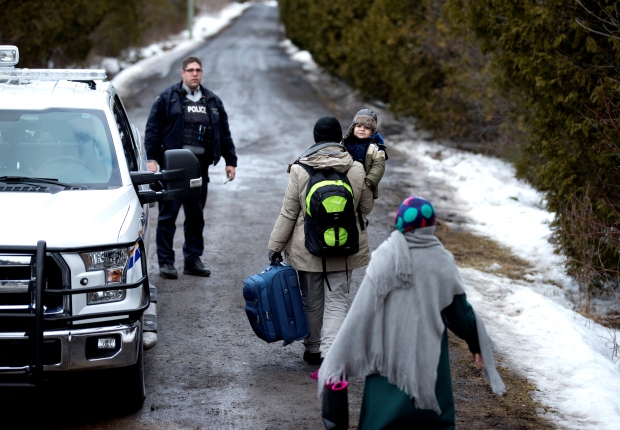
An RCMP officer carries a child from a family that said they were from Yemen after they crossed the U.S.-Canada border into Hemmingford, Que., on Sunday. (Christinne Muschi/Reuters)

But it is the pictures of RCMP officers hoisting small children above snow-covered fields along the Canada-U.S. frontier that have drawn global attention and placed political pressure on the Trudeau government from all sides.

The Opposition Conservatives are demanding a crackdown, and want those crossing illegally charged with crimes, something the government notes cannot happen until asylum claims are heard.

‘We are the endpoint’

The fact those claims are being fed into a clogged system has others urging the Liberals to put more resources into the refugee-determination process and the agencies that support newcomers.

“We are the endpoint,” said Chris Friesen, director of settlement services for the Immigrant Services Society of British Columbia.

The Immigration and Refugee Board reported in its last quarterly financial document that in the first nine months of 2016-17, there was a 40-per-cent increase in new claims compared to the same period the previous year.

Statistics provided to The Canadian Press show claim levels generally began rising in Canada before U.S. President Donald Trump took office.

Refugees crossing into Quebec

A family claiming to be from Turkey are met by a RCMP officer after they cross the U.S.-Canada border into Hemmingford, Que. (Christinne Muschi/Reuters)

In fact, the increase seems to have begun just as Prime Minister Justin Trudeau took power.

In October 2015, the month of the last federal election, 1,519 claims were lodged in Canada. The next month, when the Trudeau Liberals took office, there were 1,647 and — with the exception of two months in 2016 — they have been rising since.

Trump is pushing people into Canada, but the Trudeau government’s repeated messaging on welcoming diversity and immigration is a pretty strong pull factor, Friesen said. “We are now the beacon of hope for desperate refugees.”

In B.C., there has been a 60-per-cent increase in the number of refugee claimants in the last 12 months compared to the previous one-year period. Most are Iraqi Kurds and Afghans, and there were also 18 undocumented Latin Americans from Guatemala, Honduras and Venezuela who recently crossed the Canada-U.S. border, immigration agencies said.

The number of Mexican claimants is also starting to rise in B.C., following the end of a requirement for Mexican citizens to have a visa to enter Canada. During the last three months, there were 29 refugee claimants from Mexico, the agencies reported, compared to 30 who arrived between December 2015 and November 2016.

The Immigration and Refugee board is already adjusting to deal with the bigger numbers, but cabinet will consider giving it more resources.

Spotlight on Safe Third Country Agreement

Ministers will also consider whether there is room to alter the Safe Third Country Agreement between Canada and the U.S. The agreement says a refugee claimant must apply for asylum in whichever of the two countries they arrive first — unless they qualify for an exception.

It is being singled out as the reason people are avoiding official border stations and crossing into Canada illegally, and there are calls for Ottawa to suspend the agreement.

Source: Cabinet to map out scenarios for dealing with border-crossers – Canada – CBC News

Newly arrived Yazidis who escaped sex slavery of ISIS eager to build better future in Canada

Another article on Yazidis in Canada, focussed on London:

It’s here in London — where about 300 Yazidis have formed a small but tight-knit community since the early 1980s when they fled the dictatorship of Saddam Hussein — that Bhasa and other recently arrived Yazidis hope to start building a new life for their families and try to move beyond the horrors they suffered in captivity.

Dalal Abdallah, a Yazidi human rights activist who lives in London, says members of her community have been donating clothing, hygiene products and toys for the families who have arrived and look forward to absorbing more into their community.

“For many, many years, we have been struggling [to grow] as a community because no Yazidis were coming through,” she said. “It’s a great opportunity to build our community, and the more people, the merrier.”

She said London has already accepted and integrated Syrian refugees and that there’s enough support for Yazidis, including a program at Victoria Hospital to help refugees deal with trauma.

Other support comes from London’s Cross Cultural Learner Centre, where Yazidis can learn some basic tools for integrating in Canada: how to get housing, set up bank accounts, apply for health cards.

“We are here to support them, welcome them, make them feel comfortable, that they are not alone here,” said Omar Khoudeida, a Yazidi interpreter who works at the centre and who himself came to London nearly 20 years ago as a refugee.

“There’s a community behind them and supporting them.”

But even with that support, Bhasa must still cope with the emotional fallout of a family torn apart by genocide.

She fears being identified. Although she doesn’t know the fate of family members in Iraq, she’s worried that going public could put them in danger. She hasn’t seen her husband and other male relatives since ISIS invaded her home in August 2014.

Daughter still missing

She also fears for her daughter, who was nine years old when she was snatched by the Islamist militant group.

“They took her. She doesn’t know anything about her,”  Khoudeida said.

While ISIS targets all communities, it has particular antipathy for Yazidis, whom it considers to be infidels.

Iraq Cda Yazidis 20170222

ISIS survivors Suham Haji, from left, Samira Hasan and Saud Khalid sit in the Dohuk Girls and Women Treatment and Support Centre in Dohuk, Iraq. The three women are among 900 being treated at the centre after escaping ISIS captivity. (Ryan Remiorz/Canadian Press)

Last June, a UN commission declared in a report that ISIS was committing genocide against the religious group of about 400,000. ISIS, it said, was subjecting “every Yazidi woman, child or man that it has captured to the most horrific of atrocities.”

Source: Newly arrived Yazidis who escaped sex slavery of ISIS eager to build better future in Canada – Canada – CBC News

Donald Trump: Facts, Fascism and Tyranny: Snyder | Time.com

Historian Timothy Snyder (Bloodlands, On Tyranny: Twenty Lessons from the Twentieth Century) on the risk of Trump:

The Founding Fathers designed the constitution to prevent some Americans from exercising tyranny. Alert to the classical examples they knew, the decline of ancient Greece and Rome into oligarchy and empire, they established the rule of law, checks and balances, and regular elections as the means of preserving the new republic. Thus far, it has worked. But it need not work forever.

We might imagine that the American system must somehow always sustain itself. But a broader look at the history of democratic republics established since our own revolution reveals that most of them have failed. Politicians who emerge from democratic practices can then work to undo democratic institutions. This was true in the rise of fascism in the 1920s and 1930s, as well as during the spread of communism in the 1940s, and indeed in the new wave of authoritarian regime changes of the 21st century. Indeed, absent a truly decisive revolution, which is a rare event, a regime change depends upon such people — regime changers — emerging in one system and transforming it into another.

It is in this light that we should consider President Donald Trump and his closest advisors and spokespeople. Although they occupy the positions they do thanks to an election, there is little reason to believe that they support the American constitutional system as it stands, and much to remind us of authoritarian regimes changes of the recent past. A basic weapon of regime changers, as fascists realized nearly a century ago, is to destroy the concept of truth. Democracy requires the rule of law, the rule of law depends upon trust, and trust depends upon citizens’ acceptance of factuality. The president and his aides actively seek to destroy Americans’ sense of reality. Not only does the White House spread “alternative facts,” but Kellyanne Conway openly proclaims this as right and good. Post-factuality is pre-fascism.

The function of the press, as the Founding Fathers understood, was to generate the common knowledge on which citizens could understand and debate policy, and to prevent rulers from behaving tyrannically. Whether from the far right or the far left, the regime changers of the twentieth century understood that the media had to be bullied and deprived of importance. When Steve Bannon refers to the press as the “opposition,” or Mr. Trump calls journalists “enemies,” they are expressing their support for the demolition of the historical, ethical, and intellectual bases of the political life we take for granted. Indeed, when Mr. Trump calls journalists “enemies of the people,” he is quoting Joseph Stalin.

Since the end of the cold war, the new authoritarian regimes that have emerged in eastern Europe have taken the form of authoritarian kleptocracies: Russia is the most enduring example of this model; a revolution halted the development of a similar regime in Ukraine in 2014. The Founders, opponents of a British monarchy, were alert to the danger that government might serve to enrich a single family. The emoluments clause of the constitution confirms our common sense: no one can be trusted to defend the interests of citizens if his policy choices can make him richer. This president has not revealed the basic financial information about himself, but we know that he has business interests at home and abroad. Russians and Ukrainians have been quick to notice a familiar pattern.

In recent authoritarian regime changes, in Poland and Hungary as well as Russia, the executive power has been able to sideline the judiciary and then humble the legislature. The idea of checks and balances is enshrined in our constitution, but of course also in theirs, is that none of the three branches of government can dominate the others. In denigrating judges, Mr. Trump attacks the geometry of the system. Once the courts are tamed, the legislature cannot defend itself, and we have authoritarianism. If legislators do not support the judiciary, then their turn for humiliation will come, and the laws they pass will be unenforceable. This has been the pattern in recent authoritarian regime changes around the world.

Right-wing authoritarians today use the threat or the reality of terrorism to seek and hold power. The one consistent policy of the Trump administration thus far has been to encourage a Muslim terrorist attack within or upon the United States. Everywhere the first executive order on refugees and immigrants was understood as directed against Muslims. The major consequence, most likely the intended one, is the alienation of Muslims at home and abroad. The proposal to move the US embassy in Israel to Jerusalem is similar: it will never take place, so serves only to alienate and enrage Muslims. Michael Flynn is in the same category: though he was only national security advisor for three weeks, few Muslims will forget that he referred to their religion as a “cancer.” Modern authoritarianism is terror management, and so modern authoritarians need terror attacks: real, simulated, or both. As James Madison noticed long ago, tyranny arises “on some favorable emergency.”

The experience of the 21st century, as well as the experience of the 1930s, teaches that it takes about a year to engineer a regime change. To what, exactly? We cannot deduce, from the Trump administration’s destructive chaos and ideological incoherence, what the post-democratic American regime would be. We can be sure, however, that we would miss being free. The prospect of children and grandchildren growing up under tyranny is terrifyingly real. History can remind us of the fragile fundaments of our own democracy. But what follows now is us up to us.

Source: Donald Trump: Facts, Fascism and Tyranny | Time.com

Liberals look at making skilled immigrant loans pilot project permanent

Always good to see some of the better initiatives of the previous government continued by the current government:

A pilot Conservative project to loan money to help skilled immigrants land jobs in their field could be revived as a permanent program under the Liberal government.

One of the biggest barriers for newly arrived doctors, dentists, engineers and high-tech professionals is coming up with the cash to pay for the required licensing fees, exams and training upgrades.

Proponents say micro loans speed up the process and pay off big time for the federal treasury, yet they can’t keep up with a demand that will likely grow with the Liberal government’s plan to welcome more economic immigrants to the country in 2017.

Jean-Bruno Villeneuve, spokesperson for Patty Hajdu, the minister of employment, workforce development and labour, said a three-year pilot that was launched in 2011 under the Conservatives demonstrated that loans sped up the credential recognition process, led to a 47-per-cent increase in full-time employment and eased reliance on government income assistance.

“We were very pleased with the results of the pilot, and we’re working hard on a framework for a more permanent policy,” he told CBC News.

A spokesperson for Finance Minister Bill Morneau would not say if a new foreign credentials loan program would be included in this year’s budget.

“Can’t tip our hand here either way,” the official said. “Stay tuned.”

The Conservative government earmarked $35 million over five years to make the Foreign Credential Recognition Loans program permanent in the 2015 budget, but it was never implemented due to the election. Then-prime minister Stephen Harper had also promised to more than double that figure during the 2015 campaign by adding an extra $40 million over five years.

Herb Emery, a labour market economist at the University of New Brunswick, said loans to help immigrants overcome the up-front financial hurdle have a big net payoff in federal revenue.

‘Huge’ impact on federal treasury

“When these immigrants are taken out of low-skill jobs and converted into high-paying ones, the impact on the federal treasury is huge,” he said. “They recoup any costs they put into it in the first year alone, and from then on it’s basically pure profit for the treasury.”

Emery said immigrants often have no access to credit or bank loans — what he calls a “pervasive market failure.” That leaves newcomers unemployed or working in low-paid jobs just scraping to get by.

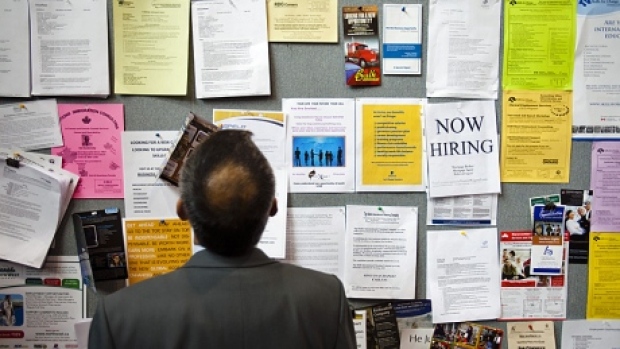
Man hunts job board

Many skilled immigrants wind up unemployed or working in low-paying jobs because of the financial barrier to earning their foreign recognition credentials. (CBC)

“We’re doing a horrible job in that we bring very high human capital individuals to Canada, then we throw away their potential by not letting them work in what they are trained and educated to do,” he said.

There are several programs in Canada offering micro loans between $5,000 and $15,000, with some receiving operating funding contributions from the federal government and the provinces.

One of the programs Emery has reviewed favourably is the Calgary-based Immigrant Access Fund (IAF), which grants loans to immigrants across the country. Dianne Fehr, vice-president of stakeholder relations, said it needs millions more in federal funding to keep up with a growing demand.

“It’s a very clear way to support immigrants toward labour market integration,” she said.

Source: Liberals look at making skilled immigrant loans pilot project permanent – Politics – CBC News