Worth noting (but uneven, as Saudi Arabia’s development of Mecca and Medina illustrates):
A recent conference in Bahrain brought together experts in Islamic archaeology to discuss the lessons of the past and how to safeguard Muslim heritage for future generations.
Under the blistering Bahraini sun archaeologist Salman Al Mahari and his team are excavating a section on the western side of the Al-Khamis mosque site.
With its twin minarets the mosque used to act as a landmark for ships at sea guiding them to land in the 14th century.
But today, excavating the mosque has a far more important function as Islamic archaeology takes on the extremists at their own game.
At a recent conference in Manama, the capital of Bahrain, archaeologists working in over 14 Islamic countries around the world participated in a first of its kind conference.
Islamic Archaeology in Global Perspective brought together some of the most distinguished scholars working in the field of Islamic archaeology to share first hand their recent practical experience in countries torn apart by war, and to investigate the various influences on the science of archaeology.
New Zealander, Alan Walmsley, Professor of Islamic Archaeology and Art at the University of Copenhagen says his investigations aim to disseminate a fuller account of social, cultural, and economic developments in Arab and Islamic history. “I interrogate faded and misinformed historical narratives,” he explains.
He begins by unpicking past Western interest in Bilad Al-Sham, an historic region of the Middle East known as Greater Syria.
“Islamic discoveries were incidental to the objective of archaeological interest in Greater Syria,” he says.”The focus of digs were on the Biblical, Hellenistic and Classical past. These earlier periods took precedence in research.”
Image copyrightRICHARD DUEBELImage captionThe site of Volubilis in Morocco is a Roman and Islamic site
Animosity between Islam and the West compounded the lack of interest in Muslim remains according to Alastair Northedge, professor at the Universites de Paris 1.
He spoke in the context of his recent trip to Iraq, about the West’s overwhelming concerns with their own past. “There is quite a good example in Iraq,” he says. “Babylon seems to belong to the West.”
Corisande Fenwick, a lecturer in Archaeology of the Mediterranean at University College London (UCL) took time to describe painstaking research into food remains indicating when pork was no longer consumed and so revealing the pace at which Islam was established across the Maghreb region.
She attributes the Western assessment of archaeological finds prior to the mid-1950s to a colonial interpretation.
“If you go back before independence, archaeology is all driven by colonial scholars,” she says.
“They were attracted by the exotic nature of their finds. That reinforced the idea that the Islamic world was somehow different and needed to be controlled by colonial powers,” she adds.
But it is not just a Western agenda that has shaped excavations in the Muslim world. Alastair Northedge also notes that Muslims themselves have not always been concerned with protecting the material heritage of the great spiritual sanctuaries.
“It is not just Mecca and Medina, but also Shia shrines in Najaf and Karbala in Iraq” he says.
“There seems to be a preference for building something new rather than conserving the old because the emphasis is on the spiritual nature of these places not their materiality.”
But a wider vision is coming and the rise in the number of excavations throughout the Gulf area attests to a burgeoning interest in the material past. St John Simpson, archaeologist and senior curator at the British Museum, says that a revival of interest in Islamic archaeology is long overdue.
“It’s part and parcel of a search for Muslim cultural identity,” he explains. It is also an opportunity to redress earlier misconceptions.
“Since the 19th century and continuing though much of the 20th century commercial excavations led by dealers have in parts of the world flooded the market with objects which were traditionally celebrated by art historians,” Dr Simpson says. “They celebrated the beauty of those pieces and therefore reconstructed material cultures on the basis of those objects.”
Former Minister Alexander’s asserted before CIMM during its study of C-24 that:
…it’s very important to distinguish between the two different broad categories of status that non-Canadian citizens can have here. One is temporary resident status and the other is permanent resident status. We are saying that the time that will count toward citizenship is permanent resident status. We don’t want those lines to be blurred. (28 April 2014)
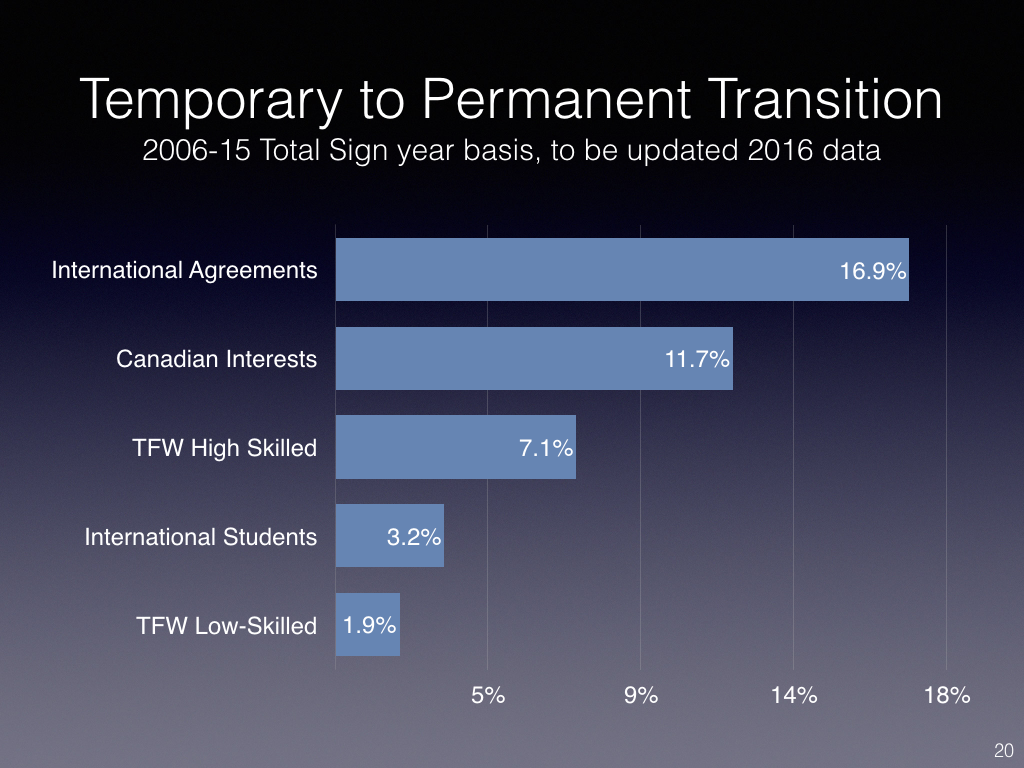
There were 310,000 temporary work permit holders on December 31, 2015, accounting for 1.7% of the national employed workforce. The number of TFWs has more than quadrupled since 2000 (Immigration, Refugees and Citizenship Canada 2017).
Over the 2000s, immigration to Canada was increasingly drawn from TFWs. For instance, the proportion of newly landed adult immigrant men already holding a job in Canada rose from 16.3% in 1999 to 28.9% in 2010. Most of this increase consisted of immigrants who had high-paying jobs in Canada before attaining permanent resident status.
About 9% of TFWs who came to Canada between 1995 and 1999 became permanent residents within five years of receiving their first work permit. This was the case for 13% of those who came to Canada between 2000 and 2004, and for 21% of those who came between 2005 and 2009.
Most transitions from TFW status to permanent resident status occurred within the five years following receipt of the first work permit. The rate rises another 1 to 3 percentage points by the 10th year, with little increase observed thereafter.
Transition rates
The rate of transition to permanent residence varied by type of work permit. Among those who came to Canada between 2005 and 2009, the five-year transition rate was highest among those in the Live-in Caregiver Program (LICP), at 56%, and the Spouse or Common-law Partner category, at 50%. The lowest rates for transition to permanent residence were among those in the Seasonal Agricultural Workers Program (SAWP), at 2%, and the Reciprocal Employment category, at 9%.
A large difference in the transition rate by type of work permit is a result of government policy. For example, while all those in the LICP are allowed to apply for permanent residence after two years of full-time work as domestic workers, SAWP workers have no dedicated stream for transition, and may only be employed for a maximum of eight months per year. Their SAWP permits, however, can be renewed over many years.
Patrick Cockburn on Salafism and Saudi Arabia’s role in spreading fundamentalism. Bit over the top in terms of wording used, but basic point about Saudi Arabia’s role valid:
In the wake of the massacre in Manchester, people rightly warn against blaming the entire Muslim community in Britain and the world. Certainly one of the aims of those who carry out such atrocities is to provoke the communal punishment of all Muslims, thereby alienating a portion of them who will then become open to recruitment by Isis and al-Qaeda clones.
This approach of not blaming Muslims in general but targeting “radicalisation” or simply “evil” may appear sensible and moderate, but in practice it makes the motivation of the killers in Manchester or the Bataclan theatre in Paris in 2015 appear vaguer and less identifiable than it really is. Such generalities have the unfortunate effect of preventing people pointing an accusing finger at the variant of Islam which certainly is responsible for preparing the soil for the beliefs and actions likely to have inspired the suicide bomber Salman Abedi.
The ultimate inspiration for such people is Wahhabism, the puritanical, fanatical and regressive type of Islam dominant in Saudi Arabia, whose ideology is close to that of al-Qaeda and Isis. This is an exclusive creed, intolerant of all who disagree with it such as secular liberals, members of other Muslim communities such as the Shia or women resisting their chattel-like status.
What has been termed Salafi jihadism, the core beliefs of Isis and al-Qaeda, developed out of Wahhabism, and has carried out its prejudices to what it sees as a logical and violent conclusion. Shia and Yazidis were not just heretics in the eyes of this movement, which was a sort of Islamic Khmer Rouge, but sub-humans who should be massacred or enslaved. Any woman who transgressed against repressive social mores should be savagely punished. Faith should be demonstrated by a public death of the believer, slaughtering the unbelievers, be they the 86 Shia children being evacuated by bus from their homes in Syria on 15 April or the butchery of young fans at a pop concert in Manchester on Monday night.
The real causes of “radicalisation” have long been known, but the government, the BBC and others seldom if ever refer to it because they do not want to offend the Saudis or be accused of anti-Islamic bias. It is much easier to say, piously but quite inaccurately, that Isis and al-Qaeda and their murderous foot soldiers “have nothing to do with Islam”. This has been the track record of US and UK governments since 9/11. They will look in any direction except Saudi Arabia when seeking the causes of terrorism. President Trump has been justly denounced and derided in the US for last Sunday accusing Iran and, in effect, the Shia community of responsibility for the wave of terrorism that has engulfed the region when it ultimately emanates from one small but immensely influential Sunni sect. One of the great cultural changes in the world over the last 50 years is the way in which Wahhabism, once an isolated splinter group, has become an increasingly dominant influence over mainstream Sunni Islam, thanks to Saudi financial support.
A further sign of the Salafi-jihadi impact is the choice of targets: the attacks on the Bataclan theatre in Paris in 2015, a gay night club in Florida in 2016 and the Manchester Arena this week have one thing in common. They were all frequented by young people enjoying entertainment and a lifestyle which made them an Isis or al-Qaeda target. But these are also events where the mixing of men and women or the very presence of gay people is denounced by puritan Wahhabis and Salafi jihadis alike. They both live in a cultural environment in which the demonisation of such people and activities is the norm, though their response may differ.
The culpability of Western governments for terrorist attacks on their own citizens is glaring but is seldom even referred to. Leaders want to have a political and commercial alliance with Saudi Arabia and the Gulf oil states. They have never held them to account for supporting a repressive and sectarian ideology which is likely to have inspired Salman Abedi. Details of his motivation may be lacking, but the target of his attack and the method of his death is classic al-Qaeda and Isis in its mode of operating.
The reason these two demonic organisations were able to survive and expand despite the billions – perhaps trillions – of dollars spent on “the war on terror” after 9/11 is that those responsible for stopping them deliberately missed the target and have gone on doing so. After 9/11, President Bush portrayed Iraq not Saudi Arabia as the enemy; in a re-run of history President Trump is ludicrously accusing Iran of being the source of most terrorism in the Middle East. This is the real 9/11 conspiracy, beloved of crackpots worldwide, but there is nothing secret about the deliberate blindness of British and American governments to the source of the beliefs that has inspired the massacres of which Manchester is only the latest – and certainly not the last – horrible example.
Hard to know whether deliberate policy or, what I think may be more likely, lower priority and capacity constraints:
Some of Canada’s leading historians say the federal government is putting the country’s historical record at risk by hoarding piles of documents inside secret archives that together would make a stack taller than the CN Tower.
Historian Dennis Molinaro of Trent University discovered ministries and agencies are stockpiling millions of decades-old papers rather than handing them over to Library and Archives Canada for safekeeping and public access. He’s launched a petition to try to convince the government to set them free.
The Canadian Historical Association (CHA) has joined his campaign and is calling on the government to mark Canada’s 150th anniversary by overhauling the laws on access to government records.
“It’s very disturbing that there are caches of documents about which we know very little. We don’t even know the extent of this,” said CHA president Joan Sangster, a colleague of Molinaro’s at Trent in Peterborough, Ont., where she teaches labour and women’s history.
As part of his research, Molinaro has been asking government departments to hand over information about Canada’s Cold War domestic spy and surveillance programs run by the RCMP. Last fall, the federal government initially refused his access-to-information request for the papers (which were never transferred to the national archives) concerning a 65-year-old top secret RCMP wiretapping program dubbed Project Picnic.
One day after CBC News reported on Molinaro’s battle with the bureaucracy, officials notified him they would release the 1951 “secret order” that authorized the wiretapping program targeting suspected Soviet spies and other subversives, signed by Prime Minister Louis St-Laurent.
‘Secret or shadow archive’
Access-to-information officials have told Molinaro the Privy Council Office holds at least 1.6 million more pages from the era, many of which could concern Cold War counter-espionage programs. He’s also learned many more intelligence-related records dating back four, five and six decades are being held by the Communications Security Establishment (CSE) and the departments of Justice and Foreign Affairs.
He’s been told in email exchanges that there’s currently no public list to help him — or any other researcher — understand, let alone access, these mountains of papers kept inside closed government storerooms.
“The government seems to be, in essence, running some kind of secret or shadow archive,” Molinaro told CBC News.
Keeping millions of records from the national archives is “appalling,” he said.
“You’re hiding the historical record from the Canadian people.”
He says the problem extends far beyond his own research interest of domestic surveillance.
“Think of how many events from the Cold War … The Cuban Missile Crisis … RCMP counter-intelligence operations, foreign intelligence operations,” he said. “What else is there on other topics? On Indigenous affairs and relations? What else is in different government institutions on a variety of topics?
“We don’t know.”
CBC News asked various government departments to identify how much historical material they keep that’s more than 30 years old — and why.
The Privy Council Office (PCO) revealed it has “1,430 cubic feet” (40.5 cubic metres) of government records dating back many decades.
PCO says transfer of these cabinet documents, discussion papers and records to Library and Archives Canada (LAC) is “time-consuming” and first requires wide consultation to ensure classified information isn’t released improperly.
The office says it’s looking at recommendations to declassify a large block of “legacy” information from 1939-1959, and considering transferring cabinet minutes and documents from the 1980s to LAC.
The CSE, Canada’s electronic spy agency, acknowledges it, too, is struggling to sort 128 linear metres of boxes of “legacy” records that are more than three decades old before handing them over to LAC.
The Foreign Affairs Department, Canadian Security Intelligence Service and the RCMP all declined to say how much historical material they continue to store.
Nicaragua must have one of the cheapest programs – USD 100,000:
Are you a high-net-worth individual that travels internationally? Are you frustrated by lack of access to countries on your current passport? Open up your destination options with the power of citizenship by investment.
Citizenship by investment allows wealthy individuals the opportunity to gain a second passport that enables them a high level of access to many first-world nations. Your second passport will give you the freedom to effortlessly travel the world.
Save time and eliminate the hassle of travel with a second passport. By directly investing in the Nicaraguan economy, you qualify for nationality and the benefits that come from being a Nicaraguan passport holder.
The Benefits of Nicaraguan Citizenship for Investors
Freedom of travel is vital for any investor. Time spent in transit, or applying for visas in person can feel frustrating, especially when you have more pressing business issues to attend to.
There are many different citizenship by investment programs available from a variety of countries. However, Nicaragua offers very good value for money when you consider the advantages.
Affordable cost of living and fantastic real estate prices.
Stable government and economic conditions.
Good schooling and favorable tax laws.
Friendly locals and good public services.
Nicaragua does not require you to reside in the country for any specific period of time to keep your citizenship. You have complete freedom of movement to live anywhere in the world that you desire and still reap the advantages of a Nicaraguan passport holder. Here’s what you can expect from your second passport;
No restrictions on travel to 112 countries, no visa required.
Live & work in any of the 26 countries in the Schengen zone.
Pension & medical programs.
5-year, renewable passport with drivers license and national ID card.
60 day processing period.
With all of the advantages available to you, it’s easy to understand why Nicaraguan passport is ranked among the top 50 in the world to hold.
The Process – How CBI Programs Work
By directly investing in the Nicaraguan economy, you are entitled to nationality and a second passport. This direct investment is offered in two different formats for the investor to choose from.
Purchasing real estate in Nicaragua, to the value of US$100,000 or more.
Making an investment of US$100,000 into the Nicaraguan “Sociedad Anónima” corporation, refundable after the investment term has expired.
Receive Your Second Passport by working with CBI Professionals
Interesting approach and exhibit, and link to Indigenous peoples:
A new art exhibition will explore the changing faces – and numbers – behind one of Australia’s biggest multicultural districts.
The exhibition ‘looking at me through you’ enlisted a group of artists to incorporate statistics from Deloitte Access Economics into a series of contemporary art pieces that reflect and challenge people’s perceptions of greater Western Sydney.
Campbelltown Arts Centre will showcase the works from May 27 to July 23.
“We asked 12 artists to look at Western Sydney through statistics, which are very neutral and subjective, and come up with some ways to tell the Western Sydney story through contemporary art,” director Michael Dagostino said.
“Rather than looking at the negative stereotypes that are portrayed in the media and other people’s lenses, we look through it and say ‘look, there’s different possibilities’.”
The pieces include models, portraits and short films exploring multiple themes unfolding throughout Campbelltown and beyond, ranging from urban development to political and cultural identity.
Artist James Nguyen chose to focus on the changing nature of land usage by creating a communal herb garden in the Arts Centre’s amphitheatre, inspired in part by his Vietnamese heritage.
“When you’re a migrant one of the first things to prove that you’re a contributing member of society is to acquire land, to build your own home, start your family,” he said. “So it’s that whole thing of linking success to settlement.”
But Nguyen added that many migrants ignore the history of the land they now occupy.
“A lot of migrants feel they don’t have the responsibility of acknowledging Aboriginal sovereignty,” he said.
“The reality is you have to deal with the histories that are already there. As migrants, I think there’s a role for us to acknowledge that sovereignty.”
Damien Shen, an artist of Chinese and Indigenous descent, was also keen to illustrate Campelltown’s Indigenous history and legacy.
After meeting with local elder Aunty Glenda Chalker, he painted portraits of her, along with her son and grandson.
“I’ve always been fascinated with people’s faces,” he said. “The history is often in the skin.
“You see the face, you’re looking into the eyes, and you can almost get a sense of what someone’s soul is like. I find it quite gripping.”
Canada had been astonishingly blessed to be mostly free of all but a few murders by angry young men mimicking serious terrorists — so far. But that is surely not a predictor of our future. Those more brutally stung by repeated attacks have moved far ahead of us in radicalization prevention, at-risk youth outreach, monitoring and countering incitement rhetoric online, in school, and in the community.
It is way past time that we made compulsory again the study of civics, in every elementary school year. A program of learning on the responsibilities of citizenship, on why a socially tolerant Canada is the only path to a safer Canada, on the story of the giants of our history on whose shoulders we stand, having been bequeathed this blessed, but always fragile, new nation.
This is not about attacks on other communities, other cultures, disguised as a “discussion about Canadian values.” Nor is it jeremiads like Supreme Court Justice Abella’s against “narcissistic populism” as powerful as they have been. It’s about demonstrating to everyone the meaning of the shared responsibilities of citizens in our democracy, and those we have to each other. What Toronto political sage Bill MacDonald has so elegantly dubbed the “Canadian culture of mutual accommodation.”
As we celebrate our 150 years of success in building a new form of nationhood, we cannot let our pride blind us to its perennial fragility. Canadian religious and public safety leaders, for example, need to deepen their conversations about the boundaries between acceptable and illegal hate speech, develop stronger models of shared engagement focused on mutual education and prevention, not merely surveillance and arrest.
Perhaps most important of all, Canadian business, civic, and community leaders need to make it clear to politicians and pundits who use racial, religious and ethnic divisions for votes or clicks, just how certain will be the destruction of their reputations and careers.
For it is not insensitive to the suffering of the Manchester families of the children who were victims of this latest atrocity to remember this: it is how we react to attack that is the path to less terror. We invest in prevention, we make punishment certain, and we double down on the peddlers of hate.
Perhaps with a deeper commitment to prevention our day will never come. But as the Japanese cliché has it, “People don’t learn from experience, only from catastrophe.” If, despite all our efforts, the one-time we fail leads to tragedy, we must ensure that our defiance in the face of attack includes a resolute commitment to the open inclusive Canada that so much blood was shed to build and to guarantee.
Good analysis, showing ongoing stratification in post-secondary education and an interesting nuance of the Asian American ‘myth of being a model minority’:
“If you look at the past 50, almost 60 years, you see we have made a lot of progress as a country in terms of high school seniors deciding to go to college in the 1.5 years after graduating,” says Andrew Nichols, director of higher education research and data analytics at the Education Trust, a nonprofit. “And that isn’t just white students. It’s also for black and Latinos. You’re seeing that increase for everybody.”
The National Center for Education Statistics reports that in 2015, 88 percent of seniors – nearly 3 million students – graduated high school. By the following October, 69 percent of them – or more than 2 million people – were enrolled in college.
But where are they attending? And do they graduate?
“There’s a great deal of stratification in terms of where students are enrolling,” says Mamie Voight, vice president of policy research at the Institute for Higher Education Policy. “African American, Hispanic, and low-income students tend to be more highly concentrated in community colleges and in for-profit colleges more so than their classmates.”
The same is true for Asian Americans, says Robert Teranishi, a professor of education at UCLA and the director of the National Commission on Asian American and Pacific Islander Research in Education (CARE). The largest concentration of Asian-American students – about half – attends community colleges, he says. It’s also where enrollment of Asian Americans is increasing the fastest.
But because community colleges have low six-year graduation rates (39 percent according to a report by the American Association of Community Colleges), this means that few of those students will actually earn degrees. “The problem is there’s not a lot of expansion in higher education,” Teranishi says. As a result, some students end up in subpar schools where they may never earn a degree. “A lot of students are relegated to two-years or they’re ending up in four-year institutions that are not doing a good job at helping students succeed and earn a degree,” he says. “They’re being set up in a bad situation.”
Meanwhile, the nation’s selective institutions — the Ivy Leagues and flagship public universities — are becoming even more selective, and remaining mostly white. According to the 2013 report “Separate & Unequal” from the Georgetown Center for Higher Education and the Workforce, since 1995, 80 percent of America’s white college students have enrolled in the country’s 468 most well-funded, selective four-year colleges and universities. These schools spend two to nearly five times as much per student as do the 3,250 less resourced, open-access colleges (which do not require applications) where students of color are concentrated.
The study also found that while inequalities of race and class overlap quite a bit, race has a distinctive negative effect. Even after controlling for academic achievement in high school, black and Latino students attend selective institutions at far lower rates and drop out of college more often.
As a result, whites have higher graduation rates and are more likely to attain advanced degrees and higher future earnings, even among equally qualified students. Anthony Carnevale, the director of the center and one of the authors of the report, told NPR in 2013 that, “We found … that while more and more minorities are going on to college, that the system itself was becoming even more unequal. That is, we were getting more and more access, and access was bringing more and more inequality, and the inequality mattered.”
For Asian Americans, a false perception persists that they’re universally high achieving. Teranishi says that they’re treated as a homogenous group even though there are many ethnic subgroups, and that there’s not enough data tracking subgroups. A 2011 report by CARE found that up to two-third of Southeast Asians and Pacific Islanders in the United States don’t have any form of post-secondary education and that for the ones who do enter college, half drop out.
“They’re generally overlooked and underserved when it comes to college opportunity programs, college access, or even student services or programs on campus,” Teranishi says. “And really, it’s rooted in this model-minority myth. There’s not a lot of understanding about their actual experiences or outcomes.”
Yet the model-minority myth persists. A 2014 lawsuit alleging that Harvard discriminates against Asian Americans draws on that stereotype. “I think there’s been some false advertising and alternative facts, if you will, around the implications of the consideration of racefor blacks and Latinos and Native Americans for other students of color. There’s a lot of false narrative in terms of it harming the Asian American population,” says Lorelle Espinosa of the Center for Policy, Research and Strategy at the American Council on Education (ACE). Espinosa also questions who was behind the lawsuit, referring to Edward Blum, a conservative legal strategist.
Teranishi finds it disconcerting that Asian Americans are used as a wedge group against other people of color and says these claims of discrimination have scant evidence. “It’s not like Harvard can admit every student who is in the top of their class with a 4.0 GPA or who has a perfect SAT. That outnumbers the number of students Harvard admits each year. There’s a lot more criteria involved in the selection process,” he says.
“The other thing that concerns me is that this narrative … removes Asian Americans from the broader discourse about the importance of diversity and equity in higher education. So that’s concerning because Asian Americans, like other students, they benefit from being exposed to students of other racial backgrounds.”
Several studies have shown that diverse student bodies benefit students of all races by improving intellectual engagement, citizenship, and cognitive skills. The positive effects stay with them even after they graduate college.
At issue was an official demand that the mosque provide 107 parking spots for its 150 worshipers, instead of the ratio of one spot for every three users required of the township’s churches, synagogues, restaurants and auditoriums.
The Planning Board’s parking requirement for the mosque set off an avalanche: If the Islamic Society were to devote as much of its land to parking as the board demanded, it would not be able to comply with mandates for drainage and lighting.
During a hearing at the federal court in Trenton, a lawyer for the township, Howard Mankoff, said that the Planning Board applied different standards to the proposed mosque.
“Are both synagogues and mosques considered churches under the definitions that the township operates under?” Judge Shipp asked.
Photo
Mohammad Ali Chaudry, president of the Islamic Society of Basking Ridge, at the site of the proposed mosque last year.CreditKarsten Moran for The New York Times
Mr. Mankoff: “No.”
Judge Shipp: “Is a mosque considered a church?”
Mr. Mankoff: “No.”
Judge Shipp: “So it is different?”
Mr. Mankoff: “Yes, your Honor.”
How so, the judge wanted to know. Mr. Mankoff said that mosques were busy on Friday evenings, rather than on Sundays.
Judge Shipp probed the implications of that answer.
“Is the board, in essence, adopting a policy that expressly applies different standards based on religion?” he asked.
“It’s not based on religion,” Mr. Mankoff said. “It’s based simply on the parking needs of the applicants.”
The judge did not accept that. “Counsel, you just stood there and told me that when you look at a mosque, you’re looking at a Friday worship,” Judge Shipp said. “When you look at Christian churches, you’re looking at a weekend worship.”
A lawyer for the Islamic Society, Adeel A. Mangi of Patterson Belknap Webb & Tyler, pointed out that the township’s synagogues did not have the same severe parking requirements. “They pray on a Friday, too,” Mr. Mangi said.
Over nearly four years, the proposed mosque was the subject of 39 hearings. Beneath the technical land-use discussions in public, a sulfurous tone was captured in emails that the Justice Department uncovered.
“As a religion, Islam owes its size and influence to a tradition from Day 1 of forced conversions through violent means,” wrote John Malay, who served on both the Planning Board and the Township Committee. Members of the two bodies discussed ways to exclude the president of the Islamic Society, Mohammad Ali Chaudry, a former mayor of the township, from a Sept. 11 commemoration. John Carpenter, a member of the Township Committee, wrote of President Obama: “Man child. The product of fools, raised by idiots and coddled by affirmative action. Behold the beast.”
None of these materials were part of Judge Shipp’s decision, which was based entirely on the filings made by the township itself.
Michael Turner, a spokesman for the township, said that many people served their township without compensation. They have the power and responsibility to shape the place where they live. In the case of Bernards Township, Judge Shipp found, it was too much.
“The Parking Ordinance unambiguously provides the Planning Board with unbridled and unconstitutional discretion,” he wrote.
Fringe party but reflects some of the popular misconceptions about multiculturalism (not unique to Quebec):
A candidate in a Quebec provincial byelection has triggered controversy with a campaign poster that criticizes Canadian multiculturalism and shows a photo of a woman wearing a niqab.
Alexandre Cormier-Denis is running for the Parti independantiste in the Montreal riding of Gouin.
The poster has the slogan Choose Your Quebec above two photos of the same woman — one in which she is sporting a blue tuque with the Fleur-de-lis and the other in which she is wearing a niqab.
Below the photos it is written Canadian Multiculturalism, No Thanks.
Police withdrew the poster from outside a subway station after they received complaints but it was put back up outside another one because Cormier-Denis is a registered candidate in the May 29 vote.
Cormier-Denis says multiculturalism ghettoizes immigrants in their own communities.
“So while an election should be the time to give voters real choices, it is considered scandalous for a candidate to dare question the multiculturalist order that Ottawa imposes on Quebec,” he wrote on Twitter.
“The journalistic caste seems incapable of imagining it is possible to get out of this multiculturalist model without it being morally reprehensible.
“Yet, by shutting them off in their communities of origin, English-Canadian multiculturalism is actually closer to real racism.”
Haroun Bouazzi, co-president of a Muslim and Arab group that is in favour of secularity, called the poster anti-Muslim and said he believes voters in Gouin will categorically reject Cormier-Denis next Monday.
“But if he gets five per cent it would be enormous, a disaster,” Bouazzi said in an interview. “But we’re urging people in Gouin to show that Quebec isn’t ready to import racist slogans and posters from France.”
Bouazzi called on Montreal Mayor Denis Coderre and Premier Philippe Couillard to launch a concerted anti-racist campaign.
The byelection is being held to replace Quebec solidaire’s Francoise David, who quit politics earlier this year. Former student leader Gabriel Nadeau-Dubois is hoping to retain the seat for the left-wing party. His opponents include the Liberals’ Jonathan Marleau and the Green party’s Alex Tyrrell.
Image copyrightRICHARD DUEBEL