ICYMI – Ray Pennings: Don’t overlook the contribution faith has made to Canada’s first 150 years | National Post

More polling data from Angus Reid/Faith in Canada 150:

Beer, beavers, and ketchup chips may be convenient replies to the perennial question “What is Canadian?” but answering with substance takes more than a word. When it comes to Canadian perceptions of the role of faith and faith institutions, new polling conducted by the Angus Reid Institute, in partnership with Faith in Canada 150, exposes unarticulated Canadian values that contradict the one-word answers most might expect on the subject.

Ask Canadians about their own religious perspectives, and 21 per cent fit into the “religiously committed” category with 19 per cent on the “non-believer” end of the spectrum. The majority is somewhere in the mushy middle. When it comes to the most obvious expressions of religion in a local community — physical buildings such as churches, temples, mosques, or synagogues — the response seems to be shrugged shoulders. Sure, 36 per cent see these buildings enhancing the aesthetic of the community (compared to 9 per cent suggesting they detract) but the majority suggests their impact is neutral.

A different story emerges, however, when Canadians are asked about more specific expressions of faith in their neighbourhood. For example, when it comes to the delivery of healthcare, whether through hospitals, homes for the elderly, health clinics or programs for individuals with special needs, between one-third and one-half of Canadians see a positive connection with religious faith compared to less than 10 per cent who see a negative one. Similarly, when it comes to caring for the marginalized and homeless, providing relief in disaster situations, or assisting in the settlement of refugees and immigrants, the proportion of those who express appreciation of faith’s role is anywhere between 31 and 50 per cent higher than those who are skeptical of it. Even non-believers generally affirm these contributions, although they are the most likely to admit ignorance of them in their communities.

As with any poll, there is nuance. It would be misleading to ignore that on most questions approximately one-quarter of the population sees the role of faith communities in Canada as “a mix of good and bad.” Certainly, the interactions of faith communities with Indigenous peoples are widely perceived to be a black mark on the Canadian faith story. At the same time, the most religious respondents are also the most likely (84 per cent) to believe in the importance of reconciliation.

Consistent with the findings of April’s poll conducted by Angus Reid Institute, Canadians seem to respond more negatively when asked about religious institutions or religion in general. However, when it comes to the specifics, their attitudes and behaviours tell a different story. They recognize that faith communities have been an important part of delivering the Canadian social safety net historically, and continue to play that role today. There is a minority negative perspective, dominated by younger males who profess no faith and express hostility to religion. But for more than two-thirds of Canadians who are quite certain that God or a higher power exists, it is clear that faith communities are doing either “very good” or “more good than bad” in their neighbourhoods.

Source: Ray Pennings: Don’t overlook the contribution faith has made to Canada’s first 150 years | National Post

High number of women failing citizenship test reflects barriers they face, advocates say

Some good analysis of the effects on gender from some of the earlier policy and program changes to the citizenship program.

Not surprising but now data and evidence-based (disclosure: I have shared my citizenship data and talked with Neighbourhood Legal Services). IRCC does not publish a gender breakdown for citizenship unlike other programs:

According to data obtained under a freedom of information request, far more women than men have their citizenship applications rejected because they are unable to meet the knowledge or language requirements.

Although the Liberal government passed a bill this month to relax some of the more stringent citizenship requirements imposed by its Conservative predecessor, critics say the changes fail to address the barriers faced by immigrant women hoping to acquire Canadian citizenship.

Between 2007 and March 2017, more than 56,000 people had their citizenship applications refused, the majority of them for failing the language and knowledge requirements, said Jennifer Stone of the Neighbourhood Legal Services, who requested the data after spotting a rising number of women coming to her office for help with their applications.

“Women and refugees are disproportionately affected by the language and knowledge requirements. Now we have data that could bear that out,” Stone said. “For them, it’s not a matter of won’t. It’s a matter of can’t.”

Stone said that in recent years the number citizenship cases received by her clinic has skyrocketed and the majority of clients having difficulty obtaining citizenship are refugee women or sponsored spouses.

A gender breakdown of the refusals showed that 24,286 or 60 per cent of the 41,071 who failed the citizenship knowledge test were women. Of the 14,779 who failed the language requirement, 66 per cent or 9,754 of them were female, according to the data.

Refugees appear to be disproportionally affected by the tightened citizenship requirements introduced by the former Conservative government: raising the passing mark for the citizenship exam, demanding proof of language proficiency and drastically increasing the non-refundable citizenship application fee to $530 from $100.

The number refugees who obtained their citizenship dropped by 25 per cent to 20,059 between 2010 and 2015 from 26,725 between 2005 and 2009.

By comparison, the citizenship conversion rate for those who came under family reunification declined by 19.6 per cent while the number of new citizens who immigrated under the economic class went up by 0.9 per cent.

Tenzin Tekan, a community legal worker with Parkdale legal clinic, said she was not surprised by the statistics.

“For someone with no formal education, it’s hard,” Tekan said. “We welcome the news about the changes (by the Liberals), but it’s not going to help everyone.”

Although there is a provision in the Citizenship Act that waives the knowledge requirement based on medical opinions that applicants will “never” pass the exam, it’s a long, tedious process.

Source: High number of women failing citizenship test reflects barriers they face, advocates say | Toronto Star

Order of Canada marks 50 years of honouring Canadian contributions – Diversity analysis


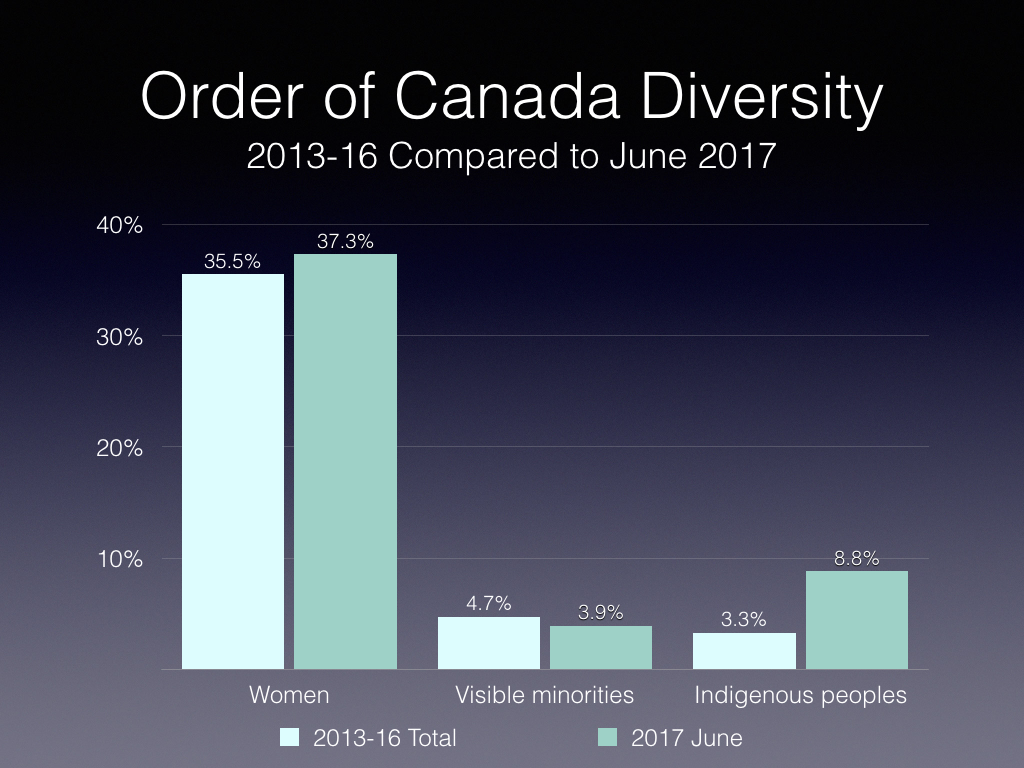
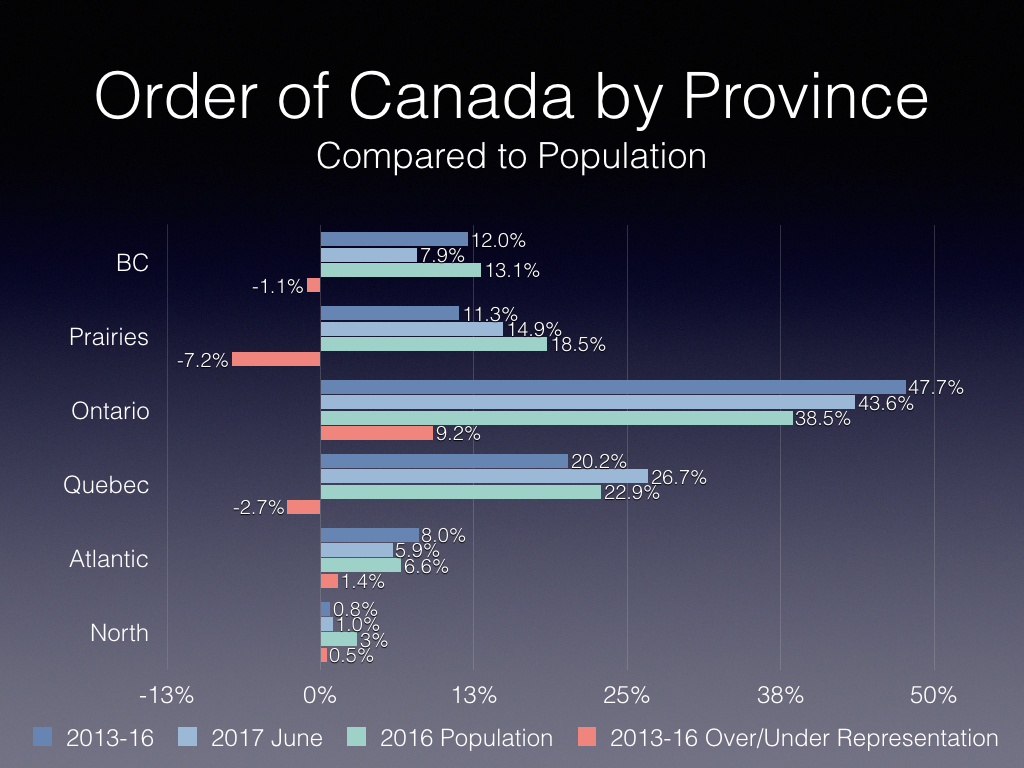
Two charts contrasting the 2013-16 baseline with the latest appointments, which should start reflecting some of the changes and additional funding announced in Budget 2015 to improve under-represented sectors, understood as Western Canadian and business-related appointments (see my earlier article in Policy Options The Order of Canada and diversity).

Given that these are only part-year appointments, full-year numbers may or may not confirm these apparent changes in diversity and provincial representation:

The Order of Canada marks its 50th anniversary this year with 99 new appointments on its Canada Day honours list, including renowned figures from the fields of law, government, entertainment and sport, as well as Canadians whose contributions are less widely known.

The list includes soccer star Christine Sinclair, television host Alex Trebek, actor Catherine O’Hara and Globe and Mail editorial cartoonist Brian Gable.

Three people were named to the highest rank, Companion of the Order of Canada: former Supreme Court Justice Marshall Rothstein, National Arts Centre president Peter Herrndorf and The Prince of Wales.

Nineeteen people were named Officers of the Order of Canada, including former spymaster Richard Fadden, hockey player Mark Messier and actor Michael Myers. There were 77 people named as members of the Order, including opera singer Tracy Dahl, historian Bill Waiser, public health nurse Cathy Crowe and Indigenous leader Terrance Paul.

The Order of Canada is considered one of the country’s highest civilian honours. It was created in the centennial year of 1967 to recognize outstanding achievement and service to the community. More than 6,700 people have been named to the Order in its 50 years.

Source: Order of Canada marks 50 years of honouring Canadian contributions – The Globe and Mail

Godwin’s Law: What the Creator Thinks of Hitler Comparisons | Time.com

Excerpt from an interview with Mike Godwin, the inventor of Godwin’s law (invoking Hitler means losing an argument):

It’s obvious you have a pulse on social media where the Hitler comparisons you predicted are rampant. You can’t just chalk that up to Trump right?
As far as I know, every President who has been President from the time I got on the internet has been compared by someone to Hitler. People compared President Obama to Hitler. People have forgotten there were pictures of Obama with a Hitler moustache. That talk was crazy.

I’m not going to tell people whether to compare Obama or Trump to Hitler. It’s the government of the United States, and that’s very hard to destroy with a cult of personality because we have a lot of institutional inertia by design.

Would you say Trump’s impact makes the comparisons to fascism online more frequent?
I think so. There’s always been a general upward trend, peaking at election times. I think President Trump’s campaign was so populist and so outside the political establishment that it inspired people to reach for the comparisons because we’ve never had a President like this come in as a media personality outsider.

Isn’t it lazy to go there?
Of course it is. If you want to say something more powerful than the last person who disagreed with you said, people volunteer the rhetorical comparisons because they haven’t thought hard about history and what’s different between now and Germany in the 1930s or Cambodia in the 1970s.

When do you believe it’s a fair shake?
I urge people to develop enough perspective to do it thoughtfully. If you think the comparison is valid, and you’ve given it some thought, do it. All I ask you to do is think about the human beings capable of acting very badly. We have to keep the magnitude of those events in mind, and not be glib. Our society needs to be more humane, more civilized and to grow up.

Any idea how to stop the glib references?
A lot of education reform. If I ran the world, I would strengthen both history and scientific education in the United States. If we fostered more self-criticism and self-skepticism, I think that would do much to prevent rhetorical meanness and mean spiritedness on the internet, of which Hitler comparisons are only a tiny part.

We are in mid-adolescence culturally. When you reach adolescence, you’re not fully socialized. If we’re more self-aware, we can use social media with newfound growth and muscles.

Source: Godwin’s Law: What the Creator Thinks of Hitler Comparisons | Time.com

Delete Hate Speech or Pay Up, Germany Tells Social Media Companies – The New York Times

Will be interesting to see the degree to which this works in making social media companies take more effective action, as well as the means that companies take to ‘police’ speech (see earlier post Facebook’s secret rules mean that it’s ok to be anti-Islam, but not anti-gay | Ars Technica). Apart from the debate over what can/should be any limits to free speech, there are risks in “outsourcing” this function to the private sector:

Social media companies operating in Germany face fines of as much as $57 million if they do not delete illegal, racist or slanderous comments and posts within 24 hours under a law passed on Friday.

The law reinforces Germany’s position as one of the most aggressive countries in the Western world at forcing companies like Facebook, Google and Twitter to crack down on hate speech and other extremist messaging on their digital platforms.

But the new rules have also raised questions about freedom of expression. Digital and human rights groups, as well as the companies themselves, opposed the law on the grounds that it placed limits on individuals’ right to free expression. Critics also said the legislation shifted the burden of responsibility to the providers from the courts, leading to last-minute changes in its wording.

Technology companies and free speech advocates argue that there is a fine line between policy makers’ views on hate speech and what is considered legitimate freedom of expression, and social networks say they do not want to be forced to censor those who use their services. Silicon Valley companies also deny that they are failing to meet countries’ demands to remove suspected hate speech online.

Still, German authorities pressed ahead with the legislation. Germany witnessed an increase in racist comments and anti-immigrant language after the arrival of more than a million migrants, predominantly from Muslim countries, since 2015, and Heiko Maas, the justice minister who drew up the draft legislation, said on Friday that it ensured that rules that currently apply offline would be equally enforceable in the digital sphere.

“With this law, we put an end to the verbal law of the jungle on the internet and protect the freedom of expression for all,” Mr. Maas said. “We are ensuring that everyone can express their opinion freely, without being insulted or threatened.”

“That is not a limitation, but a prerequisite for freedom of expression,” he continued.

The law will take effect in October, less than a month after nationwide elections, and will apply to social media sites with more than two million users in Germany.

It will require companies including Facebook, Twitter and Google, which owns YouTube, to remove any content that is illegal in Germany — such as Nazi symbols or Holocaust denial — within 24 hours of it being brought to their attention.

The law allows for up to seven days for the companies to decide on content that has been flagged as offensive, but that may not be clearly defamatory or inciting violence. Companies that persistently fail to address complaints by taking too long to delete illegal content face fines that start at 5 million euros, or $5.7 million, and could rise to as much as €50 million.

Every six months, companies will have to publicly report the number of complaints they have received and how they have handled them.

In Germany, which has some of the most stringent anti-hate speech laws in the Western world, a study published this year found that Facebook and Twitter had failed to meet a national target of removing 70 percent of online hate speech within 24 hours of being alerted to its presence.

The report noted that while the two companies eventually erased almost all of the illegal hate speech, Facebook managed to remove only 39 percent within 24 hours, as demanded by the German authorities. Twitter met that deadline in 1 percent of instances. YouTube fared significantly better, removing 90 percent of flagged content within a day of being notified.

Facebook said on Friday that the company shared the German government’s goal of fighting hate speech and had “been working hard” to resolve the issue of illegal content. The company announced in May that it would nearly double, to 7,500, the number of employees worldwide devoted to clearing its site of flagged postings. It was also trying to improve the processes by which users could report problems, a spokesman said.

Twitter declined to comment, while Google did not immediately respond to a request for comment.

The standoff between tech companies and politicians is most acute in Europe, where freedom of expression rights are less comprehensive than in the United States, and where policy makers have often bristled at Silicon Valley’s dominance of people’s digital lives.

But advocacy groups in Europe have raised concerns over the new German law.

Mirko Hohmann and Alexander Pirant of the Global Public Policy Institute in Berlin criticized the legislation as “misguided” for placing too much responsibility for deciding what constitutes unlawful content in the hands of social media providers.

“Setting the rules of the digital public square, including the identification of what is lawful and what is not, should not be left to private companies,” they wrote.

Even in the United States, Facebook and Google also have taken steps to limit the spread of extremist messaging online, and to prevent “fake news” from circulating. That includes using artificial intelligence to remove potentially extremist material automatically and banning news sites believed to spread fake or misleading reports from making money through the companies’ digital advertising platforms.

The case for keeping ‘Langevin Block’ – Peter Shawn Taylor, Begbie’s Statue – Bill McKee

I agree with Taylor on the risks of ignoring the historical context and focusing only on one aspect of their role in Canadian society. Those who forget (or erase) history, are condemned to repeat it, albeit with twists. McKee’s point on interpretative panels is a better way:

Taken on its own, Langevin’s quotation is a devastating indictment to modern ears. But what if we let the tape roll a bit longer? Later in that same speech, for example, Langevin said it was his intention to give every native child who graduates from residential school a free homestead. And in response to Langevin, Edward Blake, the leader of the Liberal party of the day, not only used words to describe Indigenous men and women that would be considered horrific today, he also complained that Ottawa’s plan was overly generous. The Liberal party of the day wanted to spend far less on the native file.

Extreme narrow focus on a few sentences of one speech may provide damning evidence of Langevin’s unfitness for present-day memorialization. But in the context of his time, Langevin actually stands among the more enlightened representatives of the federal government. As for the accusation that Langevin believed in assimilation of the Indigenous community—a concept now properly and universally considered abhorrent—he is guilty as charged.

But assimilation was conventional wisdom among all elite thinkers of his era. If statements in support of it are to be considered sufficient reason for removal from the historical record, then every politician of note in Canada prior to the 21st century must eventually be struck from the record—from Macdonald to Sir Wilfrid Laurier on down. Even Pierre Trudeau, often considered the father of an inclusive, multicultural Canada, was a confirmed assimilationist. His 1969 White Paper on “Indian Policy” planned to eliminate Indigenous status entirely. When such a plan was firmly rejected by the Indigenous community, Trudeau replied bitterly, “We’ll keep them in the ghetto for as long as they want.” Is the legacy of Trudeau senior next on the list for erasure?

And entirely ignored within the current debate over Langevin and the residential school issue is his stature as a key Francophone Quebec federalist during the crucial pre-Confederation era, which was the reason his name ended up on a federal building in the first place. Reconciliation between French and English was once considered a great Canadian virtue. It should still count for something today.

As for Cornwallis, in 1749 he did declare a bounty of 10 British guineas for every Mi’kmaq scalp delivered to him during a colonial-era conflict known as Father Le Loutre’s War. Like Langevin’s speech on residential schools, singular attention on this one act seems sufficient to declare him unfit for present-day consumption. By any standard, scalping is an horrific act. But once again history throws up some uncomfortable facts.

Father Le Loutre’s War (1749 to 1755) was the handiwork of French Catholic priest Jean-Louis Le Loutre, who goaded local Mi’kmaq tribes into conflict with the British in hopes of reclaiming New Brunswick and Nova Scotia for the French. For added motivation, he explicitly promised to pay Mi’kmaq warriors a bounty for English scalps. And they delivered. In 1753, for example, Le Loutre was reimbursed 1,800 French livres by the colonial government in Quebec City for sums he paid to the Mi’kmaq for 18 English scalps.

The payment of scalp bounties was unsettlingly common throughout North America during the entire colonial period. It was, in fact, standing French policy to offer payments for the scalps of the English—men, women and children—as a subsidy to ensure the continued loyalty of allied Indigenous tribes. Scalp bounties in the English-speaking colonies generally only appeared when a war was on; and their value waned and fluxed depending on the public’s panic level. It thus seems unfair to use Cornwallis’s scalping proclamation as conclusive evidence against him when both sides in this ancient conflict, including those Mi’kmaq nations who today demand Cornwallis’s expulsion from the public square, were fully engaged in the repulsive tactic.

And while Amherst is widely considered to be the father of modern germ warfare for allegedly handing out smallpox-infected blankets to Indigenous foes, this is a falsehood. There is no proof he ever did such a thing. Amherst responded positively to the suggestion from a fellow officer in a letter dated July 16, 1763, but this came a month after the one and only time British troops actually stooped to such a tactic—during a native siege of Fort Pitt (near present-day Pittsburgh) on June 24, 1763.

Finally, Begbie was indeed responsible for sentencing six Indigenous leaders to hanging for their role in the killing of 20 non-natives during B.C.’s Chilcotin War. Yet condemning him into oblivion on this basis ignores his vast record of support and understanding for the province’s Indigenous communities at all other times. He was fluent in several Indigenous languages, recognized the concept of Aboriginal title in his rulings and took a strong position against racism. Begbie was perhaps the most liberal and native-friendly judge of his time. As for his controversial hanging decision, which the B.C. government recently apologized for, he had no choice. The death penalty was mandatory for murder cases. Despite all this, his own law society has removed him from the firmament.

To our great disadvantage, Canada has become obsessed with replaying a slow-motion, high-definition version of our past. Historical figures are now judged by intense focus on individual statements or actions. One ‘infraction’ at odds with current acceptable standards has become sufficient evidence for expulsion from present-day society. Yet it is reasonable, if not inevitable, to expect that every notable figure from the past has probably said or done something that will grate against modern sensibilities, particularly with respect to Indigenous relations. It is therefore only a matter of time before every statue, park and street named for an historical character in Canada is declared incompatible with the present.

But while the fraught relationship between colonial Canada and Indigenous peoples is an important component of our history, it is not its entirety. We should not allow current attention being paid to the Truth and Reconciliation Commission’s findings, necessary and disturbing as they may be, to become a mechanism that strips Canada of our most significant characters and events. Or removes the context and detail from the stories of who we are and where we came from.

Source: The case for keeping ‘Langevin Block’ – Macleans.ca

Bill McKee, the former curator of B.C. history at the Museum of Canadian History in Ottawa makes a sensible suggestion on how to keep historical names and statues while acknowledging the less savoury aspects of their legacy:

Removing his [Begbie’s] statue will accomplish nothing of general benefit. It would help to hide this sad part of our history. In its absence, no one will remember or learn a lesson to understand the native side of the Chilcotin War, and the complex story behind the execution of the chiefs.

I would suggest, rather than removing this important statue, a more useful step would be to provide interpretive panels explaining all parts of the life of Matthew Baillie Begbie, around the statue, similar to an interpretive exhibition in Vancouver’s Chinatown, just east of Carrell Street. The exhibition could highlight his impact upon our history, and focus on his impact upon First Nations, not as an aside, but a central part of our history.

Another important way to recognize the cost of the arrival of the British and Canadian fur traders, the participants in the several gold rushes and of the British colonial society upon our First Nations would be to erect another large statue recognizing the story of the Chilcotin War and the resulting executions of indigenous leaders. The funding could come from the public, as well as the City of New Westminster and the governments of B.C. and Canada. It could be located on the site of the former cemetery next to the new high school or near the courthouse, where the remains of the chiefs were possibly buried. I would think the site near the high school would be a chance to highlight the story of our First Nations to young people in New Westminster.

I also want to point out that the statue of Sir Matthew Baillie Begbie was created by Elek Imredy, a refugee who came to Canada from Hungary, after the Soviet suppression of the Hungarian revolution. Many people will recognize his “Girl in a Wetsuit” statue off of Stanley Park, at the entrance to Burrard Inlet, which was created at the request of the City of Vancouver. These statues are a reflection of the contributions of the many immigrants and refugees who have contributed to our history.

Please don’t remove the statue of Matthew Baillie Begbie.

Source: Opinion: Removing statue of Judge Begbie benefits no one

Happy Canada Day: Inside Ken Dryden’s hockey rink citizenship ceremony 

To mark Canada Day, former hockey icon, writer and politician Ken Dryden remarks to new citizens of note:

I wasn’t sure but I thought I had heard that someone who has received an Order of Canada is able to preside at a citizenship ceremony. I emailed the citizenship office, and asked them, and told them about Jacques. About a month later, the office confirmed a date and a place.

The ceremony was held June 26 at the Senators’ home arena. Our daughter, continuing her work with refugees, was in Botswana with her family. Until the moment I was introduced by the Clerk of the Ceremony, Jacques and his family had no idea I would be there, in part, representing Sarah. And at that moment, my wife Lynda, who had been watching Jacques, snapped a picture of him with his mouth open.

It being Canada’s 150th birthday, 150 people received their citizenship that day. As the presiding official, I spoke briefly to them and to their families. This is what I said:

“I am very happy to be here. Happy to be here with some people I know—Jacques and Sarah, Daniela, Ivan, Naomi, Steve, and Pamela, the Bwira family, whom I met first in Uganda 14 years ago through our daughter. And happy to be here with all of you, to be part of, and to share with you, this special Canada-moment.

You are quite a sight.

You are from 49 countries. 49. Almost one quarter of all the nations on Earth! Here. Together. All of us Canadians.

Citizenship ceremony, presided over by Ken Dryden, at the Canadian Tire Centre in Ottawa June 26, 2017. 150 new Canadians were celebrated. Photograph by Blair Gable

I grew up in a very different Canada. In Etobicoke, a suburb of Toronto, and the kids I went to school with, their families had come to Canada usually many generations before, and almost all of them from Europe. Mine had come from Scotland, in 1834. Then as I got older, about 20 years ago, I went back to high school for a year to write a book about education. The school was just west of Etobicoke, in Mississauga, and by this time—1995—the classrooms were like this arena—filled with people from everywhere.

One of the big questions for me in writing the book was: how could a school like this work? All the different languages, the different cultures, in many cases students whose ancestors had fought one another, sometimes for centuries. Now all in one place, inside the same four walls. In the lunch room, you could see the divisions—the students sitting in clusters, the Chinese kids here, the Jamaican kids there, the Sri Lankan kids and others somewhere else—all of them separate and apart. But in classrooms, they had to sit next to each other—not quite comfortably at first, but then not thinking about it, then just doing it, then, often without realizing it, getting to know each other a little, then, over time, even learning from each other. It was remarkable to watch and see.

Other countries have people from lots of places too—like you, I’ve been to many of those countries—but they have more divisions. More tensions. Why is it different here? Maybe because our history is shorter, maybe because we have so much space and didn’t have to live on top of each other. Maybe because we’ve always had to live with division—our many different Indigenous peoples, later our French and English settlers—we had to learn to be tolerant, accepting, patient, to “live and let live.” But maybe too because as Canadians we have never seen Canada as something already fully formed, something that long-standing Canadians created, that new Canadians could only adapt to. Where some people feel fully Canadian, and others don’t. Instead, we’ve always been willing to put Canada on the table in front of all of us, for all of us to share, so that Canada can be, and is, our focus, not what our life was and used to be.

To me, this isn’t a multicultural society we are creating in Canada. It’s a “multiculture,” something that all of us are building, and building every day. That is different all the time. A place that changes us, but that we—all of us, old and new Canadians—change too. A place, and a future, we can all feel a part of.

And something else too—it’s our message to ourselves as Canadians and to each other, an understanding we share—that in Canada, we get along. That seems pretty simple, but it’s crucial in an increasingly global world. We get along here. We ask this of each other. We expect it. And need for it to be. This understanding and way of life is now part of your legacy, your new life, your obligation to the future.

I know that as you sit here you are grateful to Canada for opening its doors to you. For giving you this gift. I know too, you are proud to be Canadian. But you also need to know that we are grateful to you. I just got back from Kazakhstan, Tajikistan and Kyrgyzstan—countries of the old Silk Road—that connected China and Mongolia through Central Asia, to the Middle East, to the Mediterranean—and eventually to North and South America. It was not just a connection of silk and other goods, but when goods move, people move, learning moves, technologies move, philosophies and religions move, ideas and cultures move. We are grateful to you because when you came here from your original home countries, you brought with you your cultures, your ideas, your learnings. You are helping to make Canada a modern Silk Road country. You are helping to make Canada a more compelling, dynamic, creative, and interesting place. And this act of creation, this is what all of us—new and old Canadians—are doing together. So that whatever Canada has been in the past, we will be so much more in the future. And what that Canada will be, what we, all of us, will be in that future, I have no idea. And that is the best part.

So congratulations! Good luck to all of you. Good luck to all of us.”

After my talk, I asked these soon-to-be Canadians to take the Oath of Citizenship, reading out one line at a time for them to repeat, giving the entire oath in English, then in French. Most of the 150 said the oath in both languages. Then these new Canadians came up on stage to receive their certificates, one by one, families coming together.

One hundred and fifty of them: 17 from the Philippines, 11 (including the Bwiras) from Congo, 10 from Haiti and the U.S., eight from Colombia and the U.K., six from Morocco and Pakistan, five from Senegal and Sri Lanka, four from China and India. There were 125 adults and 25 children, 78 males, 72 females, 102 primarily English-speakers, 48 French. Two men came up a ramp in wheelchairs, one wore a wide, bright, red-and-white Canada tie. Another man wore a Sydney 2000 Olympics tie. His son, Simon Whitfield, had won a gold medal in the triathlon and was Canada’s flag-bearer in the closing ceremonies. Originally from Australia, the father wanted to share his Canada-moment with his son. The oldest recipient was 75, the two youngest were four. There were 23 families, of two or more; three families of five. The Bwiras, with six, were the largest family present. Almost everyone came up those stairs with a smile and a look of pride. Almost everyone was dressed up in their best, whatever their best was. Each arrived at that moment in that place with their own special story, just like the Bwiras.

Photograph by Blair Gable

The formal part of the ceremony was over. Now it was time to get informal. This was a day of solemnity, and celebration. I said to these 150 new Canadians:

“As you know, this is a hockey arena, the home of the Ottawa Senators. And in this new home of yours, Canada, there is a tradition, that when a team wins a championship, they all gather together on the ice for a team photo. Well, today, in receiving your Canadian citizenship, I think you’ve all won the championship. So let’s everybody come up here near the stage for your team picture—Team Citizenship Canada 2017.

They jammed into the open space between the stage and the seats, the kids at the front, others stood in the rows behind them. And because this was a championship photo, some of the kids lay on their sides on the concrete floor and others kneeled around them, their “We’re Number 1” fingers raised, waving small Canadian flags.

It was time to close the ceremony. I went back up on the stage, everyone was still standing, and said, “I began this morning by saying you are an amazing sight. Why don’t you all take a moment—all of you—and look around, take your time, look at each other, look at this amazing sight you have created. And never forget what you see.”

Our 150th birthday offers Canadians a chance to pause, to see where we were and where we are, and imagine what we might be. A new immigrant’s eyes are even more acute. Immigrants have lived somewhere else, they are here each for their own very good reasons, they see Canada with fresh, deep clarity. For them, receiving their citizenship represents a great new beginning. They are here, finally. They have found solid ground. They are able, now, step by step, to build a future that is absolutely possible, for themselves, for their children, for generations of their families ahead. For me, it was a chance to see Canada, Canada at 150, through their eyes.

Source: Inside Ken Dryden’s hockey rink citizenship ceremony – Macleans.ca


Facebook’s secret rules mean that it’s ok to be anti-Islam, but not anti-gay | Ars Technica

For all those interested in free speech and hate speech issues, a really good analysis of how Facebook is grappling with the issue and its definitions of protected groups. Urge all readers to go through the slide show (need to go to the article to access) which capture some of the complexities involved:

In the wake of a terrorist attack in London earlier this month, a US congressman wrote a Facebook post in which he called for the slaughter of “radicalized” Muslims. “Hunt them, identify them, and kill them,” declared US Rep. Clay Higgins, a Louisiana Republican. “Kill them all. For the sake of all that is good and righteous. Kill them all.”

Higgins’ plea for violent revenge went untouched by Facebook workers who scour the social network deleting offensive speech.

But a May posting on Facebook by Boston poet and Black Lives Matter activist Didi Delgado drew a different response.

“All white people are racist. Start from this reference point, or you’ve already failed,” Delgado wrote. The post was removed, and her Facebook account was disabled for seven days.

A trove of internal documents reviewed by ProPublica sheds new light on the secret guidelines that Facebook’s censors use to distinguish between hate speech and legitimate political expression. The documents reveal the rationale behind seemingly inconsistent decisions. For instance, Higgins’ incitement to violence passed muster because it targeted a specific sub-group of Muslims—those that are “radicalized”—while Delgado’s post was deleted for attacking whites in general.

Over the past decade, the company has developed hundreds of rules, drawing elaborate distinctions between what should and shouldn’t be allowed in an effort to make the site a safe place for its nearly 2 billion users. The issue of how Facebook monitors this content has become increasingly prominent in recent months, with the rise of “fake news”—fabricated stories that circulated on Facebook like “Pope Francis Shocks the World, Endorses Donald Trump For President, Releases Statement“—and growing concern that terrorists are using social media for recruitment.

While Facebook was credited during the 2010-2011 “Arab Spring” with facilitating uprisings against authoritarian regimes, the documents suggest that, at least in some instances, the company’s hate-speech rules tend to favor elites and governments over grassroots activists and racial minorities. In so doing, they serve the business interests of the global company, which relies on national governments not to block its service to their citizens.

One Facebook rule, which is cited in the documents but that the company said is no longer in effect, banned posts that praise the use of “violence to resist occupation of an internationally recognized state.” The company’s workforce of human censors, known as content reviewers, has deleted posts by activists and journalists in disputed territories such as Palestine, Kashmir, Crimea, and Western Sahara.

One document trains content reviewers on how to apply the company’s global hate speech algorithm. The slide identifies three groups: female drivers, black children, and white men. It asks: which group is protected from hate speech? The correct answer: white men.

The reason is that Facebook deletes curses, slurs, calls for violence, and several other types of attacks only when they are directed at “protected categories”—based on race, sex, gender identity, religious affiliation, national origin, ethnicity, sexual orientation, and serious disability/disease. It gives users broader latitude when they write about “subsets” of protected categories. White men are considered a group because both traits are protected, while female drivers and black children, like radicalized Muslims, are subsets, because one of their characteristics is not protected. (The exact rules are in the slide show below.)

Facebook has used these rules to train its “content reviewers” to decide whether to delete or allow posts. Facebook says the exact wording of its rules may have changed slightly in more recent versions. ProPublica recreated the slides.

Behind this seemingly arcane distinction lies a broader philosophy. Unlike American law, which permits preferences such as affirmative action for racial minorities and women for the sake of diversity or redressing discrimination, Facebook’s algorithm is designed to defend all races and genders equally.

But Facebook says its goal is different—to apply consistent standards worldwide. “The policies do not always lead to perfect outcomes,” said Monika Bickert, head of global policy management at Facebook. “That is the reality of having policies that apply to a global community where people around the world are going to have very different ideas about what is OK to share.”

Facebook’s rules constitute a legal world of their own. They stand in sharp contrast to the United States’ First Amendment protections of free speech, which courts have interpreted to allow exactly the sort of speech and writing censored by the company’s hate speech algorithm. But they also differ—for example, in permitting postings that deny the Holocaust—from more restrictive European standards.

The company has long had programs to remove obviously offensive material like child pornography from its stream of images and commentary. Recent articles in the Guardian and Süddeutsche Zeitung have detailed the difficult choices that Facebook faces regarding whether to delete posts containing graphic violence, child abuse, revenge porn and self-mutilation.

The challenge of policing political expression is even more complex. The documents reviewed by ProPublica indicate, for example, that Donald Trump’s posts about his campaign proposal to ban Muslim immigration to the United States violated the company’s written policies against “calls for exclusion” of a protected group. As The Wall Street Journal reported last year, Facebook exempted Trump’s statements from its policies at the order of Mark Zuckerberg, the company’s founder and chief executive.

The company recently pledged to nearly double its army of censors to 7,500, up from 4,500, in response to criticism of a video posting of a murder. Their work amounts to what may well be the most far-reaching global censorship operation in history. It is also the least accountable: Facebook does not publish the rules it uses to determine what content to allow and what to delete.

Users whose posts are removed are not usually told what rule they have broken, and they cannot generally appeal Facebook’s decision. Appeals are currently only available to people whose profile, group, or page is removed.

The company has begun exploring adding an appeals process for people who have individual pieces of content deleted, according to Bickert. “I’ll be the first to say that we’re not perfect every time,” she said.

Facebook is not required by US law to censor content. A 1996 federal law gave most tech companies, including Facebook, legal immunity for the content users post on their services. The law, section 230 of the Telecommunications Act, was passed after Prodigy was sued and held liable for defamation for a post written by a user on a computer message board.

The law freed up online publishers to host online forums without having to legally vet each piece of content before posting it, the way that a news outlet would evaluate an article before publishing it. But early tech companies soon realized that they still needed to supervise their chat rooms to prevent bullying and abuse that could drive away users.

Source: Facebook’s secret rules mean that it’s ok to be anti-Islam, but not anti-gay | Ars Technica

Report: More Than Half of Hate Crimes in U.S. Go Unreported | Time.com

Canada likely has a comparable degree of under-reporting. Interesting that this analysis does not cover religiously-motivated hate crimes:

The majority of hate crimes experienced by U.S. residents over a 12-year period were not reported to police, according to a new federal report released Thursday that stoked advocates’ concerns about ongoing tensions between law enforcement and black and Latino communities.

More than half of the 250,000 hate crimes that took place each year between 2004 and 2015 went unreported to law enforcement for a variety of reasons, according to a special report on hate crimes from the Bureau of Justice Statistics. Hate crimes were most often not reported because they were handled some other way, the report said. But people also did not come forward because they didn’t feel it was important or that police would help.

The report, based on a survey of households, is one of several studies that aim to quantify hate crimes. Its release comes as the Justice Department convenes a meeting on Thursday with local law enforcement officials and experts to discuss hate crimes, including a lack of solid data on the problem nationwide. Attorney General Jeff Sessions is scheduled to speak.

The new survey shows the limits of hate crime reporting, said Brian Levin, the director of the Center for the Study of Hate and Extremism, California State University.

“Many victims don’t report hate crimes because of personal and institutional reasons,” Levin said. For example, some Latino immigrants may be reluctant to call police after an apparent hate crime for fear of deportation, he said.

Advocates fear that problem is worsening as the Trump administration ramps up immigration enforcement.

The report says Hispanics were victimized at the highest rate, followed by blacks.

“I think this report shows the kind of fear that is going on in our communities,” said Patricia Montes, executive director of the Boston-based immigrant advocacy group Centro Presente. She worries Latinos will even be more reluctant to report hate crimes in the future.

The new report said there was no significant increase in the number of hate crimes between 2004 and 2015. It cites racial bias as the top motivation, representing more than 48 percent of the cases between 2011 and 2015. Hate crimes motivated by ethnicity accounted for about 35 percent of those cases, and sexual orientation represented about 22 percent. Almost all of those surveyed said they felt they were experiencing a hate crime because of something the perpetrator said.

Law enforcement officials have long grappled with how to catalog hate crimes. While some victims’ distrust of police keeps them from coming forward, Levin said, some LGBT victims may opt not to report a hate crime for fear of losing a job or being outed to family.

Levin said many large cities are claiming they had no hate crimes — calling into question the reliability of federal hate crimes data that are based on voluntary submissions from police departments. “We have Columbus, Ohio, reporting more hate crimes than the state of Florida,” he said.

Eric Treene, the Justice Department’s special counsel for religious discrimination, lamented the lack of solid data on hate crimes during a Senate Judiciary Committee hearing in May, saying incomplete numbers stymie officials’ ability to fully understand the problem.

But he said the department is committed to prosecuting hate crimes, even as critics have blamed the Trump administration’s tough rhetoric and policies for a spike in such offenses. Civil rights groups said investigating and prosecuting hate crimes alone would be insufficient.

Source: Report: More Than Half of Hate Crimes in U.S. Go Unreported | Time.com

New Zealand gave Peter Thiel citizenship after he spent just 12 days there | The Guardian

Pretty scandalous on many accounts. Revocation on grounds of fraud or misrepresentation?

Peter Thiel, the billionaire co-founder of Paypal, was granted New Zealandcitizenship despite spending only 12 days in the country, new documents have revealed.

The government ombudsmen has forced New Zealand authorities to release further details of Thiel’s highly unusual citizenship process because it was deemed in the public interest.

On Thursday, Nathan Guy – who oversaw Thiel’s citizenship application as minister of internal affairs in 2011 – said Theil had been “a great ambassador for New Zealand, a great salesperson”. “He is a fine individual, good character, he has invested a lot in New Zealand, he’s got great reach into the US and I am very comfortable with the decision that I made.”

The billionaire entrepreneur who is a close adviser to Donald Trump, was granted New Zealand citizenship in June 2011, after taking four brief trips to the country. He made it clear he had no immediate plans to settle in the country.

The usual route to citizenship requires applicants to be in New Zealand as a permanent resident for at least 1,350 days in the five years preceding an application.

The New Zealand government granted Thiel citizenship due to his “exceptional circumstances”, and because it was understood he would promote New Zealand on the global stage, and provide introductions and contacts for New Zealand start-ups in Silicon Valley.

Official information documents stated Thiel’s “exceptional circumstances” related to “his skills as an entrepreneur and his philanthropy”, which were deemed to be of potential benefit to New Zealanders and the country. The formal citizenship process took place in a private ceremony in Santa Monica in 2011.

In his application for citizenship Thiel stated that although he had no plans to reside in New Zealand, and did not work for a New Zealand business overseas, he intended to “represent the country on the international stage”. He also donated NZ$1m to the Christchurch earthquake relief fund, and bought prime land and luxury homes in New Zealand.

Despite this intention Thiel never appeared to mention his New Zealand citizenship in any public capacity – it was revealed by New Zealand media this year.

Labour’s immigration spokesman Iain Lees-Galloway told Radio NZ that Thiel was not promoting New Zealand internationally as he’d stated in his application, as no one knew about his citizenship or ties to New Zealand for six years.

“If Peter Thiel was an amazing ambassador and salesperson for New Zealand we would have found out he was a citizen of New Zealand because he would have told the world that he was a citizen of New Zealand,” Lees-Galloway said. “He kept it under wraps. He hasn’t gone around telling the world that he’s a citizen of New Zealand and that he’s proud of New Zealand.”

Source: New Zealand gave Peter Thiel citizenship after he spent just 12 days there | World news | The Guardian