Why Women Are Using Birthing Hotels In Canada: Lyndsie Bourgon

Good long and informative read on birth tourism in Canada. Quotes from immigration lawyer and myself among others.

The previous Conservative government pressed unsuccessfully to find ways to end the practise but failed given the small percentage of total births – an estimated 500 out of 360,000 in 2013 – and provincial opposition given the additional costs involved were – see my earlier What happened to Kenney’s cracking down on birth tourism? Feds couldn’t do it alone | hilltimes.com:

Birth tourism is legal, and despite common misconceptions, simply being a parent of a child born here is not enough to land a permanent resident visa for a prolonged length of time. Women here on visitor visas must go home with their children and apply to come back later, usually when their children are adults and can sponsor them. In the majority of cases, a Canadian passport is less a backdoor entrance into a Canada than an insurance policy for parents hoping to give their children better options.

But birthing hotels are unregulated and can go untracked. In some cities, the number of maternal hospital beds being taken up by non-residents is increasing, and, in some cases, they have become a flashpoint for people’s insecurity and xenophobia — especially urban areas such as Vancouver and Richmond, where a long history of racial tensions still simmers, and skyrocketing home prices (blamed in part on foreign investment) have some residents on edge. Here are the basics:

Why is birth tourism popular here? 

Canada is one of the few developed countries, along with the United States, that grants birthright citizenship. When a baby is born here, he or she receives a birth certificate and can apply for a Canadian passport right away. With that comes the benefits of potentially living in Canada one day: access to our education system and public healthcare, for instance. It also can provide benefits in the parent’s home country: In China, for example, a child with a foreign passport can gain access to international schools, which are often more affordable than private schools, with a high standard of education.

If China has become the main source of birth tourism to the West Coast, it’s because of the country’s volatility, explains Will Tao, an immigration lawyer at Vancouver’s Larlee Rosenberg. “Everything is tied up with government. Many people have been able to ride the wealth of China, but they realize the foundation isn’t that strong. There is this idea that at any moment, things can turn for them, and what will happen to those things they worked towards?” Canada, then, becomes a stable “Plan B,” Tao says.

How common are they?

Maternity hotels dot Canada’s major cities and, in some areas, are growing in number: In July 2016, health ministry investigators in B.C. counted 26 in the province—a threefold increase since 2009. While no such data has been made public for Ontariob Sunnybrook hospital in Toronto also reported an increase in foreign births in 2015, receiving women from China, Nigeria, Saudi Arabia and the United Arab Emirates. In 2013, Montreal authorities said women from Haiti and French-speaking northern African countries “frequently” arrived to give birth in Canada.

Between March 2015 and March 2016, 295 of the 1,938babies delivered at Richmond Hospital were to Chinese visitors. Public records released in July stated that the cost of non-resident births to the province of B.C. in 2014 and 2015 was $693,869. (Visitors to Canada do pay the hospital a fee for a baby to be born here. Melody, for example, paid around $10,000, which is a standard amount, for a standard birth procedure. “I think it is a really good deal,” she said). Some Richmond families have complained about being bumped to other facilities when they’ve shown up at the local hospital in labour and are told the facility is at capacity.

How are the hotels booked, and what are they like? 

Finding a birthing or maternity hotel is similar to finding Airbnb accommodation. (The vast majority of birthing hotels in Vancouver are marketed to Chinese women on a Craigslist-style website called Vansky.com.) Private homeowners can provide rooms at a nightly rate, which range from swanky high-end options to basic rooms with a single bed (Melody paid just under $30 per night, a bill of $4,000 overall). Booked for months at a time, the rooms are most often home to women who travel here from abroad when they are around five months pregnant—while they’re still able to fly and, often, before they are obviously showing—to give birth in Canadian hospitals. The hotel owner provides meals, as well as a myriad of other services like translation, transportation and booking appointments with family doctors.

“I wasn’t scared at the time,” Melody says. “But now I’ve realized that it was a scary experience without your parents or family around. Because it was my first child, I didn’t have much knowledge.”

What are the tensions around them?

In some cases, maternity hotels have raised the ire of their neighbours and concern from the health services community. This happened in Richmond, B.C. — a suburb where, according to the 2011 census, 49 percent of the population are Chinese Canadians.

In 2015, long-time Richmond resident Kerry Starchuk discovered the large pink stucco house next door to hers was housing pregnant women from China. From her house, she watched food being delivered and vehicles picking up and dropping off pregnant women. In her mind, it marked one more way her community was changing. (In 2014, noting there were signs in her community written only in Chinese, she lobbied the city’s council to make it mandatory that have all signs include English or French).

She started a petition (e-397), calling on the federal government to eliminate birthright citizenship, and Conservative Richmond Centre MP Alice Wong co-signed the document, which argues that, “the practice of birth tourism can be very costly to taxpayers,” and “take[s] advantage of Canada’s public health system and social security programs.”

Between July and October of that year, Starchuk’s petition gathered 8,568 signatures from across Canada, enough for Wong to take it to the House of Commons (the benchmark for this is 500 signatures). “Richmond Hospital, in the last fiscal year, reported nearly one-in-six births were to non-residents,” Wong wrote in a statement. “This has led to capacity issues.” The petition was presented in Parliament in October for review, and tabled in December with a response from Minister of Immigration, Refugees and Citizenship John McCallum. “While there may be instances of expectant mothers who are foreign nationals who travel to Canada to give birth,” McCallum wrote, abolishing birthright citizenship “would represent a significant change to how Canadian citizenship is acquired.”

What’s the experience like for the women who come to give birth?

There’s a great amount of anxiety that comes with travelling to another country to give birth, says Daisy Zhu, a PhD candidate at the University of Toronto’s Ontario Institute for Studies in Education, who researches immigrant mothers in Canada. The vast majority do not speak the language, and are often ostracized. “Many Canadians don’t want to talk to these mothers; they just use their imaginations to think of all the Chinese people coming here to take citizenship,” she says.

Zhu has experienced the workings of a maternity hotel first hand — a facility in Scarborough, Ont., that she used when her son was born two years ago, even though she was already a permanent resident. Zhu is from Wenzhou in the province of Zhejiang, and moved to Canada as a postgraduate student in 2006. The maternity hotel gave her something that was missing from her hospital birth experience—a cultural connection. In China, new mothers adhere to a strict meal plan tradition for 30 days after giving birth. Each meal is made with precise ingredients and follows a complex system; some meals are cooked with salt, some without, for instance. Typically, the mothers of new moms prepare and serve these meals to their daughters. Zhu’s parents were not in Toronto when she gave birth. So she paid $100 per day for room and board at a birthing hotel, where daily packets of food were delivered outside her bedroom door.

“In Canada, the immigration policy is to emphasize multiculturalism,” says Zhu, “but many people don’t really [think of it as something to] practice.” She notes the similarities between Starchuk’s petition against Chinese signage in Richmond, and protests against birth tourism in Hong Kong. In 2012, hospital executives there reported a doubling of women from mainland China arriving at hospitals through emergency rooms to give birth. The benefits are similar—better medical treatment and public education.

There are also parallels between Richmond and the wealthy Los Angeles suburb of Chino Hills. In 2012, Chino Hills residents protested, and shut down, a maternity hotel for Chinese women in the hills above their homes. An activist there referred to birth tourism as, “invasion by birth canal.”…

How are hospitals and doctors responding?

The increase in birth tourism has led to changes in hospital policy in Canada, and has doctors facing some delicate ethical issues.

Sunnybrook Hospital in Toronto now abstains from providing high-risk treatment and ultrasounds for foreign women with no OHIP coverage, and Tao has fielded anonymous emails from Richmond hospital staff looking for legal advice, saying they can’t keep up with the number of births. 

“As a clinician, I provide obstetrical care and this is an issue I have come into,” says Dr. Murray*, a Toronto-based family doctor, who asked to remain anonymous. “Until 24 months ago, it was something I came across every once in a while, and now [Sunnybrook] has a policy on it because so many [women from abroad are] showing up.”

“I’ve had women show up on my doorstep or be referred through other patients. It’s very common for a patient to say her sister or friend is pregnant and needs care, but then she arrives and is actually from another country and has insurance or is planning to pay cash.” Dr. Murray explains, “Then I’m in a difficult ethical position. I can’t register those women at the hospital as a patient of mine because the hospital won’t accept non-OHIP [Ontario Health Insurance Plan] cases, so I have to tell them, ‘You didn’t hear this from me, but if you show up to the emergency room in labour they have an obligation to take care of you.’”

Some doctors are hesitant to deliver a baby to a foreign national because if something goes wrong he or she could be sued for malpractice in another country. The Canadian Medical Protective Association (CMPA), which provides physicians with assistance in medical legal cases, says they can’t support foreign cases against Canadian doctors. “You can’t turn someone away because of concern about payment,” explains Dr. Doug Bell, associative executive director at CMPA. “But if there is nothing urgent, you are under no obligation to provide care.” 

Should the government be stepping in?

Andrew Griffith, a former director general of federal Citizenship and Immigration and writer on multiculturalism, insists that the numbers aren’t large enough to take any drastic action in Canada. He does, however, believe that federal and provincial governments should take on annual reporting of births to non-resident women. “And you should be able to crack down on the consulting companies and birthing hotels, in terms of legislative action,” he adds.

Tao agrees. From his perspective, this is an issue that the federal government needs to take on: “Our government has no oversight. The clients who come from overseas often have absolutely no idea what the law is,” he says, adding that they may have been given incorrect information by people overseas. In this sense, a government crackdown would be aimed at protecting women coming to Canada to give birth, as much as anything else.
Source: Why Women Are Using Birthing Hotels In Canada

We’re speaking more languages, but is our landscape more diverse? – Andrew Parkin

Thoughtful questions by Parkin of the Mowat Centre regarding the apparent lack of interest in foreign language learning:

For those who see linguistic diversity as contributing to the vibrancy of society, there are several census results that stand out as positive developments. The first is that the number of Canadians who are bilingual in terms of English and French reached a record in 2016, at 18 per cent. The other is that a number of Indigenous youth are picking up an Indigenous language as a second language, even if they did not learn it as infants in the home. This is a promising sign for the preservation of Indigenous languages in Canada.

It is also encouraging that the proliferation of languages other than English and French has not come at the expense of an ability to communicate in one of Canada’s official languages. More than 98 per cent of Canadians say they can converse in either English or French.

The census numbers, however, also raise a couple of questions about how evenly our linguistic diversity is distributed across our society. In the first instance, our “increasingly diverse linguistic landscape” is mostly driven by immigration – by the arrival in Canada of adults who speak languages other than English or French, and the passing on of these languages in the home to their Canadian-born children. It is less clear that Canadians born to English-speaking parents are learning additional languages, whether out of personal interest or to gain an advantage in the global economy.

The bar for this internationally is set pretty high. In the European Union, for instance, two-thirds of working-age adults can speak a language other than the one they learned from their parents in the home. This means, in most cases, acquiring a second (if not a third) language at school. It helps, of course, that this second language is often English, the learning of which is made easier by its ubiquity in popular culture. The point remains that the focus on foreign languages in school pays off. European societies by and large are less ethnically diverse than Canada’s, but more multilingual in terms of the ability of most adults to speak more than one language.

The other cautionary note concerns official bilingualism. The proportion of Ontarians who can speak both English and French rose between 2011 and 2016, to just more than 11 per cent. The fact remains that among Ontarians who grew up in English-speaking households, only one in 12 can speak French. In an era where anyone aspiring to hold a position of national (and, increasingly, provincial) leadership must be bilingual, too many Ontarians are selecting themselves out of contention. It is not only math or coding skills that will open doors for young people – language skills will, too.

By all means, then, let’s celebrate our growing linguistic diversity. But in an officially bilingual country nestled in a globalized world, it is important to ensure that this diversity does not end up as a thick layer of multilingual icing on top of a unilingual cake. The ability to communicate in more than one language is something that can benefit everyone, and not just those with immigrant or French-speaking parents.

Source: We’re speaking more languages, but is our landscape more diverse? – The Globe and Mail

How biased are hiring decisions? Wente

Wente does raise a valid question whether blind cvs will necessarily improve representation of women given that there may be some conscious biases in favour of more women  to redress current imbalances (see my earlier Ottawa pilots ‘name-blind’ recruitment to reduce ‘unconscious bias’ in hiring).

One of her better columns as does not present studies that only favour her main argument – a positive bias in favour of women – but also those studies that demonstrate the impact of implicit biases.

That being said, the current federal public service pilot will provide some useful data for the public service in this regard with respect to all four employment equity groups:

Australia did this too. Twenty-one hundred civil servants were asked to assess hypothetical candidates for senior jobs. Half the résumés had identifying information, and half did not. But the results were a shock. Blind hiring made things worse. It turns out that when recruiters had identifying information, they actively discriminated in favour of women and minorities – just as they’d done all along.

“Participants were 2.9 per cent more likely to shortlist female candidates and 3.2 per cent less likely to shortlist male applicants when they were identifiable,” the researchers said. “Minority males were 5.8 per cent more likely to be shortlisted and minority females were 8.6 per cent more likely to be shortlisted. … The positive discrimination was strongest for Indigenous female candidates who were 22.2 per cent more likely to be shortlisted.”

“We anticipated this would have a positive impact on diversity,” Michael Hiscox, the Harvard academic who oversaw the project, said sheepishly. “We found the opposite.” He recommended that the experiment be put on hold.

Privately, plenty of people in government and academia will tell you that hiring bias now favours women, especially in male-dominated fields. In France, researchers found, female applicants for teaching jobs in math and physics at all levels are now preferred over men. (Conversely, men have a slight edge in traditionally feminine fields such as literature.) What’s going on? The researchers concluded that the examiners are probably trying to counteract gender stereotypes.

In another famous (and hotly controversial) study, psychologists Stephen Ceci and Wendy Williams submitted hundreds of résumés from hypothetical candidates applying for tenure-track positions in STEM fields. They foundthat the women were favoured by a ratio of 2 to 1.

No one would argue that gender discrimination does not exist. But maybe it isn’t the monster problem some folks think it is. And maybe twisting ourselves into pretzels to erase imaginary biases in hiring is a poor idea.

Source: How biased are hiring decisions? – The Globe and Mail

It’s not just Google — many major tech companies are struggling with diversity – Recode

Some good comparative diversity data:

An internal memo written by a male Google engineer has reignited a heated debate about representation in Silicon Valley. Google’s new diversity VP has since come out against the memo’s central claims — which include statements about women being biologically unsuited to engineering jobs — but the debate still rages on.

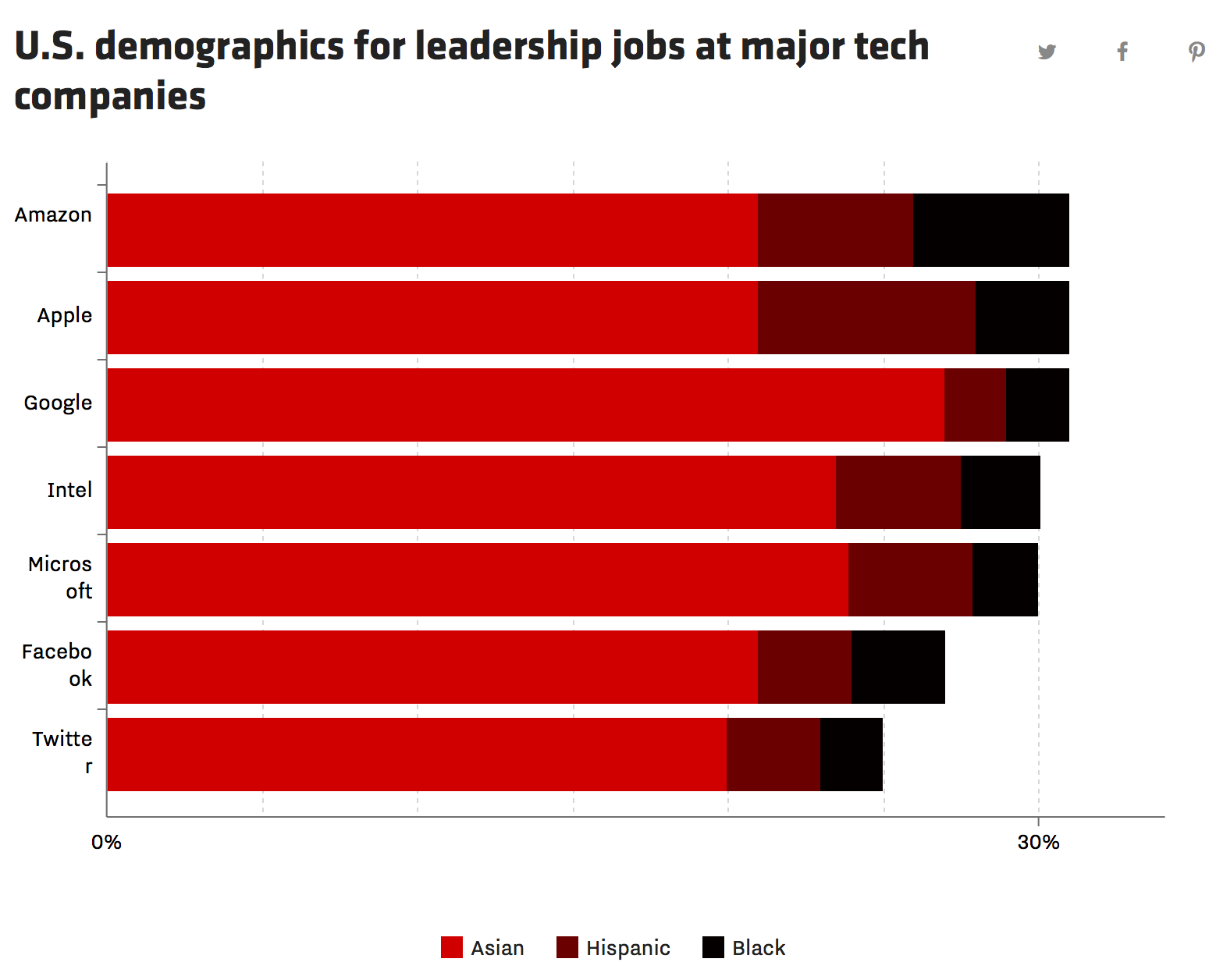
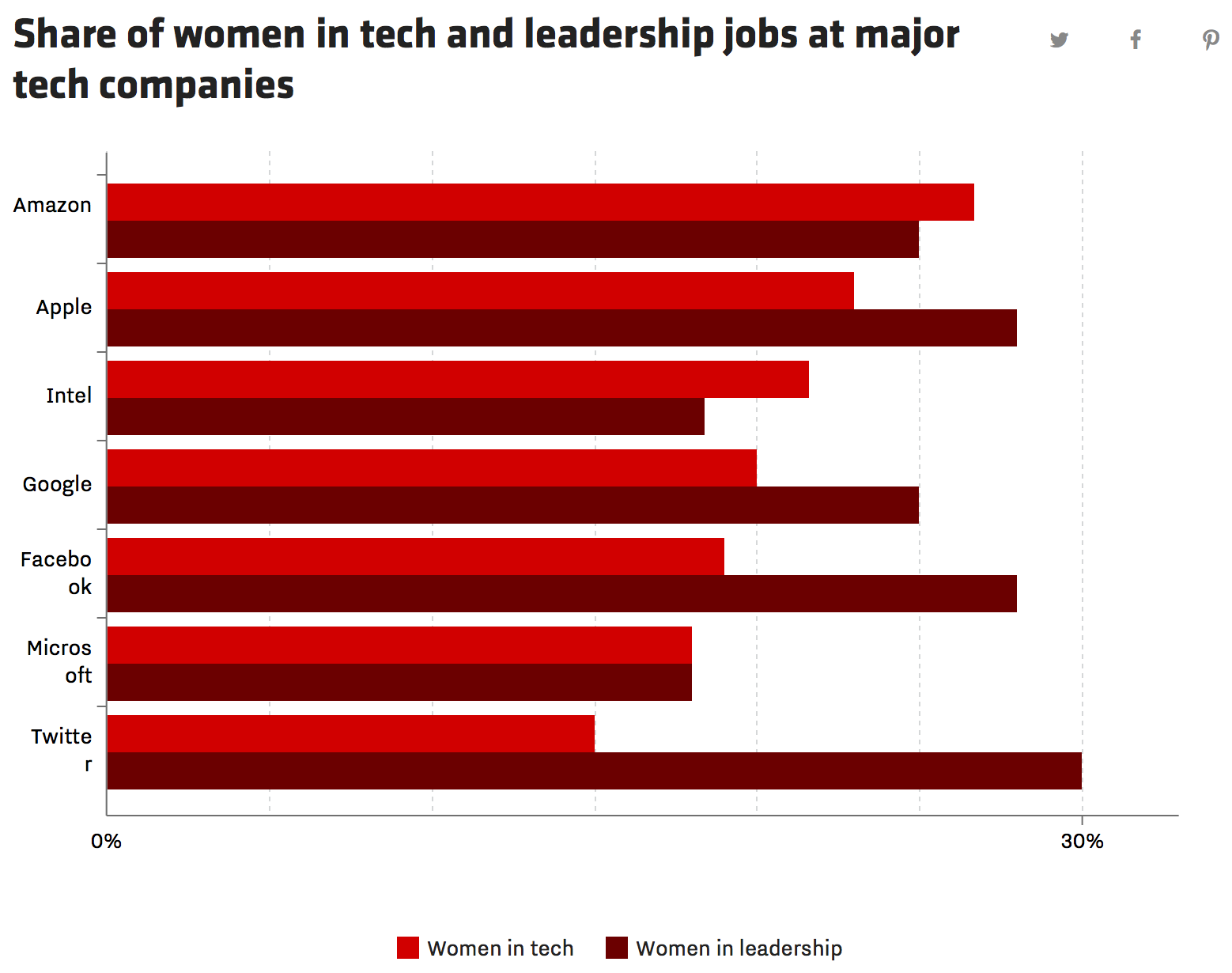
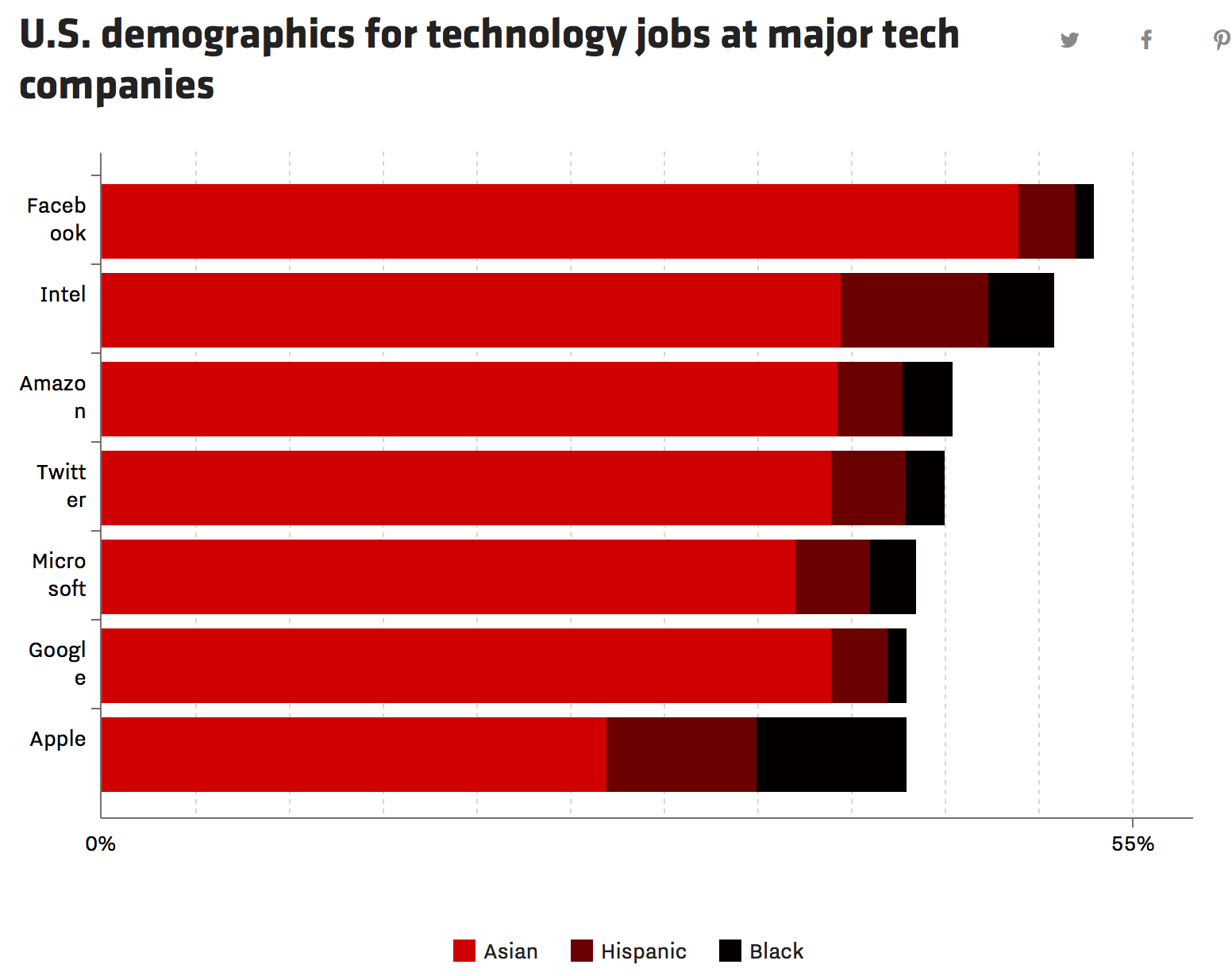
Here’s a look at major tech companies’ comparative diversity, according to their most recent reports. Women make up at most 30 percent of leadership roles and less than 27 percent of technical roles at these companies.

Twitter, the smallest company by number of employees, has the highest rate of female leadership at 30 percent. It also has the lowest rate of women in technical positions, such as engineers at 15 percent.

Racial demographics aren’t much brighter.

Blacks and Latins are represented at a much lower rate than their U.S. population. Facebook, which most recently reported new diversity numbers, had the highest share of people of color, particularly Asians, in technology jobs. Asian Americans tend to be overrepresented in technical roles but underrepresented in leadership positions.

Amazon, Apple and Google all had 31 percent of their leadership consisting of Asian, Latinx and blacks. These companies also report “other” and people who are two or more races, but those are usually under two percent.

Inequality exists at all levels of the job pipeline, but so do solutions. Look, for example, at the record number of women and minorities taking college-level computer science in high school this year.

Source: It’s not just Google — many major tech companies are struggling with diversity – Recode


There’s no easy solution to Canada’s border problem: Campbell Clark

Sensible and realistic commentary:

The latest spate of asylum seekers crossing the border over dirt paths in Quebec has once again sparked some, including Conservative politicians, to ask why Ottawa doesn’t press Washington to allow those people to be turned back to the United States.

There is, after all, a deal in place with the Americans that allows Canadian border guards to turn back asylum seekers who arrive at official border crossings from the United States – but not in between them. Many have called for the Canadian government to close that “loophole.”

But the Americans don’t want to close it. They don’t want to go through a lot of trouble to stop migrants from leaving the United States. It’s time to stop thinking there are easy, wave-of-the-pen solutions for Canada’s border problem.

…So those demanding that Canada strike a new deal with Washington to close the border “loophole” – as Conservatives did throughout the leadership race that ended in May – can save their breath.

Jason Kenney, who is running for the leadership of Alberta’s new United Conservative Party, told The Globe and Mail’s Laura Stone last week that the Liberal government should renegotiate the safe-third-country deal. But he also admitted that when he was the federal immigration minister, Obama administration officials refused.

Before 2003, asylum seekers often came through the United States to Canada. But after 9/11, the two countries signed several border-management agreements, including a “safe-third-country” agreement that stipulates if someone arrives at an official Canadian border post and claims refugee status, they can be turned back to make their claim in the United States. But the Americans didn’t want to agree to take back anyone who managed to sneak into Canada elsewhere.

That means anyone who crosses the border through a field or a across a dirt path can claim refugee status, and have their claim heard. That loophole has always been there. It’s just that more people are using it lately.

Mr. Trump’s immigration crackdown is one reason. That sparked a number of Somalis living in Minnesota to cross into Manitoba last winter. Now many Haitians who fear they will be sent home when a U.S. moratorium on deportations ends in January are coming to Quebec’s border, reportedly encouraged by false info on social media that suggests they will automatically be allowed to stay.

What to do? Conservative MP Michelle Rempel issued a press release calling for Mr. Trudeau to “take action” – but tellingly, she didn’t specify what kind.

Some suggest suspending the safe-third-country agreement, because people will at least cross the border at official entry points if they can make a refugee claim there. But history suggests that will lead to a major increase in people travelling through the United States to seek refugee status in Canada – especially with Mr. Trump cracking down on migrants from Mexico.

There’s really two ways to discourage the flow. You can make the lives of border crossers rougher, by locking them up. But that means locking up desperate families.

Or you can speed the processing of refugee claims, either through reform or extra funding, so that people without valid claims are returned home quickly – in theory, that might discourage those who aren’t bona fide refugees. Right now, Mr. Trudeau’s Liberals are hoping this latest flow of asylum seekers will subside. After Mr. Trudeau’s words about refugees being welcome, they don’t want to act tough. And there just aren’t simple solutions: Certainly, Canada can’t expect Mr. Trump’s help.

Source: There’s no easy solution to Canada’s border problem – The Globe and Mail

False information sends asylum-seeking Haitians to Canada

Suggests that more targeted communications, using diaspora networks, are needed to help reduce expectations and false information (beyond the recent PM and IRCC Minister comments in that regard):

An exodus of Haitian migrants seeking asylum at the Canadian border is being fuelled by incomplete and false information spreading like wildfire throughout the community.

Refugee advocates say many of the 58,000 Haitians living in the United States under temporary protection – which was granted after the 2010 earthquake in Haiti and exempted them from deportation to the devastated country – began to look at options in May when the administration of U.S. President Donald Trump announced the status would end in January. Attention turned to Canada in June when false rumours spread that the country was automatically welcoming people with temporary protected status (TPS) in the United States.

The effect was quickly felt in Quebec, where the daily arrival of about 50 asylum seekers a month tripled in July. Montreal’s Olympic Stadium is now being used as a temporary shelter for up to 1,050 people. Hundreds of Quebeckers rallied at the stadium Sunday to show support for the migrants. An anticipated anti-immigration protest did not happen.

Farrah Larrieux, a Haitian TPS holder and advocate who lives in Florida, said when the Trump administration announced the status would end Haitians were faced with a choice: spend nearly $500 (U.S.) in fees to extend their stay for six months or put the money toward an attempt to get into Canada.

Opportunists quickly popped up advertising Canada was offering a free ride. “There are posts on social media, ads on messaging apps, even Haitian radio hosts telling people they were willing to organize a bus to get them to Canada where they would be welcomed with open arms,” said Ms. Larrieux, who was facing deportation in 2010 for overstaying a tourist visa when an earthquake struck Haiti and she received TPS protection. “When you have this kind of chaos, you have people willing to take advantage.”

Sophia Cineas, a 31-year-old Haitian woman, was one of hundreds of people who arrived at an unofficial border crossing between upstate New York and Quebec last week. She described how much more welcoming Prime Minister Justin Trudeau is to immigrants than Mr. Trump and how she believed Canada would welcome her. “I cannot stay in the United States and there’s no better place than Canada,” she said. “I’m doing what I’ve got to do.”

Jean-Nicolas Beuze, the representative in Canada for the United Nations High Commissioner for Refugees (UNHCR), interviewed 30 newly arrived asylum seekers last week, about two-thirds of whom were Haitian. He said many of them appeared to have bad information about how easily they could get established in Canada. “There is an impression that Canada is a more generous country when it comes to refugees, but when you look at the statistics, it’s very similar.”

In Canada, 52 per cent of Haitian refugee claims were accepted in 2016, compared with 48 per cent in the United States, Mr. Beuze noted, but refugee claims will be tough to make for Haitians who have been living in the United States with protected status. “They have a different profile from the Haitians who normally come to Canada,” he said.

Many of the Haitians under TPS permits have been in the United States for years and often arrived with legitimate visitor visas or by clandestine methods. People who want to make asylum claims from within the United States are generally required to make the claim within their first year in the country. Many of the new arrivals in Quebec say they’ve been living in the United States for five to 10 years.

Most people who have legitimate refugee claims would have likely made them upon arrival in the United States, Mr. Beuze said.

In the first six months of the year, Canada processed 18,306 asylum claims. Official numbers for July are not available, but estimates indicate a big spike, ranging from about 1,100 to 2,500 for the month in Quebec alone. If the pattern continues, the numbers might approach the recent high of 44,640 in 2001, when the rules were more relaxed.

Canada can handle the load, Mr. Beuze said. The UN representative also cautioned against relying too much on projections. He noted Canada expected an influx of Mexican asylum seekers when Ottawa lifted a visa requirement for visits. It didn’t happen. This winter, as the number of border-hopping asylum claimants increased exponentially from January to March, many predicted the numbers would explode when the snow melted. Instead, the numbers from April to June stabilized before the July spike.

“You do not always understand the triggers, the push and the pull factors,” Mr. Beuze said. “People have different profiles and weigh different factors while making very personal decisions.”

The difficulty of claiming refugee status in Canada may become clearer to potential migrants and people may pursue other options to stay in the United States or return home to Haiti, he added.

Source: False information sends asylum-seeking Haitians to Canada – The Globe and Mail

The mystery of high unemployment rates for black Americans – The Economist

Further to earlier posts on blind cvs and discrimination:

Lower levels of education cannot account for the size of the racial gap. The real cause may be discrimination

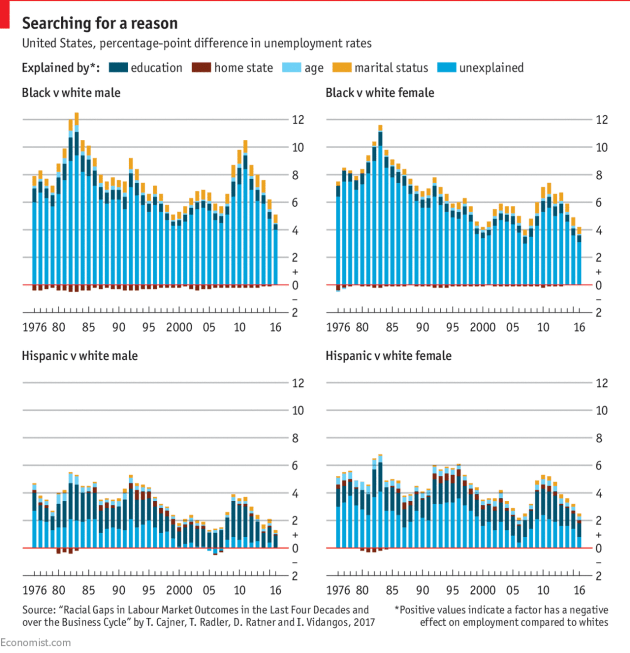
Using American census data from 1976 to 2016, the authors built a statistical model using four factors they expected to account for variations in unemployment between racial minorities and whites: education, age, marital status and the state a person lives in. Among men, these variables collectively explained around three-quarters of the difference in joblessness rates between Hispanics and whites—but only about one-fifth of the gap between blacks and whites.

The authors put forward three possible reasons for this stubborn discrepancy. First, they suggest that nominal educational attainment could be a poor measure of labour-market skills: schools vary widely in quality, and those in majority-black districts tend to underperform on standardised tests. A second potential reason is mass incarceration. Around one in three black men spend time behind bars during their lives, which severely hampers their employment prospects upon release.

The third possible explanation is outright discrimination. One study in 2004 provided strong evidence that racism among employers is at least partly to blame. The authors responded to “help wanted” advertisements in newspapers in Boston and Chicago with fake resumes. They gave names common to black Americans to some fictitious applicants, and names common to whites to the rest. Every other detail was identical. Sure enough, the candidates with stereotypically white names received 50% more job interviews.

Source: The mystery of high unemployment rates for black Americans

Google just hired a diversity VP — just as it struggles with a sexist memo from an employee – Recode

Culture change is hard:

Google recently announced a new head of diversity, just as it has had to deal with a controversial 3,000-word internal memo sent across the company by an employee.

It contains a series of what I can only describe as sexist twaddle, wrapped in the undeserved protection of free speech. (Hey bros who don’t agree, that’s just my opinion, so you’ll have to take it because … First Amendment and all!)

Danielle Brown, who was previously at Intel, was named the search giant’s new VP of diversity, integrity and governance several months ago and arrived a month ago. But she now has her first big test and it has to do with Silicon Valley’s latest problem.

Which is: Some male techies don’t seem to like women around computers.

She did note that in her memo she just sent to the company, noting she would not link to the employee’s memo because, ‘it’s not a viewpoint that I or this company endorses, promotes or encourages.”

The employee memo —which has been up for days without action by the company — went viral within Google this weekend with some decrying it and others not. Sources said execs have been struggling with how to deal with it and the fall-out, trying to decide if its troubling content crosses a line or should be allowed to be aired.

It’s not an easy line to walk. The employee — whom I am not naming since he seems to be the subject of threats online — penned a piece he sent across the company that said, among other things, that women just can’t do tech.

Titled “Google’s Ideological Echo Chamber,” it begins promisingly enough:

“I value diversity and inclusion, am not denying that sexism exists, and don’t endorse using stereotypes. When addressing the gap in representation in the population, we need to look at population level differences in distributions. If we can’t have an honest discussion about this, then we can never truly solve the problem.”

But then, in what is pretty much the main premise, he went on in detail: “I’m simply stating that the distribution of preferences and abilities of men and women differ in part due to biological causes and that these differences may explain why we don’t see equal representation of women in tech and leadership.”

Also men like status and, apparently, ladies like me are too nice to code.

More to come, but here is a memo Brown just sent out about the other memo:

“Affirming our commitment to diversity and inclusion—and healthy debate

Googlers,

I’m Danielle, Google’s brand new VP of Diversity, Integrity & Governance. I started just a couple of weeks ago, and I had hoped to take another week or so to get the lay of the land before introducing myself to you all. But given the heated debate we’ve seen over the past few days, I feel compelled to say a few words.

Many of you have read an internal document shared by someone in our engineering organization, expressing views on the natural abilities and characteristics of different genders, as well as whether one can speak freely of these things at Google. And like many of you, I found that it advanced incorrect assumptions about gender. I’m not going to link to it here as it’s not a viewpoint that I or this company endorses, promotes or encourages.

Diversity and inclusion are a fundamental part of our values and the culture we continue to cultivate. We are unequivocal in our belief that diversity and inclusion are critical to our success as a company, and we’ll continue to stand for that and be committed to it for the long haul. As Ari Balogh said in his internal G+ post, “Building an open, inclusive environment is core to who we are, and the right thing to do. ‘Nuff said.”

Google has taken a strong stand on this issue, by releasing its demographic data and creating a company wide OKR on diversity and inclusion. Strong stands elicit strong reactions. Changing a culture is hard, and it’s often uncomfortable. But I firmly believe Google is doing the right thing, and that’s why I took this job.

Part of building an open, inclusive environment means fostering a culture in which those with alternative views, including different political views, feel safe sharing their opinions. But that discourse needs to work alongside the principles of equal employment found in our Code of Conduct, policies, and anti-discrimination laws.

I’ve been in the industry for a long time, and I can tell you that I’ve never worked at a company that has so many platforms for employees to express themselves — TGIF, Memegen, internal G+, thousands of discussion groups. I know this conversation doesn’t end with my email today. I look forward to continuing to hear your thoughts as I settle in and meet with Googlers across the company.

Thanks,

Danielle”

Source: Google just hired a diversity VP — just as it struggles with a sexist memo from an employee – Recode

Update: Google has apparently fired the employee who wrote the offending memo.

Insistence on French for SCC judges could block historic appointment of first Indigenous judge – The Lawyer’s Daily

Hard one to balance:

The Trudeau government’s pledge to fill the Supreme Court of Canada’s impending western vacancy with a bilingual jurist who can function in French is liable to block the historic appointment of its first Indigenous judge, lawyers say.

The Indigenous Bar Association (IBA) has pressed Ottawa for years to make an Indigenous appointment to the 142-year-old court and will do so again for the spot that is opening  up when Chief Justice Beverley McLachlin retires Dec. 15, said IBA president Koren Lightning-Earle of Maskwacis, Alta.

However the Trudeau government’s insistence that all its Supreme Court appointees be able to read and understand French, without translation, is an additional and unfair hurdle for Indigenous candidates and a “detriment to Canada,” Lightning-Earle told The Lawyer’s Daily.

If the government “starts to think outside the box on what the language prerequisite actually means to Indigenous people, and [to] truly understand history and reconciliation … then they’ll understand why the [French] language prerequisite is ridiculous,” she explained. “Our first language is our Indigenous language. And then we were sent to residential school where we were told we were not allowed to speak our language, and we were forced to speak a colonial language [English]. And now we have to speak another colonial language — just to get a seat at the table!”

The Trudeau government vowed during the election to appoint only Supreme Court judges able to function in both English and French. This was in response to concerns expressed by Quebecers, Acadians and other francophones outside Quebec that it does a disservice to their appeals when the top court’s anglophone judges can’t understand nuanced French oral argument (because interpretation is not always perfect) or read French written briefs and supporting materials (which are usually not translated).

However Lightning-Earle points out the prime minister and his government have also committed to reconcile with Indigenous peoples, as a top priority. “You don’t just get to put up a barrier and say ‘Well this is our requirement’ — without acknowledging the history — which is the spirit and intent [of] the reconciliation that the government supposedly signed on to,” she remarked.

Certainly the language prerequisite is a major obstacle for Indigenous candidates. There are, at most, a handful of Supreme Court-calibre Indigenous jurists in the west who are able to understand and read French without translation. Saskatchewan provincial court judge Mary Ellen Turpel-Lafond, who is Cree, is one, as is Vancouver litigator and Indigenous law expert Jean Teillet, who is Métis.

“There are barriers that Aboriginal lawyers and judges face that non-Aboriginal people don’t face,” Teillet told The Lawyer’s Daily. “And language is always one of those things. And so putting that kind of qualification on a Supreme Court appointment … will mean, as a fact, that we will have not an Aboriginal judge on the Supreme Court of Canada for a very long time. It won’t be because there are not really excellent Aboriginal lawyers and judges who are capable — more than capable — of doing the job. It will be because of the language barrier.”

Among those who appear to be affected is internationally acclaimed Indigenous law scholar John Borrows, 54 — who many see as a star candidate.

A member of the Chippewas of the Nawash First Nation on Georgian Bay, Borrows is currently in immersion French studies in Montreal. He is a visiting professor at McGill University’s faculty of law where he is learning about the civil law while on sabbatical leave from his post as Canada research chair in Indigenous law at the University of Victoria’s faculty of law, where he is co-developing the first joint program in Canadian common law/Indigenous law, expected to start up in 2018.

Osgoode Hall Law School dean Lorne Sossin believes Borrows “would be an outstanding choice to join the court.” He should not be blocked as he gets his French up to speed, Sossin opined.

Source: Insistence on French for SCC judges could block historic appointment of first Indigenous judge – The Lawyer’s Daily

Blogging Break – Resuming next week