Les migrants haïtiens doivent savoir ce qui les attend, croit un élu new-yorkais

Hopefully this kind of initiative, along with Canadian consulate outreach to Haitian and other communities in the USA, will reduce the flow:

Venu de la Grosse Pomme pour vérifier si le Canada est vraiment l’eldorado imaginé par de nombreux ressortissants haïtiens, le conseiller municipal new-yorkais Mathieu Eugène promet de remettre les pendules à l’heure auprès de la communauté en rentrant chez lui.

«Je vais pouvoir mieux informer mes frères et mes soeurs qui croient trouver ici la terre promise, a souligné M. Eugène. La perception des Haïtiens aux États-Unis, c’est que le Canada va accueillir à bras ouverts tous ceux qui ont un TPS [Temporary Protected Status], mais ils ne savent pas ce qu’est la réalité.»

L’élu était à Montréal mardi à l’invitation du conseiller de la Ville du district de Saint-Michel Frantz Benjamin, avec qui il a rencontré plusieurs leaders de la communauté haïtienne, en plus de visiter un centre d’hébergement de demandeurs d’asile.

Des gens paniqués

M. Eugène représente un quartier de Brooklyn où résident de nombreux citoyens d’origine haïtienne. Connu et respecté dans la communauté, il voit défiler dans son bureau des gens paniqués qui viennent d’apprendre que leur TPS, un statut de protection temporaire accordé aux Haïtiens après le tremblement de terre de 2010, viendra à échéance dans six mois, et qu’ils devront alors retourner dans leur pays d’origine.

Se fiant naïvement à de fausses informations qui circulent sur le web et sur les réseaux sociaux, ou à des rumeurs propagées par des connaissances, relate Mathieu Eugène, ils croient améliorer leur sort en gagnant le nord du 49e parallèle.

«Ils vivent du désespoir et de la désolation devant la menace d’être déportés en Haïti. Ils ont entendu dire que la situation sera peut-être meilleure ici. Confrontés à des difficultés, ils en sont rendus à penser que le Canada est la solution.»

«Je vais leur donner des informations justes et leur dire d’y réfléchir à deux fois, mais c’est difficile de les décourager ou de prévenir leur décision de venir au Canada. Je ne peux pas contrôler tous les Haïtiens», note-t-il toutefois.

Mathieu Eugène a l’intention d’organiser une conférence de presse à New York et même des rencontres d’information, pour expliquer aux migrants qui craignent l’expulsion du pays de Donald Trump que le même sort les attend peut-être dans la contrée de Justin Trudeau, même si les messages du premier ministre sur Twitter peuvent sembler très accueillants.

Mais pour lui, la priorité est cependant de poursuivre les pressions politiques aux États-Unis afin que soit prolongé le statut de protection temporaire pour les Haïtiens, ce qui n’est pas une mince tâche, étant donné les prises de position de l’administration Trump.

«C’est une lutte que l’on mène depuis longtemps, et on va continuer», a-t-il promis.

Nouvelle plongée dans l’incertitude

Dans la communauté haïtienne de Montréal, on espère que le message de M. Eugène sera entendu aux États-Unis, parce que bien des demandeurs d’asile risquent de voir leurs espoirs déçus, a expliqué Chantal Ismé, vice-présidente du conseil de la Maison d’Haïti, au visiteur new-yorkais.

«La plupart des personnes qui traversent la frontière actuellement ne répondent pas aux critères pour obtenir le statut de réfugié, a-t-elle fait valoir. Peut-être que certaines personnes seront acceptées, mais à cause du grand nombre de personnes qui arrivent et des délais qui s’allongent, les délais seront très longs avant d’avoir une réponse. Ces gens fuient l’incertitude pour être plongés dans une autre incertitude. Si leur demande est refusée, ils seront déportés vers Haïti, pas vers les États-Unis! C’est la précarité qui les attend à nouveau.»

«Le Canada les accueille temporairement, et notre approche humaine leur laisse peut-être croire que c’est le paradis ici, renchérit Ninette Piou, directrice du centre N A Rive. Mais la route est encore longue ensuite et le processus est plein d’écueils.»

Source: Les migrants haïtiens doivent savoir ce qui les attend, croit un élu new-yorkais | Isabelle Ducas | Actualités

Québec étend la portée de son projet de loi sur la neutralité religieuse | Le Devoir

More on Quebec’s Bill 62 and its expansion to municipalities and municipal services:

La volonté du gouvernement Couillard en matière de « neutralité religieuse » s’étendra aux élus municipaux, employés des villes, travailleurs, visiteurs et utilisateurs des musées et des transports en commun — qui devront tous se présenter « à visage découvert » pour fournir ou obtenir des services.

C’est à tout le moins ce que prévoient les amendements présentés mardi par la ministre de la Justice, Stéphanie Vallée, à l’ouverture de l’étude détaillée du projet de loi 62.

Les demandes d’accommodements seront toujours possibles pour un motif religieux, mais seulement si elles respectent des critères essentiellement jurisprudentiels, comme le principe de l’égalité homme-femme ou de la contrainte excessive au bon fonctionnement d’un organisme. « Je pense que c’est important de cadrer le principe de la neutralité religieuse, de cadrer l’analyse des demandes d’accommodements pour des motifs religieux […] et j’espère que, ce faisant, on va amener une certaine paix sociale », a déclaré la ministre Vallée. Cela dit, « c’est important de faire la nuance : ce n’est pas parce qu’on demande un accommodement que, nécessairement, on y a droit », a-t-elle affirmé plus tard.

L’étude du projet de loi, qui a été déposé en juin 2015, a été reportée au mois de février. Au lendemain de l’attentat de la mosquée de Québec, le gouvernement avait alors choisi d’oeuvrer à la « bonification » du projet de loi visant à faciliter l’intégration des immigrants au marché du travail. Malgré les retards cumulés, Québec espère toujours adopter le projet de loi avant la fin de son mandat, en octobre 2018.

Dans les réseaux de transport et les municipalités, dont les noms apparaissent pour une première fois dans le projet de loi, les réactions au changement de cap du gouvernement ont été rares et succinctes. « Après vérification, nous ne semblons pas avoir été consultés sur l’amendement. Si nous sommes assujettis à la loi d’une façon quelconque, nous la respecterons, une fois qu’elle sera adoptée », a répondu la Société de transport de Montréal. « On nous a avisés de la possibilité d’un amendement en juillet. Nous avons réservé nos commentaires et les ferons à la suite de la rencontre de notre conseil d’administration, le 24 août », a aussi fait savoir la Fédération québécoise des municipalités.

La Ville de Montréal a quant à elle rappelé qu’elle est d’accord avec le fait que les services fournis par des employés de l’État doivent être rendus à visage découvert. Elle a cependant demandé à Québec « de respecter son autonomie et sa capacité de gérer la question de la tenue vestimentaire de ses employés et les conditions qui permettent à ses citoyens d’obtenir des services ».

Le projet de loi 62 ne concerne pas nommément les signes religieux, mais prévoit la prestation et la réception de services « à visage découvert ». En vertu des nouveaux amendements, le principe de « neutralité religieuse » sera exigé dans les municipalités, les sociétés de transport en commun, mais aussi les musées, la Caisse de dépôt et placement du Québec ou Héma-Québec, entre autres. Est-ce donc dire qu’une personne qui montera à bord d’un autobus ou d’un wagon de métro devra dévoiler son visage ? « Moi, je ne suis pas ici aujourd’hui pour analyser chaque cas d’espèce, parce qu’on pourrait être ici jusqu’à 17 heures », s’est bornée à répondre la ministre Vallée, soucieuse de ne pas aborder d’exemples précis. En pleine consultation sur le projet de loi, en novembre, elle s’était retrouvée en porte à faux avec le premier ministre lorsqu’elle avait déclaré — en opposition aux paroles de Philippe Couillard — que le niqab et la burqa ne seraient pas autorisés durant les examens de conduite de la Société de l’assurance automobile du Québec.

Neutralité ou laïcité

Le libellé du projet de loi, « favorisant le respect de la neutralité religieuse de l’État », a continué de déranger les partis d’opposition, qui souhaitent tous que le Québec inscrive une fois pour toutes la laïcité dans sa législation. « La neutralité, c’est beaucoup plus objectif », s’est défendue la ministre Vallée. « C’est une séparation entre l’État, les institutions et la religion », a-t-elle ajouté, en rejetant la définition voulant plutôt qu’elle reconnaisse toutes les religions comme étant sur un pied d’égalité.

Autre consensus dans l’opposition, celui dégagé par la commission Bouchard-Taylor, qui suggérait d’interdire le port de signes religieux à toutes les personnes « en position d’autorité coercitive », à savoir les magistrats, les procureurs, les policiers et les gardiens de prison. À cette liste, la Coalition avenir Québec a choisi d’ajouter les enseignants du primaire et du secondaire. Le parti avait renoncé à cette demande en février, dans l’espoir d’obtenir l’unanimité au sujet du projet de loi. « On aurait pu régler ce dossier-là avec un compromis que le gouvernement a refusé, donc nous, on revient à notre position d’origine », s’est résignée la députée Nathalie Roy. Le Parti québécois a quant à lui suggéré d’interdire le port du tchador, du niqab et de la burqa aux employés de l’État, « au motif qu’ils représentent un symbole d’oppression qui va à l’encontre du droit à l’égalité entre les femmes et les hommes ». « La longue bataille pour l’égalité des hommes et des femmes est si importante et chère au coeur des Québécois et des Québécoises […] il n’est pas question que l’État représente un recul sur cette bataille », a plaidé la porte-parole de l’opposition officielle en matière de laïcité, Agnès Maltais.

Source: Québec étend la portée de son projet de loi sur la neutralité religieuse | Le Devoir

To the James Damores of the world: Focus on your own flaws: Marie Henein

Great column by Henein on the Google/Damore controversy. Witty and pointed:

As debate rages about whether it was fair to fire Google employee James Damore for the now-infamous Google manifesto that explored women’s so-called limitations, I can’t help but think, why can’t everyone just leave my gender alone? Once again, we are being filleted, dissected, and discussed as though we barely exist. Yet another round of public debate began about how our under-representation in various fields and in leadership roles has nothing to do with hundreds of years of inequality but rather is attributable to insurmountable biological limitations. Writers in article after article actually went out of their way to justify Mr. Damore’s view of women. Was this seriously still happening?

A recent column explained that our biological differences, among other things, makes female lawyers better negotiators but worse litigators. Just as I was about to switch jobs, the author kindly pointed out that I was an outlier. I didn’t know whether to be flattered that I am some sort of unicorn, concerned that I am considered more male in my disposition (a comment I have been the recipient of since elementary school) or disappointed that I now had to break it to countless talented female litigators that they should probably give it up and limit themselves to negotiation or more gentle, womanly professions. I look forward to more enlightenment on what our biology allows us to do. Given that technology, science, leadership roles, or any jobs requiring assertiveness are clearly out, we better hurry up as scores of young girls are being grossly misled into thinking they can actually do what they wish.

Mr. Damore, in the course of his unscientific stream of consciousness, unequivocally makes the following point: “The distribution of preferences and abilities of men and women differ in part due to biological causes and that these differences may explain why we don’t see equal representation of women in tech and leadership.” (Note: the italics are mine; the asinine quote is his.) He then goes on to mansplain – which was nice given the female biological aversion to ideas – that it is highly unlikely we are going to resolve the problem ourselves. He points out that females do not succeed because they are more inclined toward feelings and aesthetics rather than ideas. Women in general, he argues, have a stronger interest in people rather than things; our extroversion is expressed as gregariousness instead of assertiveness; we are agreeable, neurotic, and have a low stress tolerance. I get it. We feel more and think less. We are an emotional, under-thinking, overstressed gender. But it’s not all bad news: we have a hell of a lot of empathy and mushy feelings.

Golly gee, if only I could overcome my natural biological disposition toward feelings rather than ideas, maybe I could understand Mr. Damore’s point. Or just maybe his biological disposition skews toward feelings rather than well-articulated, grounded, scientific ideas. Who knows? Maybe I can find a man to explain it all to me.

Look, if you want to debate the pros and cons of diversity policies, knock yourself out. If you want to dispute a company that extends certain benefits or opportunities differentially, go right ahead. There are ways to meaningfully challenge an employer’s policies. But a manifesto explaining to a substantial portion of your colleagues that they are underperforming because they were made that way – that has very little to do with meaningful discussion.

Let me be clear, you can say whatever you wish. I am a staunch believer in freedom of speech and the expression of opinions, even offensive ones. Fragility of mind when faced with opposing thought and shouting people down does not in any way advance our pressing democratic goals. And there is no crime in being stupid, but if you are an employee you are fireable. Mr. Damore should have thought of that, but perhaps his biological male assertiveness got in the way.

So I have a proposal for the James Damores of the world: why don’t you focus on your own biological inadequacies, and stop thinking about ours. After all, you know them best. He and his compatriots can feel free to write as many manifestos explaining male deficiencies, of which my feeling, female self – with aggressive male undertones – is convinced there are many. This exercise would consume both time and thousands of pages, but please, please leave my gender alone. We do not need you to explain what you perceive to be our limitations, thank you very much. We do not need to be told that we will fail and not lead because we are “more compassionate” or our brains are wired differently. We’ve got this. Focus on yourself. If only Mr. Damore had spent 8 of his 10 pages setting out the flaws in his personality, he probably would still have a job. The only inferiority that Mr. Damore definitively demonstrated is his own.

Finally, a word of advice: Girls, do not bother to read the manifesto. It isn’t worth your time. Read about Marie Curie instead who said: “We must believe that we are gifted for something, and that this thing, at whatever cost, must be attained.”

She was a scientist, by the way. Mr. Damore didn’t mention her.

Source: To the James Damores of the world: Focus on your own flaws – The Globe and Mail

Twitter Account Names and Shames Far-Right Activists At Charlottesville : NPR

Not comfortable with this trend, whether practiced by the right or left. Agree with the comments by NYU visiting professor David Clinton Wells cited later in the article:

The names and faces of individuals who were part of last weekend’s white supremacist rally in Charlottesville, Va., are being plastered all over the Internet by civil rights advocates. It’s part of an effort to shame the people who participated. But, it’s a tactic that can also snare some innocent people in its net.

“Yes!You’re a racist” is the name of a Twitter account that’s been very active in posting pictures of white supremacists at the Charlottesville rally. Logan Smith, who runs the account, thinks other people should see the faces of white supremacists.

“They’re not wearing hoods anymore — they’re out in the open,” Smith says. “And if they’re proud to stand with KKK members and neo-Nazis and anti-government militias, then I think the community should know who they are.”

Smith says he didn’t attend the rally, but he’s been getting pictures from activists who were there. They share them through social media. He re-posts them on his Twitter account. And on Twitter people are happy to help him make these individuals even more public.

“Immediately, as soon as I posted those photos people (were) saying ‘Oh! I went to high school with this person. I had a class in college with that person. I recognize this person as a prominent white supremacist in my area.’ ”

After getting more information, Smith would add names and places to the photos and that has had some consequences in the real world.

Cole White, who used to work at a hot dog restaurant in Berkeley, Calif., “voluntarily resigned” on Saturday after his employer confronted him to discuss his participation in the rally.

The father of participant Jeff Tefft felt he needed to post a letter in a local newspaper disavowing his son. Although Pearce Tefft says he and his family are not racists, once his son’s face and name were posted on social media they became the targets of people upset with his son.

David Clinton Wills, a visiting Professor at NYU who follows social media, says he’s actually troubled by the way that anti-racist activists are using Twitter. “Never in my lifetime did I remotely think I would vaguely defend the rights of a possibly very hateful person,” says Wills who happens to be black and Jewish.

Nonetheless, he says “it scares me to call that activism because it seems more like a certain condemnation and a certain judgement that ironically flies in the face of democracy itself.”

Wills sees a lynch mob mentality on both the left and the right when they try to use social media to shame people.

Just last week, Google was at the center of another social media storm when a memo by a company employee critical of diversity efforts at the company went viral. When Google fired the employee web sites on the right, critical of the company’s actions, released names of Google employees. Those employees were then harassed online.

For Wills the historical parallel is Nazi Germany. Wills says the Third Reich encouraged citizens to name people they thought were enemies of the state. “When that became a power that your neighbor could execute or your neighbor could use against other people the power became unchecked.”

Wills says all kinds of people began to get caught up in the drag net of laws and declarations of enemies. Wills knows that social media activists are still very far from the evil that was the Third Reich. But, he thinks maybe people should take a deep breath and think before they press the send button with someone else’s name in the message.

And it’s also important to remember that a picture doesn’t tell the whole story; it can be photo-shopped. Someone could have an ax to grind and try to make it look like an individual is a racist.

Smith who runs the ‘Yes! You’re a racist” Twitter account” says he’s willing to risk a mistake to speak out. “Ever since the days of the KKK burning crosses in people’s yards, they depend on people remaining silent” Smith says. “And no matter the risk I’m not going away.”

And neither are the people who disagree with Smith. One thing is certain — in the age of social media anyone who wants a soap box can have one.

Source: Twitter Account Names and Shames Far-Right Activists At Charlottesville : All Tech Considered : NPR

How Tech Companies Lose Women During the Hiring Process – The New York Times

Some good suggestions on how to walk the talk on diversity in the recruitment process:

When my company is approached to help diversify some of America’s most gender-unbalanced tech teams, here’s how it usually goes in the introductory meeting: A well-meaning executive boasts that his company has been financially supporting a number of nonprofit coding organizations that aim to train female engineers. He tells us he’ll have a booth at the Grace Hopper conference, the largest annual gathering of women in tech. He complains about how hard it is to “move the needle” on diversity numbers, especially when a staff is in the thousands.

But what the executives don’t give as much thought to are some of the simplest determinants of how successful a company will be in hiring diverse candidates. Will women have any input in the hiring process? Will the interview panels be diverse? Will current female employees be available to speak to candidates about their experiences? Many times, the answer to each of these questions is no, and the resistance to make simple changes in these areas is striking.

My colleagues and I often see companies work to make themselves appealing to candidates by emphasizing perks like Ping-Pong tables, retreats and policies that let employees bring their dogs to work. Those things can be appealing to candidates of any gender. But one size doesn’t fit all: We have to tell these companies to talk just as proudly about their parental-leave policies, child-care programs and breast-pumping rooms. At the very least, they need to communicate that their workplaces have cultures where women are valued. They need to show they’re not places where attitudes like that of the now-infamous Google engineer who wrote a memo questioning women’s fitness for tech jobs dominate.

At first, the executives balk at my suggestions and even wonder if explicitly talking about the place of women is sexist. But I remind them that when it comes to gender, they have to play catch-up, after long histories of eroding trust by grilling women about how they’ll be able to do the job with children at home and years of negative stories in the press with tales of how women are mistreated at tech companies. Candidates rightfully want assurances about whether the companies have improved — or whether they even care. Treating everyone the same won’t accomplish that.

Silicon Valley companies are in love with themselves and don’t understand why the love isn’t always returned by the few women to whom they extend employment offers. That’s why they’re so proud of so-called boomerangs — candidates who have left a company for reasons that may or may not be related to how it treats women and, after advancing their careers elsewhere, return. Executives hope these employees will add to their diversity numbers and provide evidence that the company has evolved. But even potential boomerangs are looking for hiring-process hints that they’ll be able to thrive. They want to know, what policies have changed for us? Is the environment more inclusive? Can I have a family without compromising my career? When tech firms in Silicon Valley and beyond decide to proactively answer those questions as part of their regular processes, they have a chance to successfully recruit and hire more women.

I’m often asked which companies are getting diversity and inclusion right in Silicon Valley and across the country. Most aren’t. But some are seeing small successes. Last year, we worked with a company that set a goal that women would make up 50 percent of the engineers on one of its teams. They did it by holding a webinar led by female employees, with 100 female candidates who asked questions about how the organization was changing to become more inclusive to women. They asked recruiters to follow up with the candidates to offer fuller responses and address other concerns. The company realized it needed to take extra time to convince women that it truly valued them.

It worked. The women hired through that effort are all still at the company. Now we’re working with it to bring in even more female engineers. When the next round of candidates show up for interviews, this is one place in tech that will have a story about an inclusive culture that it’s proud to tell.

Killings of Blacks by Whites Are Far More Likely to Be Ruled ‘Justifiable’ – The New York Times

Impressive large scale study with disturbing conclusions:

When a white person kills a black man in America, the killer often faces no legal consequences.

In one in six of these killings, there is no criminal sanction, according to a new Marshall Project examination of 400,000 homicides committed by civilians between 1980 and 2014. That rate is far higher than ones for homicides involving other combinations of races.

In almost 17 percent of cases when a black man was killed by a non-Hispanic white civilian over the last three decades, the killing was categorized as justifiable, which is the term used when a police officer or a civilian kills someone committing a crime or in self-defense. Over all, the police classify fewer than 2 percent of homicides committed by civilians as justifiable.

The disparity persists across different cities, ages, weapons and relationships between killer and victim.

To understand the gaps, The Marshall Project obtained dozens of data sets from the Federal Bureau of Investigation and examined various combinations of killer and victim. Two types of “justifiable homicide” are noted: “felon killed by private citizen” or “felon killed by police officer.” (In a bit of circular logic, the person killed is presumptively classified as a felon, since the homicide could be justified only if a life was threatened, which is a crime.)

The data were processed to standardize key variables and exclude more than 200,000 cases that lacked essential information or were homicides by the police. The resulting data detail the circumstances of each death: any weapons used; information on the killer’s and victim’s race, age, ethnicity and sex; and how police investigators classify each type of killing (“brawl due to the influence of alcohol,” “sniper attack” or “lover’s triangle,” for example).

Little large-scale research has examined the role of race in “justifiable” homicides that do not involve the police. The data examined by The Marshall Project are more comprehensive and cover a longer time period than other research into the question, much of which has focused oncontroversial Stand Your Ground laws.

In the United States, the law of self-defense allows civilians to use deadly force in cases where they have a reasonable belief force is necessary to defend themselves or others. How that is construed varies from state to state, but the question often depends on what the killer believed when pulling the trigger.

“If there are factors — even if they’re stereotypes — that lead the defender to believe he’s in danger, that factors in, whether it’s a righteous cause or not,” said Mitch Vilos, a Utah defense lawyer, gun rights advocate and the author of “Self-Defense Laws of All 50 States.”

Self-defense decisions by regular people, much like those involving the police, are made quickly and with imperfect information. As a result, a homicide can be ruled self-defense when the killer faced no actual threat but had a reasonable belief he or she did.

That is where irrational fear can come into play. The police, prosecutors and juries may be apt to give killers the benefit of the doubt in situations when they were faced with someone who seemed “dangerous.”

“Tell me that it doesn’t factor in if the person is black when they’re approaching the suspect,” Mr. Vilos said. “It contributes to the decision to pull the trigger because of the fear associated with the stereotype.

“Right or wrong, that’s what’s happening, in my opinion.”

The vast majority of killings of whites are committed by other whites, contrary to some folk wisdom, and the overwhelming majority of killings of blacks is by other blacks.

U.S. Muslims are concerned about extremism in name of Islam | Pew Research Center

Useful poll and analysis:

Most Americans are worried about Islamic extremism, and most Muslim Americans share these concerns.

About eight-in-ten U.S. Muslims (82%) say they are either very (66%) or somewhat concerned (16%) about extremism committed in the name of Islam around the world, about the same as the share of the general public that feels this way (83%), according to a new Pew Research Center survey. Only about one-in-six U.S. Muslims (17%) and Americans overall (15%) say they are “not too” or “not at all” concerned about extremism carried out in the name of Islam worldwide. Among both groups, concern about extremism is up 10 percentage points since the Center’s last survey of U.S. Muslims in 2011.

Muslim American women are particularly worried about global extremism in the name of Islam. Nearly nine-in-ten U.S. Muslim women (89%) say they are at least somewhat concerned about it, up 16 points since 2011. A smaller share of U.S. Muslim men (75%) say they feel this way. 

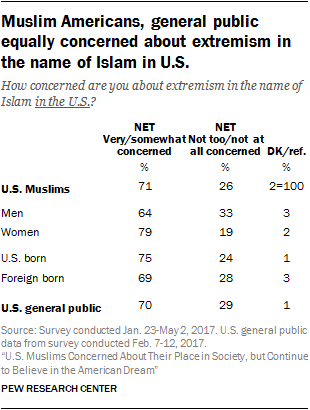
While U.S. Muslims are slightly less worried about Islamic extremism in the United States than around the world, their concern about domestic extremism is still high. About seven-in-ten American Muslims (71%) say they are at least somewhat concerned about extremism in the name of Islam occurring in the U.S. As with global extremism, the level of concern among Muslim Americans about extremism in the U.S. is very similar to the general public’s (70%).

Despite their concerns about Islamic extremism, only 17% of Muslim Americans say there is a great deal (6%) or fair amount (11%) of support for extremism among U.S. Muslims. Most say there is not much support for extremism (30%) or none at all (43%) among the U.S. Muslim community. This contrasts with the views of Americans in general. Compared with Muslims, twice as many people in the general public (35%) say there is at least “a fair amount” of support for extremism among Muslims who live in the U.S.

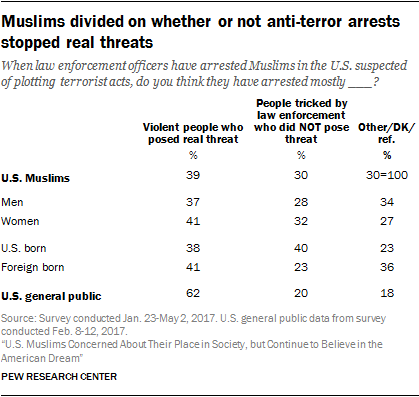
Muslim Americans also differ from the general public in their views on undercover sting operations and other police efforts to disrupt terrorist plots. Four-in-ten U.S. Muslims (39%) say that when law enforcement officers have arrested Muslims on suspicion of plotting terrorist acts, they have mostly arrested “violent people who posed a real threat.” But 30% say such arrests have mostly involved “people who were tricked by law enforcement and did not pose a real threat,” while an additional 30% say they are not sure or express no opinion.

The general public is less divided on this question: 62% of U.S. adults say anti-terror arrests have mostly stopped real threats, while only 20% say authorities mostly have entrapped people who did not pose a real threat.

Both Muslims and the general public also were asked if there are circumstances under which targeting and killing civilians can be justified in order to further a political, social or religious cause. Roughly eight-in-ten U.S. Muslims (84%) say such tactics can rarely (8%) or never (76%) be justified. The share of Muslims who say such tactics can often or sometimes be justified (12%) is similar to the share saying this among the general public (14%). And Muslims are more likely than the public as a whole to say that targeting civilians for political, social or religious causes can never be justified.

Source: U.S. Muslims are concerned about extremism in name of Islam | Pew Research Center

NGOs tell UN panel Canada is failing on racism: Paradkar

Shree Paradkar reports on the NGO critique of Canada’s record in combatting racism (Debbie Douglas of OCASI, Avvy Go of the Chinese & Southeast Asian Legal Clinic, Shalini Konanur, of the South Asian Legal Clinic of Ontario).

While their points are largely valid, they portray a completely bleak picture when surely the reality is more nuanced. This may be the nature of the process when their role is to prevent an alternative view to the more positive portrayal of the government response.

But it is surprising, given that all three are Ontario based, that they do not mention the province’s anti-racism strategy as an example that the federal government should emulate.

And surely, is the change of federal language towards diversity and inclusion, the increased diversity of appointments, and other policy initiatives of the current government not worthy of note, while allowing for criticism where needed?

Every day when I read news from around the world, I have occasion to feel thankful to be in Canada.

Yet, I was surprised this weekend to hear many Canadians, revolted by the events unfolding in Charlottesville, Va., say: At least we’re not as bad. In reality, our history, too, involves slavery, indentured labour, brutal oppression and colonization. Our country, too, has thriving right-wing extremism.

It’s not Canadian to be flashy and to shout out our deeds from the rooftops. The flip side of this modesty is, when history judges those actions to be misdeeds, we are able to dismiss them as trivial because they were not as glorified as they were down south.

The dismissal allows us to masks the past and ease our collective conscience.

It’s precisely a recognition of those past misdeeds, their present consequences and a reckoning of current laws that a group of prominent Canadian NGOs are seeking in Geneva Monday, when they ask a UN body to hold Canada’s feet to the fire for failing to keep its promises to end discrimination.

The Colour of Poverty — Colour of Change and its members are asking the United Nations Committee on the Elimination of Racial Discrimination (CERD) to recognize how Canada has “failed to comply with its international human rights obligations . . . and domestic human rights laws.”

“Racism is a matter of life and death,” for Indigenous peoples, their joint statement says, citing dismal socio-economic health indicators, suicides, murders and disappearances of thousands of people.

Both Indigenous and Black people are disproportionately poor and disproportionately represented in the criminal justice system.

“This is not the first time we brought this concern to the CERD committee, and yet very little has changed in more than a decade of our submitting shadow reports,” said Debbie Douglas, executive director of the Ontario Council of Agencies Serving Immigrants (OCASI).

The NGOs are calling for a national action plan on racism for Canada that would commit to combating discrimination in hiring, and funding anti-racist organizations.

Chiefly, it is seeking the collection of “disaggregated” data across all government departments.

This kind of data collection that specifies identities such as race, gender or disability is the minimum Canada needs so it can measure the impact of its policies whether in health or housing or jobs.

How do you try to solve a problem when you can’t quantify it?

“For instance,” says Avvy Yao-Yao Go, clinic director at the Chinese & Southeast Asian Legal Clinic, “Under the Federal Employment Equity Act, the federal government has data on the representation of women, ‘visible minority,’ Indigenous peoples and people with disabilities in the federal public service.

“However, we do not know, for instance, of the “visible minority” categories, what are the percentages for people of African descent versus people of Chinese descent versus people of South Asian descent. Or under (the category of) women, how many are women of colour and from which communities.” [Comment: Actually we do from census data – see my Federal Employment Equity and Religious Minorities in the Public Service)]

Or, take Canada’s immigration law that allows people detained for immigration purposes to be detained indefinitely. More than 6,000 people were held in 2016-17, the agencies say, although more than 90 per cent of them were not considered a security threat.

“We recently participated in a case in federal court that sought to challenge indefinite detention,” says Shalini Konanur, executive director of the South Asian Legal Clinic of Ontario.

“During that case we spoke with several detainees, and the vast majority were racialized. Currently, there is no race-based data being collected about detainees but we know anecdotally that racialized persons in Canada are disproportionately impacted by indefinite detention.”

The NGOs also want the federal and provincial government to remove barriers to the recognition of international training, and to amend the Ontario Human Rights Code to stop discrimination based on police data.

They are drawing attention to domestic laws that discriminate against specific groups.

In addition to immigrant detainees affected by law, migrant farm workers and caregivers such as nannies — the majority of whom are people of colour — are also vulnerable.

Migrant agricultural workers do not have access to permanent resident status. As for caregivers, their once guaranteed pathway to permanent residence was revoked in 2014.

Both groups have their work permit tied to a specific employer leaving them vulnerable to exploitation.

“While migrant workers contribute to social entitlement programs in Canada, their temporary status largely precludes them from accessing these programs,” said Amy Casipullai, an OCASI staffer.

The UN committee is expected to release its review on Aug. 25.

Source: NGOs tell UN panel Canada is failing on racism: Paradkar | Toronto Star

Ethnic Studies: A Movement Born Of A Ban : NPR

Interesting account of some of the history of ethnic studies, the political debates and the evidence of how it encourages more engagement among minority students:

In Jr Arimboanga’s ninth-grade classroom, students learn about critical consciousness: how to read the word, but also the world. It’s a concept popularized by a Brazilian educational theorist named Paulo Freire in his book, Pedagogy of the Oppressed.

The class is ethnic studies. It’s part of an effort by San Francisco educators like Arimboanga to teach courses centered on the perspectives of historically marginalized groups. Just last year, California passed a law mandating a model ethnic studies curriculum.

Sometimes called multicultural education or culturally responsive teaching (though there are subtle differences among the three), ethnic studies has been expanding on the west coast and in pockets across the country. San Francisco’s curriculum is “designed to give high school students an introduction to the experiences of ethnic communities that are rarely represented in textbooks,” according to the school district’s website.

Teachers of ethnic studies argue that these courses give students a pathway to break the cycles of poverty, violence, and incarceration that so many communities of color face.

“Ethnic studies works,” says Artnelson Concordia, a veteran teacher who is helping to develop the San Francisco curriculum. He wants students to see that “all of their experiences can be connected to larger issues.”

“So by the end of the school year, they’re seeing themselves as makers of history,” Concordia says.

Movements and Counter-Movements

Ethnic studies has “gained momentum, frankly, with the election of Donald Trump,” says Ravi Perry, president of the National Association for Ethnic Studies. This summer, Oregon set a timetable for the adoption of K-12 ethnic studies standards. Efforts to introduce statewide legislation are also ongoing in Kansas and starting this year, Indiana high schools will be required to offer ethnic and racial studies as an elective course. States with large indigenous populations — like Montana and Alaska — have already written standards for culturally responsive teaching.

“We have an obligation to ensure their heritage is aptly reflected in how we talk about America,” Perry says. “This is not about promoting an individual agenda. It’s about understanding the importance of community solidarity.”

Other movements are concentrated at the district level. Seattle has passed a resolution, based on recommendations from the NAACP. Students in Providence, R.I., have successfully lobbied for a pilot of the ethnic studies curriculum. Albuquerque, N.M., has launched ethnic studies courses in all of its high schools.

Though the start of the ethnic studies movement can be traced to the early 1900s, it really kicked off in the 1960s at colleges and universities. In the past decade, the growth has accelerated in K-12 schools, partly in response to an Arizona law that banned the curriculum.

There, Republican lawmakers were specifically targeting a Mexican-American studies program at Tucson High School — where minority enrollment is 88 percent. The Republicans who wrote the legislation, Tom Horne and John Huppenthal, claimed the classes were stoking racial tensions and “radicalizing students.” They pointed to the course materials — among them, Freire’s Pedagogy of the Oppressed and Rodolfo Acuña’s Occupied America — as well as the class decor, which included a poster of Che Guevara.

In 2010, Horne and Huppenthal passed HB 2281, prohibiting classes and materials that “promote the overthrow of the U.S. government,” “resentment toward a race or class or people,” or “ethnic solidarity.” (This happened soon after the passage of SB 1070, which gave local police the authority to question a person’s citizenship.)

There were other ethnic studies courses in Tucson that were not touched by the bill, Huppenthal says. He mentions African-American studies, for one. But the teachers of Mexican-American studies classes at Tucson High, Huppenthal says, were “indoctrinating students.”

“They were doing a very simplistic application of Karl Marx’s dictum: All of history is the struggle between the ‘oppressor’ and the ‘oppressed,’ ” Huppenthal says. “And they were going to identify whites as oppressors and Hispanics as the oppressed.”

Myths and Truths

“One of the things you would hear was that our classes were hateful. That we were teaching resentment,” says Curtis Acosta, who piloted one of the Mexican-American studies classes that sparked the controversy in Arizona. “That’s exactly the antithesis of what you would see.”

Acosta taught for 18 years in Tucson Unified School District. On a typical day in his Chicano literature class, Acosta says, you’d find students sitting at tables “doing really controversial things like reading and writing well.”

Each morning, his class would begin with an affirmation, a Mayan precept called In Lak Ech, which translates to “You are another me.” Students would recite in Spanish and English part of the poem by Luís Valdez:

Tú eres mi otro yo. You are my other me. Si te hago daño a ti, If I do harm to you, Me hago daño a mi mismo. I do harm to myself. Si te amo y respeto, If I love and respect you, Me amo y respeto yo. I love and respect myself.

“Students were sharing and taking risks and that didn’t happen by accident,” Acosta says. “It was real intentional.”

Alexei Marquez can attest to that. She was in Acosta’s class the first year it was offered. Up until then, she had been a dutiful, if disengaged, student. “I learned from an early age to play the game as it was,” Marquez says.

When she took Acosta’s class, it was the first time she’d connected to literature on a personal level. She fell in love with The Devil’s Highway by Luís Alberto Urrea. “I can’t even tell you what I read in AP English,” Marquez says.

She is starting her PhD in Educational Leadership and Policy at the University of Arizona. And she is not a lone success story. While 48 percent of Latino students were dropping out of high school, 100 percent of those students enrolled in Mexican-American studies classes at Tucson High were graduating, and 85 percent were going on to college.

Impact

“The research says, plainly, that this stuff works,” explains Christine Sleeter, a California State University professor and ethnic studies expert. In 2010, the National Education Association asked her to review the academic and social impact of ethnic studies.

A few things happen when students take courses that connect with their lived experience, Sleeter says. Engagement increases, as do literacy skills, overall achievement and attitudes toward learning.

“As students of color proceed through the school system, research finds that the overwhelming dominance of Euro-American perspectives leads many such students to disengage from academic learning,” Sleeter writes in the NEA report. “Ethnic studies curricula exist in part because students of color have demanded an education that is relevant, meaningful, and affirming of their identities.”

Something else happens in these classes: students develop “a sense of agency,” Sleeter writes. So they aren’t just learning about history, they’re engaging with it and shaping it — reading the word and the world.

A Stanford study finds similar outcomes — particularly for high school students at risk of dropping out. Taking a course which examines “the roles of race, nationality and culture on identity and experience” improved not only academic performance, but also attendance.

“Kids react when the curriculum isn’t speaking to their experiences or to the things that really matter to them,” Sleeter says. “They just get bored and they either intellectually drop out or physically drop out.”

Source: Ethnic Studies: A Movement Born Of A Ban : NPR Ed : NPR

The fascists are mobilizing in Donald Trump’s name: John Ibbitson

Appropriately strong column by Ibbitson:

Not all the people who support Donald Trump are Nazis, white supremacists or more mundane racists. Some genuinely believe that the institutions of the republic have become so corrupt that only a wholesale, populist cleansing will redeem the American promise.

But for whatever reason they support him, Mr. Trump’s followers are enabling a President who stokes race hatred, who will not condemn Nazis and other fascists, whose words and deeds are leading white supremacists to kill on a street in New York, on a subway car in Portland and now during a melee in Charlottesville.

We can empathize with people cast adrift by the economic storms of globalization and the digital revolution; we can understand, though never condone, their resentment over the fact that a minority of children born in the United States today are white, that the evolution of the American myth embraces a racial and sexual diversity that they can’t comprehend.

But empathy has limits. The fascists are mobilizing in Donald Trump’s name. They may be few in number, but a larger, still-silent minority may come to approve their message, if not their methods or regalia. Unless this President’s malignant poisoning of the body politic is contained, there will be more riots, more confrontations, more deaths. Unless he is contained, future historians may see Charlottesville as an overture to something even uglier and deeper and more dangerous.

Donald Trump exhausts us. He tries to tear down the social safety net. He seeks to wreck the global trading system. He attacks a free press. He threatens war against other weak, dangerous men. And he does it all at once, day after day. His assaults on democracy and civility are so multifaceted – and his term has barely begun! – that it’s tempting to turn away, to hold your family tighter and just try to carry on.

But those who believe in democracy, in a free press, in racial harmony, in peace, have to fight back. What’s so frustrating for Canadians is that there is little we can do on this side of the border, except watch in horror and pray.

Source: The fascists are mobilizing in Donald Trump’s name – The Globe and Mail