The Political Impact of Increased Diversity: What the Census Shows

The 2021 census highlights the growth in immigrants, visible and religious minorities. The political impact will continue to play out at the riding level, further reinforcing political party efforts to attract voters from these groups. This article provides a detailed analysis of diversity at the riding level, with the percentage of visible minorities and key demographic and socio-economic characteristics of these ridings.

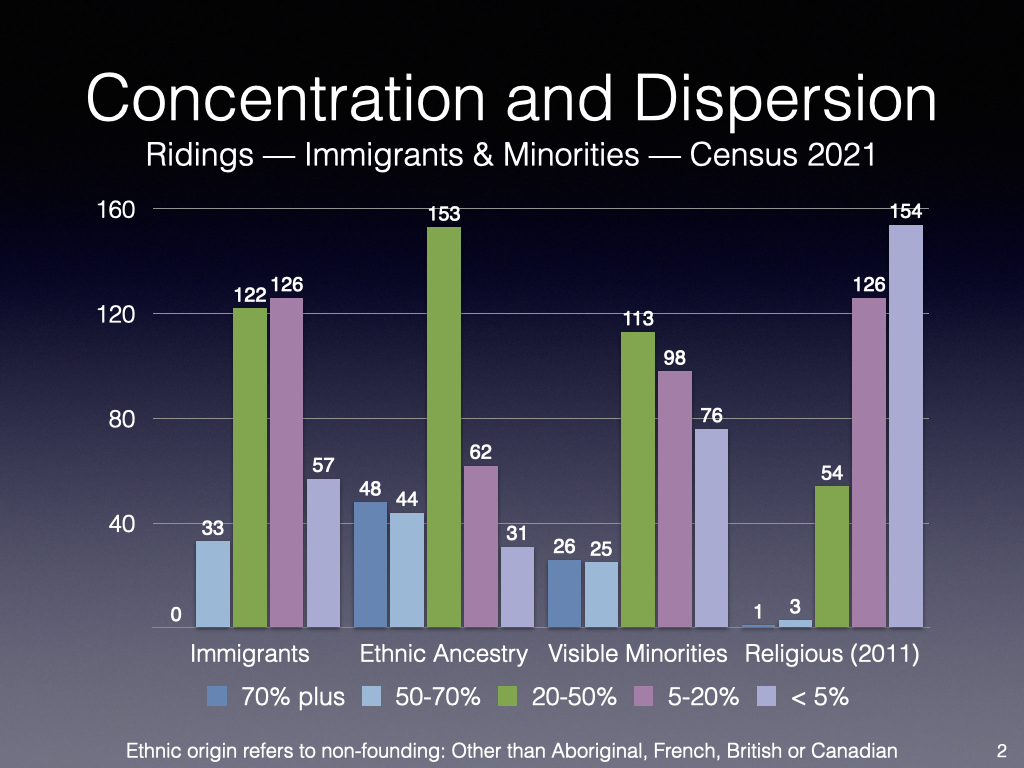
Figure 1 contrasts immigrants, non-founding ethnic ancestry or origin, visible and religious minorities by their percentage in ridings, highlighting the large number of ridings with significant population shares of each group.

Figure 2 highlights the growth of ridings where visible minorities form a significant share of the population. The number of ridings in which visible minorities form a majority of the population has increased from one in ten (33) in 2011 to close to one in six (51), reflecting high and increasing levels of immigration. Moreover, the number of ridings with significant numbers of visible minorities (20 to 50 percent) has also increased significantly, reflecting ongoing immigration to smaller urban and suburban centres.

While the number of ridings with between five and 20 percent visible minorities has stayed relatively constant, the percentage of visible minorities has increased by five percent or more in about half of these ridings.

In contrast, there are only four ridings in which religious minorities form the majority, an increase of two compared to 2011, with 54 ridings in which religious minorities are between 20 and 50 percent, an increase of 12 compared to 2011.

Figure 3 shows ridings with a majority of visible minorities by province, with Ontario, British Columbia and Alberta having the greatest share and increase compared to the 2016 census. These are all ridings where one can expect all parties to run visible minority candidates, most likely from the largest visible minority group in the riding.

However, virtually all provinces have an increased number of ridings with between 20 and 50 percent visible minorities, and thus ridings where visible minorities are a significant constituency.

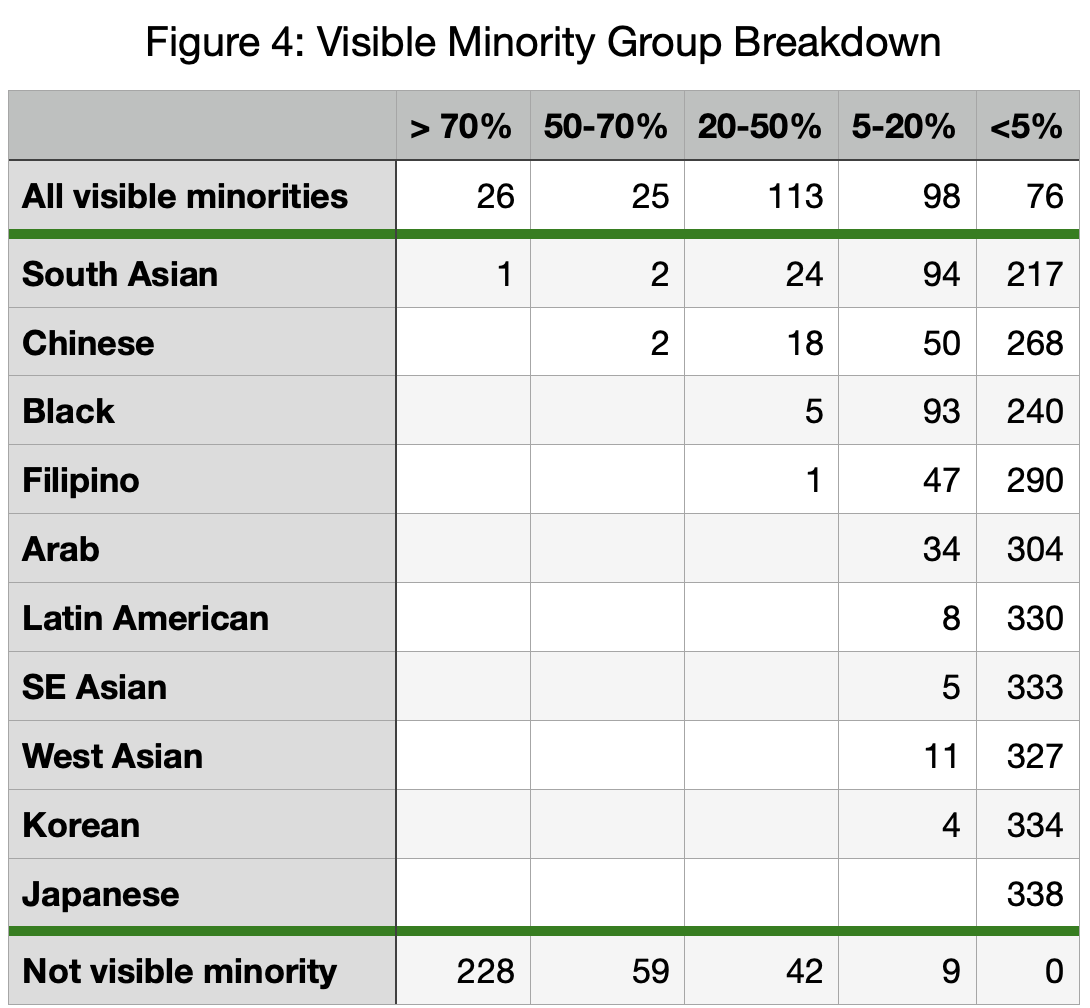
Figure 4 provides the breakdown by visible minority group, with only South Asians and Chinese being a majority of the population (five ridings out of 51 – Brampton East and West, Surrey-Newton for South Asians, Markham-Unionville and Richmond Centre for Chinese), highlighting that most visible minority majority ridings have a mix of visible minority groups. All visible minority groups are present in ridings with between 5 and 20 percent, save Japanese.

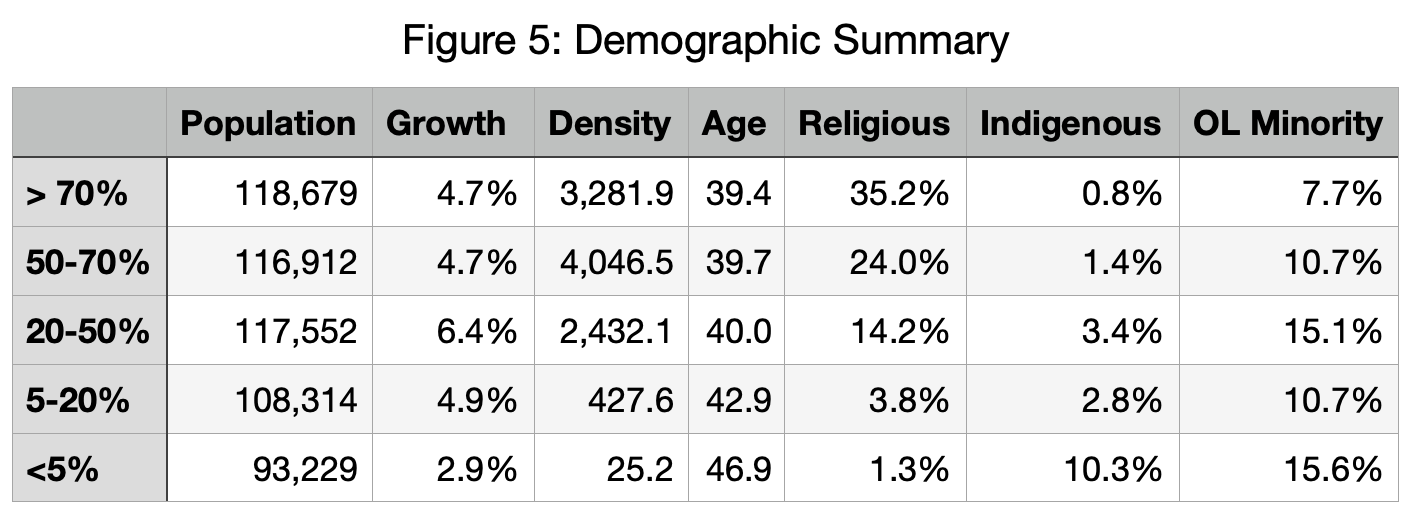
Demographic and socioeconomic characteristics vary by percentage of visible minorities as shown in Figure 5.

Visible minority majority ridings are characterized by larger populations, moderate growth, high densities, a younger population, a higher percentage of religious minorities and a low percentage of Indigenous peoples, with the reverse generally being the case for ridings with less than 20 percent visible minorities, highlighting the differences between rural and urban Canada. The highest growth occurs in ridings with 20 to 50 percent visible minorities, ridings that are increasingly diverse. The percentage of religious minorities correlates with the percentage of visible minorities. There is no overall pattern with respect to official language (OL) minorities.

As one would expect, the higher the percentage of visible minorities, the higher the percentage of immigrants and conversely, the lower the percentage of citizens given residency and other requirements as shown in Figure 6. The period of immigration highlights the contrast between earlier waves of immigration, largely European in origin and in low visible minority ridings, and later waves, largely visible minority, with an impact across all ridings, particularly in the last five years and in ridings with lower overall percentage of visible minorities.

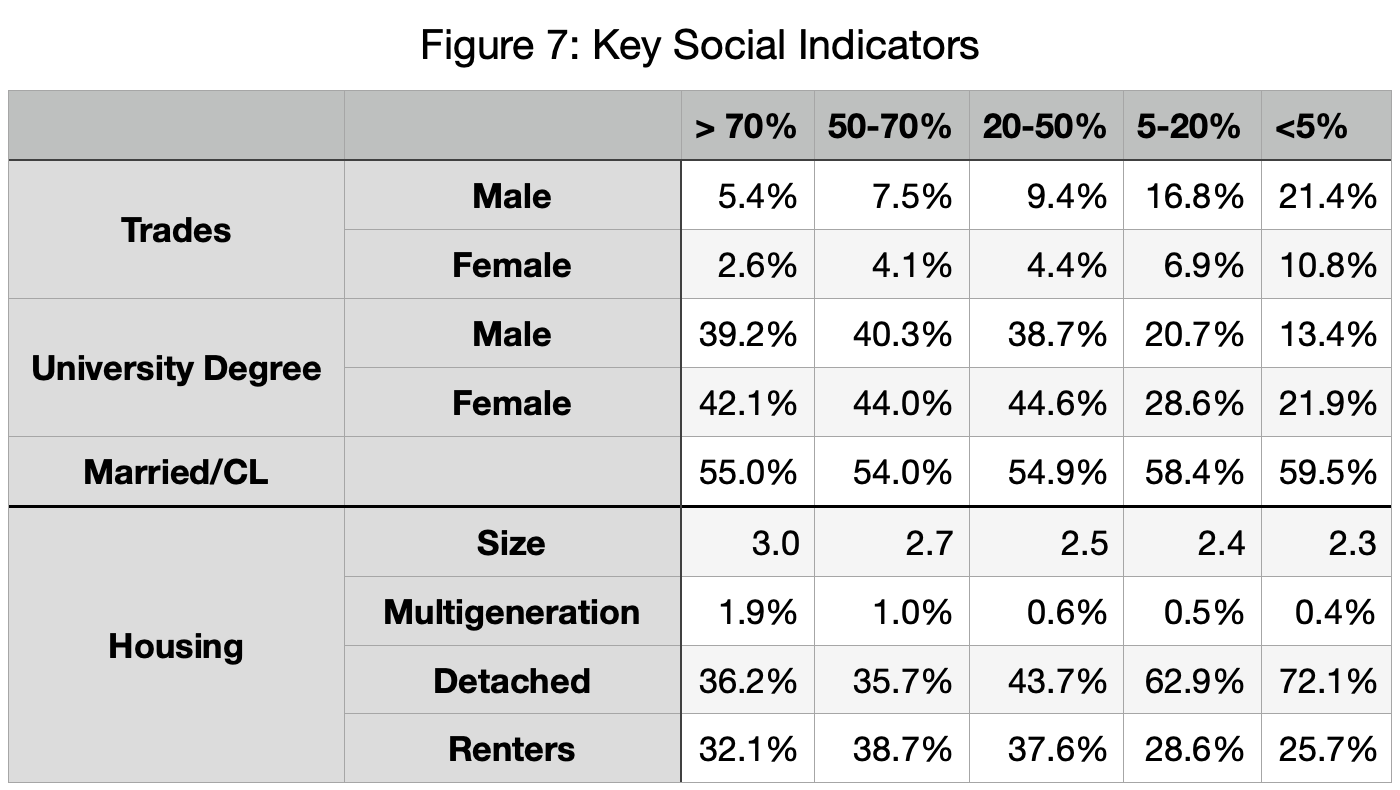
Figure 7 highlights educational attainment (trades and university degree, the percentage of married or common-law couples, household size, and whether residents form part of  multigenerational households, are in single-detached housing and the percentage of renters. Trades are more prevalent in ridings with fewer visible minorities and university diplomas more prevalent in ridings with more visible minorities. Women have higher rates of university degrees across all ridings.

Variations on marriage or common law between ridings are small. Household size directly relates to the percentage of visible minorities whereas the prevalence of single detached homes is inversely proportional. Renting is more prevalent in ridings with between 20 and 70 percent visible minorities.

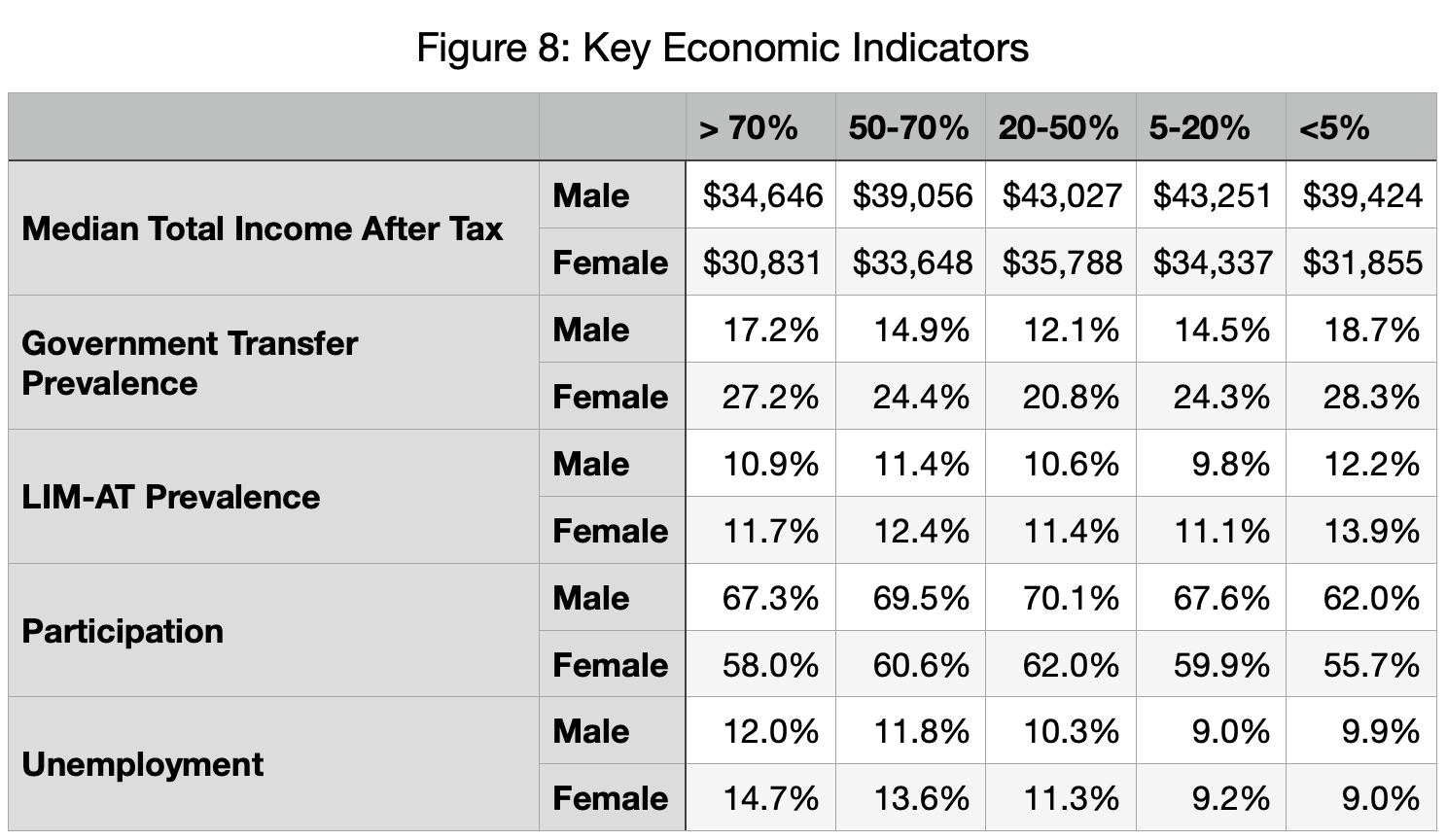
Figure 8 highlights median total after tax income, the percentage of government transfers and income along with participation and unemployment rates. In general, ridings with between 20 and 50 percent have the strongest economic outcomes save for unemployment rates which are lowest in ridings with fewer visible minorities. Outcomes for women are worse overall except with respect to unemployment in ridings with less than 20 percent visible minorities.

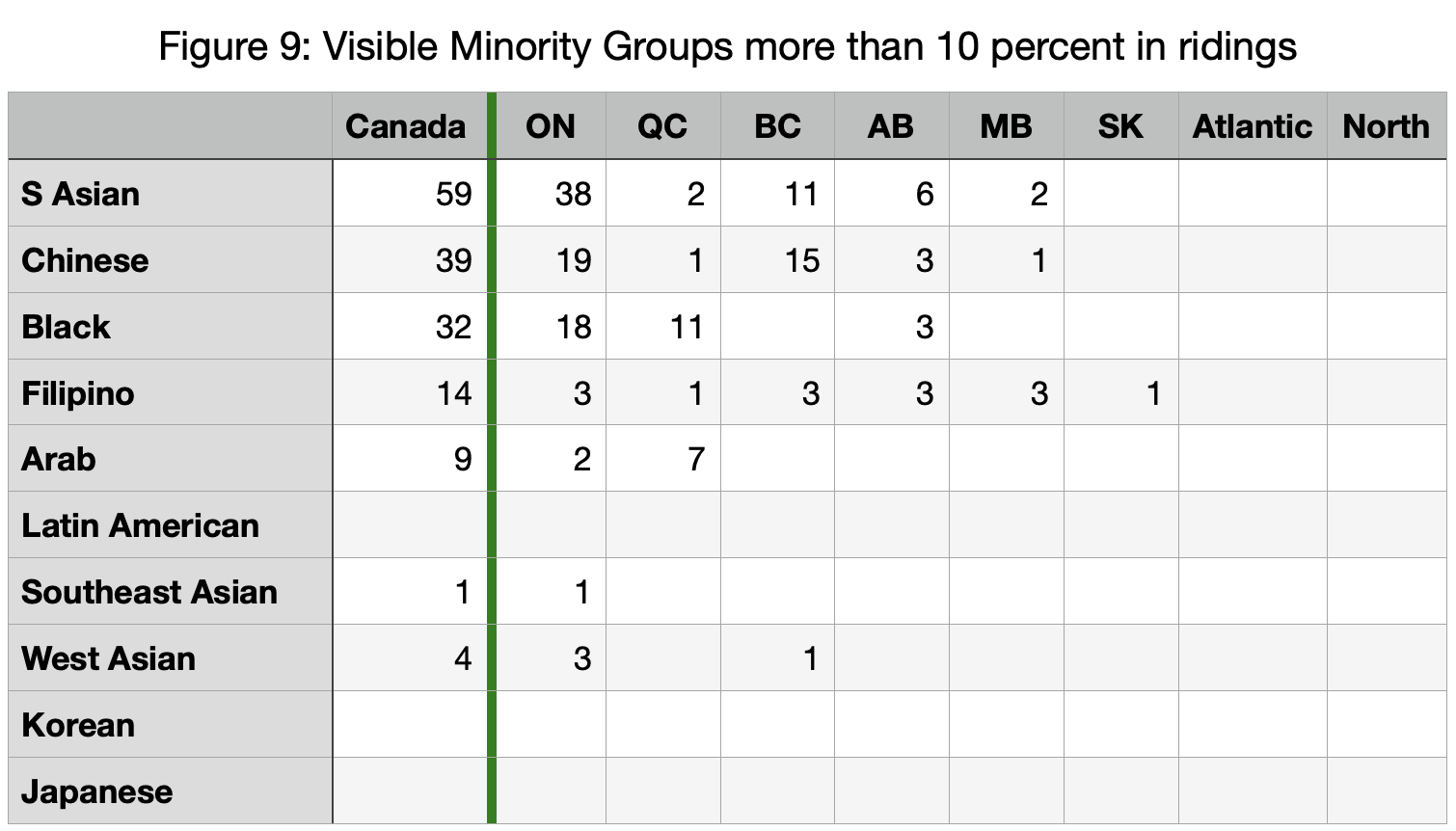
Turning to the political aspect and voter targeting, Figure 9 highlights the number of ridings where a visible minority group forms more than 10 percent of the population, broken down by province, again demonstrating the extent to which political parties need to address specific group concerns. Only Latin American, Korean and Japanese have no ridings with ten percent or more of the population; however, with a threshold of five percent, only Japanese have no ridings of significant concentration. Regionally, there are no ridings in Atlantic Canada and the North with one visible minority group forming 10 percent of the population but six ridings where one group forms more than five percent: three South Asian, two Black and one Chinese.

Figure 10 highlights the 190 ridings where a religious minority forms more than five percent of the population as a threshold of ten percent would exclude Buddhist and Indigenous spirituality. Most groups are concentrated in a number of ridings, with Muslims dispersed across the greatest number of ridings.

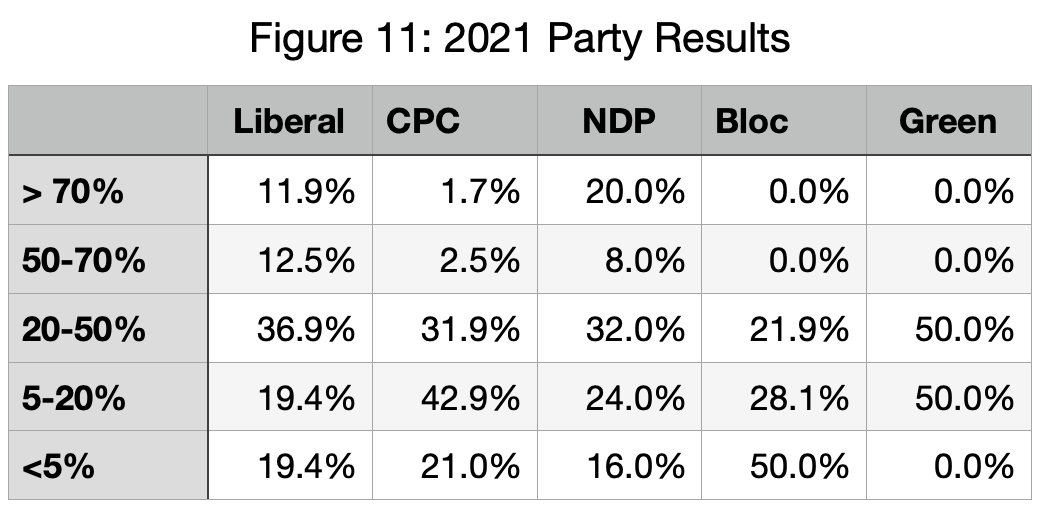
Figure 11 breaks down the 2021 election results, highlighting the relative strength of the Liberals and NDP in visible minority majority urban ridings and the relative strength of the Conservatives in ridings with between five and twenty percent visible minorities. Compared to the 2015 election, the biggest change was the increase in the relative share of NDP MPs in visible minority majority ridings and the Conservative and Bloc relative share increase in ridings with between 20 to 50 percent visible minorities. These ridings can flip; in 2011, the Conservatives won a majority of ridings with more than 50 percent visible minorities.

Concluding observations

All parties have candidate selection, policy and other electoral strategies to engage these communities and the ongoing increase in the number of visible minority candidates and MPs reflects these strategies. Substantively, there are no major differences in attitudes between immigrants and non-immigrants across a range of immigration-related issues.

While some visible minority groups have a tendency to vote for a particular political party, there is political diversity in all groups resulting in no party ignoring any group. Earlier waves of immigrants, mainly European origin, tend to lean Conservative compared to more recent waves, mainly visible minority, tend to lean Liberal.

Visible minority and immigrant groups are affected by perceived singling out or dog whistles, as the Conservatives learned to their cost in 2015, with the “barbaric cultural practices” tip line and the strength of the Liberal language “a Canadian is a Canadian is a Canadian” in response to the Conservative government’s citizenship revocation provision of C-24. Immigration-specific issues such as the ease of family reunification also play a role.

But in general, visible minority voters are more affected by overall campaign themes and issues, whether these be with respect to campaign tone, general concerns regarding the economy, housing, and healthcare, and largely follow the overall electoral trend at national and regional levels.

Riding characteristics impact upon voting patterns. Visible minority majority ridings have lower incomes and higher unemployment which generally play to left and left-of-centre parties. Similarly, larger family size and more multigenerational households in these ridings suggest that political parties target their messaging accordingly.

No major party is arguing against increased immigration, nor is any province except for Quebec. Public support is strong. Apart from administrative issues like backlogs and poor Immigration, Refugees and Citizenship Canada service, debates and discussion focus more on the practicalities and impact of immigration on housing affordability, healthcare stresses and infrastructure gaps. More recent commentaries are focussing on these negative impacts but in a non-xenophobic manner. After all, these issues affect immigrants and non-immigrants alike, helping to reduce polarization.

Methodology:

All data is from the Census profile given that it provides riding-level data. Indicators were chosen based on their pertinence. Non-founding ethnic ancestry includes all groups save for English, Scottish, Irish, Welsh, Canadian, French and Indigenous (Census allows for multiple responses). Electoral results data is from Elections Canada.

Andrew Griffith is the author of “Because it’s 2015…” Implementing Diversity and InclusionMulticulturalism in Canada: Evidence and Anecdote and Policy Arrogance or Innocent Bias: Resetting Citizenship and Multiculturalism and is a regular media commentator and blogger (Multiculturalism Meanderings). He is the former Director General for Citizenship and Multiculturalism and has worked for a variety of government departments in Canada and abroad and is a fellow of the Canadian Global Affairs Institute and Environics Institute. 

Source: The Political Impact of Increased Diversity: What the Census Shows

Watt: In 2023, Canadians deserve a grand vision from our political leaders

Watt notes the need for an actual plan how to address the impact of high immigration levels, which by its nature would require joint federal and provincial collaboration and much more medium and longer term policy and program measures:

A federal election in 2023?

Though far from a certainty, more and more, it feels like one. Federal minority governments have seldom endured more than a few years and the current Liberal-NDP agreement is unlikely to be an exception tothis rule.

If the plug is pulled and the current Parliament Hill tone continues, the election will be waged on decidedly pessimistic terms. Take, for example, Conservative leader Pierre Poilievre’s and Prime Minister Justin Trudeau’s recent exchange played out over the closing weeks of 2022.

To great effect, Poilievre has repeatedly asserted that “it feels like everything is broken in this country” — a message that resonates strongly with Canadians. At a year-end Liberal holiday party, Trudeau countered that “Canada is not broken.”

While Canada is far from broken, it’s time we acknowledged that there are significant cracks in the land and the current government’s continued approach of ignoring the legitimate concerns of families battling record inflation and a housing crisis can’t continue.

As Poilievre tells it, Justin Trudeau’s excessive spending, runaway deficits and second-rate commitment to infrastructure mean that a continued Liberal reign poses no less than an existential threat to our nation.

Trudeau’s challenge is that circumstances beyond his control — namely brutal economic conditions — make defending against Poilievre’s charges harder and harder. He is left, as many long-term governments are, selling a hypothetical alternative narrative of another kind of doom and gloom.

And so, Trudeau paints a sloppy picture of a Poilievre-inspired hellscape where you pay for groceries with Ethereum and carbon costs less than an FTX token.

Source: In 2023, Canadians deserve a grand vision from our political leaders

Pierre Poilievre thinks he can win over new Canadians. Here’s how he plans to do it.

Reasonable take and strategy and familiar to someone who worked in the Kenney years. Expect that the party has learned some lessons from its use of “barbaric cultural practices” in the citizenship guide and in the 2015 tippling. Minister Fraser’s comment is a bit ingenuous given the liberal record of responding (some would say pandering) to new Canadian voters:

A young Pierre Poilievre sits in front of a room of Conservative faithful and explains their party’s strategy for winning a majority mandate. 

That hasn’t happened yet. It’s 2009 and while the Tories have won two federal elections, they’ve remained in minority territory for three years. 

“We will win a majority if we appeal to naturally conservative-inclined voters and get them out to vote, and we turn small-c conservative immigrants into big-C Conservative voters,” the MP says in a video posted to the website of the Cable Public Affairs Channel.

“That’s the formula.”

More than a decade after former prime minister Stephen Harper pulled off that majority in 2011, Poilievre is the party’s leader. 

Since Harper’s four-year term, Conservatives have lost three straight elections to Prime Minister Justin Trudeau’s Liberals, with losses stacking up in Toronto- and Vancouver-area suburban seats, home to many visible minorities and new Canadians. 

If there’s one thing many in the party agree on, it’s the need for Conservatives to build support in such communities. But can Poilievre do it? 

Enter Arpan Khanna. This week, Poilievre tapped the Greater Toronto Area lawyer, who served as one of the co-chairs on his leadership campaign in Ontario, to co-ordinate outreach efforts.

Khanna was a political staffer for the man federal Conservatives credit most for making the inroads with immigrant communities that helped Harper along to a majority: Jason Kenney. 

Colleagues had nicknamed the former federal cabinet minister and Alberta premier the “minister of curry in a hurry” for spending his weekends darting to dozens of cultural events around Toronto and Vancouver.

Khanna said he sees the same drive in Poilievre, who visited the Toronto area multiple times, plus Vancouver in his first three months as leader, sometimes attending up to 15 events a day. He is planning visits with Chinese community groups in Markham, Scarborough, Vancouver and Burnaby to mark the Lunar New Year. 

The new leader has taken the idea of “building a Jason Kenney style of outreach” to heart, Khanna said. “He’s all into this. He understands the importance of it.”

The first step is showing up, he said.

“We recently were at someone’s backyard for a barbecue party with about 100 people from the Tamil community, just having a conversation about their issues.”

Poilievre has been hitting the road nearly every weekend. 

Often travelling with him are his two deputy leaders. Melissa Lantsman, who is Jewish and the party’s first openly lesbian member of Parliament, hails from Thornhill, just north of Toronto. Longtime Edmonton MP Tim Uppal, who is Sikh, became Canada’s first minister to wear a turban when Harper appointed him to cabinet in 2011. 

For the high-profile finance critic role, Poilievre picked former small business owner Jasraj Singh Hallan, who had been considered an at-risk youth after immigrating to Canada as a child. 

It’s stories like Hallan’s that Poilievre promotes, touting the promise of the Canadian dream. 

“It doesn’t matter if your name is Poilievre or Patel … Martin or Mohamed,” a video posted online shows Poilievre saying at a Diwali event in October. “If you’re prepared to work hard, contribute, follow the rules, raise your family, you can achieve your dreams in this country.”

Poilievre often points out that he married an immigrant Canadian. His wife Ana and her family were refugees from Venezuela. 

Tenzin Khangsar, who worked in Kenney’s office when he was immigration minister and assisted with the Tories’ outreach strategy, said Poilievre is setting an example for his caucus and the entire party. “And frankly shows to all Canadians that look, ‘this is a priority for me. This is not just something I’ll do during an election campaign.’”

Khangsar said that if step one is showing up, step two is following up with policy. 

Poilievre has promised to get provinces to speed up recognizing foreign credentials, one of his first policy announcements as a leadership candidate. He’s also railed against “gatekeepers” at the federal immigration department.

During a roundtable with ethnic community media convened during the race, Poilievre said immigrant and Conservative values are the same: “hard work, family, freedom, tradition.”

“Values upon which we need to build a future Conservative party.”

A roughly 50-minute video from the event shared on Facebook shows Poilievre offering more detail on his immigration policy ideas: expanding express entry, making it easier for temporary foreign workers to become permanent residents, improving immigrants’ ability to bring their parents to Canada to help with child care and expanding private sponsorship of refugees. 

He was emphatic in an interview with a Punjabi radio show last month: “The Conservative party is pro-immigration.” 

But the NDP’s immigration critic, Jenny Kwan, threw water on the idea, saying in a statement that the Harper government cut settlement services for newcomers and made family reunifications more difficult. 

Liberal Immigration Minister Sean Fraser didn’t wade into the Tories’ past, but in a statement said speaking to newcomers is the job of any political leader. 

“Newcomers are not a voting block to pander to. They are Canadians, and soon-to-be Canadians.”

But many Conservatives believe that the party’s approach to immigration issues lost them the 2015 election, as Tories pushed policies such as banning niqabs at citizenship ceremonies and establishing a tip line for so-called barbaric cultural practices. 

Lantsman and Uppal both publicly apologized for supporting what became known as the “niqab ban.” But Poilievre has defended the policy as simply requiring “that a person’s face be visible while giving oaths at citizenship ceremonies.” 

An internal review of the Tories’ 2021 election loss found the party’s image remained damaged among immigrant communities. 

Poilievre’s immigration critic, Tom Kmiec, said Conservatives believe in an “employer-driven immigration system.”

Asked whether they support the Liberal government’s plan to welcome a record-high number of permanent residents in the coming years, which includes a target of 500,000 by 2025, Kmiec said “the number is not as important as the customer-service experience.”

Kmiec, a Polish immigrant, said the federal immigration department is dealing with massive backlogs and out of control processing times. “It’s a total lack of compassion to over-promise what you can actually deliver.”

Andrew Griffith, a former director of multiculturalism policy for the federal government, predicted Conservatives will avoid attacking the targets for fear of being labelled xenophobic.

Griffith said he doesn’t perceive the party is skeptical about immigration, despite such views being historically present in its base. 

Source: Pierre Poilievre thinks he can win over new Canadians. Here’s how he plans to do it.

New group with Beijing links to promote friendly candidates in Canadian elections

So it continues:

On the face of it, the fledgling organization’s goals seem innocuous enough — to encourage Chinese-Canadians to run for elected office and vote in elections. The Chinese Council for Western Ontario Elections says it wants to be an “incubator” for candidates who support the community’s interests and educate newcomers about Canadian democracy.

But the council’s links to groups that are closely aligned with the Chinese government — and possibly to a Chinese police station here — are raising concerns amid growing debate about Beijing’s alleged interference in Canadian politics.The council — launched at a formal event in Mississauga on Sunday — is headed by businessman Guo BaoZhang.

Guo is also executive president of the Canada Toronto Fuqing Business Association, named after a city in China’s Fujian province. Its own website says it was set up under the guidance of the United Front Work Department (UFWD) — a branch of the Chinese Communist Party (CCP) whose mission is in part to extend Beijing’s influence worldwide.

The association is also named as the owner of units in a Markham, Ont., commercial building that media in China say is the site of one of three Fujian “police service stations” in the province. The same address is listed on the association website as its own location. The RCMP has said it’s investigating the stations, amid fears they could be used to intimidate Chinese expatriates here.

Two of the Fuqing group’s three honorary leaders are Weng Guoning and Wei Chengyi, the current president and honorary chair of the Confederation of Toronto Chinese Canadian Organizations (CTCCO), a group that has long worked with the city’s Chinese consulate to promote Beijing’s positions on contentious issues.

The CTCCO’s Weng is also featured in multiple photographs of the election council’s launch event on Sunday and gave a speech at the ceremony. Someone by his name is listed as a director of another, related elections group.

There’s no indication the council will break any law, but Chinese-Canadian critics of the CCP say the connections are clear, and worrying.

“They are by and large an extension of the apparatus of Beijing,” alleged Karen Woods, founder of the independent Canadian Chinese Political Affairs Committee. “I definitely think this is an area where our security agencies or the police should pay close attention.”

Woods once worked for a lobby firm that represented China’s Toronto consulate, before growing disenchanted with Beijing. Her association touts itself as being independent of China and opposed to foreign interference in elections.

“This really is like an ideological invasion,” said Jonathan Fon, a Toronto paralegal and outspoken critic of the Chinese government, about the new group. “I think that undermines our national security, our social security.”Guo could not be reached for comment by deadline Thursday.

But according to a Chinese-language news report on Sunday’s gathering, the council’s head said its goal was simply to “introduce Canadian democracy to the Chinese community, to help Chinese Canadians better understand Canadian elections, participate in the democratic process, and participate actively in elections.”

“We support candidates of any race, as long as they advocate democratic equality, oppose racial discrimination and support multiculturalism,” Guo is quoted as saying. “We are willing to share our network resources with them to help them gain recognition and support from Chinese voters.”The council was launched as China’s alleged interference in Canadian politics becomes a burning topic on Parliament Hill, with opposition MPs grilling the Liberals on the issue repeatedly recently.

Some of the attention was prompted by a Global News report that said the Canadian Security Intelligence Service had briefed the Prime Minister’s Office in January about a Chinese program that gave money to 11 sympathetic candidates in the 2019 election, using a member of the Ontario legislature and community groups as go-betweens.

Prime Minister Justin Trudeau has denied he received such a briefing and says outside experts have concluded the last two elections unfolded fairly, but accused Beijing of playing “aggressive games” with Canada and other democracies. And he reportedly raised interference in a brief meeting with Chinese President Xi Jinping on the sidelines of the G20 meeting in Bali. China rejects suggestions it has intruded in any way.

The Western Ontario election council was registered as a federal non-profit corporation earlier this year. It appears to be an offshoot of the Chinese Council for Canadian Elections, which was registered in 2019. An individual with the same name as CTCCO president Weng is listed as one of that group’s three directors. Another of the three has the same family name and address.

A Chinese-language mission statement by the council obtained and translated by Fon says the group will abide by this country’s laws and constitution

The council will “support incubating Chinese ethnic candidates to participate in the election,” says the statement, adding that it would also back candidates of other ethnicities “who are friendly to the Chinese community” and promise “political views beneficial to the Chinese community after being elected.”

The United Front Work Department that provided “guidance” to Guo’s Fuqing business group was greatly expanded under Xi’s leadership. While it reportedly works closely with diaspora groups to promote China’s interests on issues like Tibet, the Muslim Uyghur minority and Taiwan, it also has an eye on politics in foreign countries.

A leaked handbook for United Front cadres even touted the fact that the number of politicians of Chinese descent elected in Toronto had almost doubled between 2003 and 2006, and urged officials to “work with” them.

The CTCCO, meanwhile, has been a reliable ally of the Chinese government. It ihas defended Beijing’s crackdown on democracy protesters in Hong Kong, while working with the local consulate to promote Beijing’s stance on Tibet, try to bring its Confucius Institute to Toronto schools and celebrate the 70th anniversary of the People’s Republic. Beijing’s Overseas Chinese Affairs Office praised the group on its website.

Honorary chairman Wei himself shook hands with Xi at a 2019 event in Beijing. The CTCCO website includes a profile of president Weng by the “propaganda department and the United Front Work Department of the Fuqing Municipal Party Committee.”

With those sorts of connections, it’s hard not to be wary of the new election council, said Cheuk Kwan of the Toronto Association for Democracy in China.

“I’m highly suspicious,” he said. “I would not be surprised if the Chinese consulate or Chinese government is heavily involved.”

Source: New group with Beijing links to promote friendly candidates in Canadian elections

Douglas Todd: Ethnic politics is already a science in the U.S. It’s on the way in Canada

It already is well entrenched at the federal and provincial levels and candidate nominations and members of legislatures and electoral strategies indicate. Todd’s points are based on municipal elections, where the general absence of parties and more locally-based and less sophisticated data analysis prevails:

In the U.S. polls are run constantly into the political preferences of voters based on ethnicity, in addition to gender, age, religion and other demographics.

Race-based politics has long been established in multi-ethnic cities like Chicago, New York and Miami. American pundits have also analyzed how religion and ethnicity combine, particularly since 1960 when 80 per cent of Catholics of European descent voted for John F. Kennedy.

With people of Hispanic, Black and Asian origins now accounting for more than 80 million Americans, politicians are not the only ones who find it valuable to keep up with scientific polling.

Polls generally show two thirds of Hispanic Americans vote Democrat, while one third lean Republican. Only one in 10 Black voters are Republican and just 26 per cent of Asian-Americans. About one third of people of European descent cast ballots for Democrats, and just over half go Republican.

Canadians are more shy about how ethnicity connects to politics. We don’t often learn about surveys that probe how minority groups tend to think about political issues.

When I’ve asked Canadian politicians if their party conducts private polling on ethnicity, they all say, of course they do: Race-based strategies are crucial to any campaign. But no party has ever handed me their internal data.

Political scientist Shinder Purewal of Kwantlen Polytechnic University has had a similar experience. “I’ve spoken to a number of pollsters and they’re very reluctant to give ethnic numbers, while they’ll give numbers in general.”

One recent exception to this hands-off Canadian approach was a poll by YouGov, which revealed that Indo Canadians lean liberal-left. More than 38 per cent of respondents said last year they would cast a vote for the Liberals — twice the number that planned to go with the Conservatives.

This fall, a Leger poll for Postmedia detailed how ethnic groups would affect October’s tide-shifting elections in the cities of Vancouver and Surrey.

Understanding the hopes and fears of ethnic groups can be a big political deal. In the city of Vancouver, 44 per of the population is of European descent, 20 per cent is of Chinese descent and 14 per cent are of South Asian descent. Indo Canadians are the largest group in Surrey, at 38 per cent compared to 33 per cent who are of European descent.

The Leger poll found the eventual winner in Vancouver, Ken Sim, who highlighted how he would be the city’s first Chinese Canadian mayor, appealed to 21 per cent of those of European ancestry, 15 per cent of South Asian voters and 35 per cent of those with Chinese roots.

Meanwhile, defeated mayor Kennedy Stewart — who was the last of an amazing streak of seven Vancouver mayors in a row of Scottish ancestry — appealed to 12 per cent of European-descent voters, 21 per cent of Indo Canadians and only five per cent of those of Chinese background.

Surrey was a different scenario. There, the three mayoral candidates who received the most votes are of European ancestry: Brenda Locke, Doug McCallum and Gordie Hogg. McCallum, the incumbent, did best in the districts that are overwhelmingly Punjabi, Purewal said.

“That tells you that people are actually paying attention to what politicians have to say, what they stand for,” Purewal said. “Many don’t care what (ethnic) flock you’re from.”

In Vancouver, what issues drew voters to Sim?

Housing affordability came out the top worry when Leger’s respondents named their top three issues: But that concern ran equally across ethnic lines. 

Property taxes and spending were Vancouver residents’ third biggest issue, particularly since council had sharply increased both under Stewart’s guidance. Sim promised to be fiscally prudent, which would be important to ethnic Chinese voters, 36 per cent of whom cited taxation as a leading issue compared to 26 per cent overall.

Policing, public safety and crime was the fourth big issue. And Sim’s promise to hire 100 more police officers would have also played well with Chinese Canadian voters, 30 per cent of whom worried about crime compared to 25 per cent in general.

Sim also played down themes that Stewart and his council had pushed hardest — such as climate change, and especially social justice, equity and First Nations reconciliation. These were of low concern to all voters, particularly to those of Chinese background.

Such trends suggest to Purewal that, even while Sim often cited the scourge of anti-Asian racism and campaigned strongly through Chinese-language media outlets, he and his ABC party didn’t win simply because he was Chinese Canadian.

“I would say the vast majority voted for him because they agreed with his plan.”

What of Surrey, B.C.’s second largest city? South Asians in Surrey, many of whom are foreign-born, were significantly more likely to rank housing affordability as a top worry, at 56 per compared to 38 per cent of people descended from Europeans. And Indo Canadians were the least likely to zero in on homelessness.

Even though the Leger poll initially suggested Surrey mayoral candidate Sukh Dhaliwal was the favourite of South Asians, the support did not carry the day for him. Locke and McCallum, who came in a close second, were able to draw votes from both South Asians and those of European descent.

A similar lesson about the value of cross-ethnic appeal can be taken from growing Richmond, B.C.’s fourth most-populous city.

Mayor Malcolm Brodie has been winning elections there for 21 years, despite people of European ancestry now being only 20 per cent of the population, down to 40,000 from 68,000 in 2001. Purewal said Brodie has cultivated the loyalty of a solid portion of the 113,000 Richmond residents of Chinese origin.

Sometimes race-based politics can burst into controversy, as it did this fall in Los Angeles, where a national furor erupted after top Latino politicians were caught in a secret recording making crude, racist remarks about Black rivals and voters. Similar things can happen in Canada.

But for the most part, U.S. and Canadian politicians don’t appear to take advantage of ethnic-based data to manufacture wedge issues: They simply see ethnic differences, as well as similarities, as fundamental factors to understand.

Let’s hope most North Americans politicians try to balance their desire to appeal to voters from specific ethnic groups with a larger commitment to social harmony.

Source: Douglas Todd: Ethnic politics is already a science in the U.S. It’s on the way in Canada

Conservative Policies Linked to Higher Death Rates for Americans, Study Finds

Not that surprising. Not exactly pro-life policies:

November’s midterms will serve as a political referendum on a number of issues, from gas prices to gun safety legislation and more. “At the end of the day, it’s just politics,” you might think. But according to new research, social and economic policies are life-or-death matters for working-age Americans. Changing state policies to become more liberal will save hundreds of thousands of lives while shifting to conservative policies will cost them, a study published Wednesday in PLoS ONE finds.

The new study is one of a recent spate to look at the link between policy and an unexpected increase in deaths among working-age Americans. Compared to European countries and other Western peers, the rise in deaths among this population in the U.S. has been “alarming,” Jennifer Karas Montez, a sociology researcher at Syracuse University and the first author of the new research, told The Daily Beast. She and her co-authors looked at mortality rates for the leading causes of death over a period of 20 years, at a time when “dramatic changes in state policies” were occuring.

The link between more conservative or liberal state policies and events like cardiovascular deaths or suicides are clearer for some policies, like regulations around tobacco. More liberal environmental policies are linked to lower levels of air pollution and decreased rates of asthma and other respiratory problems that can increase one’s chances of dying, Montez said. Liberal labor policies, like an increased minimum wage, may put more money in workers’ pockets that they can spend on healthier food or medical care.

“We often don’t talk about economic policies as if they’re health policies, but the reality is they are,” she said.

Some of these policies took a few years to immediately affect mortality rates. Criminal justice reform, for instance, took at least three years to have significant effects on rates of death—Montez said this may be due to the fact that these policies may have a downstream impact on people’s lives and livelihoods, and not one immediately felt. Liberal firearm safety laws, on the other hand, resulted in a near-immediate decrease in suicide deaths.

Of the policies studied, only more liberal marijuana policies were associated with a decrease in life expectancy. Even so, other studies on the overall health effects of marijuana policies have been inconclusive, identifying benefits such as treatment for chronic pain but an increased risk of motor vehicle accidents.

If states had adopted liberal policies across the board, Montez and her co-authors calculated that 171,030 lives would have been saved in 2019 alone; on the flip side, conservative policies in all states would have led to an additional 217,635 working-age deaths.

Americans should realize that the decisions being made in state houses are becoming increasingly important to their own lives, Montez said.

“We’ve pointed the finger at opioid manufacturers, we pointed the finger at multinational corporations, but state policymakers have been given a free pass, and that’s a really critical oversight,” she said. “We need to make sure that we’re holding them accountable for the decisions that they’re making that affect how healthy and long we live.”

Source: Conservative Policies Linked to Higher Death Rates for Americans, Study Finds

Paul: When Diversity Isn’t the Right Kind of Diversity

Useful reminder that minorities are not monolithic in their political perspectives.

In many ways, it is a positive sign of civic integration when all groups participate in different political parties and formations, as is the case in Canada:

The death of Queen Elizabeth II has dominated headlines this month, homages to her reign and dissections of the Harry and Meghan situation unsurprisingly pushing other news aside, especially other stories from Britain.

But even amid all the pomp, one news item out of Britain has attracted curiously little attention. Liz Truss, the new Conservative prime minister, announced her cabinet, and for the first time ever, not a single member of the inner circle — what’s referred to as the Great Offices of State — is a white man.

The home secretary, Suella Braverman, is the daughter of Kenyan and Mauritian immigrants. The mother of the foreign minister, James Cleverly, emigrated from Sierra Leone. The new chancellor of the Exchequer, Kwasi Kwarteng, was born to Ghanaian parents.

Did the left break into applause? Were there hosannas throughout progressive Twitter heralding this racial, ethnic and gender diversity as a step forward for society?

Not exactly.

Instead, the change was dutifully relayed, often with caveats. “Liz Truss’s cabinet: diverse but dogmatic,” noted The Guardian. The new team was criticized as elite, the product of schools like Eton, Cambridge and the Sorbonne. These people aren’t working class, others pointed out. They don’t sufficiently support the rights of those seeking asylum in Britain or policies that address climate change.

“It’s a meritocratic advance for people who have done well in education, law and business,” Sunder Katwala, the director of British Future, a think tank that focuses on issues of immigration, integration and national identity, told CNN. “It’s not an advance on social class terms.”

This is an interesting criticism. “Meritocratic,” used here in a pejorative sense, means based on ability and achievement, earned through a combination of talent and hard work. Traditionally, merit served as the primary consideration in hiring, but some people today see the very systems that confer merit as rigged, especially against minorities. In an effort to rectify that imbalance and to diversify the work force, particularly for leadership positions, it has become common practice in hiring — in the business and nonprofit worlds, as in government — to make racial or ethnic diversity a more significant factor.

The trouble is that for many of the same people, ethnic and racial diversity count only when combined with a particular point of view. Even before Truss’s cabinet was finalized, one member of the Labour opposition tweeted, “Her cabinet is expected to be diverse, but it will be the most right-wing in living memory, embracing a political agenda that will attack the rights of working people, especially minorities.”

Another Labour representative wrote: “It’s not enough to be a Black or ethnic minority politician in this country or a cabinet member. That’s not what representation is about. That’s actually tokenism.”

The implication is that there’s only one way to authentically represent one’s race, ethnicity or sex — otherwise you’re a phony or a pawn. Is that fair?

I’m not politically aligned with Truss on most issues. This is not the team I’d choose to lead a country reeling from Covid, an energy crisis and the twin disasters of Boris and Brexit. But it’s Truss’s prerogative to hire people with whom she is ideologically aligned and who support her policies.

And one has to assume those new hires joined her willingly and with conviction. Surely they, like all racial and ethnic minorities, are capable of the same independence of mind and diversity of thought as white people — some people Trumpy, other people Bernie.

Nor are they the first conservative minorities to hold top positions of power in Britain. It was the Conservative Party that, despite widespread antisemitism, first appointed a Jewish-born prime minister, Benjamin Disraeli, in 1868. The three women who have served as prime ministers — Margaret Thatcher, Theresa May and now Truss — have all been Conservatives. The former prime minister David Cameron was no lefty, yet he made a point of emphasizing ethnic and racial diversity among his leadership appointments.

Black and other ethnic minority voters in Britain aren’t uniformly lefty, either. They cast 20 percent of their votes for Conservatives in 2019.

A similar diversity of political opinion among minorities exists in the United States, and it bewilders the left. An increasing number of Latinos are running as and voting for Republican candidates. Donald Trump got more votes from ethnic minorities in 2020 than he did in 2016. Black men’s support for Trump increased by six percentage points the second time around. And that was after the murder of George Floyd, an event assumed to have galvanized many minority voters on the left.

In his prescient 1991 book, “Reflections of an Affirmative Action Baby,” the law professor Stephen Carter decried many of the assumptions around diversity nascent at that time — including the notion that racial or ethnic minorities are expected to think as a group, not as individuals. He bemoaned “the idea that Black people who gain positions of authority or influence are vested with a special responsibility to articulate the presumed views of other people who are Black — in effect, to think and act and speak in a particular way, the Black way — and that there is something peculiar about Black people who insist on doing anything else.”

It’s been three decades since Carter’s book was published, and that lamentable assumption has only gained purchase. As he pointed out then: “In an earlier era, such sentiments might have been marked down as frankly racist. Now, however, they are almost a gospel for people who want to show their commitment to equality.”

It seems odd to have to point out in 2022 that “diverse” hires can be every bit as diverse on the inside as they are on the outside. For every Ketanji Brown Jackson, you’re liable to get a Clarence Thomas. Apparently, we need constant reminders that there’s more to people than meets the eye and that in multicultural societies, an acceptance of diversity must be more than skin deep.

Source: When Diversity Isn’t the Right Kind of Diversity

Martin: It’s not the economy, stupid. It’s the media

Good column, if depressing:

A major change in the communications system, Canadian media guru Marshall McLuhan opined long ago, “is bound to cause a great readjustment of all the social patterns, the educational patterns, the sources and conditions of political power, [and] public opinion patterns.”

Given the vast changes that have marked the digital age, McLuhan can hardly be accused of overstatement. The online world is corrosively altering social and political “patterns,” to use the McLuhan term, and destabilizing democracies.

In using internet platforms, fringe groups and hate generators have multiplied exponentially and contributed to an erosion of trust in public institutions. They’ve prompted violent threats against public officials, driven the United States into two warring silos, and cast a pall of negativity over the public square seldom seen.

The contamination of the dialogue is such that even agreement on what constitutes basic truths has come to be tenuous. Talk of a post-truth America is no joke. Canada isn’t there yet, but give the disinformation amplifiers more scope and we soon might be.

Bill Clinton’s campaign strategist, James Carville, may have had it right back in the 1990s when he famously declared why voters had soured on then-president George H.W. Bush: “It’s the economy, stupid.” But not today. Now it’s the media, stupid. It’s the upheaval in the communications system. A media landscape gone rogue.

Economic woes get regulated. Not so the convulsions in our information ecosphere. We have no idea how to harness the hailstorm. Few efforts are being made. Calls for regulation are greeted by a great hue and cry over potential freedom-of-speech transgressions.

So broadly has media influence and power expanded that a cable network has become the avatar of the Republican Party. Donald Trump has maintained support from the GOP because he has what Richard Nixon didn’t. A kowtowing TV network and a Twitter following, until he was blocked, of 90 million users.

Social media platforms, like an upstart rival sports league, have served to delegitimize, if not disenfranchise, traditional media, magnifying public distrust. There is still a lot of high-quality journalism around, including at this awards-dominating newspaper. But traditional media no longer set the tenor of the national discussion and help shape a national consensus as in times past. Enfeeble a society’s credible news and information anchors, replace them with flotsam and you get, as per the United States, a country increasingly adrift.

The trajectory of media decline is worth recalling. From having just two or three television networks in Canada and the U.S. that aired news only for an hour or so a day, we have expanded to around-the-clock cable networks. News couldn’t fill that much airtime so opinion did – heaps of it. Hours of tirades filled the airwaves from reactionaries like Rush Limbaugh. Then the internet took hold, along with the invasion of unfiltered social media, awash in vitriol.

And so the chaff now overwhelms the wheat.

Mainstream media got in on the act, lowering their standards, contributing to the debasement of the dialogue by running ad hominem insults on comment boards from readers who hide behind pseudonyms. As I’ve noted before, that’s not freedom of speech. That’s fraud speech.

The crisis in our information complex is glaring, but it isn’t being addressed. Mainstream media, while demanding transparency everywhere else, rarely applies this standard to itself. Despite its exponential growth in importance, the media industry gets only a small fraction of the scrutiny that other powerful institutions do.

Big issues go largely unexamined in Canadian media. We rarely take a critical look at the unfettered rise of advocacy journalism, the impact of the disappearance of local newspapers or media ownership monopolies. There are precious few media columnists in this country. There is no overarching media institute to address the problems.

Conservative leadership candidate Pierre Poilievre’s big idea is to deprive us of one of our longest-standing national institutions. He would gut the CBC, defund it practically out of existence. At his rallies, he’s cheered on lustily for the promise, an indication of the low regard held by many in the population toward the mainstream media.

Any kind of media-reform drive always runs up against the freedom of speech barrier. The Trudeau government has passed Bill C-10, but it was diluted and will have little regulatory impact. A Commission on Democratic Expression, whose membership included former Supreme Court Justice Beverley McLachlin, has recommended regulatory reforms to curb social media’s impact. But it didn’t receive anywhere near the attention it deserved.

There’s a vacuum. Ways to regulate the destabilizing forces in the new communications paradigm must be found; ways that leave no possibility of control by political partisans. Such ways are possible and, given the ravages of the new media age, imperative.

Source: It’s not the economy, stupid. It’s the media

Shafiq: Getting more immigrants to run for political office means paving the way for active citizenship

Of interest:

Kristyn Wong-Tam just made history. They became the first Asian-Canadian, queer and non-binary person elected to Ontario’s legislature, significantly expanding the vision of what a politician looks like in this country. 

Wong-Tam joins other recent Canadian political “firsts,” including Bhutila Karpoche, the first elected official in North America of Tibetan descent, and Doly Begum, the first Bangladeshi-Canadian woman to be elected in the country.

These leaders share a similar journey that first began with meaningful participation in civic engagement and community work, increasing political engagement, culminating in the decision to run for elected office.

Why does the political engagement of people like Wong-Tam, Karpoche and Begum matter so much?

Seeing a visibly powerful immigrant woman or non-binary person in an elected, decision-making role in the political arena empowers others to do the same. Emerging research shows that visibility and role modelling increases political participation and results in a stronger democracy from more diversified representation.

Higher engagement from traditionally under-represented groups strengthens our social and political fabric, creating more trust in our institutions. This is particularly important now when our democracy is threatened by the rise of misinformation, low voter turnout and a growing distrust of authorities and institutions.

So how can we support civic engagement for future trailblazers like Wong-Tam? In our recent academic and community-based research on civic participation of immigrants and refugees in Canada at the Journeys to Active Citizenship project, we found that the journey starts first with community involvement.

We found newcomers often become involved in local community-based activities before engaging in formal political activities like voting and running for office.

Unsurprisingly, voter turnout amongst immigrants is higher the longer someone has been in Canada. Elections Canada even acknowledges that language can be a barrier to voting for new Canadians, alongside a lack of knowledge of the election process, less awareness of early voting opportunities and a lack of trust in the Canadian political process. However, once immigrants and refugees overcome settlement challenges, they are more likely to vote.

Immigrant women in the past have been less likely to participate in formal political processes, however, they are much more likely to participate in informal civic activities, which often act as a critical stepping-stone to formal participation through actions like voting, writing to your elected representative or running for office.

So how can we bolster opportunities for formal and informal civic participation for immigrants, and particularly immigrant women?

Building social networks has been proven to strengthen integration and belonging and is critical to help immigrants establish trust with fellow Canadians. Enabling community engagement is another key piece of the puzzle.

Creating and strengthening civic education and engagement that is tailored to newcomers, particularly women, would be important to build the skills, knowledge, capacity and confidence that would enable newcomers to engage more fully in Canada’s democracy.

In our interviews and group sessions with immigrants and refugees over the last two years, we found three recurring sources of community: religious spaces, community-based organizations and post-secondary institutions. 

Academic literature also tells us that community-based organizations may act as mobilizing agents for civic participation. Delivering programs through these places of community important to newcomers in their early years would be critical for success.

Supporting programs that bolster opportunities for newcomers to engage in a wide range of community initiatives, such as volunteering, participating in local community events, or joining social clubs, will help foster a sense of trust and belonging in our political processes and institutions, and ultimately lead to an increase in formal political participation.

Canada already benefits greatly from the labour of immigrant women — something that has been highlighted throughout the pandemic. It’s time we included their voices, expertise and experiences in the political process. 

Source: Getting more immigrants to run for political office means paving the way for active citizenship

For campaigns looking to turn support into seats in Parliament, not all ‘ethnic communities’ are created equal

Good overview, particularly the comments by Erin Tolley. Looking forward to the October Census release that will allow for updating of riding demographics in terms of ethnicity, visible and religious minorities:

The conventional wisdom around the potential for so-called “ethnic voting blocs” to swing elections is often overstated, but “parties make a big mistake when they perceive of immigrant and racialized voters as a passive voting bloc,” says political science professor Erin Tolley.

“These are groups that are very politically savvy, and they understand their power and they understand the influence that they can have,” said Tolley, the Canada Research Chair in gender, race, and inclusive politics at Carleton University. “And when parties don’t repay that support by listening to their preferences or by acting to advance their interests, they take that power and they put it elsewhere.”

As communities like Italian Canadians, Sikh Canadians, and Tamil Canadians have each become more established in the country, Tolley said they have “flexed their political muscles” in order to get what they wanted from political parties, and to enter the political arena themselves.

Political commentator Seher Shafiq, a co-founder of the non-profit group Canadian Muslim Vote, said when Canadian Muslims became more organized and dramatically increased their voter engagement levels in the 2015 elections, “all of a sudden we had politicians engaging way more than before.”

“There’s a definite change of tone that wasn’t there before 2015,” said Shafiq, referring to how politicians “at all levels” now pay attention to hate crimes against Muslims, and even to Muslim holidays. Shafiq credits the grassroots organizing of several groups, including the National Council of Canadian Muslims, with increasing community engagement and with grabbing the attention of political parties.

“There’s something to discuss and maybe something to study about how a community that wasn’t organized in the way that the Sikh community or the Ismaili community is, became organized, and how that coincided with a dramatic shift in tone from government, and even to some extent action,” said Shafiq.

Sherry Yu, an associate professor at the University of Toronto who studies multiculturalism, media, and social integration, emphasized the role that so-called ethnic media play in helping new immigrants learn about the Canadian political process, and in boosting civic participation among older immigrants who have been more passive.

Yu told The Hill Times that many communities, especially those that are more concentrated in particular regions, have media outlets and community organizations that reinforce each other, with so-called ethnic newspapers being distributed at local shops and grocery stores.

The Conservatives and the Liberals each had periods during the 20th century where one or the other seemed to have the upper hand in terms of support from immigrants, with John Diefenbaker’s and Pierre Trudeau’s governments each assembling different coalitions of support over the decades. With the Conservatives in the midst of a leadership race, supporters have debated whether the party is doing enough to appeal to a broader voter base and which leadership hopeful can lead the way on that front, with the now-booted Patrick Brown regarded as the candidate who had the strongest ties to cultural and religious minorities.

Tolley said the idea of appealing to immigrant and racialized voters “is not a new idea. It didn’t start with Patrick Brown, it didn’t start with Jason Kenney.”

Under prime minister Stephen Harper and then-immigration minister Jason Kenney, the Conservative Party of Canada made a concerted effort to appeal to communities that had previously been assumed to be steadfastly Liberal out of gratitude for Pierre Trudeau’s policies on immigration and multiculturalism.

The strategy was reportedly born out of a conversation between Harper and Kenney over a pint at the Royal Oak Pub on Bank Street in Ottawa in 1994, when Kenney tried to convince the future prime minister that Canada’s conservative movement should seek out immigrants who shared its values.

Kenney’s packed schedule of visits to temples, gurdwaras, festivals, and other community events, which began during the party’s first mandate when he was secretary of state for multiculturalism and Canadian identity, earned him the moniker of “secretary of state for curry in a hurry.”

But Tolley warned against giving too much credence to sweeping narratives about so-called ethnic voting blocs. “Immigrant and ethnic and racialized Canadians have policy preferences just like other Canadians,” she said, “and they vote for a variety of reasons. Their ethnic or immigrant background is not the only reason and it’s often not even the most important one.”

“Community by community, some parties and some leaders have had success, but when you look in the aggregate, what they gain from appealing to one community, they often lose from a separate community.”

Tolley said there is “a bit of urban lore” that tends to oversimplify the Harper Conservatives’ success at reaching out to immigrant and racialized voters. She said the Conservatives saw a boost in their vote share from particular communities, mostly non-racialized communities such as Ukrainian Canadians, Italian Canadians, and Jewish Canadians, but that they saw very little support from other groups, such as Muslim Canadians.

“And in the aggregate it didn’t really budge the vote share one way or the other when you compare with other parties.”

Drilling down further into the data, Tolley pointed out that the Conservatives under Harper “were quite successful with Cantonese-speaking Chinese Canadians, but less so with Mandarin-speaking Chinese Canadians.”

Political campaigns looking for cohesiveness and geographical concentration

Carleton University political science professor Erin Tolley says former prime minister Stephen Harper used Senate appointments to boost his party’s connection with immigrant communities. Photograph courtesy of Erin Tolley

For political campaigns looking for the most efficient way to turn community support into seats in Parliament, not all immigrant or racialized communities are created equal. Political organizers are focused on winning ridings, said Tolley, more so than they are interested in expending finite resources on driving up their party’s overall vote count. 

“Groups that are larger in number and are cohesive, and who reside together in a district, that’s the kind of group that a party is going to find very attractive,” said Tolley, “because that is how elections are won and lost.”

“I think that’s why you see parties tapping into Ismaili Muslims or Punjabi Sikhs,” said Tolley, “rather than courting the Black vote.”

“One reason that I think parties have largely ignored Black Canadians is that they don’t know how to tap into that community because it is such a diverse community. It is geographically spread out. And that stands in the way of parties figuring out how to effectively organize within that community.”

Shafiq concurred, saying that the fact that much of the Muslim Canadian community is concentrated in key swing ridings in the Greater Toronto Area contributed to creating a perception among political parties “that this is a community they need to engage.”

Sikh Canadians have been elected in ridings where the community forms a substantial segment of the local population, such as Vancouver and Surrey in British Columbia and Brampton and Mississauga in Ontario, with growing populations around Edmonton and Calgary also electing Sikh MPs.

After the 2015 election, The Globe and Mail reported there were 17 Sikh Canadians elected to Parliament–16 for the Liberals, including several who made it in cabinet, like International Development Minister Harjit Sajjan (Vancouver-South, B.C.)–making Punjabi the third-most spoken language in the House of Commons.

The fact that multiple political parties have sent Sikh Canadians to Parliament means those MPs can serve as a pool of knowledge within their community, and an avenue through which the parties can make further connections within the Sikh community. The first waves of Ukrainian Canadian MPs and Italian Canadian MPs filled the same functions in previous decades.

But getting that first generation of leaders elected to Parliament remains a challenge for communities that are less established on the Canadian politician landscape. In these cases, said Tolley, political parties look to other elected bodies, such as school boards, to identify up-and-coming leaders.

As prime minister, Harper also used Senate appointments as a way “to cultivate leadership within the party,” said Tolley, appointing community leaders to generate goodwill and to make inroads into communities that did not yet have representation in the House of Commons.

For all the complaints that Harper’s government shut out the press during its time in power, it actively sought out and tracked political coverage in the so-called ethnic press. In 2012, Kenney told Alec Castonguay, then chief political reporter for L’actualité, that he made it a habit to read translated versions of the ethnic press every morning, before reading the mainstream national papers.

When Kenney was immigration minister, The Canadian Press reported that the department of citizenship and immigration spent $745,050 between March 2009 and May 2012 tracking media coverage by so-called ethnic or multicultural outlets, including assessments of campaign events and perceptions of Kenney.
Yu, whose research includes comparisons of the Vancouver Sun and the Vancouver Province with two local Korean community newspapers, said this media monitoring was an acknowledgement of the significance of ethnic media, but said she was concerned that the information gathered was not shared with the public.
“Until the release of these documents, we did not know that monitoring was done,” said Yu.

Maturation of a community leads to new demands

As communities become more established in Canada, however, they may no longer be satisfied by a meet and greet with a prominent politician or with a promise that a party will consider a particular policy proposal, said Tolley. “There is definitely evidence of a transformation in political behaviour among community members. Some refer to it as a maturation of one’s political involvement.”

The Tamil community has had several decades to establish itself in the political landscape. It has elected MPs from different parties in ridings in Scarborough, Ont., including Liberal MP Gary Anandasangaree (Scarborough-Rouge Park, Ont.), a three-term MP first elected in 2015 who has served as president of the Canadian Tamils’ Chamber of Commerce. Many Tamil Canadians arrived in Canada in the 1980s, during the civil war in Sri Lanka.

Ken Kandeepan, a member of the advisory board for the non-partisan Canadian Tamil Congress (CTC), told The Hill Times that “many people in the Tamil community are actively involved in politics” and that community members have provided “considerable support” to various parties at the federal level.

But, he added, it was “a pet peeve” of his that once the elections are over, “the quid pro quo is somewhat absent.” As an example, Kandeepan mentioned appointments to directorships for government corporations.

“It is unfortunate that once the elections are over, these kinds of outreach are not made to the Tamil community. In asking them for appropriate candidates and individuals to be appointed to these positions, at least to the best of the knowledge of the CTC.”

“So the attitude seems to be ‘please help us,’ and ‘thank you for your help, and we’ll see you at the next election.’” 

Tolley said Kandeepan’s comments are an example of a case where members of a particular community “don’t want to be seen as just a set of votes.”

“They want to be taken seriously, they want to have a voice. They want to be able to run and be successful as candidates supported by parties. And when they are successful, they would like to see themselves in positions of influence. Parties that don’t take that seriously learn pretty quickly that, sure these are potential voting blocs in one’s favour, but they can also shift alliances.”

Source: For campaigns looking to turn support into seats in Parliament, not all ‘ethnic communities’ are created equal