Ifill: The curse of unserious politicians

Interesting mix of self-awareness in terms of her positions/identity/branding and obliviousness of how some of her critiques (e.g, “ludicrous solutions,” “misinformation”) can also be applied to her along with many politicians, not just the arguably more egregious example of Pierre Poilievre:

I’m back as the award-winning journalist and economist you’ve come to love or hate, but can never dismiss. In my fourth year of this column, I will continue to regale you with news stories and political and policy analysis from an intersectional feminist lens, which also includes analyses of equity and power. I’m not your friendly gender-based analysis plus co-ordinator who is only interested in the check-box exercise of performative policy analysis done by the federal public service. No, policy and politics need to be done differently for the times we are in and beyond.

We are not a homogenous society, and post-pandemic, we need better tools to determine how we’re heterogenous and how to deliver public services to disparate communities. Politics continues to be a white man’s game, and policy decisions continue to be made by people who lead homogenous lives and lifestyles of privilege. If we are not centring the vulnerable and marginalized—i.e. those without power—we’re doing politics and policy wrong. The results of that are growing chasms of inequalities that will upend society and polarize our politics, which one can observe is already happening.

Unfortunately, in these serious times we are besieged by unserious people who have been instrumental in the memeification of politics and political discourse. And this is dangerous.

In his 1976 book, The Selfish Gene, Richard Dawkins defined a meme: “Memes (discrete units of knowledge, gossip, jokes and so on) are to culture what genes are to life. Just as biological evolution is driven by the survival of the fittest genes in the gene pool, cultural evolution may be driven by the most successful memes.” However, an internet meme does not mutate according to evolutionary standards of random change and Darwinian properties; it is made to deliberately be manipulated through the creativity and purpose of the creator. In both instances, the resulting effect would be to go viral.

For the 2018 Ontario provincial election—the one in which the Ontario NDP could not capitalize, and the Ontario Liberals collapsed—much of the success of the Progressive Conservatives had been predicated on the success of Ontario Proud, a meme factory. It was given credit, though without much evidence, by Ontario news media for its alleged success in dethroning Kathleen Wynne’s Liberal party. It did so through the creation of memes and other online content, as reported by the Toronto Star: “It unabashedly promoted Doug Ford’s Progressive Conservatives in last spring’s Ontario election, using social media to create viral videos and memes that mercilessly mocked Wynne before shifting to attack the NDP once polls showed the premier’s party cratering.”

In contrast, its sister organization, Canada Proud, has not been able to scale this effect nationally. The organization wanted to replicate its success for then-Conservative Party leader Andrew Scheer, only we all know how that turned out. More recently, founder of Ontario Proud and Canada Proud, Jeff Ballingall, was the digital director of councilman Brad Bradford’s ignominious run for mayor of Toronto. Ballingall’s candidate ended that run with only 9,254 votes, or 1.3 per cent. In the June 26 election, Bradford made himself into a caricature with his insistence on filming himself holding a Jamaican patty all under the auspices of his digital director.

Unfortunately, meme culture has ushered in the rise of unserious people. People who can’t be taken seriously every time they open their mouths because what they propose are ludicrous solutions to important problems, and thereby wasting our collective time. Typically, their brand of unseriousness is coupled with misinformation and based on irrelevant contextualization, bigotry, and general asininity. Imagine how far we could’ve gotten on climate change policies had we not been held back by unserious people. Imagine how far along we’d be as a society if we didn’t have these time-wasters holding us back. It’s maddening and frustrating.

The most unserious person in Canadian politics is Pierre Poilievre. After revealing himself to be a capable politician, through his victory speech after his Conservative leadership win last fall, one would think he would’ve continued along that trajectory. But unserious people can’t be serious for long. Instead of building political capital, he squandered it by reducing himself to his own meme, much like Bradford. His showing at Calgary’s Stampede, which showcased a new look—one without glasses, pumped up, and photographed alongside homophobes—demonstrated the lengths Conservatives will go to alienate the general voting public. They will then whine and complain about imaginary media bias against them when all Canadians can see throughout social media is their latest bigoted attack. What’s dangerous about this is the platforming and integration of bigotry, misinformation, and general farcical nature of Poilievre’s brand of politics. He’s not here to solve problems, like a serious person committed to the betterment of all in this country. In contrast, he’d rather sully his assumed intellect for the next viral moment like the shallow, unctuous man he’s shown the Canadian public he is.
Source: The curse of unserious politicians

As the Canadian population passes 40 million, fast-growing provinces gain relatively fewer seats in Ottawa 

Will accentuate regional tensions over time:

When Canada’s population hit 40 million last week, it was a reminder that representation in the House of Commons will have to keep pace with the growing country. But although the number of MPs from Alberta and Ontario could grow over the next 20 years, those provinces risk becoming even more underrepresented as special clauses protect other provinces, such as Quebec.

Last month, the Journal de Montréal published a series of articles claiming Quebec will eventually become “trapped” by Ottawa and lose political power as immigration rates increase in the rest of the country.

“Quebec will find itself drowned in a sea of 100 million Canadians by the end of the century, if the massive immigration targets announced by the Trudeau government last fall materialize,” it said, referring to Ottawa’s plan to welcome as many as 500,000 immigrants a year in 2025. Premier François Legault said this was a threat to Quebec and the French language.

Even though the 100-million figure came from the Century Initiative advocacy group, not the federal government, Canada is well on its way to this kind of growth and could exceed 50 million people within the next 20 years.

Demographic growth, already overwhelmingly dependent on immigration, will be even more so as the population ages and birth rates remain low across all provinces, explained Marc Termote, an associate professor of demography at the University of Montreal.

Because Quebec’s share of immigration is and will likely remain much lower than its share of the Canadian population – the province is considering increasing its immigration target to 60,000 a year, about half of what it needs to keep up with the rest of the country – “Quebec will continue to lose demographic weight, and therefore political weight,” Prof. Termote said.

The Constitution requires that the number of seats in the House of Commons be recalculated every 10 years to reflect changes in Canada’s population according to the representation formula, which takes into account demographic growth and special clauses.

Under current law, provinces don’t lose seats – even when their share of the population falls. At the same time, the number of MPs is restricted by the formula, so fast-growing provinces gain relatively few seats.

“Quebec is ever so slightly overrepresented at the moment, but that’s going to become a flashpoint over the coming years if Quebec doesn’t grow faster than it has been,” said Richard Johnston, professor emeritus at the University of British Columbia’s department of political science.

In late 1997, as Canada was about to reach 30 million people, Ontario had 11.3 million residents while Quebec had 7.3 million, British Columbia had almost four million, Alberta had 2.8 million and Nova Scotia stood at fewer than a million.

During that year’s federal elections, Canadians voted in 301 electoral districts, carrying Prime Minister Jean Chrétien’s Liberal Party to a second majority government. At the time, Ontario had 103 seats, Quebec 75, B.C. 34, Alberta 26 and Nova Scotia 11.

That meant Ontario, even though it had the highest number of seats of any province as the country’s most populous, was underrepresented in Parliament. The same was true of B.C. and Alberta, while Quebec was slightly overrepresented and Nova Scotia more so.

Seats added in 2013 to Ontario, B.C. and Alberta as a result of the last decennial revision did not match their fast population growth, as Atlantic provinces, along with Manitoba and Saskatchewan, remain overrepresented in today’s 338-seat Parliament.

This dynamic will continue when Parliament grows to 343 seats, following the 2021 census, which should come into force in September.

Quebec, initially set to lose one riding with the revision, will keep 78 seats. Mr. Legault pushed back against the planned reduction at the time, saying that “the nation of Quebec deserves a certain level of representation in the House of Commons, regardless of the evolution of the number of inhabitants in each province.”

The federal government obliged and passed a bill amending the Constitution Act last year. It provided that no province can have fewer MPs than it had in 2019, which could lead to severe distortions in the decades to come.

According to Statistics Canada, the country’s population could hit the 50-million mark by 2043 if current immigration levels stay in place. In projections released last year, a high-growth scenario put it at 52.5 million people 20 years from now.

Under that scenario, Ontario (projected to reach 21.1 million), Alberta (7.2 million) and B.C. (7.4 million) would continue to outpace other provinces, while Quebec (10.2 million) would be left behind, like Atlantic Canada.

The number of MPs for the fastest-growing provinces would go up, but that would be unlikely to cause a fundamental shift in Ottawa under the current rules, UBC’s Prof. Johnston said, because of the embedded protections in the representation formula. “In fact, the underrepresentation of Ontario, Alberta and B.C. is probably going to get worse,” he said, even as their numbers of MPs grow. “The critical question is whether the rules are politically sustainable.”

Using today’s rules to compute what this would mean for the 2040s’ Parliament, Quebec, Manitoba, Saskatchewan and the Atlantic provinces would keep their current numbers of MPs even as their demographic weight continues to decrease and more ridings are added to other provinces, for a total of 362.

It would mean that Alberta, set to reach 13.6 per cent of the population in 2043 under a high-growth scenario, would claim 44 seats (or 12.2 per cent of the ridings), while Quebec – whose population growth alone would warrant a diminished number of seats if not for the fact that it is protected, like other overrepresented provinces, by special clauses – will keep 78 seats (21.5 per cent) for 19.4 per cent of the country’s population. Ontario would claim 131 seats (36.2 per cent) for 40.3 per cent of the population.

The representation formula, however, is not immutable, and changes could induce faster growth in ridings during the next two revisions, as happened after the 2011 census under Stephen Harper’s Conservative government in an attempt to “compensate for what was a systematic drag on the representation of the fastest-growing provinces,” Prof. Johnston said.

But demographic changes not only influence the number of seats in Parliament but many other resources as well. “Federal transfers – related to equalization, health care, postsecondary education, social assistance, child care – depend directly on the number of each province’s inhabitants,” Prof. Termote said. “As Quebec’s share in the total Canadian population will continue to decline, Quebec’s share in the total federal transfers will necessarily also decline.”

Source: As the Canadian population passes 40 million, fast-growing provinces gain relatively fewer seats in Ottawa

Ie: Minority representation in the House won’t improve without better data

Interesting idea, having the Library of Parliament collect and present data on visible minorities. But having the Library use the analysis of analysts like Jerome Black, Erin Tolley, myself and others, however tempting, is unlikely to be accepted by MPs.

Self-identification in their parliamentary bios would be a better approach, but again would require MP consent

Not sure, of course, that this would result in any substantive change or more accurate numbers:

One of the fundamental purposes of the House of Commons is to represent the diversity of interests, identities, and values of Canadian society.

In 2021, Canadians elected 53 members of Parliament of racialized-minority background, 15.7 per cent of the House of Commons. These represent the highest number and share for minority representation in Canada’s history, but a significant representational deficit remains. The 2021 census indicates that 26.3 per cent of Canadians were “visible minorities,” the standard Statistics Canada term for “persons, other than Aboriginal persons, who are non-Caucasian in race or non-white in colour.” About 20 per cent of Canadian citizens are of racialized background.

Racialized persons in Canada are not evenly distributed across the country, of course. Ninety-five per cent live in a “census metropolitan area,” urban centres of 100,000 people or more. Indeed, in two of Canada’s largest cities, the white population is the minority: 42 per cent in Vancouver and 41 per cent in Toronto.

Because racialized Canadians are concentrated in urban centres, we will tend to be under-represented. Scholar Jerome Black suggests that, as of 2016, 41 of 338 ridings (about 12 per cent) were “minority-majority,” in which visible minorities constituted more than half of the population. In these ridings, parties have been more and more likely to recruit racialized candidates.

However, 109 ridings are more than 95 per cent white. Thus, even though a record 18.2 per cent of 2021 candidates were visible minority, many were running in ridings where there were multiple minority candidates. In Markham-Unionville, for example, all four major party candidates were of racialized status. Many other ridings in the Toronto region, metro Vancouver, and Calgary had similar slates of all or mostly all minority candidates.

Equitable minority representation in Canada’s House of Commons is about both demonstrating a commitment to fundamental values and substantive representation of the diverse needs and interests of Canadians. However, there are no easy solutions. A truly comprehensive, systemic path to improving minority representation needs to consider the roles of electoral systems, party recruitment practices, and other processes outside the halls of the House of Commons.

For the purposes of this series on parliamentary reform, the question, then, is: can anything be done within the bounds of Parliament and its processes?

One small but important step would be to improve the collection of information about the lack of minority representation in the first place. For instance, the Library of Parliament’s database of parliamentarians, Parlinfo, provides information on all MPs and Senators since Confederation, in 1867, including gender and occupation, but not ethnicity or racialized status.

The Library of Parliament provides research and information to parliamentarians and their staffers. Thus, the absence of information on minority representation in Parlinfo suggests lack of interest on the part of parliamentarians rather than deliberate oversight. Nonetheless, given the relatively small number of visible-minority MPs elected in Canada’s history and the fact that scholars such as Jerome Black have already compiled this information, adding it to Parlinfo should be relatively straightforward. The benefit of demonstrating at least modest institutional recognition of racialized status as an important representational concern would surely outweigh the costs of such an effort.

Unfortunately, Parliament itself has shown little concrete interest in this concern. I searched for the term “minority representation” in both the House of Commons and Senate debates from the 41st Parliament (2011-2015) onwards. I found only 13 mentions of the term in the House. None of them concerned the House’s own role and what it could do better. Rather, the mentions mostly related to arguments about electoral and Senate reform – implications for minority representation of different election processes and changes to the way Senators are chosen.

The story is much the same in Senate debate, and searches of committee proceedings in both chambers produce little further evidence of interest. While not an exhaustive search, what I have seen leads me to conclude that parliamentarians have been largely averse to considering their own role in the problem of minority representation, preferring instead to focus on the possibilities, however implausible, of external systemic fixes.

Some of this lack of interest may be complacency about our incremental progress and self-congratulatory belief in Canada as a welcoming, multicultural mosaic. Another reason could be tied to the fact that the political-intellectual class in Canada – opinion-makers and shapers in academia and the media, for example – are significantly more ethnically homogenous than the Canadian population.

The most recent Canadian Newsroom Diversity Surveyconducted by the Canadian Association of Journalists, for instance, reports that “most newsrooms continue to not be representative of the communities they serve.” Minority persons are concentrated in a few large outlets and are less likely to be in full-time leadership positions.

My investigation of diversity in my own field reveals embarrassingly few racialized scholars studying Canadian politics, with less than four per cent of permanent faculty members in departments of political science across Canada. Astonishingly, some larger departments themselves have more white men than there are racialized Canadian politics scholars in the whole country!

The media and academia do not solely determine what is important to parliamentarians, of course, but they do play significant roles in shaping the agenda and the ideas underlying political debate. The lack of diversity in media and academia means that the interests and lived experiences of racialized Canadians are less visible within our political discourse than they should be. It is unsurprising, then, that Parliament and parliamentarians seem so uninterested.

In 2010, a Canadian parliamentary delegation participated in, and signed onto, an Inter-Parliamentary Union statement called the Chiapas Declaration. The declaration committed consenting parliaments to debate and adopt plans to improve minority participation, among other actions. These plans, the declaration states, should include measures such as requiring all legislation to include impact assessment on minorities, regularly discussing minority issues and mainstreaming such issues into parliamentary work, particularly within committees, and allocating resources to provide dialogue spaces for racialized persons and groups within House processes.

Our House of Commons has not followed up on these commitments in any meaningful way. It has not, for instance, created even a committee with a mandate to focus on issues of racialization and minority exclusion, when such a committee is assumed to exist in the Chiapas Declaration. There has been minimal attention to minority representation in debate or committee: what little there is has been focused on external fixes or representation in civil society or the public service rather than in the House itself.

As the Canadian delegation’s report on the declaration reflects, our position has been one of self-satisfaction that because there are no explicit discriminatory laws in Canada preventing minorities from participating in politics and because of the progress we have made, there is not much more we should be doing.

Yet, as this series on parliamentary reform shows, the representational legitimacy and democratic quality of the House of Commons should not be taken for granted. Equitable minority representation and inclusion must be accepted as a core responsibility of the House rather than being considered someone else’s problem.

Source: Minority representation in the House won’t improve without better data

Phillips: Justin Trudeau has not learned from Hillary Clinton’s infamous ‘deplorables’ gaffe

Good advice:

Remember Hillary Clinton’s “basket of deplorables?”

She came up with that peculiar turn of phrase in September, 2016, when she was campaigning for the U.S. presidency against Donald Trump. Half of Trump’s supporters, she declared, were among those deplorables — people who are “racist, sexist, homophobic, xenophobic and Islamophobic.”

There were plenty of reasons why Clinton lost to Trump, but pretty much everyone agrees that dismissing maybe a quarter of American voters as racist, sexist, etc., was one of them. Even Clinton conceded the point in the end. In her memoir of the campaign, “What Happened,” she said she regretted handing Trump “a political gift” by insulting millions of well-intentioned (but wrong) voters.

The lesson — a pretty basic one, you’d think — is that while it’s fine to attack your opponent it’s hardly ever fine to attack their supporters. In the end, you’re after their votes. Not all of them, certainly. Some will never be won over, and some no doubt will be “deplorable” in one way or the other.

But you want to persuade the persuadables, and tarring them with labels like racist and sexist is bound to push people away, not bring them over to your side. At least, that’s how it turned out for Clinton, with tragic results for the United States and the rest of us as well.

In light of that, what to make of Justin Trudeau’s most recent diagnosis of what’s fuelling support for his Conservative rival, Pierre Poilievre?

In a revealing interview with the Star’s Susan Delacourt, the prime minister was eager to take on Poilievre. Trudeau, Delacourt wrote over the weekend, accuses the Conservative leader of “whipping up the anger to appeal to those Canadians who are nostalgic for a country that worked well for them, maybe not so much for others.”

In Trudeau’s words: “He’s playing and preying on the kinds of anger and anxieties about some Canada that used to be — where men were men and white men ruled.”

This is red meat for Poilievre and his core supporters, so it was no surprise to see him jump right on those words. The Conservative leader posted a three-minute video, one of those, “Hey Justin” jobs he’s become so expert at, accusing Trudeau of saying “the reason you claim you’re so unpopular with Canadians is that Canadians are racist.”

So, basic fact check: is that what Trudeau said? Certainly not. Is Poilievre distorting his words for crass political advantage? Of course. 

But is there something to what Poilievre says? Well, kind of. Trudeau didn’t say Canadians are racist; he didn’t even say Poilievre’s supporters are racist. But he did link Canadians’ anger and anxieties to something that could reasonably be interpreted as racist — a fond memory, or nostalgia as Delacourt put it, for a once-upon-a-time Canada where “white men ruled.”

At this point there are people who will be thinking something along the lines of: Right on, Justin. That’s what Poilievre’s really all about. Good for you for “calling out” him and his sleazy supporters. 

To those people, all I would say is — fine, go ahead and think that. But to Trudeau and those around him I would say — don’t go there. If you didn’t actually cross the line into accusing Conservative supporters of being racist, you did edge up to it and took a good look.

Trudeau is actually very thoughtful on these issues. After living through the pandemic and the convoy protests he’s had plenty of opportunity to reflect on what animates the anger across the country — including the fury directed at him personally.

He’s quite right that many people are upset at the way society has changed, and not always for good reasons. But his job isn’t to be a political analyst; it’s to manage that change in a way that unites people and brings as many as possible over to his side. 

To succeed at that, he needs to take on board the lesson Hillary Clinton learned the hard way. Don’t insult people on the other side. It’ll only come back and hit you in the face.

Source: Justin Trudeau has not learned from Hillary Clinton’s infamous ‘deplorables’ gaffe

Diversity lags in provincial and territorial legislatures but is improving

My latest analysis:

How does diversity in the provincial and territorial legislatures compare with diversity in the federal Parliament? Federal Parliament diversity has been tracked systematically since 1993 by Jerome Black, but little comparative analysis has taken place at the level of the legislatures. This analysis aims to fill that gap by contrasting the most recent elections with the previous ones for all provinces and territories, looking at the percentage of women, visible minorities and Indigenous Peoples elected among the total of 772 provincial and territorial legislature members.

Just as diversity in the federal Parliament has increased over time, the last two provincial/territorial election cycles have shown an increase in diversity in most legislatures.

For a benchmark, the percentage of visible-minority citizens from the 2021 census is used rather than the percentage of visible-minority residents. This narrow approach reflects the fact that only citizens can become members of legislatures, whereas the population approach recognizes that non-residents also participate in supporting candidates and political parties. For Canada, visible minority citizens make up 21.4 per cent of the total population, compared to 26.5 per cent for all visible minorities, but there is considerable variation among provinces.

Table 1 compares overall representation to citizens. Underrepresentation of women ranges from almost 30 per cent in Newfoundland and Labrador to only four per cent in Quebec. Underrepresentation of visible minorities ranges from nine per cent in British Columbia to around five per cent or less for other provinces. Nova Scotia is the only province with greater representation of visible minorities (seven per cent) than their share of the population, in part because of a significant African Nova Scotian population. Underrepresentation of Indigenous Peoples ranges from a high of 14 per cent in Saskatchewan to two per cent in Ontario, Quebec and Prince Edward Island, with only Nunavut, not surprisingly, having representation reflecting the population.

https://e.infogram.com/2023-01-griffith-figure-1-1hmr6g7r3vmpo6n?live?parent_url=https%3A%2F%2Fpolicyoptions.irpp.org%2Fmagazines%2Fjanuary-2023%2Fdiversity-lags-in-provincial-and-territorial-legislatures-but-is-improving%2F&src=embed#async_embed

Table 2 contrasts representation at both the member and cabinet levels, highlighting overall representation of women, visible minorities and Indigenous members. Given that governments often factor diversity into cabinet formation, the third set of columns assesses the degree that provincial and territorial governments have compensated for underrepresentation of their caucus. It is clearly the case with Alberta for both visible minorities and Indigenous members, and for Ontario in the case of visible minorities. It is striking that Saskatchewan and Manitoba cabinets have not done so for both visible minorities and Indigenous Peoples, whereas it is less surprising that Quebec has not done so for visible minorities.

https://e.infogram.com/2023-01-griffith-figure-2-1hnq410ejrv0k23?live?parent_url=https%3A%2F%2Fpolicyoptions.irpp.org%2Fmagazines%2Fjanuary-2023%2Fdiversity-lags-in-provincial-and-territorial-legislatures-but-is-improving%2F&src=embed#async_embed

Table 3 contrasts the most recent provincial and territorial elections with the previous election. Representation of women increased in all provinces save Alberta, Ontario, and Newfoundland and Labrador. Similarly, representation of visible minorities remained stable or increased in all provinces save Newfoundland and Labrador. However, Indigenous Peoples’ representation decreased or remained stable in all provinces save Manitoba, Newfoundland and Labrador, and The Northwest Territories.

https://e.infogram.com/2023-01-griffith-figure-3-1h984wor7jl9z6p?live?parent_url=https%3A%2F%2Fpolicyoptions.irpp.org%2Fmagazines%2Fjanuary-2023%2Fdiversity-lags-in-provincial-and-territorial-legislatures-but-is-improving%2F&src=embed#async_embed

Table 4 examines the intersectionality between gender and visible minorities. Visible minority women members made up a larger share of the total number of visible minority members than their respective non-visible minority counterparts, and by 9.5 per cent overall. Notable exceptions are Alberta, Saskatchewan and Yukon. (Provinces with no visible minority members are excluded.) In short, visible minority women were more likely to contribute to greater gender diversity in most provinces.

https://e.infogram.com/2023-01-griffith-figure-4-1h984wor7jeyd6p?live?parent_url=https%3A%2F%2Fpolicyoptions.irpp.org%2Fmagazines%2Fjanuary-2023%2Fdiversity-lags-in-provincial-and-territorial-legislatures-but-is-improving%2F&src=embed#async_embed

While there is no clear political alignment between parties at the provincial/territorial levels, table 5 attempts an approximate ideological lens between left-leaning, centrist and right-leaning parties. Left-leaning parties have the strongest representation of women, visible minorities and Indigenous Peoples followed by centrist parties for women and visible minorities. Right-leaning parties have lower representation for all groups save men.

https://e.infogram.com/2023-01-griffith-figure-5-1h9j6qgery0n54g?live?parent_url=https%3A%2F%2Fpolicyoptions.irpp.org%2Fmagazines%2Fjanuary-2023%2Fdiversity-lags-in-provincial-and-territorial-legislatures-but-is-improving%2F&src=embed#async_embed

Provincial and territorial legislatures, like the federal Parliament, have considerable underrepresentation of women, visible minorities and Indigenous Peoples with the exceptions noted above. In general, greater diversity can be found in parties leaning left compared to parties leaning right. However, compared with the previous election, representation is improving for women and visible minorities in most provinces and territories, with a more mixed record for Indigenous Peoples.

For the four largest provinces, Quebec has the least underrepresentation of visible minorities and Indigenous Peoples while British Columbia has greatest underrepresentation of visible minorities and Alberta has the greatest underrepresentation of Indigenous Peoples.

The 2021 census has highlighted an ongoing increase in immigrants and visible minorities. Parties at the provincial level, like their federal counterparts, are clearly taking this into account in their candidate selection and campaign strategies. The increase in representation, while uneven and partially dependent on which party wins an election, indicates the degree to which this is so.

Methodology

Women, visible minorities and Indigenous Peoples are identified through name, photo and biographical analysis. MLA lists come from provincial and territorial election organizations and legislatures. 

For the ideological lens, we classified parties as follows, recognizing that there is considerable variation among the provinces:

Left-leaning: NDP, Québec solidaire, Parti québécois, Green

Centrist: Liberal, Independent Liberal, Independent

Right-leaning: Conservative, CAQ, UCP, Saskatchewan Party, B.C. Liberal (now B.C. United), People’s Alliance

Source: Diversity lags in provincial and territorial legislatures but is improving

The Political Impact of Increased Diversity: What the Census Shows

The 2021 census highlights the growth in immigrants, visible and religious minorities. The political impact will continue to play out at the riding level, further reinforcing political party efforts to attract voters from these groups. This article provides a detailed analysis of diversity at the riding level, with the percentage of visible minorities and key demographic and socio-economic characteristics of these ridings.

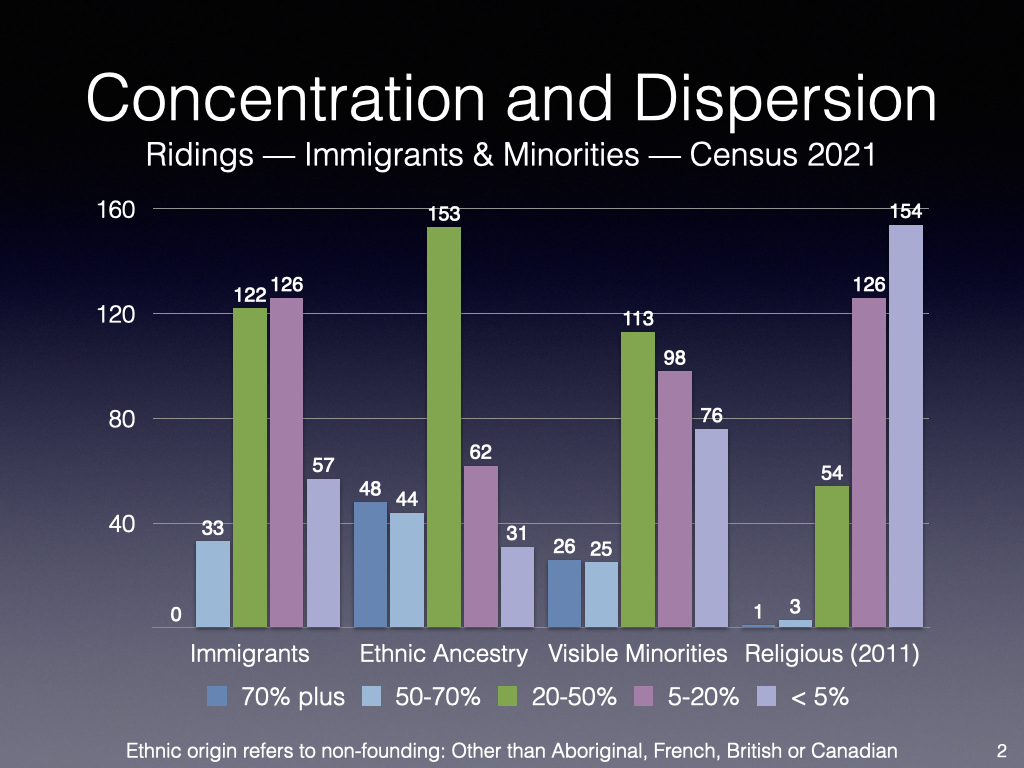
Figure 1 contrasts immigrants, non-founding ethnic ancestry or origin, visible and religious minorities by their percentage in ridings, highlighting the large number of ridings with significant population shares of each group.

Figure 2 highlights the growth of ridings where visible minorities form a significant share of the population. The number of ridings in which visible minorities form a majority of the population has increased from one in ten (33) in 2011 to close to one in six (51), reflecting high and increasing levels of immigration. Moreover, the number of ridings with significant numbers of visible minorities (20 to 50 percent) has also increased significantly, reflecting ongoing immigration to smaller urban and suburban centres.

While the number of ridings with between five and 20 percent visible minorities has stayed relatively constant, the percentage of visible minorities has increased by five percent or more in about half of these ridings.

In contrast, there are only four ridings in which religious minorities form the majority, an increase of two compared to 2011, with 54 ridings in which religious minorities are between 20 and 50 percent, an increase of 12 compared to 2011.

Figure 3 shows ridings with a majority of visible minorities by province, with Ontario, British Columbia and Alberta having the greatest share and increase compared to the 2016 census. These are all ridings where one can expect all parties to run visible minority candidates, most likely from the largest visible minority group in the riding.

However, virtually all provinces have an increased number of ridings with between 20 and 50 percent visible minorities, and thus ridings where visible minorities are a significant constituency.

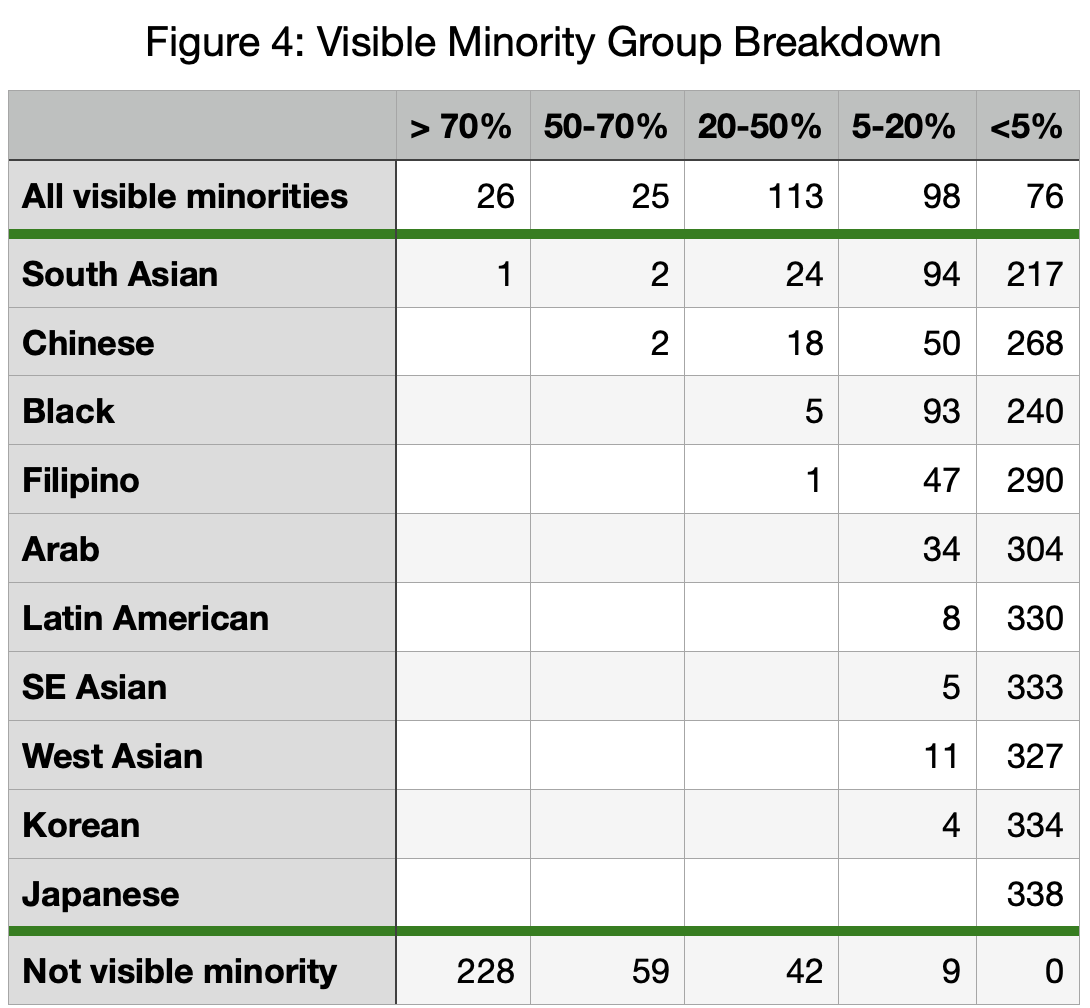
Figure 4 provides the breakdown by visible minority group, with only South Asians and Chinese being a majority of the population (five ridings out of 51 – Brampton East and West, Surrey-Newton for South Asians, Markham-Unionville and Richmond Centre for Chinese), highlighting that most visible minority majority ridings have a mix of visible minority groups. All visible minority groups are present in ridings with between 5 and 20 percent, save Japanese.

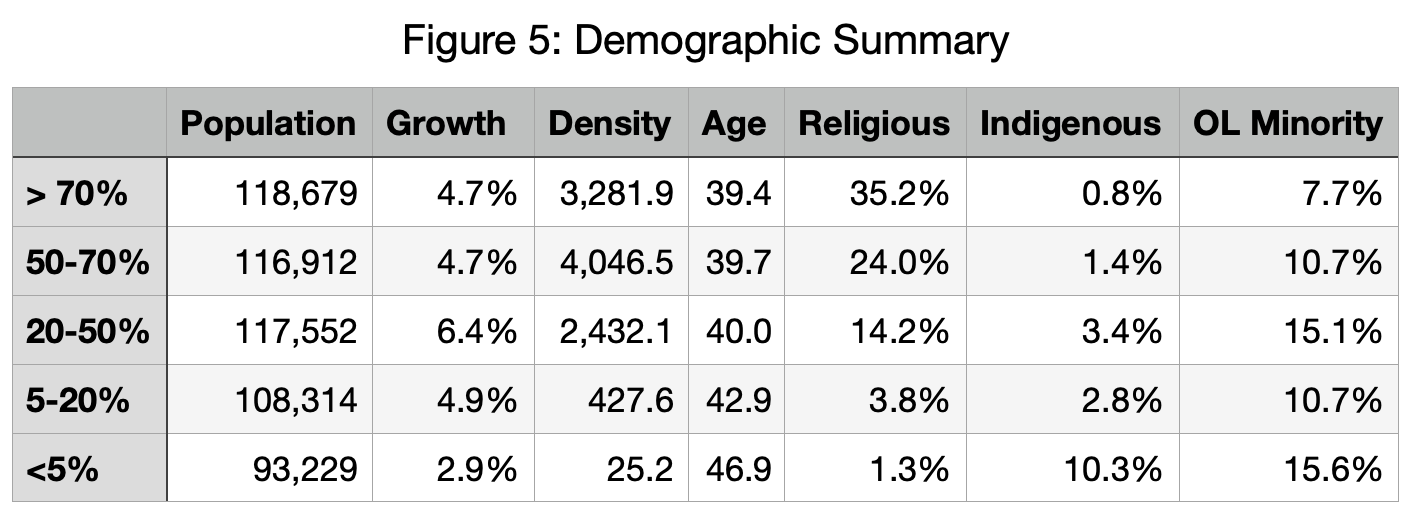
Demographic and socioeconomic characteristics vary by percentage of visible minorities as shown in Figure 5.

Visible minority majority ridings are characterized by larger populations, moderate growth, high densities, a younger population, a higher percentage of religious minorities and a low percentage of Indigenous peoples, with the reverse generally being the case for ridings with less than 20 percent visible minorities, highlighting the differences between rural and urban Canada. The highest growth occurs in ridings with 20 to 50 percent visible minorities, ridings that are increasingly diverse. The percentage of religious minorities correlates with the percentage of visible minorities. There is no overall pattern with respect to official language (OL) minorities.

As one would expect, the higher the percentage of visible minorities, the higher the percentage of immigrants and conversely, the lower the percentage of citizens given residency and other requirements as shown in Figure 6. The period of immigration highlights the contrast between earlier waves of immigration, largely European in origin and in low visible minority ridings, and later waves, largely visible minority, with an impact across all ridings, particularly in the last five years and in ridings with lower overall percentage of visible minorities.

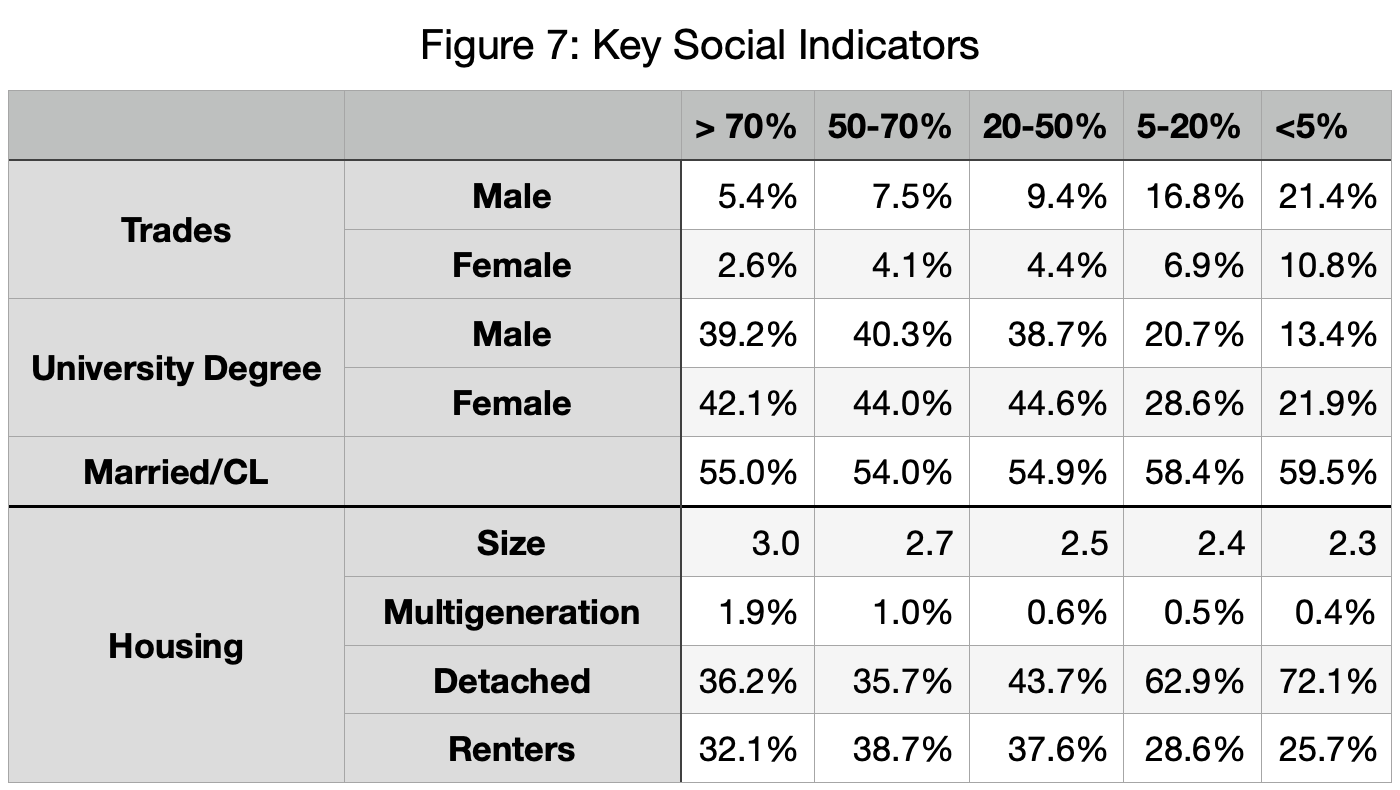
Figure 7 highlights educational attainment (trades and university degree, the percentage of married or common-law couples, household size, and whether residents form part of  multigenerational households, are in single-detached housing and the percentage of renters. Trades are more prevalent in ridings with fewer visible minorities and university diplomas more prevalent in ridings with more visible minorities. Women have higher rates of university degrees across all ridings.

Variations on marriage or common law between ridings are small. Household size directly relates to the percentage of visible minorities whereas the prevalence of single detached homes is inversely proportional. Renting is more prevalent in ridings with between 20 and 70 percent visible minorities.

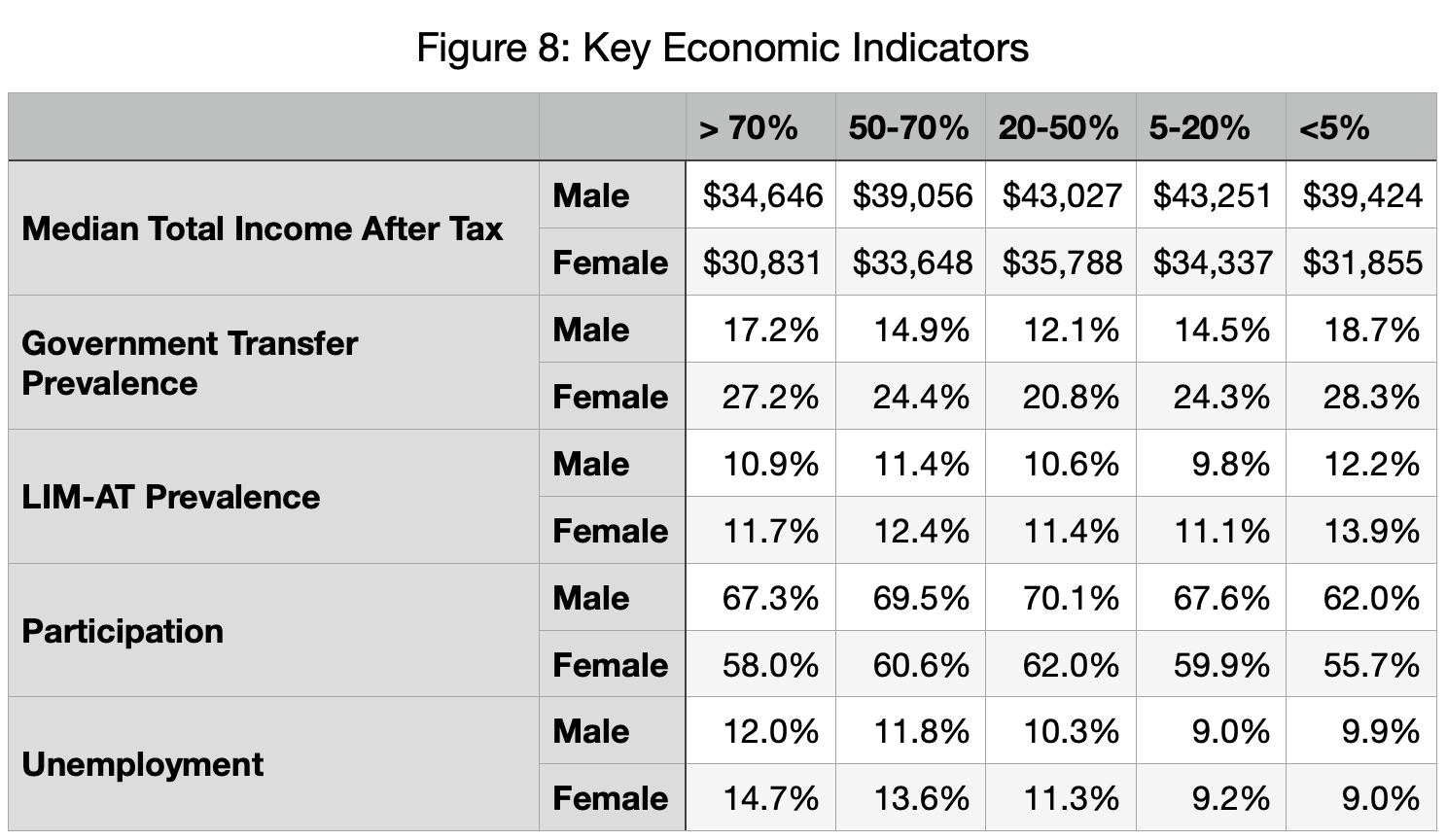
Figure 8 highlights median total after tax income, the percentage of government transfers and income along with participation and unemployment rates. In general, ridings with between 20 and 50 percent have the strongest economic outcomes save for unemployment rates which are lowest in ridings with fewer visible minorities. Outcomes for women are worse overall except with respect to unemployment in ridings with less than 20 percent visible minorities.

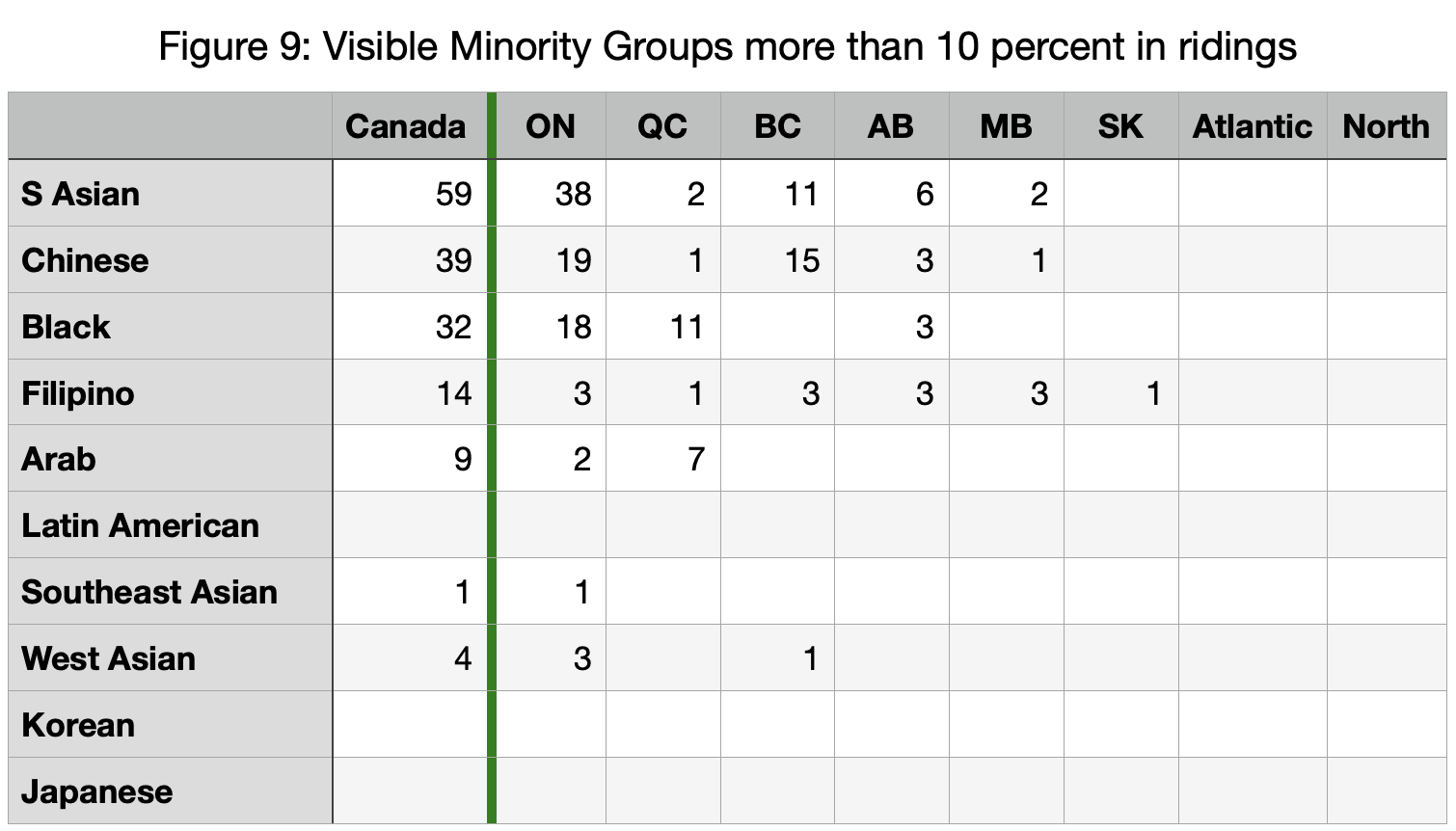
Turning to the political aspect and voter targeting, Figure 9 highlights the number of ridings where a visible minority group forms more than 10 percent of the population, broken down by province, again demonstrating the extent to which political parties need to address specific group concerns. Only Latin American, Korean and Japanese have no ridings with ten percent or more of the population; however, with a threshold of five percent, only Japanese have no ridings of significant concentration. Regionally, there are no ridings in Atlantic Canada and the North with one visible minority group forming 10 percent of the population but six ridings where one group forms more than five percent: three South Asian, two Black and one Chinese.

Figure 10 highlights the 190 ridings where a religious minority forms more than five percent of the population as a threshold of ten percent would exclude Buddhist and Indigenous spirituality. Most groups are concentrated in a number of ridings, with Muslims dispersed across the greatest number of ridings.

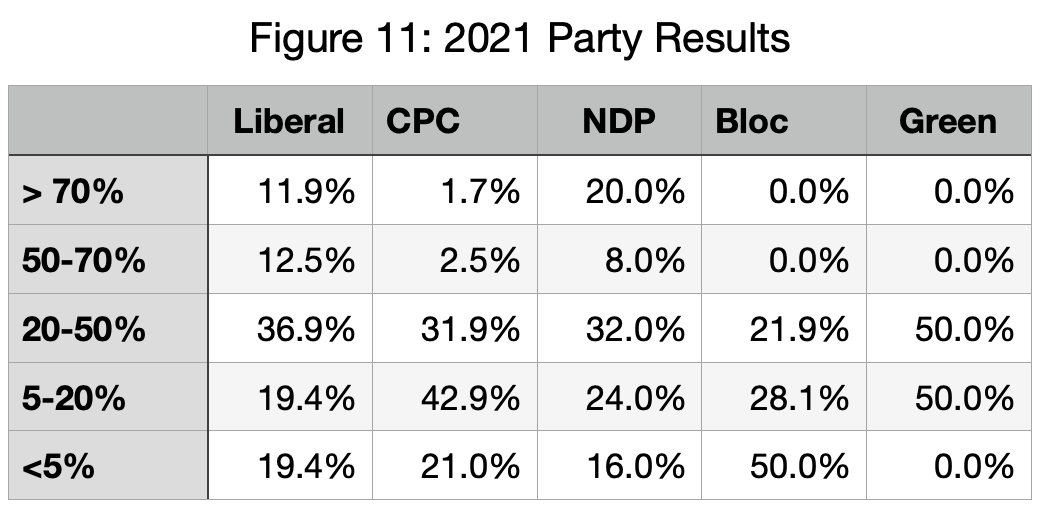
Figure 11 breaks down the 2021 election results, highlighting the relative strength of the Liberals and NDP in visible minority majority urban ridings and the relative strength of the Conservatives in ridings with between five and twenty percent visible minorities. Compared to the 2015 election, the biggest change was the increase in the relative share of NDP MPs in visible minority majority ridings and the Conservative and Bloc relative share increase in ridings with between 20 to 50 percent visible minorities. These ridings can flip; in 2011, the Conservatives won a majority of ridings with more than 50 percent visible minorities.

Concluding observations

All parties have candidate selection, policy and other electoral strategies to engage these communities and the ongoing increase in the number of visible minority candidates and MPs reflects these strategies. Substantively, there are no major differences in attitudes between immigrants and non-immigrants across a range of immigration-related issues.

While some visible minority groups have a tendency to vote for a particular political party, there is political diversity in all groups resulting in no party ignoring any group. Earlier waves of immigrants, mainly European origin, tend to lean Conservative compared to more recent waves, mainly visible minority, tend to lean Liberal.

Visible minority and immigrant groups are affected by perceived singling out or dog whistles, as the Conservatives learned to their cost in 2015, with the “barbaric cultural practices” tip line and the strength of the Liberal language “a Canadian is a Canadian is a Canadian” in response to the Conservative government’s citizenship revocation provision of C-24. Immigration-specific issues such as the ease of family reunification also play a role.

But in general, visible minority voters are more affected by overall campaign themes and issues, whether these be with respect to campaign tone, general concerns regarding the economy, housing, and healthcare, and largely follow the overall electoral trend at national and regional levels.

Riding characteristics impact upon voting patterns. Visible minority majority ridings have lower incomes and higher unemployment which generally play to left and left-of-centre parties. Similarly, larger family size and more multigenerational households in these ridings suggest that political parties target their messaging accordingly.

No major party is arguing against increased immigration, nor is any province except for Quebec. Public support is strong. Apart from administrative issues like backlogs and poor Immigration, Refugees and Citizenship Canada service, debates and discussion focus more on the practicalities and impact of immigration on housing affordability, healthcare stresses and infrastructure gaps. More recent commentaries are focussing on these negative impacts but in a non-xenophobic manner. After all, these issues affect immigrants and non-immigrants alike, helping to reduce polarization.

Methodology:

All data is from the Census profile given that it provides riding-level data. Indicators were chosen based on their pertinence. Non-founding ethnic ancestry includes all groups save for English, Scottish, Irish, Welsh, Canadian, French and Indigenous (Census allows for multiple responses). Electoral results data is from Elections Canada.

Andrew Griffith is the author of “Because it’s 2015…” Implementing Diversity and InclusionMulticulturalism in Canada: Evidence and Anecdote and Policy Arrogance or Innocent Bias: Resetting Citizenship and Multiculturalism and is a regular media commentator and blogger (Multiculturalism Meanderings). He is the former Director General for Citizenship and Multiculturalism and has worked for a variety of government departments in Canada and abroad and is a fellow of the Canadian Global Affairs Institute and Environics Institute. 

Source: The Political Impact of Increased Diversity: What the Census Shows

Watt: In 2023, Canadians deserve a grand vision from our political leaders

Watt notes the need for an actual plan how to address the impact of high immigration levels, which by its nature would require joint federal and provincial collaboration and much more medium and longer term policy and program measures:

A federal election in 2023?

Though far from a certainty, more and more, it feels like one. Federal minority governments have seldom endured more than a few years and the current Liberal-NDP agreement is unlikely to be an exception tothis rule.

If the plug is pulled and the current Parliament Hill tone continues, the election will be waged on decidedly pessimistic terms. Take, for example, Conservative leader Pierre Poilievre’s and Prime Minister Justin Trudeau’s recent exchange played out over the closing weeks of 2022.

To great effect, Poilievre has repeatedly asserted that “it feels like everything is broken in this country” — a message that resonates strongly with Canadians. At a year-end Liberal holiday party, Trudeau countered that “Canada is not broken.”

While Canada is far from broken, it’s time we acknowledged that there are significant cracks in the land and the current government’s continued approach of ignoring the legitimate concerns of families battling record inflation and a housing crisis can’t continue.

As Poilievre tells it, Justin Trudeau’s excessive spending, runaway deficits and second-rate commitment to infrastructure mean that a continued Liberal reign poses no less than an existential threat to our nation.

Trudeau’s challenge is that circumstances beyond his control — namely brutal economic conditions — make defending against Poilievre’s charges harder and harder. He is left, as many long-term governments are, selling a hypothetical alternative narrative of another kind of doom and gloom.

And so, Trudeau paints a sloppy picture of a Poilievre-inspired hellscape where you pay for groceries with Ethereum and carbon costs less than an FTX token.

Source: In 2023, Canadians deserve a grand vision from our political leaders

Pierre Poilievre thinks he can win over new Canadians. Here’s how he plans to do it.

Reasonable take and strategy and familiar to someone who worked in the Kenney years. Expect that the party has learned some lessons from its use of “barbaric cultural practices” in the citizenship guide and in the 2015 tippling. Minister Fraser’s comment is a bit ingenuous given the liberal record of responding (some would say pandering) to new Canadian voters:

A young Pierre Poilievre sits in front of a room of Conservative faithful and explains their party’s strategy for winning a majority mandate. 

That hasn’t happened yet. It’s 2009 and while the Tories have won two federal elections, they’ve remained in minority territory for three years. 

“We will win a majority if we appeal to naturally conservative-inclined voters and get them out to vote, and we turn small-c conservative immigrants into big-C Conservative voters,” the MP says in a video posted to the website of the Cable Public Affairs Channel.

“That’s the formula.”

More than a decade after former prime minister Stephen Harper pulled off that majority in 2011, Poilievre is the party’s leader. 

Since Harper’s four-year term, Conservatives have lost three straight elections to Prime Minister Justin Trudeau’s Liberals, with losses stacking up in Toronto- and Vancouver-area suburban seats, home to many visible minorities and new Canadians. 

If there’s one thing many in the party agree on, it’s the need for Conservatives to build support in such communities. But can Poilievre do it? 

Enter Arpan Khanna. This week, Poilievre tapped the Greater Toronto Area lawyer, who served as one of the co-chairs on his leadership campaign in Ontario, to co-ordinate outreach efforts.

Khanna was a political staffer for the man federal Conservatives credit most for making the inroads with immigrant communities that helped Harper along to a majority: Jason Kenney. 

Colleagues had nicknamed the former federal cabinet minister and Alberta premier the “minister of curry in a hurry” for spending his weekends darting to dozens of cultural events around Toronto and Vancouver.

Khanna said he sees the same drive in Poilievre, who visited the Toronto area multiple times, plus Vancouver in his first three months as leader, sometimes attending up to 15 events a day. He is planning visits with Chinese community groups in Markham, Scarborough, Vancouver and Burnaby to mark the Lunar New Year. 

The new leader has taken the idea of “building a Jason Kenney style of outreach” to heart, Khanna said. “He’s all into this. He understands the importance of it.”

The first step is showing up, he said.

“We recently were at someone’s backyard for a barbecue party with about 100 people from the Tamil community, just having a conversation about their issues.”

Poilievre has been hitting the road nearly every weekend. 

Often travelling with him are his two deputy leaders. Melissa Lantsman, who is Jewish and the party’s first openly lesbian member of Parliament, hails from Thornhill, just north of Toronto. Longtime Edmonton MP Tim Uppal, who is Sikh, became Canada’s first minister to wear a turban when Harper appointed him to cabinet in 2011. 

For the high-profile finance critic role, Poilievre picked former small business owner Jasraj Singh Hallan, who had been considered an at-risk youth after immigrating to Canada as a child. 

It’s stories like Hallan’s that Poilievre promotes, touting the promise of the Canadian dream. 

“It doesn’t matter if your name is Poilievre or Patel … Martin or Mohamed,” a video posted online shows Poilievre saying at a Diwali event in October. “If you’re prepared to work hard, contribute, follow the rules, raise your family, you can achieve your dreams in this country.”

Poilievre often points out that he married an immigrant Canadian. His wife Ana and her family were refugees from Venezuela. 

Tenzin Khangsar, who worked in Kenney’s office when he was immigration minister and assisted with the Tories’ outreach strategy, said Poilievre is setting an example for his caucus and the entire party. “And frankly shows to all Canadians that look, ‘this is a priority for me. This is not just something I’ll do during an election campaign.’”

Khangsar said that if step one is showing up, step two is following up with policy. 

Poilievre has promised to get provinces to speed up recognizing foreign credentials, one of his first policy announcements as a leadership candidate. He’s also railed against “gatekeepers” at the federal immigration department.

During a roundtable with ethnic community media convened during the race, Poilievre said immigrant and Conservative values are the same: “hard work, family, freedom, tradition.”

“Values upon which we need to build a future Conservative party.”

A roughly 50-minute video from the event shared on Facebook shows Poilievre offering more detail on his immigration policy ideas: expanding express entry, making it easier for temporary foreign workers to become permanent residents, improving immigrants’ ability to bring their parents to Canada to help with child care and expanding private sponsorship of refugees. 

He was emphatic in an interview with a Punjabi radio show last month: “The Conservative party is pro-immigration.” 

But the NDP’s immigration critic, Jenny Kwan, threw water on the idea, saying in a statement that the Harper government cut settlement services for newcomers and made family reunifications more difficult. 

Liberal Immigration Minister Sean Fraser didn’t wade into the Tories’ past, but in a statement said speaking to newcomers is the job of any political leader. 

“Newcomers are not a voting block to pander to. They are Canadians, and soon-to-be Canadians.”

But many Conservatives believe that the party’s approach to immigration issues lost them the 2015 election, as Tories pushed policies such as banning niqabs at citizenship ceremonies and establishing a tip line for so-called barbaric cultural practices. 

Lantsman and Uppal both publicly apologized for supporting what became known as the “niqab ban.” But Poilievre has defended the policy as simply requiring “that a person’s face be visible while giving oaths at citizenship ceremonies.” 

An internal review of the Tories’ 2021 election loss found the party’s image remained damaged among immigrant communities. 

Poilievre’s immigration critic, Tom Kmiec, said Conservatives believe in an “employer-driven immigration system.”

Asked whether they support the Liberal government’s plan to welcome a record-high number of permanent residents in the coming years, which includes a target of 500,000 by 2025, Kmiec said “the number is not as important as the customer-service experience.”

Kmiec, a Polish immigrant, said the federal immigration department is dealing with massive backlogs and out of control processing times. “It’s a total lack of compassion to over-promise what you can actually deliver.”

Andrew Griffith, a former director of multiculturalism policy for the federal government, predicted Conservatives will avoid attacking the targets for fear of being labelled xenophobic.

Griffith said he doesn’t perceive the party is skeptical about immigration, despite such views being historically present in its base. 

Source: Pierre Poilievre thinks he can win over new Canadians. Here’s how he plans to do it.

New group with Beijing links to promote friendly candidates in Canadian elections

So it continues:

On the face of it, the fledgling organization’s goals seem innocuous enough — to encourage Chinese-Canadians to run for elected office and vote in elections. The Chinese Council for Western Ontario Elections says it wants to be an “incubator” for candidates who support the community’s interests and educate newcomers about Canadian democracy.

But the council’s links to groups that are closely aligned with the Chinese government — and possibly to a Chinese police station here — are raising concerns amid growing debate about Beijing’s alleged interference in Canadian politics.The council — launched at a formal event in Mississauga on Sunday — is headed by businessman Guo BaoZhang.

Guo is also executive president of the Canada Toronto Fuqing Business Association, named after a city in China’s Fujian province. Its own website says it was set up under the guidance of the United Front Work Department (UFWD) — a branch of the Chinese Communist Party (CCP) whose mission is in part to extend Beijing’s influence worldwide.

The association is also named as the owner of units in a Markham, Ont., commercial building that media in China say is the site of one of three Fujian “police service stations” in the province. The same address is listed on the association website as its own location. The RCMP has said it’s investigating the stations, amid fears they could be used to intimidate Chinese expatriates here.

Two of the Fuqing group’s three honorary leaders are Weng Guoning and Wei Chengyi, the current president and honorary chair of the Confederation of Toronto Chinese Canadian Organizations (CTCCO), a group that has long worked with the city’s Chinese consulate to promote Beijing’s positions on contentious issues.

The CTCCO’s Weng is also featured in multiple photographs of the election council’s launch event on Sunday and gave a speech at the ceremony. Someone by his name is listed as a director of another, related elections group.

There’s no indication the council will break any law, but Chinese-Canadian critics of the CCP say the connections are clear, and worrying.

“They are by and large an extension of the apparatus of Beijing,” alleged Karen Woods, founder of the independent Canadian Chinese Political Affairs Committee. “I definitely think this is an area where our security agencies or the police should pay close attention.”

Woods once worked for a lobby firm that represented China’s Toronto consulate, before growing disenchanted with Beijing. Her association touts itself as being independent of China and opposed to foreign interference in elections.

“This really is like an ideological invasion,” said Jonathan Fon, a Toronto paralegal and outspoken critic of the Chinese government, about the new group. “I think that undermines our national security, our social security.”Guo could not be reached for comment by deadline Thursday.

But according to a Chinese-language news report on Sunday’s gathering, the council’s head said its goal was simply to “introduce Canadian democracy to the Chinese community, to help Chinese Canadians better understand Canadian elections, participate in the democratic process, and participate actively in elections.”

“We support candidates of any race, as long as they advocate democratic equality, oppose racial discrimination and support multiculturalism,” Guo is quoted as saying. “We are willing to share our network resources with them to help them gain recognition and support from Chinese voters.”The council was launched as China’s alleged interference in Canadian politics becomes a burning topic on Parliament Hill, with opposition MPs grilling the Liberals on the issue repeatedly recently.

Some of the attention was prompted by a Global News report that said the Canadian Security Intelligence Service had briefed the Prime Minister’s Office in January about a Chinese program that gave money to 11 sympathetic candidates in the 2019 election, using a member of the Ontario legislature and community groups as go-betweens.

Prime Minister Justin Trudeau has denied he received such a briefing and says outside experts have concluded the last two elections unfolded fairly, but accused Beijing of playing “aggressive games” with Canada and other democracies. And he reportedly raised interference in a brief meeting with Chinese President Xi Jinping on the sidelines of the G20 meeting in Bali. China rejects suggestions it has intruded in any way.

The Western Ontario election council was registered as a federal non-profit corporation earlier this year. It appears to be an offshoot of the Chinese Council for Canadian Elections, which was registered in 2019. An individual with the same name as CTCCO president Weng is listed as one of that group’s three directors. Another of the three has the same family name and address.

A Chinese-language mission statement by the council obtained and translated by Fon says the group will abide by this country’s laws and constitution

The council will “support incubating Chinese ethnic candidates to participate in the election,” says the statement, adding that it would also back candidates of other ethnicities “who are friendly to the Chinese community” and promise “political views beneficial to the Chinese community after being elected.”

The United Front Work Department that provided “guidance” to Guo’s Fuqing business group was greatly expanded under Xi’s leadership. While it reportedly works closely with diaspora groups to promote China’s interests on issues like Tibet, the Muslim Uyghur minority and Taiwan, it also has an eye on politics in foreign countries.

A leaked handbook for United Front cadres even touted the fact that the number of politicians of Chinese descent elected in Toronto had almost doubled between 2003 and 2006, and urged officials to “work with” them.

The CTCCO, meanwhile, has been a reliable ally of the Chinese government. It ihas defended Beijing’s crackdown on democracy protesters in Hong Kong, while working with the local consulate to promote Beijing’s stance on Tibet, try to bring its Confucius Institute to Toronto schools and celebrate the 70th anniversary of the People’s Republic. Beijing’s Overseas Chinese Affairs Office praised the group on its website.

Honorary chairman Wei himself shook hands with Xi at a 2019 event in Beijing. The CTCCO website includes a profile of president Weng by the “propaganda department and the United Front Work Department of the Fuqing Municipal Party Committee.”

With those sorts of connections, it’s hard not to be wary of the new election council, said Cheuk Kwan of the Toronto Association for Democracy in China.

“I’m highly suspicious,” he said. “I would not be surprised if the Chinese consulate or Chinese government is heavily involved.”

Source: New group with Beijing links to promote friendly candidates in Canadian elections

Douglas Todd: Ethnic politics is already a science in the U.S. It’s on the way in Canada

It already is well entrenched at the federal and provincial levels and candidate nominations and members of legislatures and electoral strategies indicate. Todd’s points are based on municipal elections, where the general absence of parties and more locally-based and less sophisticated data analysis prevails:

In the U.S. polls are run constantly into the political preferences of voters based on ethnicity, in addition to gender, age, religion and other demographics.

Race-based politics has long been established in multi-ethnic cities like Chicago, New York and Miami. American pundits have also analyzed how religion and ethnicity combine, particularly since 1960 when 80 per cent of Catholics of European descent voted for John F. Kennedy.

With people of Hispanic, Black and Asian origins now accounting for more than 80 million Americans, politicians are not the only ones who find it valuable to keep up with scientific polling.

Polls generally show two thirds of Hispanic Americans vote Democrat, while one third lean Republican. Only one in 10 Black voters are Republican and just 26 per cent of Asian-Americans. About one third of people of European descent cast ballots for Democrats, and just over half go Republican.

Canadians are more shy about how ethnicity connects to politics. We don’t often learn about surveys that probe how minority groups tend to think about political issues.

When I’ve asked Canadian politicians if their party conducts private polling on ethnicity, they all say, of course they do: Race-based strategies are crucial to any campaign. But no party has ever handed me their internal data.

Political scientist Shinder Purewal of Kwantlen Polytechnic University has had a similar experience. “I’ve spoken to a number of pollsters and they’re very reluctant to give ethnic numbers, while they’ll give numbers in general.”

One recent exception to this hands-off Canadian approach was a poll by YouGov, which revealed that Indo Canadians lean liberal-left. More than 38 per cent of respondents said last year they would cast a vote for the Liberals — twice the number that planned to go with the Conservatives.

This fall, a Leger poll for Postmedia detailed how ethnic groups would affect October’s tide-shifting elections in the cities of Vancouver and Surrey.

Understanding the hopes and fears of ethnic groups can be a big political deal. In the city of Vancouver, 44 per of the population is of European descent, 20 per cent is of Chinese descent and 14 per cent are of South Asian descent. Indo Canadians are the largest group in Surrey, at 38 per cent compared to 33 per cent who are of European descent.

The Leger poll found the eventual winner in Vancouver, Ken Sim, who highlighted how he would be the city’s first Chinese Canadian mayor, appealed to 21 per cent of those of European ancestry, 15 per cent of South Asian voters and 35 per cent of those with Chinese roots.

Meanwhile, defeated mayor Kennedy Stewart — who was the last of an amazing streak of seven Vancouver mayors in a row of Scottish ancestry — appealed to 12 per cent of European-descent voters, 21 per cent of Indo Canadians and only five per cent of those of Chinese background.

Surrey was a different scenario. There, the three mayoral candidates who received the most votes are of European ancestry: Brenda Locke, Doug McCallum and Gordie Hogg. McCallum, the incumbent, did best in the districts that are overwhelmingly Punjabi, Purewal said.

“That tells you that people are actually paying attention to what politicians have to say, what they stand for,” Purewal said. “Many don’t care what (ethnic) flock you’re from.”

In Vancouver, what issues drew voters to Sim?

Housing affordability came out the top worry when Leger’s respondents named their top three issues: But that concern ran equally across ethnic lines. 

Property taxes and spending were Vancouver residents’ third biggest issue, particularly since council had sharply increased both under Stewart’s guidance. Sim promised to be fiscally prudent, which would be important to ethnic Chinese voters, 36 per cent of whom cited taxation as a leading issue compared to 26 per cent overall.

Policing, public safety and crime was the fourth big issue. And Sim’s promise to hire 100 more police officers would have also played well with Chinese Canadian voters, 30 per cent of whom worried about crime compared to 25 per cent in general.

Sim also played down themes that Stewart and his council had pushed hardest — such as climate change, and especially social justice, equity and First Nations reconciliation. These were of low concern to all voters, particularly to those of Chinese background.

Such trends suggest to Purewal that, even while Sim often cited the scourge of anti-Asian racism and campaigned strongly through Chinese-language media outlets, he and his ABC party didn’t win simply because he was Chinese Canadian.

“I would say the vast majority voted for him because they agreed with his plan.”

What of Surrey, B.C.’s second largest city? South Asians in Surrey, many of whom are foreign-born, were significantly more likely to rank housing affordability as a top worry, at 56 per compared to 38 per cent of people descended from Europeans. And Indo Canadians were the least likely to zero in on homelessness.

Even though the Leger poll initially suggested Surrey mayoral candidate Sukh Dhaliwal was the favourite of South Asians, the support did not carry the day for him. Locke and McCallum, who came in a close second, were able to draw votes from both South Asians and those of European descent.

A similar lesson about the value of cross-ethnic appeal can be taken from growing Richmond, B.C.’s fourth most-populous city.

Mayor Malcolm Brodie has been winning elections there for 21 years, despite people of European ancestry now being only 20 per cent of the population, down to 40,000 from 68,000 in 2001. Purewal said Brodie has cultivated the loyalty of a solid portion of the 113,000 Richmond residents of Chinese origin.

Sometimes race-based politics can burst into controversy, as it did this fall in Los Angeles, where a national furor erupted after top Latino politicians were caught in a secret recording making crude, racist remarks about Black rivals and voters. Similar things can happen in Canada.

But for the most part, U.S. and Canadian politicians don’t appear to take advantage of ethnic-based data to manufacture wedge issues: They simply see ethnic differences, as well as similarities, as fundamental factors to understand.

Let’s hope most North Americans politicians try to balance their desire to appeal to voters from specific ethnic groups with a larger commitment to social harmony.

Source: Douglas Todd: Ethnic politics is already a science in the U.S. It’s on the way in Canada