Denmark Bans Kosher and Halal Animal Slaughter

Balance between animal “rights” and human religious rights. But one would need to know how Denmark treats all farm animals to know whether this is consistent or targeted:

Denmark enacted a sweeping ban on the religious slaughter of animals Monday, prompting a furious backlash from Jewish and Muslim community representatives.

The ban, which requires slaughterhouse workers to stun animals before killing them, will now extend to religious communities that were previously afforded an exemption. “Animal rights come before religion,” Danish minister for agriculture and food Dan Jørgensen told Denmark’s TV2.

Activists with Danish Halal called the restriction a “clear interference in religious freedom,” the Independent reports, while Israeli chief rabbi David Lau slammed the law as “a serious and severe blow to the Jewish faith and to the Jews of Denmark,” according to Times of Israel.

Both observant Jews, under kashrut laws and Muslims, under halal laws, will not eat meat unless the animal has been killed with a single slice to the neck, with the intention to minimize its pain.

Denmark Bans Kosher and Halal Animal Slaughter

Getting past victimhood starts with an honest look in the mirror: Sheema Khan

Another good piece by Sheema Khan:

While Canadian Muslim leadership is evolving, there are still too many who ascribe to victimhood and conspiracy theories. Such self-defeating attitudes do not serve the community well; blaming others prevents much-needed self-introspection, thereby allowing flaws to fester.

Islamophobia is real and must be addressed. This week alone, a London mosque was vandalized and a video surfaced of an anti-Muslim verbal attack on a Calgary cab driver. But Islamophobia should not be used as a cover to mask wrong behaviour.

A parallel theme weaves through Saul Bellow’s novel The Victim, in which a Jewish protagonist blames his misfortunes on anti-Semitism without much introspection. Gradually, he takes stock of his own shortcomings, and with a renewed moral compass takes on life’s challenges (including anti-Semitism) with a confident, balanced attitude.

This type of fresh outlook is evident in the next generation of Muslim leaders, such as physician Alaa Murabit, who was raised in Saskatoon and moved to Libya at the age of 15. Shocked by widespread gender discrimination in her new environment, she eventually founded the Voice of Libyan Women (VLW) to challenge the prevailing norms.

In her recent TED talk, “What my religion really says about women,” Ms. Murabit is unapologetic about her love for Islam, her source of strength. She readily acknowledges the discrimination faced by women in Muslim cultures (rather than blaming news media for reporting on real-life horrors). She seeks to address the “crooked foundation” by advocating that women reclaim their religion by looking to examples of Muslim women in early Islamic history, to the authentic example of the Prophet Mohammed and to the Koran itself.

The Noor Campaign, a VLW program, has used this approach to combat violence against women in Libya and abroad. It is gruelling work. Criticized by the right, the left, the fundamentalists and the secularists, Ms. Murabit marches on with honesty, humility and compassion – because she believes in forging positive societal change.

Canadian Muslims do not need to wait for leadership from traditional institutions to evolve to this level of dynamism. They can independently forge initiatives that address areas of neglect, such as family dysfunction, substance abuse and mental health. Or they can participate in wider campaigns on issues such as poverty and the environment. They should also demand a seat at the table at Islamic centres, since women and youth are stakeholders.

Getting past victimhood starts with an honest look in the mirror – The Globe and Mail.

Canadians converting to Islam: A rocky, complex road, new study finds

More details on the study on converts (see earlier post Canadian converts to Islam focus of study by Australian sociologist):

“Converts are disconnected from mosque communities usually because they are from a different ethnic background,” said Australian researcher Dr. Scott Flower during a weekend Ottawa workshop on conversion.

Mosques are initially warm and welcoming to converts because conversion is one of their duties, he said.

But the welcome can quickly wear out.

“Most mosques are Pakistani, Turkish, Saudi or whatever, and converts are not being accepted into those communities,” he said. “So they are outsiders. If they are not connecting to the mosque and they lose their families, they are doubly isolated.”

Flower, a professor in political economy at the University of Melbourne, is leading the first known Canadian study into conversion to Islam.

The study, featuring a 70-question survey for participating converts across the country, and separate interviewing of imams, is being funded with a $170,000 grant from Public Safety Canada.

Flower has conducted similar studies in Australia and Papua New Guinea.

Public Safety officials haven’t specifically told Flower what they hope to gain from the study when the research is complete and analyzed, likely early next year.

“They don’t know anything about Muslim converts in this country because there is still not one peer-reviewed academic journal article on the topic,” he said. “They are trying to get any general information they can to better understand converts.

“And I’m glad because in their world they see everything through this tiny pipe called classified information,” added Flower. “It’s much broader and much more complex. Ninety-nine-point-nine per cent of converts never radicalize or even get political. They just practise their religion. If you want to understand those who do (radicalize), you also have to understand those who don’t.”

Flower concedes that an atmosphere of suspicion among Canadian Muslims in the “post-911 environment” could be impacting the quality of the study.

“They are living in this environment and it’s not conducive to openness,” he said. “They ask, ‘Do you work for CSIS?’ or, ‘Do you work for the government?’ Even if they don’t ask it, it has to be on their minds. It’s the reality of doing research on this very sensitive topic.”

While it’s generally accepted that conversion to Islam is a growing phenomenon, Flower says a lack of co-operation from imams he and his researchers have approached so far is making it difficult to quantify.

But there is no simple answer to why Canadians convert, he added.

“We can’t say it’s lack of education because we have people who are professors, have master’s degrees or Grade 12 educations. It’s not about income, either. We have people in our sample who are incredibly wealthy and have converted and people on welfare who have converted.”

But typically, he says, converts experience a spiritual search or personal crisis before converting — a common trait, too, in Canadians gravitating to Pentecostal Christianity, another growing branch of religion.

Canadians converting to Islam: A rocky, complex road, new study finds | Ottawa Citizen.

Salman Rushdie on Islam: ‘We have learned the wrong lessons’

Unfortunately, I think he is right:

Salman Rushdie believes that if The Satanic Verses had been published today, the members of the literary elite who rounded on Charlie Hebdo in the wake of the French satirical magazine winning a PEN prize for courage would not have defended him.

In an interview with the French magazine L’Express, the novelist said that “it seems we have learned the wrong lessons” from the experience of The Satanic Verses, which saw a fatwa issued against him by Iranian leader Ayatollah Khomeini in 1989, sending him into hiding. “Instead of realising that we need to oppose these attacks on freedom of expression, we thought that we need to placate them with compromise and renunciation,” he said.

Speaking about the decision by PEN’s American branch to award Charlie Hebdo with a freedom of expression courage award in May, which led to more than 200 writers putting their names to a letter protesting the decision for valorising “material that intensifies the anti-Islamic, anti-Maghreb, anti-Arab sentiments already prevalent in the western world”, Rushdie said the conflict had left “deep divisions” in the literary world. He would never have imagined that writers such as Michael Ondaatje, Peter Carey and Junot Díaz “would have taken this attitude”, and he had written to one of the key dissenters, Teju Cole, about the situation, he revealed.

“[Cole] replied with a bizarre letter: ‘My dear Salman, dear big brother, everything I know I learned it at your feet,’” Rushdie said. “But his reply was mostly full of false claims: Teju assured me that he would never have taken this part against The Satanic Verses because, in my case, it was to do with an accusation of blasphemy, but in the case of Charlie Hebdo, it was about the alleged racism of the magazine against the Muslim minority.”

Rushdie told L’Express that he disagreed, saying that the 12 people murdered at Charlie Hebdo’s offices were killed because their words were seen as blasphemous. “It’s exactly the same thing,” he said. “I’ve since had the feeling that, if the attacks against The Satanic Verses had taken place today, these people would not have defended me, and would have used the same arguments against me, accusing me of insulting an ethnic and cultural minority.”

The novelist told the French magazine that he believes “we are living in the darkest time I have ever known”, with the rise of Islamic State of “colossal importance for the future of the world”. He argued that the taboo surrounding “supposed ‘Islamophobia’” must be brought to an end.

“Why can’t we debate Islam?” he said. “It is possible to respect individuals, to protect them from intolerance, while being sceptical about their ideas, even criticising them ferociously.”

Salman Rushdie on Islam: ‘We have learned the wrong lessons’ | Books | The Guardian.

UAE, concerned about militant Islam, passes law against race, faith hate | Reuters

Expect application will be broader than cracking down on militant Islam given that it also outlaws “insults against religions”:

The United Arab Emirates has outlawed religious or racial discrimination, the state news agency WAM said on Monday, citing a royal decree by President Sheikh Khalifa bin Zayed Al Nahyan.

The law is aimed in part at countering Islamist militancy, particularly the practice known as takfir, whereby hardline Muslims label followers of other schools of Islam unbelievers, but it also outlaws insults against religions.

“The new law No. 02 of 2015 criminalizes any acts that stoke religious hatred and/or which insult religion through any form of expression, be it speech or the written word, books, pamphlets or via online media,” WAM reported.

The UAE, an oil-exporting confederation of seven Muslim emirates ruled by hereditary dynasties and bordering Saudi Arabia and Oman, is worried about political Islam, which appeals to religious conservatives while challenging its lack of democratic rule.

UAE, concerned about militant Islam, passes law against race, faith hate | Reuters.

Douglas Todd: MP’s church comments not out of the ordinary

More on background and issues behind her remarks:

Vancouver South Conservative MP Wai Young’s contentious political remarks about Jesus and the Air India bombing are not out of the ordinary in some Canadian churches, says a specialist on evangelicals and Chinese Christians.

“They’re remarkably fascinating comments, but they’re not sensational,” said Justin Tse, a post-doctoral student at the University of Washington who earned his UBC PhD studying religion and trans-national migrants.

The evangelical pastors who head Harvest City Church in East Vancouver, where Wai spoke in late June, “felt her talk was so uncontroversial that they posted it on their website,” said Tse.

The national media is buzzing over comments Wai made during the service, in which she linked the federal Conservative party’s decision to launch anti-terrorist Bill C51 to the courage of Jesus Christ, “who served and acted to always do the right thing, not the most popular thing.”

Young, one of about 100,000 Chinese evangelical Christians in Metro Vancouver, also defended Bill C-51 by telling the Pentecostal congregation that Canada’s spy agency knew there was a bomb on the Air India flight that exploded over the coast of Ireland in 1985, killing 329 people, mostly Canadians. Young has retracted that statement. Her constituency office sent out a statement in which Young says she “misspoke,” adding “I regret this error.”

Tse said Young’s talk, one of others that she has made at Vancouver churches in recent months, was designed to appeal to evangelicals by portraying Jesus as a leader who “built community” — particularly one who did so within the framework of a “Conservative party ideology.”

Young’s talk at the church, Tse said, equated community and nationhood “with strong security.” The MP, a former provider of services to immigrants, stressed the importance of anti-terrorist legislation, firm borders, fighting crime and lowering taxes.

… Debra Bowman, the minister of Vancouver’s Ryerson United Church, echoed the views of many of Young’s critics when she urged the federal Conservatives to put as much effort into probing the charitable tax status of Tory-friendly churches as it does to auditing environmental and other non-profit groups.

“The thing I find really upsetting isn’t so much (Young’s) dreadful Christological claims for Harper’s Conservatives,” said Bowman. She was more concerned about the way the backbench MP appears to be flouting Canada Revenue rules on politically partisan activity by religious groups.

“I really hope someone will track whether (such churches) come under the same financial scrutiny that many justice-environment-church groups have been experiencing,” said Bowman.

Harvest City Church released a statement late Wednesday saying Young’s “comments were her own and Harvest City Church does not endorse her comments, nor any political party, nor does it endorse the use of its facility as a political platform.”

…Former federal Liberal cabinet minister Ujjal Dosanjh, who lost the predominantly Asian-immigrant riding to Young in 2011, said the Hong-Kong-born politician is a “well-meaning” backbench MP who would not have access to high-level information about Canada’s spy service or the Air India bombing.

While commenting that Young’s comparison of Jesus to the federal Tories amounts to “political pandering” that is “pretty far out,” Dosanjh focused on how he believes the Vancouver South MP made key mistakes in her analysis of the 1985 bombing of Air India Flight 182.

… Dosanjh said he cannot imagine any way that CSIS knew there was a bomb on the Air India plane. He also said the laws that existed in the mid-1980s did not bar CSIS from sharing such crucial security information.

With the rise of Sikh extremism in the 1980s, in which “Sikh temples in B.C. were used as bully pulpits by politicians and others,” Dosanjh said he became more and more convinced that no religious organization should be used for partisan political speeches.

Dosanjh said that period of time, in which he was severely beaten by Sikh extremists, “taught me that the separation of religion and state is very important. One should never make politically partisan statements in a religious institution. From my perspective she (Young) crossed the line. But I’m not picking on her. She’s not the only one. It happens frequently.”
Douglas Todd: MP’s church comments not out of the ordinary.

Prayer in Canadian Public Life: a Nation Divided – Angus Reid Institute

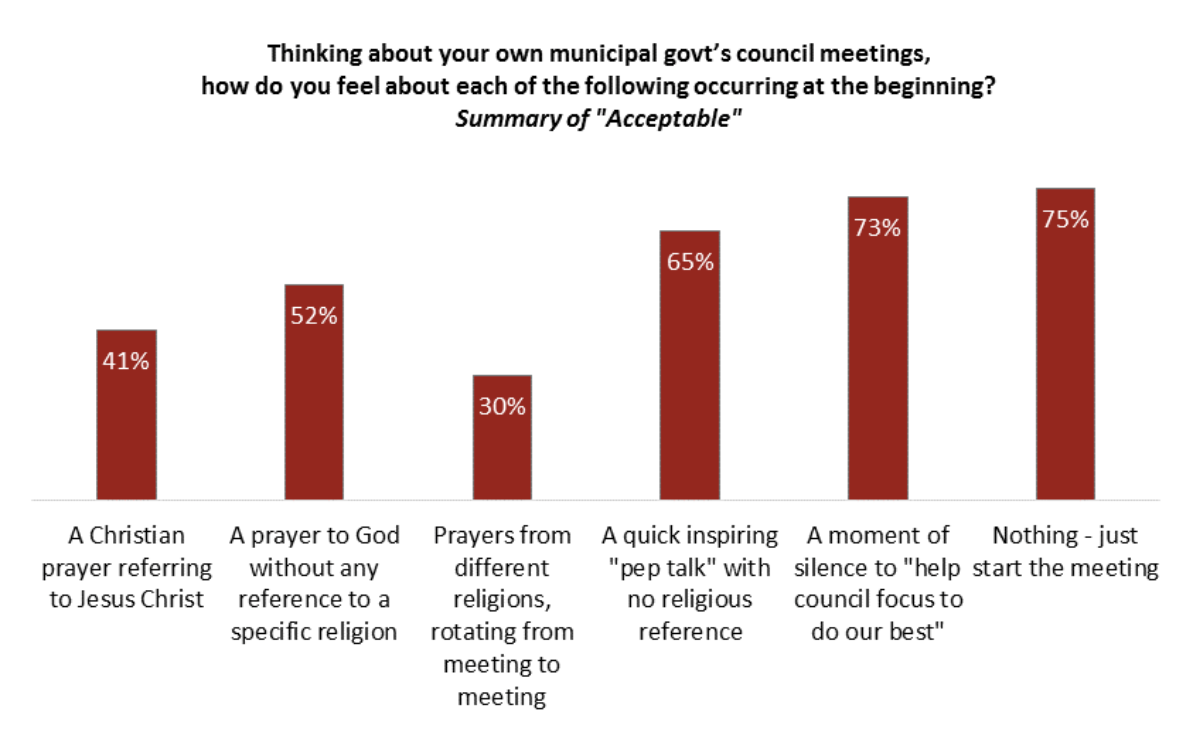
Prayer_in_Canadian_Public_Life__a_Nation_Divided_-_Angus_Reid_InstituteThe latest polling on the Supreme Court’s ruling against prayer in public meetings. Key Findings:

  • Just over half (56%) of respondents are in favour of the court’s decision while the rest (44%) are opposed.
  • That support drops to one-third (34%) among the religiously inclined, and jumps to nearly four-fifths (78%) among those who say religion isn’t important to them.
  • In spite of the secularist view on prayer at public meetings, very few (7%) of respondents want to see the lyrics to O Canada changed so that reference to God is removed.

Prayer in Canadian Public Life: a Nation Divided – Angus Reid Institute.

How to talk to kids about religion: Spiritual multiculturalism is absolutely essential

Lisa Miller on the need for spiritual multiculturalism:

If a spiritual compass, commitment to family, and spiritual community as a sustaining source of love are must haves for children’s life journey, then spiritual multilingualism is their passport. Having our own spirituality and sense of community, whatever that may be, is important to a child. But you want your child to be able to see the sacred in others. Spiritual multilingualism enables us to cross familiar borders and embrace the essence of spirituality in its many cultural narratives.

Children come to understand that diverse spiritual traditions share common themes and often have parallel ideas and observances: the rhythm of the seasons, the birth of a baby, ceremonies of commitment, or rituals around death and mourning. Having your own spiritual or religious orientation but being able to hear and understand others doesn’t only make it easier to engage with other people; it also enhances your own access to sacred experience by making these universal inner connections available to you wherever we go. A child who is conversant in the “many names, many faces” of spiritual practice can find the sacred in others— engage more meaningfully with other people in our diverse global culture.

“The biggest mistake people make when first beginning to look at unfamiliar perspectives is immediately to make comparisons between the familiar and the unfamiliar,” writes Buddhist feminist theologian and author Rita Gross. “The power of the comparative lens comes not from making positive and negative comparisons; rather, it comes from seeing each perspective clearly, in its own right. In other words, one gets a deeper understanding of one’s own perspective by understanding how others understand their own perspective.”

In childhood, natural spirituality of the heart very quickly attaches to the names, stories, and rules to which our children gain daily exposure. Starting as early as age four and certainly by age seven, children absorb the language and customs of thought used to express spirituality in their family or spiritual community. Research shows that for children these names are prioritized as spiritually “more real.” A team of Harvard psychologists led by professor Mahzarin Banaji, investigated whether very young children, ages four to six, already had in- group versus outgroup—my God is better than your God— perceptions around the names of the higher power. The team found in controlled experiments, a child as young as age six will rate “God” as named by her faith as more omniscient than “God” as named by another geographically remote unfamiliar faith. No matter what we may think about religion, we want to be sure children are open to other possibilities. You want your kid to be as open minded as possible. As parents, we want to act early, deliberately, and swiftly. We do not want a child to build tribal superiority, which has nothing to do with a clear and open pipeline for natural spirituality. Theology competition is a misguided form of implicit socialization that ultimately distorts access to transcendent love in all three forms of self, other, and higher power.

The early mental packaging of a child’s natural spirituality makes imperative— read urgent— that our children become, in essence, spiritually multilingual and multicultural from an early age if we genuinely want them to have respect and appreciation for natural spirituality in other people and cultures. This “many faces, many names” perspective is the opposite of religious chauvinism and all other “isms.” Offer your child a window into the religions of other families and peoples. As ambassadors, offer the opportunity to feel transcendence in many places and ways.

How to talk to kids about religion: Spiritual multiculturalism is absolutely essential – Salon.com.

Why Islam doesn’t need a reformation | Mehdi Hasan

Mehdi Hasan on the intellectual laziness of those who call for an Islamic reformation and the uncomfortable facts behind Luther’s reformation:

The truth is that Islam has already had its own reformation of sorts, in the sense of a stripping of cultural accretions and a process of supposed “purification”. And it didn’t produce a tolerant, pluralistic, multifaith utopia, a Scandinavia-on-the-Euphrates. Instead, it produced … the kingdom of Saudi Arabia.

Wasn’t reform exactly what was offered to the masses of the Hijaz by Muhammad Ibn Abdul Wahhab, the mid-18th century itinerant preacher who allied with the House of Saud? He offered an austere Islam cleansed of what he believed to be innovations, which eschewed centuries of mainstream scholarship and commentary, and rejected the authority of the traditional ulema, or religious authorities.

Some might argue that if anyone deserves the title of a Muslim Luther, it is Ibn Abdul Wahhab who, in the eyes of his critics, combined Luther’s puritanism with the German monk’s antipathy towards the Jews. Ibn Abdul Wahhab’s controversial stance on Muslim theology, writes his biographer Michael Crawford, “made him condemn much of the Islam of his own time” and led to him being dismissed as a heretic by his own family.

Don’t get me wrong. Reforms are of course needed across the crisis-ridden Muslim-majority world: political, socio-economic and, yes, religious too. Muslims need to rediscover their own heritage of pluralism, tolerance and mutual respect – embodied in, say, the Prophet’s letter to the monks of St Catherine’s monastery, or the “convivencia” (or co-existence) of medieval Muslim Spain.

If we are to fight extremism we must bring people together, not silence and ban them

What they don’t need are lazy calls for an Islamic reformation from non-Muslims and ex-Muslims, the repetition of which merely illustrates how shallow and simplistic, how ahistorical and even anti-historical, some of the west’s leading commentators are on this issue. It is much easier for them, it seems, to reduce the complex debate over violent extremism to a series of cliches, slogans and soundbites, rather than examining root causes or historical trends; easier still to champion the most extreme and bigoted critics of Islam while ignoring the voices of mainstream Muslim scholars, academics and activists.

Hirsi Ali, for instance, was treated to a series of encomiums and softball questions in her blizzard of US media interviews, from the New York Times to Fox News. (“A hero of our time,” read one gushing headline on Politico.) Frustratingly, only comedian Jon Stewart, on The Daily Show, was willing to point out to Hirsi Ali that her reformist hero wanted a “purer form of Christianity” and helped create “a hundred years of violence and mayhem”.

With apologies to Luther, if anyone wants to do the same to the religion of Islam today, it is Isis leader Abu Bakr al-Baghdadi, who claims to rape and pillage in the name of a “purer form” of Islam – and who isn’t, incidentally, a fan of the Jews either. Those who cry so simplistically, and not a little inanely, for an Islamic reformation, should be careful what they wish for.

Why Islam doesn’t need a reformation | Mehdi Hasan | Comment is free | The Guardian.

Keeping faith: The changing face of religion in Canada

Just as immigration is driving population growth, it is driving growth in some religions:

University of Lethbridge sociologist Reginald W. Bibby has spent several decades surveying Canadians about their attitudes on faith.

He isn’t optimistic about a Protestant turnaround anytime soon.

“The United Church, the Anglicans, the Presbyterians and the Lutherans were all being fed with these wonderful immigration pipelines for an awfully long time with people coming from Europe.”

“What’s happened,” says Bibby, “is those pipelines have been shut down.  And the reality is unless those groups do some proselytizing, they are going to continue to decline rapidly as far as numbers.”

Proselytizing — not to mention their often livelier church services — may have helped some Evangelical Christians buck that downward trend.

The Angus Reid survey, which Bibby co-designed, suggests roughly 12 per cent of Canadians are members of an Evangelical group, and unlike other Protestant groups, that percentage has kept relatively constant with population growth.

Catholics, as well as non-traditional religions in Canada, such as Muslims, Sikhs and Buddhists, have fared far better than Protestants in terms of overall numbers.

Roughly, one in five immigrants — particularly those from the Philippines and South America — come to Canada and bring their Catholic faith with them.

“No question the whole religious scene in Canada has been lit up a lot by immigration,” says Bibby.

So, in spite of an overall drift away from organized religion, he notes there are some religious hot spots.

Keeping faith: The changing face of religion in Canada – Canada – CBC News.