UAE, concerned about militant Islam, passes law against race, faith hate | Reuters

Expect application will be broader than cracking down on militant Islam given that it also outlaws “insults against religions”:

The United Arab Emirates has outlawed religious or racial discrimination, the state news agency WAM said on Monday, citing a royal decree by President Sheikh Khalifa bin Zayed Al Nahyan.

The law is aimed in part at countering Islamist militancy, particularly the practice known as takfir, whereby hardline Muslims label followers of other schools of Islam unbelievers, but it also outlaws insults against religions.

“The new law No. 02 of 2015 criminalizes any acts that stoke religious hatred and/or which insult religion through any form of expression, be it speech or the written word, books, pamphlets or via online media,” WAM reported.

The UAE, an oil-exporting confederation of seven Muslim emirates ruled by hereditary dynasties and bordering Saudi Arabia and Oman, is worried about political Islam, which appeals to religious conservatives while challenging its lack of democratic rule.

UAE, concerned about militant Islam, passes law against race, faith hate | Reuters.

Douglas Todd: MP’s church comments not out of the ordinary

More on background and issues behind her remarks:

Vancouver South Conservative MP Wai Young’s contentious political remarks about Jesus and the Air India bombing are not out of the ordinary in some Canadian churches, says a specialist on evangelicals and Chinese Christians.

“They’re remarkably fascinating comments, but they’re not sensational,” said Justin Tse, a post-doctoral student at the University of Washington who earned his UBC PhD studying religion and trans-national migrants.

The evangelical pastors who head Harvest City Church in East Vancouver, where Wai spoke in late June, “felt her talk was so uncontroversial that they posted it on their website,” said Tse.

The national media is buzzing over comments Wai made during the service, in which she linked the federal Conservative party’s decision to launch anti-terrorist Bill C51 to the courage of Jesus Christ, “who served and acted to always do the right thing, not the most popular thing.”

Young, one of about 100,000 Chinese evangelical Christians in Metro Vancouver, also defended Bill C-51 by telling the Pentecostal congregation that Canada’s spy agency knew there was a bomb on the Air India flight that exploded over the coast of Ireland in 1985, killing 329 people, mostly Canadians. Young has retracted that statement. Her constituency office sent out a statement in which Young says she “misspoke,” adding “I regret this error.”

Tse said Young’s talk, one of others that she has made at Vancouver churches in recent months, was designed to appeal to evangelicals by portraying Jesus as a leader who “built community” — particularly one who did so within the framework of a “Conservative party ideology.”

Young’s talk at the church, Tse said, equated community and nationhood “with strong security.” The MP, a former provider of services to immigrants, stressed the importance of anti-terrorist legislation, firm borders, fighting crime and lowering taxes.

… Debra Bowman, the minister of Vancouver’s Ryerson United Church, echoed the views of many of Young’s critics when she urged the federal Conservatives to put as much effort into probing the charitable tax status of Tory-friendly churches as it does to auditing environmental and other non-profit groups.

“The thing I find really upsetting isn’t so much (Young’s) dreadful Christological claims for Harper’s Conservatives,” said Bowman. She was more concerned about the way the backbench MP appears to be flouting Canada Revenue rules on politically partisan activity by religious groups.

“I really hope someone will track whether (such churches) come under the same financial scrutiny that many justice-environment-church groups have been experiencing,” said Bowman.

Harvest City Church released a statement late Wednesday saying Young’s “comments were her own and Harvest City Church does not endorse her comments, nor any political party, nor does it endorse the use of its facility as a political platform.”

…Former federal Liberal cabinet minister Ujjal Dosanjh, who lost the predominantly Asian-immigrant riding to Young in 2011, said the Hong-Kong-born politician is a “well-meaning” backbench MP who would not have access to high-level information about Canada’s spy service or the Air India bombing.

While commenting that Young’s comparison of Jesus to the federal Tories amounts to “political pandering” that is “pretty far out,” Dosanjh focused on how he believes the Vancouver South MP made key mistakes in her analysis of the 1985 bombing of Air India Flight 182.

… Dosanjh said he cannot imagine any way that CSIS knew there was a bomb on the Air India plane. He also said the laws that existed in the mid-1980s did not bar CSIS from sharing such crucial security information.

With the rise of Sikh extremism in the 1980s, in which “Sikh temples in B.C. were used as bully pulpits by politicians and others,” Dosanjh said he became more and more convinced that no religious organization should be used for partisan political speeches.

Dosanjh said that period of time, in which he was severely beaten by Sikh extremists, “taught me that the separation of religion and state is very important. One should never make politically partisan statements in a religious institution. From my perspective she (Young) crossed the line. But I’m not picking on her. She’s not the only one. It happens frequently.”

Douglas Todd: MP’s church comments not out of the ordinary.

Prayer in Canadian Public Life: a Nation Divided – Angus Reid Institute

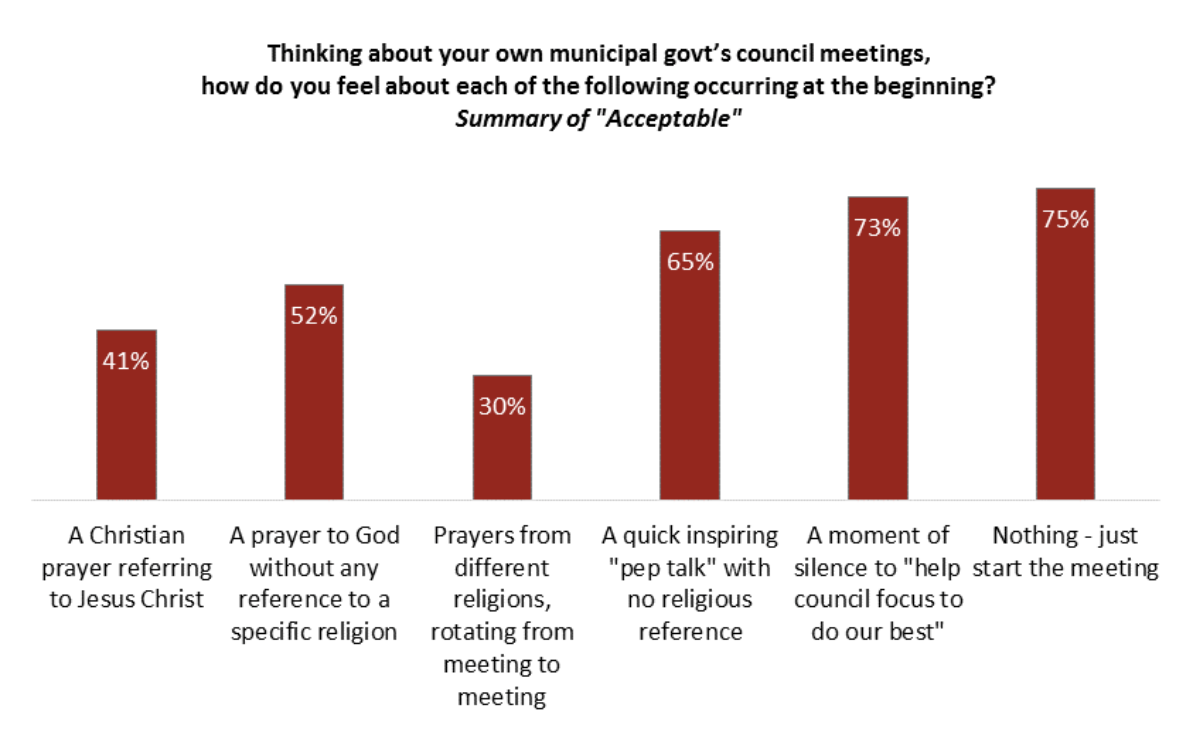
Prayer_in_Canadian_Public_Life__a_Nation_Divided_-_Angus_Reid_InstituteThe latest polling on the Supreme Court’s ruling against prayer in public meetings. Key Findings:

  • Just over half (56%) of respondents are in favour of the court’s decision while the rest (44%) are opposed.
  • That support drops to one-third (34%) among the religiously inclined, and jumps to nearly four-fifths (78%) among those who say religion isn’t important to them.
  • In spite of the secularist view on prayer at public meetings, very few (7%) of respondents want to see the lyrics to O Canada changed so that reference to God is removed.

Prayer in Canadian Public Life: a Nation Divided – Angus Reid Institute.

How to talk to kids about religion: Spiritual multiculturalism is absolutely essential

Lisa Miller on the need for spiritual multiculturalism:

If a spiritual compass, commitment to family, and spiritual community as a sustaining source of love are must haves for children’s life journey, then spiritual multilingualism is their passport. Having our own spirituality and sense of community, whatever that may be, is important to a child. But you want your child to be able to see the sacred in others. Spiritual multilingualism enables us to cross familiar borders and embrace the essence of spirituality in its many cultural narratives.

Children come to understand that diverse spiritual traditions share common themes and often have parallel ideas and observances: the rhythm of the seasons, the birth of a baby, ceremonies of commitment, or rituals around death and mourning. Having your own spiritual or religious orientation but being able to hear and understand others doesn’t only make it easier to engage with other people; it also enhances your own access to sacred experience by making these universal inner connections available to you wherever we go. A child who is conversant in the “many names, many faces” of spiritual practice can find the sacred in others— engage more meaningfully with other people in our diverse global culture.

“The biggest mistake people make when first beginning to look at unfamiliar perspectives is immediately to make comparisons between the familiar and the unfamiliar,” writes Buddhist feminist theologian and author Rita Gross. “The power of the comparative lens comes not from making positive and negative comparisons; rather, it comes from seeing each perspective clearly, in its own right. In other words, one gets a deeper understanding of one’s own perspective by understanding how others understand their own perspective.”

In childhood, natural spirituality of the heart very quickly attaches to the names, stories, and rules to which our children gain daily exposure. Starting as early as age four and certainly by age seven, children absorb the language and customs of thought used to express spirituality in their family or spiritual community. Research shows that for children these names are prioritized as spiritually “more real.” A team of Harvard psychologists led by professor Mahzarin Banaji, investigated whether very young children, ages four to six, already had in- group versus outgroup—my God is better than your God— perceptions around the names of the higher power. The team found in controlled experiments, a child as young as age six will rate “God” as named by her faith as more omniscient than “God” as named by another geographically remote unfamiliar faith. No matter what we may think about religion, we want to be sure children are open to other possibilities. You want your kid to be as open minded as possible. As parents, we want to act early, deliberately, and swiftly. We do not want a child to build tribal superiority, which has nothing to do with a clear and open pipeline for natural spirituality. Theology competition is a misguided form of implicit socialization that ultimately distorts access to transcendent love in all three forms of self, other, and higher power.

The early mental packaging of a child’s natural spirituality makes imperative— read urgent— that our children become, in essence, spiritually multilingual and multicultural from an early age if we genuinely want them to have respect and appreciation for natural spirituality in other people and cultures. This “many faces, many names” perspective is the opposite of religious chauvinism and all other “isms.” Offer your child a window into the religions of other families and peoples. As ambassadors, offer the opportunity to feel transcendence in many places and ways.

How to talk to kids about religion: Spiritual multiculturalism is absolutely essential – Salon.com.

Why Islam doesn’t need a reformation | Mehdi Hasan

Mehdi Hasan on the intellectual laziness of those who call for an Islamic reformation and the uncomfortable facts behind Luther’s reformation:

The truth is that Islam has already had its own reformation of sorts, in the sense of a stripping of cultural accretions and a process of supposed “purification”. And it didn’t produce a tolerant, pluralistic, multifaith utopia, a Scandinavia-on-the-Euphrates. Instead, it produced … the kingdom of Saudi Arabia.

Wasn’t reform exactly what was offered to the masses of the Hijaz by Muhammad Ibn Abdul Wahhab, the mid-18th century itinerant preacher who allied with the House of Saud? He offered an austere Islam cleansed of what he believed to be innovations, which eschewed centuries of mainstream scholarship and commentary, and rejected the authority of the traditional ulema, or religious authorities.

Some might argue that if anyone deserves the title of a Muslim Luther, it is Ibn Abdul Wahhab who, in the eyes of his critics, combined Luther’s puritanism with the German monk’s antipathy towards the Jews. Ibn Abdul Wahhab’s controversial stance on Muslim theology, writes his biographer Michael Crawford, “made him condemn much of the Islam of his own time” and led to him being dismissed as a heretic by his own family.

Don’t get me wrong. Reforms are of course needed across the crisis-ridden Muslim-majority world: political, socio-economic and, yes, religious too. Muslims need to rediscover their own heritage of pluralism, tolerance and mutual respect – embodied in, say, the Prophet’s letter to the monks of St Catherine’s monastery, or the “convivencia” (or co-existence) of medieval Muslim Spain.

If we are to fight extremism we must bring people together, not silence and ban them

What they don’t need are lazy calls for an Islamic reformation from non-Muslims and ex-Muslims, the repetition of which merely illustrates how shallow and simplistic, how ahistorical and even anti-historical, some of the west’s leading commentators are on this issue. It is much easier for them, it seems, to reduce the complex debate over violent extremism to a series of cliches, slogans and soundbites, rather than examining root causes or historical trends; easier still to champion the most extreme and bigoted critics of Islam while ignoring the voices of mainstream Muslim scholars, academics and activists.

Hirsi Ali, for instance, was treated to a series of encomiums and softball questions in her blizzard of US media interviews, from the New York Times to Fox News. (“A hero of our time,” read one gushing headline on Politico.) Frustratingly, only comedian Jon Stewart, on The Daily Show, was willing to point out to Hirsi Ali that her reformist hero wanted a “purer form of Christianity” and helped create “a hundred years of violence and mayhem”.

With apologies to Luther, if anyone wants to do the same to the religion of Islam today, it is Isis leader Abu Bakr al-Baghdadi, who claims to rape and pillage in the name of a “purer form” of Islam – and who isn’t, incidentally, a fan of the Jews either. Those who cry so simplistically, and not a little inanely, for an Islamic reformation, should be careful what they wish for.

Why Islam doesn’t need a reformation | Mehdi Hasan | Comment is free | The Guardian.

Keeping faith: The changing face of religion in Canada

Just as immigration is driving population growth, it is driving growth in some religions:

University of Lethbridge sociologist Reginald W. Bibby has spent several decades surveying Canadians about their attitudes on faith.

He isn’t optimistic about a Protestant turnaround anytime soon.

“The United Church, the Anglicans, the Presbyterians and the Lutherans were all being fed with these wonderful immigration pipelines for an awfully long time with people coming from Europe.”

“What’s happened,” says Bibby, “is those pipelines have been shut down.  And the reality is unless those groups do some proselytizing, they are going to continue to decline rapidly as far as numbers.”

Proselytizing — not to mention their often livelier church services — may have helped some Evangelical Christians buck that downward trend.

The Angus Reid survey, which Bibby co-designed, suggests roughly 12 per cent of Canadians are members of an Evangelical group, and unlike other Protestant groups, that percentage has kept relatively constant with population growth.

Catholics, as well as non-traditional religions in Canada, such as Muslims, Sikhs and Buddhists, have fared far better than Protestants in terms of overall numbers.

Roughly, one in five immigrants — particularly those from the Philippines and South America — come to Canada and bring their Catholic faith with them.

“No question the whole religious scene in Canada has been lit up a lot by immigration,” says Bibby.

So, in spite of an overall drift away from organized religion, he notes there are some religious hot spots.

Keeping faith: The changing face of religion in Canada – Canada – CBC News.

How a change of heart led to a backlash from the ‘Church of Nasty’ | Michael Coren

Michael Coren on the backlash against his leaving the Catholic Church and becoming more liberal in his social views. Well worth reading:

It’s been an interesting two weeks. I was fired from three regular columns in Catholic magazines, had a dozen speeches cancelled and was then subjected to a repugnant storm of tweets, Facebook comments, emails, newspaper articles and radio broadcasts where it was alleged that I am unfaithful to my wife, am willing to do anything for money, am a liar and a fraud, a “secret Jew,” that my eldest daughter is gay and I am going directly to hell. As I say, an interesting two weeks.

The reason for all this probably seems disarmingly banal and for many people absurdly irrelevant. At the beginning of May it was made public that a year ago I left the Roman Catholic Church and began to worship as an Anglican. More specifically, from being a public and media champion of social conservatism I gradually came to embrace the cause of same-sex marriage, more liberal politics and a rejection of the conservative Christianity that had characterized my opinions and persona for more than a decade. I’d won the RTNDA Broadcasting Award for a major radio debate where I opposed equal marriage, I was the author of the bestselling book Why Catholics Are Right, I was Michael Coren, for God’s sake — certainly not someone who would ever appear in the pages of the Toronto Star!

The change was to a large extent triggered by the gay issue. I couldn’t accept that homosexual relationships were, as the Roman Catholic Church insists on proclaiming, disordered and sinful. Once a single brick in the wall was removed the entire structure began to fall.

I refused to base my entire world view and theology, as so many active Catholics do, around abortion, contraception and sex rather than love, justice and forgiveness. Frankly, it was tearing me apart. I wanted to extend the circle of love rather than stand at the corners of a square and repel outsiders. So I quietly and privately drifted over to an Anglican Church that while still working out its own position on many social issues, is far more progressive, open, relevant and willing to admit reality.

But social media being what it is I was “outed” by some far-right bloggers and the gates of media hell opened roaring wide. Thus the comments above. Actually, my daughter lives with her long-term boyfriend in Paris, not that her sexuality matters to me and shouldn’t to anyone else. I am far too ugly to cheat on my wife and we’re very much in love. My dad was Jewish but I’m not and never have been really, secret or otherwise. I’m boringly honest and have never defrauded anyone. I’ve lost a substantial amount of money through lost work because of all this, so if financial gain is the purpose I’m pretty dumb. As for going to hell, I suppose that’s still open to question.

But on a serious note, why? Why would the religious and political change of what is at best a mid-level Canadian journalist and broadcaster cause such visceral anger and aggression in so many people? Their disappointment is understandable, of course, but that they would troll my children’s Facebook pages and make up lies about my family says something far greater and more worrying about contemporary religion and politics and in particular the conservative right.

Over the years I have been attacked by various people in various camps, but I have never witnessed such an organized, personal and unkind campaign — all from men and women who claim to follow the Prince of Peace, a Messiah who preached turning the other cheek, empathy and endless light. I’m trying to forgive because as a Christian I’m in the forgiving business. But I tell you in all honesty, it’s hard.

…If any single characteristic dominates the mindset and ideology of such people it is fear. They have built themselves a hobbit-hole of seclusion, a bunker of protection against the outside world. Nor can this simply be blamed on their age because some of the fiercest and cruellest of them are fairly young. The fear is a result of their socialization, their mingling of church and state and their desire for a cause in an era they see as corrupt and immoral.
I don’t see that corruption and immorality. I see the same challenges, the same greatness and the same brokenness that has always been. But here’s the paradox: while Canada may be less explicitly Christian than ever before, it has arguably become in its sense of equality, fairness and downright decency more Christian than ever. Perhaps that’s why my new friends are so angry with me, with Canada and with pretty much everything.
As for me, in spite of, or perhaps even because of, all this I’ve never felt deeper and more content in my faith and never happier to be a Canadian. As I say, it’s been an interesting two weeks.

How a change of heart led to a backlash from the ‘Church of Nasty’ | Toronto Star.

Fewer Americans Calling Themselves Christians, Survey Finds

Similar to Canadian numbers:

The share of Americans calling themselves Christians has dropped sharply in recent years, according to a new Pew Research Center survey — while the population of religiously unaffiliated adults has risen.
Though more Christians call America home than any other country, the percentage of American adults identifying as Christians has fallen from 78.4% in 2007 to about 70.6%. Meanwhile, over one in five (22.8%) say they are unaffiliated with any faith, a 6.7% percentage point jump since 2007.
Pew finds the Millennial generation is leading the decline in religious affiliation, though adults of all ages and across all demographic groups are steering away from Christianity. About 36% of Americans between 18 and 24 claim to be religiously unaffiliated, along with some 34% of Americans between 24 and 33.

http://time.com/3855277/american-christianity-poll-nones/

Dad rules when sex ed collides with religion: Adams

Michael Adams on how patriarchy is a proxy for conservative views:

If conservative Protestants and mainline Protestants mark the high and low ends of the patriarchy spectrum, non-Christians (8.8 per cent of Canadians) are in the middle. On average, 30 per cent of these Canadians believe father must be master. For Jews, Sikhs, Buddhists, and Hindus, our sample is too small to analyze. Muslims, who now make up 3.2 per cent of the population, score high on deference to Dad (58 per cent) but they haven’t cornered the market on patriarchy: Canadian-born Muslims are outscored slightly by foreign-born conservative Protestants.

For the time being, Canada and its progressive social mores – a willingness to question dad, religious leaders, and tradition; and a willingness to respect individuals’ self-determination, sexual and otherwise – enjoy the assent of the majority. This majority includes the non-religious, members of mainline Christian denominations, substantial proportions of non-Christian religious groups, and even progressive members of more conservative religious groups (Christian and non-Christian).

The minority who feel stronger attachment to traditional authority will make their distress about this mainstream permissiveness known, as they have in Ontario. Whether their children will be persuaded by their parents or by the wider culture remains to be seen – but if trends in my generation of Catholics and in past waves of second-generation immigrants are any indication, most of those kids will give Dad a hug and then go their own way. Still, the year 2050 will likely find at least some of them marching in front of some legislature, protesting against the latest assault on religious patriarchy.

  Dad rules when ex ed collides with religion – The Globe and Mail.

Islam in UK: Losing my religion | The Economist

Interesting trend even if the numbers are small as well as observation that many British Muslims have become more religious as a response to feeling that their faith is under attack:

Former Muslims’ reluctance to admit to their lack of faith rarely stems from a fear of violence, as in countries such as Sudan where laws make apostasy punishable by death. Rather the worry in Britain is about the social stigma, moral condemnation and ostracism that follows, says Simon Cottee of the University of Kent, who has written a book on the subject.

Many do not divulge their unbelief to their families, let alone the wider community. At events organised by the CEMB, some come straight from the mosque. Women say they continue to wear their veil at home to conceal their change of heart. Those who are openly godless often use the language of gay rights, talking about “coming out” to those close to them.

Despite such difficulties, the internet is making life easier. Muslims questioning their faith can talk to others online. The CEMB’s forum has over 4,000 users, says Marayam Namazie, the group’s founder. In the past would-be atheists had to sneak off to libraries to explore their doubts. Doing so online is easier and more discreet. Nonetheless the CEMB also offers guidance on concealing such activities, advising those with doubts to erase e-mails and search histories and to use a computer to which others do not have access.

Ibrahim Mogra, an imam in Leicester, says that he has heard of only a handful of cases of Muslims who have openly renounced their religion over the past 30 years. More common, he says, are those who abandon many of the practices of Islam—regular prayers, the dietary laws and dress codes, for example—but still identify as Muslims. This group, which is culturally but less spiritually committed to Islam, is getting larger, suggests Mr Mogra. Growing up in secular Britain leads people, especially the young, to drift away. But many grow out of their doubts, he reckons, and return, especially when they have children.

Religious leaders certainly try to draw them back into the fold. Sermons on Friday, when more backsliders may appear, are an opportunity to boost their faith. Ramadan is a chance to recharge the spiritual batteries of people who will only return again 11 months later for a top-up, says Mr Mogra. But a culture in which youngsters could express their uncertainties openly and discuss them with scholars would be good, he argues. “If, after that, they still have doubts, that’s up to them.”

The difficulty for Muslims with misgivings, at least in revealing them, is the politicisation of Islam. Many British Muslims have become more overtly religious as they perceive their faith to be under attack. Islam has become a greater part of their identity. That makes it harder for doubters to come out—and leaves them in a quandary. Some interviewed by Mr Cottee were wary of putting their testimonies online, anxious to avoid giving ammunition to those who would vilify Islam. Until Muslims feel more at ease in Britain and Britons more relaxed about Islam, the number coming out will be small.

Islam: Losing my religion | The Economist.