U.S. Supreme Court won’t hear ‘Sister Wives’ polygamy appeal

Reality tv meets the justice system, but on a technicality:

The U.S. Supreme Court said Monday it won’t hear an appeal from the family on TV’s “Sister Wives” challenging Utah’s law banning polygamy.

The decision ends the family’s long legal fight to overturn a seldom used and unique provision of Utah’s law that the Browns and other polygamous families contend has a chilling effect by sending law-abiding plural families into hiding because of fear of prosecution.

The provision bars married people from living with a second purported “spiritual spouse” even if the man is legally married to just one woman, making it stricter than anti-bigamy laws in other states.

The reality TLC cable channel TV show follows the lives of Kody Brown, his four wives and all their children. When it debuted in 2010, it was considered ground-breaking by offering viewers a glimpse into how a plural family navigates the unique complexities of the arrangement.

Utah prosecutors say they generally leave polygamists alone but that they need the ban to pursue polygamists for other crimes such as underage marriage and sexual assault. Only 10 people were charged with violating the law between 2001 and 2011, prosecutors say.

The Utah Attorney General’s Office declined comment on the Supreme Court’s denial of the case, which the justices issued without comment.

The saga between the Browns and Utah officials began in September 2010 when the first episode aired of the TLC show, “Sister Wives.” A county prosecutor opened an investigation, leading the Browns to leave their longtime of Lehi, Utah, in 2011, to settle in Las Vegas where they still live today.

That same year, the Browns filed a lawsuit calling the opening of the investigation government abuse. The case was closed without filing any charges.

In 2013, the Browns scored a key legal victory when a federal judge in Utah ruled the law violated polygamists’ right to privacy and religious freedom.

But an appeals court in Denver decided last year that the Browns could not sue because they were not charged under the Utah law. It did not consider the constitutional issues. That ruling will now stand.

The Brown’s attorney, Jonathan Turley, said in a statement posted on his blog that he and the family are disappointed but not surprised because the high court is on a pace to hear less than 1 per cent of the 7,500 appeals it is likely to receive this term.

Turley emphasized that an appeals court ruling was not made based on the merits of the Browns’ assertion that Utah’s law violates their rights of speech and religion.

“Our victory in Salt Lake City will remain as a cautionary decision for legislators who wish to marginalize or sanction this community in the future,” Turley said. “It has been a long road for all of us and it is not the end of the road. Plural and unconventional families will continue to strive for equal status and treatment under the law.”

Kody Brown is legally married to Robyn Brown, but says he is “spiritually married” to three other women. They live together in a plural relationship and belong to a religious group that believes in polygamy as a core religious practice. Their show continues to air on TLC.

Source: U.S. Supreme Court won’t hear ‘Sister Wives’ polygamy appeal – Macleans.ca
Should we ‘ban’ Salafism? – Gurski

Good piece by Phil Gurski:

Truth be told, I am no fan of most Salafis (full disclosure: I am not Muslim so my views count for little). I happen to find them arrogant, intolerant and distrustful of Muslims who are not like them (this means most Muslims—look at the figure presented above: of an estimated 4.3 million Muslims in Germany, 10,000— i.e. less than one per cent—are Salafi). In the same way I have little time for fundamentalists of any religion, including my own. But, I don’t tell them how to pray and how to worship—that is not my job. Is the German government now the arbiter of Islam in Germany? Does it really want that job?

This is fraught with problems. Is anyone associated with the German government qualified to determine who is a Salafist and who isn’t? What about divisions within Salafism? Most reputable scholars recognize at least three divisions with only the third—the Salafi jihadis—as a group that must be opposed because they believe in the use of violence to get their way. If Germany cracks down on “Salafists,” whether or not they espouse violence, should it not also ban other fundamentalist groups (Jews, Christians, Hindus…)? If not, why not?

At the end of the day the people best placed to deal with Salafism, if we agree that it is a “problem,” are not those in government, but the communities where it has taken hold. They are the ones most affected by it and they are the ones criticized by those with more intolerant views. They have a vested interest in challenging this issue, not the state. If certain preachers advocate violence, then ban them.

Furthermore, and this is really important, just as there is not a direct correlation/causation between Islam and terrorism, nor is there one on every occasion between Salafi Islam and terrorism. Saying there is is disingenuous. Let’s not make the serious problem of terrorism bigger than it already is. The “escalator” model of terrorism (i.e. that there are concrete steps always present along the pathway to violent extremism) is a poor one and has never been shown to apply universally. This lack of certainty describes the relationship between Salafism and terrorism.

Canada’s 15th prime minister, Pierre Elliott Trudeau, famously said that the “state has no business in the bedrooms of the nation.” Nor does it have a place in the mosques, pews, synagogues, temples or gurdwaras. If any of these places serve as hub or venue for conspiracy to commit a terrorist act, then that is a different story and the State does have both a right and a duty to get involved. Otherwise, it is wiser to stay out of that domain.

Source: Should we ‘ban’ Salafism? – The Hill Times – The Hill Times

To Secular Bangladeshis, Textbook Changes Are a Harbinger – The New York Times

Not encouraging:

Bangladesh’s Education Ministry was preparing to print the 2017 editions of its standard Bengali textbooks when a group of conservative Islamic religious scholars demanded the removal of 17 poems and stories they deemed “atheistic.”

By the time the books were distributed to schools on Jan. 1, the 17 poems and stories were gone, with no explanation from the government. Other changes had crept in, too: First graders studying the alphabet were taught that “o” stands for “orna,” a scarf worn by devout Muslim girls starting at puberty, not for “ol,” a type of yam; and a sixth-grade travelogue describing a visit to the Hindu-dominated north of India was replaced by one about the Nile in Egypt.

The changes were barely noticeable to the general public, but they alarmed some Bangladesh intellectuals, who saw them as the government’s accommodating a larger shift toward radical Islam.

Bangladesh has struggled to contain extremist violence in recent years, as Islamist militants have targeted secular writers and intellectuals. But equally significant, over the long term, are changes taking place in the general population: The number of women wearing the hijab has gradually risen, as has the number of students enrolled in madrasas, or Islamic schools.

That religious organizations now have a hand in editing textbooks, a prerogative they sought for years, suggests that their influence is growing, even with the Awami League party, which is avowedly secular, in power.

It is a shift that, increasingly, worries the United States. Bangladesh broke away from Pakistan in 1971, and in the decades that followed, it defined itself as adamantly secular and democratic.

For years, this ideology seemed to serve as an insulating force. Transnational jihadist networks that flourished in Afghanistan and Pakistan found little purchase in Bangladesh, despite its dense, poor Muslim population and porous borders.

But over the last several years, as extremist attacks on atheist bloggers and intellectuals became commonplace, secular thought was also fast receding from Bangladesh’s public spaces.

Islamist organizations, analysts say, are so skilled at mobilizing that it has become harder for the government to ignore their demands, especially with a general election coming in 2019.

Hefazat-e-Islam, a vast Islamic organization based in Dhaka, the capital, first called for changes to the textbooks during huge rallies in 2013.

“We went to the higher-ups in the government,” Mufti Fayez Ullah, the group’s joint secretary general, said. “The government realized, ‘Yes, the Muslims should not learn this.’ So they amended it. I want to add that all the political parties, they consider their popularity among the people.”

Éthique et culture religieuse: contre tous les dogmatismes | Le Devoir

Good defence of the Quebec ethics and religious culture course by Christine Cossette who teaches it:

Je dis aussi à mes élèves que le doute fait partie de la foi et la rend plus intelligente en l’éloignant des dogmatismes. La foi n’est pas une évidence ; elle doit se soumettre constamment à l’esprit critique. Je la présente donc non pas comme une instance qui dit quoi penser, mais plutôt comme celle qui donne des outils pour mieux penser sa vie. C’est alors que la religion est au service de l’homme et non le contraire.

Ce que le volet Culture religieuse m’autorise à faire, c’est de mettre en lumière le nécessaire travail d’exégèse sur les textes sacrés. En étudiant par exemple la question de l’origine de la vie, je vois le darwinisme et j’analyse le contexte d’écriture des récits de la Genèse qui peuvent, s’ils sont lus mot à mot, mener à de l’obscurantisme. Mes élèves comprennent donc que, dans ces textes, scientifiques et bibliques, deux discours se côtoient mais ne s’opposent pas et qu’un scientifique peut donc être croyant ou non.

Le cours d’ECR m’offre aussi l’occasion de parler de la spiritualité qui est la commune condition humaine (qu’on soit religieux ou pas). En effet, l’être humain n’a pas nécessairement besoin de se lier à une quelconque divinité pour vivre de valeurs qui le grandissent. La spiritualité appartient à l’homme dans son humanité la plus profonde, précisément parce qu’il porte en lui un mystère qui le dépasse. L’occasion est belle ici de parler de ceux qui ont ouvert d’incroyables chemins d’humanité grâce à leur foi, à leur générosité ou à leur réflexion philosophique.

La mondialisation, avec ses limites et ses grandeurs, nous oblige à réfléchir sur l’avenir de l’humanité : comment en arriver à sauver un espace de dialogue entre chacun de nous ? Le combat n’est plus à faire entre les athées et les croyants, mais bien entre les esprits ouverts et les esprits dogmatiques qui, eux, prétendent connaître la Vérité. Or, on sait que le dogmatisme se cache autant dans le monde religieux que dans l’univers anti-religieux. « Pour mener ce combat pour la liberté et pour la tolérance, dit Comte-Sponville, nous avons besoin de faire la paix entre croyants et incroyants, de nous allier contre notre ennemi commun, qui n’est pas la religion, qui n’est pas l’athéisme, mais qui est le dogmatisme. »

Le cours d’ECR me permet de proposer cet espace de réflexion pour une humanité plus respectueuse des uns et des autres. Il me donne cette possibilité aussi de présenter ce que l’orthodoxe Olivier Clément appelle le « noyau de feu » de chacune des grandes religions en mettant en lumière ce qui les unit. Après tout, n’est-il pas honnête de dire que d’autres avant nous ont laissé des trésors pour vivre en humanité ?

J’aime donner ce cours. J’estime qu’il contribue à former des citoyens justes, courtois et à l’esprit critique. Mais je suis fatiguée de lire toutes les inepties qu’on peut en dire. Je rêve du jour où, enfin, ses détracteurs se donneront la peine de lire, non pas les cahiers d’exercices, mais bien le programme tel qu’il a été pensé, tout en précisant qu’il devrait être un peu plus balisé pour obliger ses professeurs à toujours plus de rigueur à travers l’apprentissage de fondements philosophiques, historiques et théologiques.

The U.S. Army Just Made It Easier for Religious Troops to Wear Beards, Turbans and Hijabs | TIME

Just in time prior to the Trump inauguration:

U.S. service men and women who wish to wear a turban, beard or hijab for religious reasons will be able to gain approval thanks to revised uniform regulations that aim to better accommodate religious minorities serving in the military.

The revisions — outlined in a memorandum signed by U.S. Army Secretary Eric Fanning earlier this week — allow brigade-level commanders to approve religious accommodations, Reuters reports.

In the past, the authority to approve such accommodations rested with the Army secretary.

Lieut. Colonel Randy Taylor, the army’s director of public affairs and assistant secretary, said in a statement, “Our goal is to balance soldier readiness and safety with the accommodation of our soldiers’ faith practices, and this latest directive allows us to do that.”

Under the new guidelines, Muslim and Sikh servicemen will be able to wear beards, provided they are shorter than 2 in., rolled up or tied. Turbans, patka (under turbans), as well as head scarves or hijab for women, are permitted under the new rules. The memo also stipulates that hair braids, cornrows, twists and locks are also allowed.

“We are pleased with the progress that this new policy represents for religious tolerance and diversity,” Harsimran Kaur, legal director of civil-rights-advocacy group the Sikh Coalition, told Reuters.

Previous Army uniform rules had clashed with religious clothing and grooming customs, making it difficult for soldiers to serve without compromising their religious beliefs and traditions. Many American Sikhs have protested the grooming rules, leading to several court cases.

Source: The U.S. Army Just Made It Easier for Religious Troops to Wear Beards, Turbans and Hijabs | TIME

Atheists, Agnostics, Nonreligious Remain Far Underrepresented In US Congress : NPR

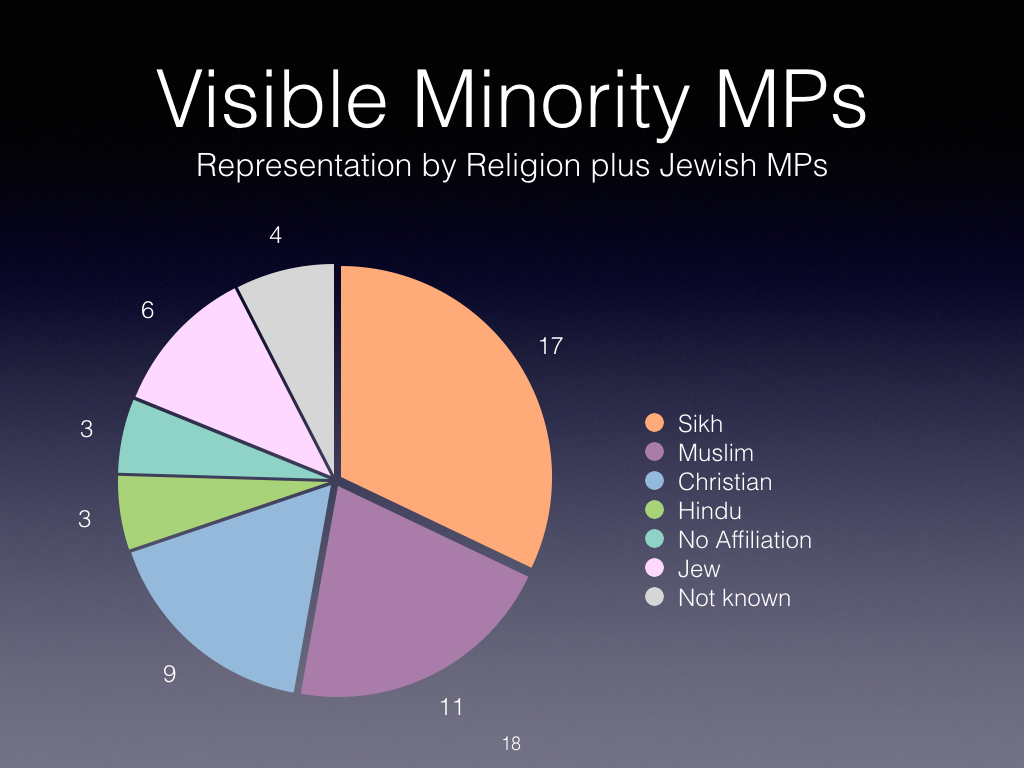
Interesting comparison between the US Congress and the population it represents (in Canada, it is about one in four). In terms of the religion of Canadian MPs, my analysis of visible minority MPs is below:

election-2015-vismin-and-foreign-born-mps-018

atheists__agnostics__nonreligious_remain_far_underrepresented_in_congress___nprOne in five Americans is religiously unaffiliated. Yet just one of 535 members of the new Congress is.

That’s what the latest data from the Pew Research Center show on the opening day of the 115th Congress. The nation’s top legislative body remains far more male and white than the rest of the U.S. population as well, but religion is one of the more invisible areas where legislators in Washington simply aren’t representative of the people they represent.

Only Arizona Democratic Rep. Kyrsten Sinema admits to being “unaffiliated,” which Pew defines as people who are atheist, agnostic or who describe their religion as “nothing in particular.” That means only 0.2 percent of Congress is unaffiliated, compared with 23 percent of U.S. adults. That group is faster-growing than any religious group in America, as Pew found in 2015.

Meanwhile, nearly 91 percent of congressional members are Christian, compared with 71 percent of U.S. adults. Here’s a full breakdown of how Congress’ religious affiliations compare with those of the U.S. population:

America’s nonreligious are young — and not politically organized

Why the massive gap? For one, religiously unaffiliated people tend to be young, and Congress just isn’t that young. In the 114th Congress, the average age for House members was 57 years old and for senators it was 61. (To a modest extent, this is a reflection of age rules: Senators must be 30 or older, and representatives have to be at least 25.)

In addition, younger Americans tend to have much lower voting rates than older people. That may also contribute, though the logic requires a couple of leaps — if this means the (relatively young) religiously unaffiliated population isn’t voting as much, and if the religiously unaffiliated are more drawn to likewise unaffiliated politicians — that could also help explain the lack of “nones” in Congress. Likewise, the inverse is true: If older (and more religious) Americans are voting for more religious politicians, it means less room for the nonreligious ones.

(Perhaps unsurprisingly, the unaffiliated Sinema is also relatively young for a congressional member at 40.)

One more potential reason unaffiliated people aren’t in power: Not being affiliated often also means not being politically cohesive.

Source: Atheists, Agnostics, Nonreligious Remain Far Underrepresented In Congress : NPR

Why Islam Gets Second-Class Status in Germany – The New York Times

Interesting commentary by Alexander Gorlach:

Religion in Germany is not a private affair. Government at all levels recognizes religious communities as public institutions, and encourages participation in them — Germans who register with the state as Roman Catholics, Protestants or Jews pay a “religion tax,” which the government then sends to their respective institution. Religious groups are also allowed to give faith-based instruction in public schools: It’s not uncommon for a small-town pastor, priest or lay person to have a spot on the local high school faculty.

To enjoy this privileged status, religious communities must have a defined set of beliefs, their members must be recorded, and they must have historical and social significance. The Catholic, Protestant and Jewish religious communities are organized as public institutions; in the state of Berlin, Jehovah’s Witnesses and the Mormon Church are as well.

It might seem as if Islam, with 4.3 million adherents in Germany, would have qualified easily. But so far, the German government has resisted including it.

The reason is both simple and complex: Muslim communities are separated along ethnic lines as well as along denominational lines among Sunnis, Shiites and Alawites. Often there is little unity among these groups, hence they fail the most important state criterion: a unified religious body with shared goals and doctrines.

These requirements for a religion to get a privileged status in Germany highlight the anachronistic state of the secular federal republic in its approach to faith. The idea that the state can cooperate with religious groups in the same way it cooperates with, say, labor unions presumes a certain unity and hierarchy on the part of those groups. But Islam doesn’t work that way. It simply doesn’t fit within criteria written for the structured Christian churches that have shaped Europe, with bishops and baptismal registers.

For quite some time, there have been demands that the law be renamed to the Religionsrecht (State and Religion Law), and for it to include a wider diversity of religions. Though nothing much has changed on the national level, there has been progress in the states, where most of the country’s religious laws are promulgated. Bavaria, a conservative Catholic state that polls very high in measurements of xenophobia and anti-refugee sentiment, nevertheless has been running an Islamic-education pilot program in schools; it is also home to Germany’s oldest mosques. Perhaps the Bavarians, precisely because they protect their own religious and cultural traditions so ferociously, are also the most willing to recognize and support the traditions of others.

But it’s not only in Bavaria that reform is moving forward. In the Protestant-dominated north, Christian Wulff, a premier of Lower Saxony, set up training courses for future imams and Islamic religious teachers at the universities of Münster and Osnabrück. Later, when he was president of Germany, Mr. Wulff said, “Islam belongs to Germany.”

Though Mr. Wulff served just two years as president before resigning in 2012 over allegations of corruption (since dropped), his actions on behalf of Islam — and that quotation in particular — set off a debate that continues across the country. Critics of Islamic religious education in the schools, including many Muslims themselves, say that there is no group in the country that can speak for all Muslims. And indeed, it is estimated that the Central Council of Muslims and the Islamic Council for the Federal Republic of Germany, the two groups that have the best claims to speak for Islam in Germany, represent no more than 20 percent of German Muslims.

Germany is a secular country, but the German legal framework approves of institutionalized religions in a biased way. The religions must organize themselves according to state standards, and those standards are tailored toward the structures of the Christian religion.

The result is a delegitimization of the state’s relationship to religious groups in the eyes of many non-Christians, particularly Muslims — a dangerous prospect at a time when rapid integration is essential to maintain social peace. In the context of a growing Muslim community and a rising number of citizens affiliated with no religion at all, Germany may not be able to maintain an order that arose many generations ago.

Reports: Gulf States supporting ultraconservative Islam branch in Germany | DW.COM

While religious fundamentalism does not necessarily equate to terrorism and extremism, it is not conducive to integration:

Saudi Arabia, Kuwait and Qatar have increasingly been providing support to a fundamentalist interpretation of Islam, German media said on Monday citing Germany’s foreign and domestic intelligence agencies.

Religious organizations from those three countries have been sending preachers to Germany as well as financing the construction of mosques and schools, the German “Süddeutsche Zeitung” newspaper and public service broadcasters NDR and WDR reported. The intelligence reports were conducted on the behalf of the German government.

By upping their support of Salafist missionary activities, the religious groups intend to spread the ultraconservative version of Islam in Germany, the intelligence reports said.

There are currently 9,200 people involved in the Salafist scene in Germany, but the government has concerns that the increased missionary work could swell their ranks. Berlin is also concerned that the groups could play a role in radicalizing Sunni refugees.

Possible government ties

The German government has repeatedly called on the Saudi government to stop supporting radical Islamists in Germany. Saudi Arabia, on the other hand, has said its religious organizations are a “stronghold” against the so-called “Islamic State.”

Although the Riyadh insists that the religious organizations are independent, Germany’s intelligence agencies concluded that the groups “are closely linked with state posts in their countries of origin.”

The intelligence agencies did note, however, that there is a lack of evidence to suggest that the religious groups support “violent Salafist structures and networks.”

Influence in schools and real estate

The intelligence reports also specifically named three religious organizations active in Germany that are believed to be supported by the state: the “Shaykh Eid Charity Foundation” from Qatar, the “Muslim World League” from Saudi Arabia and the “Revival of Islamic Heritage Society” (RIHS) from Kuwait.

Source: Reports: Gulf States supporting ultraconservative Islam branch in Germany | News | DW.COM | 13.12.2016

Author cleared of slander for saying Muslim school’s teachings go against Quebec values | National Post

While I find such aggressive language unnecessary (there are other ways to make the same points), the judge appears to have made the right call based upon the facts as reported:

The criticism Djemila Benhabib leveled against a private Muslim school during a 2012 radio interview was harsh. The school was providing small children indoctrination worthy of a military camp in Afghanistan, she said. It was grooming “fundamental activists.” It offered as a model a society “where men are probably going to commit honour crimes against their sisters.”

But in what her lawyer called an important victory for free speech, a judge cleared Benhabib of slander Tuesday, ruling her comments were neither erroneous nor made in bad faith.

“Certainly, these remarks are severe and could have been hurtful,” Superior Court Justice Carole Hallée wrote. “However they have a place in a democratic society like ours.”

Benhabib, an author and outspoken critic of Islamic fundamentalism, had begun looking into the Muslim School of Montreal after seeing a brochure in which the female students all wore hijabs. She learned on the school’s web site that children were memorizing Qur’anic passages that spoke of beautiful virgins awaiting male believers in the afterlife, while non-believers endured the fires of hell.

She told radio host Benoît Dutrizac of 98.5FM that the school was instituting a “sexual apartheid” and that it was “very far from the values of our society.”

The school sued for defamation, seeking $95,000 in damages from Benhabib. It claimed the interview had led students to fear for their safety, necessitating additional security measures and provoking a drop in enrollment.

At the trial last September, Benhabib insisted her criticism was justified. “The school’s societal model is not the Quebec societal model. It is not Quebec values,” she said.

Ahmed Khebir, president of the school’s board of directors, said her interview, linking its curriculum to military camps, sparked fears within the school that it would be targeted by anti-Muslim fanatics.

“I was devastated, appalled, horrified, insulted and worried,” he testified. “How was it possible that someone who had never set foot inside our school could make such damaging and insulting statements?”

In her ruling, Hallée questioned Khebir’s credibility and said the school had presented no evidence that its reputation suffered as a result of the interview. She accepted Benhabib’s testimony that when she spoke of military camps she was not referring to terrorist-training camps but simply to a rigid military mindset.

Hallée found that enrollment figures did not support the claim of a drop, and it seems more likely that security improvements made in 2015 were the result of terror attacks in Paris, not an interview three years earlier.

More importantly, she ruled that Benhabib had not slandered the school or its students. The issues she was raising – the wearing of the hijab and memorization of religious passages in school – were matters of public interest.

“Everyone must be allowed to express themselves as freely as possible on these questions,” Hallée wrote.

Benhabib’s remarks, she continued, “are at the heart of freedom of expression’s raison d’être, that is to favour active participation in debates on subjects of public interest.”

If criticism like Benhabib’s were silenced, the judge wrote, society would suffer.

“If this protection is not given to freedom of expression in the context of a debate of interest to the public, it is society that will suffer enormous harm in that many debates will no longer be moved forward, many subjects will no longer be raised and, in the end, everyone will stop talking about it,” she wrote.

Source: Author cleared of slander for saying Muslim school’s teachings go against Quebec values | National Post

Battle against religious persecution ‘diminished’ under Liberal government: ex-ambassador

Bennett’s comments are not surprising, as the intent of the merger into the human rights division was to encourage a more integrated approach to all rights, which ultimately means a lower profile for religious freedom than provided by a separate office.

Same thing happened when multiculturalism moved from Canadian Heritage to IRCC in 2008 under then Minister Kenney, where it withered away in terms of personnel, funding and importance, and has yet to recover despite its move back to Canadian Heritage:

I agree fully with his call for greater religious literacy among officials (not just diplomats), given the place that religion plays in many peoples lives:

Canada’s former ambassador for religious freedom launched thinly veiled criticisms at the new Office of Human Rights, Freedoms and Inclusion on Wednesday.

Speaking to the Senate’s human rights committee, Andrew Bennett, now a senior fellow with Christian think-tank Cardus, said the “ill-defined and thoroughly vague” concept of “inclusion” could muddy the water and distract from specific religious persecution issues faced by minorities abroad.

Bennett implied the Liberal government’s new office, which replaced his Office of Religious Freedom earlier this year, has a vaguer mandate less focused on specific issues of religious persecution than it did under the Conservatives.

He said more training is needed because there is a “relative ignorance” of religion in the public-service ranks and a “false understanding of separation of church and state” still seems prevalent. To ignore the fact that religion plays a role in public life is “out of step,” “historically inaccurate” and a “very serious diplomatic blind spot,” he said.

“Allies are wondering why there has been a diminishment in focus on religious freedom,” Bennett added, arguing that religious freedom is fundamental and that to prioritize it does not deny attention to other human rights.

“Certain human rights need to be brought to the floor and actively and persuasively championed when they’re most being challenged,” he said. His office could have been louder, Bennett noted, when it came to specific issues, such as the treatment of Falun Gong practitioners and Tibetan Buddhists in China, of Christians in Saudi Arabia and of Shia Muslims in Pakistan.

Bennett said he worked with the new office as part of a transition process, including extending his own network of contacts, until June. But, in the context of a question about the transition period, he said, “unfortunately I was never afforded the opportunity to brief the minister on the work of the Office of Religious Freedom.”

Foreign Affairs Minister Stéphane Dion’s press secretary, Chantal Gagnon, said however that the two had met earlier, on Feb. 10, when they “discussed the work of the office.”

In an emailed follow-up statement to the National Post, Bennett said the meeting was held with “no more than two hours’ notice” and that Dion requested “advice on the political sensitivities of the non-renewal of the office” and his relationship with the office’s External Advisory Committee. “But that was not a structured, formal briefing on the office itself.”