The U.S. Army Just Made It Easier for Religious Troops to Wear Beards, Turbans and Hijabs | TIME

Just in time prior to the Trump inauguration:

U.S. service men and women who wish to wear a turban, beard or hijab for religious reasons will be able to gain approval thanks to revised uniform regulations that aim to better accommodate religious minorities serving in the military.

The revisions — outlined in a memorandum signed by U.S. Army Secretary Eric Fanning earlier this week — allow brigade-level commanders to approve religious accommodations, Reuters reports.

In the past, the authority to approve such accommodations rested with the Army secretary.

Lieut. Colonel Randy Taylor, the army’s director of public affairs and assistant secretary, said in a statement, “Our goal is to balance soldier readiness and safety with the accommodation of our soldiers’ faith practices, and this latest directive allows us to do that.”

Under the new guidelines, Muslim and Sikh servicemen will be able to wear beards, provided they are shorter than 2 in., rolled up or tied. Turbans, patka (under turbans), as well as head scarves or hijab for women, are permitted under the new rules. The memo also stipulates that hair braids, cornrows, twists and locks are also allowed.

“We are pleased with the progress that this new policy represents for religious tolerance and diversity,” Harsimran Kaur, legal director of civil-rights-advocacy group the Sikh Coalition, told Reuters.

Previous Army uniform rules had clashed with religious clothing and grooming customs, making it difficult for soldiers to serve without compromising their religious beliefs and traditions. Many American Sikhs have protested the grooming rules, leading to several court cases.

Source: The U.S. Army Just Made It Easier for Religious Troops to Wear Beards, Turbans and Hijabs | TIME

Atheists, Agnostics, Nonreligious Remain Far Underrepresented In US Congress : NPR

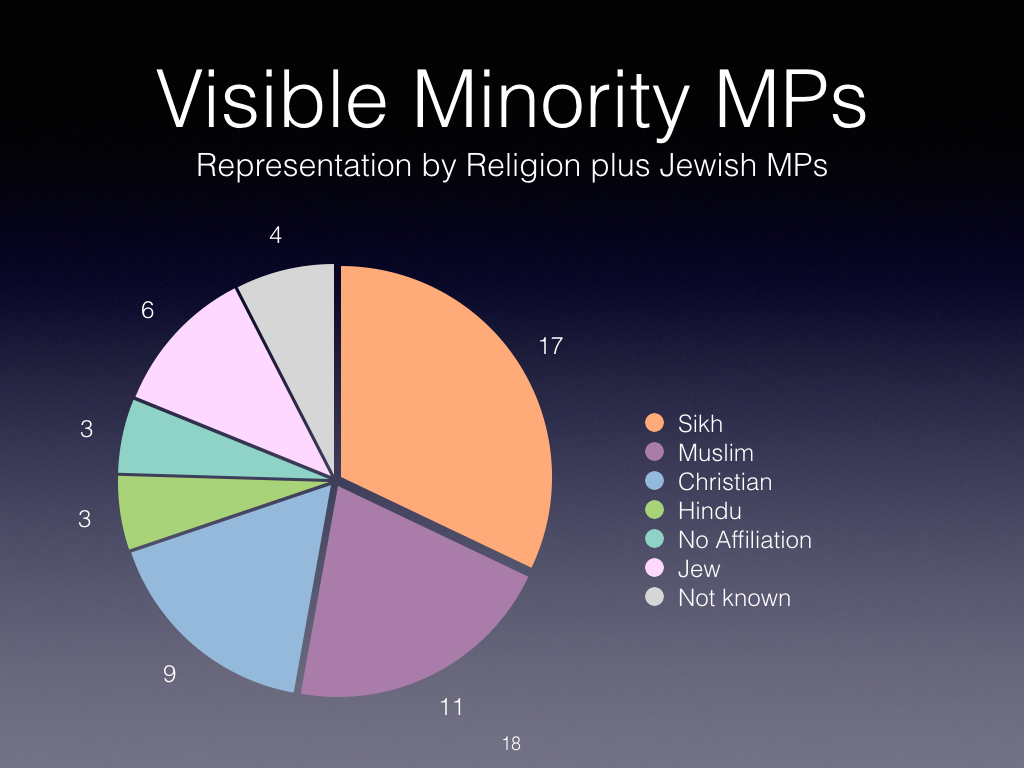
Interesting comparison between the US Congress and the population it represents (in Canada, it is about one in four). In terms of the religion of Canadian MPs, my analysis of visible minority MPs is below:

election-2015-vismin-and-foreign-born-mps-018

atheists__agnostics__nonreligious_remain_far_underrepresented_in_congress___nprOne in five Americans is religiously unaffiliated. Yet just one of 535 members of the new Congress is.

That’s what the latest data from the Pew Research Center show on the opening day of the 115th Congress. The nation’s top legislative body remains far more male and white than the rest of the U.S. population as well, but religion is one of the more invisible areas where legislators in Washington simply aren’t representative of the people they represent.

Only Arizona Democratic Rep. Kyrsten Sinema admits to being “unaffiliated,” which Pew defines as people who are atheist, agnostic or who describe their religion as “nothing in particular.” That means only 0.2 percent of Congress is unaffiliated, compared with 23 percent of U.S. adults. That group is faster-growing than any religious group in America, as Pew found in 2015.

Meanwhile, nearly 91 percent of congressional members are Christian, compared with 71 percent of U.S. adults. Here’s a full breakdown of how Congress’ religious affiliations compare with those of the U.S. population:

America’s nonreligious are young — and not politically organized

Why the massive gap? For one, religiously unaffiliated people tend to be young, and Congress just isn’t that young. In the 114th Congress, the average age for House members was 57 years old and for senators it was 61. (To a modest extent, this is a reflection of age rules: Senators must be 30 or older, and representatives have to be at least 25.)

In addition, younger Americans tend to have much lower voting rates than older people. That may also contribute, though the logic requires a couple of leaps — if this means the (relatively young) religiously unaffiliated population isn’t voting as much, and if the religiously unaffiliated are more drawn to likewise unaffiliated politicians — that could also help explain the lack of “nones” in Congress. Likewise, the inverse is true: If older (and more religious) Americans are voting for more religious politicians, it means less room for the nonreligious ones.

(Perhaps unsurprisingly, the unaffiliated Sinema is also relatively young for a congressional member at 40.)

One more potential reason unaffiliated people aren’t in power: Not being affiliated often also means not being politically cohesive.

Source: Atheists, Agnostics, Nonreligious Remain Far Underrepresented In Congress : NPR

Why Islam Gets Second-Class Status in Germany – The New York Times

Interesting commentary by Alexander Gorlach:

Religion in Germany is not a private affair. Government at all levels recognizes religious communities as public institutions, and encourages participation in them — Germans who register with the state as Roman Catholics, Protestants or Jews pay a “religion tax,” which the government then sends to their respective institution. Religious groups are also allowed to give faith-based instruction in public schools: It’s not uncommon for a small-town pastor, priest or lay person to have a spot on the local high school faculty.

To enjoy this privileged status, religious communities must have a defined set of beliefs, their members must be recorded, and they must have historical and social significance. The Catholic, Protestant and Jewish religious communities are organized as public institutions; in the state of Berlin, Jehovah’s Witnesses and the Mormon Church are as well.

It might seem as if Islam, with 4.3 million adherents in Germany, would have qualified easily. But so far, the German government has resisted including it.

The reason is both simple and complex: Muslim communities are separated along ethnic lines as well as along denominational lines among Sunnis, Shiites and Alawites. Often there is little unity among these groups, hence they fail the most important state criterion: a unified religious body with shared goals and doctrines.

These requirements for a religion to get a privileged status in Germany highlight the anachronistic state of the secular federal republic in its approach to faith. The idea that the state can cooperate with religious groups in the same way it cooperates with, say, labor unions presumes a certain unity and hierarchy on the part of those groups. But Islam doesn’t work that way. It simply doesn’t fit within criteria written for the structured Christian churches that have shaped Europe, with bishops and baptismal registers.

For quite some time, there have been demands that the law be renamed to the Religionsrecht (State and Religion Law), and for it to include a wider diversity of religions. Though nothing much has changed on the national level, there has been progress in the states, where most of the country’s religious laws are promulgated. Bavaria, a conservative Catholic state that polls very high in measurements of xenophobia and anti-refugee sentiment, nevertheless has been running an Islamic-education pilot program in schools; it is also home to Germany’s oldest mosques. Perhaps the Bavarians, precisely because they protect their own religious and cultural traditions so ferociously, are also the most willing to recognize and support the traditions of others.

But it’s not only in Bavaria that reform is moving forward. In the Protestant-dominated north, Christian Wulff, a premier of Lower Saxony, set up training courses for future imams and Islamic religious teachers at the universities of Münster and Osnabrück. Later, when he was president of Germany, Mr. Wulff said, “Islam belongs to Germany.”

Though Mr. Wulff served just two years as president before resigning in 2012 over allegations of corruption (since dropped), his actions on behalf of Islam — and that quotation in particular — set off a debate that continues across the country. Critics of Islamic religious education in the schools, including many Muslims themselves, say that there is no group in the country that can speak for all Muslims. And indeed, it is estimated that the Central Council of Muslims and the Islamic Council for the Federal Republic of Germany, the two groups that have the best claims to speak for Islam in Germany, represent no more than 20 percent of German Muslims.

Germany is a secular country, but the German legal framework approves of institutionalized religions in a biased way. The religions must organize themselves according to state standards, and those standards are tailored toward the structures of the Christian religion.

The result is a delegitimization of the state’s relationship to religious groups in the eyes of many non-Christians, particularly Muslims — a dangerous prospect at a time when rapid integration is essential to maintain social peace. In the context of a growing Muslim community and a rising number of citizens affiliated with no religion at all, Germany may not be able to maintain an order that arose many generations ago.

Reports: Gulf States supporting ultraconservative Islam branch in Germany | DW.COM

While religious fundamentalism does not necessarily equate to terrorism and extremism, it is not conducive to integration:

Saudi Arabia, Kuwait and Qatar have increasingly been providing support to a fundamentalist interpretation of Islam, German media said on Monday citing Germany’s foreign and domestic intelligence agencies.

Religious organizations from those three countries have been sending preachers to Germany as well as financing the construction of mosques and schools, the German “Süddeutsche Zeitung” newspaper and public service broadcasters NDR and WDR reported. The intelligence reports were conducted on the behalf of the German government.

By upping their support of Salafist missionary activities, the religious groups intend to spread the ultraconservative version of Islam in Germany, the intelligence reports said.

There are currently 9,200 people involved in the Salafist scene in Germany, but the government has concerns that the increased missionary work could swell their ranks. Berlin is also concerned that the groups could play a role in radicalizing Sunni refugees.

Possible government ties

The German government has repeatedly called on the Saudi government to stop supporting radical Islamists in Germany. Saudi Arabia, on the other hand, has said its religious organizations are a “stronghold” against the so-called “Islamic State.”

Although the Riyadh insists that the religious organizations are independent, Germany’s intelligence agencies concluded that the groups “are closely linked with state posts in their countries of origin.”

The intelligence agencies did note, however, that there is a lack of evidence to suggest that the religious groups support “violent Salafist structures and networks.”

Influence in schools and real estate

The intelligence reports also specifically named three religious organizations active in Germany that are believed to be supported by the state: the “Shaykh Eid Charity Foundation” from Qatar, the “Muslim World League” from Saudi Arabia and the “Revival of Islamic Heritage Society” (RIHS) from Kuwait.

Source: Reports: Gulf States supporting ultraconservative Islam branch in Germany | News | DW.COM | 13.12.2016

Author cleared of slander for saying Muslim school’s teachings go against Quebec values | National Post

While I find such aggressive language unnecessary (there are other ways to make the same points), the judge appears to have made the right call based upon the facts as reported:

The criticism Djemila Benhabib leveled against a private Muslim school during a 2012 radio interview was harsh. The school was providing small children indoctrination worthy of a military camp in Afghanistan, she said. It was grooming “fundamental activists.” It offered as a model a society “where men are probably going to commit honour crimes against their sisters.”

But in what her lawyer called an important victory for free speech, a judge cleared Benhabib of slander Tuesday, ruling her comments were neither erroneous nor made in bad faith.

“Certainly, these remarks are severe and could have been hurtful,” Superior Court Justice Carole Hallée wrote. “However they have a place in a democratic society like ours.”

Benhabib, an author and outspoken critic of Islamic fundamentalism, had begun looking into the Muslim School of Montreal after seeing a brochure in which the female students all wore hijabs. She learned on the school’s web site that children were memorizing Qur’anic passages that spoke of beautiful virgins awaiting male believers in the afterlife, while non-believers endured the fires of hell.

She told radio host Benoît Dutrizac of 98.5FM that the school was instituting a “sexual apartheid” and that it was “very far from the values of our society.”

The school sued for defamation, seeking $95,000 in damages from Benhabib. It claimed the interview had led students to fear for their safety, necessitating additional security measures and provoking a drop in enrollment.

At the trial last September, Benhabib insisted her criticism was justified. “The school’s societal model is not the Quebec societal model. It is not Quebec values,” she said.

Ahmed Khebir, president of the school’s board of directors, said her interview, linking its curriculum to military camps, sparked fears within the school that it would be targeted by anti-Muslim fanatics.

“I was devastated, appalled, horrified, insulted and worried,” he testified. “How was it possible that someone who had never set foot inside our school could make such damaging and insulting statements?”

In her ruling, Hallée questioned Khebir’s credibility and said the school had presented no evidence that its reputation suffered as a result of the interview. She accepted Benhabib’s testimony that when she spoke of military camps she was not referring to terrorist-training camps but simply to a rigid military mindset.

Hallée found that enrollment figures did not support the claim of a drop, and it seems more likely that security improvements made in 2015 were the result of terror attacks in Paris, not an interview three years earlier.

More importantly, she ruled that Benhabib had not slandered the school or its students. The issues she was raising – the wearing of the hijab and memorization of religious passages in school – were matters of public interest.

“Everyone must be allowed to express themselves as freely as possible on these questions,” Hallée wrote.

Benhabib’s remarks, she continued, “are at the heart of freedom of expression’s raison d’être, that is to favour active participation in debates on subjects of public interest.”

If criticism like Benhabib’s were silenced, the judge wrote, society would suffer.

“If this protection is not given to freedom of expression in the context of a debate of interest to the public, it is society that will suffer enormous harm in that many debates will no longer be moved forward, many subjects will no longer be raised and, in the end, everyone will stop talking about it,” she wrote.

Source: Author cleared of slander for saying Muslim school’s teachings go against Quebec values | National Post

Battle against religious persecution ‘diminished’ under Liberal government: ex-ambassador

Bennett’s comments are not surprising, as the intent of the merger into the human rights division was to encourage a more integrated approach to all rights, which ultimately means a lower profile for religious freedom than provided by a separate office.

Same thing happened when multiculturalism moved from Canadian Heritage to IRCC in 2008 under then Minister Kenney, where it withered away in terms of personnel, funding and importance, and has yet to recover despite its move back to Canadian Heritage:

I agree fully with his call for greater religious literacy among officials (not just diplomats), given the place that religion plays in many peoples lives:

Canada’s former ambassador for religious freedom launched thinly veiled criticisms at the new Office of Human Rights, Freedoms and Inclusion on Wednesday.

Speaking to the Senate’s human rights committee, Andrew Bennett, now a senior fellow with Christian think-tank Cardus, said the “ill-defined and thoroughly vague” concept of “inclusion” could muddy the water and distract from specific religious persecution issues faced by minorities abroad.

Bennett implied the Liberal government’s new office, which replaced his Office of Religious Freedom earlier this year, has a vaguer mandate less focused on specific issues of religious persecution than it did under the Conservatives.

He said more training is needed because there is a “relative ignorance” of religion in the public-service ranks and a “false understanding of separation of church and state” still seems prevalent. To ignore the fact that religion plays a role in public life is “out of step,” “historically inaccurate” and a “very serious diplomatic blind spot,” he said.

“Allies are wondering why there has been a diminishment in focus on religious freedom,” Bennett added, arguing that religious freedom is fundamental and that to prioritize it does not deny attention to other human rights.

“Certain human rights need to be brought to the floor and actively and persuasively championed when they’re most being challenged,” he said. His office could have been louder, Bennett noted, when it came to specific issues, such as the treatment of Falun Gong practitioners and Tibetan Buddhists in China, of Christians in Saudi Arabia and of Shia Muslims in Pakistan.

Bennett said he worked with the new office as part of a transition process, including extending his own network of contacts, until June. But, in the context of a question about the transition period, he said, “unfortunately I was never afforded the opportunity to brief the minister on the work of the Office of Religious Freedom.”

Foreign Affairs Minister Stéphane Dion’s press secretary, Chantal Gagnon, said however that the two had met earlier, on Feb. 10, when they “discussed the work of the office.”

In an emailed follow-up statement to the National Post, Bennett said the meeting was held with “no more than two hours’ notice” and that Dion requested “advice on the political sensitivities of the non-renewal of the office” and his relationship with the office’s External Advisory Committee. “But that was not a structured, formal briefing on the office itself.”

Le cours d’éthique et de culture religieuse jugé sexiste | Le Devoir

Should have seen this coming – the challenge of how to improve awareness of different religions and their beliefs, a desirable goal in a diverse society, while placing these in the context of gender and other rights:

Le Conseil du statut de la femme (CSF) reproche au cours d’éthique et de culture religieuse d’enseigner les religions sans critiquer leur contenu sexiste. Dans un nouvel avis, il recommande que l’enseignement des religions soit séparé de celui de l’éthique, et joint au cours d’histoire.

Le cours ne « remet pas en question les pratiques sexistes au sein des religions » et se contente de décrire les récits religieux sans offrir de mise en contexte critique, déplore le CSF.

On donne l’exemple du récit d’Abraham dans l’Ancien Testament et de ses rapports avec son épouse Sarah et la servante de qui il aura un enfant (Ismaël). Certains manuels, note le Conseil, rendent Sarah « responsable du viol » de la servante et« euphémisent » la violence sexuelle subie par cette dernière.
Les textes sur l’institution du mariage catholique posent le même problème, selon le CSF. On expliquera par exemple aux enfants que les interdits et les rites visent à mettre les femmes « au service de la communauté » en favorisant notamment la « stabilité de la famille ». Or, à nouveau, c’est décrit sans regard critique, plaide-t-on.
Même chose pour la pratique du « gèt » (acte de divorce) dans la religion juive qui est réservée aux hommes, ou des règles régissant l’habillement des femmes dans les religions musulmane ou hindoue.
« Aucun élément de contenu ne permet aux élèves de comprendre que les religions sont des institutions sociales certes significatives pour un grand nombre de personnes, mais qui ont été et demeurent responsables d’un grand nombre de violences envers les femmes, ainsi que du maintien de pratiques et de représentations inégalitaires. »
Le CSF propose donc que la religion soit enseignée dans le cadre du cours d’histoire plutôt que dans celui du cours d’éthique. L’éducation à l’égalité, à la citoyenneté et à la sexualité devrait quant à elle s’insérer dans le cours d’éthique durant tout le parcours primaire et secondaire.

L’avis s’en prend en outre au cours d’histoire, qui explique mal ou peu les luttes menées par les femmes. Ainsi, dans un manuel traitant de l’obtention du droit de vote en 1940, on écrit qu’Adélard Godbout leur a « accordé » sans expliquer qu’elles ont « lutté des années pour l’obtenir ». Certains efforts sont toutefois soulignés, tel l’ajout de personnages historiques féminins dans les manuels.

Des biais sexistes

L’organisme s’inquiète en outre de la persistance de certains biais sexistes chez les enseignants. On constate que ces derniers donnent trop de place aux stéréotypes selon lesquels les garçons sont meilleurs en mathématiques, plus physiques et ont plus besoin de bouger que les filles, alors que ces dernières seraient plus à l’aise dans le monde des sentiments, des émotions et de l’aide au prochain.
« Si le corps enseignant peut tenir compte de ces différences — dues à la socialisation différenciée des garçons et des filles —, il ne devrait pas les consolider, écrit le CSF. Au contraire, l’école devrait contribuer à contrecarrer les effets de la socialisation de genre en évitant de réserver certaines approches pédagogiques ou certaines activités aux filles et aux garçons. »
Pour l’affirmer, l’organisme s’appuie notamment sur un questionnaire mené auprès de 393 enseignants. Parmi les répondants, 80 % ont soutenu que les garçons avaient besoin de méthodes éducatives plus « dynamiques et actives ». Une enseignante du primaire citée dans l’avis raconte « qu’il y a des exemples qui parlent plus aux garçons (mise en situation parlant de hockey) et d’autres qui intéressent plus les filles (décoration pour traiter de l’aire par exemple). »

Cela pousse le Conseil à faire une série de recommandations, dont l’ajout à la formation des maîtres d’un cours obligatoire sur le thème des inégalités de sexe. Or, le milieu semble réticent. Mercredi, lors du dévoilement de l’avis à l’Université Laval, la vice-doyenne à la recherche Annie Pilote a expliqué qu’il n’y avait « pas de marge de manoeuvre » pour un tel ajout dans le programme et qu’il faudrait plutôt que cela s’insère dans la formation continue.

Despite uproar over Trinity Western, many B.C. Christian school policies bar LGBTQ teachers | National Post

Open question whether this form of discrimination in religious schools is compatible with continuing to receive public funding:

While the debate over Trinity Western University’s community covenant rages on through the courts and the media, many Christian elementary and high schools that receive B.C. government funding are quietly operating with similar policies that essentially bar gay and lesbian teachers from employment.

The independent schools all belong to the Society of Christian Schools in B.C. (SCSBC), which requires each of its 31 member schools to draft “community standards policies” for employees to follow. The suggested language includes refraining from all sexual activity outside of heterosexual marriage.

Several members of the society have posted policies that include these restrictions online, including schools in Abbotsford, Surrey, Langley, Nanaimo, and Houston. These policies also tend to include prohibitions on things like public drunkenness and watching porn.

“What a terrible message,” said former Vancouver school trustee Patti Bacchus. “Something like that, it just goes backwards. It’s flat-out discrimination and a violation of someone’s human rights.”

Ed Noot, the executive director of the SCSBC, is overseas and declined to answer questions by email.

Canadian legal precedent largely falls on the side of protecting the rights of religious schools to set their own policies, as long as they’re made in good faith and based on honestly-held religious beliefs. The defining Supreme Court of Canada case dates back to 1984, when the justices ruled in favour of a Vancouver Catholic school that fired a teacher after she married a divorced man.

The B.C. Court of Appeal followed that line of thinking when its panel of five judges ruled in favour of TWU establishing a law school, calling the B.C. Law Society’s attempt to deny the school accreditation on the basis of its discriminatory covenant a well-intentioned act carried out in an “intolerant and illiberal” manner.

That case will likely end up in the country’s highest court, and there are those who say it’s time for a change in direction.

Vancouver lawyer and queer activist Barbara Findlay believes that freedom of religion and freedom from discrimination are both essential rights, but she has strong feelings about how these rights should be balanced.

“I say that your right to freedom of religion ends where you want me to do something. My right to be free from discrimination can only exist if your right to freedom of religion is not allowed to trump it,” findlay said.

“I’m hoping that this question will be definitively settled in the Trinity Western case when it heads to the Supreme Court.”

This fall, Education Minister Mike Bernier announced that all public and private schools in B.C. would have to include protections for LGBTQ students in their anti-bullying policies, and choked up as he remembered the difficulties his lesbian daughter faced in school. Meanwhile, the province’s new curriculum asks teachers to ensure their lessons support inclusion and diversity, including “diversity in family compositions and gender orientation.”

In an emailed statement, the education ministry stressed that “We believe in safe, respecting and inclusive schools.” But the statement also pointed out that Canada’s Human Rights Act allows certain schools to discriminate if their primary purpose is promoting the interest of a religious group. Most independent school authorities in B.C. meet the requirements for that, according to the ministry.

Source: Despite uproar over Trinity Western, many B.C. Christian school policies bar LGBTQ teachers | National Post

Enclaves of Islam see UK as 75% Muslim | News | The Times & The Sunday Times

Failure of British integration and related programs. Some interesting observations at the end of the article about the risk of monocultural white schools and far right radicalization:

Some Muslims lead such separate lives that they believe Britain is an Islamic country where the majority of people share their faith, according to a report to be published this week.

Evidence gathered by Dame Louise Casey, the government’s community cohesion tsar, will lift the lid on how some Muslims are cut off from the rest of Britain with their own housing estates, schools and television channels.

Her report finds that thousands of people from all-Muslim enclaves in northern cities such as Bradford, Dewsbury and Blackburn seldom, if ever, leave their areas and have almost no idea of life outside.

A source who has read the report said: “Certain Muslims, because they are in these communities and go to Muslim schools, think Britain is a Muslim country. They think 75% of the country is Muslim.”

The correct figure, according to the 2011 census, is 4.8% of the population in England and Wales. Christians account for 59.3%.

Casey’s report will be embarrassing for ministers, and Theresa May in particular, because it will say the government does not have any serious integration strategy.

The report will criticise the Home Office, which May used to run, and other departments for not doing enough to manage the pace and consequences of mass immigration.

“It will say that nobody has been on it,” said a source familiar with the contents.

A source close to Casey said: “There is a desire [among policymakers] to tolerate such a level of significant difference that you have overcompensated and gone way too far.”

Those familiar with the report say Casey, who investigated failings by children’s services at Rotherham council after the child abuse scandal, has seen off attempts by the Home Office to water down her report. One described it as “full-fat Louise”.

The report will “send shock waves through the system”, a Whitehall source said, adding: “It’s going to be quite hard reading for some people.”

Casey will attack the police and other state bodies for “weakness” and pandering to false notions of what they think ethnic communities want — such as a police chief who said female officers could be allowed to wear the full veil.

“The report will say that we are in a vicious circle where some institutions are so wrongfully interpreting their version of political correctness that they are gifting the far right,” a source said.

Sir Michael Wilshaw, the departing chief inspector of schools, warns today that about 500 schools in England are either 100% white or 100% ethnic minority — and pupils in them are at risk of alienation and radicalisation.

Wilshaw told The Sunday Times that parallel communities were developing in Britain and children growing up in monocultural schools in these communities were in danger of being cut off from British values and vulnerable to either far-right or Islamist causes.

The chief inspector said that he was particularly worried about a cluster of 21 schools in Birmingham — many of them primaries with predominantly Muslim pupils — where there were no white pupils. Nearly half of the schools have been judged “less than good”.

“We have to make sure these schools are good schools so youngsters in them feel they are part of British society and they have to respect other people’s faiths and cultures,” Wilshaw said.

“In white-only schools the same thing applies. Though we might not be as concerned in white communities about radicalisation, certainly we are worried about alienation and the rise of the far right.

“If these children have not been well educated and cannot get jobs as a result that will feed into alienation and the espousal of right-wing ideologies.”

Casey has examined the social alienation felt by the white working class. Although her report will not dismiss the far right it will say that Islamist extremists pose a more serious threat.

The report will also attack the government for not doing enough to defend Prevent, its embattled counter-extremism policy, against misinformation put out by Islamist and far-left groups.

Source: Enclaves of Islam see UK as 75% Muslim | News | The Times & The Sunday Times

Dutch lower house approves limited ban on burqas, niqabs

Somewhat more restrictive than Quebec’s Bill 62 given that it also covers public transport:

Lawmakers in the lower house of the Dutch parliament on Tuesday approved a limited ban on “face-covering clothing” including Islamic veils and robes such as the burqa and niqab.

The legislation, approved by a large majority in the 150-seat lower house, must now be approved by the upper house of parliament before it can be signed into law.

In a text message to The Associated Press, anti-Islam lawmaker Geert Wilders called the limited ban, “a step in the right direction” and said he will push for a full burqa ban if his Freedom Party wins elections in March.

Studies suggest that only a few hundred women in the Netherlands wear niqabs or full-face burqas, but successive governments have attempted to ban the garments, following the example of European countries such as France and Belgium.

The Dutch proposal, described by the government as “religion-neutral,” does not go as far as the complete bans in those countries. It applies on public transport and in education institutions, health institutions such as hospitals, and government buildings.

In a debate last week that paved the way for Tuesday’s swift vote, Interior Minister Ronald Plasterk acknowledged that debate about the burqa had played a major role in the ban. But Plasterk, who is from the centre-left Labor Party, said that in a free country like the Netherlands people should be allowed to appear in public with their faces covered, if they want to, but that in government buildings, schools and hospitals people need to be able to look each other in the face.

The maximum fine for breaching the ban, which also covers ski masks and full-face helmets, is just over 400 euros ($425).

Source: Dutch lower house approves limited ban on burqas, niqabs – The Globe and Mail