ICYMI – After Ahok: Indonesia Grapples with the Rise of Political Islam | The Diplomat

Unfortunate trend:

Five months after its closure, the doors of the Al-Hidayah mosque were sealed with wooden planks and crisscrossed with yellow police tape, as if it some kind of grisly crime had taken place within. Barred from entering their house of worship by official order, four young men held their midday prayer in the heat outside, their bodies bent towards a large sign driven into the concrete by the local authorities. Its message was emblazoned in red: “Activities are banned.”

In February, police converged on this green-tiled mosque in Depok, 15 kilometers south of the Indonesian capital Jakarta, to enforce an order sealing off the building until further notice. The order followed a clamor from Islamic fundamentalists, who held protests calling for the expulsion of this small congregation of Ahmadi Muslims from the district. “We had a permit to build this mosque, so we have no idea why they sealed it,” said Abdul Gofur, 42, the caretaker of the site.

The unpretentious Al-Hidayah mosque, a box-like building lacking the otherworldly dome and minaret of many Muslim houses of worship, has a long history of run-ins with the local authorities. Gofur said the mosque had been “sealed” six times since 2011, and has survived a concerted campaign from hardline vigilante groups, including the notorious Islamic Defenders Front, or FPI, which sees Ahmadis as heretics and apostates.

On June 23, two nights before Idul Fitri (as Eid al-Fitr is known in Indonesia), the festival marking the end of the fasting month of Ramadan, Gofur said that white-robed militants pelted the building with eggs and paint, and strung up spray-painted banners calling for the expulsion of the Ahmadiyah. The 400-strong congregation has erected its own signs reading, “Love for All, Hatred for None.”

The Ahmadi minority numbers around 500,000 people scattered across this island nation of 260 million. The sect is not officially recognized in Indonesia, which acknowledges just six religions: Islam, Protestantism, Catholicism, Hinduism, Buddhism, and Confucianism. While most Ahmadiyah see themselves as Muslims, they cleave to unorthodox tenets: the sect has its own holy text, the Tadzkirah, and does not regard Muhammad as the final prophet – a belief that many Indonesians see as heresy. As a result, they have become both a subject of official discrimination, and a target for religious vigilantes.

Things got particularly bad after 2007, when a leading clerical body declared the Ahmadiyah a deviant sect; the following year, then-President Susilo Bambang Yudhoyono signed a decree banning Ahmadi Muslims from disseminating their faith. Following the decree, mosques were shuttered and burned, and members of the community were subject to violent attacks. In February 2011, west of Jakarta in Banten province, three Ahmadi men were beaten to death by a mob; the perpetrators received only light sentences. According to the Jakarta-based Setara Institute for Democracy and Peace, which monitors religious freedom in Indonesia, there have been a total of 546 violent incidents against Ahmadi Muslims since 2007.

Source: After Ahok: Indonesia Grapples with the Rise of Political Islam | The Diplomat
ICYMI – Attitudes to Islam in Europe are hardening: The Economist

Good summary of recent European polling and worrisome (and correct) fear of further polarization:

IF integration means doing a bit better in education and the job market, then there are grounds to be optimistic about the status of Muslim communities across western Europe. But when you ask Europeans how they feel about Islam and its adherents, then the picture is much harsher and in some ways getting worse.

Those are the broad impressions left by a raft of recently published surveys on the subject. The authors of a study by Germany’s Bertelsmann Foundation, focusing mainly on Britain, France, Germany, Switzerland and Austria, found some encouraging indicators on schooling and employment but still reported a big income disparity between Muslims and non-Muslims.

Professional progress was “not accompanied by an equal level of…social acceptance,” noted the report, which looked not at refugees but longer-standing Muslim residents. The authors were troubled by the finding that 20% of respondents did not want Muslim neighbours. That number would almost certainly have been higher if the study had looked at countries further south and east. A poll by Pew Research, an American think-tank, found that a majority of people in Hungary, Italy, Poland, Greece and Spain harboured hostile attitudes to Islam while only a minority of northwestern Europeans held similar views.

The Bertelsmann report welcomed the fact that in France, only one in ten Muslims leaves school before turning 17, compared with about a third of Muslim youngsters in Germany. But learning doesn’t seem to guarantee earning. In neither Germany nor Switzerland was there much difference between the employment rate of Muslims and non-Muslims. In France, by contrast, the jobless rate was 14% for Muslims compared with 8% for non-Muslims.

Moreover, there are some clear signs of hardening attitudes. In England, around four people in ten acknowledged that they have become more suspicious of Muslims following terrorist attacks in London and Manchester. That was one of the findings of the latest study published by Hope Not Hate, an anti-extremism lobby group.

Looking at a series of recent data, it concluded that in many ways sentiment in England was gradually becoming more liberal and tolerant of diversity, but Islam and the reactions it inspired were a clear exception. About half the population apparently thought Islam posed a “threat to Western civilisation” while a quarter regarded it as a “dangerous” religion because of its perceived capacity to incite violence. The picture changes depending on how the question is framed. The pool of respondents who opined (50% versus 22%) that the Muslim faith was a civilisational threat also agreed by a clear majority that it was wrong to blame an entire religion for a few extremists.

In Germany, a widely-quoted poll last year found that more than half the population believed that Islam did not belong in their country. But attitudes to Muslim people, as opposed to their religion, can sometimes be much more emollient, albeit varying a lot with the respondent’s political ideology.

Pew found that half the Germans who hewed to the political left thought Muslims were making a good effort to adapt to the country’s way of life, compared with one in five of those who leaned rightwards. The numbers for Britons of right and left were almost exactly the same. Given the many different ways in which progress (or regress) can be measured, the state of Islam in Europe may always be a vessel that some see as half-empty and others see as half-full.

What’s worrying is that almost every terrorist movement aims to polarise feelings in a way that drives people into opposing camps. The terrorist who claims to represent a certain community often hopes that the authorities, and perhaps society as whole, will stigmatise that community and provoke in it a defensive mood, so that violence starts to seem like a reasonable option. Historically, such polarising tactics have often worked.

Although things have not yet reached that point, these poll results suggest something sinister: it’s perfectly conceivable that the murderous van-drivers and knife-wielders who claim to speak for Muslims in Europe could enjoy a similar “success” in polarising sentiment across the continent.

Source: Attitudes to Islam in Europe are hardening

U.S. Muslims are religiously observant, but open to multiple interpretations of Islam | Pew Research Center

Usual interesting survey results from Pew, along with some comparisons with Christianity and Judaism in America:

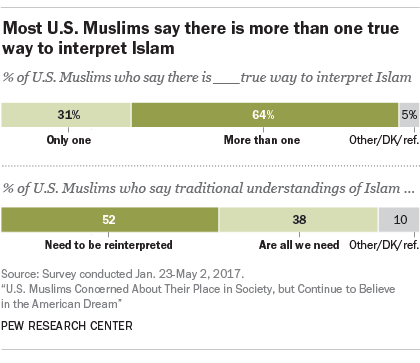
For American Muslims, being highly religious does not necessarily translate into acceptance of traditional notions of Islam. While many U.S. Muslims say they attend mosque and pray regularly, sizable shares also say that there is more than one way to interpret their religion and that traditional understandings of Islam need to be reinterpreted to address the issues of today.

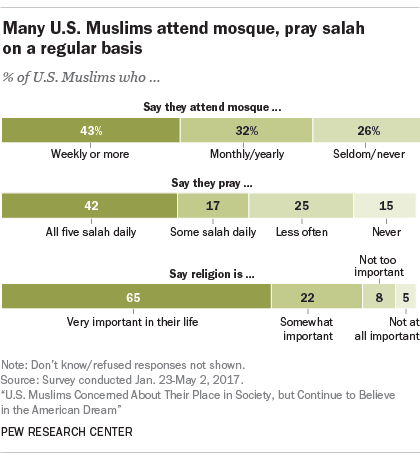
By some conventional measures, U.S. Muslims are as religious as – or more religious than – many Americans who belong to other faith groups. Four-in-ten (43%) Muslim Americans say they attend mosque at least once a week, including 18% who say they attend more than once a week, according to a 2017 Pew Research Center survey. An additional 32% say they attend once or twice a month, or a few times a year. These attendance levels are comparable to those of U.S. Christians, 47% of whom say they attend services weekly or more, and greater than the 14% of American Jews who say the same.

A majority also say that they pray at least some or all of the salah, or ritual prayers required of Muslims five times per day. Among all U.S. Muslims, fully 42% say they pray all five salah daily, while 17% pray at least some of the salah every day. A quarter say they pray less often, and just 15% say they never pray.

And nearly two-thirds of U.S. Muslims (65%) say that religion is very important in their lives, similar to the share of U.S. Christians who say the same (68%), and higher than the share of U.S. Jews who say this (31%). An additional 22% of Muslims say that religion is somewhat important in their lives, while fewer say that religion is not too or not at all important to them.

At the same time, American Muslims openly acknowledge that there is room for multiple interpretations of the teachings of Islam. A majority (64%) say there is more than one true way to interpret the faith’s teachings, while just half as many (31%) say there is only one true way to interpret Islam. And it’s not just less-religious Muslims who express this sentiment: While 72% of Muslims who say religion is somewhat (or less) important in their life say they are open to multiple interpretations, a majority (59%) of those who say religion is very important in their life also say there is more than one true way to interpret the faith. Among U.S. Christians, there is a similar balance: 60% say there is more than one true way to interpret the teachings of their religion, while 34% say there is just one true way.

About half (52%) of all U.S. Muslim adults also say that traditional understandings of Islam must be reinterpreted to reflect contemporary issues, while 38% maintain that traditional understandings of Islam are all that are needed to address today’s issues. On this question there is more of a difference of opinion among Muslims when it comes to how important religion is in their lives. Those who say religion is very important in their lives are evenly divided (43% say traditional understandings should be reinterpreted vs. 46% who say traditional understandings are all that is needed), while about seven-in-ten (71%) of those who say religion is less important express the view that Islamic teachings need to be reinterpreted.

Source: U.S. Muslims are religiously observant, but open to multiple interpretations of Islam | Pew Research Center

ICYMI – Inheritance rules ‘definative’ in Islam: Al-Azhar grand sheikh – Egypt Independent

Sigh….

Al-Azhar Grand Sheikh, Ahmed al-Tayyeb, stressed that the “inheritance rules” in Islam are clear and “definitive”, rejecting the Tunisian president’s call for equality between men and women in regards to inheritance.

Tayyeb added in a statement Sunday that, inheritance is regulated in the Quran by clear and definitive verses that leave no room for interpretation, unlike other verses that could be interpreted by scholars in more than one way,

He added that such rulings cannot be allowed, as they are not based in the study of Sharia or Islamic scriptures, pointing out that such ideas provoke the Muslim masses and could lead to destabilization in Muslim societies.

Tayyeb stated he firmly rejects political interference with the set rules of Islamic Sharia.

Al-Azhar declared its position on the equality between men and women in inheritance based on the religious responsibility it has held for more than a thousand years, and to make clear the rules of Islamic Sharia to the Islamic nation around the world, Tayyeb said in a statement on Sunday.

The sheikh went on to say that the institution guards the rules of Islam around the world regardless of geographic borders or political orientations.

Source: Inheritance rules ‘definative’ in Islam: Al-Azhar grand sheikh – Egypt Independent

Rabbis ditch High Holy Days call with Trump – POLITICO

As Andrew Cohen recently argued, Trump’s Jewish advisers should stand up to him. Rabbis message should provoke reflection. As for the evangelical leaders still supporting Trump (the only council yet to have lost members or disbanded?), some signs of weakening support (Evangelicals Losing Faith in Trump After Racist Ranting):

A prominent coalition of American rabbis has decided not to hold its annual conference call with the president to mark Jewish holidays, citing Donald Trump’s remarks on the recent violence in Charlottesville, Virginia, as supporting “those who advocate anti-Semitism, racism and xenophobia.”

“We have concluded that President Trump’s statements during and after the tragic events in Charlottesville are so lacking in moral leadership and empathy for the victims of racial and religious hatred that we cannot organize such a call this year,” the groups — the Central Conference of American Rabbis, Rabbinical Assembly, Reconstructionist Rabbinical Association and Religious Action Center of Reform Judaism — said in a statement.

The coalition represents the leaders of much of the U.S. Jewish community, with the exception of Orthodox Jews, who have been much more supportive of Trump. His daughter Ivanka and her family are Orthodox Jews. The White House did not immediately respond to a request for comment on Wednesday.

The call, which is organized by the Reform rabbis group CCAR, is a standard event for presidents each year. Rabbi Steve Fox, CCAR’s executive director, said former President Barack Obama participated in each year of his administration.

“These are religious issues, not political issues. It is important that the president steps forward as a moral leader on these issues,” Fox said in an interview. “As the leader of the U.S. and the leader of the free world, we believe it is his obligation to condemn these white supremacists.”

Fox said Trump’s response to the Charlottesville unrest — among other comments, the president said there were “very fine people” amid a crowd of white supremacists and neo-Nazis protesting in defense of a Confederate statue — put the celebration of the Jewish High Holy Days at risk.

“We pray that President Trump will recognize and remedy the grave error he has made in abetting the voices of hatred,” the group said. “We pray that those who traffic in anti-Semitism, racism and xenophobia will see that there is no place for such pernicious philosophies in a civilized society.”

Trump has faced a barrage of criticism since the Charlottesville white supremacist rally that left one person dead. Trump has defended his response that “many sides” are to blame for the violence that ensued. At a campaign rally in Phoenix on Tuesday, the president accused the media of misrepresenting his response and read parts of his initial remarks, though he omitted the controversial language that seemingly placed blame on counter-protesters.

Most members on Trump’s evangelical council, meanwhile, have not distanced themselves from the president. A.R. Bernard, who once a member of the Evangelical Advisory Board, said on Friday that he resigned due to a “deepening conflict in values” between himself and the Trump administration.

Source: Rabbis ditch High Holy Days call with Trump – POLITICO

India’s supreme court bans Islamic instant divorce | The Guardian

Welcome development:

India’s top court has banned a controversial Islamic practice that allows men to divorce their wives instantly, saying it was unconstitutional.

Victims of the practice known as “triple talaq”, whereby Muslim men can divorce their wives by reciting the word talaq (divorce) three times, had approached the supreme court to ask for a ban.

Triple talaq “is not integral to religious practice and violates constitutional morality”, a panel of judges said.

“It’s a very happy day for us. It’s a historic day,” said Zakia Soman, the co-founder of the Indian Muslim Women’s Movement, which was part of the legal battle to end the practice.

“We, the Muslim women, are entitled to justice from the courts as well as the legislature,” she added.

The five supreme court judges were from India’s major faiths – Hinduism, Christianity, Islam, Sikhism and Zoroastrianism. In their ruling, they said it was “manifestly arbitrary” to allow a man to “break down [a] marriage whimsically and capriciously”.

“What is sinful under religion cannot be valid under law,” they said.

The practice had been challenged in lower courts but it was the first time India’s supreme court had considered whether triple talaq was legal.

India allows religious institutions to govern matters of marriage, divorce and property inheritance in the multi-faith nation, enshrining triple talaq as a legal avenue for its 180 million Muslims to end unions.

More than 20 Muslim countries, including neighbouring Pakistan and Bangladesh, have banned the practice while in India, the practice has continued. While most Hindu personal law has been overhauled and codified over the years, Muslim laws have been left to religious authorities and left largely untouched.

The Hindu nationalist government of the prime minister, Narendra Modi, had backed the petitioners in this landmark case, declaring triple talaq unconstitutional and discriminatory against women. Modi’s Bharatiya Janata party has long pushed for a uniform civil code, governing Indians of all religions, to be enforced.

The issue remains highly sensitive in India, where religious tensions often lead to violence.

The All India Muslim Personal Law Board (AIMPLB), a grouping of Islamic organisations, had told the court that while they considered the practice of triple talaq wrong, they opposed any court intervention and asked that the matter be left to the community to tackle.

Progressive Muslim activists had criticised the board’s position. “This is the demand of ordinary Muslim women for over 70 years and it’s time for this country to hear their voices,” activist Feroze Mithiborwala told New Delhi television station.

Source: India’s supreme court bans Islamic instant divorce | World news | The Guardian

Don Macpherson: The Couillard government’s anti-niqab bill gets worse 

Good pointed commentary:

Batman will not sit in the Quebec National Assembly.

This would be the effect of one of the amendments to the Couillard government’s proposed anti-niqab legislation announced this week. Bill 62, targeting Muslim women who wear facial veils, would ban giving or receiving public services with the face concealed. The amendment would extend the ban to MNAs, municipal councillors and school commissioners.

That Quebecers would choose a masked candidate to represent them is almost as hypothetical as the fictional cowled crusader leaving Gotham City for this province, acquiring citizenship, and running for office here on his record as a crimefighter. But then so was the possibility of a niqabi seeking employment in a public service.

Still, one can’t be too careful. That appears to be the thinking of the “bare-face” bill’s sponsor, Justice Minister Stéphanie Vallée, to the extent she has thought about the bill at all.

Another of her proposed amendments would extend the original ban from the provincial public services to municipal ones, and to public transit. When a reporter asked Vallée the reasonable question of whether this would stop a woman wearing a veil from taking the bus, the minister was unwilling, or perhaps unable, to answer.

Her amendments would make what was already a bad bill even worse.

Bill 62 stigmatizes the tiny number of Muslim women in Quebec who wear facial veils. It encourages their persecution, like the harassment of women wearing Muslim head scarves during the debate on the former Parti Québécois government’s ill-fated “charter of values.”

It would enshrine in legislation the hypocrisy of Quebec’s “Catho-laïcité,” or Catho-secularism. One of Vallée’s amendments pretends that Quebec’s public institutions are founded on the separation of church and state, while the bill would preserve the crucifix placed in the Assembly to symbolize an alliance between the two.

The government pretends that the ban on face coverings in general does not discriminate on religious grounds. But its intent is given away by the fact that the ban is contained in a bill to restrict religious accommodations.

And the bill is useless, not only because it addresses imaginary problems, but also because its guidelines for handling accommodation requests are so general.

Not only is the bill bad policy, it’s bad politics, another demonstration of the sheer political stupidity of the Couillard Liberals.

It won’t achieve its political objective of settling the accommodations issue once and for all before the general election due by October 2018. The Liberals’ relatively feeble entry in the competition to defend the majority against the undesirables in their midst doesn’t go nearly far enough to satisfy the nationalist opposition parties.

It is nevertheless useful to them. Since it was presented by Quebec’s most diverse and least nationalist party, it gives political legitimacy to the restriction of minority rights.

Bill 62 is the Couillard government’s version of Bill 22, adopted in 1974 by Robert Bourassa’s Liberal government. As the first Quebec legislation restricting minority language rights, Bill 22 enabled the succeeding PQ government’s more draconian Bill 101.

Originally, Premier Philippe Couillard intended to get the accommodations debate over with at the beginning of his term. Instead, his government squandered its time, and begins the pre-election year fighting on ground favouring its adversaries.

Couillard continues to entrust that fight to a minister who has already shown she’s not up to it. Listening to Vallée’s poorly prepared news conference on her amendments this week was like watching somebody juggling blindfolded with running chainsaws.

The PQ and the Coalition Avenir Québec party, vying for position as the leading alternative to the Liberals in the election, can be expected to prolong the debate on the bill in the Assembly as much as possible.

And on his other side, Couillard was forced to back Vallée against Montreal Mayor Denis Coderre, who indicated the province’s metropolis will defy her legislation.

Source: Don Macpherson: The Couillard government’s anti-niqab bill gets worse | Montreal Gazette

ICYMI: A Week of Reckoning [Richard Dawkins disinvite]

One of the better commentaries on the Richard Dawkins’ affair by Andrew Sullivan:

It’s revealing, it seems to me, that Richard Dawkins is the latest target of the authoritarian left — and why he is under attack. This week, he was disinvited from a book event hosted by a progressive radio station, KPFA, because of his criticisms of Islam. “While KPFA emphatically supports serious free speech, we do not support abusive speech,” the radio station explained. “We apologize for not having had broader knowledge of Dawkins’s views [on Islam] much earlier.” This is hilarious. As anyone with a brain and an internet connection knows, Dawkins has made a second career out of vilifying religions of all kinds.

To take one random example, here’s what he has written of Judaism: “The God of the Old Testament is arguably the most unpleasant character in all fiction: jealous and proud of it; a petty, unjust, unforgiving control-freak; a vindictive, bloodthirsty ethnic cleanser; a misogynistic, homophobic, racist, infanticidal, genocidal, filicidal, pestilential, megalomaniacal, sadomasochistic, capriciously malevolent bully.” Why is he Islamophobic and not also obviously anti-Semitic? Why was one disqualifying and the other not? And I won’t begin to cite his fulminations against Christianity. Perhaps his sin was a recent, not completely relativist pronouncement that “it’s tempting to say all religions are bad, and I do say all religions are bad, but it’s a worse temptation to say all religions are equally bad because they’re not. If you look at the actual impact that different religions have on the world, it’s quite apparent that at present the most evil religion in the world has to be Islam.”

Notice the qualifier: “at the present.” And with that qualifier, who, on earth, could deny this? Is there a Christian regime currently anywhere even close to ISIS’s caliphate? How many Jewish terrorists are setting off bombs at pop concerts full of young girls? History is replete with horrors of all religions when abused by fanatics. But today, it is Islam that is clearly out in front. Dawkins is not, moreover, attacking Muslims. In fact, in the same interview, he immediately followed up with this: “It’s terribly important to modify that because of course that doesn’t mean all Muslims are evil, very far from it. Individual Muslims suffer more from Islam than anyone else.” KPFA couldn’t read that far?

I fear that the truth is Islam has become an untouchable shibboleth for some on the left. What they lacerate in other religions, they refuse to mention in Islam. Sexism, homophobia, the death penalty for apostasy … all of this is to be rationalized if the alternative is Islamophobia. Why, one wonders? Is it because Muslims are a small minority? But the same could be said for Jews. My best guess is simply that, for the far left, anything that is predominantly “of color” is preferable to anything, like Judaism and Christianity, that can usually be described as “white.” That’s how “intersectionality” can be used to defend what would otherwise be indefensible. The preoccupation with race on the far left is now so deep, in other words, it’s becoming simply an inversion of that on the far right.

Source: A Week of Reckoning

Malaysia: Group decries govt’s move to ban book promoting ‘moderate’ Islam

Discouraging trend, as in Indonesia:

A PRO-MODERATION group comprising eminent ethnic Malays has questioned the Malaysian government’s move to ban a book it published on “moderate” Islam amid concerns of rising Islamic fundamentalism in the country.

The Home Ministry banned the book authored by the group of predominantly former senior civil servants, who call themselves G25, for being “prejudicial to public order”, reported Malay Mail Online on Thursday.

A notice on the Federal Gazette, dated July 27, listed the prohibition of the book, titled Breaking the Silence: Voices of a Moderation Islam in a Constitutional Democracy under the Printing Presses and Publications (Control of Undesirable Publications) (No 12) Order 2017.

The group’s spokesman Datuk Noor Farida Ariffin said she was shocked by the ban, given the government’s long-standing drive to promote the wassatiyyah (moderation) concept espoused in Islam.

“This is obviously an action intended to suppress free speech. The articles in the book were written by respected academics, lawyers and social activists,” she told Asian Correspondent when contacted.

“They are intellectual articles mainly discussing the place of Islam in the Federal Constitution. None of the articles have criticised Islam or touched on matters of Aqidah ( faith ).”

G25

The G25 group says it will appeal the government’s ban on the book it published. Source: Amazon

Noor Farida, a prominent former judge and diplomat, also suggested the questionable timing of the ban as the book was released back in December 2015.

“This does not make sense as in the nearly two years that the book has been on the market, we have not heard of any of the readers causing public disorder or a public nuisance as a result of reading the book!”

The government, she said, should instead favour the book due to its “moderate” stance. Malaysia promotes an image of moderate Islam internationally, despite the increasing implementation of Syariah law across the country.

The government gazette’s notice stated the printing, importation, production, publishing, sale, issue, circulation, distribution, or possession of the publication is “likely to be prejudicial to public interest”, which led to the nationwide ban.

Noor Farida said the G25 group would seek an explanation from the ministry and appeal the ban.

“We are still discussing this among our group members, but we will appeal and ask the Home Ministry to point out to us what the offending passages prejudicial to public order are,” she was quoted by The Star as saying.

Civil society groups such as the G25 have recently expressed alarm over the northeastern state of Kelantan’s move to amend its religious Islamic laws to allow public caning against “criminals” who breach its strict Syariah code.

At the end of this month, Malaysia’s lower house of Parliament is expected to debate a Bill to amend Act 355 of the Syariah Courts (Criminal Jurisdiction) Act 1965, also known as the controversial RUU355.

The Bill – commonly known as Hadi’s Bill after the man who proposed it – would increase the Syariah punishment caps in Malaysia to a maximum 30 years’ imprisonment, RM100,000 (US$22,400) fine and 100 lashes of the cane – far harsher sentences than those currently implemented under the civil system.

Noor Farida said the G25 promotes moderation and peace and harmony among our people of various faiths and ethnicities.

“We believe in promoting respect for the beliefs of others. And we firmly believe in upholding our secular Federal Constitution against any attempts by religious bigots to turn Malaysia into an Islamic state.”

Muslims In The U.S. Face Increased Discrimination, PEW Report Says : NPR

Interesting interview regarding some of the latest findings on American Muslims:

A newly-released poll from the Pew Research Center finds Muslims in the U.S. are facing increased discrimination but are optimistic about being both Muslim and American.

KELLY MCEVERS, HOST:

There are an estimated 3.3 million Muslims in the United States, and that number is growing. Today the Pew Research Center released a wide-ranging poll on Muslims in America. And while almost half the Muslims surveyed reported incidents of verbal or physical abuse in the past 12 months, many still say they are optimistic about their future and about this country. To talk about this, we’re joined now by NPR’s Leila Fadel. You might remember her from her time as NPR’s Cairo correspondent. Now she has taken on a new job covering culture, race and diversity here in the U.S. She is with us from her new base in Las Vegas. Hi there.

LEILA FADEL, BYLINE: Hi.

MCEVERS: So what were the most striking findings in this poll of Muslim-Americans?

FADEL: Well, this is the third Pew poll on Muslims in America in 10 years. And I think the first thing that’s so noticeable is the incredible diversity of Muslim communities in this country. Often Muslims are spoken about as a monolith when, in fact, this is a population that’s really a diverse mosaic. There’s no one ethnic group that dominates the population. It’s African-American. It’s white. It’s Asian. It’s Arab. It’s Latino. And list goes on. And it’s really young. The majority of Muslims in America are under 40.

MCEVERS: And what about that finding that I mentioned in the introduction that Muslims are feeling optimistic?

FADEL: Yeah, it’s interesting. Despite this feeling that they’re not accepted as part of the mainstream, that the president is unfriendly toward Muslims and that discrimination is going up, 7 in 10 respondents really believe in the American dream still, that if you work hard, you can get ahead. And the overwhelming majority are proud to be both American and Muslim. This is what Besheer Mohamed, lead author of the report, had to say.

BESHEER MOHAMED: There’s a thread throughout the survey of this tension that our Muslim respondents tell us about where on the one hand, they’re uncertain about their acceptance by the larger society. But on the other hand, they’re committed to an American identity. And I think this finding that 9 in 10 say they’re proud to be American is sort of a perfect example of that commitment.

MCEVERS: Who did the poll survey?

FADEL: So the poll was conducted on a sample size of about a thousand Muslim adults living in the U.S. And really there’s not that much data out there on Muslims in the U.S. Muslims are a group of people in America that are often spoken about and scrutinized, but there’s very little data, including how many there are because being Muslim is not something you check on the census form.

MCEVERS: You’ve been traveling and visiting a lot of different Muslim communities across the U.S. Does this poll reflect what you’ve been seeing?

FADEL: Well, yeah. I visited communities in Texas and California as well as cities like Chicago and New York and spoke to Muslims in all parts of the country. And it’s funny because in the poll, it seems that women are more worried about discrimination. They’re more worried about their place in society. And I really felt that same way in doing interviews across the country. And I think that’s really because when a woman decides to put a scarf on her head and cover her hair, she suddenly becomes unmistakably Muslim and de facto ambassador of the faith and a de facto target for the faith.

So, you know, I met people like a young girl in California who’s being bullied at school. And she decided to put on the scarf because her mom does, and she loves her mom and admires her mom. And she found at school that suddenly kids were whispering behind her back allahu akbar, pinning things to her backpack. And the teacher was handing out articles about stonings in Afghanistan as an example of her faith. And this is what she was having to deal with and answer for in her faith at just 14 years old while her sister, who doesn’t cover her hair, didn’t have to deal with any of that.

Source: Muslims In The U.S. Face Increased Discrimination, PEW Report Says : NPR