India’s supreme court bans Islamic instant divorce | The Guardian

Welcome development:

India’s top court has banned a controversial Islamic practice that allows men to divorce their wives instantly, saying it was unconstitutional.

Victims of the practice known as “triple talaq”, whereby Muslim men can divorce their wives by reciting the word talaq (divorce) three times, had approached the supreme court to ask for a ban.

Triple talaq “is not integral to religious practice and violates constitutional morality”, a panel of judges said.

“It’s a very happy day for us. It’s a historic day,” said Zakia Soman, the co-founder of the Indian Muslim Women’s Movement, which was part of the legal battle to end the practice.

“We, the Muslim women, are entitled to justice from the courts as well as the legislature,” she added.

The five supreme court judges were from India’s major faiths – Hinduism, Christianity, Islam, Sikhism and Zoroastrianism. In their ruling, they said it was “manifestly arbitrary” to allow a man to “break down [a] marriage whimsically and capriciously”.

“What is sinful under religion cannot be valid under law,” they said.

The practice had been challenged in lower courts but it was the first time India’s supreme court had considered whether triple talaq was legal.

India allows religious institutions to govern matters of marriage, divorce and property inheritance in the multi-faith nation, enshrining triple talaq as a legal avenue for its 180 million Muslims to end unions.

More than 20 Muslim countries, including neighbouring Pakistan and Bangladesh, have banned the practice while in India, the practice has continued. While most Hindu personal law has been overhauled and codified over the years, Muslim laws have been left to religious authorities and left largely untouched.

The Hindu nationalist government of the prime minister, Narendra Modi, had backed the petitioners in this landmark case, declaring triple talaq unconstitutional and discriminatory against women. Modi’s Bharatiya Janata party has long pushed for a uniform civil code, governing Indians of all religions, to be enforced.

The issue remains highly sensitive in India, where religious tensions often lead to violence.

The All India Muslim Personal Law Board (AIMPLB), a grouping of Islamic organisations, had told the court that while they considered the practice of triple talaq wrong, they opposed any court intervention and asked that the matter be left to the community to tackle.

Progressive Muslim activists had criticised the board’s position. “This is the demand of ordinary Muslim women for over 70 years and it’s time for this country to hear their voices,” activist Feroze Mithiborwala told New Delhi television station.

Source: India’s supreme court bans Islamic instant divorce | World news | The Guardian

Don Macpherson: The Couillard government’s anti-niqab bill gets worse 

Good pointed commentary:

Batman will not sit in the Quebec National Assembly.

This would be the effect of one of the amendments to the Couillard government’s proposed anti-niqab legislation announced this week. Bill 62, targeting Muslim women who wear facial veils, would ban giving or receiving public services with the face concealed. The amendment would extend the ban to MNAs, municipal councillors and school commissioners.

That Quebecers would choose a masked candidate to represent them is almost as hypothetical as the fictional cowled crusader leaving Gotham City for this province, acquiring citizenship, and running for office here on his record as a crimefighter. But then so was the possibility of a niqabi seeking employment in a public service.

Still, one can’t be too careful. That appears to be the thinking of the “bare-face” bill’s sponsor, Justice Minister Stéphanie Vallée, to the extent she has thought about the bill at all.

Another of her proposed amendments would extend the original ban from the provincial public services to municipal ones, and to public transit. When a reporter asked Vallée the reasonable question of whether this would stop a woman wearing a veil from taking the bus, the minister was unwilling, or perhaps unable, to answer.

Her amendments would make what was already a bad bill even worse.

Bill 62 stigmatizes the tiny number of Muslim women in Quebec who wear facial veils. It encourages their persecution, like the harassment of women wearing Muslim head scarves during the debate on the former Parti Québécois government’s ill-fated “charter of values.”

It would enshrine in legislation the hypocrisy of Quebec’s “Catho-laïcité,” or Catho-secularism. One of Vallée’s amendments pretends that Quebec’s public institutions are founded on the separation of church and state, while the bill would preserve the crucifix placed in the Assembly to symbolize an alliance between the two.

The government pretends that the ban on face coverings in general does not discriminate on religious grounds. But its intent is given away by the fact that the ban is contained in a bill to restrict religious accommodations.

And the bill is useless, not only because it addresses imaginary problems, but also because its guidelines for handling accommodation requests are so general.

Not only is the bill bad policy, it’s bad politics, another demonstration of the sheer political stupidity of the Couillard Liberals.

It won’t achieve its political objective of settling the accommodations issue once and for all before the general election due by October 2018. The Liberals’ relatively feeble entry in the competition to defend the majority against the undesirables in their midst doesn’t go nearly far enough to satisfy the nationalist opposition parties.

It is nevertheless useful to them. Since it was presented by Quebec’s most diverse and least nationalist party, it gives political legitimacy to the restriction of minority rights.

Bill 62 is the Couillard government’s version of Bill 22, adopted in 1974 by Robert Bourassa’s Liberal government. As the first Quebec legislation restricting minority language rights, Bill 22 enabled the succeeding PQ government’s more draconian Bill 101.

Originally, Premier Philippe Couillard intended to get the accommodations debate over with at the beginning of his term. Instead, his government squandered its time, and begins the pre-election year fighting on ground favouring its adversaries.

Couillard continues to entrust that fight to a minister who has already shown she’s not up to it. Listening to Vallée’s poorly prepared news conference on her amendments this week was like watching somebody juggling blindfolded with running chainsaws.

The PQ and the Coalition Avenir Québec party, vying for position as the leading alternative to the Liberals in the election, can be expected to prolong the debate on the bill in the Assembly as much as possible.

And on his other side, Couillard was forced to back Vallée against Montreal Mayor Denis Coderre, who indicated the province’s metropolis will defy her legislation.

Source: Don Macpherson: The Couillard government’s anti-niqab bill gets worse | Montreal Gazette

ICYMI: A Week of Reckoning [Richard Dawkins disinvite]

One of the better commentaries on the Richard Dawkins’ affair by Andrew Sullivan:

It’s revealing, it seems to me, that Richard Dawkins is the latest target of the authoritarian left — and why he is under attack. This week, he was disinvited from a book event hosted by a progressive radio station, KPFA, because of his criticisms of Islam. “While KPFA emphatically supports serious free speech, we do not support abusive speech,” the radio station explained. “We apologize for not having had broader knowledge of Dawkins’s views [on Islam] much earlier.” This is hilarious. As anyone with a brain and an internet connection knows, Dawkins has made a second career out of vilifying religions of all kinds.

To take one random example, here’s what he has written of Judaism: “The God of the Old Testament is arguably the most unpleasant character in all fiction: jealous and proud of it; a petty, unjust, unforgiving control-freak; a vindictive, bloodthirsty ethnic cleanser; a misogynistic, homophobic, racist, infanticidal, genocidal, filicidal, pestilential, megalomaniacal, sadomasochistic, capriciously malevolent bully.” Why is he Islamophobic and not also obviously anti-Semitic? Why was one disqualifying and the other not? And I won’t begin to cite his fulminations against Christianity. Perhaps his sin was a recent, not completely relativist pronouncement that “it’s tempting to say all religions are bad, and I do say all religions are bad, but it’s a worse temptation to say all religions are equally bad because they’re not. If you look at the actual impact that different religions have on the world, it’s quite apparent that at present the most evil religion in the world has to be Islam.”

Notice the qualifier: “at the present.” And with that qualifier, who, on earth, could deny this? Is there a Christian regime currently anywhere even close to ISIS’s caliphate? How many Jewish terrorists are setting off bombs at pop concerts full of young girls? History is replete with horrors of all religions when abused by fanatics. But today, it is Islam that is clearly out in front. Dawkins is not, moreover, attacking Muslims. In fact, in the same interview, he immediately followed up with this: “It’s terribly important to modify that because of course that doesn’t mean all Muslims are evil, very far from it. Individual Muslims suffer more from Islam than anyone else.” KPFA couldn’t read that far?

I fear that the truth is Islam has become an untouchable shibboleth for some on the left. What they lacerate in other religions, they refuse to mention in Islam. Sexism, homophobia, the death penalty for apostasy … all of this is to be rationalized if the alternative is Islamophobia. Why, one wonders? Is it because Muslims are a small minority? But the same could be said for Jews. My best guess is simply that, for the far left, anything that is predominantly “of color” is preferable to anything, like Judaism and Christianity, that can usually be described as “white.” That’s how “intersectionality” can be used to defend what would otherwise be indefensible. The preoccupation with race on the far left is now so deep, in other words, it’s becoming simply an inversion of that on the far right.

Source: A Week of Reckoning

Malaysia: Group decries govt’s move to ban book promoting ‘moderate’ Islam

Discouraging trend, as in Indonesia:

A PRO-MODERATION group comprising eminent ethnic Malays has questioned the Malaysian government’s move to ban a book it published on “moderate” Islam amid concerns of rising Islamic fundamentalism in the country.

The Home Ministry banned the book authored by the group of predominantly former senior civil servants, who call themselves G25, for being “prejudicial to public order”, reported Malay Mail Online on Thursday.

A notice on the Federal Gazette, dated July 27, listed the prohibition of the book, titled Breaking the Silence: Voices of a Moderation Islam in a Constitutional Democracy under the Printing Presses and Publications (Control of Undesirable Publications) (No 12) Order 2017.

The group’s spokesman Datuk Noor Farida Ariffin said she was shocked by the ban, given the government’s long-standing drive to promote the wassatiyyah (moderation) concept espoused in Islam.

“This is obviously an action intended to suppress free speech. The articles in the book were written by respected academics, lawyers and social activists,” she told Asian Correspondent when contacted.

“They are intellectual articles mainly discussing the place of Islam in the Federal Constitution. None of the articles have criticised Islam or touched on matters of Aqidah ( faith ).”

G25

The G25 group says it will appeal the government’s ban on the book it published. Source: Amazon

Noor Farida, a prominent former judge and diplomat, also suggested the questionable timing of the ban as the book was released back in December 2015.

“This does not make sense as in the nearly two years that the book has been on the market, we have not heard of any of the readers causing public disorder or a public nuisance as a result of reading the book!”

The government, she said, should instead favour the book due to its “moderate” stance. Malaysia promotes an image of moderate Islam internationally, despite the increasing implementation of Syariah law across the country.

The government gazette’s notice stated the printing, importation, production, publishing, sale, issue, circulation, distribution, or possession of the publication is “likely to be prejudicial to public interest”, which led to the nationwide ban.

Noor Farida said the G25 group would seek an explanation from the ministry and appeal the ban.

“We are still discussing this among our group members, but we will appeal and ask the Home Ministry to point out to us what the offending passages prejudicial to public order are,” she was quoted by The Star as saying.

Civil society groups such as the G25 have recently expressed alarm over the northeastern state of Kelantan’s move to amend its religious Islamic laws to allow public caning against “criminals” who breach its strict Syariah code.

At the end of this month, Malaysia’s lower house of Parliament is expected to debate a Bill to amend Act 355 of the Syariah Courts (Criminal Jurisdiction) Act 1965, also known as the controversial RUU355.

The Bill – commonly known as Hadi’s Bill after the man who proposed it – would increase the Syariah punishment caps in Malaysia to a maximum 30 years’ imprisonment, RM100,000 (US$22,400) fine and 100 lashes of the cane – far harsher sentences than those currently implemented under the civil system.

Noor Farida said the G25 promotes moderation and peace and harmony among our people of various faiths and ethnicities.

“We believe in promoting respect for the beliefs of others. And we firmly believe in upholding our secular Federal Constitution against any attempts by religious bigots to turn Malaysia into an Islamic state.”

Muslims In The U.S. Face Increased Discrimination, PEW Report Says : NPR

Interesting interview regarding some of the latest findings on American Muslims:

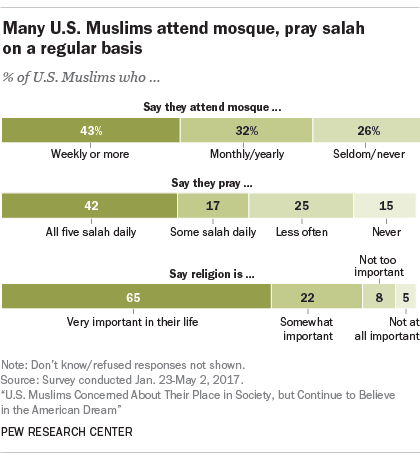
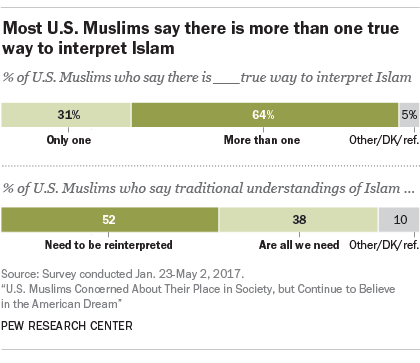
A newly-released poll from the Pew Research Center finds Muslims in the U.S. are facing increased discrimination but are optimistic about being both Muslim and American.

KELLY MCEVERS, HOST:

There are an estimated 3.3 million Muslims in the United States, and that number is growing. Today the Pew Research Center released a wide-ranging poll on Muslims in America. And while almost half the Muslims surveyed reported incidents of verbal or physical abuse in the past 12 months, many still say they are optimistic about their future and about this country. To talk about this, we’re joined now by NPR’s Leila Fadel. You might remember her from her time as NPR’s Cairo correspondent. Now she has taken on a new job covering culture, race and diversity here in the U.S. She is with us from her new base in Las Vegas. Hi there.

LEILA FADEL, BYLINE: Hi.

MCEVERS: So what were the most striking findings in this poll of Muslim-Americans?

FADEL: Well, this is the third Pew poll on Muslims in America in 10 years. And I think the first thing that’s so noticeable is the incredible diversity of Muslim communities in this country. Often Muslims are spoken about as a monolith when, in fact, this is a population that’s really a diverse mosaic. There’s no one ethnic group that dominates the population. It’s African-American. It’s white. It’s Asian. It’s Arab. It’s Latino. And list goes on. And it’s really young. The majority of Muslims in America are under 40.

MCEVERS: And what about that finding that I mentioned in the introduction that Muslims are feeling optimistic?

FADEL: Yeah, it’s interesting. Despite this feeling that they’re not accepted as part of the mainstream, that the president is unfriendly toward Muslims and that discrimination is going up, 7 in 10 respondents really believe in the American dream still, that if you work hard, you can get ahead. And the overwhelming majority are proud to be both American and Muslim. This is what Besheer Mohamed, lead author of the report, had to say.

BESHEER MOHAMED: There’s a thread throughout the survey of this tension that our Muslim respondents tell us about where on the one hand, they’re uncertain about their acceptance by the larger society. But on the other hand, they’re committed to an American identity. And I think this finding that 9 in 10 say they’re proud to be American is sort of a perfect example of that commitment.

MCEVERS: Who did the poll survey?

FADEL: So the poll was conducted on a sample size of about a thousand Muslim adults living in the U.S. And really there’s not that much data out there on Muslims in the U.S. Muslims are a group of people in America that are often spoken about and scrutinized, but there’s very little data, including how many there are because being Muslim is not something you check on the census form.

MCEVERS: You’ve been traveling and visiting a lot of different Muslim communities across the U.S. Does this poll reflect what you’ve been seeing?

FADEL: Well, yeah. I visited communities in Texas and California as well as cities like Chicago and New York and spoke to Muslims in all parts of the country. And it’s funny because in the poll, it seems that women are more worried about discrimination. They’re more worried about their place in society. And I really felt that same way in doing interviews across the country. And I think that’s really because when a woman decides to put a scarf on her head and cover her hair, she suddenly becomes unmistakably Muslim and de facto ambassador of the faith and a de facto target for the faith.

So, you know, I met people like a young girl in California who’s being bullied at school. And she decided to put on the scarf because her mom does, and she loves her mom and admires her mom. And she found at school that suddenly kids were whispering behind her back allahu akbar, pinning things to her backpack. And the teacher was handing out articles about stonings in Afghanistan as an example of her faith. And this is what she was having to deal with and answer for in her faith at just 14 years old while her sister, who doesn’t cover her hair, didn’t have to deal with any of that.

Source: Muslims In The U.S. Face Increased Discrimination, PEW Report Says : NPR

Losing our religion: How anti-Muslim sentiment threatens religious freedom | Toronto Star

Asma Maryam Ali and Amira Elghawaby on risks to religious freedom.

While Muslim women should feel safe wearing the hijab, is there not also a broader question of religious edicts requiring head coverings, or the need for edicts permitting their removal?

And yet, news of emerging anti-Muslim militias, the significant rise of hate crimes and hate incidents and apparent lack of consequences, the proliferation of xenophobic, and bigoted groups online, the tacit acceptance of discriminatory policies by some municipalities, and even occasional political rhetoric targeting Muslim communities, threaten to undermine all that is positive.

Some Muslim women in our circles are now seeking religious edicts that deem it acceptable to remove the head scarf in order to feel safe. In a striking parallel, Muslims in 15th century Spain sought a similar edict from the Mufti of Wahran to allow them to alter what many deem an Islamic compulsory act so that they could be less visible.

Canadian Muslims at work and school are also now debating whether to worship at the appointed times or to delay it in order to avoid tension. In June, anti-Muslim protesters gathered to protest in front of a secondary school in Toronto as students were heading home.

A 2016 study out of San Francisco State University highlighted how American Muslim children between the ages of 5 and 9 years old are internalizing this zeitgeist. According to the findings, one in three children did not want to tell anyone they are Muslim, 1-in-2 did not know whether they could be both American and Muslim, and 1-in6 would pretend not to be Muslim.

This process, called “dissimulation” by the late French scholar Jean Baudrillard, is deeply concerning because it signifies a gradual deterioration of cultural and religious identity.

Where does this leave us? With a faith and identity that’s constantly in question, and inevitably in flux. We must collectively address these worrying trends in order to promote healthy, cohesive communities where everyone is encouraged to fulfil their potential and be true to their varied and diverse identities.

Let’s not allow these values to be relegated to Canada’s own history books.

Source: Losing our religion: How anti-Muslim sentiment threatens religious freedom | Toronto Star

The cost of unbelief – The Economist

Interesting:

ACROSS the world, people who reject all religious belief or profess secular humanism are facing ever worse discrimination and persecution, but the existence and legitimacy of such ideas is becoming more widely known and accepted. That is the rather subtle conclusion of the latest report by the International Humanist and Ethical Union, an umbrella body for secularist groups in 40 countries, which in 2012 began making annual surveys of how freedom of thought and conscience are faring worldwide.

In common with lots of other reports on the subject, it noted that many countries still prescribe draconian penalties for religious dissent, through laws that bar blasphemy against the prevailing religions or “apostasy” from Islam. Some 19 countries punish their citizens for apostasy, and in 12 of those countries it is punishable by death. In Pakistan, the death sentence can be imposed for blasphemy, for which the threshold is very low. In all, 55 countries (including several Western ones) had laws against blasphemy; the perceived offence could lead to prison terms in 39 countries and execution in six.

Aside from all that ghastliness, the report detected a new trend, a “marked increase” in the specific targeting of atheists and humanists, which was a kind of back-handed acknowledgement of the reality that such beliefs existed and were spreading. Saudi Arabia had enacted a new law equating atheism with terrorism. In Malaysia, Prime Minister Najib Razak had branded “humanism and secularism as well as liberalism” as deviant. And in Egypt, the youth ministry had launched an organised campaign against non-belief among the young, designed to spread awareness of the “dangers of atheism” and the “threat to society” that it posed. Dreadful as it was, this trend could be a negative side-effect of a “different, positive, parallel trend”—the fact that atheism and humanism were being recognised as cohesive world-views.

I asked one of the best-known professed atheists to have emerged from the Muslim world, the exiled Egyptian blogger Mikael Nabil Sanad, what he thought of the report’s conclusions. And Mr Nabil, who was not involved in the report, offered a very similar point about his native country. On the one hand, despite the overthrow last year of an Islamist regime, repression of all minorities, including atheists, is as bad as ever. But, he says, acceptance by society of atheism as a tenable position is growing. Mr Nabil, who recently moved to Washington, DC, told me that in 2008, when he renounced his Coptic Christian background and declared himself an atheist, “it was completely shocking to society”. Now, he says, “society accepts it” as a possibility. For example, there have been television debates between Christians, Muslims and atheists. Last year, a group of Egyptian atheists made some proposals to a committee that was reviewing the constitution; the very fact that such proposals could be aired and reported marked progress in a country where officialdom generally assumed that everybody was Muslim, Christian or Jewish.

Having spent much of 2011 in prison, where he was tortured and went on hunger strike, and then studied for two years in Germany, Mr Nabil says it is unsafe for him to return to Egypt because blasphemy charges have been laid against him. He now hoped to write a book about his experiences and campaign for change in his homeland, where despite the authorities’ best efforts, social media and private communications were still buzzing with discordant and dissident opinions, including atheist ones. There is a broader point there. The fact that dissident religious and anti-religious ideas are being persecuted ever more severely does not mean that the persecutors will prevail.

Not enough being doing to halt persecution of Christians [in Mid-East]: Marmur

Valid points:

“Neither the horror of what Christians go through at the hands of Islamists and others, nor the scale of the crisis of Christian populations in the Middle East especially, appears to be widely known, let alone the subject of public concern.” So wrote Peter D. Williams, the Catholic social and political commentator in the online journal Spiked.

His article was published at the end of last May, days after 28 Coptic Christians were killed and many more wounded on their way to a monastery in Egypt. The same week, Williams reported, there were also two attacks on Christians in the Philippines.

His conclusion is that “it’s hard not to suspect that the reason why the persecution of Christians is not being reported widely across the globe is not merely due to over-familiarity, but because of active disinterest.” He suggests that “more could and would be done if the Western media gave Christians subjected to the cruellest and filthiest forms of tortuous hate the attention and concern their situation truly deserves.”

As a result, according to Prof. Jonathan Adelman of the University of Denver writing in The World Post, the Christian population in the Middle East has dropped from 20 per cent in 1900 to 4 per cent today. It’s likely to drop another per cent by 2050.

The only exception is the Jewish State of Israel where, according to Adelman, “the 160,000 Israeli Christians live as citizens in a democratic First World country with freedom of religion, rule of law and open elections.” They can move anywhere, their holy places are secure and their churches own much land in Jerusalem.

Adelman isn’t blind to problems that the Christian minority is facing also in Israel, mostly by the hands of bureaucrats and some Jewish fanatics. Yet, he insists, “Israel is the only place in the Middle East where the Christians are growing in number. They are excelling in education, doing well in business and feeling relatively safe from their radical tormentors.”

Jews have known for much of their history the lethal power of religious prejudice, much of it manifest as Christian anti-Semitism. It’s therefore gratifying to know that, despite the past, Jews are now providing a safe haven for Christians.

But Israel isn’t in a position to solve the global problem. Collectively, however, the Western world — where most Christians reside and many still greatly influence public discourse and policy — could and should do very much more than they seem to be doing.

That was ostensibly the purpose of the World Summit in Defence of Persecuted Christians held In Washington in early May. U.S. Vice President Mike Pence made the promising declaration that “protecting and promoting religious freedom is a foreign policy priority of the Trump administration.”

Though he assured the audience they “have the prayers of the president of the United States” and that “the suffering of Christians in the Middle East has stirred Americans to action,” it’s not clear if this will go beyond rhetoric and result in tangible deeds.

Having experienced Catholic-laced anti-Semitism as a child in Poland after the horrors of the Holocaust, I identify with the millions of Christians around the world who’re now facing extinction. I’m astounded that the very resourceful churches here and elsewhere don’t seem to be doing enough to protect them. Some, particularly ostensibly liberal Christians, appear to be much keener to find faults with Israel’s treatment of Muslims than to actively support Christians in Muslim lands.

Even if they may not be able to defeat extremism, they should seek measures to protect Christian minorities in ways that go far beyond President Trump’s prayers.

Source: Not enough being doing to halt persecution of Christians: Marmur | Toronto Star

Young Islamists have ′very scant′ knowledge of Islam, study finds | DW | 11.07.2017

Interesting analysis of texts among young radicalized Muslims:

Young Muslims who become radicalized often invent a patchwork, imagined version of Islam that has little or nothing to do with the Koran. That’s the conclusion drawn by scholars at the universities of Bielefeld and Osnabrück. They’ve just published a book analyzing 5,757 messages from a WhatsApp group of 12 young men ahead of a spring 2016 terrorist attack.

The messages came from a mobile phone, seized by police, that had belonged to one of the young men involved in the attack. The researchers say that the chat offers unique insights into the radicalization process and mindset of Islamists in Germany.

The messages also illustrate the enormous differences between Islamism and Islam. Many of the self-styled “true Muslims,” the experts found, themselves have little valid knowledge of the Koran or the rest of their religion.

“The result is a kind of ‘Lego Islam’ that can be continually adapted to new requirements and in practice has nothing to do with the forms of traditional Islam practiced by the majority of mosque communities in Germany,” write co-authors Becem Dziri and Michael Kiefer.

The authors omitted the names of those involved in the chat and didn’t specify the attack, although the time reference strongly suggests that it was the bombing of a Sikh temple in Essen in April 2016. At the time it was reported that the young people involved in that attack were radicalized via social media, and three of them, all teenagers, were later convicted of attempted murder and conspiracy to murder.

Deutschland Anschlag auf Sikh Tempel in Essen (picture-alliance/AP Photo/M. Kusch)Luckily no one was killed in the temple bombing

Budding Islamists mix jihad and genies

The conversations leading up to that act of violence suggest that the youths were willing to kill for a faith of which they had only a rudimentary understanding.

“The religious education within the group is very scant,” writes co-author Rauf Ceylan. “Often they didn’t even know the simplest Islamic theological basics. The members of the group are laymen and autodidacts who pick and choose information from the internet and communicate it to the rest of the group.”

Excerpts from the chats often seem like comedy sketches sprinkled with sometimes misused Arabic words and phrases and English slang. In one, a participant responds to a self-appointed leader’s call for a meeting to discuss the jama’a (group) by saying he didn’t have any Islamic clothing. The leader responds: “You can also were sweatpants or something like that. If you want I can loan you something for the day.”

Another message reveals that the author doesn’t even own a copy of Islam’s main religious text.

“I need a Koran,” he writes. “I’ll get one soon from lies [a Salafist group that gives away Korans on the street in Germany]. If I see abu nagi, I’ll tell him he’s a kafir [infidel] because he thinks erdogan [sic] is a Muslim.”

When asked what the most absurd detail of the chats was, Ceylan told DW that participants interwove the belief in magical genies in their pseudo-theology.

“Over the course of the chat protocol, you can see how a religious world gets invented in which supernatural beings can have real effects on the young men,” Ceylan said. “They take fragments of the Koran and cobble them together. That’s why we call it ‘Lego Islam.'”

Salafisten verteilen Korane (picture-alliance/dpa/B.Roessler)Salafists pass out free Korans on German streets

Careers as ‘pop preachers’

Scholars also say that the chat illustrates the process by which young Muslims get radicalized. Key is the role of the “amir,” the self-appointed leader, who “instructed” the others despite lacking any theological credentials himself.

“He’s an alpha male like you have in school,” Ceylan told Deutsche Welle. “The people who act as Salafist preachers aren’t theologians. They’re people who have sometimes failed in life, but if they have a gift for being alpha males, they can become superstars overnight. This shouldn’t be underestimated. You can make a whole career of being a pop preacher.”

The second ingredient in the making of a radical Islamist, the scholars explain, is a young person with the right biography. Emancipation from parents – becoming an adult – gets conflated with emancipation from the mainstream community as one of the “chosen ones.” Ceylan cites the example of a young man who became radical after discovering that his father was having an affair and telling his mother, which led to a divorce.

“These are fundamentally young people who are trying to overcome a crisis in their lives or a biological ruptures,” said Ceylan. “The timing is crucial. Who do I meet in this phase?”

Social media platforms often play a role in radicalizing young people

The importance of language

Ceylan says that although bogus theology is part of the problem, religious instruction is not enough to combat radicalization. He calls for more money for German language imams, psychological therapists in prisons, where many young people get radicalized, and interventions in schools.

“These young people don’t get radicalized secretly, as the chat protocols show,” Ceylan said. “Their teachers see that something’s not right. A kid grows his beard out or starts saying more and more radical things. And the parents see it before everyone else.”

Above all, Ceylan says, those who do intervene with young people susceptible to Islamism need to speak the right language.

“The characteristics of the charismatic ‘self-made’ preachers…are that they speak German, use young people’s slang, make a theatrical impression, display street credibility and present themselves cleverly. That, together with the simplicity of what they teach, makes them attractive to young people.”

Source: Young Islamists have ′very scant′ knowledge of Islam, study finds | TOP STORIES | DW | 11.07.2017

The never-ending argument over what is “real Islam”

Good piece and advice from The Economist:

IN THE commentariat, the world of higher learning (religious and otherwise) and the corridors of political power, the long-running, hot-tempered debate about the real nature of Islam shows no sign of reaching a conclusion. The temperature rises every time some ghastly act of violence is perpetrated by people who say they are inspired by their Muslim beliefs. Broadly it pits those who think that killers who practise violence in Islam’s name are traducing the faith and perhaps mis-stating their own motives, up against those who insist that Islam’s core beliefs (and not just some idosyncratic version of them) can easily prompt people to take up the sword.

Sam Harris, an atheist public intellectual, is among the best-known advocates of the second view. Despite the change of guard at the White House, and the apparent conversion of Donald Trump to a slightly more emollient view of Islam, Mr Harris is still pouring scorn on Barack Obama for insisting that Islam was at heart a religion of peace. Another person whose views Mr Harris excoriates is Tariq Ramadan, a Muslim thinker who combines leftist political ideas with fairly traditional religious ones. Mr Ramadan incurs the American writer’s contempt when he argues that political, economic or geopolitical grievance, rather than any Muslim beliefs, motivate the terrorist group known as Islamic State (IS).

In a new twist of the argument, Mr Harris has published a podcast, lasting nearly two hours, in which he discusses these matters with Graeme Wood, an author and reporter who has travelled the world interviewing prominent members or supporters of IS and probing their motives and intentions. Both broadly agree that some widely held Muslim beliefs, especially those connected with the world’s end times and the battles portending that era, are important drivers of violent behaviour. But this emphasis has been dismissed as “deeply wrong” by Phil Torres, author of a book entitled “The End: What Science and Religion Tell Us About the Apocalypse”. His book argues that apocalyptic ideas could easily become self-fulfilling. But he also observes that bloodshed (and other dramatic events) in the here-and-now are the real reasons why people suddenly start to think about the final acts in history.

All participants in this discussion merit a hearing. Mr Harris and Mr Wood do a decent job of demolishing some of the more simplistic arguments used to support the views they dislike. For example, the point is often made that many of the people who become jihadis, whether they are converts or Muslim by birth, lack theological sophistication. Indeed, at least one was found to be studying a book with the self-explanatory title, “Islam for dummies”. So, the argument goes, being extremely Muslim and being extremely violent do not seem to go together.

The point about non-sophistication may be true as far it goes, but as both Mr Harris and Mr Wood agree, a person can be very passionate about a belief system without fully understanding its details. And there is no guarantee that even if those details were fully mastered, they would prompt the learner to behave in more peaceful ways. To put it bluntly, jihadis may indeed be theologically ignorant, but that does not prove that a sound theological education would make them more peaceful. (That said, there may be plenty of other reasons for encouraging nuanced theological awareness.)

Mr Wood’s research has reinforced his view that IS is much more apocalyptic in its mentality than earlier jihadi movements such as al-Qaeda. IS propagandists take seriously the notion that Dabiq, a location in northern Syria, will witness a titanic battle between Islamic forces and those of “Rome”—which might mean anything from NATO to the Christian world to the constitutionally secular republic of Turkey. Also widespread is the expectation that an Antichrist figure known as Dajjal will emerge (possibly from an island in the Red Sea) and kill Muslim fighters until Jesus returns to earth and leads the faithful to victory. (Jesus is the second-most-revered prophet in Islam after Muhammad.)

Mr Torres agrees that these beliefs are widely held and significant, but also asks why this is now the case. It was the 2003 assault by America and Britain on Saddam Hussein’s Iraq which turned many Sunni Muslims to end-time thinking, he notes: “prior to the US invasion, Sunni Muslims were uninterested in apocalypticism.” He points out that apocalyptic thinking is most widespread in the two countries where American-led armies have entered in force, Iraq and Afghanistan. As Mr Torres sees things, apocalyptic obsessions can be both a result and a cause of real-world violence.

So how can the “true nature” of Islam, or any other religion, be determined? It might be helpful to divide statements about this into two categories. First, there are value judgments, usually made from inside the boundaries of one’s belief system. This includes statements from religious authority figures such as: “Having studied and reflected on the matter, I believe the real message of our religion’s founder(s) is…” Such messages can have moral force even if they run completely counter to the way in which most followers of a religion have, in practice, acted.

In the second basket are historical or sociological statements, which can be made by any fair-minded observer. These are on the long lines of: “Whatever the prophets and scriptures of this religion may teach, it’s an observable fact that hundreds of millions of followers of this faith behave in certain ways, and that they root this stance in their religious world view.” You might call it a behaviourist approach. In the case of modern Islam, one would have to concede that a not-insignificant number of Muslims are, in some cases, prepared to condone religious violence. But they are far outnumbered by the hundreds of millions of Muslims who live peaceful, law-abiding lives and hope that others will do the same. These are statements which can be debated, investigated, affirmed or falsified in a way that religious statements cannot.

For figures of secular authority, be they American presidents, counter-terrorism officials or even opinion-makers, it is often best to stick to the second kind of statement. The “real” nature of a religion, if such a concept has any meaning at all, is hard for an outsider to determine, and certainly well beyond the remit of a more-or-less secular state.

Source: The never-ending argument over what is “real Islam”