Opinion | The Wrong Way for Germany to Debate Islam – The New York Times

Thoughtful commentary:

It was a warm June day in a northern German village, and I was talking to a Syrian friend outside a local shop. I had just bought some ice cream and offered to share it, but my friend refused. He was observing Ramadan: no food or drink until after sunset.

“If you had found asylum at the Arctic Circle instead of Germany,” I asked, “would you have starved by now?” It wasn’t an entirely academic question. In our village on Germany’s Baltic shore, the sun doesn’t set in summer until around 11 p.m.

My Syrian friend chuckled at the question about the Arctic Circle — where the summer sun never fully vanishes — but insisted: The law is the law; it’s what the Prophet Muhammad commands.

But wouldn’t the prophet be content if you observed, say, Damascus time? I wondered.

He chuckled again: No, this wouldn’t be what he had said.

The exchange left me with mixed feelings. I felt great respect for my friend’s willpower and the idea of Ramadan: to experience deprivation in order to stir empathy with the poor. What startled me, though, was his refusal to question religious commands and at least try to align them with reason without reducing their moral purpose.

This is an anodyne example, but it relates to a conundrum facing Germany as a country. To many non-Muslim Germans, the comparatively high significance that many Muslims attach to divine laws raises the question of to whom all the immigrants and refugees who have come to us in recent years would rather pledge allegiance and loyalty: the state that took them in, or Allah? Are the newcomers really convinced of the blessings of an open, liberal society, or are they just happy to seize its advantages?

The new German minister for the interior, Horst Seehofer, recently addressed this fear with a sentence that was meant as a reassurance to voters: “Islam does not belong to Germany.” With this Mr. Seehofer, who is also the chairman of the conservative Christian Social Union party, is rejecting an opposite claim made back in 2010 by Christian Wulff, then the president, and subsequently by Chancellor Angela Merkel. One of Mr. Seehofer’s party colleagues, Alexander Dobrindt, went even further: “Islam, no matter the form, does not belong to Germany.”

Their provocation is calculated to create a backlash against the naïveté and carelessness of those who have tried to make space for Islam as a part of German culture — a position conservatives think has been dominating public discourse for too long.

What a splendid idea: Counter leftist simplification with rightist crudeness! If there is one thing that doesn’t belong to a enlightened nation like Germany, it is a deliberate coarsening of a debate where a maximum of nuance is needed.

On the surface, of course, there’s an obvious tension between the largely secular, liberal traditions of German culture and those forms of Islam that, for example, place religious law over secular law. But that’s also a moot point: Muslims have been living here in large numbers since the 1960s, and now Germany’s six million Muslims make up roughly 6 percent of the population. The problem is that the way Germany has dealt with them is a history of mistakes.

The first mistake, the one conservatives made, was to believe that the early “guest workers” brought from Turkey in the 1960s, to make up for a labor shortage, would eventually go home again. The second mistake, the one the left made, was to embrace all foreigners, whatever their values. After Sept. 11, more or less all sides have made a third mistake, the failure to ask painful questions about how to reconcile Islam with an pluralist, secular democracy.

Apathy, illusions and false tolerance have left important issues unaddressed for half a century. That has now turned to hostility: Many Germans just don’t believe that Islam is compatible with Western values.

And yet the fact that there are many liberal observant Muslims living in Germany suggests the opposite. These are the people who speak out against false dogma, the overly literal reading of the Quran, and anti-Western teachings. The problem is their small number and the hostility they encounter from fellow Muslims here in Germany.

In a representative survey conducted by the University of Münster in 2016, 47 percent of Turkish immigrants and their descendants said that it was more important for them “to abide by religious commands than by the laws of the country I live in.” Some 32 percent said that Muslims should try to re-erect a social order like the one during the lifetime of the Prophet Muhammad. And 50 percent said there was “only one true religion.”

These are troubling figures. While giving divine laws priority over worldly laws does not necessarily mean rejecting democracy (many Christians and Jews would subscribe to the same statement), the apparent longing of so many Muslims for an authoritarian rather than an open society is shocking. Their intolerance for those of other beliefs matches a political attitude that surprised this country one year ago: Of the roughly 700,000 Turkish Muslims in Germany who participated in the constitutional referendum in Turkey last April, 63 percent voted in favor of granting President Recep Tayyip Erdogan unilateral powers.

This contempt for liberalism is a real problem, but rhetoric like Mr. Seehofer’s will only make things worse. It will compound a feeling, already widespread among Muslims, of not belonging to Germany anyway. The sentence “Islam does not belong to Germany” is a gift to radicals who hold an obsessive, binary, West versus Islam worldview.

So how do we move on? Instead of prolonging the mistakes of the past, the secular majority in Germany should make clear two things to their fellow Muslim citizens. Yes, Muslims belong here — but belonging brings with it expectations. Being a citizen means, first and foremost, upholding the values and laws that make this country so attractive. The secular majority must learn how to convey this expectation in a clear yet civil manner.

Germans struggle with this because they are uncomfortable, for historical reasons, with making such demands of religious minorities. The problem, in other words, is not just politicians who wield stupid slogans. It is also the majority of nonpopulist Germans who are shy about expressing the terms of participation in a pluralist society.

via Opinion | The Wrong Way for Germany to Debate Islam – The New York Times

Christian Colleges Are Tangled In Their Own LGBT Policies : NPR

Interesting – belief grappling with the reality of people:

Conservative Christian colleges, once relatively insulated from the culture war, are increasingly entangled in the same battles over LGBT rights and related social issues that have divided other institutions in America.

Students and faculty at many religious institutions are asked to accept a “faith statement” outlining the school’s views on such matters as evangelical doctrine, scriptural interpretation and human sexuality. Those statements often include a rejection of homosexual activity and a definition of marriage as the union of one man and one woman. Changing attitudes on sexual ethics and civil rights, however, are making it difficult for some schools, even conservative ones, to ensure broad compliance with their strict positions.

“Millennials are looking at the issue of gay marriage, and more and more they are saying, ‘OK, we know the Bible talks about this, but we just don’t see this as an essential of the faith,’ ” says Brad Harper, a professor of theology and religious history at Multnomah University, an evangelical Christian institution in Portland, Ore.

LGBT students at Christian schools are also increasingly likely to be open about their own sexual orientation or gender identity.

At Calvin College in Grand Rapids, Mich., junior Sam Koster, who identifies as queer, finds fellow students to be generally tolerant.

“People I’ve met in the English Department,” Koster says, “even in my dorms, they’re like, ‘Oh, you’re queer? OK, cool. Do you want to go get pizza?’ ”

Staff and faculty at these Christian schools have to balance a need to attend to their students’ personal and spiritual needs with a commitment to their schools’ faith statements or official positions on sexuality.

“You’ve got those two values,” says Mary Hulst, senior chaplain at Calvin. “We love our LGBT people. We love our church of Jesus Christ. We love Scripture. So those of us who do this work are right in the middle of that space. We are living in the tension.”

Calvin College is affiliated with the Christian Reformed Church, which holds that “homosexual practice … is incompatible with obedience to the will of God as revealed in Scripture.” Hulst leads Bible study groups with her LGBT students and discusses with them the passages that refer to same-sex relationships.

“Those are the clobber passages,” Koster says. “They’re used to clobber queer kids back into being straight.”

Koster was troubled by those Bible verses at first but eventually became comfortable with a devout Christian identity and joined the Gay Christian Network.

“When I realized that my faith wasn’t necessarily about the [Christian Reformed] Church, and it wasn’t even necessarily about the Bible but about my relationship with God and that God is all-encompassing and loving, I felt very free,” Koster says.

Koster says Hulst helped guide that faith journey, but Hulst herself is still torn between her love for her LGBT students and her own understanding that the Bible does not really allow them to act on their sexual orientation.

“It’s a place where you need to be wise,” Hulst says. “I tell them I want to honor Scripture, but I also honor my LGBT brothers and sisters.”

It doesn’t always work out.

“Someone from the LGBT community will say, ‘If you will not honor the choices I make with my life, if I choose a partner and get married, then you’re not actually honoring me.’ I can understand that,” Hulst says, grimacing. “I can see how they might come to that conclusion.”

Legal entanglement

In addition to changing social and cultural attitudes, conservative religious schools face a changing legal environment regarding LGBT issues. Title VII of the Civil Rights Act of 1964 prohibits employment discrimination on the basis of “race, color, religion, sex, or national origin.”

Though the language does not refer to sexual orientation or gender identity, some courts have interpreted Title VII as protecting LGBT individuals and the recent trend has been in a pro-LGBT direction.

Christian colleges and universities also have to consider Title IX of the Higher Education Amendments of 1972: “No person in the United States shall, on the basis of sex, be excluded from participation in, be denied the benefits of, or be subjected to discrimination under any education program or activity receiving Federal financial assistance.”

As with Title VII, the question of whether “sex” under Title IX should be interpreted as referring to sexual orientation is hotly debated.

In April 2015, during a Supreme Court argument over the constitutional rights of LGBT individuals, Justice Samuel Alito noted that Bob Jones University in South Carolina had lost its tax-exempt status because of its prohibition on interracial dating and marriage.

“Would the same apply to a university or a college if it opposed same-sex marriage?” Alito asked then-U.S. Solicitor General Donald Verrilli Jr.

“It’s certainly going to be an issue,” Verrilli answered. “I don’t deny that.”

The exchange alarmed officials at conservative religious schools, for which the loss of tax-exempt status or federal funding would be devastating. Their anxiety deepened a year later, when the Obama administration notified colleges and universities that it interpreted Title IX as prohibiting discrimination “based on a student’s gender identity, including discrimination based on a student’s transgender status.” Christian schools saw that letter as threatening a loss of federal funding if they refused to accommodate students who identify as transgender and want to be housed with other students who share their gender identity.

Upon taking office, the Trump administration rescinded the Obama directive, but some leaders at Christian schools still fear the cultural and legal trends are in favor of expanded LGBT rights on their campuses, which could mean their policies on sexual behavior could face serious challenges.

Educational institutions can currently apply for an exemption from the nondiscrimination provisions of Title VII by demonstrating that those provisions contradict their religious beliefs, but opinions vary on whether those exemptions will protect Christian colleges that seek to maintain strict student and employee policies relating to sexual orientation.

“Religious exemptions are exemptions because they are for small groups of people, and it doesn’t necessarily undermine the full purpose of the law to have them,” says Shapri LoMaglio, vice president for government affairs at the Council for Christian Colleges and Universities. “I think case law is upholding the idea that that exemption is the right thing in order to be faithful to the Constitution.”

Other Christian college leaders, however, fear that the application of civil rights law to LGBT individuals could eventually jeopardize religious exemptions.

“Four years down the line, eight years down the line, depending on the makeup of the Supreme Court, depending on who is president, I can see the gay/transgender issue being pushed in a way that would seek to make Christian colleges either surrender their federal funding or change their position and conform with the wider consensus,” says Carl Trueman, a professor of church history at Westminster Theological Seminary in Pennsylvania.

Preparing for revoked funding

In a recent article in the journal First Things, titled “Preparing for Winter,” Trueman argued that conservative Christian schools need to begin planning for a “worst-case scenario, where not only federal money but also tax-exempt status is revoked.”

The combination of changing social attitudes and more complex legal issues were major points of discussion when the CCCU assembled representatives of more than 130 of its member institutions in Dallas in late January. College chaplains, student counselors and classroom professors reviewed how they were responding to LGBT students, while administrators and financial officers considered whether they need to prepare for more government scrutiny of their positions and policies on sexual orientation and activity.

One off-the-record session titled “Is Government Funding Replaceable?” was packed solid.

“The fear is so large in many institutions because 40 or 50 or maybe even 60 percent of their budgets are really coming from the federal government,” says Dale Kemp, the chief financial officer at Wheaton College in Illinois and the speaker at the CCCU session. “To think they could survive without that [funding] would be catastrophic.”

Brad Harper of Multnomah University, which affirms that “sexual relationships are designed by God to be expressed solely within a marriage between a man and a woman,” says he has seen growing anxiety about the future of federal aid at like-minded schools in recent years.

“Every single Christian institution is wondering about that, and thinking, ‘What happens if we lose government funding?’ ” he says. “Everybody has done the math about how much money you would have to raise if you lose government funding. You can’t do it.”

Just as vexing are the cultural questions, especially among the staff and faculty who work with LGBT students on a daily basis. All colleges and universities receiving federal aid are required to have a Title IX coordinator responsible for working with students who feel they have been subject to discrimination because of their sex. Whether gay or transgender students are entitled to Title IX protection is unresolved, so Title IX coordinators find themselves having to judge on their own how to respond to those students who seek their help.

“Sex has to do with identity and your gender and with who you are,” says Christine Guzman, the Title IX coordinator at Azusa Pacific University in California, “so if there’s a student who is feeling discriminated against because of their gender, then, yes, absolutely, I’m going to apply that law.”

So far, at least, Guzman is attentive to gay and transgender students despite her school’s official belief that human beings are created “as gendered beings” and that heterosexuality is “God’s design.”

At Calvin College, Hulst says the struggle to find an appropriate response to her LGBT students is among the most difficult challenges she has faced as a college chaplain.

“The suicidality of this particular population is much higher,” she notes. “The chances that they will leave the church are much higher. These [realities] weigh very heavily on me.”

via Christian Colleges Are Tangled In Their Own LGBT Policies : NPR

FATAH: Sandra Solomon’s bigotry helps the Islamists

I don’t normally post articles by Tarek Fatah given I find him overly alarmist but his critique of Sandra Solomon more than merited:

Just when the spectre of a Canadian law based on Motion 103 that would have criminalized the critique of Islam seemed to be receding, one Sandra Solomon has given Islamists a fresh lease on life. Solomon states she is an ex-Muslim convert to Christianity, saying she is a Palestinian who suffered sexual abuse in Saudi Arabia by her former husband.

Last week, Solomon visited a mosque in Mississauga where she tore up pages of the Quran and heaped abuse on worshippers, referring to the Muslim holy text as a “satanic evil book” and said she wants to see the Quran designated as “hate literature.”

Had Solomon simply stood outside the mosque with placards to criticize Islam and protest the Islamic texts that permit wife-beating and promote armed jihad, she would be in her right to do so. But that is not all what she did.

Video footage shows Solomon entered the mosque when worshipers were praying and yelled bigoted epithets. “What God do you worship? You worship Satan, that’s who Muslims worship,” she shouted as she was led out.

In a video that has since been deleted from the Internet, but captured by Global TV, Solomon speaks to the camera boasting that she has been visiting mosques for over a year. She then proceeds to rip pages out of a Quran, and places them on the windshields of cars in the parking lot.

If not hateful, at best Solomon’s behaviour was derisive, uncouth, ill-mannered, uncivil and most certainly undeserving of the cross she proudly wears as a symbol of her faith in Jesus.

On the two occasions that I have run into Solomon, she has come across as someone obsessed with herself, and seeking the attention of people around her. At an event hosted by “Muslims Against M103”, she had to be told to stop addressing the audience from the floor when she started ranting about herself.

If Solomon was protesting the alleged hatred some Muslims have for non-Muslims, then she played straight into the hands of the very people she was opposing.

Hatred cannot be fought with hate (or even love). Wisdom suggests hatred is fought only with truth backed by facts and reason. Unfortunately, Solomon has plenty of hate and totally lacks wisdom. Just a tiny bit of the latter would have made her realize that she is the agent provocateur who unwittingly serves the interests of the people she supposedly opposes.

Earlier this year my colleague Farzana Hassan wrote on these pages that the “M103 report seems to signal victory for citizens who sought to protect free speech.” Her optimism, she said, was based on the fact the wording on the M103 report “certainly appears to accede to their demand that ‘Islamophobia’ not be treated as a special case” as “twenty-nine out of the 30 recommendations in the report even avoid the nebulous and troublesome word.”

Now that Solomon has provided a fresh lease on life to ‘Islamophobia,’ Hassan’s words may well prove to be premature. Already a group The Muslim Council of Peel and some mosques say they are working with the police and “have asked for this to be investigated as a hate incident.”

As for the self-righteous Imams and Islamists who are crying “hate”, perhaps it is time for them to take stock of their own actions. At least 20 times a day, from dawn to dusk in every mosque of Canada, they should stop describing Jews as “people who are suffering the wrath of God” and Christians as people “led astray from the path of God.”

Source: FATAH: Sandra Solomon’s bigotry helps the Islamists

Social conservatives savour victory, thank immigrants: Konrad Yakabuski

Yakabuski picks up on the Pricker-Ibbitson theory in The Big Shift towards more conservative social policies as a result of more religious and socially conservative new Canadians.

The reality is more nuanced as new Canadians, like most voters, are not single issue candidates; after all, the Liberals won the vast majority of ridings in which visible minorities form the majority despite more liberal social views:

Canada has accepted about five million new immigrants in the past 25 years and they have irreversibly changed our political dynamics.

Twenty-five years ago, Quebec’s place within the Canadian federation was almost all we ever talked about. Today, the Quebec question has faded from the national agenda. All we seem to talk about now is diversity.

For most of us, this means ensuring that more women and minorities are represented in all spheres of Canadian life. We have branded ourselves as an immigrant nation that embraces people of all origins. “Diversity is our strength” has become our national motto, replacing A Mari Usque Ad Mare (from sea to sea) everywhere but on our country’s official coat of arms.

What our political elites have a hard time admitting, however, is that diversity is not a one-way street toward harmonious living – what the French call le vivre-ensemble – but a multilane expressway of competing and often colliding values, norms and ideas. Nowhere has this become as apparent as in the emergence of social conservatism as a political force in Canada.

Doug Ford’s election as the leader of Ontario’s Progressive Conservative Party would not have been possible without the mobilization of social conservatives. That a strident anti-abortion activist – Tanya Granic Allen – was even on the ballot was proof in itself that this is no longer your father’s PC Party. That Ms. Granic Allen captured almost as much first-ballot support as the centrist Caroline Mulroney, and that her supporters propelled Mr. Ford over the top on the final ballot, was especially sweet for social conservatives.

The latter are now celebrating their new-found political clout — in dozens of languages. Immigration has swelled the ranks of Canada’s social conservatives. Polls shows that Canadian-born voters are less religious than ever, even when they claim to belong to a particular faith. That is not true of immigrants, who often identify more with their religion than their country.

Immigrants have increasingly shaped our communities, our schools and our self-conception as a country. So, it was only a matter of time before they began shaping our politics, too. It is unlikely Ontarians would be debating the province’s new sex-education curriculum at all if only Canadian-born voters were concerned. Resistance to the new curriculum has been strongest among immigrant parents. Some even pulled their kids out of school in protest.

Ground zero for the anti-sex-ed movement is Thorncliffe Park, in Toronto’s inner suburbs, where 70 per cent of the population was born outside Canada and almost 60 per cent of residents speak neither English nor French at home. They’re far more likely to speak Urdu, Farsi and Tagalog.

Campaign Life Coalition, the anti-abortion activist group that has led the fight against Liberal Premier Kathleen Wynne’s update to the sex-ed curriculum, publishes some of its literature in 10 languages. The group claims to have signed up 9,000 new PC Party members during the leadership race to support Ms. Granic Allen as their first choice and Mr. Ford as their second.

“New Canadians are extremely important to CLC. It is probably our fastest growth segment in terms of general supporters and activists,” CLC spokesman Jack Fonseca said in an e-mail. “I do believe that their mobilization could shift public policy momentum on life and family issues.”

Not all social conservatives are religious. Chinese immigrants, whom Mr. Fonseca said have accounted for “a lot of growth” in his group’s membership, are among those least likely to practise a religion. But for most social conservatives, religion is the motivating factor in their political mobilization.

More than half a million Muslims immigrated to Canada in the 20 years to 2011, according to Statistics Canada’s National Household Survey. The 2016 census showed that Canada accepted more than 150,000 immigrants from Pakistan, Iran, Iraq and Syria— all Muslim-majority countries – between 2011 and 2016. Tens of thousands more came from Algeria, Morocco, Tunisia and Egypt.

Almost 200,000 Filipino immigrants came to Canada in the five years to 2016, replenishing the pews of the country’s Catholic churches. As with most Canadian Muslims, these Filipino newcomers take their faith ultraseriously.

A 2016 Environics poll showed Canadian Muslims voted overwhelmingly for Prime Minister Justin Trudeau’s Liberals in 2015. But that was likely a result of the uproar surrounding Conservative attempts to ban the niqab at citizenship ceremonies and the party’s pro-Israel foreign policy. The same poll found that, among Canadian Muslims, “religious identity and practice are important and growing, in contrast to the broader secularizing trend in Canada.”

How long can these two trends co-exist without colliding? Doug Ford’s leadership win may just have given us the answer.

via Social conservatives savour victory, thank immigrants – The Globe and Mail

Islam doesn’t belong to Germany, new interior minister says

The remarks are slightly more nuanced than the header but still unfortunate. The same remark, “live with us, not next to us or against us” applies to all groups:

New Interior Minister Horst Seehofer said Islam did not belong to Germany, in an interview published on Friday, setting him on a collision course with Chancellor Angela Merkel who has stressed the need to integrate Muslims.

Seehofer also set out a range of hardline policies on immigration, as the new coalition prepares to see off the rising challenge of the far-right Alternative for Germany (AfD) party, which entered the national parliament in last year’s elections.

“Islam does not belong to Germany,” Seehofer told mass-selling Bild newspaper, contradicting former German president Christian Wulff who fuelled a debate over immigration in 2010 by saying Islam was part of Germany.

In 2015 Merkel echoed Wulff’s words at a time when anti-immigration campaign group PEGIDA – or Patriotic Europeans Against the Islamisation of the West – was holding marches.

The German government estimates between 4.4 and 4.7 million Muslims are living in Germany. Many of them have a Turkish background and many of the more than a million migrants who have arrived in the country from the Middle East and elsewhere after Merkel adopted an open-door policy in mid-2015 are also Muslims.

Seehofer – a member of Merkel’s CSU Bavarian allies who are further to the right than her own Christian Democrats (CDU) – said he would implement a “master plan for quicker deportations”.

He also promised to do more to tackle the reasons people flee and classify more states as ‘safe’ countries of origin, which would make it easier to deport failed asylum seekers.

“Of course the Muslims living here do belong to Germany,” Seehofer said before going on to say Germany should not give up its own traditions or customs, which had Christianity at their heart.

“My message is: Muslims need to live with us, not next to us or against us,” said Seehofer, who was sworn in as interior minister on Wednesday.

Seehofer is keen to show his party is tackling immigration ahead of Bavaria’s October regional election, when the AfD is expected to enter that state assembly.

In a coalition agreement, Merkel’s CDU/CSU conservative bloc and the Social Democrats (SPD) agreed they would manage and limit migration to Germany and Europe to avoid a re-run of the 2015 refugee crisis.

They also said they did not expect migration (excluding labour migration) to rise above the range of 180,000 to 220,000 per year.

via Islam doesn’t belong to Germany, new interior minister says

The covenant and the courts: Inside a Christian university’s law school crusade

Interesting good long read about Trinity Western, including the policies of its covenant and the realities of student life:

…After so many years of debate, members of the tight-knit Trinity Western community are used to hearing arguments that bear little relationship to their daily lives.

“Academic staff are required to teach students that the Bible is the ultimate, final, and authoritative guide by which ethical decisions are to be made,” Elaine Craig, a Dalhousie University law professor who is widely cited among those opposed to accreditation, wrote in a 2013 paper.

“This compulsory ideological conformity effectively excludes students on the basis of their sexual orientation or marital status,” the United Church of Canada argued in its factum to the Supreme Court. “It is also demeaning and degrading of these individuals, explicitly characterizing them as immoral outcasts, who are worthy of being shunned, or excluded by being pitied.”

“The Covenant is a binding contract. It governs conduct both on and off campus,” intervenors Start Proud and Outlaws intoned in their factum.

But as anyone who has signed a code of conduct or even scanned a list of institutional policies knows, rules are rarely followed to the letter, and recriminations are anything but guaranteed. It is just so at Trinity. Last year the campus newspaper, Mars’ Hill, conducted a survey of covenant compliance. While unscientific, the results were nevertheless revealing: 28 per cent of respondents said they had used marijuana or other non-medical drugs; 55 per cent admitted to drinking to excess; 32 per cent admitted to sex outside marriage; four per cent admitted to having an abortion.

There are also LGBTQ students at Trinity, as media have reported. Yet the suggestion they might feel welcome despite the covenant “defies logic,” Craig argued in another paper in 2014. “Not only are prospective students required … not to engage in same-sex sexual intimacy under any circumstances, but they are also required to police each other for any breaches of this promise.” (The covenant says it “may at times” be necessary for students “to hold one another accountable,” as most honour codes do.)

Lawyers are naturally going to argue from written policies. But such sweeping statements are simply irreconcilable with the observable reality on campus. And that gets up a lot of noses in the Trinity Western community, including those who would very much like the university to change.

Trinity was first founded as a two-year college on a dairy farm. Today there are all manner of degree options, including education and nursing.(Ben Nelms for National Post)

There is no shortage of such people: In a recent open letter to the community bearing 287 signatures, an LGBTQ-affirming group of Trinity students, faculty and staff, alumni and parents called OneTWU argued “that homophobia and transphobia are affronts to our Creator God,” and that “reconciliation and healing is needed to bridge the gap between the Christian church and the LGBTQ+ community at large.”

Two hundred and eighty-seven signatures is a fair haul in such a small community. And the letter’s language reflects conflicted attitudes about the prospective law school: some strongly believe in Trinity’s right to hold its religious views, even while teaching law, but are also weary of the endless battle and the toll it takes on students.

Bryan Sandberg, who graduated in 2014 and has spoken before about his mostly positive experiences as a gay student at Trinity, says that most in the community are “not rampaging bigots” — “they’re just people” — but the community covenant “explicitly creates this space where homophobia is allowed to exist, where LGBTQ people are viewed as lesser.”

In a word, he says, it is “uncomfortable.”

“These are people who are growing up in churches, who are born into Christian families, and there’s nothing they can do about that. Their faith becomes an extremely important part of who they are,” Cam Thiessen, a graduate student in biblical studies who signed the OneTWU letter as an “ally,” says of Trinity students. Coming to grips with their sexuality in such an environment can obviously be terribly difficult.

“This could have been an opportunity for Trinity to begin making steps toward a more ecumenical approach to this issue — recognizing that there are Christians who are affirming of LGBTQ people and there are entire denominations that are very affirming,” including some evangelical groups, he argues.

“Instead it’s a ton of money and a ton of time going towards fighting for the right to exercise some sort of authority over this group of people” — time and money that Thiessen wishes could go toward “hiring more faculty, or bringing in more guest speakers, or bringing in better resources for people in the LGBTQ community to understand what their place is in this type of religious society.”

In the meantime, however, many students say Trinity is a far more welcoming, tolerant and diverse campus than outsiders realize. Many, including LGTBQ community members and their allies, believe a place they love and where they have felt loved has been unfairly caricatured….

Source: The covenant and the courts: Inside a Christian university’s law school crusade

HASSAN: Enough with the feminists who stay silent on Islam

Some valid points (e.g., on polygamy, FGM), less so with respect to the hijab:

The usual gusto accompanied International Women’s Day on March 8, with enlightened people of both sexes commending the strides we have made. Women debated our roles in this day and age, and how our lot can be further improved.

Needless to say, even after decades of public conversations on women’s rights, their plight in undeveloped nations has not changed much. In fact, in this politically correct era there are some nominal Western feminists who say too little about the suffering of third world women.

As always, developed countries have fared better. The biggest news is the #MeToo movement, which has prompted public conversations on sexual harassment faced by women in various settings, but especially the workplace. Actions bring reactions, however; while the movement has raised awareness on these issues, some employers may now fear to hire women because they anticipate sexual allegations.

There were already issues specific to Canadian women, such as workplace discrimination and lack of comparable wages — an issue our prime minister addressed at Davos. Accounting for missing and murdered aboriginal women is an enduring problem, as are violence and abuse in these communities.

Radical ideologies also turn many Muslim women into victims, even in Canada. This is most offensive to me, as a Muslim woman. Feminist groups, who usually expound a leftist worldview, have often defended discriminatory practices in the name of a “new feminism.”

An opinion piece by Nakita Valerio on the CBC website states that “New feminism is based on the understanding that there is nothing inherently liberating about one expression over another. Rather, the liberation is in a woman’s choice and part of modern gender equality rests on the acceptance of diverse womanhood on her own terms, regardless of one’s background.”

Really? So, by extension, there is nothing inherently constraining in any expression of womanhood. Therefore, a woman who is self-assured, economically independent and capable of making career choices is no more liberated than one who lives her entire life according to the whims of her husband? A woman who “chooses” to let her husband take a second wife because her religion permits it, and then suffers all the consequences of a polygamous union, is as liberated as one who rejects such an arrangement as repugnant?

Let’s extend this argument. Submission to the requirements of one brand of Islam has convinced some women to support the heinous practice of female genital mutilation. Their understanding of religion has brainwashed them into considering this beneficial. Such a procedure subjects them or their daughters to pain and poor health. Are they more liberated because they have defined their femininity in these terms?

Clothing matters less than mutilation. The niqab and hijab may be “mere” pieces of cloth, but the expectation that women will wear them remains an important issue. The requirement is rooted in patriarchy, and it is hard to accept that any woman who “chooses” to wear these garments has somehow defined her womanhood in a liberated way.

The new feminists have regressed if they do not call out such practices with the fervour of #MeToo. Their silence endorses a way of thinking which keeps countless women in permanent submission.

Next International Women’s Day it would be encouraging if the women’s movement redefined some of its goals as universal rather than relative. Culture can never be an excuse.

via HASSAN: Enough with the feminists who stay silent on Islam | Toronto Sun

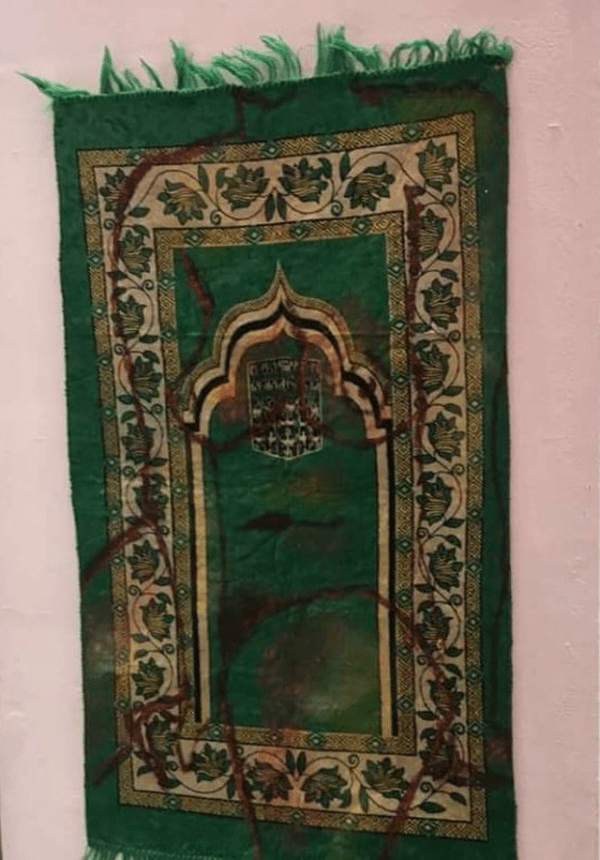
Christie Blatchford: Depiction of nude on a prayer mat too provocative for Ontario art school

Over reaction by the students and administration:

The “safe space” people have struck again at another Ontario university campus.

Monday night, an untitled, anonymous piece of art hanging in a student show at the Ontario College of Art and Design University in downtown Toronto was quietly removed.

It was a green Islamic prayer mat with the black outline of a nude woman on it.

In its place is a notice, apparently from the curators and jurors of the show, saying that absent knowing “the intent of the work that was previously hanging in this space,” they had decided to “remove it temporarily … until a statement from the artist can accompany it.”

The notice referred to “the concerns of a number of OCAD University student groups” and offered a one-two apology if either the original inclusion of the piece or its removal “has caused anyone harm.”

The formal complaint came from the Muslim Student Association at the school, which over the weekend issued a statement with several demands — the immediate removal of the piece, an investigation into how it was approved and “whether this was done out of ignorance or not” and an official apology from the university “that this piece was approved for display.”

The controversial piece.

“As a Muslim community,” the statement said, “we feel greatly offended, concerned and disappointed.

“This has already provoked Muslims and has caused very upsetting reactions, and several students’ responses and behaviour towards this is extremely alarming and is starting to make some students feel unsafe at OCAD.

“This is serious and we do not take it lightly.”

In a private, members-only Facebook group for OCAD students, the piece was immediately a lightning rod for controversy after the show, titled Festival of the Body, opened last Friday.

It sparked a spirited debate, sharp rebukes (and much apparent after-the-fact deletion of controversial posts) from the group moderators, one of whom snapped at one point, “This group was doing fine until these recently violent posts by some of you.”

Members of the group say dozens upon dozens of comments were arbitrarily deleted if they weren’t supportive of the decision to remove the piece.

Of those that remain, only one could be remotely described as violent, and it comes from a supporter of removing the prayer mat artwork.

He is a student who works part-time as a cab driver and who asked, “why does someone need to disrespect a whole religion and the way of life of billions of people?” He said the “intent” of the artist didn’t matter.

“… The intent does not change the blatant disrespect to our Islamic faith and the objects, places and symbols we hold dear to our heart.

“Picking up customers in my taxi that swear I hate them and want to kill them simply because I am Muslim or having my mother or my sisters followed and abused for wearing the hijab makes me live a certain anxious and protective lifestyle.”

In a phone interview Tuesday, OCAD professor Natalie Majaba Waldburger, a co-curator of the show, appeared to try to distance the university from the short notice that now sits in place of the art.

She said the artist, whom she identified as a Muslim woman and “we understood she was speaking from within her own cultural practices and experiences,” originally had her name by the piece, but then removed it over the weekend.

Several other pieces — the show includes at least one full-frontal nude, of a male — had no artist statement.

“We didn’t feel we could put up the work without any information,” Waldburger told the National Post.

She said the artist wants to provide an artist’s statement — such statements can range from the direct to the hopelessly oblique — and that “we’ve been working with her the last couple of days. We’ve been in discussion.” Waldburger said she hopes it can be re-installed.

Some sort of authorship, whether the artist’s name or statement, is required, she said. “So for her, no name and no statement means the work has to come down.”

Waldburger said she’s aware of the controversy raging around the work, but “that doesn’t mean we’re shutting the dialogue down. The university supports the right to artistic expression.”

Christine Crosbie, OCAD’s media and communications manager, said the school is aware that freedom of speech issues are controversial on campus at the moment.

“We respect the Muslim Student Association has their opinions, and this is an important dialogue around this piece. It’s a matter of looking at both sides.”

Interestingly, one of the mandatory art history courses at the school covers an infamous piece of art called Immersion (Piss Christ).

A 1987 photograph by American photographer Andres Serrano, Piss Christ is a photo of a plastic crucifix submerged in a tank of Serrano’s own urine.

Just about every time it has been exhibited over the past three decades, Christians have denounced, vandalized or threatened the photograph or photographer.

After the Charlie Hebdo attacks in Paris three years ago, sparked by the satirical magazine republishing the Danish cartoons of the Prophet Muhammad, the Associated Press removed an image of Piss Christ from its editorial archives.

Serrano wrote at that time, “We’ve seen the same impulse for self-censorship in the West before … Given the seriousness of the violence, such self-censorship is understandable; it’s also a step backward at a time when we need to reassert the importance of free expression by artists, activists, journalists and editors alike.”

Amin, as they say in Arabic.

Source: Christie Blatchford: Depiction of nude on a prayer mat too provocative for Ontario art school

Montreal prelate fears “second class citizenship” for people of faith

Interesting commentary on some cross faith commonalities:

Last fall, the Canadian province of Quebec passed legislation, Bill 62, that would make it illegal for anyone to receive public services if they did not show their face. Dubbed as a “religious neutrality” law, critics claimed the bill discriminated against Muslims who wear headscarves as a part of their religious practice — and should be cause for concern for all people of faith.

In recent months another controversy has brewed over Canada’s summer jobs program — a popular funding initiative for businesses and organizations to hire students during summer break — when the government of Prime Minister Justin Trudeau announced that in order to receive funding, you must attest to supporting abortion rights in Canada. Last month, a group of Jewish, Catholic, and Muslim leaders joined together in protest of the decision and called on the government to reverse its policy.

In an interview with Crux, Archbishop Christian Lépine of Montreal said he feared both the example of Bill 62 and the Canadian Summer Jobs program are moving the country in the direction of relegating people of faith to “second-class citizens.”

CRUX: Bill 62 — which requires that people who receive public services to show their faces — will most concretely affect Muslims who wear the niqab or a burka if religious accommodations aren’t put into place. What principles of religious liberty do you believe to be at stake here?

Archbishop Christian Lépine: – The clear intention of the law is to affirm freedom of religion and conscience in the name of neutrality of the state. But what is neutrality? Neutrality can be understood — and it’s my understanding of it — that everyone is welcome. You don’t have to hold a particular belief and whatever your belief might be, generally, you are welcome — just as you are, as a person. When neutrality becomes “You’re welcome, but signs of your belief cannot be visible,” is this still freedom? Is this still welcoming? You are welcome, but not in every respect.

If you are a government official or civil servant, you might say that we are serving the goal of neutrality by excluding certain signs. But, in my view, I think neutrality would be better served by saying that everyone, along with their particular signs of belief, is welcome. In which case, pluralism becomes visible; one can see that we’re a pluralistic society. However, if you say we’re a pluralistic society but certain visible signs are not allowed, then pluralism becomes invisible. I don’t believe in a neutrality that excludes people.

Why should Catholics care about this case?

Well, first there is the issue of principle. You can say: “It doesn’t involve us, it’s for others.” But one day, it might be for us.

Another concern is the ripple effect. Laws have a socialization effect, sending signals about what society considers important. If we choose to exclude in the name of neutrality, then, perhaps one day, a person will be waiting in a line to be served — maybe at a drug store or some company — and someone will say: “What are you doing here with your burka or niqab? Go back to your country if you don’t like it here. Get out of the line or remove your sign.” The ripple effect of this law can affect people’s mentality and their capacity to welcome others and their beliefs.

Do you see this as a sign of a diminishing of religious tolerance in Canada?

It is a sign of diminishing freedom of religion and conscience. Some might say it’s not very much, but Pope Francis talks about “polite persecution,” and it could possibly lead to that. I don’t think that is the intention of the law, but if neutrality of the state is used to exclude the public manifestation of certain religious beliefs, somehow, you are moving in the direction of creating second-class citizens.

Do you think Pope Francis has helped build a bridge between interfaith communities in Quebec?

Some, in Quebec, were at work building interfaith bridges before the Second Vatican Council. But after the council, religious leaders and civil society made a conscious effort to do so. Pope Francis certainly helps in this regard with his focus on “a civilization of encounter.” Of course, encounter means encountering those within our own belief system, but it’s also about encountering people of other beliefs and other ways of life.

Speaking of interfaith issues, multiple faith-based groups have come together to protest the government’s changes to Canada’s Summer Jobs program guidelines requiring a pledge of support for abortion rights before receiving federal funding. How did this happen and what’s at stake here?

We need to go back to the United Nations Declaration of Human Rights in 1948, which is the model of our Charter of Rights. Not everyone around the table professed the same religious beliefs, philosophy or convictions. There were Christians, but there were also Muslims, atheists, and a Communist regime at the table. After two years of discussion, they had trouble drafting a common declaration regarding the grounds for respecting human rights. So, they made a decision to shift their focus, moving from their own unique starting positions and focusing, instead, on making a solid affirmation of the inherent dignity of every human person. That became the starting point, with each group with their own religions or philosophies justifying it their own way. It wasn’t about using the Declaration to create a belief system to judge other belief systems or to diminish them. It’s about creating a society which includes different belief systems and respects them. It’s not about imposing your belief system on others.

The Charter of Rights is there to protect pluralism and the diversity of religions, beliefs and ways of thinking. It’s not there so I can take my Charter and use it against the beliefs of others. In that sense, I don’t think you can use the Charter of Rights to say “Your beliefs, your ways of thinking are not mine, so you won’t receive any funding from the government.” Abortion is not in the Charter of Rights, so if you want to respect people who hold various beliefs, and if you want to be democratic, you don’t decide who receives funding or not based on matters related to their beliefs.

You mention that Pope Francis has talked about the “polite” persecution of Christians—do you think this is also an example of that?

In the example of the Summer Jobs Program, I would call it a form of exclusion. It says: “You are a part of society, but there are certain aspects of who you are that you should keep private, and we don’t want them to be part of society.” Our Charter of Rights was not made for that; it was made to prevent us from creating second-class citizens.

via Montreal prelate fears “second class citizenship” for people of faith

Year of the Dog exposes growth of Islamic conservatism in Malaysia – CNN

More on Malaysia and Islamic fundamentalism and the impact on the Chinese minority:

With the Lunar New Year round the corner, Chinese around the world are preparing to welcome the Year of the Dog.

But in Malaysia, where people of ethnic Chinese descent make up almost a quarter of the population, images of the dog have been omitted from Lunar New Year decorations and merchandise for fear of offending the country’s Muslim majority.
The omission has raised hackles in the Chinese community and caused concern among Malaysians of all faiths, who see it as yet another symptom of the country’s growing Islamic conservatism, driven by the government’s flirtation with hardline Islamist policies and a cultural shift by religious students returning from the Middle East.

Backlash

Sunway Pyramid decided not to display dogs because they wanted to be respectful to what they perceive as Muslim sensitivities, but it suffered for its decision.
Sarah Chew, a communications officer for the mall, said her company has been the target of a backlash on social media for its decision not to display “contentious” cultural emblems, with calls for a boycott of its mall.
Ms Tan, a 40-year-old Malaysian-Chinese shopkeeper in the mall, who declined to give her full name, said: “This is a multiracial country, when they do something like that it shows disrespect to the Chinese race here.”
“If this is the case they should just make this only an Islamic country, but we have Buddhists, Hindus and other… (religions) as well here,” she added.
Several shops selling the customary red and gold new year decorations in Kuala Lumpur’s Chinatown have kept those featuring dogs inside rather than on display out front.
Last month, Reuters reported that Pavillion Mall, a shopping mall in the heart of Kuala Lumpur which gets about 3 million monthly visitors, also chose not to depict dogs in its decorations, citing religious and cultural sensitivities as a factor in their decision.
Earlier this year, a hypermarket chain around the country was embroiled in controversy when it emerged that Lunar New Year t-shirts being sold there depicted 10 animals in the Chinese zodiac, but not the dog or the pig.
The 2018 Lunar New Year isn’t the only time that animals considered taboo in Islam have caused public furor. There were outcries when Malaysia in 2016 ordered eateries and fast food chains such as Auntie Anne’s and A&W to change the name of dishes such as ‘Pretzel Dog’ and ‘Coney Dog’ to ‘Pretzel Sausage’ and ‘Beef Coney’ or ‘Chicken Coney’.
The reason? The country’s Islamic department said ‘dog’ would confuse Muslims.
Malaysia’s 30-million population is estimated to be 60% Malay Muslim, with prominent Chinese, Indian and other minorities.
Though Islam is Malaysia’s official religion and the country has Sharia courts for civil cases for Muslims, it is constitutionally secular.

Secularism disappearing

Maria Chin Abdullah, a prominent pro-democracy activist, says what’s happening with the Lunar New Year decorations are “just small signs” of growing Islamic conservatism.
“The secularism in our system that we enjoyed seems to be disappearing.”
As evidence, Chin pointed to the increasing frequency with which Malay women now wear the tudung, (headscarf), the Arabisation of Malay vocabulary — for example the word “Eid” being used for the Islamic religious holiday instead of the Malay “Hari Raya Puasa”, and books being banned for espousing moderate forms of Islam.
Other contentious recent issues include a beer festival in Kuala Lumpur that was canceled last year on security grounds, dress codes being imposed on international performers at pop concerts and Christians being prevented from erecting crosses on buildings.
“Schools have become less multi-racial and things are becoming scary,” said Chin.
“My own son will come back from school and tell me we can’t touch dogs and ask why I’m not wearing a headscarf.”
Other critics have pointed to the presence in Malaysia of hardline Indian Muslim televangelist Zakir Naik. He is banned in the UK and his views have sparked a criminal investigation in his native India.
Last year, Prime Minister Najib Razak’s government confirmed it had given Naik permanent residency, a decision to which activists have mounted a legal challenge.
Najib’s support for more Islamist policies has grown since his ruling coalition lost the popular vote in the 2013 general election – its worst ever electoral performance – as he seeks to strengthen his hold on the ethnic Malay Muslim vote.
Malaysia’s evolution has raised alarm bells at the UN, which has urged the country to protect its tradition of tolerance from the rise of fundamentalism.
“I have heard worrying reports of attempts at Islamization spreading in many areas of society which could lead to cultural engineering,” said UN human rights expert Karima Bennoune last year following a 10-day fact-finding mission to the country.

‘Conservatism is becoming worse’

The government, which is widely expected to win elections due before August, drew criticism last year for allowing the opposition Pan Malaysian Islamic Party to put forward a parliamentary bill calling for harsher punishments — including more flogging – for moral “crimes”.
Malaysia’s nine sultans, the official guardians of Islam in Malaysia, last year issued a call for religious harmony after what they described as excessive actions.
Ahmad Farouk Musa, founder of a moderate think-tank, Islamic Renaissance Front, is yet another who says Islamic conservatism is worsening.
“One of the reasons is that Malaysia sends thousands of students to Saudi Arabia, where they are indoctrinated with hardline intolerant forms of Islam like Salafism and Wahhabism.”
“They bring back intolerant ideas, for example, a hatred of Shias. That never existed in Malaysia before,” he added.
But there’s another fundamental problem that dates back to the birth of the country – its race-based political system.
Parties set up on ethnic lines originated under the country’s former colonial rulers, the British, who imported Chinese and Indian labor to Malaysia, largely keeping Malays in impoverished rural areas.
After Malaysia won independence in 1957, its new leaders granted privileges to Malays, including cheaper land, easier access to tertiary education and preference for civil service jobs, to try to help them reach economic parity with the Chinese community.
This policy was strengthened in 1969 after Malay animosity over increasing Chinese economic and political power boiled over into a race riot in Kuala Lumpur in which scores of people, mostly Chinese, were killed.
Reformists argue the system has made Malays dependent on handouts and has bred demagoguery that thrives on religious and ethnic tension.

via Year of the Dog exposes growth of Islamic conservatism in Malaysia – CNN