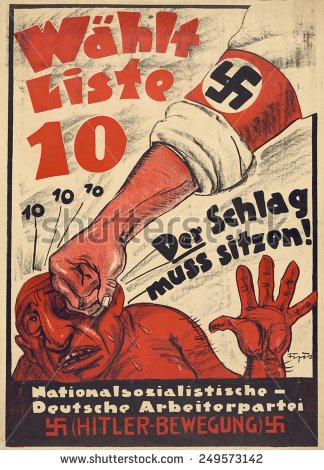
Indeed. Reminder of messaging and posters under the Nazis regarding Jews:
The far-right Alternative for Germany party released a new campaign poster last week with a slogan promising “Islam-free schools” beneath a photo of smiling white schoolchildren.
Alternative for Germany, also known as AfD, released the posters in the midst of its election campaign in the southern German state of Bavaria. Recent polls show the party is on track to win the third-largest share of the vote as it saps votes from the traditional conservative party aligned with German Chancellor Angela Merkel.
But as AfD rallies voters ahead of Bavaria’s elections next month, the party is under intense public and political scrutiny for its links to neo-Nazi organizationsand role in encouraging far-right riots in recent weeks.
AfD’s Bavarian anti-Islam posters have added to the backlash against the party. A German teachers’ associations called the posters dangerous, and an Austrian member of the European Parliament accused the party of promoting fascist rhetoric and racially segregated schools. A British hate crime monitoring group also denounced the poster, tweeting, “Welcome to the new face of fascism.”
AFD
Alternative for Germany’s new poster, vowing “Islam-free schools!” and promoting “dominant German culture.”
AfD claims that the posters are not calling for barring Muslim children from schools, Germany’s Der Spiegel reports, but are opposed to Islamic education in schools and face veils. But some Germans on social media criticized the posters for echoing Nazi-era discrimination against Jewish students, HuffPost Germany reported.
The party has a history of anti-Islamic propaganda, and during last year’s national elections it worked with a conservative American ad agency to create a controversial series of posters, including one reading “Burkas? We prefer bikinis” and another with a photo of a pregnant white woman with the tagline “New Germans? We’ll make them ourselves.”
Although AfD is often careful to distance itself from more politically toxic extremist groups and violent rhetoric, it has repeatedly provoked scandals after its officials made statements downplaying the Holocaust or siding with far-right activists. After anti-migrant riots erupted after the killing of a German man in the city of Chenmitz two weeks ago, a prominent AfD official marched with the founder of anti-Islamic extremist group PEGIDA in a demonstration against migration.
While AfD is still shut out of governing in Germany, its success has caused traditional right politicians to swing farther right in hopes of winning back voters, especially prevalent in Bavaria, where the Merkel-allied Christian Social Union is losing support and increasingly embracing anti-immigration, anti-Islamic views.
CSU leader Horst Seehofer nearly brought down the German government this year after demanding tighter border controls, and more recently he called immigration the “mother of all political problems” and said he would have joinedfar-right anti-migrant protests were he not an elected official. Bavaria’s CSU premier ordered that crucifixes be hung in all government buildings, and the party last year drafted a law banning full-face veils in public places.
Much like in several other countries where establishment parties mimic the far right, most recently Sweden, the CSU’s shift hasn’t worked, and the party is expected to lose its absolute majority government in a state where it once dominated.
Ongoing French struggles with integration approaches. While there are obviously serious problems of Islamist extremism, France also needs to deal with failures of economic integration and ongoing discrimination:
French President Emmanuel Macron will review a new report that lays out proposals to reform Muslim society in France and create a “French Islam.”
The report’s author, Hakim El Karoui, who is the nephew of former Tunisian Prime Minister Hamed Karoui, has called for “a system with men, money and financing to combat [radicalization],” Politico reported. He proposes funding this regulatory system by taxing halal foods, while also restricting religious financing from abroad.
“There are activists on one side and nobody across to say something else. [The Islamists] have an influence that goes well beyond their number of followers,” El Karoui told Europe 1 Radio on Monday.
Speaking to BFM TV, the report’s author also warned that young French Muslims often learned about Islam via social media, where extremists often had a strong presence. He further raised concerns about preachers and mosques funded by religiously conservative foreign nations, such as Saudi Arabia.
In France, many politicians and analysts have long drawn attention to the “parallel society” arising within the country’s Muslim population. At the same time, France’s strict laws separating religion from the state prevent the government from interfering directly to oversee what is presented in mosques. Some politicians, such as far-right leader Marine Le Pen, have capitalized on a wave of terror attacks and anti-Semitic murders to urge the government to police mosques and crack down on extremist clerics.
A public call was made by several leading political figures in April to strike verses in Islam’s holy book, the Koran, that call for punishing and killing Jews, Christians and nonbelievers, The Atlantic reported. While the manifesto did not specifically say the verses should be removed from the text, many Muslims saw the open letter as an attempt to alter their sacred text, which led to significant backlash.
El Karoui also emphasized this week that only a small fraction of France’s Muslim population turned to extremism.
“There are many Muslims who are going to eat halal, women who are going to be veiled, but who are not Islamists in the sense that they do not think that the ideological political project of the Islamists is better or more important than that of the Republic,” he said, according to France 24.
Earlier this year, Macron indicated a plan to address the tensions arising in the country and to create an “Islam of France.” French Muslim leaders had also called for reforms, but efforts made by previous governments had proved unsuccessful. Under the leadership of former President Nicolas Sarkozy, France tried to create a central Islamic religious authority recognized by the state, as was done with France’s Jewish population during the time of Napoleon Bonaparte, according to Politico. But the representative council failed to maintain popular support, primarily because of significant differences among Muslims hailing from many different countries.
It remains to be seen whether or not the new report will lead to government action. Some politicians have already criticized the proposals.
Bruno Retailleau, a senator for the right-leaning Les Républicains party said that creating “an Islam of France” would “not protect the French from radical Islam,” Politico reported. He also argued that it could weaken the devoutly secular nation’s “republican pact.”
The fact that Thilo Sarrazin doesn’t have a high opinion of Arabs and Turks is no secret ever since his bestseller Deutschland schafft sich ab (Germany Abolishes Itself) was published in 2010. At the time, the book’s controversial theses on integration and immigration had sparked a heated debate in Germany.
In the book, the former Berlin senator of finance and former member of the executive board of the Bundesbank claimed that Muslim immigrants had educational deficits and refused to integrate. While Sarrazin already explained why he perceived Muslims as a threat to Western societies in his previous book, he did not deal explicitly with the religion of Islam.
He now tackles the religion more directly in his new book, Feindliche Übernahmen (Hostile Takeover; no English version available).
His initial question — to determine if Islam plays a role in the violent acts of Muslims — is understandable considering the world’s current events. Trying to find out if the religion itself has anything to do with the lower level of education, the lower rate of innovation and the weak economic development of certain parts of the Islamic world are also legitimate discussion points, which are also being debated by many Muslims.
However, the author’s claim that his book provides a sober and impartial study of Islam quickly proves to be an empty assertion.
Absurd presumptions
He explores Islam through the Quran, which he claims to have read in its entirety. Even though this approach sounds correct, his claim to be able to determine the core statements of Islam by reading the Quran without any knowledge of Arabic or theological background is an absurd presumption. Sarrazin openly admits that his analysis “exclusively” follows his own “direct understanding of the text,” as if the Quran were really to be understood without taking into account the context of its origin and the history of its reception.
He ignores everything that doesn’t fit into his own interpretation. He does not discuss the ambiguity of the text nor its poetic dimension. Instead of looking at the Quran as a whole, he takes individual excerpts out of context and reorganizes them under selected themes.
The “religious content” of the Quran is “very simple, the guidelines for the faithful are therefore very clear,” writes Sarrazin. His conclusion: The Muslims’ holy book is obsessive about questions related to sexuality, and it is full of hatred for unbelievers and calls for violence.
“If you take it literally, it leaves little room for misunderstanding,” writes Sarrazin about the Quran. His reading does not see a separation of politics and religion in Islam as possible. “The more literally one takes the Quran, the clearer it appears that the world’s governance can only find its legitimacy through God,” he writes. Like many other Islam critics, Sarrazin picks up one of the Islamists’ core arguments; he presents their interpretation of the Quran not only as a conclusive view, but also as the exclusive one.
A distorted picture based on prejudice
Sarrazin also ignores the fact that the political ideology of Islamism is a product of modernity and that its interpretation is rejected by a great majority of Muslims. He does not say a word about the moderate versions of mystical Islam prevailing in most Muslim countries.
It may appear contradictory that he should adopt the radical reading of the Islamists as the “true” version of Islam, but that is necessary to support Sarrazin’s concept, in which he condemns Islam in its entirety as an “ideology of violence in the guise of a religion.”
His portrayal of Islam is a caricature that has more to do with his own prejudiced views than with the beliefs guiding the lives of the majority of Muslims.
Beyond his study of the Quran, he tries to provide an appearance of objectivity though quotes, numbers and statistics, but the book’s goal remains clear: to confirm his preconceived ideas. His description of the history of Islamic culture as an 800-year-long decline reveals his downright malicious urge to deny Muslims anything positive.
Pitiful bigotry
Anyone who has ever been to Istanbul, Granada or Cairo can only be astonished to read Sarrazin’s declaration that “an independent Islamic building culture never developed.” Anyone who knows Iran’s impressive Naqsh-e Jahan Square in Isfahan, a UNESCO World Heritage Site, can hardly agree with his statement that Muslims do not know anything “about urban planning with axes and public spaces.”
He also reveals an almost astounding ignorance when he claims that Muslims, “apart from a few fairy tales,” have never developed their own literature — as if poets such as Hafis, Saadi or Mevlana had never existed.
Revealing the full force of his deeply Eurocentric perspective, he cites the lack of symphonic orchestras as evidence of the cultural backwardness of the Islamic world. He apparently cannot imagine that there are other concepts of culture and beauty than the ones developed in Europe. Instead of appreciating the richness, complexity and elegance of the ornaments on carpets, tiles and facades created in Muslim countries, he only sees the absence of portraits and sculptures. You can almost feel pity for Sarrazin for such narrow-mindedness.
No interest in finding solutions
Throughout the book, it is clear that he only takes into account anything that fits into his preconceived world view. He avoids mentioning that the credibility of the statistics he uses has been questioned — that would ruin his narrative. Beyond all the figures on birth rates, levels of education and economic performance, it’s his basic thesis that appears the most questionable, in which he claims that all the Muslims’ social and economic problems can be blamed on their religion — or as the second part of his book’s title states: “How Islam Impedes Progress and Threatens Society.”
Hardly a Muslim bases his actions primarily or even exclusively on Islam. But even if Islam were the cause of all problems, what would be the solution? That all Muslims give up their culture and their faith? That’s not likely.
Sarrazin does not present a solution to this dilemma, as he is not even interested in finding solutions. His whole book shows that he is not concerned with helping shape peaceful coexistence, but rather with the strict separation of peoples and stopping the immigration of Muslims.
Ulrich von Schwerin works as a freelance correspondent for various media in Istanbul. In addition to Turkey, he also focuses on Iran. His political science PhD dissertation was about Iranian cleric and dissident Ayatollah Montazeri.
An example of fake news, where the original headline was “Islamic Relief and Other Groups to Receive $23M”, and the Sun was obliged to issue the following correction, not been picked up by the media and bloggers recirculating the story.
“Clarification
Tarek Fatah in a July 3, 2018 column incorrectly stated the National Council of Canadian Muslims (NCCM) is receiving funding from a federal multicultural program. Liberal MP Iqra Khalid suggested organizations such as NCCM would receive funding in a video referenced by Fatah however NCCM has not applied for funding. The Toronto Sun regrets the error”
Slightly reworded article to reflect the correction:
On the afternoon of June 27 while most of Canada was at work or watching the World Cup matches, a major funding announcement was made with little fanfare and in front of no more than a couple of dozen, mostly Muslim audience of Pakistani Canadians.
Mississauga-Erindale MP Iqra Khalid who has been the mouthpiece of the divisive Motion M103 on ‘Islamophobia’ stood in her constituency office to announce that the Trudeau government was investing an additional $23 Million into its multiculturalism program.
With no mainstream media in attendance to ask any questions, Khalid boasted that her “hard work has resulted into tangible action.” She listed the following two groups as being potential recipients of the new funding:
The National Council of Canadian Muslims (NCCM), a former branch of the U.S. based Council on American Islamic Relations (CAIR) that was named in 2008 as an unindicted co-conspirator connected to the “largest terror-funding trial in U.S. history. NCCM has denied links to CAIR.
Islamic Relief, a worldwide charity accused of links to Islamist extremism by Middle East Forum, Israel and the United Arab Emirates among others.
There is no solid record that the Canadian arms of these two organizations have contributed to current problematic behaviour. Nonetheless, for over a year many Muslim Canadians, including yours truly, my Sun colleague Farzana Hassan as well as other Muslim critics of Islamism had warned that the M103 initiative was much more than the victimhood culture of guilt being forced onto ordinary Canadians.
Khalid, in explaining during a press conference to announce the funding, suggested the $23 million is intended to “build bridges” between Canadians and to give new Canadians a “foundation” in this country by supporting community groups.
“NCCM that does a lot of data collecting on hate crimes and really pushing that advocacy needle forward within our country,” Khalid said. “Or like Islamic Relief, that does work not only within Canada, across Canada, across the world in really removing those stereotypes.”
So on Wednesday, we saw our fears come true. While Islamists are eligible to receive funds to conduct their Sharia agenda in Canada, Muslim critics of jihad, polygamy, FGM and Sharia have been left on their own to fight global Islamofascism.
In a message to MP Khalid, I asked her to clarify if any part of the $23M will be used to counter the daily denigration of Christians and Jews that takes place in mosques across Canada, from dawn to dusk.
I reminded her that “most Friday sermons at mosque congregations end with a call to Allah to grant Muslims victory over non-Muslims, referred to as ‘Qawm al Kafiroon’.”
“Will the $23M be used to de-radicalize mosque clerics and educate them to end hateful sermons from the pulpits,” I asked.
Despite reaching out to her office twice, I did not get a response, nor any press release or statement issued by any ministry of the Trudeau cabinet.
In making the announcement, the Pakistan-born Liberal MP told her scant audience, her M103 initiative was about “systemic racism and religious discrimination” and that “my goal was to study it and understand why does it happen and to find solutions.”
Most Canadians would have told her, ‘physician, heal thyself,’ but of course, ordinary Canadians are too scared to be labelled as ‘racist’ by privileged Islamists riding the waves of victimhood.
In recommending Islamic Relief as one of the recipients of the $23 million fund, Khalid covered up the fact that even Bangladesh, a Muslim-majority country has banned Islamic Relief from providing either relief or aid to some 500,000 Rohingya refugees who have taken refuge in the country.
Khalid also shrugged off allegations that Islamic Relief has long been accused of funding terror. The United Arab Emirates has designated Islamic Relief as a terror-financing organization while in Russian authorities have accused Islamic Relief of supporting terrorism in Chechnya.
My question to ordinary Canadians is this: Who will stand up to the Islamist agenda in our country if it’s the government itself that funds their agenda?
Clarification
Tarek Fatah in a July 3, 2018 column incorrectly stated the National Council of Canadian Muslims (NCCM) is receiving funding from a federal multicultural program. Liberal MP Iqra Khalid suggested organizations such as NCCM would receive funding in a video referenced by Fatah however NCCM has not applied for funding. The Toronto Sun regrets the error
Green-domed mosques still dominate the skyline of China’s “Little Mecca”, but they have undergone a profound change – no longer do boys flit through their stone courtyards en route to classes and prayers.
In what locals said they fear is a deliberate move to eradicate Islam, the atheist ruling Communist Party has banned children under 16 from religious activity or study in Linxia, a deeply Islamic region in western China’s Gansu province that had offered a haven of comparative religious freedom for the ethnic Hui Muslims there.
China governs Xinjiang, another majority Muslim region in its far west, with an iron fist to weed out what it calls “religious extremism” and “separatism” in the wake of deadly unrest, throwing ethnic Uygurs into shadowy re-education camps without due process for minor infractions such as owning a Koran or even growing a beard.
Now, Hui Muslims fear similar surveillance and repression.
“The winds have shifted” in the past year, said a senior imam who requested anonymity. “Frankly, I’m very afraid they’re going to implement the Xinjiang model here.”
Local authorities have severely curtailed the number of people over 16 officially allowed to study in each mosque and limited certification processes for new imams.
They have also instructed mosques to display national flags and stop sounding the call to prayer to reduce “noise pollution” – with loudspeakers removed entirely from all 355 mosques in a neighbouring county.
“They want to secularise Muslims, to cut off Islam at the roots,” the imam said, shaking with barely restrained emotion. “These days, children are not allowed to believe in religion: only in communism and the party.”
More than 1,000 boys used to attend his mid-sized mosque to study Koranic basics during summer and winter school holidays but now they are banned from even entering the premises.
His classrooms are still full of huge Arabic books from Saudi Arabia, browned with age and bound in heavy leather. But only 20 officially registered pupils over the age of 16 are now allowed to use them.
Parents were told the ban on extracurricular Koranic study was for their children’s own good, so they could rest and focus on secular coursework. But most are utterly panicked.
“We’re scared, very scared. If it goes on like this, after a generation or two, our traditions will be gone,” said Ma Lan, a 45-year-old caretaker, tears dripping quietly into her uneaten bowl of beef noodle soup.
Inspectors checked her local mosque every few days during the last school holiday to ensure none of the 70 or so village boys were present.
Their imam initially tried holding lessons in secret before sunrise but soon gave up, fearing repercussions.
Instead of studying five hours a day at the mosque, her 10-year-old son stayed home watching television. She said he dreamed of being an imam, but his schoolteachers had encouraged him to make money and become a communist cadre.
The Hui number nearly 10 million, half the country’s Muslim population, according to 2012 government statistics.
In Linxia, they have historically been well integrated with the ethnic Han majority, able to openly express their devotion and centre their lives around their faith.
Women in headscarves dish out boiled lamb in mirror-panelled halal eateries while streams of white-hatted men meander into mosques for afternoon prayers, passing shops hawking rugs, incense and “eight treasure tea”, a local speciality including dates and dried chrysanthemum buds.
But in January, local officials signed a decree pledging to ensure that no individual or organisation would “support, permit, organise or guide minors towards entering mosques for Koranic study or religious activities”, or push them towards religious beliefs.
“I cannot act contrary to my beliefs. Islam requires education from cradle to grave. As soon as children are able to speak we should begin to teach them our truths,” he said.
“It feels like we are slowly moving back towards the repression of the Cultural Revolution,” he said, referring to a nationwide purge from 1966 until 1976 when local mosques were dismantled or turned into donkey sheds.
Other imams complained authorities were issuing fewer certificates required to practise or teach and now only to graduates of state-sanctioned institutions.
“For now, there are enough of us, but I fear for the future. Even if there are still students, there won’t be anyone of quality to teach them,” one imam said.
Local authorities failed to answer repeated calls seeking comment but Linxia’s youth ban comes as China rolls out its newly revised Religious Affairs Regulations.
The rules have intensified punishments for unsanctioned religious activities across all faiths and regions.
Beijing was targeting minors “as a way to ensure that faith traditions die out while also maintaining the government’s control over ideological affairs”, said William Nee, a China researcher at Amnesty International.
Another imam said the tense situation in Xinjiang was at the root of changes in Linxia.
The government believed that “religious piety fosters fanaticism, which spawns extremism, which leads to terrorist acts – so they want to secularise us”, he said.
But many Hui are quick to distinguish themselves from Uygurs.
“They believe in Islam too, but they’re violent and bloodthirsty. We’re nothing like that,” said Muslim hairdresser Ma Jiancai, 40, drawing on common stereotypes.
Sitting under the elegant eaves of a Sufi shrine complex, a young scholar from Xinjiang said his family had sent him alone aged five to Linxia to study the Koran with a freedom not possible in his hometown.
“Things are very different here,” he said with knitted brows. “I hope to stay.”
Phil Gurski on Ihsaan Gardee’s earlier column (reprinted below):
There are times when you read something that makes your blood boil and demands a response. One such time occurred to me last week within the pages of The Hill Times in an op-ed by Ihsaan Gardee, executive director of the National Council of Canadian Muslims (NCCM). Entitled “Government must rebuild trust with Canadian Muslims on national security“, this op-ed piece is full of language like “over-reaching and draconian,” “smearing Muslims,” “Islamophobia,” “systemic bias and discrimination,” and “little or no accountability,” all directed at CSIS and other agencies involved in national security.
Gardee paints a picture of CSIS that seems to have it in for Canada’s Muslims and which has undermined attempts by those communities to “establish robust partnerships.” He appears convinced that CSIS is an organization run rogue that has “protracted problems” which leads to the “stigmatization” of those among us who are Muslim.
As a former analyst at CSIS who not only worked on Islamist extremism for 15 years, but who has written four books on the topic—and met with Muslims all across the country to discuss the issues of radicalization and terrorism—I think I am in a better position than him to draw a better picture. And no, for the record, I am not a ‘shill’ for CSIS and more than happy to point to the bad as well as the good within the agency.
So to the first accusation levelled by Gardee: does Islamophobia exist within CSIS? Absolutely—I saw it first-hand and challenged it when I saw it, although it is not as pervasive as he thinks it is. And, yes, the lawsuit containing allegations about Islamophobia among other shortcomings that was settled by five former employees was based on facts, as I outlined quite clearly in a previous Hill Times column. Aside from that, however, everything else Gardee alleges as endemic within CSIS—I cannot speak for another agency such as CBSA as I never worked there and would never purport to know what goes on within its walls—is false. As CSIS won’t publicly address these fabrications, I will, if for no other reason than I toiled tirelessly for a decade and a half to do my small part in keeping Canadians safe from terrorism and don’t want my time construed as wasted in a racist environment.
But if you look at the terrorist/violent extremist environment in Canada since 9/11, which seems to be the timeframe Gardee sees when everything went to hell for Muslim Canadians, the vast majority of attacks have been perpetrated by Islamist extremists. And that does not even take into account the Islamic State ‘foreign fighter’ phenomenon that led to the deaths of countless thousands in Iraq and Syria. Does this perhaps explain why CSIS and its partners have focused on the Muslim community in that time, given that these perpetrators come from that community?
What Gardee appears to fail to understand is that CSIS is an intelligence agency that is driven by intelligence. Intelligence tells it where to put its resources; that and government requirements. If the threat is emanating primarily from a small number of Canadians who happen to be Muslim then that is exactly where you would want our protectors to look, not elsewhere.
I am not saying that CSIS or its employees are perfect. No, they are not as they are human. In addition, there is always room for improvement, and that includes its relations with communities across Canada, Muslims among them. Since 9/11, however, CSIS has done its part with its partners to prevent deaths. I would think that Gardee would at least acknowledge that much.
I thus reject Gardee’s accusations. He owes CSIS an apology for his ill-considered words. Phil Gurski is a former strategic analyst with CSIS, an author and the Director of Intelligence and Security at the SecDev Group.
Once bitten, twice shy. That’s the sense within Canadian Muslim communities when it comes to the Liberal government’s proposed overhaul of national security law under Bill C-59.
The legislation was back before the House last week after examination by the Public Safety and National Security Committee.
Let’s not forget where this first started. Under the previous government, Canadian anti-terrorism laws quickly morphed into overreaching and draconian policies. This was coupled with Muslim communities facing jarring public scrutiny and increasing Islamophobia.
Back then, despite efforts from Canadian Muslims to establish robust partnerships on national security, the government’s response was to smear them as a threat to Canada. The result: trust between Canadian Muslims and the government agencies tasked with protecting us all evaporated after years of work.
The days when the loyalty of Canadian Muslims was being questioned by government officials seem behind us—for now. But that is no standard by which to measure meaningful change.
That very public show of Islamophobic discourse by government overshadowed something even more alarming—the permeating of systemic bias and discrimination against Muslims by and in our security agencies.
In the past several months alone, we have seen sweeping allegations by CSIS employees about racism and Islamophobia within the service and new data that suggests the CBSA disproportionately targets non-whites, particularly those from the Middle East.
These accounts, along with the direct reports regularly received by our organization, only amplify concerns about what Canadian Muslims have been experiencing for years.
To be fair, Bill C-59 does make important, long-overdue improvements to previous laws, including better and more focused review powers and mechanisms as well as some stricter directives to prevent complicity with torture by foreign powers.
Last December, our organization told the House Public Safety Committeethat redress and review were only a partial solution to the problems plaguing Canada’s national security system. Real reform of security work is necessary to address systemic bias and discrimination.
As outlined by experts and civil society, there are several concerning elements in Bill C-59; however, two key issues have recently come to the fore.
First, the government has not substantially reined back the contentious disruption powers given to CSIS—an agency that we know through public inquiries has targeted Muslims with little to no accountability for their actions. There must be a concerted effort by government to confront the systemic bias in the way CSIS approaches and resources its intelligence work. Until real change occurs, these powers which remain unproven in their effectiveness are only an invitation to more abuse and scandal.
Second, the lack of due process in the Passenger Protect Program—Canada’s No Fly List—continues. This has been one of the most troubling instruments of state power for over a decade. There are no reported cases of Canadians successfully getting off the list through the Passenger Protect Inquiries Office which was created in 2016. Families impacted by the list say the inquiries office has been of little to no use. Although recently funding has been earmarked for a new redress system to remove false flagging, how and why Canadians find themselves on this draconian list in the first place remains unanswered.
As we look ahead, the aegis of this legislation does not engender the kind of trust from communities that is needed.
Incidentally, Public Safety Canada’s recently launched Canada Centre for Community Engagement and the Prevention of Violence is pledging a strategy that “reflects the realities faced by Canada’s diverse communities.” Canadian Muslims are closely watching whether this initiative is yet another exercise in falsely framing national security as the “Muslim problem” or whether policymaking will finally take into account the growing threat of far-right extremism in Canada.
In other words, rebuilding trust with our communities cannot be achieved through roundtables and focus groups.
It has been more than a decade since the Arar Inquiry report first outlined some of the protracted problems within our country’s security apparatus. Through the haze of political haste, 12 years later Canadian Muslims are still seeking the partnership with government that ends their national security stigmatization.
Interesting research and findings on the generational shifts, with appropriate nuance on trends:
Upon arrival in Canada, newcomers often look to spiritual communities for support, whether for help learning a new language, locking down a job or simply to find a social circle as they make their way in a new country.
And, while some new immigrants find spiritual fulfilment in addition to material help from these communities, firmly held religious views — such as the role religion ought to play in public life — tend to sag over subsequent generations, says new research by the Angus Reid Institute, a non-profit opinion research organization, and Cardus, a non-partisan, faith-based think tank.
“I’m not sure Canadians appreciate the story of what faith communities do,” says Ray Pennings, Cardus’s executive vice-president. “They actually play a pretty significant role in our day-to-day life.”
The report says nearly one-half of those born outside of Canada received material support from a faith-based group, while 63 per cent relied on them to form a social network.
“They don’t know anyone, so they go to their church, synagogue, temple or whatever, and that’s where they find people,” says Angus Reid, chairman of the Angus Reid Institute. The survey, Reid says, didn’t differentiate between services from religiously based organizations and those provided directly from congregations.
“You’re going back to the history of settlement in Canada. Churches always, always played a big role,” says Fariborz Birjandian, who heads the Calgary Catholic Immigration Society, which provides services ranging from child care and transitional shelter to employment services. He says many agencies, including his, started as specifically faith-based organizations and are now more religiously diverse, serving a wide array of religious and cultural backgrounds.
Ray Pennings is vice president of research for the Work Research Foundation, a think tank dedicated to the study of Canada’s social architecture.
“If you look at it deeply, the faith groups, part of the mandate is to help those (who are) vulnerable,” he says.
Birjandian, a Baha’i refugee from Iran, says he was helped by the Baha’i community when he arrived in Canada. “That’s was actually an amazing place for us to go, because we were accepted when we went to our faith group with no questions,” he says. “You want to be accepted … and definitely a faith group plays a big, big role.”
And, yes, 65 per cent of respondents — the sample included 1,509 adults who are members of the Angus Reid Forum, a community of opinion-givers, and 494 members of Ethnic Corner, a research group focusing on ethnic groups and new Canadians — said they found a spiritual home among Canada’s religious communities. The polling includes both refugees and those who immigrated for different reasons.
But the data suggest there is a change in religiosity between generations of immigrants: 20 per cent of those newly arrived, for example, say religion should have a major influence on public life. But among second-generation immigrants, it drops to 14 per cent and, among those the survey calls “third generation+” (those who trace their roots to their grandparents at least – so, most of the rest of us) that percentage drops to just 10 per cent.
Reid says that while “the political implications of all this remain something you can only speculate on,” the belief in the importance of religion in the public sphere could pose a challenge on issues such as abortion or public funding of religious schools.
On other metrics, too, some views fade, such as the importance of a formal welcoming into religious life, such as baptism. 60 per cent of those born outside of Canada say this is very or somewhat important, dropping to 50 per cent for second-generation Canadians and 47 per cent for everyone else.
As for believing in God or a higher power, 65 per cent of immigrants believe this is very or somewhat important for their children, while 57 per cent of the second generation and 51 per cent of the third generation say that’s the case.
Among those surveyed born outside of Canada, 57 per cent said religion has more positive than negative effects on Canada; by the second generation, 54 per cent say it’s a mix of good and bad and just 33 per cent agree with their parents on its positive effects.
Peter Beyer, a University of Ottawa professor who’s researched religion and migration, says these trends aren’t surprising, although he says some research suggests, among certain demographics, trends of declining religiosity among each generation doesn’t always hold true.
Still, he says, “in the history of migration studies … this has been noted again and again: Immigrants do not stay the same.”
Lurking in the background of a Saudi-Moroccan spat over World Cup hosting rights and the Gulf crisis is a more fundamental competition for the mantle of spearheading promotion of a moderate interpretation of Islam.
It’s a competition in which history and long-standing religious diplomacy gives Morocco a leg up compared to Saudi Arabia, long a citadel of Sunni Muslim intolerance and ultra-conservatism.
Saudi Arabia is the new, baggage-laden kid on the block with Crown Prince Mohammed bin Salman asserting that he is returning the kingdom to a top-down, undefined form of moderate Islam.
To be sure, Prince Mohammed has dominated headlines in the last year with long-overdue social reforms such as lifting the ban on women’s driving and loosening restrictions on cultural expression and entertainment.
Yet, Prince Mohammed has also signalled the limits of his definition of moderate Islam. His recurrent rollbacks have often been in response to ultra-conservative protests not just from the ranks of the kingdom’s religious establishment but also segments of the youth that constitute the mainstay of his popularity.
Just this week, Prince Mohammed sacked Ahmad al-Khatib, the head of entertainment authority he had established. The government gave no reason for Mr. Al-Khatib’s dismissal, but it followed online protests against a controversial Russian circus performance in Riyadh, which included women wearing “indecent clothes.”
The protests were prompted by a video on social media that featured a female performer in a tight pink costume.
In a similar vein, the Saudi sports authority closed a female fitness centre in Riyadh in April over a contentious promotional video that appeared to show a woman working out in leggings and a tank-top. A spokesman for the royal court, Saud al-Qahtani, said the closure was in line with the kingdom’s pursuit of “moderation without moral breakdown.”
Saudi sports czar Turki bin Abdel Muhsin Al-Asheikh said “the gym had its licence suspended over a deceitful video that circulated on social media promoting the gym disgracefully and breaching the kingdom’s code of conduct.”
To be sure, the United States, which repeatedly saw ultra-conservative Islam as a useful tool during the Cold War, was long supportive of Saudi propagation of Islamic puritanism that also sought to counter the post-1979 revolutionary Iranian zeal.
Nonetheless, Saudi Arabia’s more recent wrestle with what it defines as moderate and effort to rebrand itself contrasts starkly with long-standing perceptions of Morocco as an icon of more liberal interpretations of the faith.
Established three years ago, Morocco’s Mohammed VI Institute for Imam Training has so far graduated 447 imams; 212 Malians, 37 Tunisians, 100 Guineans, 75 Ivorians, and 23 Frenchmen.
The institute has signed training agreements with Belgium, Russia and Libya and is negotiating understandings with Senegal.
Critics worry that Morocco’s promotion of its specific version of Islam, which fundamentally differs from the one that was long prevalent in Saudi Arabia, still risks Morocco curbing rather than promoting religious diversity.
Albeit on a smaller scale than the Saudi campaign, Morocco has in recent years launched a mosque building program in West Africa as part of its soft power policy and effort to broaden its focus that was long centred on Europe rather than its own continent.
In doing so Morocco benefits from the fact that its religious ties to West Africa date back to the 11th century when the Berber Almoravid dynast converted the region to Islam. King Mohammed, who prides himself on being a descendant of the Prophet Mohammed, retains legitimacy as the region’s ‘Commander of the Faithful.’
West African Sufis continue to make annual pilgrimages to a religious complex in Fez that houses the grave of Sidi Ahmed Tijani, the 18thcentury founder of a Sufi order.
All of this is not to say that Morocco does not have an extremism problem of its own. Militants attacked multiple targets in Casablanca in 2003, killing 45 people. Another 17 died eight years later in an attack in Marrakech. Militants of Moroccan descent were prominent in a spate of incidents in Europe in recent years.
Critics caution however that Morocco is experiencing accelerated conservatism as a result of social and economic grievances as well as an education system that has yet to wholeheartedly embrace more liberal values.
“Extremism is gaining ground,” warned Mohamed Elboukili, an academic and human rights activist, pointing to an increasing number of young women who opt to cover their heads.
“You can say to me this scarf doesn’t mean anything. Yes, it doesn’t mean anything, but it’s isolating the girl from the boy. Now she’s wearing the scarf, but later on she’s not going to shake hands with the boy . . . Later on she’s not going to study in the same class with boys. Those are the mechanisms of an Islamist state, that’s how it works,” Mr. Elboukili said.
Mr. Elboukili’s observations notwithstanding, it is Morocco rather than Saudi Arabia that many look to for the promotion of forms of Islam that embrace tolerance and pluralism. Viewed from Riyadh, Morocco to boot has insisted on pursuing an independent course instead of bowing to Saudi dictates.
Morocco refused to support Saudi Arabia in its debilitating, one-year-old economic and diplomatic boycott of Qatar but recently broke off relations with Iran, accusing the Islamic republic of supporting Frente Polisario insurgents in the Western Sahara.
Moroccan rejection of Saudi tutelage poses a potential problem for a man like Prince Mohammed, whose country is the custodian of Islam’s two holiest cities and who has been ruthless in attempting to impose his will on the Middle East and North Africa and position the kingdom as the region’s undisputed leader.
Yet, Saudi Arabia’s ability to compete for the mantle of moderate Islam is likely to be determined in the kingdom itself rather than on a regional stage. And that will take far more change than Prince Mohammed has been willing to entertain until now.
Interesting and not surprising how preferences reflect values and ideologies:
Gone are the days when God was an old man up in the clouds, peering down with stern, aged eyes.
According to a new study, modern American Christians now picture God as a younger, cuter and more approachable guy who could just as easily be drinking a beer at the bar.
However, the tendency to group the apparent divine makeover with celebrities such Elon Musk and Ryan Gosling has left researcher Joshua Jackson shaking his head. Jackson stressed that the goal of the study was not to compile an absolute result but rather compare individual features that 511 American Christian participants chose out of more than 300 face samples, all constructed off an demographic average of the American face.
“The strength of the study is that the features people constantly collected aligned with their view of God and those are the features that you should compare,” he said.
On comparing the faces chosen by study participants, Jackson and his colleagues at University of North Carolina, were surprised to see a face ‘much more kinder and loving’ than the authoritarian old man painted on the Sistine Chapel, giving life to Adam.
Michaelangelo’s iconic painting of God giving life to Adam, on the 16th century Sistine Chapel.
Furthermore, comparing the study results with earlier studies that compared verbal descriptions of God, has Jackson and his colleagues revisiting the stereotypical notion of the old, bearded man altogether. “People were generating these benevolent, warm adjectives much earlier than the kind of authoritarian figure we see,” he said.
That’s not to say that the authoritarian description was thrown out of the mix altogether. Conservative participants still visualize a face that was relatively ‘masculine, older, more powerful and wealthier’, reflecting what the study called, their ‘motivation for a God who enforces order.’
Liberals, on the other hand, sought a God is socially tolerant and were therefore more lenient in their choices, picking faces that were younger, more feminine and more African-American than that of their political counterparts.
It all comes down to individual motivation, according to Jackson. “Some theory in research has argued that people’s views of the divine figures are related to their motivations,” he said. “And so people are more inclined to conceptualize a God that’s more suited to their needs.”
So, African-Americans chose someone who was marginally more black while Caucasians chose someone who was more white. People who perceived themselves as more attractive chose a better-looking God, fitting in with the researcher’s hypothesis that people would choose faces that matched their own.
Gender did not play a significant role in the choice of the divine. “It could be that people don’t naturally use their gender a reference point when they think of divine figures, compared to other physical features,” said Jackson.
Jackson said researchers were ‘surprised’ to not see a face that was more authoritarian.
“It could suggest, but not prove, that our view of God has been changing throughout history as this is naturally something people have definitely chosen,” he added.
Would researchers be able to expect similar results on surveying American Muslims, or a Chinese community? It’s hard to say. While it is possible to predict a face based on overall cultural motivations, Jackson does note that there will be ‘cultural differences that they won’t be able to account for, which can amplify across a geographical region’ and impact the results of their study.
Using the study composite comes with its own set of constraints as Jackson acknowledges that there are some features that have not been included in the base face. “We were never going to faces (in the study result) with a dramatic change, like the face of a brunette, or someone who has a beard.”
It is the first time that a study of this kind has used this method of ‘reverse correlation’, i.e., asking participants to choose randomly generated facial samples with subtle changes. While the method has been used for other purposes, i.e., to determine how participants visualize trustworthiness, previous studies on visualizing the divine have relied on using verbal adjectives.
Inside Berkeley’s Qal’bu Maryam, Tuli Bennett-Bose was preparing for jummah, the Friday prayer service. At 18, Bennett-Bose was a recent convert to Islam, and still working out the intricacies of dress and ritual that come with being an observant Muslim. “I’m a half-jabi,” she joked as she rewrapped her rust-colored hijab to frame her face. Sometimes she prefers to let her head covering reveal some of her silver pixie cut. On this afternoon, she was covering all of her hair because of the service, and also because it was raining.
Qal’bu Maryam — Arabic for “Maryam’s heart” — opened in Berkeley in April 2017. The mosque represents a stark departure from orthodox Muslim tradition, welcoming LGBTQ congregants, allowing women to lead prayers and deliver sermons (called khutbahs), and encouraging all genders to pray shoulder to shoulder. Bennett-Bose stumbled upon the congregation online and was drawn to its inclusivity. “I know that I was meant to be Muslim,” she says. “But I also knew that I was gay before I converted.” Although many mainstream strains of Islam shun homosexuality, Bennett-Bose took the shahada, the Muslim declaration of faith. Soon after, she visited Qal’bu Maryam.
Neither Qal’bu Maryam nor its founder, Rabia Keeble, who converted to Islam 15 years ago, have been universally welcomed within the East Bay’s Muslim community. Some faith leaders criticize the congregation for its deviation from traditions that have been in place for millennia. Abdullah Ali, an assistant professor at nearby Zaytuna College, the first accredited Muslim undergraduate university in the country, has little love for Keeble’s “particular project.” Men and women praying side by side “is definitely not the instruction given by our prophet,” he says, referring to the hadith, or the sayings of Prophet Muhammad. “The instruction was very clear, and we know what prayer looked like at this time: Women pray behind men.”
More important, Ali says, Qal’bu Maryam was founded with the explicit intention of being “provocative” and, in particular, of antagonizing people who are committed to traditional Islamic teachings. “They want to challenge what they consider to be orthodoxy,” he says.
On that point, he won’t get much argument from Keeble. An Ohio-raised woman (she declines to share her age), Keeble came to the faith in 2003 and lives by a “no tolerance for bullshit” policy, doling out grand, confrontational statements that often rankle whomever she’s debating. “What I did started a conversation,” she tells me of Qal’bu Maryam’s founding. “Men and women need to learn together. This will end misogyny within the religious sphere.”
Keeble is a self-proclaimed “third-wave black feminist and womanist” whose daily getup includes hijab, eyeliner, and bright lipstick. Central to her mission is to reconcile Islam with contemporary feminism; it’s on this point that she encounters the most resistance. Both she and Ali believe the two worldviews can and do coexist. How they achieve it, however, is very much a point of contention.
Feminist Islam is not a new concept. While Europe suffered through the Dark Ages, women in Arabia benefited from inheritance, consent as a requirement for marriage, and education. Muslims frequently cite the Prophet’s wife, Khadija, an independent businesswoman, as evidence of the faith’s feminist principles in action.
“Feminists are not anti-Islam. We want the fulfillment of what the Prophet, peace be upon him, started before his death,” Keeble says. Ali agrees that Islam can be consistent with feminist ideology, but he points to liberation feminism, which “accepts that men and women are fundamentally different and that men have often belittled the importance of women.” “Equality feminism” of the type practiced by “people like Rabia Keeble” is not compatible with Islam, he says. “Equality feminism is focused on attempting to equalize the degree of influence and level of authority between men and women to the extent that we completely ignore biological differences.”
For Ali, the hadith was never to be taken as a sign of women’s inferiority, “just as leading the prayer was never taken as a sign of political power.” Instead, he says, the practice is rooted in principle: “The Prophet told the people, ‘Pray as you see me pray.’ And we know that the norm is that he was always leading prayer during his lifetime.” For that reason and others — for instance, the fact that Keeble thinks women can pray while on their periods, a practice considered taboo by Ali and others—he looks upon Qal’bu Maryam as a prayer space, not a mosque. It lacks the sanctity, he says, that a mosque deserves.
It’s exactly that inequality, in Keeble’s eyes, that has hurt Muslim women and caused them to have shallower relationships with their faith. Because of male dominance in mosques, “it is very difficult for women to approach the imam after sermons to ask questions,” she explains.
Fighting for her congregation has been draining for Keeble. Earlier this year, she took a month-long leave from the mosque to regroup; aside from dealing with “so-called volunteers who were all talk and no show,” she was “physically worn out” from handling outreach and logistics alone. She was also attending speaking engagements, creating and distributing weekly advertisements, and scheduling Friday speakers. During her period of reflection, she refocused on Qal’bu Maryam’s mission, paying particular attention to the sermons being delivered there. “I wanted to focus on the use of gendered language specifically. I have to ask myself, Is this language that honors women?”