Khan: The downfall of Quebec’s Bill 21 could come thanks to women

We will see:

The notwithstanding clause of the Canadian Charter is no longer an obscure legal term. Thanks to Ontario Premier Doug Ford’s recent use of Section 33 to prevent job action by education workers – he has invoked the clause, or threatened to do so, three times in four years – ordinary Canadians now know that their basic human rights can be suspended at any time. We aren’t talking about emergency measures here, nor are we discussing reasonable limits through democratic mechanisms; ours is the only constitutional democracy that potentially allows for the gutting of basic rights in the name of what a parliamentary majority deems a matter of governance.

Who could have foreseen the consequences of this clause?

Well, Canadian women, for one.

When the Charter was being drafted, women demanded equality rights – but they were derided at committee hearings for doing so. In 1980, Senator Harry Hays derisively countered by suggesting special rights for babies and children, since “all you girls will be out working and we’re not going to have anybody to look after them.” A year later, more than 1,300 women descended on Parliament Hill to assert equality rights in the Constitution, by affirming Section 15 on general equality and proposing Section 28, on gender equality rights.

Initially, the notwithstanding clause could have been used on Section 28, too. But women fought for its exclusion, having had the foresight to ensure that gender equality rights could not be denied by the potential whims of future governments. We owe them a great deal.

And yet, today, we see the Constitution’s notwithstanding clause leading to disproportionate damage to Muslim women in Quebec.

François Legault’s government has pre-emptively used the notwithstanding clause twice since 2019, to ensure the passage of two bills. One of them, Bill 21, bans some public-sector workers from wearing religious symbols, but lawyers have provided evidence at the Quebec Court of Appeal – which heard a legal challenge to the bill this month – that only Muslim women who wear the hijab have lost their jobs as a result of it.

Indeed, Quebec’s religious minorities have felt increased alienation and despair in recent years, according to the Association for Canadian Studies. Its survey found that the situation is particularly dire for Muslim women: 73 per cent of them said they’ve felt less safe in public since 2019, while 83 per cent said their confidence in their children’s future has worsened.

The Quebec government touted Bill 21 as a “feminist” law, but it has only reinforced prejudices, and given license to bigots. I know this firsthand: During a visit to Montreal, I was berated by a middle-aged francophone Uber driver for wearing the hijab. At the end of the ride, he asked me not to file a complaint. (Of course, I did the opposite.)

This all illustrates Bill 21′s egregious violation of Section 28 of the Charter – namely, that the law disproportionately affects women, and thus violates gender equality. Since the notwithstanding clause cannot override Section 28, Bill 21 could be seen by the courts as invalid – an argument that University of New Brunswick law professor Kerri Froc raised years ago, and is now gaining traction.

Quebec Muslim women are not wilting. They have protested alongside allies who believe in a Quebec where all individuals can thrive. Take, for example, Institut F, a Montreal-based organization that seeks to ensure Muslim women’s personal agency. Its programs provide resources so that each woman knows that she belongs, her voice matters and she is a valued member of society – even if the Quebec government thinks otherwise. At a recent Institut event, I met talented Muslim women in STEM fields such as artificial intelligence, biotechnology and data science – talent that Quebec needs to remain economically competitive. Yet, many of those women expressed doubts about thriving in a society that overtly discriminates against religious minorities.

Something may have to give on this front, too. The labour shortage is so acute in Quebec that the town of Hérouxville – infamous for issuing a code of conduct for immigrants warning them not to stone or burn women alive – is now actively courting newcomers. Today, neighbouring towns are helping migrants find halal food. Economic reality will force the realization that attracting workers means making all feel welcome – not just a select few.

Bill 21’s damage has been done – abetted by the notwithstanding clause. The women who fought to exclude Section 28 from the clause knew its dangers. As Canadians, we must continue that fight to guarantee basic rights for all, be they religious and linguistic minorities in Quebec, education workers in Ontario, or anyone threatened by the notwithstanding clause.

Source: The downfall of Quebec’s Bill 21 could come thanks to women
USA: Religious groups with immigrant members grew fastest over past decade

Similar as in Canada as Douglas Todd has reported on:

A decennial study of U.S. religious life shows what many demographers and others have long known: Participation in congregational services has not kept up with overall population growth. However, religious groups drawing large numbers of immigrants have seen steady growth.

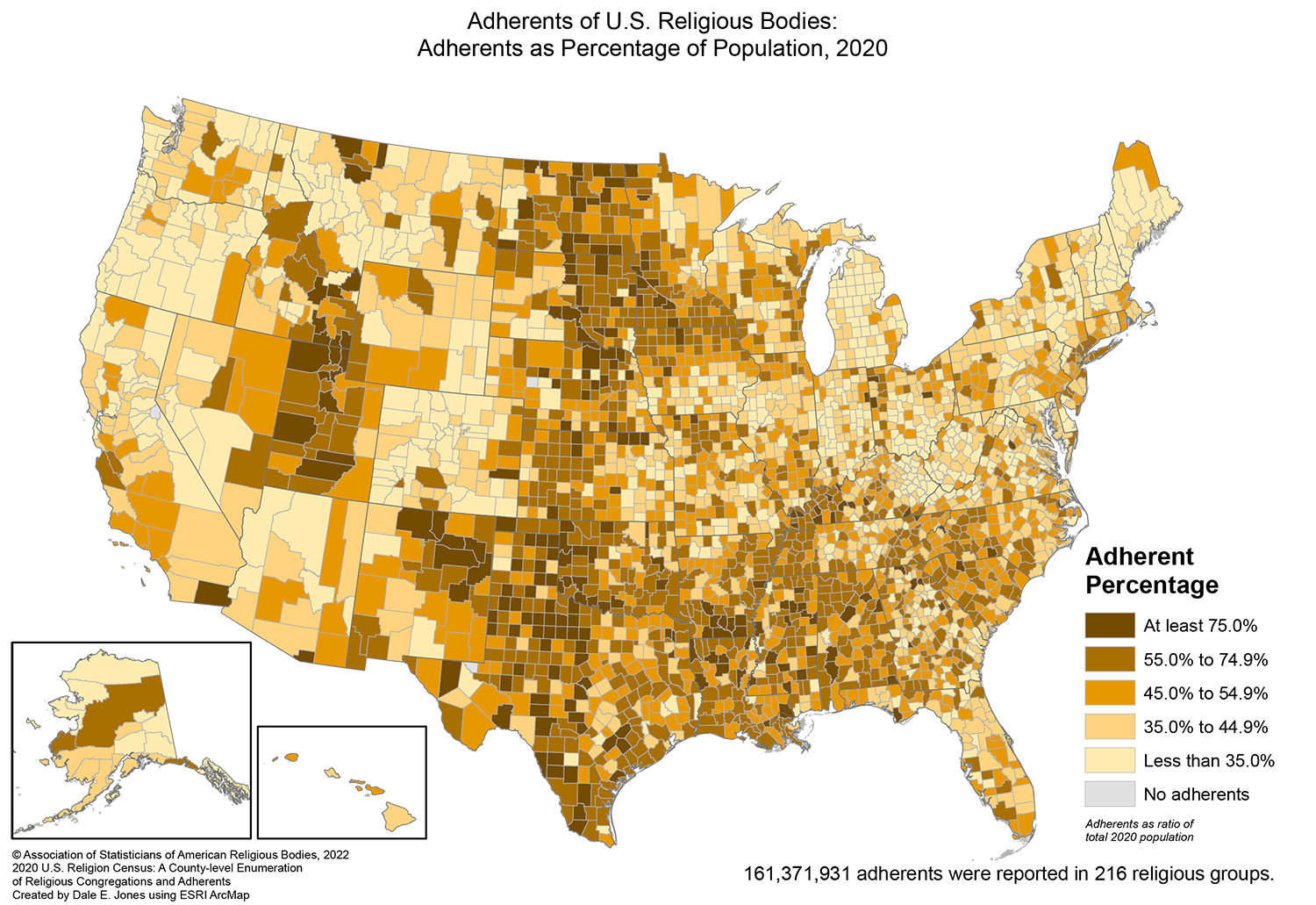
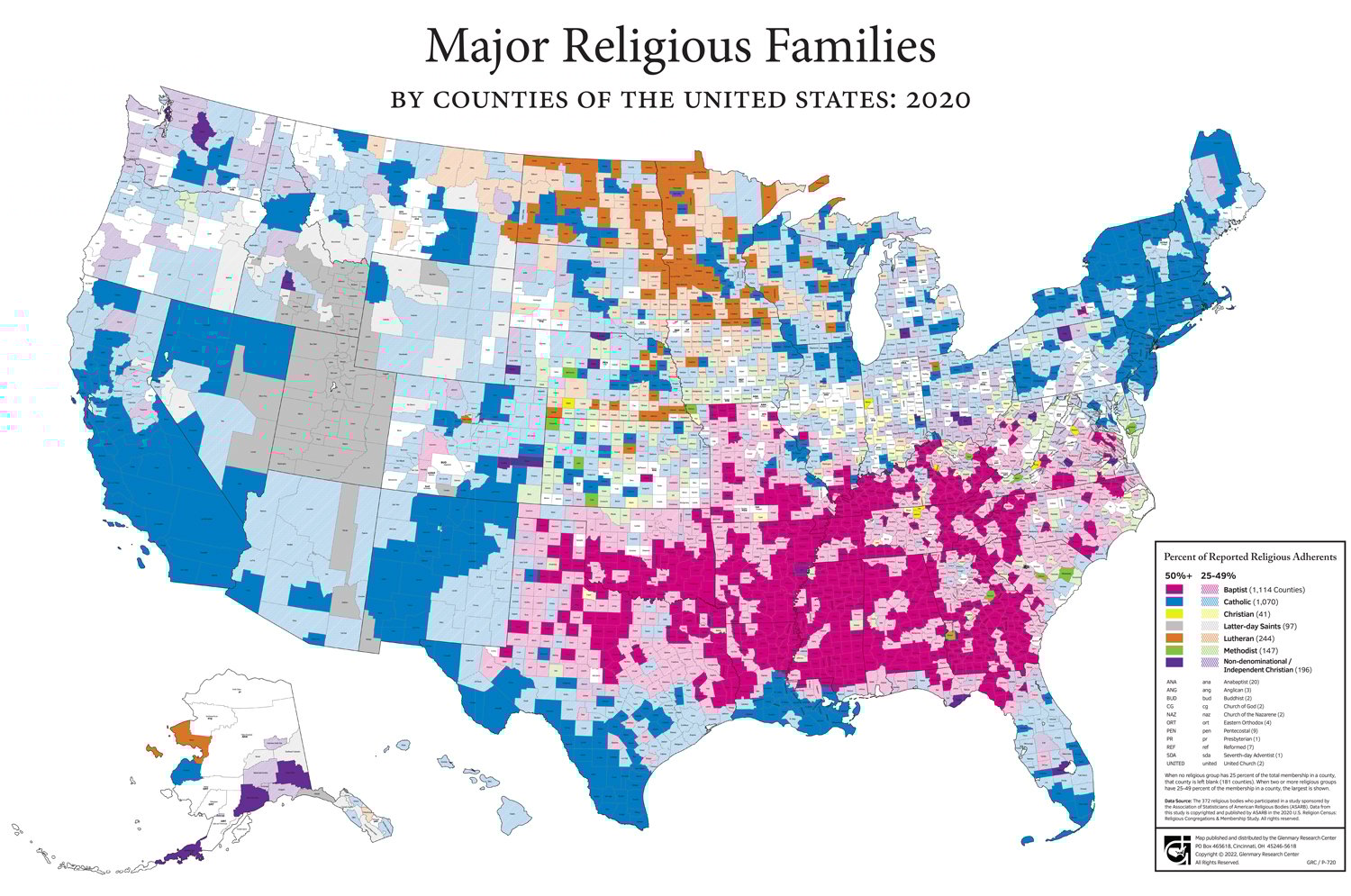
The U.S. Religion Census, conducted every 10 years by the Association of Statisticians of American Religious Bodies, concluded there were 356,739 religious congregations across the nation, and 161 million adherents, including children, in 2020. (Adherents is the formula researchers used to count those with an affiliation to a congregation, including children and people who attend but may not belong.)

Unlike polling, which asks questions from a small sample of the population and extrapolates to the general population, the religion census gathers information from denominations and other religious bodies and maps out the number of congregations and adherents on a county-wide basis. In the 2020 study, researchers collected data from 372 religious bodies, mostly denominations, but also 44,000 independent nondenominational churches. The count included synagogues, mosques and temples of Jewish, Muslim, Buddhist, Hindu, Sikh and Jain traditions

Courtesy Chart

Courtesy Chart

The study finds that the Catholic Church in the U.S. is the largest religious body, with 61 million adherents in more than 19,000 churches, comprising close to 19% of the U.S. population. That’s a modest growth of 2 million adherents from 2010, when the church had nearly 59 million adherents.

Sociologist who worked on the census said growth is almost entirely made up of Hispanic immigrants.

“If you took away the Hispanic population in the Catholic Church, it would look as bad as mainline denominations,” said Scott Thumma, director of the Hartford Institute for Religion Research, who counted independent churches for the census. (Mainline denominations, such as Episcopalian, Lutheran and Presbyterian, have been declining for more than 50 years.)

Perhaps the most striking growth was among Muslims. The number of Muslims who participate in mosque prayer increased from 2.6 million in 2010 to 4.5 million in 2020, a 75% increase. (Pew Research estimates there were 3.85 million Muslims in the U.S. in 2020, but those numbers do not include children.)

That growth is due mainly to immigration, said Ihsan Bagby, associate professor of Islamic Studies at the University of Kentucky, who collected the data for Muslims. Higher birth rates may be a secondary reason.

Bagby estimated the number of U.S. mosques at 2,771, a jump of 871 mosques in just a decade.

He suggested Muslims may be in a kind of golden age in the U.S. They are younger than the American population overall, and the Boomers among them are financially well off and able to contribute to the construction of new mosques. (First-generation mosques were often in retrofitted churches or warehouses.)

Mosques, Bagby said, “have mellowed and matured and become more moderate in their understanding of Islam and that has also been an attraction,” he said. “Many Muslims who had kept away feel more comfortable coming.”

Courtesy Chart

Courtesy Chart

U.S. mosques, like those overseas, do not typically keep memberships. Bagby said he arrived at his estimates by asking for information on weekly Jumah prayers as well as holiday or Eid prayers. (Muslims make up about 2.8% of all religious adherents and about 1.3% of the total population, the study estimates.)

Much of the value of the census is its county-level aggregation, which corresponds to how researchers in other fields, such as population studies and public health, collect and analyze data, said Rich Houseal, secretary-treasurer of the sociological group that conducted the study.

Houseal said the data is also useful to businesses, too. Walmart, he said, has contacted him to help determine what books to stock in their stores based on the dominant religious group in a county.

Among other interesting data points in the study:

  • Southern Baptists have the most churches of any religious group: 51,379.

  • There are some 44,319 nondenominational churches, a jump of nearly 9,000 over 10 years ago, and about 9 million adherents. Still, overall, they account for only 13% of the total number of religious adherents in the U.S.
  • Southern Baptists and United Methodists each lost 2 million members from 2010 to 2020.

“Denominational brands have weakened, and divisions have increased over issues such as female clergy or sexual orientation, Thumma said. “This likely led some adherents to seek or even start new nondenominational churches.”

Source: Religious groups with immigrant members grew fastest over past decade

The Canadian census: A rich portrait of the country’s religious and ethnocultural diversity

More highlights from the StatsCan daily:

More than 450 ethnic or cultural origins were reported in the 2021 Census. The top origins reported by Canada’s population, alone or with other origins, were “Canadian” (5.7 million people), “English” (5.3 million), “Irish” (4.4 million), “Scottish” (4.4 million) and “French” (4.0 million).

In 2021, over 19.3 million people reported a Christian religion, representing just over half of the Canadian population (53.3%). However, this proportion is down from 67.3% in 2011 and 77.1% in 2001.

Approximately 12.6 million people, or more than one-third of Canada’s population, reported having no religious affiliation. The proportion of this population has more than doubled in 20 years, going from 16.5% in 2001 to 34.6% in 2021.

While small, the proportion of Canada’s population who reported being Muslim, Hindu or Sikh has more than doubled in 20 years. From 2001 to 2021, these shares rose from 2.0% to 4.9% for Muslims, from 1.0% to 2.3% for Hindus and from 0.9% to 2.1% for Sikhs.

Racialized groups in Canada are all experiencing growth. In 2021, South Asian (7.1%), Chinese (4.7%) and Black (4.3%) people together represented 16.1% of Canada’s total population.

The portrait of racialized groups varies across regions. For example, the South Asian, Chinese and Black populations are the largest groups in Ontario, while the largest groups are Black and Arab people in Quebec, Chinese and South Asians in British Columbia, and South Asians and Filipinos in the Prairies.

Source: The Canadian census: A rich portrait of the country’s religious and ethnocultural diversity

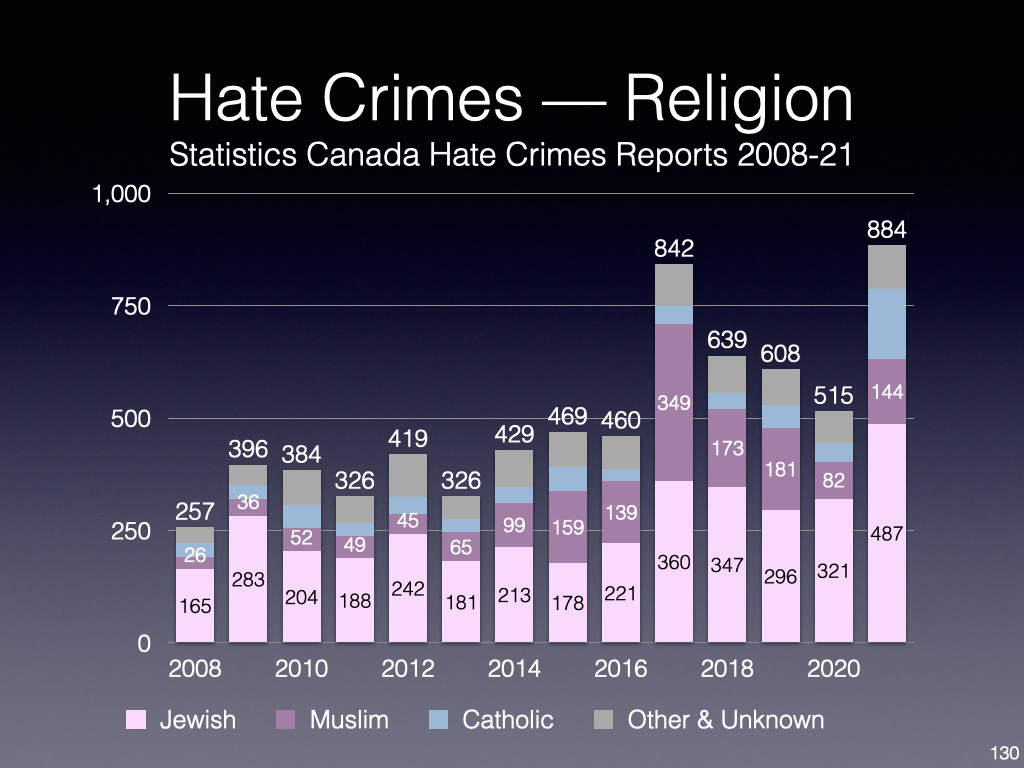
ICYMI: Douglas Todd: Hate crimes against Catholics almost tripled. Do Canadians care?

The Canadian Catholic church and its members, many of whom are Indigenous or immigrants, were last year buffeted by a horrendous 260 per cent spike in hate crimes.
Of note, from a small base of 42 in 2020 to 155 in 2021. Suspect largely due to the discovery of possible unmarked graves and greater attention to the Catholic Church’s involvement in residential schools:
Catholics were subject to a far higher escalation in police-reported hate incidents than any other religious or racial group, according to a Statistics Canada study.

Source: Douglas Todd: Hate crimes against Catholics almost tripled. Do Canadians care?

Toronto celebrates 50 years of Ismaili Muslim community in the city

One of the more successful communities in Canada, integrated while preserving their culture and identity:

She has been a lawyer, a manager of philanthropic foundations and a diplomat in Afghanistan, but Sheherazade Hirji has not forgotten that late afternoon nearly 50 years ago when she was a teenager with her family, making their way through menacing military checkpoints.

“There were lots of checkpoints and people were robbed and they would look into people’s bodies, women’s bodies under their saris, they would look everywhere,” she recalled.

Ms. Hirji and her family were heading for the airport in Kampala, Uganda’s capital. They were among the last to leave, part of the 80,000 residents of South Asian descent in the African country who were suddenly expelled in 1972 by the dictator Idi Amin.

More than 6,000 of them, members of the Ismaili Shia Muslim community, were able to resettle quickly in Canada, after their spiritual leader, the Aga Khan, called on his friend, then-prime minister Pierre Trudeau, to provide them with a haven.

Half a century later, standing by the landscaped lawn of Toronto’s Ismaili Centre, Ms. Hirji could contemplate the journey that led her community to become one of Canada’s great refugee success stories.

In the early days, she said, having few possessions and no place to practise their faith, newly arrived Ismailis in Canada would gather in basements, bringing sheets, so they could pray together. Later, they were able to rent school halls.

And now, on Sunday, prominent members of the community had been invited to a bright, spacious atrium at the Ismaili Centre, to hear Mayor John Tory announce that he had bestowed a Key to the City to the Aga Khan and renamed the street outside after the Ismaili imam.

The Ismailis, the mayor said, were part of a lineage of newcomers who had successfully built a new life in Canada, such as the Vietnamese, the Tamils and more recently Ukrainian refugees.

The honours for the Ismaili imam was “the least we could do,” Mr. Tory told the gathering, citing the extensive charities, schools and other philanthropic endeavours supported by the Aga Khan. He said he had been travelling in Pakistan in the wake of the 2013 earthquake and found that the Aga Khan’s humanitarian organizations were helping in the most remote villages.

The appreciation for the Aga Khan mirrored the goodwill accrued by the diligent, hard-working way the Ismailis had integrated into Canadian society. In 1972, the message from the imam to his faithfuls was to “make Canada your home and enrich Canada for the benefit of all Canadians,” Karim Thomas, vice-president of the Ismaili Council for Canada, said in an interview.

“We’ve been received by Canada and by Canadians with extraordinary warmth and with openness. … We’re very grateful for the opportunities that Canada has given us.

Behind the success story of the Ismaili refugees lay also the pain of their sudden expropriation and expulsion in Uganda, said Mahmoud Eboo, the Aga Khan Development Network representative to Canada.

“What people don’t appreciate is the shock and trauma that one undergoes when you suddenly hear overnight that all your possessions are gone. The businesses that you may have worked all your life for your family and your children are taken, your home that you’ve lived in is gone. … You have absolutely no idea what tomorrow will bring for you.”

South Asians had settled in Uganda and other British colonies in Africa since the 19th century. Ms. Hirji’s grandparents had moved from India, so she and her parents were born in Uganda. “I was the second generation born in Africa and so for us Uganda had always been home. It was the only home I ever knew.”

But the community’s prosperity also made it a scapegoat after Idi Amin took power in a coup d’état and ordered their expulsion.

Bringing only what they could carry in a suitcase, Ms. Hirji’s family landed first in Britain. They moved to social housing in Newcastle and her mother took a job in a factory manufacturing silverware.

She and her husband eventually settled in Canada, appreciating the country’s attitude toward diversity.

Canada’s diversity remains a crucial quality in the current circumstances, said Prince Amyn Aga Khan, the Ismaili’s leader’s younger brother, who represented the imam at the ceremony.

“His highness has looked at Canada as a model of pluralism,” he said, “one that is ever more critically, more urgently needed in our increasingly divisive and fragmented world.”

Source: Toronto celebrates 50 years of Ismaili Muslim community in the city

PEN Canada standing up for Salman Rushdie 30 years after ambitious plan to condemn Iran’s state-sanctioned act of terror against him

Good reminder of just how courageous Canadian political leaders, particularly Bob Rae then Premier of Ontario, were. British PM Thatcher was equally principle in providing Rushdie with protection despite his harsh criticism of her policies and reference to her as Mrs. Torture in Satanic Verses.

As noted before, I was posted to Tehran when the fatwa was issued and we were concerned that the Toronto event might impact our safety but fortunately it didn’t.

Proud of the Canadian leaders who stood up for free speech when many did not. Sharp contrast to some of the shallow and tendentious invocations of freedom and free speech that are all too common today:

Thirty years ago, PEN Canada, a non-partisan organization that supports freedom of expression in Canada and writers endangered around the world, staged an extraordinary coup in Toronto. Held in support of award-winning English novelist Salman Rushdie, it went on to have international ramifications – with this country at the root of it.

In 1992, Rushdie was in his fourth year of hiding, under constant police protection for fear of his life. Three years earlier, Ayatollah Khomeini of Iran had issued a fatwa calling for his murder, and the murder of those associated with his novel, The Satanic Verses. Khomeini claimed the novel insulted Islam, though his son admitted later that he never read it.

Internationally, political will to stand up to such an astonishing public threat against a private citizen of another country was sadly lacking. But no country was willing to act alone. Louise Dennys, then president of PEN Canada, told the head of the International Salman Rushdie Defence Committee that she believed Canada could break the impasse.

A handful of PEN members – Louise, with Ric Young, John Ralston Saul, Adrienne Clarkson, Marian Botsford-Fraser and Clayton Ruby – hatched an ambitious plan to persuade the Canadian government to condemn Iran’s state-sanctioned act of terrorism against Rushdie. The strategy: to use the annual PEN Canada Benefit to showcase public support for Rushdie in the country and galvanize the government in Ottawa to take the issue to the United Nations. They needed to bring Rushdie to Canada and draw intense media coverage.

This was no easy matter. It required absolute secrecy, the support of MI6 in Britain alongside CSIS and the RCMP in Canada, and a frantic last-minute search for means – ultimately, a private jet offered by an anonymous donor – to bring Rushdie across the Atlantic when the initial flight plan fell through.

Miraculously, they managed it. On Dec. 7, 1992, Rushdie appeared as a surprise guest on stage at the Winter Garden Theatre before an astonished audience of a thousand people. There was a collective gasp as the crowd rose to its feet in applause, even as they suddenly became aware of the 60-some security personnel present in the theatre, talking into their sleeves.

And then Bob Rae, premier of Ontario at the time, came on stage and embraced Rushdie, the first head of government anywhere to publicly stand with him. Rae called upon all governments to “do the right thing.”

It did not end there. The small delegation flew straight to Ottawa. Overnight, a morning press conference was convened. A few hours later, Barbara McDougall became the first secretary of state of any country to meet with Rushdie. Jean Chrétien, then the leader of the Official Opposition, walked him over to the House of Commons where he testified before the Parliamentary Sub-Committee on Development and Human Rights.

The result was electrifying. Within 48 hours, Canada became the first country in the world to pass a unanimous, all-party resolution condemning the Iranian government for its shameful record on human rights, demanding the withdrawal of the fatwa. Three months later, at the instigation of the Canadian government, the United Nations Commission on Human Rights in Geneva passed a resolution condemning Iran’s actions and calling for sanctions.

Remarkably – and sadly, given the cause – a full generation after the epochal 1992 benefit, the organization is again holding an event to stand with Rushdie after the horrific attack on him in August at the Chautauqua Institute, in upper New York State. Together with the Toronto International Festival of Authors, Penguin Random House Canada and the Writers Trust, PEN Canada will hold a reading of Rushdie’s works on Sept. 27.

Thirty years ago, PEN Canada, a non-partisan organization that supports freedom of expression in Canada and writers endangered around the world, staged an extraordinary coup in Toronto. Held in support of award-winning English novelist Salman Rushdie, it went on to have international ramifications – with this country at the root of it.

In 1992, Rushdie was in his fourth year of hiding, under constant police protection for fear of his life. Three years earlier, Ayatollah Khomeini of Iran had issued a fatwa calling for his murder, and the murder of those associated with his novel, The Satanic Verses. Khomeini claimed the novel insulted Islam, though his son admitted later that he never read it.

Internationally, political will to stand up to such an astonishing public threat against a private citizen of another country was sadly lacking. But no country was willing to act alone. Louise Dennys, then president of PEN Canada, told the head of the International Salman Rushdie Defence Committee that she believed Canada could break the impasse.

A handful of PEN members – Louise, with Ric Young, John Ralston Saul, Adrienne Clarkson, Marian Botsford-Fraser and Clayton Ruby – hatched an ambitious plan to persuade the Canadian government to condemn Iran’s state-sanctioned act of terrorism against Rushdie. The strategy: to use the annual PEN Canada Benefit to showcase public support for Rushdie in the country and galvanize the government in Ottawa to take the issue to the United Nations. They needed to bring Rushdie to Canada and draw intense media coverage.

This was no easy matter. It required absolute secrecy, the support of MI6 in Britain alongside CSIS and the RCMP in Canada, and a frantic last-minute search for means – ultimately, a private jet offered by an anonymous donor – to bring Rushdie across the Atlantic when the initial flight plan fell through.

Miraculously, they managed it. On Dec. 7, 1992, Rushdie appeared as a surprise guest on stage at the Winter Garden Theatre before an astonished audience of a thousand people. There was a collective gasp as the crowd rose to its feet in applause, even as they suddenly became aware of the 60-some security personnel present in the theatre, talking into their sleeves.

And then Bob Rae, premier of Ontario at the time, came on stage and embraced Rushdie, the first head of government anywhere to publicly stand with him. Rae called upon all governments to “do the right thing.”

It did not end there. The small delegation flew straight to Ottawa. Overnight, a morning press conference was convened. A few hours later, Barbara McDougall became the first secretary of state of any country to meet with Rushdie. Jean Chrétien, then the leader of the Official Opposition, walked him over to the House of Commons where he testified before the Parliamentary Sub-Committee on Development and Human Rights.

The result was electrifying. Within 48 hours, Canada became the first country in the world to pass a unanimous, all-party resolution condemning the Iranian government for its shameful record on human rights, demanding the withdrawal of the fatwa. Three months later, at the instigation of the Canadian government, the United Nations Commission on Human Rights in Geneva passed a resolution condemning Iran’s actions and calling for sanctions.

Remarkably – and sadly, given the cause – a full generation after the epochal 1992 benefit, the organization is again holding an event to stand with Rushdie after the horrific attack on him in August at the Chautauqua Institute, in upper New York State. Together with the Toronto International Festival of Authors, Penguin Random House Canada and the Writers Trust, PEN Canada will hold a reading of Rushdie’s works on Sept. 27.

Source: PEN Canada standing up for Salman Rushdie 30 years after ambitious plan to condemn Iran’s state-sanctioned act of terror against him

Serwer: The Right to Free Speech Is Not the Right to Monologue

Good and thoughtful commentary:

In august, the author Salman Rushdie was stabbed in the neck. The novelist has spent decades living under the threat of a hit put out by Ayatollah Ruhollah Khomeini in 1989. The religious directive was a response to Rushdie’s novel The Satanic Verses, which Khomeini regarded as blasphemous. For many, the attack was an opportunity to reflect on the importance of free expression, and a reminder of the clear distinction between speech and violence.

For others, it was an opportunity to remind others of the clear distinction between speech and violence, which is something that all those snowflake libs, who are sort of like the fanatic who stabbed Rushdie in the neck, should take to heart.

“We live in a culture in which many of the most celebrated people occupying the highest perches believe that words are violence,” Bari Weiss wrote on her Substack, citing no one in particular. “In this, they have much in common with Iranian Ayatollah Ruhollah Khomeini.” She added that “of course it is 2022 that the Islamists finally get a knife into Salman Rushdie. Of course it is now, when words are literally violence and J.K. Rowling literally puts trans lives in danger and even talking about anything that might offend anyone means you are literally arguing I shouldn’t exist.”

As an outlet, The Atlantic attempts to provide readers with a broad spectrum of perspectives based on shared values. One of these values is freedom of speech, a principle to which I and all of my cherished colleagues are deeply committed. The assassination attempt on Rushdie was a direct attack on that freedom, and it should be no surprise that writers here have a great deal to say about it. But I must respectfully disagree with some of my colleagues about the conclusions they have drawn from the attack, linking contemporary left-wing discourse with a fundamentalist theocrat’s call for assassination.

My colleague Graeme Wood pointed to Jimmy Carter’s 1989 op-ed criticizing Rushdie to argue that “over the past two decades, our culture has been Carterized. We have conceded moral authority to howling mobs, and the louder the howls, the more we have agreed that the howls were worth heeding.” He acknowledged, however, that “since the attempt on Rushdie’s life, almost no one has advanced these arguments,” meaning a link between the emotional injury of blasphemy and the very literal violence of murder. If our society were truly “Carterized,” I would have expected instead to have seen some prominent American figures make the argument Carter did decades ago.

Another one of my colleagues, Caitlin Flanagan, settled for an exegesis of the views of the Twitter user @MeerAsifAziz1, whose account no longer exists. She argued that “the culture of free speech is eroding every day,” and offered a hypothetical example: “Ask an Oberlin student—fresh outta Shaker Heights, coming in hot, with a heart as big as all outdoors and a 3 in AP Bio—to tell you what speech is acceptable, and she’ll tell you that it’s speech that doesn’t hurt the feelings of anyone belonging to a protected class.”

I’ll make no secret that I believe the focus on the misguided egalitarianism of undergraduates at private colleges has been disproportionate. People like this exist, though, and it’s fair to criticize them. What I frankly find puzzling is presenting this hypothetical student as the avatar of the idea that dangerous speech and ideas must be suppressed, when in statehouses and governors’ mansions, politicians who have the authority to enforce their ideas about censorship with state power are actually putting them into practice. Unlike the hypothetical Oberlin student, these officials are real, and the threat they pose to free speech is not only clear and present, but backed by a certain level of popular demand.

I agree with Weiss and Wood and Flanagan that there is a bright line between speech and violence that must be respected, and that trying to kill someone for offending you is monstrous. Speech is not violence, and to argue so is to imply that violence is an appropriate response. The unacknowledged reality of these three essays, however, is that what I just stated remains the broad, widely held consensus in American life, from right to left. Americans simply do not live under anything resembling the kind of repression in which people are killed for blasphemy with state or popular support.

Weiss, Wood, and Flanagan also noted the objection of a group of writers and thinkers to the PEN association bestowing an award on Charlie Hebdo, the French satirical publication that terrorists attacked in 2015 over its caricatures of the Muslim prophet Muhammad, murdering 12 people, including several staff members, police officers, a maintenance worker, and someone who was visiting that day. The letter signers described the massacre as “sickening and tragic” while criticizing PEN for “valorizing selectively offensive material: material that intensifies the anti-Islamic, anti-Maghreb, anti-Arab sentiments already prevalent in the Western world.”

Weiss attacked the “civic cowardice” of those who objected, while Flanagan wrote that these writers were pressuring the organization to “abandon its mission” of protecting freedom of expression. Wood described the writers’ position as muddling “the distinction between offense and violence, and between a disagreement over ideas and a disagreement over whether your head should remain attached to your body.”

I would not have signed that letter if asked, not only because I do not sign open letters, as a matter of preference, but because I believe that blasphemy is a human right, and that the message that PEN was sending with the award was an endorsement not of Charlie Hebdo’s content but of the staff’s bravery in the face of an attempt to silence them through murder. But just as I have no objection to the award, I have no issue with people criticizing it because they do not want it to be interpreted as an endorsement of the racist caricatures Charlie Hebdo is known for, even accepting that they are intended with a layer of irony. (I’m not sure how many of the people disseminating these images are aware of the irony.) These may be mutually exclusive positions, but both are consistent with respecting free speech. Indeed, both the writers of the letter and its critics are arguing that there are things you can say but should not.

One of the significant measures of free speech in a given society is how people deal with blasphemy—whether religious offense provokes state censorship or violence. America has a relatively strong record in that respect in comparison with much of the rest of the world, while clearly faltering in others. The suggestion here, however, is that the writers who objected to the award granted to Charlie Hebdo are in some sense justifying the massacre, and therefore defending the notion that violence is an appropriate response to offensive speech. But surely one can defend the right of Nazis to publicly protest while rejecting the tenets of national socialism. If I cannot defend the fundamental right of a speaker to be offensive while objecting to their speech, then what am I actually defending?

In this case, the rights being asserted seem to be the right to be offensive, and the right of the offended to shut up and like it. The former combined with the latter is not an assertion of the right to free speech so much as a right to monologue, which I do not recognize.

The American culture of free speech is indeed under threat, as Flanagan argued. Free speech requires a robust exchange of views without the coercion of threats and violence, and self-censorship in response to social pressure is a genuine risk. Yet by definition, there is no free speech if one person is allowed to make an argument and another is not allowed to object to it. Nor has there ever been a time in American history when freedom of speech was not threatened with proscription by the state, or when one could express a controversial opinion and not risk social sanction. In short, the culture of free speech is always under threat.

In almost every era of U.S. history, the bounds of free expression have been contested. In the founding era, patriots tarred and feathered royalists. Before the Civil War, southern states passed laws that could be used to prosecute the dissemination of abolitionist literature and sought to prevent the Postal Service from delivering antislavery pamphlets, saying they would foment insurrection by the enslaved. Mobs followed the abolitionist Frederick Douglass across the North, throwing rotten eggs, stones, and menacing slurs at the orator at speaking events.  After Reconstruction, white supremacists destroyed the office of Ida B. Wells’s newspaper, The Free Speech and Headlight, following the publication of an editorial arguing that lynchings of Black men accused of raping white women were in fact punishment for consensual relationships. The Red Scares of the 20th century saw Americans forced from their jobs and prosecuted for leftist beliefs or sympathies on the grounds that those were tantamount to a commitment to overthrowing the government. Out of that crucible emerged a civil libertarian concept of free speech that many have mistaken for timeless rather than a product of a certain history and a particular arrangement of political power. The idea that certain forms of speech or expression justify or provoke violence, let alone that blasphemy does so, is not an invention of modern social-justice discourse.

Every generation faces a different challenge when it comes to freedom of expression. Ours includes not only the widespread and growing campaign of state censorship led by Republican lawmakers, but a social-media panopticon that can both deny us the privacy necessary to come to our own conclusions and inhibit the courage necessary to express them. Most of us are not meant to be privy to every misguided utterance of a stranger, nor are we meant to have our errors or worst moments evaluated publicly by people who learned of our existence only as the focus of political propaganda, as the subject of ridicule, or as acceptable targets in pointless feuds between online cliques. (Although it must be said, there are those who thrive in such conditions, and have successfully exploited them for fame, profit, and status.)

Yet, as Aaron R. Hanlon recently wrote in The New Republic, this wave of censorship laws in Republican-controlled states bears scant mention among many of the most prominent self-styled defenders of free speech, or at least, far less than the tyranny of the ratio. But we do not become little Rushdies when our inboxes and mentions are inundated with deranged filth from disturbed strangers, as a result of the public-facing profession we chose and the technological advancements that make us more accessible to such people.

It is not minimizing the power of digital mobs to say that spending decades with the state-backed threat of an assassin’s blade at your throat is coercion of a different magnitude. The wrath of an online mob can be harrowing: harassment, outrageous falsehoods, and threats are not pleasant to bear, and can threaten not just your mental health but your livelihood, and in extreme cases your safety. To pretend that seeking to avoid such an experience does not condition what people say and how they act would be foolish. But to pretend that this is a left-wing ideological phenomenon rather than a structural one, when educatorsmedical providerselection officials, and others from all walks of life are being driven underground by right-wing influencers who can conduct a mob like an orchestra, would be equally foolish.

The United States is living through the largest wave of state censorship since the second Red Scare. Beyond the plague of education gag laws restricting the teaching of unpleasant facts about American history, conservative judges seek to rewrite constitutional free-speech protections to punish the “liberal” media, and conservative states pass laws against public protest and immunize from liability those who would run over protesters with their cars, while law-enforcement organizations hope to use civil lawsuits to sue demonstrations against police brutality out of existence. Conservatives have sought to fire librarians and purge public libraries of books they deem controversial by categorizing them as obscene, as state officials try to punish teachers who provide their students with public information that allows them to access samizdat from libraries in states where it is not forbidden. Not only do abortion bounty laws seek to enforce silence around reproductive health, lest a person discussing the subject prick the ears of some snitch seeking a payday, but the overturning of Roe has coincided with explicit attempts to criminalize speech about abortion. In the strongest labor market in a generation, billionaires seek to use their power and authority to crush workers organizing for better conditions and a living wage.

There is no shortage of major free-speech issues to address in America today, but many of us in the writing profession are primarily concerned with our social-media experience, because that is what we most directly and frequently encounter. Instead of recognizing that the warped behavioral incentives created by social media are a structural problem, we tend to blame the people online who annoy us the most. In many cases, those defending “free speech” are not defending freedom of expression so much as seeking the power to determine which views can be publicly expressed without backlash, and which can be silenced without reproach. When we speak of an idealized past without chilling effects, we are simply imagining a time when the social consensus was repressive and stifling for someone else.

These conflicts are far more complex precisely because there is no clear line where social pressure from those exercising their rights of free speech and association crosses over into censoriousness. State censorship and violent compulsion are relatively easy to identify and oppose, if not always easy to prevent. When does accountability become harassment? When does protest become coercion? What views should be acceptable to state in polite society, and which should be appropriately shunned by decent people? When does a voice of criticism become the howl of a mob? When does corporate speech become corporate censorship? No society in human history has ever had simple answers to these questions. In a free society, sometimes people will choose to be horrible, and there is little to do other than make a different choice and counsel people to do the same.

Presenting these dilemmas as similar to an attempt to silence someone with a theocratic death mark is trivializing, and ahistorical. There has never been a golden age when anyone could say what they wanted without consequence, only eras in which one shared perspective was dominant. Though nostalgia may cloud our perceptions, those times were no more free, even if politics, ideology, or self-promotion might compel us to remember otherwise.

Source: The Right to Free Speech Is Not the Right to Monologue

Tremblay: Le sang de Salman Rushdie

From Le Devoir film critic Odile Tremblay:

« Quand la superstition entre par la porte, le bon sens se sauve par la fenêtre », écrivait Salman Rushdie dans Les versets sataniques.

Ce livre, qui lui valut en 1989 la fatwa de l’anathème en Iran par la voix de l’ayatollah Khomeini appelant à son assassinat, le déchirera jusqu’au tombeau.

Survivra ? Survivra pas ? On aura suivi en quelques jours avec horreur la nouvelle de son assaut par un jeune Américain d’origine libanaise (dix coups de couteau) lors d’une de ses conférences dans l’État de New York, puis l’hospitalisation, l’évolution de son état de santé. L’écrivain indo-britannique s’en sort, mais risque de perdre un œil. Son cou, son bras, son foie sont en piteux état. Il parle un peu, plaisante ; trait d’héroïsme. On imagine sans peine les mois, les années de physio et de thérapies qui l’attendent avant le retour à un certain équilibre physique et psychologique. Philippe Lançon, l’auteur de l’immortel Lambeau, en a su quelque chose, lui qui traversa les affres de la réadaptation après avoir été grièvement blessé lors du massacre islamiste chez Charlie Hebdo.

Espérons que l’attentat contre Rushdie ne sera pas qu’un fait divers décrié par les grands de ce monde (pas tous) puis effacé au profit d’un nouveau scandale. En Iran, des fondamentalistes se réjouissent de son sort. C’est lui qui conservera le vrai pouvoir magique des mots.

Je l’avais interviewé il y a dix ans au Festival de Toronto, quand un film avait été tiré de son roman Les enfants de minuit. Il se disait lassé de revenir sur cette fatwa, qui fit de lui longtemps un reclus, un homme traqué. Dix ans d’escorte policière. Dix ans de fuites et de repaires secrets. Des autodafés du livre, des manifestations sanglantes, le meurtre du traducteur japonais des Versets sataniques, la peur et les cris étaient les jalons de son parcours. Puis vint une accalmie. « Il n’y a que les journalistes pour me demander si ma vie est encore en danger », s’irritait-il en 2012 d’un sourcil hérissé. Salman Rushdie se déclarait heureux depuis une décennie, enfin sorti de cette galère. Pensez-vous… On lui prédit d’autres gardes du corps, de nouvelles retraites. Il était déjà un symbole. Aujourd’hui… Un mythe sanglant.

Depuis l’attentat, tout le monde s’arrache ces Versets sataniques en version numérique. Dans les librairies, c’est la rupture de stock. Les lecteurs trouveront-ils sa prose difficile d’accès ? Près de 35 ans après son lancement, dans un monde où la facilité intellectuelle domine, l’œuvre d’un auteur exigeant et complexe risque d’en égarer plusieurs. Cette dérive-là, l’attentat contre Salman Rushdie nous la rappelle tristement aussi.

Ce roman, une brique touffue de 600 pages, ne tient pourtant pas de la provocation frontale. Tissé d’intrigues multiples sur les mille fléaux du monde, il aborde entre autres l’exode et l’exil, le racisme et la violence policière. Mais en quelques pages, au cours d’un épisode rêvé, le prophète Mahomet, sous le nom de Mahound, prenait des libertés face au dogme officiel. Un imam venait dévorer son peuple. Une jeune fille invitait des pèlerins à traverser à pied la mer d’Arabie, sur la foi du miracle. Rien pour appeler à la guerre sainte. Les imams qui hurlaient le plus fort au blasphème n’avaient guère lu le livre avant de sonner l’hallali, mais le titre du roman faisait déjà scandale.

Les écrivains, les journalistes, les artistes, champions de la liberté d’expression, sont des cibles à travers le monde, en Chine comme en Russie, au Moyen-Orient et ailleurs. Mais ils ne sont pas les uniques victimes de la barbarie. Des personnes parfois sans histoire se font blesser ou tuer pour des motifs religieux, politiques, pour leur couleur, leur genre, leur orientation sexuelle, un regard de travers, un territoire à soumettre par les armes ou parce qu’elles passaient dans le coin. Quant à l’intolérance, comment la résumer aux seules dérives islamiques ? Sur les réseaux sociaux, dans les rues, dans une Amérique déchirée et armée, l’obscurantisme et la pulsion de mort ravagent de concert les esprits.

Rushdie, écrivain athée de culture musulmane, me l’affirmait en substance : la bataille pour la liberté d’attaquer la religion a d’autres moteurs que le combat touchant les crimes raciaux, puisqu’elle touche au monde des idées. Reste que l’extrémisme à pourfendre naît sur bien des terrains, enfourchant les idées et les croyances comme les pulsions discriminatoires de tous acabits, des enjeux sanitaires, des mirages trumpiens, des rêves d’appartenance. La religion fanatisée constitue un vecteur de haine rouge, mais les motifs de polarisation violente sont devenus si nombreux et parfois si futiles qu’on n’aura jamais assez d’écrivains, même incompris, même ensanglantés, pour dénoncer la bêtise humaine qui fleurit partout.

Source: Le sang de Salman Rushdie

Atwood: If we don’t defend free speech, we live in tyranny: Salman Rushdie shows us that

I was in working at the Canadian Embassy in Tehran when Rushdie spoke in Toronto and appeared on stage with then premier Bob Rae. We were worried regarding potential fall-out and possible threats but fortunately none materialized. (I read The Satanic Verses in Tehran, adding another personal twist to my time there).

Usual trenchant commentary by Atwood:

A long time ago – 7 December 1992, to be exact – I was backstage at a Toronto theatre, taking off a Stetson. With two other writers, Timothy Findley and Paul Quarrington, I’d been performing a medley of 1950s country and western classics, rephrased for writers – Ghost Writers in the Sky, If I Had the Wings of an Agent, and other fatuous parodies of that nature. It was a PEN Canada benefit of that era: writers dressed up and made idiots of themselves in aid of writers persecuted by governments for things they’d written.

Just as the three of us were bemoaning how awful we’d been, there was a knock on the door. Backstage was locked down, we were told. Secret agents were talking into their sleeves. Salman Rushdie had been spirited into the country. He was about to appear on stage with Bob Rae, the premier of Ontario, the first head of government in the world to support him in public. “And you, Margaret, as past president of PEN Canada, are going to introduce him,” I was told.

Gulp. “Oh, OK,” I said. And so I did. It was a money-where-your-mouth-is moment.

And, with the recent attack on him, so is this.

Rushdie exploded on to the literary scene in 1981 with his second novel, Midnight’s Children, which won the Booker prize that year. No wonder: its inventiveness, range, historical scope and verbal dexterity were breathtaking, and it opened the door to subsequent generations of writers who might previously have felt that their identities or subject matter excluded them from the movable feast that is English-language literature. He has ticked every box except the Nobel prize: he has been knighted; he is on everyone’s list of significant British writers; he has collected an impressive bouquet of prizes and honours, but, most importantly, he has touched and inspired a great many people around the globe. A huge number of writers and readers have long owed him a major debt.

Suddenly, they owe him another one. He has long defended freedom of artistic expression against all comers; now, even should he recover from his injuries, he is a martyr to it.

In any future monument to murdered, tortured, imprisoned and persecuted writers, Rushdie will feature large. On 12 August he was stabbed on stage by an assailant at a literary event at Chautauqua, a venerable American institution in upstate New York. Yet again “that sort of thing never happens here” has been proven false: in our present world, anything can happen anywhere. American democracy is under threat as never before: the attempted assassination of a writer is just one more symptom.

Without doubt, this attack was directed at him because his fourth novel, The Satanic Verses, a satiric fantasy that he himself believed was dealing with the disorientation felt by immigrants from (for instance) India to Britain, got used as a tool in a political power struggle in a distant country.

When your regime is under pressure, a little book-burning creates a popular distraction. Writers don’t have an army. They don’t have billions of dollars. They don’t have a captive voting block. They thus make cheap scapegoats. They’re so easy to blame: their medium is words, which are by nature ambiguous and subject to misinterpretation, and they themselves are often mouthy, if not downright curmudgeonly. Worse, they frequently speak truth to power. Even apart from that, their books will annoy some people. As writers themselves have frequently said, if what you’ve written is universally liked, you must be doing something wrong. But when you offend a ruler, things can get lethal, as many writers have discovered.

In Rushdie’s case, the power that used him as a pawn was the Ayatollah Khomeini of Iran. In 1989, he issued a fatwa – a rough equivalent to the bulls of excommunication used by medieval and renaissance Catholic popes as weapons against both secular rulers and theological challengers such as Martin Luther. Khomeini also offered a large reward to anyone who would murder Rushdie. There were numerous killings and attempted assassinations, including the stabbing of the Japanese translator Hitoshi Igarashi in 1991. Rushdie himself spent many years in enforced hiding, but gradually he came out of his cocoon – the Toronto PEN event being the most significant first step – and, in the past two decades, he’d been leading a relatively normal life.

However, he never missed an opportunity to speak out on behalf of the principles he’d been embodying all his writing life. Freedom of expression was foremost among these. Once a yawn-making liberal platitude, this concept has now become a hot-button issue, since the extreme right has attempted to kidnap it in the service of libel, lies and hatred, and the extreme left has tried to toss it out the window in the service of its version of earthly perfection. It doesn’t take a crystal ball to foresee many panel discussions on the subject, should we reach a moment in which rational debate is possible. But whatever it is, the right to freedom of expression does not include the right to defame, to lie maliciously and damagingly about provable facts, to issue death threats, or to advocate murder. These should be punished by law.

As for those who are still saying, “yes, but …” about Rushdie – some version of “he should have known better”, as in “yes, too bad about the rape, but why was she wearing that revealing skirt” – I can only remark that there are no perfect victims. In fact, there are no perfect artists, nor is there any perfect art. Anti-censorship folks often find themselves having to defend work they would otherwise review scathingly, but such defending is necessary, unless we are all to have our vocal cords removed.

Long ago, a Canadian member of parliament described a ballet as “a bunch of fruits jumping around in long underwear”. Let them jump, say I! Living in a pluralistic democracy means being surrounded by a multiplicity of voices, some of which will be saying things you don’t like. Unless you’re prepared to uphold their right to speak, as Salman Rushdie has done so often, you’ll end up living in a tyranny.

Rushdie didn’t plan to become a free-speech hero, but he is one now. Writers everywhere – those who are not state hacks or brainwashed robots – owe him a huge vote of thanks.

Source: If we don’t defend free speech, we live in tyranny: Salman Rushdie shows us that

How a Quebec student’s hijab became the target of a political and cultural storm

Groundhog Day…

The photograph on the Montreal business school’s website was intended to demonstrate a young woman’s possibility and her academic success.

“A rewarding international presence,” reads the blurb beside the photo, written in a black font to match the black cloth hijab wrapped around the head and neck of the woman’s smiling face.

There is not much more that would stand out as unusual in the promotional image of the Algerian exchange student at the HEC Montréal — an image the school uses to tout its international programs, a deep and important revenue stream for the institution, as it is for most other Canadian universities.

But when Jean-François Lisée, a prominent Quebec academic, writer and former politician, viewed the image last weekend, he saw it not as a ploy by a public institution in search of private funds.

Instead, the former leader of the sovereigntist Parti Québécois flared at what he took to be a breach of the secular codes that Quebec governments have been trying to establish over the past two decades to separate religion and the state.

Those efforts culminated in 2019 with the passage into law of Bill 21, which enshrines state secularism, mainly by banning public-sector workers from wearing items of religious clothing or decoration, including crucifixes, turbans and hijabs, while at work.

“University students can display their convictions, religious or not,” Lisée wrote on Twitter. “But for a public institution that is by definition secular, pro-science and pro-gender equality to normalize a misogynistic religious sign in an ad is unacceptable.”

The rebuke from a man who has straddled Quebec’s media and political realms for more than 40 years cast the province back into a fraught debate that it cannot seem to resolve.

Increasingly present in the form of turbans, hijabs and kippahs, at least in part due to immigration patterns in the province, many of Quebec’s white, francophone majority would apparently prefer that religion be neither seen nor heard from in the public sphere.

But each instance of religion rearing its head, reigniting the debate over the place of religious expression in a secular society, is like a freshly formed scab over a cut that is pulled away, exposing the wound to the sting of fresh air.

Kimberley Manning calls them “moments of punctuation” that revive the frequently noxious debate that, in her opinion, risks revictimizing religious minorities in Quebec.

“They contribute to and exacerbate an ever-present experience of not being fully Quebeckers,” says the associate professor of political science at Montreal’s Concordia University. “This is what seems to be coming through in the polling and the research.”

Manning has done her own work, notably a March study of students that found feelings of discrimination that respondents linked to the province’s secularism law.

A more extensive study of Bill 21’s impacts in Quebec, released this week, contends that the law has created a frightening, oppressive and grim environment for religious minorities.

In surveys, Jews, Sikhs and Muslims reported a deterioration in their likelihood to participate in social and political life in the province, in their sense of personal safety, and in their confidence for future prospects.

“(The law) promises all kinds of very noble values, and when we measured those up against the results in the study, we see that it doesn’t achieve those values of neutrality, equality and social harmony,” says Miriam Taylor, director of publications and partnerships with the Association of Canadian Studies.

What the law — most any law — does do is normalize and concretize the biases which underpin it, Taylor says.

Survey respondents said they had experienced a rise in verbal abuse, threats and physical confrontations since the law was adopted.

This jibes with anecdotal evidence and a general sense of uncertainty and anxiety in Quebec’s Muslim communities, says Lina El Bakir, Quebec Advocacy Officer for the National Council of Canadian Muslims.

“When you set out a law that is discriminatory, you allow that to permeate society and people’s views,” she says.

“It affects mental health, it affects security, it affects the ability to just be, you know?”

Lisée, who declined an interview request, said in his criticisms that his beef was not with the Algerian exchange student in the hijab, but with the business school.

The website content in question does not breach any aspects of the provincial law, but he said it sends a message to young Algerians standing up to the pressure of imams and fundamentalists that the school “is not your ally.”

An HEC Montréal spokesperson says the only goal of the image was to show off the diversity of its student body, which includes 3,746 international students from 142 countries. The image will come down from the site next week — not because of Lisée’s indignation but because that’s when its previously scheduled two-week publication run ends.

That may come as a relief to the student, who came to Montreal to obtain a business degree and now finds herself in a debate that is part polisci, part sociology — one that has been going on so long that at least part of it belongs to the annals of history.

Speaking to La Presse columnist Rima Elkouri, the 22-year-old, who declined the Star’s interview request, explained she was initially nervous about coming to study in Canada. She had heard about the killing of four members of the Afzaal family of London, Ont., who were run down by the driver of a pickup truck on June 6, 2021, in what police allege was a hate-motivated attack.

But, Nouha, who was identified only by her first name, said she quickly warmed to her new home in Montreal.

“I have never suffered from discrimination or a lack of respect,” she told the Montreal newspaper.

She said that wearing the hijab was a personal decision, not one forced upon her by her family, though she acknowledged the women who have no choice in the matter.

“I’m against that,” she said, adding that she considers herself a feminist.

“I’ve never found (the hijab) to be a symbol that diminishes the value of a woman. Personally, I consider myself to be a very strong woman. In a few years, I’ll be managing a team of workers. I can’t afford to see myself as a weak person.”

She also said she acknowledges and understands the principles of secularism in Quebec.

“I understand that the school must be truly neutral. But from my point of view, it’s also important to display people from minority groups because those minorities look for a place where they feel at peace.”

The issues on display are not going away.

Before the end of the month, Quebec will be into a provincial election campaign and parties have often fallen back on identity issues to stir up the passions of their voters.

Taylor said she worried about the negative consequences of a campaign in which religion and secularism, majority views and minority rights were “instrumentalized for political gain.”

Before the end of the year, Quebec’s court of appeal is expected to hear a legal challenge to Bill 21. And in Ottawa, Justin Trudeau’s Liberal government has already promised to challenge the provincial secularism law at the Supreme Court.

Taylor’s study found that support for the law among Quebeckers would drop considerably if the Supreme Court ruled that it violated the Constitution.

This bolsters El Bakir’s contention that Quebeckers, like other Canadians, value human rights, despise discrimination and strive for equality.

But she reverts to her native French, and invokes the most Quebecois of expressions, to explain that an older segment of the Quebec population support secularism because they remember when the Catholic Church exerted strict control over all aspects of the province —from schools to hospitals to politics to family life.

“It doesn’t take the head of Papineau!” she says, in reference to Louis-Joseph Papineau, a leader of the rebel Patriote movement in 19th century Lower Canada who was reputed for his intelligence.

“I do understand where older generations are coming from, however societies evolve and we need to understand that realities do change, and one narrative doesn’t always apply.”

Source: How a Quebec student’s hijab became the target of a political and cultural storm