Harper policies undermine deradicalization

Reminder by Faisal Kutty of the complexities of combatting radicalization and how much of it depends on debate and discussion within the Muslim community, and how Government actions can undermine such efforts:

Radicalization must be confronted without undermining social cohesion, violating human rights and deviating from core democratic ideals.

The heavy lifting in this Herculean project must be borne by Muslims, who to their credit have repeatedly condemned violent extremism in the strongest of terms even before 9/11. In fact the National Council of Canadian Muslims NCCM recently even came out with a handbook titled “United Against Terrorism.”

However, more must be done to challenge some of the existing narratives fueling cognitive radicalization. Imams must be more proactive in undermining some of the classical texts glorifying violence and martyrdom, by emphasizing the ethical/peaceful vision of the Quran. This can only be done by deconstructing and better contextualizing the violent rhetoric in some of the Prophetic teachings and juristic interpretations adopted uncritically by too many. Parroting that Islam means peace is not enough. Teachings that may serve as the springboard to violent radicalism must be confronted head on. Such efforts must be internally driven. Any government meddling will only backfire.

Some souls may be forever lost, but this will help redirect the younger ones.

…It [the Harper Government] has ignored the death and devastation unleashed on Muslims around the world, be it through direct attacks or the unconditional support of our allies. At the domestic level Harper has targeted the community by going after its charities and organizations (defaming NCCM for instance), and even religious symbols. These play into the hands of Islamophobes and extremists alike. Ottawa is now busy tightening the already draconian anti-terror laws (preventive detention), introducing new hate laws restricting speech, amending the CSIS Act, etc. These will initially affect Muslims (as noted by leading former jurists last week) disproportionately but will eventually impact all Canadians.
Harper policies undermine deradicalization | Toronto Star.

ICYMI: Getting information on the ground on the Islamic State

Fascinating reporting in the Globe of some of the efforts to collect information on war crimes and other human rights violations:

There are risks, however, that come with sending investigators into a combat zone with armed opposition groups. Some outside observers worry about the reliability of the embedded investigators, in part because there is always a risk they could become involved in wartime atrocities themselves.

Documentation collected now could be dismissed by a future war crimes tribunal for multiple reasons. Questions about the investigators’ methods, issues with the way witnesses are interrogated, and errors in tracking custody of documents that are retrieved are all issues that could be picked apart by a defence team.

But many observers seem to believe the benefits of running an investigation now – rather than waiting until the conflict is over – far outweigh the risks.

Independent groups like the one investigating Islamic State also have a higher tolerance for risk than the more formal investigation by the United Nations commission of inquiry on Syria, which has produced reports on atrocities but is not focused on linking specific crimes to the individuals who may have ordered them.

“There is going to be an immense security challenge once the conflict ends,” one investigator said. “If the Syrians don’t want to endure a decade or more of terrorism, as experienced by Iraq, they’re going to need a security foundation, and that foundation will be built on information derived from investigations now.”

Getting information on the ground on the Islamic State – The Globe and Mail.

Don’t Overreact, Canada – Patriquin

Martin Patriquin on the risks of over-reaction:

Canadians need only look to the south to see how attacks on individuals and establishments can’t usually be prevented by increased surveillance of a country’s civilians. The United States arguably is home to the world’s largest and most sophisticated intelligence-gathering network, the excesses of which have been documented by leaks from the former National Security Agency contractor Edward J. Snowden.

Yet none of this prevented the breach of the White House in September, in which an Iraq war veteran scaled the White House fence and made it to within feet of where the president and his family live before being apprehended. Nor has surveillance hindered the ability of various gunmen to inflict mass murder on innocents throughout the years. As the former Vice President Al Gore noted last year, in a speech decrying the folly of such mass intelligence gathering, “When you are looking for a needle in a haystack, it’s not always wise to pile more hay on the haystack.”

Theoretically, it would be possible for the Canadian government to legislate itself the powers to prevent all such attacks. Yet the trade-off — constant surveillance, criminalization of dissent, restriction of free movement and the economy — would make the country unlivable. It would be a travesty if the actions of two troubled individuals moved the country closer to that possibility.

Don’t Overreact, Canada – NYTimes.com.

Ottawa students use satire to battle ISIL and highlight plight of Arab women with video

One of the better examples of grass-roots efforts to create a radicalization counter-narrative, and a funny parody of Apple ads in the ISIS context (watch the video report – 2 minutes):

Inspired by Jon Stewart’s Daily Show and John Oliver’s Last Week Tonight, the trio and half a dozen occasional cast members are attempting to bring satire into places and minds that have never experienced it.

“We are trying to take the best of this world and introduce it to the Middle East and bring the best of the Middle East and introduce it to this world,’ says Barghouthi, a Carleton University biology student.

Prime among the trio’s target audience are Canadian Muslims in their own age group – the same young western Muslims that ISIL has in its sights.

“ISIS has been able to get wide attention across the world by using very slick videos made by highly qualified people,” says Marwah. “By making people laugh we hope our message will sink in.“

“Our message to young Muslims is that ISIS is using Islam in a sick way – using it as an excuse to kill people,” says Carleton political management student Marwah. “They are going after your emotions. Canada is a beautiful country, don’t let this stuff spoil it for you.”

Marwah says he has seen no evidence in his circle of friends that the ISIL message is resonating.

“For all of us, I think to know that someone would want to kill people in the name of our religion is frustrating,” he says.

Ottawa students use satire to battle ISIL and highlight plight of Arab women with video | Ottawa Citizen.

How to prosecute radicalized Canadians a quandary, Senate group hears | Ottawa Citizen

The challenges of prosecuting radicalized Canadians and Government messaging of note from Senator Beyak:

“The legitimate investigation by the police of those individuals does not necessarily coincide at this moment in time to there being that many cases that are ready to go for charges.”

He and Saunders then detailed how seven Canadians, including five initial suspects in the Toronto-18 terror case, have been placed on peace bonds, court orders that restrict the movement of people not found guilty of an offence but deemed a risk to others. They also mean stiffer sentences for someone if later found guilty of a crime.

But even that power is limited, according to police. RCMP Commissioner Bob Paulson, speaking before the committee last week, complained that the legal threshold for obtaining peace bonds needs to be lowered to a “reasonable suspicion.”

Saunders later added that gathering evidence against suspected Canadian overseas fighters who have returned to Canada is even more difficult.

“It’s a challenge the police face, to gather evidence for activities that people may have been engaged in while they’re overseas in countries where it’s difficult for our authorities to have access to,” he said.

He added: “We have to prove that somebody is guilty beyond a reasonable doubt, that will not be changed.”

After more than an hour of committee questioning, Sen. Lynn Beyak’s frustrations boiled over.

Canadians “don’t want to hear us talk, they don’t want to hear 1,000 reasons why we can’t solve this problem,” she told the witnesses.

“They want us to put our collective heads together and find a way to protect the rights of 35 million Canadians instead of the rights of 90 or 93 or 130 individuals.

“There has to be a better way for Canadians then to just listen to us talk and the problem gets worse.”

Part of the trade-off with the rule-of-law that the Government so often cites as one of the key Canadian values along with freedom, democracy, and human rights.

How to prosecute radicalized Canadians a quandary, Senate group hears | Ottawa Citizen.

Deradicalization programs aim to get ahead of the curve in stopping extremists

Good overview on various deradicalization programs (and the absence of Canadian ones), and the challenge of measuring their effectiveness:

While there is greater interest in deradicalization programs, questions remain about their effectiveness.

McCants at the Brookings Institution acknowledges that the Saudi program has had some success in turning detainees into productive members of society, but “whether they’ve left the ideology behind is a harder question to answer.”

The Saudi government has acknowledged some of the graduates of its deradicalization program have returned to extremist activity, including one who became deputy commander of al-Qaeda in the Arabian Peninsula.

Brian Jenkins, a counterterrorism expert at the Rand Corporation, says that while a lot of things are being tried, the success of deradicalization strategies is notoriously difficult to measure.

According to a story published in the Christian Science Monitor in July, Hayat Berlin had steered 20 individuals from fighting in Syria. But even if they had proceeded to the front lines, it doesn’t necessarily mean they would have returned to wage attacks at home.

“Is there some comparative statistic that says, does this particular technique work, did that particular technique work? I havent seen anything that tells me that,” says Jenkins. “The statistics aren’t there.”

Part of that may be deliberately hedging on the part of the governments involved, says Jenkins, but it also reflects the fact that while its easy to keep statistics on criminal incidents, “its hard to count things that don’t occur.”

Deradicalization programs aim to get ahead of the curve in stopping extremists – CBC News – Latest Canada, World, Entertainment and Business News.

Harper’s silence on anti-Muslim backlash disheartens Muslim groups

They have a point. Silence from the top speaks:

Muslim groups have condemned the killings and the extremist beliefs which apparently motivated them. But they say their efforts to demonstrate that most Muslims do not share those beliefs and to show solidarity with non-Muslim Canadians need to be reinforced by political leaders, particularly the prime minister.

“We are trying to work together with our law enforcement and our authorities to end this what is called radicalization of youth. We are trying to do our utmost to help,” said Mostefa.

But when political leaders denounce Muslim extremists but don’t come to the defence of moderate Muslims, Mostefa said young Muslims will think: “This is my country and you don’t come to my support to stand by my side.”

And that sends “the wrong message.”

….. “Our leaders have a very important role to play,” concurred Amira Elghawaby, human rights co-ordinator for the National Council of Canadian Muslims.

“It’s the leaders who have to set the positive tone.”

Immediately following the 9-11 terrorist attacks in New York and Washington, Elghawaby noted that then-prime minister Jean Chretien visited a mosque “just to show Canadians that there’s no such thing as collective guilt.”

She said her group expects Harper, “as leader of our country, to speak up for the minorities that live here.”

“He has a responsibility to represent everyone and certainly Canadian Muslim communities are extremely worried about a backlash and I think that needs to be spoken to.”

Alia Hogben, executive director of the Canadian Council of Muslim Women, said it’s “very disheartening” that Harper has not bothered to speak out against the anti-Muslim backlash. But it’s not surprising to her.

“I don’t think he much likes Muslims,” Hogben said.

Canada is a multicultural country with over 1 million Muslims, most of whom are Canadian citizens whose religion is only part of their identity, she pointed out.

“I think it’s absolutely vital that the head of the country, like the prime minister, would accept that and also somehow reinforce it and reassure people.”

Asked why Harper has not specifically denounced any of the recent anti-Muslim incidents, the prime minister’s spokesman Jason MacDonald said: “These acts are obviously unacceptable.

Contrast this to any number of statements and the like on antisemitic incidents.

Harpers silence on anti-Muslim backlash disheartens Muslim groups.

Was it ‘terrorism’? We need answers, not labels – Globe Editorial

Good editorial in the Globe on the need to avoid simplistic labels:

The debate – terrorism or not? – isn’t particularly useful. It takes a complex issue and tries to reduce it to a label. It short-circuits an honest inquiry into questions that demand answers: Why did these men do what they did? And what can be done to reduce the likelihood of future attacks? Invoking the threat of terrorism may also lower public resistance to new security measures that wouldn’t otherwise be acceptable, such as making it easier for police to detain people suspected of being sympathetic to terrorist groups or ideas. Or, as Justice Minister Peter MacKay mused publicly this week, making it a criminal offence to “glorify” terrorist groups or activities, a law adopted by the British that has been highly controversial and almost never used.

Everyone can agree that the Ottawa attack was criminal. And leaving it at that leaves the door open to deeper thought: How do we monitor people before they suddenly commit a crime? Should we monitor some people more closely? How much evidence should be required to monitor or detain? And was Mr. Zehaf-Bibeau’s attack driven above all by long-standing mental health issues rather than a long-held ideology? If so, why wasn’t he able to get help? How did he get his hands on a rifle? Are guns properly secured in Canada?

Canadians need to ask every imaginable question about what happened in Ottawa. A fight over labels gets in the way of an honest search for answers and solutions.

Was it ‘terrorism’? We need answers, not labels – The Globe and Mail.

Peter MacKay suggests anti-terror laws don’t need major overhaul – Politics – CBC News

As the Government continues to consider what further changes, if any, are required to current legislation, some mixed signals:

… former public safety minister Stockwell Day warned hes hearing the government may try to eliminate the requirement that a judge sign off on such orders, giving discretion solely to the minister of public safety.

“One of the provisions Im hearing about, I don’t know if its accurate yet, is there may be a provision for a minister like myself to sign for [preventive] arrest, and not having it countersigned by a judge,” he said in an interview on CBC Radio’s The Current.

“I’ r always appreciated the balance [of both judge and minister signing] for preventive arrest and wiretaps … I would take a close look at that if a judge’s [signature] is no longer required,” Day added.

Without getting into specifics, MacKay seemed to dismiss that idea, “We’re not going to upset that balance that requires police to make that very important evidentiary determination.”

“I always would come down on the side of judicial oversight before you would make any interventions,” MacKay added.

MacKay also said the government is looking for ways to crack down on those who encourage terrorist acts online. “There’s no question that the type of material that is used often to recruit, to incite, and the word I don’t particularly like … but, glorification,” he said, adding he’s looking closely at legislation in the United Kingdom on this topic.

Day believes the legislation will “talk about things like, those who support calls on terrorists to attack Canadians or to kill Canadians, those who support groups who are calling for attacks on Canadians.’”

Peter MacKay suggests anti-terror laws dont need major overhaul – Politics – CBC News.

And the information and privacy czars pick up on the point that any increased powers should be matched by increased review and oversight.

If you step up police powers to fight terrorism, make watchdogs more powerful, privacy czar tells Tories

Similarly, a note of caution not to rush things from former judges, Frank Iacobucci, John Major and Dennis O’Connor:

Panel of judges urges caution in passing new anti-terror laws

Adam Chapnick has a thoughtful piece on the challenge of managing our reactions to terror:

As a professor of defence studies, I know all too well that it’s impossible to stop every ‘lone wolf’ with a gun or a bomb. No measure enacted by any government can guarantee our safety.

It follows that the national conversation led by our parliamentarians over the next few weeks cannot be about terrorism. It must be about managing the terror that Canadians feel.

We need calm reassurance, not more calls to be fearful. We need to see unity of effort and purpose among all of our MPs — not the divisive, fearmongering partisanship to which we have grown far too accustomed.

The debate must last as long as is necessary to enable all interested Canadians — not just supporters of the government — to understand what new measures are being exacted, and why.

It must shape a degree of consensus over the extent to which we are willing to surrender the freedoms we hold so dear in order to feel more comfortable on our streets and in our homes.

Terrorism is a state-level problem — but terror itself is personal. Let us hope that our elected representatives understand the difference as we move forward.

The real problem isn’t terrorism. It’s terror (pay wall)


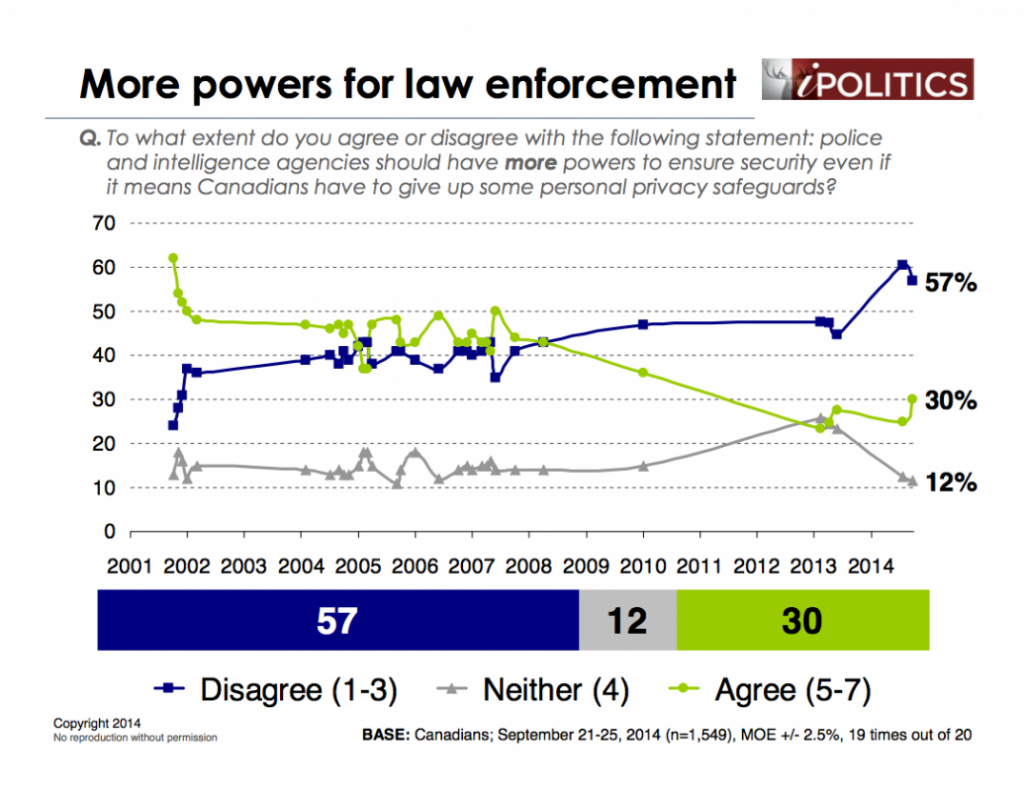
The EKOS poll: Fear fades — values endure

Ekos - Law Enforcement and TerrorismFrank Graves of Ekos on public opinion regarding the threat of terrorism:

  • Virtually all responses made by Western governments to the threat of terrorism in the 21st century have been deemed failures in hindsight. Almost universally, the public sees these past interventions as having yielded nothing but a more dangerous world.
  • Overwhelmingly, Canadians want to see their leaders re-think their reliance on military and security-oriented approaches to the terrorist threat, in favour of approaches more in keeping with our core values as a nation.
  • Canadians have lost faith in the security agenda which says the problem can solved by restricting civil liberties even further, and want to see our leaders place more emphasis on the traditional tools of diplomacy and development.

The EKOS poll: Fear fades — values endure (pay wall)