ICYMI: Turning up the war rhetoric isn’t the same as confronting the threats – The Globe and Mail

Sensible commentary by Campbell Clark in the Globe:

But the big issue is clearly trying to prevent young Canadians, many of them apparently ordinary-joe young suburbanite men, from becoming radicals. And because that’s hard, governments talk less about it.

Talk of war on a massive scale won’t dissuade radicalization. Quite the opposite. One of the motivators for violent radicalization, according to experts, is that it makes marginalized, alienated young men feel important, even feared. ISIS even uses videos with themes from video games like Call of Duty to recruit foreign fighters. A potential recruit would probably be drawn, not deterred, by the idea that this is war on a massive scale. It might be better to employ ridicule.

It is true, as Mr. Harper said last week, that there are threats. But the unpleasant fact is that turning up the war rhetoric isn’t the same as confronting them.

Turning up the war rhetoric isn’t the same as confronting the threats – The Globe and Mail.

Radicalization of prisoners discussed at Canadian roundtable

Interesting to see whether the CSC will revisit the earlier decision to cancel the chaplain program in 2013 (Is Canada doing enough to ‘de-radicalize’ convicted terrorists?):

Don Head, commissioner of the Correctional Service of Canada (CSC), got approval from Public Safety Minister Steven Blaney to fly in participants from other parts of Canada and from the United States, the United Kingdom, New Zealand, Israel, France, Spain and the Netherlands at a cost of about $63,000, according to a briefing note obtained by CBC News through Access to Information.

“Violent extremist or radicalized offender populations may pose a threat to the safety and security of institutions and communities, necessitating an examination of evidence-based assessments, interventions and management practices for this group of offenders,” the document reads.

CSC confirmed the three-day event took place Dec. 2-4, bringing together international experts who discussed ways to manage extremist offenders.

Amedy Coulibaly, seen in an undated video posted online Sunday by militants, shot a policewoman and four hostages at a kosher grocery in Paris before he was killed by police on Friday. Coulibaly is said to have been radicalized in prison, where he met one of the Kouachi brothers responsible for last week’s Charlie Hebdo killings. (Associated Press)

The issue of radicalization behind bars is on the global radar after revelations that two gunmen involved in last week’s attacks in France are believed to have been radicalized in prison.

French authorities are struggling to contain the threat from what is now considered fertile ground for extremism.

….Rioux said CSC’s initiatives to prevent radicalization include comprehensive intake and screening procedures and training for front-line staff on security threat group identification.

Radicalization of prisoners discussed at Canadian roundtable – Politics – CBC News.

More state power, not free speech, the likeliest we-are-Charlie result – Neil MacDonald

Extensive commentary by Neil MacDonald of the CBC who unfortunately nails it in his somewhat lengthy piece on the aftermath of the Paris killings:

Western governments are, however, quite interested in enforcement and security, and that, not more speech, is the order of the day once again.

With unintended irony, and a very short memory, French Prime Minister Manuel Valls declared over the weekend that France is now locked in a “war on terror.”

That’s exactly the term George W. Bush used after 9/11. It presaged an unprecedented expansion of the surveillance state and the powers of America’s security apparatus.

Civil liberties were tossed aside. Other countries’ laws, even those of U.S. allies, became irrelevant.

And the frightened American population cheered.

The French, among others, mocked the slogan relentlessly, especially once it became apparent that the U.S. invasion of Iraq, carried out as part of this war on terror, was based on a false pretext.

Eventually, Bush’s own Pentagon quietly dropped the slogan. And when the Democrats took the White House, they repudiated it.

But it’s clearly back on. U.S. Attorney General Eric Holder agreed with the French prime minister. America, he said, is at war, too.

Next month, Washington is convening an international summit to discuss new measures.

Canada is preparing new legislation to expand the powers of its security agencies.

The French, and the Americans, and no doubt the Canadians, are considering how better to monitor and obliterate incitement on the internet.

Or, more precisely, what security officials consider incitement. It’s a term that can be interpreted rather broadly, and no doubt will be.

Clearly, the ultimate answer to the Charlie Hebdo massacre will not be freer speech. It will be a mostly secret intensification of police power, with attendant shrinkage of individual freedoms.

And we will all be told not to worry: If you aren’t doing anything wrong, you have nothing to worry about.

At least one French demonstrator seemed to recognize some of this over the weekend. The sign he hoisted read: “Je marche, mais je suis conscient de la confusion et de l’hypocrisie de la situation.”

I march, but I am aware of the confusion and hypocrisy of the situation.

More state power, not free speech, the likeliest we-are-Charlie result – World – CBC News.

No “Clash of Civilizations” – Commentary Magazine

From a surprising source, Commentary Magazine:

Surveys indicate that the broad majority of Muslims around the world are not in the violent, jihadist camp. A Pew poll in 2013, for example, found that across 11 Muslim countries, 67 percent of those surveyed said they are somewhat or very concerned about Islamic extremism and 57 percent said they had an unfavorable view of al-Qaeda while 51 percent had an unfavorable view of the Taliban. Moreover, “about three-quarters or more in Pakistan (89%), Indonesia (81%), Nigeria (78%) and Tunisia (77%), say suicide bombings or other acts of violence that target civilians are never justified.” Indeed the only place where a majority of Muslims justified suicide bombings was in the Palestinian territories.

It seems safe, then, to say that most Muslims around the world are moderate. But there is a substantial minority of extremists which, in absolute numbers, pose a serious threat, given the fact that there are an estimated 1.2 billion Muslims in the world. While those extremists pose a substantial threat to the West, they present an even bigger threat to fellow Muslims. The vast majority of victims of Islamist terrorist organization such as the Taliban, ISIS, al-Qaeda, and Hezbollah have been fellow Muslims. Such organizations, after all, are principally bent on dominating their own societies, thus by definition oppressing and killing fellow Muslims; they generally attack the West only as an auxiliary line of operations. One of the truly disturbing aspects of modern-day Islamist movements is the ease with which they declare their Muslim enemies to be “takfir” (i.e. apostates) and therefore liable to be killed.

What is going on, then, is not a war between civilizations but a war within Islamic civilization pitting an armed, militant minority against a peaceful but easily cowed majority. Any talk of waging “war on Islam” is thus deeply misguided and harmful. What we in the West need to do is to help moderate Muslims wage war on the radicals. Sound impossible? Far from it. Just look at how successfully (if brutally) Muslim states such as Morocco, Egypt, Tunisia, and Algeria have fought to repress Islamist movements–or how courageously so many Iraqi and Afghan security officers have fought against Islamist extremists. (They would fight even more effectively if their own organizations were less corrupt and more effective.)

The “us-vs.-them” narrative only distracts from what needs to be done while playing into the terrorists’ hands–that is after all, precisely the narrative they seek to promulgate to rally Muslims to their side.

No “Clash of Civilizations” – Commentary Magazine Commentary Magazine.

The far right spreads its wings over Europe

Good survey of the rise of intolerance and right-wing anti-immigration parties by Jonathan Manthorpe and his plea for perspective:

There’s no doubt at all that public fears of Islamist violence have been stoked by government alerts and alarmism — a trend that started before the 9-11 attacks. More recently, western governments — including our own — have seized on the psychopathic Islamic State group in Syria and Iraq, warning that Muslim citizens recruited into IS will return with terrorist skills and cause havoc at home.

As with the Charlie Hebdo attack, the “lone wolf” killings of two Canadian soldiers in Quebec City and Ottawa in October have been held up as evidence of the threat of radicalized Muslims living in the West. What’s missing from these panic-fueled statements is anything like perspective.

Remember, just two Canadian misogynists — Robert Pickton and Marc Lepine — together accounted for the deaths of 63 people. And on any bad day, Canada’s warring drug gangs in greater Vancouver and Toronto notch up death tolls far outstripping anything Islamic terrorists can come up with. And most mass killings of Mounties in recent years — four at Mayerthorpe in 2005 and three in Moncton last June — have been perpetrated by mentally unstable Canadians with hunting rifles.

The far right spreads its wings over Europe (paywall)

And Gwynne Dyer on the situation in Germany:

Germany is taking in more immigrants than ever before: some 600,000 this year. That’s not an intolerable number for a country of 82 million, but it does mean that if current trends persist, the number of foreign-born residents will almost double to 15 million in just 10 years. That will take some getting used to—and there’s another thing. A high proportion of the new arrivals in Germany are Muslim refugees.

Two-thirds of those 600,000 newcomers in 2014 were people from other countries of the European Union where work is scarce or living standards are lower. They have the legal right to come under EU rules, and there’s really nothing Germany can do about it. Besides, few of the EU immigrants are Muslims.

The other 200,000, however, are almost all refugees who are seeking asylum in Germany. The number has almost doubled in the past year, and will certainly grow even larger this year. And the great majority of the asylum-seekers are Muslims.

This is not a Muslim plot to colonize Europe. It’s just that a large majority of the refugees in the world are Muslims. At least three-quarters of the world’s larger wars are civil wars in Muslim countries like Syria (by far the biggest source of new refugees), Iraq, Yemen, Somalia, Afghanistan and Libya.

Asylum-seekers: The limits of tolerance in Europe

And a more encouraging story from Germany, that of Professor Mouhanad Khorchide:

In his lecture, the long conversation and a telephone call after the shootings on Wednesday at the office of the satirical newspaper Charlie Hebdo in Paris, Mr. Khorchide was calm and optimistic, delivering insight with a Viennese lilt in his German.

He expressed fear that extremists on both sides would try to use the attack for their own ends. “The Muslim extremists will say, ‘Oh, look how strong and mighty we are,’ ” he said, “while those who fear Islam will say, ‘See, that is what Islam is, and what we were warning about all along.’ ”

He said he expected more attacks, but also more questioning from Muslims. “Such events force us to discuss openly about theological positions,” he said. “It is too simple to say, ‘No, no, that has nothing to do with Islam.’ These people,” he added of jihadists, “are referring to the Quran, and we must confront these passages in the Quran.”

His students, he said, were angry after the Paris shootings. In part, they were upset with Muslim extremists seeking to please what they consider a false idol. But they were also resentful that now “they must justify themselves: ‘We are peaceful,’ ” he said. “And this constant justifying and defending oneself is annoying.”

Europe’s populist current “whips up fears where no fears exist,” Mr. Khorchide said. “For instance, the Islamization of Europe: Demographic data shows that this is a fantasy.”

Furthermore, he noted, Muslim children born in Europe now tend to adopt its ways, the tiny minority who go off to fight in Iraq and Syria notwithstanding.

Teaching Islam’s ‘Forgotten’ Side as Germany Changes

Lastly, from the Netherlands, not surprising to see a spike in support for Geert Wilders.

But interesting that the Dutch PM declined to use the word “war” in favour of  a more nuanced expression, yet one that also communicates resolve:

Wilders, known for his inflammatory rhetoric, said after the Paris bloodshed that the West was “at war” with Islam, drawing a rebuke from Dutch Prime Minister Mark Rutte on Sunday.

If elections were held now, his party would be the single largest in the Netherlands, with 31 seats in the 150-member parliament, more than twice as many as it won in the last elections, according to a Sunday poll.

The governing Liberal and Labour parties, damaged by persistent sluggish growth, would have just 28 seats between them, compared to the 79 they held after the 2012 elections.

The Freedom Party was polling 30 seats just prior to the Jan. 7-9 Paris attacks, in which 17 people including journalists and policemen were killed by three Islamist gunmen who were later shot dead by French special forces.

Wilders this week called in an interview for measures against Islam: “If we don’t do anything, it will happen here,” he was quoted by the newspaper Het Parool as saying.

But speaking to Dutch public television shortly before leaving to attend a peace rally in Paris, the Dutch prime minister distanced himself from Wilders’s comments.

“I would never use the word ‘war,'” he said. “We are in a struggle with extremists who are using a belief as an excuse for attacks.”

More than 80 percent of respondents to the De Hond poll said people who left the Netherlands to wage jihad (holy war) in Syria should lose their Dutch citizenship and those returning from fighting in Syria or Iraq should face lengthy jail terms.

Paris attacks boost support for Dutch anti-Islam populist Wilders | Reuters.
Paris policeman’s brother: ‘Islam is a religion of love. My brother was killed by terrorists, by false Muslims’

From the brother of the slain police officer, Ahmed Merabet:

“My brother was Muslim and he was killed by two terrorists, by two false Muslims,” he said. “Islam is a religion of peace and love. As far as my brother’s death is concerned it was a waste. He was very proud of the name Ahmed Merabet, proud to represent the police and of defending the values of the Republic – liberty, equality, fraternity.”

Malek reminded France that the country faced a battle against extremism, not against its Muslim citizens. “I address myself now to all the racists, Islamophobes and antisemites. One must not confuse extremists with Muslims. Mad people have neither colour or religion,” he said.

“I want to make another point: don’t tar everybody with the same brush, don’t burn mosques – or synagogues. You are attacking people. It won’t bring our dead back and it won’t appease the families.”

Paris policeman’s brother: ‘Islam is a religion of love. My brother was killed by terrorists, by false Muslims’ | World news | The Observer.

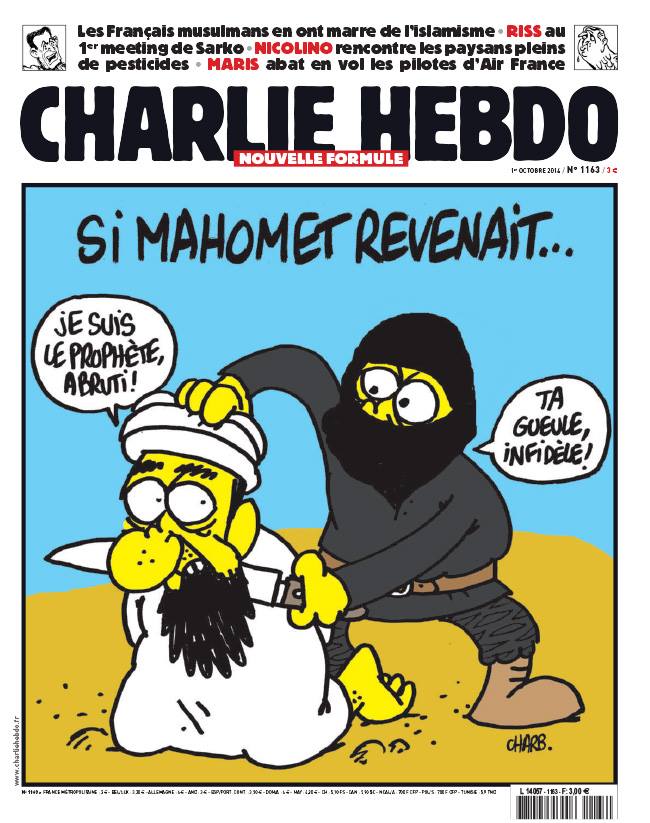
Charlie Hebdo shooting: Debate over publishing the Muhammad cartoons

charlie hebdo no1163 011014While it is a legitimate debate to have over whether or not to publish the cartoons given fear of giving offence or further stirring things up, my sense is that editors have made a blanket decision rather than looking at the cartoons and selecting some that are not gratuitous but make valid points.

My example would be the one above:

Studer said the CBC decided against running the cartoons, arguing that to show those depictions of Muhammad would needlessly offend Muslims, who consider such depictions sacrilege.

And he wasn’t alone in putting forward that argument. The New York Times executive editor Dean Baquet told the paper’s public editor he spent about half of the day deciding whether or not to publish the cartoons, changing his mind twice before ultimately deciding not to run the images.

“We have a standard that is long held and that serves us well: that there is a line between gratuitous insult and satire. Most of these are gratuitous insult,” Baquet said.

The Washington Post ran one image on its editorial pages while the main U.S. networks, including ABC News, CNN and Fox backed off from publishing the cartoons. The Associated Press also declined to make them available.

In Canada, of the Toronto-based newspapers, only the National Post ran the controversial cartoons. Almost none of the U.K. papers ran the cartoons, nor did the BBC and the Paris-based papers Le Monde or Le Figaro.

Charlie Hebdo shooting: Debate over publishing the Muhammad cartoons – World – CBC News.

And in Quebec media, which apart from the Montreal Gazette, widely published some of the cartoons:

Publier les caricatures ou pas?

In the Mideast, as in France, satire is a weapon against extremists

Interesting piece by Nahrain Al-Mousawi on satire within the Arab world with some quite amusing examples. Her conclusion regarding the risks of organizing such satire by Western governments is valid.:

While the efforts highlighted above are organic, based on a shared community, other efforts appear to be more technocratically orchestrated. A recent article noted that Mr. Sharro’s satirical chart was widely shared, including by the U.S. State Department’s Center for Strategic Counterterrorism Communications. The CSCC has exhibited its own type of muted mockery in a video countering IS recruitment efforts. The integration of humor in U.S. counter-terrorism strategies has been ramped up since the development of social media and its snarky style of communication. A State Department program calling itself Viral Peace confronts and undermines online currents of extremism with “logic, humor, satire,” in its creator’s words.

But a government-backed effort does not necessarily make for an effective means of striking back (and can often be perceived as intrusive, stilted or awkward). After all, satire’s subversiveness can be an ill-fitting mask worn by government institutions, distinct from more organic efforts, produced in times of crisis by a shared, discursive community – at least, when that community itself is threatened. Still, if laughing in the face of the absurd reveals an ability to “dwell with the incomprehensible without dying from fear or going mad,” then that may be the first step in striking back – by having the last laugh.

In the Mideast, as in France, satire is a weapon against extremists – The Globe and Mail.

Barbara Kay: When it comes to Islam, the media needs to ditch the ‘narrative,’ and report the truth

What Kay misses, in her reductionist approach to ideology and extremism of all kinds, is what are the factors that push some to violence and what are the ones that increase resilience to these appeals.

With lone-wolf extremists, it is clear that mental illness and other issues can be one of the factors that push them over the edge. It does not mean that Islamist ideology is not involved; it is just that there can be other factors as well that make some individuals more susceptible.

And I would distinguish between these kinds of attacks and the more “sophisticated”and “professional” attacks that took place on Charlie Hebdo.

And of course, none of this reduces the horror over any attack, no matter the motives or factors:

We’re in the middle of a Hot War with Islamism. There will be more attempted, or realized, lone-wolf terrorist attacks on our shores. In the event, it would be helpful if the liberal media could ditch its love affair with narratives, and stick with the truth.

The right-wing media also should ‘ditch its love affair with narratives’ and recognize the complexity of the various factors involved.

Barbara Kay: When it comes to Islam, the media needs to ditch the ‘narrative,’ and report the truth | National Post.

ICYMI: Experts view radicalized individuals who incite violent attacks as misfits with ‘overvalued ideas’

More on radicalization:

But [Matthew] Logan said it would be a disservice to categorize him simply as a “jihadist.” Many radicalized individuals are misfits of society who cling obsessively to “overvalued ideas” as a way to elevate their sense of self, Logan said. They can just as easily be drawn to the cause of animal activism as the Islamic State narrative, he said.

“They’re not terrorists. They’re people with overvalued ideas jumping on a cause,” he said.

In a column published in the journal Violence and Gender, Logan wrote that while they may see themselves as rebels for a particular cause, “it should be understood that it is really not ‘the cause’ that moves them to violence,” but an underlying psychopathology, perhaps mixed with a bit of narcissism.

“These persons have idealized values, which have developed into such an overriding importance that they totally define the ‘self’ or identity of the individual,” he wrote.

Academics have used the concept of “overvalued ideas” to try to explain the actions of everyone from Ted Kaczynski (the “Unabomber”), the American mathematician who sent mail bombs as part of a campaign against technology, to people with anorexia nervosa, the eating disorder in which people starve themselves to achieve a desired body image.

Logan is quick to add, however, that having “overvalued ideas” should not diminish one’s culpability for a violent act.

Experts view radicalized individuals who incite violent attacks as misfits with ‘overvalued ideas’.