John Ivison: PQ could learn from Jason Kenney the right way to promote cultural values | National Post

As this is behind the firewall (and it quotes me extensively!), full text below for those who do not have National Post access:

Gérard Bouchard, co-author of the Bouchard-Taylor report on diversity in Quebec, once remarked that Jason Kenney’s reforms to Canada’s multiculturalism policies had brought the Quebec and Canadian models closer — an emphasis on integration over accommodation.

Both Quebec nationalists and Canadian conservatives were suspicious of Pierre Trudeau’s multiculturalism policies — particularly the Liberal tradition of indulging cultural groups just long enough to extract their votes.

In large measure, Mr. Kenney, as Multiculturalism Minister, pursued his own charter of values. But, crucially, he used “soft” policy tools to persuade people to buy into his vision of Canada, rather than the bludgeon of legislation that the Parti Québécois government is proposing in its secularism charter.

As the author of a new book — Policy Arrogance or Innocent Bias: Resetting Citizenship and Multiculturalism — makes clear, Mr. Kenney pursued an unabashed policy of integration (often in the face of opposition from his own public servants).

Andrew Griffith was a director general of multiculturalism at Citizenship and Immigration at a time when significant shifts in policy were being introduced by the Conservatives.

“Kenney did make a major shift towards integration … I would argue he brought multiculturalism back to its roots, as it was always about making various communities more comfortable about integrating into the Canadian ‘mainstream’, while preserving their culture, all within the common framework of Canadian laws [and] regulations,” said Mr. Griffiths.

While placing high value on cultural diversity and religious freedom, he set limits and condemned “extreme” behaviour like honour killings that were not in compliance with Canadian laws, identity and values.

In 2011, he even aligned himself with the Quebec approach when he announced that the niqab would not be allowed at citizenship ceremonies, claiming it was not a religious obligation to wear the veil. The next year, Mr. Kenney introduced a language requirement for citizenship applicants, obliging them to provide objective evidence like test results to prove they could speak either French or English.

Mr. Griffiths said Mr. Kenney’s extensive outreach into ethnic communities gave him credibility to take a broad range of positions.

“My take on him is that it is a very rare minister who can both implement more restrictive immigration, refugee and citizenship policies and yet ‘narrowcast’ to individual communities, addressing their concerns while reinforcing broader pan-Canadian messages.”

Mr. Kenney not only stressed integration into the Canadian “mainstream,” he redefined what that mainstream would look like.

Most famously, he revamped the citizenship guide for new Canadians from a very Liberal “A Look At Canada” to the Conservative-friendly “Discover Canada.”

“I think we need to reclaim a deeper sense of citizenship, a sense of shared obligations to one another, to our past, as well as to the future. In that I mean a kind of civic nationalism where people understand the institutions, values and symbols that are rooted in our history,” he told Maclean’s in 2009.

But the guide cherry-picked those symbols to promote the Conservatives’ preferred narrative, with emphasis placed on the military and the monarchy at the expense of peace-keeping, medicare and gay rights.

The results were not always appreciated internally, particularly among staff who were forced to turn down grant applications from non-governmental organizations they’d supported for years. Mr. Griffiths notes how some demonstrated the initial stages of the Kubler-Ross grief model — denial, anger and depression.

But there is some evidence that the shift in policy worked. A Citizenship and Immigration Canada survey from the 2012 departmental performance report found that 88% of foreign-born, compared to 81% of Canadian-born, respondents reported “feeling proud” to be Canadian.

Not only did foreign-born Canadians demonstrate a higher level of attachment to Canada, they also had a better understanding of what is required of citizens.

Those findings suggest that a balance has been struck between the majority culture and integration of minorities in the rest of Canada; that, in large measure, sensible public policy has ensured that the fundamental values of the majority have been respected, while allowing new Canadians to preserve their food, music, folklore and religion.

One wonders how many Sikhs, Jews and Muslims can say they feel proud to be Quebecers today?

John Ivison: PQ could learn from Jason Kenney the right way to promote cultural values | National Post.

Charte des valeurs québécoises – Round-up

ON recruitmentThe big news is the division among the sovereigntists. The Bloc has lost its one woman member, Maria Mourani with a strong position in favour of gender and religious rights. And her riding is very multicultural. Good for the Quebec debate.

Charte des valeurs québécoises – L’inconfort des forces souverainistes explose | Le Devoir.

And some articles about the impact of Quebec’s international reputation (let alone within Canada). Couillard is particularly eloquent describing his experience as a doctor in Saudi Arabia (I lived in Saudi 1986-88):

« J’ai connu, moi, c’est quoi, un régime autoritaire. J’ai connu, moi, c’est quoi, un régime qui exclut », a-t-il dit. « Je sais c’est quoi, être l’étranger qui n’a pas la religion de la majorité. Je sais c’est quoi, être celui qui n’a pas la même couleur de peau que les autres. Je sais c’est quoi, être celui qui se fait arracher ses lumières de Noël devant chez eux. C’est arrivé chez nous quand j’étais là-bas. »

Charte des valeurs québécoises – Le Québec pourrait en payer le prix, dit Couillard

The contrary view is expressed by Lise Payette, former PQ Cabinet Minister, in the 70s, who puts the proposed Charter in a liberation context – but liberation from what and from who:

Le pas que nous désirons faire aujourd’hui est la suite logique de notre libération. Nous souhaitons de tout coeur que vous en fassiez partie.

Le Québec qui renaît de ses cendres

Premier Marois continues to praise the French model of integration. France has a terrible record here with its Muslim population – just take a tour of the suburbs if you dare – and look at employment and other statistics. Me thinks broader life experience would have been helpful for her and other members of her Cabinet:

Charte des valeurs québécoises: Marois vante l’intégration à la française

And a nice reminder that Ontario hospital recruiters are looking forward to hiring new talent:

Un hôpital ontarien en recrutement

‘We don’t care what’s on your head ’: Ontario hospital launches ad aimed at Quebec medical students, values charter

Some general analysis on Quebec dynamics and “chronic anxiety”, understandable given Quebec’s history and identity, but by no means justifying the proposed Charter, as well as the possible longer-term political impact:

PQ’s controversial new secular values charter preys on Quebec’s chronic ‘identity-related anxiety’

Quebec values charter: Is it a political game changer for the PQ? 

As always, some general commentary. Again, part of the uniqueness of Canada is that even many commentators on the right strongly oppose such bans and approaches, as individual rights, including religious, are paramount. Ironic that those who once condemned the Canadian Charter of Rights and Freedoms are now among its strongest defenders:

Freedom under fire: Parti Quebecois values charter an outright attack on indidual rights

And in closing, a good opinion piece by Christian Rioux of Le Devoir contrasting the Anglo-Saxon approach, based more on inclusion and ensuring different faith groups are treated equally, and the French and Latin approach, which tends towards banning religion in the public sphere.

The reality is more complex; in practice French and Latin countries provide lots of public support to religion, whether school, maintenance of cathedrals and the like, but nevertheless a good piece to reflect upon.

He misses that the Canadian and Anglo-Saxon approach is based on individual rights, not community rights, unlike some European countries where communitarianism is more common, reflecting their history of managing Protestant and Catholic communities:

Laïcité ou communautarisme

Does Education Decrease Terrorism? « The Dish

The Dish has been doing a series on the links between education and terrorism. While there are no simple and consistent patterns here,  a large number of the radicalized do appear to be relatively well-educated, although there are some notable exceptions. The example cited pertains to the Palestinian territories, where employment opportunities are limited. Still doesn’t answer the question why some turn to terrorism, some do not. Correlation is not causation.

Does Education Decrease Terrorism? « The Dish.

More on the Charte des valeurs québécoise – Round-up

Starting with the dirty little secret of just how poor Quebec’s record on integrating newcomers into the government workforce – only 2 percent, compared to close to 9 percent visible minority population (2006 Census). Not surprisingly, the SFPQ union supports the Charte, as it reinforces their existing membership base.

La Charte vise moins de 2 % des fonctionnaires | Le Devoir.

PQ gets backing of civil-servants’ union for religion plan

Premier Marois maintains that the Charte is équilibrée (​Laïcité – Pauline Marois affirme que sa proposition est équilibrée) and the PQ presses the private sector to follow the government’s lead on secular workplaces (PQ presses private sector to follow its lead on secular workplaces).

But more on the divisions within Quebec on the Charte. This ranges from Montreal, Quebec’s most diverse city, but Western Quebec, next to Ottawa, and diverse, remains undecided. And various groups, including sovereigntists, also expressing opposition:

Charte des valeurs: l’île de Montréal se rebiffe

 Charter widens rifts between mayors, PQ and sovereigntists

Charte des valeurs: les CPE (Centres de la petite enfance) divisés 

West Quebec institutions undecided on ‘opting out’ of Charter of Values

Charte des valeurs: les indépendantistes divisés

Charte des valeurs québécoises – Les souverainistes divisés

Québec inclusif – Engouement pour le manifeste anti-Charte

Couillard veut scinder la «charte de la chicane» pour l’adopter

And some more general commentary, starting with some good political analysis, particularly from Paul Wells:

Charter of values: Old dogs, nous tricks

PQ’s tower of babble

Marois’s Charter of Values is more about electoral politics than sovereignty

Who actually applauded Quebec’s values charter?

And a good discussion about federal paternalism, acknowledging the vigorous debate within Quebec but without reference to the legitimate federal role, grounded in the Constitution and the Charter of Rights and Freedoms, but the universal declaration of human rights and other instruments.

Given the strength of the debate and controversy within Quebec, the PQ may have over-reached. I would be curious to know the advice of the public servants on the proposal – likely not comfortable given the ideological and political basis for the Charte:

Le paternalisme fédéral

Charter of Quebec values on collision course with Constitution?

And Justin Trudeau, Liberal leader who was first off the mark criticizing the Charte, has an op ed expressing faith that Quebeckers will reject the proposal, with Patrick Lagacé noting the politics of the initiative:

 Justin Trudeau writes: I have faith in Quebec. So should you 

The PQ’s not racist – just running scared

And a reminder that the French approach, which Quebec sometimes to draw from without due consideration of how Quebec has a history of generally successfully integrating immigrants from countries as diverse as Ireland, Italy, Portugal, Haiti, with some of the more recent waves of immigrants having more challenges (as happens elsewhere):

Quebec charter of values plan could take a few pages from France: Don Murray

And a sensible call to pursue the Bouchard-Taylor recommendation of a white paper and consultations to have an informed discussion and debate, rather than what appears to be an ad hoc electoral and divisive strategy of throwing out poorly conceived ideas and proposals. On the other hand, that may help kill the Charte.

La Charte des valeurs – L’espace du compromis

Expect that coverage will quieten over the next few weeks until the parliamentary and related processes pick up. But I have been wrong before!

Reaction to Quebec’s values charter

Charte symbolsSo the draft Charte is out with few surprises. Lots of reaction. Starting with what’s in and what’s out:

Would

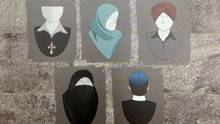
Bar public sector employees — including everyone from civil servants to teachers, provincial court judges, daycare workers, police, health-care personnel, municipal employees and university staff — from wearing a hijab, turban, kippa, large visible crucifix or other “ostentatious” religious symbols while on the job.

Allow five-year opt-outs from the ban for certain organizations, but not daycare workers or elementary school teachers.

Require that those receiving or providing government services uncover their faces.

Exempt elected members of the Quebec legislature from the regulations.

Amend Quebec’s human rights legislation, the Charter of Human Rights and Freedoms, to specify limits on when someone can stake a claim for religious accommodation.

Wouldn’t

Remove religious symbols and elements considered “emblematic of Quebec’s cultural heritage.” That includes: the crucifixes in the Quebec legislature and atop Mount Royal in Montreal, the thousands of religiously based geographic names (e.g. Saint-Louis-du-Ha! Ha!) and the names of schools and hospitals.

Ban public sector employees from wearing small religious symbols like a ring with a Star of David, earrings with the Muslim crescent or a necklace with a small crucifix.

Eliminate subsidies to religious private schools. The Quebec government currently funds about 60 per cent of the budgets of most of the province’s private schools, including parochial ones.

Ban opening prayers at municipal council meetings, which was recommended by the 2008 Bouchard-Taylor Commission report into cultural accommodation. The Quebec Court of Appeal ruled in May that such prayers do not necessarily violate Quebec’s current human rights legislation.

Eliminate property tax exemptions for churches, mosques, synagogues and other religious buildings.

In other words, some of the deeper aspects of multiculturalism, deeper than the rest of Canada, and arguably less integrative like subsidies for religious schools, would remain, while imposing restrictions on public service employees. And will we have a ‘sartorial’ police measuring the size of ‘discrete’ or small religious symbols?

5 things Quebec’s values charter would do, and 5 it wouldn’t – Montreal – CBC News.

Quebec reveals religious symbols to be banned from public sector

Five key consequences of Quebec’s planned Charter of Values

Reaction in Quebec to the proposal is mixed. While Minister Drainville continues to say with a straight face that the Charte aims at harmony, others disagree, particularly in Montreal, where most of the communities live and work together:

Une Charte au nom de l’harmonie, selon Drainville

Signes religieux: la Charte se bute à un écueil

Mairie de Montréal : unanimité contre la charte des valeurs

Signes religieux – Québec fait fausse route, dit la Fédération des femmes

Charte des valeurs québécoises – Réactions mitigées sur la scène politique provinciale

«C’est une Charte contre les femmes»

Federal politicians have pronounced strongly against the proposed Charte. Particularly striking – and courageous given Quebec politics – that both federal leaders from Quebec, Justin Trudeau of the Liberals, and Tom Mulcair, Leader of the Official Opposition and NDP, have been unequivocal in their defence of human rights and freedoms, as has been Minister for Multiculturalism and Economic and Social Development Jason Kenney, speaking on behalf of the government, although as some have noted, he was less expansive than usual.

Given the Ottawa-Quebec dynamics, and the desire by the PQ to play politique identitaire, this may fit into their game plan to create a wedge issue. But irresponsible politics at best.

How Kenney, Mulcair and Trudeau took on Quebec’s charter of values

Tories gear up for constitutional fight as parties unite against PQ’s charter

Le prix de ses principes

NDP Leader Tom Mulcair denounces Quebec’s proposed charter of values

Some other reaction and analysis in English Canada:

De-valued promises in Quebec

Controversial Quebec charter exemptions based on idea that some religious symbols have become purely secular

Charter of Values hints that Quebec having second thoughts over mad dash for immigrants

And an opinion piece in Le Devoir in favour of laicité:

La laïcité, enfin!

And unfortunately behind Le Devoir’s firewall, an opinion piece by Gérard Bouchard, one of the co-authors of the Bouchard-Taylor report, and one of the more thoughtful thinkers on multiculturalism and interculturalisme around. Interview below:

Le sociologue Gérard Bouchard, professeur à l’Université du Québec à Chicoutimi, a codirigé avec le philosophe Charles Taylor de l’Université McGill la Commission de consultation sur les pratiques d’accommodements reliées aux différences culturelles, en 2007-2008. Il juge sévèrement la proposition du gouvernement défendue par le ministre Bernard Drainville pour « répondre au pluralisme religieux dans un état moderne ».

Si le ministre Drainville vous appelait pour vous demander conseil, lequel lui donneriez-vous ?

Je lui dirais que la façon de poser les termes du débat indispose les libertés fondamentales et risque de produire une fracture sociale. C’est donc une mauvaise façon et nous allons nous faire mal. La sagesse consisterait présentement à couper le projet de réforme en deux. Une partie concerne les accommodements et une autre concerne les signes religieux. Sur les signes religieux, visiblement, le Québec n’est pas prêt à se diriger vers un consensus. À mon avis, cette partie du débat sera un échec. Les Québécois seront très, très divisés. Par contre, sur les accommodements, il y a toutes les chances de réaliser un très large consensus parmi l’ensemble des Québécois, la minorité, comme la majorité. Là, à mon avis, il y aurait la possibilité d’en arriver à une loi.

Et tout irait pour le mieux, tout simplement ?

Non. J’ai une autre inquiétude. En parlant des accommodements, le ministre a amplifié toutes les mauvaises perceptions à propos des accommodements. Il a répandu l’idée que les accommodements portaient atteinte régulièrement à l’égalité hommes-femmes. Ce n’est pas vrai. Aucune étude ne soutient ça. Il a aussi répété qu’il y avait une accumulation d’accommodements déraisonnables consentis récemment. Pas de preuve encore. Pas d’études. Rien pour soutenir ça.

Quel autre élément de la proposition vous semble négatif ?

Au cœur de l’affaire, il y a la volonté de s’en prendre à un droit fondamental qui concerne la liberté de manifester sa religion en public, incluant au travail, dans les postes de l’État ou les institutions parapubliques. C’est reconnu comme un droit fondamental par les deux Chartes, canadienne et québécoise, partout en Occident et par l’ONU. Il est permis de supprimer un droit fondamental. Mais il faut alors s’appuyer sur un motif supérieur. Le meilleur exemple au Québec, c’est la loi 101. Elle restreint ou supprime des droits, par exemple en limitant le droit de choisir l’école de ses enfants. Mais il y avait un motif légitime que même la Cour suprême du Canada a reconnu. Je ne trouve pas de motif équivalent dans le cas présent. Il n’y a pas de proportionnalité entre le droit restreint et les motifs évoqués.

Pourquoi est-ce si grave d’interdire des signes religieux aux fonctionnaires ?

Dire que tous les employés de l’État et des organismes parapublics — et ça fait beaucoup — devraient s’abstenir de porter un signe religieux ne tient pas compte de la réalité profonde de certaines croyances. Pour certains croyants, le signe religieux n’est pas dissociable du credo. En se défaisant du signe, le croyant trahit sa foi. C’est pourquoi jamais un sikh ne va retirer son turban au travail. Voilà pourquoi les sociétés doivent trouver des accommodements, dans la mesure où ça ne nuit à personne, sans nuire au travail.

Qu’auriez-vous souhaité alors ?

Charles Taylor et moi, dans notre rapport, nous recommandions l’adoption d’un régime de laïcité au Québec. Il fallait énoncer les grands principes et les justifier. Il fallait énoncer des règles générales de conduite à l’usage des décideurs des institutions. Ce qui a été dévoilé ne fait pas ce travail, ne décrit pas le régime de laïcité qui dirait les rapports entre les religions et les convictions profondes, qui ne sont d’ailleurs pas toutes religieuses, dans notre société. Le gouvernement a tout de suite sauté à des conclusions qui conduisent à la suppression d’un droit fondamental.

Que pensez-vous du droit de retrait de certaines institutions, pour une période allant jusqu’à cinq ans, inclus dans la proposition ?

C’est une affaire difficile à comprendre. Ce droit de retrait se trouve à défaire ce que le projet est censé faire. Premièrement, le problème juridique de fond reste. Deuxièmement, il va en découler une fragmentation juridique du Québec, d’une municipalité à l’autre, d’une université à l’autre. Une jeune étudiante portant le foulard pourra fréquenter tel cégep, mais pas tel autre. C’est assez surprenant. En général, quand l’État statue sur un droit, il le fait pour l’ensemble de la société. Il paraît très étrange de donner aux citoyens la liberté de respecter la loi et des dispositions de la Charte. Troisièmement, cette option donne à la majorité la possibilité de disposer des droits des minorités. On ne peut pas confier la gestion des droits fondamentaux aux humeurs de la majorité. Imaginez où en serait le droit des homosexuels si on fonctionnait comme ça.

​Gérard Bouchard: «Nous allons nous faire mal»

And lastly, some questions for those in favour of the Charte and laicité absolue:

  1. Is this driven by ideology or unconscious prejudice against people with religious beliefs?
  2. Do you assume greater competence among public servants without religious symbols than those with?
  3. Do you view the wearing of a cross as purely secular or not?
  4. When being treated at a hospital, taking a child to day care or school, or getting on a bus, what assumptions do you make regarding someone wearing a cross, kippa, turban, hijab or other symbol?
  5. Is the issue competence or appearance? Comfort or discomfort?

As someone who has been in and out of hospital for more time than I would like to remember, and has been treated with a variety of doctors and nurses, some with religious symbols, some without, competence trumps appearance and I have not been disappointed. Yesterday, it was a nurse wearing a hijab that did my regular blood work; and it was one of the more painless pokes in recent memory.

Book Launch Announcement in The Hill Times

Along with other ‘Heard on the Hill’ items, a good pre-article about my book Policy Arrogance or Innocent Bias (half-way down the first page). The Hill Times main audience are political staffers, officials who need to follow the politics, and the journalists who cover the hill.

Should generate some interest. Full article below given pay wall:

Former top bureaucrat Griffith to release provocative new book, Policy Arrogance, on Sept. 23 at Three Brewers on Sparks Street

Six years ago, Andrew Griffith, a director general at the Canadian Heritage department, received a call from then-secretary of state for Multiculturalism Jason Kenney asking him why he had not approved language that was to be sent out in a press release. He replied, “But minister, it doesn’t sound ministerial.”

It was a late afternoon on a Friday and his first day on the job. He says in his new book, Policy Arrogance or Innocent Bias: Resetting Citizenship and Multiculturalism, he spent the weekend wondering if he was still employed.

“I survived, and went on to work with him and his staff for close to four years, first at Canadian Heritage and then at Citizenship and Immigration Canada (CIC), following the transfer of the multicultural program to CIC in October 2008 after Kenney’s appointment as Minister of Citizenship, Immigration and Multiculturalism,” he wrote in the preface to Policy Arrogance or Innocent Bias. “During this period, citizenship (added to my responsibilities at CIC) and multiculturalism policies and programs were fundamentally reset, in line with the government’s emphasis on more meaningful citizenship and more integrative multiculturalism.”

Mr. Griffith, who is launching his book on Sept. 23 in Ottawa, said that Policy Arrogance or Innocent Bias is a small case study about how the public service had to readjust to policy-making following the federal Conservatives’ rise to power. He said public servants had to “become more modest about the degree of expertise and knowledge” it provided to their political masters, “forced by the radically different perspective that the Harper government and Minister Kenney brought to these inherently complex social policy issues.”

In addition, Mr. Griffith wrote, “It is also the story of how officials balanced the public service challenge function role of ‘fearless advice’ with the need to serve the government of the day through ‘loyal implementation.’ Given the sharp nature of the policy reset, and the entrenched views of many public servants, this book aims to provide a small case study of how public servants adjusted to the new reality—one in which their expertise was fundamentally challenged, discounted, and at times ignored.”

The changes to policy making were so fundamental, Mr. Griffith said, that “In many cases, officials had to work through the Kübler-Ross stages of grief and loss—denial, anger, bargaining, depression, and acceptance—in dealing with the traumatic challenge to their role, as well as to the long-standing consensus between previous Liberal and Conservative parties on citizenship and multiculturalism issues.”

He called this period “an intense and interesting time of policy change and political-bureaucratic interface challenges.”

The book launch takes place on Sept. 23 at The Three Brewers, 240 Sparks St., from 5 to 7 p.m.

Fight Club, anyone? Hill Times, Embassy, and GCTC start Friday Night Fights | hilltimes.com.

Charte des valeurs québécoises – Round-up

On the morning the draft Charte will be revealed, the usual round-up of articles. While it appears the main direction has not changed – banning religious signs in all government-funded workplaces, implementation periods and renewal derogations will be allowed. Another layer of bureaucracy, another way to keep the politique identitaire a public issue, and another way for Quebec to avoid coming to terms with diversity, interculturalisme, and expressions of faith. And sad that the government is not going back to the more nuanced and moderate laïcité ouverte of the Bouchard-Taylor Commission.

However, delaying implementation of a bad law does not make it good.

Charte des valeurs québécoises – À peine connue, déjà contestée | Le Devoir.

Le mieux et le bien

Parti Québécois to unveil secular charter Tuesday

And a naive article on the implications for Charter challenges:

Vers des exceptions à la Charte des valeurs

And divisions among the membership of one of the teacher’s unions, the Fédération autonome de l’enseignement (FAE), not surprising but illustrative of Québec public opinion:

Laïcité – La position de la FAE décriée

An opinion piece by Lucia Ferretti, largely favourable to the proposed approach, and noting how embedded religion is in society, whether the schooling system in Québec (government-financed faith-based schools unlike Ontario, NGOs). He neglects the human rights element of freedom of religion, which includes, of course, Catholics in Québec, whether secularized or traditional, whether progressive or traditional (like other religions):

Charte des valeurs québécoises – Séparation oui, neutralité, non

And a good piece by Bruce Anderson on how motives, and how they are perceived, can help a policy initiative sink or swim:

 Bruce Anderson: For Marois’s charter, voters will judge the motives 

And some good profiles in the Globe from a range of Québécois:

Five Quebeckers weigh in on the proposed secular charter

Sheema Khan reinforces her ongoing message:

Institutions should reflect local best practices, where discourse, debate and inclusion of stakeholders set the tone. Currently, most Muslim institutions are replicas of their foreign counterparts, with a top-down approach in which the voices of women and youth are often absent.

We need intelligent, dispassionate discussions of how Western principles, such as gender equality, freedom of conscience, freedom of expression and critical inquiry, meld with overarching Islamic principles.

Civic engagement will also be paramount for future integration, as Muslims participate in wider policy issues, such as the environment, energy security, aboriginal self-assertion and, yes, Quebec identity.

In classical Islamic thought, the overriding principle of the faith was understood to be mercy. It was manifest by the intent to do good to others, to bring benefit to the wider society and to prevent harm. It is a principle worth resurrecting as Muslims establish roots here.

Reconciling Muslim practices with Western principles

Marois urged to apologize over ‘terrible’ remarks – Round up

A whole series of articles on Quebec Premier Marois’ ongoing effort to fan the flames and, in the process, making her look more ignorant on multiculturalism, interculturalisme, and common sense approaches to diversity. Will not comment on each – too painful. Fortunately, lots of highly critical comment and debate in Quebec press.

Pauline Marois au Devoir – L’étapisme pour la Charte des valeurs (the interview that started it all)

Marois urged to apologize over ‘terrible’ remarks linking multiculturalism and violence | National Post.

 Marois blasts multiculturalism in defence of ‘values’ charter

Marois blames multiculturalism for violence in England – Montreal | Globalnews.ca

Multiculturalisme: Marois dit qu’elle ne voulait pas choquer | Politique québécoise


Paul Wells of Macleans remarking on just how limited her experience outside the Quebec bubble is, and how  ‘drinking the Kool-aid’ makes such comments possible:

Pauline Marois: Protecting Quebec against the fate of England

And the ever sensible Chantal Hébert:

PQ debate on values bringing irreconcilable differences to the surface: Hébert

And beyond the silly, some serious discussion, starting with PLQ leader Couillard:

Multiculturalisme: Marois doit s’excuser, croit Philippe Couillard

​Philippe Couillard prône la neutralité religieuse de l’État, mais pas celle des individus | Le Devoir

Quebec Liberals would enshrine religious neutrality of the state in charter

And from LSE professor Grégoire Webber:

Charte des valeurs québécoises – Où sont les bombes, Madame Marois?

And some analysis by Philippe Authier to round-up the round-up:

Why PQ has us on a values roller-coaster

Probably more that what my readers want, but given the details should come out this week, good to capture the tenor of the comments and debate.

Feds take aim at violence against Muslim women | Toronto Sun

While I am not a great fan of changing vocabulary – sometimes it is better to use existing words like “honour killings” that are used in the community and force a discussion about why such “honour” is not honourable than finding a technically neutral term like femicide. However, the organization involved, The Canadian Council of Muslim Women, has a good track record in such initiatives, and work in this area is warranted.

Feds take aim at violence against Muslim women | Canada | News | Toronto Sun.

Canadian vs. Syrian multiculturalism | Toronto Sun

One of the sillier arguments around. Canadian multiculturalism came from a long history of living together among aboriginal Canadians, French Canadians, English Canadians, further enriched by Ukrainian Canadians who settled the West and successful waves of European and other immigrants. Not without debates, not without tensions, but not artificial like the deep and long-standing sectarian divisions in many of the artificial borders of the Mid-East.

Canadian vs. Syrian multiculturalism | Columnists | Opinion | Toronto Sun.