Extremist ‘foreign fighters’ may threaten Canada: U.S. top official | Ottawa Citizen

Short reference to outreach programs during the visit of the head of Homeland Secruity,  Jeh Johnson:

Johnson said that in addition to a military mission to crush ISIL in the Middle East, and an intelligence strategy to track foreign fighters, the U.S. is conducting an “outreach” program in U.S. Islamic communities. That program is designed to prevent people from being fooled into recruitment by ISIL’s “slick” propaganda.

“ISIL is a stateless group of depraved criminals —rapists, kidnappers, killers and terrorists who control a territory,” he said. “There is no religion, including Islam and there is no God, including Allah, that would condone ISIL’s violent tactics.”

Extremist ‘foreign fighters’ may threaten Canada: U.S. top official | Ottawa Citizen.

Lorne Gunter, true to form in the Toronto Sun, rails against political correctness in describing ISIS as not Islamic, and implicitly casting a slur on all Muslims as well as political leaders:

Western civilization won’t be defeated by economic collapse or government debt, by an external military force or even its own internal decadence. But it could well be done in by political correctness.

It’s bad enough that U.S. President Barack Obama could stand bare-faced in front of his nation two weeks ago and insist the Islamic State terror group “is not Islamic.”

Huh!? Islam is in their name and behind every murderous, brutal, barbarous act ISIS commits.

There are imams and Muslim scholars who would argue that ISIS is, in fact, the very epitome of Islamic faith put into action. It is possible to debate that those Muslim leaders and ISIS itself are wrong in their interpretation of Islam.

But to insist to the world that ISIS “is not Islamic” is the equivalent of standing in front of a red wall and insisting it is green. It is contrary to what is plainly, clearly, obviously true.

Not sure what I am missing but there seems to be a lot, understandably, talk about Islam-inspired extremism and fanaticism these days.

Why can’t we talk about Muslim fanatics?

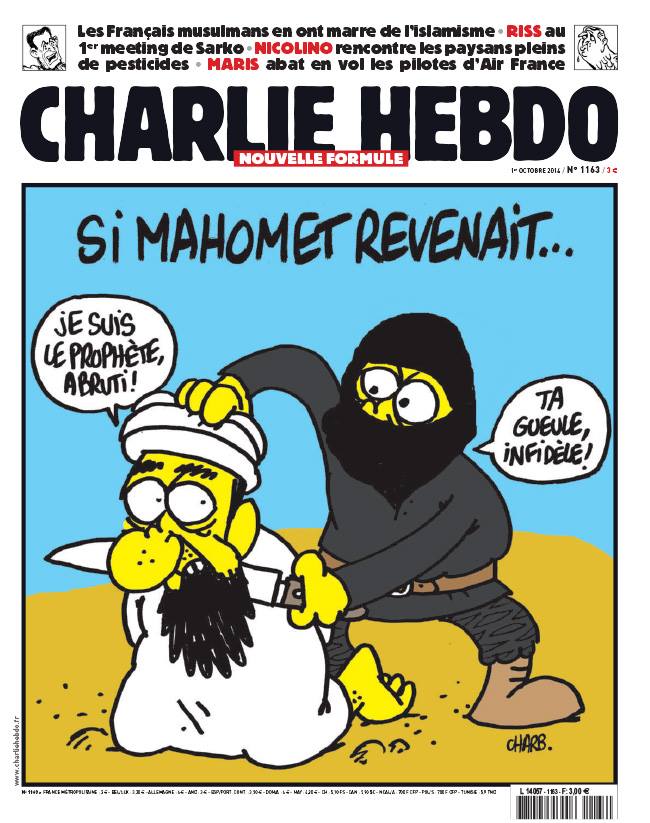
Charlie Hebdo on ISIS

Wonderful cartoon.

Arun's avatarArun with a View

charlie hebdo no1163 011014

Voilà the cover of the latest issue of Charlie Hebdo, which will hit the newsstands tomorrow (October 1st). For those whose French is not up to par, it reads:

IF MOHAMMED WERE TO RETURN…

“I’m the Prophet, idiot!”

“STFU, infidel!”

Charlie Hebdo nails it. Totally.

Somehow I think security will be reinforced outside Charlie Hebdo’s office in the 11th arrondissement.

ADDENDUM: For other irreverent CH covers I’ve posted on, go here, here, here, and here.

View original post

Robert Cushman: No, the feminists didn’t ruin English

For those interested in language, writing and debates over feminism, good piece, if a bit meandering, by Robert Cushman, taking down the arguments of David Gelernter on the use of he or she and equivalents, starting with yet another good Orwell quote:

George Orwell, another model author, once compiled his own list of rules for good clear writing; it culminated in the admonition to break any of his preceding instructions “rather than write something outright barbarous.” Which means that these things have to be approached case by case, to be judged by the eye and especially the ear.

I can’t understand, for example, why Gelernter should object to “firefighter” replacing “fireman”; it may have an extra syllable, but it’s still a more active and descriptive word.

Well, no, I can understand; he thinks that the change is the result of caving in to those New Feminists. For him, as for others, feminism is a word applied to anything that its employer dislikes or feels threatened by, a sort of all-purpose Bogeyman. (Or should that be Bogeywoman? The professor certainly wouldn’t countenance Bogeyperson; and neither, for the record, would I.) I can’t see why a female member of a fire brigade should put up with being referred to as a fire man. And neither side would welcome ”firewoman,” which just sounds silly (though “policewoman,” for whatever reason, doesn’t).

…. It’s likely true that students today enter university less equipped to write well than were their predecessors. But that isn’t the fault of feminism. It’s because both English language and English literature are taught less, and possibly less well, than they used to be; and because of the pervasive sloppiness of communication that underlies the abuses I noted in my opening paragraphs, none of which have anything to do with gender.

Gelernter puts it all down to “ideology,” another of those words that merely means something that its user disagrees with. It’s like “elite,” a term that the Left used to hurl at the Right, that the Right now throws at the Left, and that is equally meaningless either way. He begins his article by inveighing against the words “chairperson” and “humankind.” I think that the first is an abomination and the second quite unobjectionable, and my reasons in both cases are aesthetic, not ideological.

It’s true, as Gelernter says, that what any writer agonizes over while actually writing is where the next word is coming from. But those words aren’t chosen in a vacuum; they’re the expression of whatever idea the writer is trying to convey: of, if you insist, his ideology.

Yes, I said his ideology. Because, judging from this article, Professor Gelernter is quite the ideologue himself.

Robert Cushman: No, the feminists didn’t ruin English

Un jugement aveugle sur le niqab | Le Devoir

More on the niqab in Quebec, where a Quebec journalist, writing about the niqab (apparently in a balanced manner) had to pay damages to a niqab-wearing woman for publishing her picture without permission. Formality (requirement for permission) and substance (niqab provides anonymity):

En juin 2012, M. Cristea a publié un article où il décrit l’émoi causé par la vue d’un niqab au marché aux puces de Sainte-Foy. Son texte était accompagné d’une photographie de la femme en voile intégral en compagnie de son mari. La lecture de l’article ne révèle aucune intolérance, le texte soulignant seulement le choc culturel causé par le niqab dans une société non musulmane ; quant à l’identification des personnes photographiées, elle s’avère pratiquement impossible. Comme l’a écrit François Bourque, chroniqueur au Soleil et ancien président de la Fédération professionnelle des journalistes du Québec, le reportage incriminé est « sobre et factuel » et « n’incite pas à la haine, au mépris ou à l’intolérance » ; au sujet de la photo, le même journaliste affirme que « sauf pour des proches, il semble impossible de reconnaître la femme et difficilement son conjoint » Le Soleil, 30 janvier 2013.

….On peut s’étonner de cette décision de la Cour. D’abord, la question de l’identification des personnes est fort discutable : le niqab n’entraîne-t-il pas en effet l’occultation complète de l’individualité ? En outre, selon le juge, la publication de la photographie n’était pas d’intérêt public. Or, le sujet traité, le port du voile intégral, est d’une grande actualité et anime de nombreux débats tant au Québec qu’ailleurs dans le monde. Publier une photo d’une femme en niqab en complément d’un article qui porte justement sur le voile intégral afin de montrer aux lecteurs d’un journal que cette réalité existe bel et bien dans leur milieu, n’est-ce pas tout à fait fondé sur le plan journalistique ?

Enfin, le juge n’a pas tenu compte du fait que la photographie a été prise dans un espace public et non dans l’intimité d’une résidence privée. La femme musulmane, en se présentant au marché aux puces en niqab, devait savoir qu’elle quittait la sphère privée et qu’elle s’exposait ainsi aux regards et au jugement d’autrui. Elle aurait dû accepter toutes les conséquences de ce geste fait volontairement au sein d’une collectivité peu habituée à ce genre d’habillement.

En fait, le juge a retenu surtout l’argument du non-consentement, négligeant les aspects sociaux du litige. C’est là une tendance forte de nos tribunaux d’aujourd’hui qui, en vertu de la prédominance qu’ils accordent aux chartes des droits de la personne, en sont arrivés à évacuer la perspective sociale au profit de la seule perspective individuelle.

Cette cause soulève de façon très vive la question de la liberté de presse. Les tribunaux doivent certes intervenir devant les dérapages possibles des médias, particulièrement quand il s’agit de tromperie ou de diffamation. Mais ce n’est manifestement pas le cas ici. Le juge s’est permis, dans cette affaire, de condamner le travail d’un journaliste qui avait pourtant écrit un texte d’intérêt public dans un style très respectueux et avec une photo des plus pertinentes. Citons encore François Bourque, dans un autre article : « On note que [les] balises [établies par la Cour suprême] peuvent ouvrir la porte à une interprétation très restrictive de l’intérêt public. Ce n’est pas une bonne nouvelle pour les médias. »

Nous avons fait la connaissance de M. Cristea et nous avons pu constater combien il était sensible aux dangers que comporte le communautarisme dans lequel les immigrants risquent de s’enfermer et à quel point il avait à coeur de favoriser avant tout leur intégration pleine et entière à la société québécoise. En guise de remerciement, nos tribunaux n’ont trouvé rien de mieux que de le condamner à 7000 $ en « dommages moraux » au profit d’un couple qui n’a pas hésité à afficher le niqab en public, vêtement sexiste que le premier ministre Philippe Couillard lui-même entend faire interdire en tant que signe d’« instrumentalisation de la religion pour des fins d’oppression et de soumission » (Le Devoir, 26 septembre 2014). Il faut encourager M. Cristea à faire appel pour que le bon sens prévale dans ce pays. Nous l’assurons de tout notre appui dans cette démarche.

Un jugement aveugle sur le niqab | Le Devoir.

In the Fight Against ISIS, Islam Is Part of the Solution – The Daily Beast

Dean Obeidallah on anti-ISIS strategies that engage Islamic leaders and precepts to counter the ISIS narrative and acts:

Will this work? It is addressing ISIS’s very sales pitch, as documented in its online magazine, that invokes Islamic principles to lure people to join. And I can tell you this—it’s a much better approach than the State Department’s recently released video designed to dissuade Muslims from joining ISIS. That video simply showed images of violence, but its fatal flaw is that it didn’t use Islamic values to counter ISIS.

I’m sure some are asking: Why didn’t we see Muslim scholars do this before? Bedier responded that the Muslim community has become better organized in recent years and can now respond in a more united way. Plus there’s an understanding by Muslim leaders that many people of other faiths see only negative images of Muslims in the media, thus, making it important to not allow the extremists to define the faith.

I also believe there’s another reason why we are seeing this and why some Muslim nations have joined the military campaign versus ISIS. While ISIS potentially poses a threat to the United States, to many Muslims living in the Middle East, ISIS is a clear, present, and immediate threat. ISIS’s philosophy is in reality not “submit to Islam or die”; after all the group is slaughtering Muslims daily. It’s “submit to ISIS or die.” Nothing is a greater motivator than self-preservation.

The fight against groups like ISIS will likely be with us for years. No doubt that a military component must be part of this approach. But to really cut off ISISs pipeline of recruits and financial support from Muslims, it requires that we not view Islam as the problem, but actually as a big part of the solution.

In the Fight Against ISIS, Islam Is Part of the Solution – The Daily Beast.

Sheema Khan takes a similar bent, drawing upon the history of a 7th century fanatical Islamic-inspired cult, the Khawarij:

Today, theologians are warning Muslims about the dangers of the Islamic State by pointing to the movement’s similar theological underpinnings. Don’t be fooled by the flowery language, the invocation of God and the Koran, the readiness for martyrdom or the call to sharia – this is a fanatical cult that has deviated from the path of Islam, and its actions belie its adherents’ professed faith.

As with the Khawarij, the Islamic State has attracted misguided youth with “foolish dreams.” The Khawarij declared those with theological differences as “disbelievers” warranting death; the Islamic State has killed thousands of Muslims – Sunni and Shia – during its takeover of villages in Iraq and Syria. The Khawarij demanded the enslavement of women and children during the battle of Siffin (the Caliph Ali refused); the Islamic State has carried out this abominable practice. Both groups are willing to die in a heartbeat for their “beliefs.” Like the Khawarij, Islamic State members believe they are the only “true Muslims” while the rest are disbelievers, worthy of death. It has threatened all opponents, including Muslim theologians warning against its fanatical ways. Their self-professed piety is built on a foundation of arrogance.

If history is any lesson, this fight will not be for the faint of heart. Nonetheless, for Muslims, it will be a necessary battle for the very soul of their faith.

 Another battle with Islam’s ‘true believers’ 

David Motadel provides a useful history of previous Islamic-inspired revivalist rebel movements and state-builders:

At the same time, Islam was at the center of these movements. Their leaders were religious authorities, most of them assuming the title “commander of the faithful”; their states were theocratically organized. Islam helped unite fractured tribal societies and served as a source of absolute, divine authority to enhance social discipline and political order, and to legitimize war. They all preached militant Islamic revivalism, calling for the purification of their faith, while denouncing traditional Islamic society, with its more heterodox forms of Islam, as superstitious, corrupt and backward.

Today’s jihadist states share many of these features. They emerged at a time of crisis, and ruthlessly confront internal and external enemies. They oppress women. Despite the groups’ ferocity, they have all succeeded in using Islam to build broad coalitions with local tribes and communities. They provide social services and run strict Shariah courts; they use advanced propaganda methods.

If anything, they differ from the 19th-century states in that they are more radical and sophisticated. The Islamic State is perhaps the most elaborate and militant jihad polity in modern history. It uses modern state structures, including a hierarchically organized bureaucracy, a judicial system, madrasas, a vast propaganda apparatus and a financial network that allows it to sell oil on the black market. It uses violence — mass executions, kidnapping and looting, following a rationale of suppression and wealth accumulation — to an extent unknown in previous Islamic polities. And unlike its antecedents, its leaders have global aspirations, fantasizing about overrunning St. Peter’s in Rome.

And yet those differences are a matter of degree, rather than kind. Islamic rebel states are overall strikingly similar. They should be seen as one phenomenon; and this phenomenon has a history.

Created under wartime conditions, and operating in a constant atmosphere of internal and external pressure, these states have been unstable and never fully functional. Forming a state makes Islamists vulnerable: While jihadist networks or guerrilla groups are difficult to fight, a state, which can be invaded, is far easier to confront. And once there is a theocratic state, it often becomes clear that its rulers are incapable of providing sufficient social and political solutions, gradually alienating its subjects.

David Motadel: Why Islamic rebel states always fail

Multicultural Marketing: Tokenism Won’t Cut It – New Canadian Media – NCM

Good review by Gautam Nath of Robin Brown and Kathy Cheng’s book, Migration Nation: A Practical Guide to Doing Business in Globalized Canada:

Migration Nation introduces the concept of the Cultural Lens, which affects how people view products, services, or brands in the Canadian landscape. The Cultural Lens is shaped by one’s ethnic culture, pre-migration experiences with products and brands, and post-migration experiences of acculturation. Together, all those factors influence one’s habits and attitudes towards retailing, service style, and service conventions.

Our tastes and preferences are shaped by the language, cultural, religion, values, and habits from our countries of origin. Brown and Cheng provide the example of Chinese Canadians who, they say, may like orange juice, but “tend not to drink it in the mornings, unlike the mainstream, as they find it too cold and acidic, and therefore prefer something hot for breakfast.”

Yet, while such practices may trend culturally, they also vary by individual, particularly post-migration. Many immigrants experience a period of disorientation as they scramble to get their ducks in a row, but over a few years, a greater sense of belonging and ease develops as they acculturate, and although they never really forget or lose their cultural roots, a sense of independence begins to balance their earlier cultural practices.

“The settlement journey as we conceive it is not a linear process of leaving one’s ethnic culture behind and adopting something else,” the authors write. They very simply and meaningfully explain the stages of disorientation, orientation, belonging, and independence that characterize the immigrant’s settlement journey. It makes for interesting reading for any marketer, but perhaps especially for those not born overseas or who have not lived in another country.

Understanding the settlement journey will help marketers to better understand their consumers and the need to communicate with them in a more relevant and actionable manner.

Multicultural Marketing: Tokenism Won’t Cut It – New Canadian Media – NCM.

Conservatives received most election coverage in GTA ethnic newspapers – New Canadian Media – NCM

Interesting but not surprising research:

[April] Lindgren’s research, which will be published in the December 2014 issue of the Canadian Journal of Political Science, focused on coverage of the 2011 federal election in five ethnocultural publications in the Greater Toronto Area – the Russian Express, Korea Times Daily, Canadian Punjabi Post, Punjabi Daily and Ming Pao. All are daily publications except for the weekly Russian Express. The study concluded that while there was no overwhelming pattern of stories or photos skewed explicitly in favour of the Conservatives, the party did benefit in that more of its politicians were featured in photographs, it was the sole focus of more stories and photos than its competitors, and it was mentioned first most frequently in news coverage.

“The degree to which a candidate or party can consistently earn first mentions in stories…is a measure of campaign effectiveness in that it means party strategists are choosing the topic and framing the discussion, leaving the competition to react in later paragraphs,” Lindgren observed in the paper, entitled “Toronto-area ethnic newspapers and Canada’s 2011 federal election: An investigation of content, focus and partisanship.”

Lindgren said she was interested in investigating election coverage in the ethnic media because language barriers have limited the amount of research done in this area. During the 2011 election, the Conservative Party, in particular, also launched a media strategy that targeted ethnic communities, because a “growing number of ridings in and around major Canadian cities were home to concentrations of potential supporters from single ethnic groups,” Lindgren wrote.

In almost all cases the ethnic papers filled in gaps left by mainstream media by providing more extensive coverage of the local races of interest to their readers.

Most Canadian voters do not participate directly in political events and therefore depend on the news media to help them make informed decisions, Lindgren noted. In addition to examining whether the Conservative party’s courtship of ethnic media paid off in terms of coverage, the research also examined how much election-related news the ethnocultural publications carried, the subject matter dealt with in the coverage and the geographic focus of the reporting local campaigns versus national campaigns.

The results showed that interest in the election varied by publication. The Punjabi Daily carried the most election-related coverage – a total of 123 stories and photos, or 32 per cent of all news items the paper published during the study period. The Russian Express, on the other hand, published just 19 election-related stories and photos, which made up a mere 5.9 per cent of their total news items. The study also observed that both the Punjabi Daily and the Punjabi Post were more similar to mainstream news coverage in that both publications ran more stories about election strategy and poll results than issue-related articles.

Analysis of the election coverage also suggested that individual newspaper’s commitment to election coverage seemed to be influenced by the number of candidates from the publication’s readership community. The Punjabi newspapers, which carried the most election news, also had the most in-group candidates to cover.

Conservatives received most election coverage in GTA ethnic newspapers – New Canadian Media – NCM.

Hockey used to ‘Canadianize’ new immigrants and help grow the sport

Good initiative:

There’s an appetite for hockey within this new, largely untapped, market according to Dave Croutch, Director of the North York Hockey League.

He says introducing the sport to new immigrants is an effective way to build community and integrate them more seamlessly into North American life.

“If Billy and Johnny are talking about hockey in the playground at school, [some students] previously were not part of that conversation. But now that they’re playing the game, they are actually part of the conversation,” said Croutch.

Maple Leaf Sports and Entertainment donated hockey equipment to the effort. They acknowledged introducing hockey to new immigrants is a good way to grow the sport and add diversity to the game.

“You look at Nazem Kadri for the Toronto Maple Leafs and his ethnicity. It’s a great thing for the diversity of Toronto,” says Nilesh Chauhan, who’s with the MLSE Foundation.

“The most I enjoy about hockey is that now if we get our own rink, we can play as much as we want. Because before it cost a lot of money and we didn’t get enough ice time,” says Ayaan, a young boy who was donning a Maple Leafs jersey during the fundraiser.

Hockey used to ‘Canadianize’ new immigrants and help grow the sport – Toronto | Globalnews.ca.

Rex Murphy: The case for revoking the citizenship of Canadian terrorists

Rex Murphy makes the case for revoking citizenship.

Like Wente (How can we stop the jihadi tourists? – Margaret Wente), he forgets, either by design or by ignorance,  to mention that this means different treatment for the same crime based upon whether one has Canadian or dual nationality:

Priests are defrocked; medals from honour societies have been imperiously stripped from their holders; soldiers are court-marshalled and drummed out in disgrace; lawyers disbarred, judges swept from the bench, Senators tossed from caucuses, and even Presidents impeached.

The soldier who flees in combat and exposes his fellows to danger is seen as not worthy of being a solider. The judge who has oiled his palm with a bribe is seen as not worthy of being a judge. Treason and excommunication are long-standing responses to ultimate disfealties — and they are surely a kind of cancellation of status, one by the death penalty, the other by exclusion from the community of believers and the possibilities of salvation.

To my mind, these are all of an inferior enormity to the case of a citizen who abandons the country in which he was born, or to which he gave the oath of citizenship, who then pledges his fealty to a murderous band professing a murderous creed.

It’s a strange world in which we have even to contemplate such exigencies, but it is a strange world we find ourselves in today, in which nationals of the democracies willingly travel abroad to invest themselves in the orders of international terrorism, spit on their achieved citizenship, and threaten the safety of their onetime fellows in nationality.

The denial of passports is a stage toward the denial of citizenship. But the denial or witholding of passports is not a sufficient signal of the detestation a country and its people hold for those who so contemptuously forsake the gifts of loyalty and respect that a country rightfully commands from real citizens.

So to use his examples, decisions to defrock a priest do not depend on whether he was born into that religion or converted.

Neither are medals stripped, soldiers court martialed, lawyers disbarred, judges swept from the bench, or Senators tossed on the basis on the distinction whether they are single or dual nationality.

It is the crime or infraction that determines the punishment, with the same punishment for the same crime.

Passport cancellation applies to all, Canadian-born or naturalized, single or dual nationality, and thus consistent with the fundamental principle of equal treatment.

So pursue relentlessly, punish through the Canadian justice system but don’t make a distinction between nationality. After all, we have any number of Canadian-only nationals involved in extremist activity (e.g. Damian Clairmont, the Gordon brothers, John Maguire).

Rex Murphy: The case for revoking the citizenship of Canadian terrorists

The Barbarians Within Our Gates – Hisham Melhem

A thoroughly depressing article on the failure of Arab states, unfortunately one that rings all too true:

Almost every Muslim era, including the enlightened ones, has been challenged by groups that espouse a virulent brand of austere, puritanical and absolutist Islam. They have different names, but are driven by the same fanatical, atavistic impulses. The great city of Córdoba, one of the most advanced cities in Medieval Europe, was sacked and plundered by such a group Al Mourabitoun in 1013, destroying its magnificent palaces and its famed library. In the 1920s the Ikhwan Movement in Arabia no relation to the Egyptian movement was so fanatical that the founder of Saudi Arabia, King Abdul-Aziz Al Saud, who collaborated with them initially, had to crush them later on. In contemporary times, these groups include the Taliban, al Qaeda and the Islamic State.

Yes, it is misleading to lump—as some do—all Islamist groups together, even though all are conservative in varying degrees. As terrorist organizations, al Qaeda and Islamic State are different from the Muslim Brotherhood, a conservative movement that renounced violence years ago, although it did dabble with violence in the past.

Nonetheless, most of these groups do belong to the same family tree—and all of them stem from the Arabs’ civilizational ills. The Islamic State, like al Qaeda, is the tumorous creation of an ailing Arab body politic. Its roots run deep in the badlands of a tormented Arab world that seems to be slouching aimlessly through the darkness. It took the Arabs decades and generations to reach this nadir. It will take us a long time to recover—it certainly won’t happen in my lifetime.

My generation of Arabs was told by both the Arab nationalists and the Islamists that we should man the proverbial ramparts to defend the “Arab World” against the numerous barbarians imperialists, Zionists, Soviets massing at the gates. Little did we know that the barbarians were already inside the gates, that they spoke our language and were already very well entrenched in the city.

The Barbarians Within Our Gates – Hisham Melhem – POLITICO Magazine.