Canadians with alleged terrorist links – Canada – CBC News

The list as compiled by CBC.

And the normal mix of those who have dual nationality (or who have citizenship rights from another country) and who can have their citizenship revoked, and those who have Canadian citizenship only, who cannot:

Likely Dual Nationals

Likely Canadian Only

Canadians charged by the RCMP but still at large

Ferid Ahmed Imam

Ahmad Waseem

Maiwand Yar

Hasibullah Yusufzai

Canadians reported to be fighting or supporting extremists abroad, but not charged

Mohammed Ali

Sami Elabi

Um m Haritha

Omar Hassan

Mohammad Ibrahim

Abu Dujana al-Muhajir

Farah Mohamed Shirdon

Collin Gordon

Gregory Gordon

John Maguire

Canadians accused of possible terrorist links by other countries

Faker Boussora

Abderraouf Jdey

Amer El-Maati

Abu Ameenah Bilal Philips

Canadians with alleged terrorist links – Canada – CBC News.

And the accompanying article and debate whether the list should be broader (i.e., lower standard of proof to be on the list):

Who are the most wanted extremists in Canada?

How to think about “think” tanks

Interesting observations on think tanks.

MilesCorak's avatarEconomics for public policy

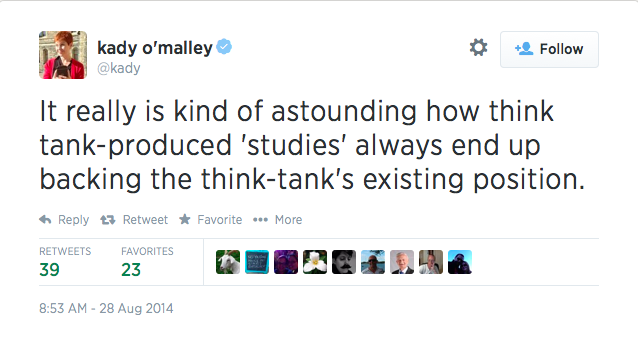
Kady O'Malley Tweet on Think Tanks 1It is sometimes said that think tanks are good for democracy; indeed the more of them, the better. If there are more ideas in the public arena battling it out for your approval, then it’s more likely that the best idea will win, and that we will all have better public policies. But intuitively many of us have trouble believing this, have trouble knowing who is being truthful, and don’t know who to trust.

This battle of ideas, studies, and statistics has the potential to make many of us cynical about the whole process, and less trusting of all research and numbers. If a knowledgeable journalist like the Canadian Kady O’Malley expresses a certain exasperation that think-tank studies always back up “the think-tank’s existing position,” what hope is there for the rest of us? A flourishing of think tanks just let’s politicians off the hook, always allowing them to pluck…

View original post 2,585 more words

Majority of Canadians worry about domestic terrorism, according to new survey

Results are not that surprising, given recent events, and given that civil liberties rarely do well in public polling.

But encouraging that people recognize the importance of prevention and the contributing role of mental illness and marginalization:

Almost two-thirds of Canadians believe homegrown terrorism is a serious issue, but most do not perceive a threat from radicalized individuals in their communities, according to a new survey.

The national poll, conducted in the wake of deadly attacks on Canadian soldiers, found that just over half of respondents supported new anti-terror legislation that would boost the powers of Canada’s spies. Another 22 per cent said the government should go even further, suggesting they have not been swayed by civil liberties concerns.

At the same time, those surveyed recognized that there are many factors behind radicalization — religion, mental illness and marginalization — and seemed open to a range of preventative measures, not just punitive ones.

“People are sensitive to the fact this is a complex issue that requires a comprehensive approach,” said Christian Leuprecht, a security expert at the Royal Military College of Canada and Queen’s University.

Majority of Canadians worry about domestic terrorism, according to new survey.

‘Wage jihad against jihadism’: ‘Progressive’ Muslims

Outreach to the more secular segment of the Canadian Muslim community and some of the minority sects, whereas many of the challenges are with the more fundamentalist and ‘mainstream’ sects and individuals. While valid, a bit preaching to the converted:

Acknowledging that military action, which also includes arming and training Iraqi and Kurdish security forces, would not stop ISIS by itself, he [Kenney] said it had at least “stopped the spread of Daish [the Arabic name for the group] in Iraq, and we will never know how many lives it has saved.”

The minister made the comments at an event organized by the Coalition of Progressive Canadian Muslim Organizations, which brought together leaders of Canadian Yazidi, Christian, Shia, Ahmadiya, Jewish, Sunni, Kurdish and other groups to discuss strategies for fighting ISIS.

Kamran Bokhari, a Middle East analyst and author, said it was up to police and intelligence agencies to deal with those who break the law, “but they can’t police ideology, that’s the job of the Canadian Muslim community.”

He said a Muslim mainstream would have to emerge to moderate the extremists, whom he noted were not present at the event. “Ultimately what we need to do is wage a jihad against jihadism,” he said, defining the problem as “it’s our way or the highway” thinking.

“How do we reach out to them? That is our challenge.”

The national president of the Ahmadiya Muslim Jama’at Canada, Lal Khan Malik, blamed Muslim scholars whom he said had misunderstood the concept of jihad as a call to kill non-believers. “This is a grossly misguided understanding of Islam,” he said.

The Coalition’s Facebook page hasn’t been active since December 2013 so unclear how active the group is (although the President, Salma Siddiqui, is a regular commentator on Islam and radicalization issues).

‘Wage jihad against jihadism’: ‘Progressive’ Muslims eager to reach out to radicalized youth in Canada

Opinion: Multiculturalism should not be misused to justify divisions: Farid Rohani

Farid Rohani of the Laurier Institution on multiculturalism and integration:

Canadians must understand that multiculturalism is not about segregation and division.

What we are seeing now, more and more, is a polarization and mistrust among significant segments of our population. What is needed, then, is a more unified vision of Canadian society, one that emphasizes interdependence and cooperation among diverse groups, beginning at arrival and continuing at schools and throughout our communities.

Failure to do so will see some within our communities who don’t understand or accept the fundamental concept of pluralism use violence, including acts of terror and fear to import distant conflicts onto our shores. There will be attempts at imposing their beliefs on the rest of society and they will use, support or facilitate violence, as a method to effect societal change to achieve their goals.

Any polling I have seen suggests that Canadians get it and view multiculturalism in this manner, and place emphasis more on integration than an “anything goes” accommodation.

And no matter what governments and others do, there will always be some who sit outside that political consensus, whether in the context of religious fundamentalism (or other fundamentalisms) or violent extremism.

Overly general, without concrete or practical suggestions.

Opinion: Multiculturalism should not be misused to justify divisions | Montreal Gazette.

Women gain on corporate boards but visible minority representation dips

Incredibly low number for visible minorities:

Women have climbed slowly but steadily in recent years from 10.9 per cent of directors in 2001 to 13.7 per cent by 2009 and 15.6 per cent in 2013, the study shows.

However, visible minorities hold just 2 per cent of board seats, a decline from 5.3 per cent in 2010, and people who report having disabilities fill just 1.4 per cent of board seats, down from 2.9 per cent in 2010. Aboriginal directors hold 0.8 per cent of board seats, a number unchanged from 2010.

Diversity council founder Pamela Jeffery said it is disappointing to see a decline in visible minority directors while Canada’s population – especially in major cities where head offices are located – becomes steadily more diverse.

“I think it underscores what we know, which is that most board seats are filled in a less-than-desirable way, with board members sitting at the table asking each other who they know,” she said. “Sadly, aboriginal people or people with disabilities are not in their networks.”

Ms. Jeffery said she is encouraged, however, that the rate of increase for women on boards has accelerated, growing by 1.5 percentage points between 2013 and 2014 after increasing by just 0.32 percentage points in each year on average between 2001 and 2012.

However, Ms. Jeffery said the level of gender diversity remains low compared to many other major countries. Britain, for example, will have 25 per cent women on boards of its top 100 companies by next year, she said.

Women gain on corporate boards but visible minority representation dips – The Globe and Mail.

BBC News – Radicalisation risk at six Muslim private schools, says Ofsted

Ongoing issue in UK schools, this time at private faith-based Muslim schools:

At one school, inspectors found pupils did not know the difference between sharia and British law.

And they said the curriculum at Mazahirul Uloom School in Tower Hamlets “focused solely” on Islamic themes.

In a letter to Ms Morgan, Sir Michael said he was “extremely concerned about the large number of failings” in each of the six schools and was “not convinced” current managers were capable of making necessary improvements.

“I believe that, in all six schools, pupils physical and educational welfare is at serious risk,” he wrote.

“Given the evidence gathered from these inspections, particularly in relation to the narrowness of the curriculum, I am concerned that pupils in these schools may be vulnerable to extremist influences and radicalisation.”

BBC News – Radicalisation risk at six Muslim private schools, says Ofsted.

Enhancing Creativity Through Multiculturalism

Some interesting research on creativity and multiculturalism from Singapore:

In one study, Professor Leung exposed European American undergraduates to one of these three conditions using a 45-minute multi-media slideshow:

  1. single culture through presenting pictures of items that depicted either the American culture e.g., the Statue of Liberty, a hamburger or the Chinese culture e.g., the Great Wall, hotpot dinner on each slide;
  2. dual cultures through presenting pictures of items that depicted American culture and pictures that depicted Chinese culture on each slide; and,
  3. fusion of cultures e.g., a picture of Starbucks’ mid-Autumn festival mooncakes.

She found that participants demonstrated better creative performance when exposed to dual cultures and fusion of cultures, compared to those who were exposed to a single culture. Their creative performance persisted five to seven days after initial exposure.

“Initially, I thought those who were exposed to the fusion culture would perform the best. But the tendency was that those who were exposed to two different cultures showed more creativity. Perhaps the exposure to separate cultures gave them the space to engage in cognitive juxtaposition of the ideas from the respective cultures. When they seek to actively compare and contrast the presented cultures, they delve deeper into the different cultural representations and receive more creative inspirations,” she says.

Another significant finding from her research was that while multicultural individuals tended to be more creative, other considerations had to be taken into account, such as how open and receptive an individual was to new experiences.

Enhancing Creativity Through Multiculturalism | Asian Scientist Magazine | Science, Technology and Medicine News Updates From Asia.

Immigrants took the brunt of recession-year turn toward self-employment

Self-EmploymentInteresting study by StatsCan on the effects of the 2008 recession and increase in self-employment:

During the recent recession in Canada, rates of self-employment increased by 3.9 per cent, while paid employment in both the private and public sectors shrank by 4.1 per cent and 1.6 per cent, respectively.

“Economic downturns do not impact all groups of workers equally. It is newcomers, particularly those recently arrived, who are more likely to lose their paid employment compared to Canadian-born workers,” says the 48-page study.

“These workers are often left to compete for low-paying, part-time and temporary types of precarious jobs to survive . . . Some workers are pushed into self-employment as a means to replace lost income from paid employment and due to the failure of government social safety nets.”

Toronto immigrants also fared worse than their Canadian counterparts in self-employment, with median income at $7,270 a year — $560 less than non-immigrants. They were also more likely to work in trade and transportation industries, while the business and professional services sectors are the most common for self-employed Canadians.

The newcomer group had a median before-tax total income including paid jobs of $17,220, compared with $25,180 for non-newcomers, though immigrant men made almost $1,000 per annum more than newcomer women.

Immigrants took the brunt of recession-year turn toward self-employment | Toronto Star.

Holocaust memorial should be returned to its rightful home

Op-Ed by Bernie Farber and myself on the Daniel Libeskind memorial of Jewish refugees on the MS St. Louis not admitted to Canada prior to the outbreak of World War II:

The Wheel of Conscience serves as a reminder, in today’s troubled times, of the need for a more understanding and welcoming approach to refugees, whether we’re talking about the millions displaced in the Mideast or the refugee claimants fighting for health-care access here in Canada. And it serves as a reminder, too, of the terrible cost of the opposite approach.

Treating the Wheel as so much junk packed away in a dark warehouse for no one to see is a disgrace. Canadian Holocaust survivors have stated their desire to have the memorial at Pier 21 where it properly deserves to be.

It is time for the federal government under whose auspices Pier 21 operates to take action.

The Wheel of Conscience belongs at the gateway to Canada, where it can stand as a canary in the mine, a cry against inhumanity and intolerance. Let it no longer be a refugee, let it be granted its proper home.

http://t.thestar.com/#/article/opinion/commentary/2014/11/18/holocaust_memorial_should_be_returned_to_its_rightful_home.html