Holiday Break and Season’s Greetings
2014/12/15 2 Comments
 Best wishes to all readers. Will restart in the New Year.

Working site on citizenship and multiculturalism issues.
2014/12/15 2 Comments
Best wishes to all readers. Will restart in the New Year.
2014/12/13 Leave a comment
More commentary on deradicalization approaches:
And while these may seem to be the only two options open to Canadians who turn down the path of violent extremism — death or a court date — experts say a third option — deradicalization — isn’t receiving the attention it deserves.
“These programs can work,” said Jocelyn Bélanger, a psychology professor at the Université du Québec à Montréal who has studied radicalization around the world.
“Even though the number of cases (of homegrown extremism) are limited, we know how much damage just a few individuals can create. … If we do it well, if we read the research on this, we can develop better programs. We can be preventive as well, flagging individuals who are at risk, and once they are flagged they go into a (deradicalization) program.
”Existing approaches to this type of “deprogramming” have had varying degrees of success, and the rehabilitation is usually offered on a voluntary basis, Bélanger said. In most cases, the “beneficiary” is given a choice, to serve their sentence in jail or in a special facility.
“I know it sounds like a false choice, but it is nonetheless psychologically important,” explained Bélanger. In Saudi Arabia, he noted, “Imams will actually use the Qur’an, will engage in discussion with the beneficiary about the Qur’an, ultimately trying to convince them that Islam does not support the killing of innocents.”
Changing the minds of wannabe terrorists.
Farzana Hassan, who seems to be oblivious to the many messages from Canadian Muslims against extremism:
Muslims need to transcend the propaganda that has so defined their narrative on these issues and reject the naive “crusader” fiction.
Tragically, this is a point lost on the majority of the faithful, even supposed moderates.
Mosques must discredit this narrative actively, and they must preach the values of Canadian identity even above religious affiliation.
While Muslims are of course entitled to remain distinct, they must abide not only by the laws of the land but also by its universal values.
Inciting the murder of innocent Canadians is a clear violation of those laws and values.
In dealing with religious extremism, true moderation involves more than refusing to commit violence; it involves campaigning against the absurd political assumptions that may encourage it in others.
…It is the obscurantist views of extremists like Maguire that have hampered progress towards economic prosperity and political stability in the Muslim world for so long.
Muslims must not see attacks on ISIS as attacks on their religion as a whole.
On the contrary, they may help alleviate all the burdens that have bedeviled the Islamic world for so many decades.
Al Canadi’s rants are those of an impressionable and disturbed young man brainwashed by a lethal world view, a view so simplistic we can only wonder at its appeal.
http://www.torontosun.com/2014/12/11/john-maguire—brainwashed-disturbed …
Michel Petrou provides a good overview of some of the challenges with deradicalization and the absence of an equivalent program in Canada, citing the UK experience in particular:
Usama Hasan, a British imam and senior researcher at the Quilliam Foundation, a counter-extremism think tank in Britain, says he is “astonished” that Canada does not have a de-radicalization program for Canadians who have returned from Syria and Iraq.
“There may be a risk that they’ve spent time with extremist groups and been brutalized by the war. So there’s always a risk that their minds won’t be thinking straight. So it’s very important to have ‘de-rad,’ which has to include a bit of mental health counselling and looking at PTSD and things like that,” he says.
“Even if they are prosecuted and convicted, you still need to de-rad them, because they will eventually be released from prison, and quite possibly they will be even more of a threat then because they will have been hardened in prison, and so they’re a threat either way.”
When he was a student at Cambridge University in the early 1990s, Hasan left Britain and briefly joined the Islamist insurrection, or jihad, against Afghanistan’s communist government.
At the time, Hasan was a radical Salafist and followed an extreme interpretation of Islam. He has since become much more moderate. In addition to officiating at interfaith marriage ceremonies, he now advises the British government on its own de-radicalization program, dubbed Channel.
People immersed in extremist groups “live in a kind of disconnected world,” says Hasan.
“They have their own reality, which they invent and perpetuate among their group by repeating the same old propaganda over and over again, but also blocking out anything that runs counter to that world view. We have to find holes in their world view and try to get through to them in as many ways as possible to make them doubt and rethink those kinds of ideas.”
Has likens the process to convincing someone to leave a gang. “You have to give them alternatives, address their needs,” he says.
When extremists rely on their faith to justify their world view, “you have to address all those religious points as well,” he says, “with better religion.”
Hasan describes recently counselling a young man who was determined to go to Syria. Hasan says the man knew “almost nothing” about the conflict there, or about the Middle East in general.
“People had just told him it was a war between Muslims and non-Muslims, and it was his duty to go and fight for Islam.”
The man believed there were American ground troops in Syria whom he could fight. Hasan educated him about the war, especially its sectarian nature and the ongoing slaughter occurring between Muslims. The potential recruit decided to stay in Britain.
He was lucky. Many others have left from Britain, Canada and other Western countries and died far from home. Some have committed horrific atrocities. Some will come back. Whether we like it or not, we’re going to have to figure out a way to live with them.
Canada’s extremist problem – Macleans.ca
From the US and the need for a more differentiated approach:
“Should they be prosecuted, should they be counseled, should they be reintegrated in a more compassionate way?” says Juan Zarate, who used to be a terrorism official at the Treasury Department. He’s now at the Center for Strategic and International Studies.
“Those are important questions because to the extent they are not fully radicalized, they perhaps were lured by a romanticized vision of what life was like in Syria,” he says. “Maybe it is appropriate to apply different tools and measures to peel them away from the movement as opposed to the same tools we have applied to more hard-core members of the group.”
When Americans Head To Syria, How Much Of A Threat Do They Pose?
2014/12/13 Leave a comment
Good article in The Economist regarding state control of mosques and Imams to reduce radicalization:
In fact, the Saudi effort to tone down its clerics is mild, hesitant and belated compared to what some Muslim states do. Uzbekistan, Kazakhstan and Tajikistan already routinely use cameras. Kuwait has long installed tape-recorders to monitor Friday sermons. Preachers in the neighbouring United Arab Emirates need not write their own sermons. Except for a few trusted senior clerics, they read instead from a text delivered weekly by the government department for religious affairs that also pays all their salaries. “Protecting Youth from Destructive Ideas” and “Our National Flag, Symbol of Affiliation and Loyalty” provided two stimulating recent topics. Similarly, Turkey has for decades enforced a monopoly of Islamic discourse via a religious bureaucracy, known as Diyanet, that wields 121,000 employees and a budget of $2.3 billion.
Other governments aspire to such dominance. Tunisia’s government has in recent months restored strict state control of mosques that had slipped following its revolution of January 2011, leading to a brief flowering of Wahhabist-style jihad promotion. Morocco, whose king has traditionally posed as Commander of the Faithful, delivering televised Ramadan sermons, has steeply boosted state promotion of a relatively tolerant version of the faith. Its budget for training imams, including a growing number of foreign students, has swollen tenfold in the past three years. The unspoken aim is to counter the spread of extreme Salafist ideas in places such as Mali and northern Nigeria.
…Egypt’s government has of late clamped unprecedented controls. In January it decreed that all Friday sermons must adhere to a weekly theme set by the religious-affairs ministry, establishing a hotline to allow worshippers to denounce preachers daring to voice political dissent. Further decrees required all preachers to be government-licensed, imposed a code of ethics forbidding discussion of politics in mosques, and banned smaller prayer halls from holding Friday prayers. The ministry fired 12,000 preachers and now allows only those trained in government-approved institutes to deliver sermons.
…As a foil to the powerful Brotherhood, the [Egyptian] state had long allowed followers of quietist forms of Salafism to run some 7,000 mosques. But the ministry in September decreed it would take over their mosques too, after reports of a sermon forbidding the faithful from buying interest-bearing government bonds.
Amr Ezzat, an Egyptian researcher, sees the effort to impose state-ordained orthodoxy as misguided and possibly dangerous. Religious institutions will lose legitimacy with time, pushing more Muslims towards radical margins. And by acting in effect as the imam, the state takes upon itself a duty to enforce morality. It is perhaps as a sop to religious conservatives, for instance, that Egyptian authorities have mounted an increasingly lurid campaign against homosexuality, most recently by staging a midnight raid on a Cairo bathhouse on national television, dragging a score of naked men to prison.
The state and Islam: Converting the preachers | The Economist.
2014/12/13 1 Comment
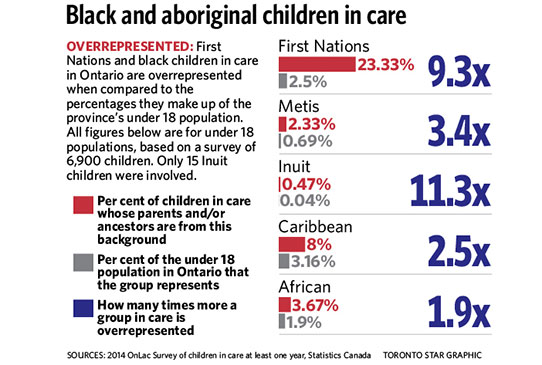 Interesting but not surprising. Having the data allows questions and discussion:
Researchers concluded the results were influenced by the 2008 recession, which affected blacks more than whites and caused more strain on families. Poverty, it noted, is the strongest predictor of maltreatment rates.
Most children’s aid societies in Ontario don’t keep income statistics on the families they serve. The new provincial database won’t capture that information either. But local CAS officials know poverty is often a factor.
“Sometimes people don’t want to make the connection between poverty and child protection,” says David Rivard, chief executive officer for the Toronto CAS. “But there is a correlation. That’s the reality.”
A recent report on child poverty in Toronto co-authored by the agency noted that 41 per cent of children of southern and eastern African heritage are growing up poor — more than three times the rate of children with roots in the British Isles. Meantime, 26 per cent of children whose families are from the Caribbean and 25 per cent from North Africa live in poverty.
Groups serving the black community are trying to bridge the cultural divide that can land children in care. The common use of spanking to discipline children in Africa and the Caribbean, for example, can lead to astonished parents being charged with assault.
… After the Star began asking about the over representation of black youth in care, the Ministry of Children and Youth Services met with CAS officials, the provincial child advocate and Parsons’ African Canadian Legal Clinic.
Children’s aid officials and the legal clinic late last month submitted a funding proposal for a project to look into why the numbers are so high and how to reduce them.
“This cannot be just another study or training program,” Parsons insists. “What I want to see is concrete, substantive change — a reduction in those numbers.”
Parsons and other advocates say the numbers won’t go down until family counsellors from their community team up with CAS workers on every protection investigation involving a black child. That’s how Texas, for example, reduced the number of black children and youth in care.
“I’m not saying there aren’t kids in our community who should be in care,” Parsons says. “But the first approach for an African-Canadian child should not be apprehension and care. And that’s what the numbers are saying to me right now.”
Why are so many black children in foster and group homes? | Toronto Star.
2014/12/11 Leave a comment
Some of the anti-extremist messaging by Canadian Muslims:
If you are a Canadian Muslim, considering joining ISIS, here are a list of sins you will commit if you do:
– You will murder the People of the Book, mainly Iraqi and Syrian Christians and others, without justification.
– You will destroy churches.
– You will kill innocent Muslims, Sunni, Shia and others — including seniors, the disabled, women and children of all ages.
– You will destroy mosques, Sunni and Shia.
– You will remove people, Muslims, Christians and others, including those many consider “believers” from their homes and promote the exodus of innocent families from the region to refugee camps, where many suffer and some die, including seniors, children and pregnant women.
– You will dishonour your parents, particularly your mother, upon whom there is the duty to regard in the highest honour, regardless of her faith.
– You will engage in acts of rape and child abuse, none of which is permissible.
– You will act in contravention of the laws of your country, the nation of Canada.
– You will imitate the oppression perpetuated by the established tribes of Mecca, during the period of jahiliyya, against our Holy Prophet Muhammad (pbuh). It was as a result of such oppression that our Holy Prophet (pbuh) joined with Jews, Christians and pagans to stop such oppression, as our Iraqi and Syrian brothers and sisters, against ISIS, are doing now.
As well, many Muslim Canadians, including peaceful conservative ones, those you likely consider “strong” Muslims, will no longer consider you part of the Muslim Ummah. As a result of your expressed hatred for much of humankind, you will be considered a kufr, subjected to takfir.
A Muslim Message to Those Leaving Canada to Join ISIS | Shahla Khan Salter.
2014/12/10 Leave a comment
More on corporate board director diversity (or lack thereof) by Anita Anand and Vijay Jog (see earlier post Women gain on corporate boards but visible minority representation dips):
In light of these arguments in favour of board diversity and given the ever changing mix of the Canadian population in general, one might think visible minority directors would be more present on Canadian corporate boards. But this is not the case. We have found they represent 5.5 per cent of directors of TSX-listed firms (and less if certain foreign-owned firms are excluded). Visible minorities represent only 4.2 per cent of those graduating from director-education programs, some of whom have previous board experience as an admission requirement.
The percentage of women is much higher in both cohorts; white women comprise 26 per cent of graduates of director programs but only 12 per cent of public company board members. Thus corporate boards have much fewer visible minority directors relative to both white women and white men.
But does diversity even matter? Prior academic research has been somewhat inconclusive. We find that firms with white male boards do not show significantly better performance than firms with boards comprised of females and visible minorities. We do not claim that these results show causality since it is possible that firms that demonstrate superior stock performance are forward-thinking or that investors respond positively to such proactive measures. At the very least, our results suggest that there is no performance deterioration by having a diverse board.
Visible minorities contribute significantly to GDP and represent a high growth segment of the population. Let’s open up the conversation about board diversity beyond gender parity and consider whether boards should bear some demographic similarity to the society in which the corporation operates. Corporate Canada will need to face this issue at some point: why not now?
2014/12/10 Leave a comment
I think the experts have it about right. The videos may resonate with some who are already down the radicalization path but are unlikely to trigger interest in radicalization:
[Amarnath] Amarasingam says ISIS’s belief that it can win followers by throwing a few local references into its boilerplate message about Muslim grievances is ineffective.
Theyre “making an argument from deep inside the jihadi narrative,” hoping that it will resonate with westerners “who don’t believe in that narrative.”
The fact that Maguire emphasizes that he was a “bright” student with a “strong” grade-point average in university is ISIS’s attempt to counter the idea that Westerners who join the group suffer from mental problems, says Paul Bramadat, director of the Centre for Studies in Religion and Society at the University of Victoria.
Maguire appears to be challenging “the notion that only terribly alienated, dislocated, or mentally disturbed people might be attracted to this particular religious or political ideology,” says Bramadat, who is also the co-editor of the book Religious Radicalization in Canada and Beyond.
“By underlining his very ordinary upbringing – the hockey, the music – he is saying, Look, I have been a normal member of Canadian culture. I know what I am talking about. I am not an outsider.”
But any right-thinking person can see through it, says [Robert] Heft. “Who is [the message] really going to? A young, uneducated, sometimes depressed and unstable person in society.
“Theres nobody who is a balanced person who says, Wow, he’s fighting a great cause.”
2014/12/09 Leave a comment
Interesting study by Vince Showers, a US finance professor, on the spending patterns of the religious (no breakdown by religion):
After using a lot of fancy statistical tools, they came up with some expected findings, and some rather unexpected ones. Households “with a strong commitment to faith”— demonstrated by higher spending on religious activities—are less likely to be weighed down by excessive mortgage outgoings or loan payments for cars. Compared with other households, they are more likely to be home owners but their property tax burden tends to be less—suggesting that “some moderation in [the] selection of home in terms of extravagance or location….”
Devout households seem keener on mitigating risk and therefore spend more on life insurance and health insurance; they lay out less on alcohol and tobacco and more on domestic appliances, including cooking utensils. Such homely behaviour is most heavily correlated with religious belief in the American South and Midwest, which are also the regions with “the most conservative interpretation of scripture,” Mr Showers notes, in an article in the Interdisciplinary Journal of Research on Religion. (The research more-or-less conflates the term “religious” with “Christian” or “Judeo-Christian” which in the American context is only a smallish distortion.)
But religious families do allow themselves some earthly pleasures. Indeed, they are if anything a little more likely than other households to spend spare money on clothing or jewellery, although the amount each household splurges on jewellery is a bit less. Some of that jewellery, of course, might be devotional: silver crosses or stars of David. They are as likely as anybody else to be spending money on child support or alimony—a proxy for failed marriages—and they are as inclined as other folk to incur interest payments on credit cards.
Religion and spending: Prudent but not puritan | The Economist.
2014/12/09 Leave a comment
The latest ISIS recruitment video, starring John Maguire from Ottawa (see earlier profile on Maguire’s troubled past in Ottawa jihadi seeking ‘martyrdom’ with ISIS in Syria | Ottawa Citizen):
“It follows quite closely to the theme of a variety of videos aimed at Western audiences, like the video aimed at French Muslims a few weeks ago,” said Professor Amarnath Amarasingam of the Dalhousie University Resilience Research Centre, who is studying Canadian foreign fighters.
“The interrelated themes are of course ones of religious obligation: if a caliphate has been established and Muslims have been persecuted by the state you are living in, you are required to leave the state you are living in. The risk of staying is hellfire. Maguire’s video is similar to the video aimed at French Muslims, asking a simple question: what are you waiting for?”
The video refers repeatedly to the October killings of two Canadian Forces members in Quebec and Ottawa by men who had adopted Islamist extremist beliefs. It said the attacks were a “direct response” to Canada’s military role in Iraq.
“The more bombs you drop on our people, the more Muslims will realize and understand that today, waging jihad against the West and its allies around the world is beyond a shadow of the doubt a religious obligation binding upon every Muslim.”
John Maguire, Ottawa man fighting for ISIS, urges attacks on Canadian targets in video
And good in-depth reporting on deradicalization programs in Germany and Denmark in the Globe:
Reversing radicalization through anti-terror ‘psychological warfare’
2014/12/09 Leave a comment
Douglas Todd on the annual ‘War on Christmas’ ritual, and the need for greater public recognition of faith:
Instead of inadvertently silencing Christian and other religious people, then, let’s truly recognize this is a pluralistic country, with many faiths and secular world views.
That means encouraging the expression of virtually all world views, religious and secular, in the public square. (And also being open to criticism of them.)
When it comes to publicly recognizing Christmas along with other festivals, however, the trickiest part is pragmatic.
Statistics Canada says two-thirds of Canadians consider themselves Christian, a one-quarter consider themselves non-religious and the rest following other faiths.
It would be more than awkward to have vacation days to mark the festivals of every faith, no matter how small their membership. Chaos could reign, especially in workplaces. But other gestures can make possible diverse expressions.
Given the ethno-cultural and religious fragmentation in Canada, it’s conceivable a decorated Christmas tree display could have a unifying influence in this country.
After all, I could name countless atheists who merrily put up Christmas trees. Sikhs often do the same thing. And Muslims tell me they love Christmas lights and the focus on Jesus and Mary, since they’re important to Muslim tradition. Hindus and Buddhists, too, are pretty relaxed about spiritual diversity.
Indeed, even though B.C. has one of the world’s highest ratios of religious eclecticism and foreign-born residents, an Insights West poll last year found that British Columbians prefer to say “Merry Christmas” by a 10-to-one margin over “Happy Holidays.”
These British Columbians appear aware that, when a North American travels to a predominantly Hindu, Buddhist, Shinto or Muslim country, the citizens are not going to be apologizing for public expressions of their long-held customs.
Similarly, if we take the spirituality and tradition out of Canadian Christmas, we’ll just end up with commercialism and Jingle Bells triteness.

Click image for book purchase

