Pianist says TSO donor threatened to cut funds if she performed

Diaspora politics at play?

Valentina Lisitsa, whose appearances were cancelled this week by the Toronto Symphony Orchestra because of tweets she posted about the Ukrainian crisis, says the TSO told her agent a donor threatened to withhold funds if she performed as scheduled.

In an interview in Toronto on Tuesday, the Ukrainian pianist also said orchestra CEO Jeff Melanson repeatedly refused to discuss the matter directly with her, and that orchestra management was swayed by “malicious translations” of some of her tweets in Ukrainian.

Ms. Lisitsa swept into a downtown hotel late in the afternoon saying she was determined to play in recital somewhere in Toronto on the nights she was to have played Rachmaninoff’s Piano Concerto No. 2. “Maybe I’ll play it without them, just the solo part,” she said. “I’ve done it before.”

Ms. Lisitsa’s account of her dismissal conflicts at several points with the account given on Tuesday by Mr. Melanson. But they agreed that she would not retract the offending tweets.

Mr. Melanson said in a phone interview there was “absolutely no donor pressure.” Ms. Lisitsa showed The Globe and Mail an e-mail from her agent, Tanya Dorn at IMG Artists, dated Feb. 27, in which Ms. Dorn said she had spoken with Loie Fallis, TSO vice-president of artistic planning, who told her (in Ms. Dorn’s words) a “Ukrainian donor wants to pull his sponsorship.”

Mr. Melanson said the TSO received complaints from “a wide swath of Torontonians, I would say in the hundreds” about Ms. Lisitsa’s engagement because of her social media posts. He pointed to four tweets, one of which was translated as: “Dear conscious Ukrainians: I will never get tired of reminding you that you are dog feces. Thank you kindly for your attention.” Another shows the behinds of three hogs, with a text translated as: “Here are the faces of the leaders.”

Ms. Lisitsa said the translations were wrong, that “leaders” should have been “bureaucrats,” and that the first comment, translated without the quotation marks of the original, was an ironic quote from a literary work. Other tweets have been taken out of context or misinterpreted, she said.

…On March 13, Ms. Lisitsa said, the TSO forwarded to Ms. Dorn an e-mail from Toronto lawyer Michael C. Smith that cited section 319 of the Criminal Code concerning “wilful promotion of hatred,” and said “there is a possibility that Ms. Lisitsa could be stopped at the border … and deemed ‘unacceptable’ to Canada.” An attached note from Mr. Melanson, who is not a lawyer, went further, stating that Ms Lisitsa’s social media posts “would likely breach or come close to breaching the Criminal Code of Canada.” Ms. Lisitsa replied with her lawyer’s opinion rejecting that of Mr. Smith.

“The TSO said they were concerned,” she said, “and I offered to talk, but they never would. Jeff would never talk to me in person. They would say, ‘Jeff is going to talk to the Ukrainian community and he’ll get back to you.’ And I said, ‘Why won’t he talk to me?’ There was always a wall.”

Mr. Melanson gave a somewhat different account. “I think there was one offer to speak with us,” he said, but added that Ms. Lisitsa eventually insisted all communications go through lawyers. On Sunday, Ms. Lisitsa sent Ms. Fallis an e-mail, which she shared with The Globe, in which she said: “I am more than happy, if you wish, to meet tomorrow and talk how to best handle things that will arise from my appearance with TSO… I am not coming to give political speeches.”

That day, Ms. Lisitsa said, the orchestra told her manager her appearances were cancelled, and proposed a “very neutral” public statement that she was unable to perform. Ms. Lisitsa said that had she acquiesced, those in the local Ukrainian community who objected to her engagement would claim victory, “and wave it like a flag. I thought, it’s going to come out anyway, and not on my terms.”

Pianist says TSO donor threatened to cut funds if she performed – The Globe and Mail.
A God? That’s complicated. Canadians hanging on to personal faith as organized religion declines: poll | National Post

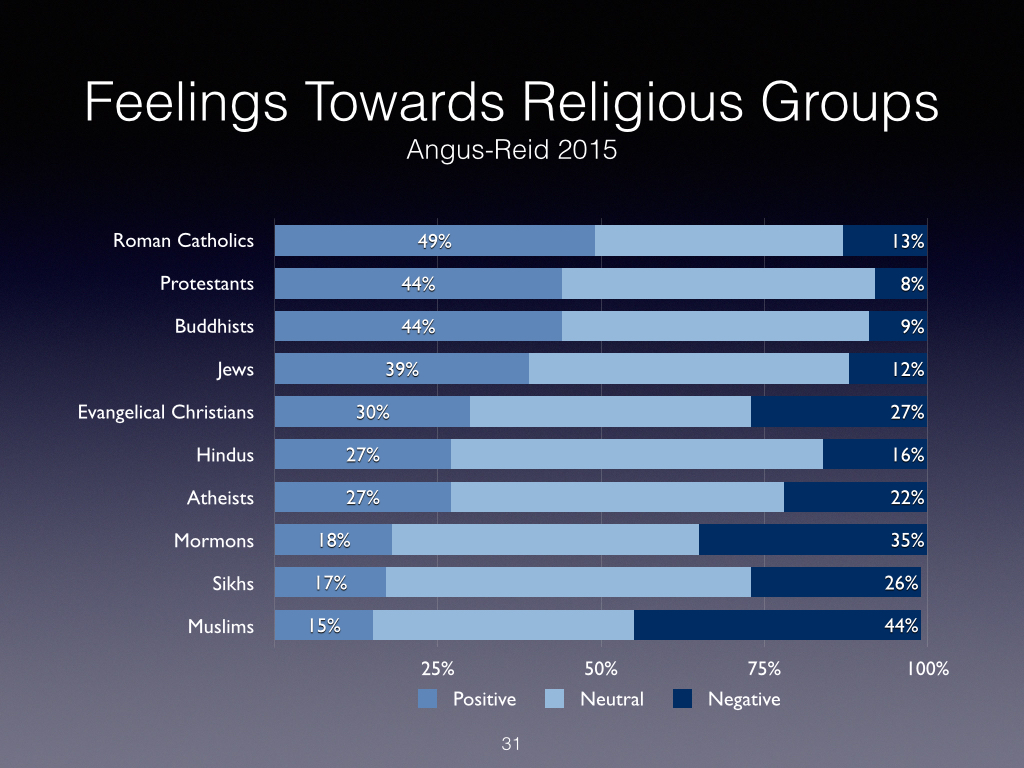
Angus Reid Religon Poll 2015 - Feelings Towards.001The National Post provides a very good infographic summarizing the findings of the recent Angus-Reid survey Religion and faith in Canada today: strong belief, ambivalence and rejection define our views which contains a wealth of information on attitudes and practices and worth reviewing.

Chart above highlights feelings towards different religions and is largely unsurprising.

The chart below provides a relatively rare view of immigration by religion between 2001-11, showing that while religious minorities are a significant share (36 percent), they are still less than Christian immigrants (42 percent). But the median age of religious minorities is younger than for Christians: 32 compared to 41.

Religious Immigration 2001-11.001

A God? That’s complicated. Canadians hanging on to personal faith as organized religion declines: poll | National Post.

Policy Arrogance or Innocent Bias: Review in Canadian Ethnic Studies

For those interested, Policy Arrogance or Innocent Bias: Resetting Citizenship and Multiculturalism continues to attract interest, most recently in this review by Nelson Wiseman of UofT in the most recent issue of Canadian Ethnic Studies.

Canadian Ethnic Studies Review 2015

Treating Saudi Arabian Jihadists With Art Therapy

Saudi Arabia’s deradicalization program using art therapy, with reasonably good results (only 20 percent failure rate). Kind of interesting to be using art in a place where it is generally frowned upon:

“They’re not so tough,” says Dr. Awad Al-Yami, a counselor here. “These are our kids, and anyway, they are members of our society, and they are hurting us. We feel obligated to help them.”

Al-Yami trained as an art therapist at the University of Pennsylvania. He pioneered an innovative program that’s unusual in Saudi’s ultra-conservative culture, where some clerics say that drawing is forbidden.

“I had a hard time convincing my people with art, let alone art therapy for jihadists,” he says.

But the program has delivered results.

“Actually, art creates balance for your psyche,” he says.

It is also a window on the psyche, he says. Drawing is a way for inmates to express emotions, anger and depression, when they first arrive at the center.

He keeps a gallery of paintings, which he analyzes like a detective. The black and white landscapes, which depict scenes from Afghanistan, mean an inmate is still living in the past.

After a few months of counseling, the paintings show more promise. Inmates use color and depict scenes from family life in Riyadh. Al-Yami says this is a sign that the inmate is coming to terms with coming home.

There is a striking number of inmates who draw pictures of castles with high walls. Those send a distinct message, according to Al-Yami.

“I’m not going to give you any information,” he says. “I’m behind the wall and you can’t get through. If I give you information, I am weak.”

He takes the failures hard. Some 20 percent of the inmates here go back to the fight. One spectacular failure went on to become an al-Qaida leader in Yemen.

Now, Al-Yami is preparing for a new wave of inmates: the ISIS generation. He knows they are more extreme than al-Qaida.

“We’ve got some in prison, waiting for their sentences to be over and they will be here,” he says.

Treating Saudi Arabian Jihadists With Art Therapy : Parallels : NPR.

The Holocaust’s long reach: Trauma is passed on to survivors’ children

Good long piece on the work of Helen Epstein (author of Children of the Holocaust: Conversations with Sons and Daughters of Survivors) and Vivian Rakoff of the ongoing inter-generational trauma faced by children of Holocaust survivors, and the commonality of that experience with other atrocities:

Trauma is trauma, whether it is besetting children of Holocaust survivors or children of families shattered by atom bombs, civil war, terrorism, domestic violence, sexual abuse, addiction, or even illness and disability. The stories keep emerging: in Heather Connell’s Small Voices, a film about the children of survivors of the Khmer Rouge killing fields; in Peter Balakian’s memoir Black Dog of Fate, written as the son of survivors of the Armenian genocide; in Michael Arlen’s Passage to Ararat, also about Armenia. (Memoirs by the children of Rwandan survivors are rarer: They’re just becoming adults.) The details of each oppression make it unique, but the effect of the trauma always follows the same path.

“I don’t feel possessive about my PTSD at all,” Ms. Epstein says. “I think it’s nearly universal.” To which Vivian Rakoff adds, “I think the transmission of trauma has to be admitted to. That when you do something terrible, it has effects. You can have psychic transmission of disorder in the same way you can have microbial transmission of disorder.”

Now we are learning that the horror can be passed along physically, and perhaps even genetically. Efforts are being made to interrupt that fateful flow: At Mount Sinai in New York, Dr. Yehuda has a theory that hydrocortisone might stymie the establishment of PTSD. There are also encouraging therapies and experimental programs, as Judith Shulevitz reported in The Atlantic, in which pregnant women at risk for PTSD receive counselling to help them through the thickets of child rearing.

Trauma and the atrocities that cause it are unavoidable. Parliament’s decision to expand Canada’s war against the Islamic State is, at least arguably, a legitimate and necessary evil. But the children of the soldiers and victims who fall on both sides in that war will feel its trauma regardless, in some place too dark to see. Then will come the hard part. Because once we notice trauma, and inquire after it, we are apologizing for it, and admitting to some sense of responsibility.

Maybe this is why we try so hard not to to notice other people’s pain, why we resist the idea that formative experiences are passed along in physical form as memory, conscious or collective or otherwise. We know we’re connected to one another in ways we can’t see or control, inconvenient as the fact often is. “Much of history is written in blood,” Helen Epstein writes in Children of the Holocaust, “and experiencing some degree of trauma seems to be a part of experiencing life. What that means to me is that it is not ‘other’ but, to various degrees, ‘us’ and that we need to learn to use that insight toward connection rather than separation.” Human pain turns out to be not very private after all.

Judith Herman, the Harvard psychiatrist who in 1993 wrote Trauma and Recovery: The Aftermath of Violence from Domestic Abuse to Political Terror, observed that “the study of psychological trauma has a curious history – one of episodic amnesia.” Why? Because “to study psychological trauma is to come face to face both with human vulnerability in the natural world and with the capacity for evil in human nature.”

We want to remember, and we want to forget. We are who we are. But sometimes we can’t bear to admit it.

The Holocaust’s long reach: Trauma is passed on to survivors’ children – The Globe and Mail.

Cosmo accused of racial bias in trends that ‘need to die’ list

Cosmo TrendsSomeone not thinking (unconscious bias at play):

Fashion magazines are always publishing their Do’s and Don’ts columns, but Cosmo’s latest — in which black models are used to illustrate trends that “need to die” but not showcased for any that are deemed trendy — is being given a major DON’T online.

The feature, appearing on Cosmopolitan.com, focused on fashion faux pas and was accused of being racist. It included 21 beauty trends that are dying and Cosmo-approved alternatives, but overwhelmingly the women of colour that are featured appear exclusively in the Don’t column. While the examples of Do’s are almost exclusively all white women.

The reaction was harsh and unforgiving.

Cosmo accused of racial bias in trends that ‘need to die’ list – Trending – CBC News.

The worst time for Jews to abandon Europe – Avraham Burg

Avraham Burg on European Jews:

In a generation in which we Israelis have forgotten how to be sensitive and empathetic to minorities, to those who are different, to the persecuted, and many American Jews are swallowed up in their comfort zones of white society and are abandoning their partnership with the “others,” in America, the “United States of Europe” is presenting a new model of identity – a union between those who are different, and the “other.” It’s a model no different from the American one which seeks to assimilate all into a monochromatic American democracy.

Further, Europe is the current meeting point between Islam and the West. Some of that encounter involves clashes, and some involves learning. The Christian continent is learning to make space for other, rich and varied identities. My friends, Ziya from Bangladesh, Shaida whose family is from Turkey and Rob from Jamaica, are impressive Europeans, and Europe is better off with them. Just like Shaul from Venice, Yoop from Amsterdam and Brian from London – there is no dissonance between their Jewish heritage and their European identity. The discourse between white, Christian Europe and those who are different is fascinating. More important is the dialogue between Western Europe and the Muslim forces in its midst.

The Muslim world and some of its members are embarking on a long journey toward the Western values of freedom, equality and brotherhood. The institutionalization of Western Islam in the heart of Europe – that which is absorbing values of democracy while remaining true to Muslim tradition – is where the strategic potential exists for bridging the gaps peacefully in the generations to come. It’s not happening in the Middle East or North America, but only in Europe. That is where the vanguard of humanity and humaneness is to be found. There has never been a worse time for Jews to abandon Europe.

The challenge facing the West and Europe is no longer military or economic, but rather an intellectual challenge of values. The philosopher Hans-George Gadamer said that he regards abundance of diversity as the most precious treasure which Europe managed to save from the conflagrations of the past, to offer to the world today.

“To live with Another, live as Another for Another, is the fundamental task of man – both on the highest and the lowest level …therein perhaps dwells that specific advantage of Europe, which could and had to learn the art of living with others,” Gadamer is quoted in Zygmunt Bauman’s book “Culture in a Liquid Modern World.”

A fight for the future of the West without the Jews of Europe would be almost tragic, and must be avoided at all costs.

The worst time for Jews to abandon Europe – Opinion – Israel News | Haaretz.

Ayaan Hirsi Ali’s ‘Heretic’ – NYTimes.com

Good review of Hirsi Ali’s latest book, “Heritic:”

In “Heretic,” Hirsi Ali forgoes autobiography for the most part in favor of an extended argument. But she has trouble making anyone else’s religious history — even that of Muhammad himself, whose life story she recounts — as dramatic as she has made her own. And she loses the reader’s trust with overblown rhetoric. Many Muslim immigrants in the West grapple with conflicted identities, she writes, leaving them longing for one extreme or another in the pursuit of certainty. She wonders: “Must all who question Islam end up leaving the faith, as I did, or embracing violent jihad?” (Probably not.) She tries to warn Americans about their naïveté in the face of encroaching Islamic influences, maintaining that officials and journalists, out of cultural sensitivity, sometimes play down the honor killings that occur in the West. But it is safe to say there is no shortage of horrified fascination in the topic; she even cites a 3,000-word Time magazine article that, in fact, spelled out every tragic detail of one of her examples.

When Hirsi Ali writes, almost wistfully, that “it is unrealistic to expect a mass exodus from Islam,” even secular readers may begin to wonder if she is their best guide to understanding the religion. (A suitable subtitle for “Heretic” might be: “How to Be a Muslim, if You Must.”)

Unquestionably, Hirsi Ali poses challenging questions about whether American liberals should be fighting harder for the rights of Muslim women in countries where they are oppressed, and she is fearless in using shock tactics to jump-start a conversation. Blasphemy is an essential part of any religious reform, she argues, and defends her right to speak bluntly. “I have taken an enormous risk by answering the call for self-reflection,” Hirsi Ali has said, in response to critics who find her tone abrasive. “I have been convinced more than ever that I must say it in my way only and have my criticism.” There is no denying that her words are brave. Whether they are persuasive is another matter.

Ayaan Hirsi Ali’s ‘Heretic’ – NYTimes.com.

Catholic public health board nominee dumped

Interesting debate in Toronto over what views are acceptable in the Board of Health:

But her voting record as a long-standing trustee did not sit well with several councillors. Kennedy, a registered nurse for 45 years, has voted against gay-straight clubs in schools, HPV vaccinations for young girls and is opposed to abortion.

“Thankfully, council did the right thing,” said Councillor Joe Mihevc, chair of the Toronto Board of Health who introduced the motion to replace Kennedy with Chris Glover, a public school board trustee from Etobicoke.

Mihevc said Kennedy’s “consistent” opposition to gay-straight alliances makes her unsuitable to sit as a board member, he said.

“Would we allow that as a society if it was black-white alliances? That’s what human rights are about and those perspectives in a public health context just won’t work.”

Mayor John Tory supported Kennedy’s appointment, though he said he disagrees “completely” with her views on HPV vaccinations, gay/straight alliances in schools and a woman’s right to choose.

“If we started applying every test based on whether we disagree with somebody’s views on people we appoint to things . . . it’s sure going to change the nature of this place.”

Councillors Paula Fletcher, Gord Perks  and Joe Cressy  did not support Kennedy’s appointment. “These are actually human rights issues, the right for gays and lesbians to lead an equal life in the city of Toronto,” Fletcher said.

Kennedy is the wrong fit because the board of health has an obligation to deliver programs that meet health standards set out in legislation, such as programs to encourage safer sex, Perks said.

“This isn’t about whether you’re trying to get people on the board of health who vote the way you feel,” he said. “It is whether or not we are prepared to appoint people who support the legal mandate of the entity they are being appointed to.”

Catholic public health board nominee dumped | Toronto Star.

PM Harper’s ‘dangerous’ comments on Muslims show lack of understanding on culture, says Taylor

Hard to disagree with Charles Taylor’s assessment:

Prime Minister Stephen Harper’s comments on the niqab are “very dangerous” and could lead to stigmatization and even radicalization, one of Canada’s most renowned political thinkers said Saturday.

Speaking to a packed room at the Broadbent Institute’s Progress Summit in Ottawa Saturday morning, McGill University philosopher Charles Taylor said the prime minister’s comments on the niqab as coming from an anti-feminist culture conflates Muslim dress with the threat of terrorism and jihadism, which stigmatizes the entire Muslim population and creates a rupture in Canadian society.

“This kind of stigmatization is exactly what we have to avoid,” Prof. Taylor told reporters following his address.

The Prime Minister has been “tone deaf” in his comments about Muslims, he said, which demonstrates a lack of understanding of the culture he’s discussing, though he also said electoral considerations likely figure in the approach.

“Ask yourself what are the recruiters of Islamic State saying? They’re saying, ‘Look, they despise you. They think that you’re foreign, you’re dangerous, you’re not accepted here so why don’t you come to them?’” he told reporters.

“The more you make it sound like that, the more you’re helping them. It’s strange that people don’t see that.”

PM Harper’s ‘dangerous’ comments on Muslims show lack of understanding on culture, says Taylor | hilltimes.com.