Wesley Wark: Information gap about Zehaf-Bibeau threatens security

Wesley Wark’s trenchant criticism of the narrowness of Canadian inquiries into the Zehaf-Bibeau and Couture-Rouleau attacks, which focus only on the security dimensions rather than also including the process of radicalization issues:

There is nothing in the forensic analysis of the Zehaf-Bibeau attack that can bear the burden of such a sweeping statement, but it smacks of politics and of an ill-considered willingness to add to public anxiety about Canada’s counter-terrorism capabilities.

The RCMP’s own, separate, after-action review was deliberately limited, by whose decision is not clear, to “the protective actions taken by the RCMP in response to the incident;” it explicitly precluded any examination of the national security context, existing threat levels at the time of the attacks, or any “pre-incident” information about the shooter.

This leaves Canadians with a worrying chasm of information about Zehaf-Bibeau’s development as a jihad-inspired terrorist, and any reflection of what, if anything, could have been done to prevent the attack plot. It may well be that confusion lingers about whether Zehaf-Bibeau even deserves the tag of “terrorist.” This became a highly politicized issue immediately following the attacks, with the prime minister’s immediate labeling of Zehaf-Bibeau as a terrorist.

An even greater chasm exists with regard to the other, and largely forgotten, terrorist attack of October 2014, in which Martin Couture-Rouleau ran down and killed Warrant Officer Patrice Vincent. Where is the inquiry into that attack and the subsequent death of Couture-Rouleau in a confrontation with the Quebec Sûreté? Unlike Zehaf-Bibeau, Couture-Rouleau had been under investigation by the RCMP, had his passport seized and had been prevented from travelling abroad. The RCMP had intervened directly with him and, as they confessed shortly after his attack, had come to a conclusion that he had changed his ways and did not pose an imminent threat. Later media leaks changed the channel on the story to one of an inability of the RCMP to acquire a peace bond against him, a leak that came suspiciously close to the government’s tabling of Bill C-51, the new anti-terrorism act, which included lowered thresholds for the issuance of peace bonds.

As a recent meeting of the Senate Liberal “Open Caucus” heard from several witnesses, including me, Canada suffers from an endemic problem of overweening secrecy that chokes off public debate. That problem has raised its head once more in the failure to constitute a proper public study of the attacks of October 2014. We need only look at how the Australians responded to their Sydney terror siege in December 2014, with an Australian government review issued in February 2015 and an on-going coroner’s inquiry that is expected to extend into 2016, to know that the balance between secrecy and public knowledge is out of kilter here.

Wesley Wark: Information gap about Zehaf-Bibeau threatens security | Ottawa Citizen.
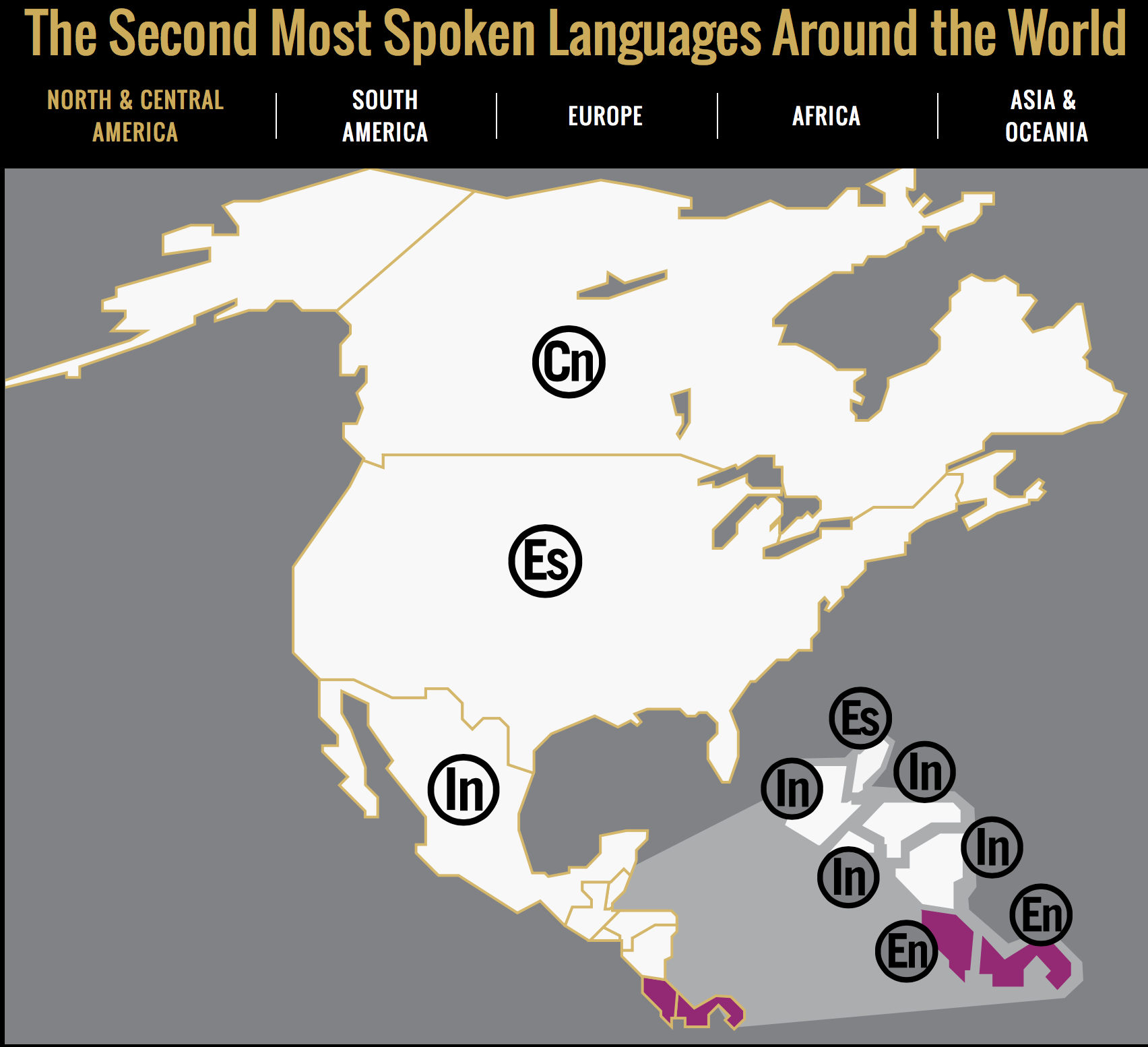
The Second Most Spoken Languages Around the World | Olivet Nazarene University

The_Second_Most_Spoken_Languages_Around_the_World___Olivet_Nazarene_UniversityPeriodically, I get these messages regarding some new interactive way of displaying data. This one is a nice web page that provides information on main second languages for most countries. Worth checking out if you like this kind of thing.

The Second Most Spoken Languages Around the World | Olivet Nazarene University.

Multiculturalism doesn’t work in Hungary, says Orban

More from Hungarian Prime Minister Orban. Never knew coexistence was a bad thing:

“Multiculturalism means the coexistence of Islam, Asian religions and Christianity. We will do everything to spare Hungary from that,” he said in an interview with daily Napi Gazdasag.

“We welcome non-Christian investors, artists, scientists, but we don’t want to mix on a mass scale.”

Orban, whose governing Fidesz party is losing ground in the polls to the far-right, anti-immigrant Jobbik party, has clashed with European counterparts over his isolationist views.

At the European Parliament in mid-May, he criticized as “bordering on insanity” EU proposals for migrant quotas drafted in response to thousands of deaths among asylum-seekers trying to reach Europe across the Mediterranean in increasing numbers.

On Wednesday he called Jobbik dangerous for Hungary “because they offer a constant temptation, an intellectual capitulation to the simplest solutions”, saying his government would strike a conciliatory tone towards voters.

Multiculturalism doesn’t work in Hungary, says Orban – Yahoo News.

ICYMI: ‘There’s no way back now’: For female ISIL members, Syria is one-way journey

More on the recruitment of women by ISIS and how it is a one-way ticket:

In interviews, court documents and public records, the Associated Press has compiled a detailed picture of European girls and young women who join extremists such as ISIL — a decision that is far more final than most may realize.

The girls are married off almost immediately, either in Turkey or just after crossing into Syria. With an estimated 20,000 foreign fighters — among them 5,000 Europeans — in Syria, there is no shortage of men looking for wives. That number is expected to double by the end of the year. Once among the jihadis, the women are not permitted to travel without a male chaperone or a group of other women and must remain fully covered outside, according to material published by ISIL and researchers who follow the group. Otherwise, they risk a lashing or worse.

European women who blog about their lives under ISIL tend to be chipper about the experience, but reading between the lines of an e-book of travel advice shows a life that will be radically circumscribed, with limited electricity, lack of even the most basic medicine, and practically no autonomy. Women do not fight, researchers say, despite the Hunger Games-like promises of recruiters.

“The lives of those teenage girls are very much controlled,” said Sara Khan, a British Muslim whose group Inspire campaigns against the dangers of extremist recruiters. “I don’t think that discussion ever comes up. It’s so romanticized, the idea of this utopia. I don’t even think those young girls have necessarily considered that there’s no way back now.”

‘There’s no way back now’: For female ISIL members, Syria is one-way journey

Truth and Reconciliation Commission: Citizenship Recommendations

Interesting last two recommendations in the Truth and Reconciliation Commission‘s Call to Action:

Newcomers to Canada

93. We call upon the federal government, in collaboration with the national Aboriginal organizations, to revise the information kit for newcomers to Canada and its citizenship test to reflect a more inclusive history of the diverse Aboriginal peoples of Canada, including information about the Treaties and the history of residential schools.

94. We call upon the Government of Canada to replace the Oath of Citizenship with the following:

I swear (or affirm) that I will be faithful and bear true allegiance to Her Majesty Queen Elizabeth II, Queen of Canada, Her Heirs and Successors, and that I will faithfully observe the laws of Canada including Treaties with Indigenous Peoples, and fulfill my duties as a Canadian citizen.

Essentially,  a significant add-on to the current oath rather than a major makeover.

Calls to Action (EN)

The current wording in the citizenship guide, Discover Canada, does include the following para on residential schools:

From the 1800s until the 1980s, the federal government placed many Aboriginal children in residential schools to educate and assimilate them into mainstream Canadian culture. The schools were poorly funded and inflicted hardship on the students; some were physically abused. Aboriginal languages and cultural practices were mostly prohibited. In 2008, Ottawa formally apologized to the former students.

And while there is extensive commentary on the broad scope and recommendations, John Ibbitson’s piece, derived in part from Bob Rae, captures the challenges well for both sides:

Each and every one of us means non-aboriginal Canadians who fail to respect the sovereignty and integrity of the First Nations, who disown the damage inflicted on native culture by generations of European settlers and their descendants, who elect and re-elect federal and provincial governments of all political stripes that feel no compulsion to put native issues at the forefront of their agenda.

It also means aboriginal leaders who place the nursing of grievance above the needs of members of their communities who depend on them, who refuse to accept the reality that there are only 330,000 people living on reserve and 34.6 million living off it, who ignore the 280,000 immigrants – almost the equivalent of the entire on-reserve population – who arrive in Canada each year. Most of these new arrivals are from countries that suffered under colonialism. They have their own scars.

We need to change beyond these recommendations

We need skilled footwork around religious freedom, gender equity: Sheema Khan

Further to my earlier post (Girl players leave high school soccer game after complaints from Muslim boys’ team), Sheema Khan on religious reasonable accommodation. A somewhat meandering piece, and her conclusion, in calling for “wisdom and aplomb” is harder in practice than in theory. But nevertheless to be aimed for:

In 2007, a Montreal synagogue paid for a neighbouring YMCA to replace its windows with frosted glass, so that the synagogue’s male students would not be distracted by spandex-clad women exercising next door. Once YMCA members found out, a protest ensued, adding fuel to a fiery Quebec debate about religious accommodation that continues unabated to this day.

In the soccer case, teams should abide by ROPSSAA regulations, or forfeit a match from the outset when gender equity is an issue. Teams must accept the forfeit, rather than maximize goal output at the expense of female teammates.

There will probably be further collisions between religious freedom and gender equity. Each should be handled on a case-by-case basis, guided by Charter principles, with wisdom and aplomb, without recourse to incendiary language or political demagoguery.

We need skilled footwork around religious freedom, gender equity – The Globe and Mail.

U.S. Supreme Court affirms religious rights in Abercrombie & Fitch case

Reasonable accommodation example. Will see how the lower court rules in terms of the specifics but at least the general principle has been confirmed:

The U.S. Supreme Court strengthened civil rights protections Monday for employees and job applicants who need special treatment in the workplace because of their religious beliefs.

The justices sided with a Muslim woman who did not get hired after she showed up to a job interview with clothing retailer Abercrombie & Fitch wearing a black headscarf.

The headscarf, or hijab, violated the company’s strict dress code, since changed, for employees who work in its retail stores.

Employers generally have to accommodate job applicants and employees with religious needs if the employer at least has an idea that such accommodation is necessary, Justice Antonin Scalia said in his opinion for the court.

Job applicant Samantha Elauf did not tell her interviewer she was Muslim. But Scalia said that Abercrombie “at least suspected” that Elauf wore a headscarf for religious reasons. “That is enough,” Scalia said in an opinion for seven justices.

U.S. federal civil rights law gives religious practices “favoured treatment” that forbids employers from firing or not hiring people based on their observance of religion, Scalia said. The federal civil rights law known as Title VII requires employers to make accommodations for employees’ religious beliefs in most instances. Elauf’s case turned on how employers are supposed to know when someone has a religious need to be accommodated.

The decision does not, by itself, resolve her case. Instead, it will return to the Tenth Circuit Court of Appeals in Denver, which earlier ruled against her.

“While the Supreme Court reversed the Tenth Circuit decision, it did not determine that [Abercrombie & Fitch] discriminated against Ms. Elauf. We will determine our next steps in the litigation,” company spokeswoman Carlene Benz said in an email.

Some business groups said Monday’s ruling will force employers to make assumptions about applicants’ religious beliefs.

“Shifting this burden to employers sets an unclear and confusing standard making business owners extremely vulnerable to inevitable discrimination lawsuits,” said Karen Harned, a top lawyer at the National Federation of Independent Business. “Whether employers ask an applicant about religious needs or not, there is a good chance they will be sued.”

Jenny Yang, chairwoman of the federal Equal Employment Opportunity Commission, praised the court for “affirming that employers may not make an applicant’s religious practice a factor in employment decisions.” The commission had sued on Elauf’s behalf.

As to the protestations of the National Federation of Independent Business, it does not appear to me too difficult to make the assumption that someone wearing a cross, a kippa, a turban or a hijab is likely doing so for religious reasons.

U.S. Supreme Court affirms religious rights in Abercrombie & Fitch case – World – CBC News.

Racial Diversity Grows On Network Television, But Will Quality Lag Behind?

For those who watch US network TV, a take on the upcoming season in relation to diversity and quality:

The good news from the big broadcast networks’ upfront presentations earlier this month, where they revealed their new shows for the next season, is that television’s turn toward inclusion seems like more than a passing fad.

Of 42 new shows planned for next TV season on the Big Four broadcast networks, 13 series (or 30 percent), either star non-white actors, feature a mostly non-white cast or feature non-white actors as co-leads. Given that we’re 15 years past a TV season when no new show on the top four networks had any non-white actors in the cast at all, those numbers look like progress.

These numbers also suggest that talk about white actors losing parts en masse to great crowds of performers of color — sparked by a Deadline.com story filled with anonymous sources that read like the dying gasp of Hollywood’s white, male privilege — was overblown.

But there may be bad news: A look at early information and trailers for many of these shows — most pilots aren’t available to critics yet — hint that the new crop of programs may not be nearly as groundbreaking or innovative as the stuff we saw this past TV season.

… Regardless of the economics of television diversity, recent history indicates that networks have to take a more active part in seeking out incisive, groundbreaking shows and roles for non-white stars – in the way Fox has encouraged producers to maintain diversity on its recent shows.

The networks also need to empower non-white producers to create shows, in the way ABC has worked with 12 Years a Slave screenwriter John Ridley to create American Crime, and Fox backed The Butler director Lee Daniels to make Empire.

It’s part of the constant struggle to create television that reflects the racial diversity of America without amplifying its problems with stereotyping and prejudice. And what’s obvious from a look at the new shows coming next season is that the struggle is about to get more complicated than it has ever been.

Racial Diversity Grows On Network Television, But Will Quality Lag Behind? : Code Switch : NPR.

Foreign donations to foster extremist ideology fly under Canada’s radar

More on alleged foreign funding of fundamentalism, and the irony that these are from the same countries that are opposed to ISIS:

It has been widely suspected for years that wealthy Gulf Arabs from Saudi Arabia, Kuwait and Qatar have been bankrolling conservative Wahhabi and Salafist institutions and teachings in western countries. The strict and puritanical interpretations of Islam have no direct links to terrorism. Still, security experts say the conservative ideologies offer fertile ground for individuals contemplating jihad.

Richard Fadden, the prime minister’s national security adviser, told the committee in April that money is coming into Canada to promote extremist ideology and much of it is going to religious institutions. That followed similar testimony to the committee by an imam who manages 13 mosques across the country.

“I think it’s fair to say, without commenting on the particular country of origin, there are monies coming into this country which are advocating this kind of approach to life,” said Fadden.

“A lot of these funds, I think, are directed to religious institutions or quasi-religious institutions. It’s very difficult in this country to start poking about, if you’ll forgive my English, religious institutions because of the respect that we have for freedom of religion.”

There are no restrictions on non-resident charitable donations coming into Canada, provided they are not from a banned terrorist organization. Most donations arrive by bank wires, which CRA does not have the ability to track because it does not have access to banking transactional records or money services business records.

Instead, non-resident gifts of more than $10,000 must be disclosed by the charities. Beyond that, however, Canada Revenue has no way of knowing how much of that money is directed to Islamic religious and educational programming.

“We know that that’s no ideal and we want to be able to collect better information and we’re looking at that actively now,” Hawara told the committee. (The agency is able to track foreign donations directed for political purposes and routinely audits the appropriateness of all charities’ activities and whether they support the organizations’ charitable objectives, among other things.)

The millions of dollars coming to Canada from wealthy Gulf states are for all sorts of purposes, including to support organizations that may ultimately be determined to be fronts for terrorist organizations, or affiliated with them, said Christine Duhaime, a leading expert on terrorist financing and money-laundering.

“It tends not to be funds directly sent to support overt acts of terrorism in large volumes (here). If we had that happening, terrorist groups in Canada would be more powerful and already causing damage to critical infrastructure. Yet, there is funding for so-called extremist purposes, including for terrorist propaganda.”

Foreign donations to foster extremist ideology fly under Canada’s radar | Ottawa Citizen.

Canadian Race Relations Foundation: Directions Journal Call for Submissions

A reminder and should be an interesting edition, given the focus on words and lexicons:

Is our lexicon a positive force or part of the problem?

The Call for Papers for the Winter 2015 Issue is now open.

Published in print and online December 2015, The Power of Words speaks to the importance of reviewing and evolving social science terminology in response to changing demographics and settlement trends. The concept of hyphenated Canadians, terms such as ‘visible minorities’ and ‘newcomers,’ and even the idea of ‘race relations’ require ongoing reassessment, and are being challenged and re-examined in the context of our changing society.

Directions provides a space for established and emerging scholars, community organizations and race relations practitioners to publish their research. It also offers a forum for important dialogue and debate on race-related issues and best practices, and practical recommendations for policy development and change. Directions is curated to promote social cohesion amongst all individuals and groups living in a harmonious Canada.

Research Questions

How do language and lexicon in policy, in the media, and in daily interactions influence our experiences, identities, attitudes, and relationships? How can discourse create and perpetuate unbalanced power relations, marginalizing certain groups and individuals? How can we use language to promote positive race relations in a harmonious Canada?

These dynamic questions represent the types of issues that CRRF intends to explore in the upcoming issue of Directions in Winter 2015.

Call for Papers

Submit your research, editorial, abstract, or book review for the Winter 2015 Issue of Directions.

Submit a letter of inquiry or abstract by June 30, 2015 Submit online >