Exploring the lack of diversity in Quebec police forces

This has been an issue for a considerable time.

Police_ForcesThe table above compares police force diversity in Montreal, Toronto and Vancouver; what surprised me when collecting this information directly from the respective police forces was the degree to which the information is not public on their website and does not appear to be systematically collected (Surête de Québec does keep good stats):

Quebec’s police academy doesn’t have “a lot of influence” over whether visible minorities apply to become officers, says a spokesman for the academy.

Pierre Saint-Antoine, director of communications of École nationale de police du Québec in Nicolet, said racial minorities made up five per cent of its student population in 2015, despite attempts to “recruit people from all diversities and communities in Quebec.”

“We don’t have a lot of influence on the people that apply here,” Saint-Antoine said, adding that Nicolet has a program in place, in conjunction with the Quebec government, to encourage more diversity among applicants.

Saint-Antoine’s comments come after numbers compiled by CBC News show that Quebec police forces are lagging in their hiring of visible minorities.

For instance, the Sûreté du Québec serves more than 2.5 million people, however, fewer than one per cent of its officers are not Caucasian.

Community activists have said a lack of diversity among police leads to strained relationships with racial minorities.

But getting more people to apply is no easy task, says Paul Chablo, the head of John Abbott’s police technology program.

Before going to Nicolet, prospective police officers must first complete a three-year CEGEP program, and Chablo said many people from minority backgrounds don’t apply.

Out of roughly 250 students at John Abbott, 49 define themselves as having an “ethnic background” and only seven are visible minorities.

‘They have to adjust their techniques’

Chablo, who is also the former director of communications for the Montreal police, points to a multitude of factors — including lacklustre recruiting efforts and poor relationships with some ethnic communities — to explain the lack of diversity among applicants.

He said Quebec police need to a better job of reaching out to prospective employees to encourage them to apply to CEGEP programs in the first place.

“I think they have to adjust their techniques,” he said in an interview.

Source: Exploring the lack of diversity in Quebec police forces – Montreal – CBC News

Malcolm Turnbull: multiculturalism and tolerance will combat terrorism| The Guardian

Welcome change in language from his predecessor and strong message regarding the contribution that multiculturalism and inclusion can make to reducing the risks and extent of radicalization:

Malcolm Turnbull has nominated Australia’s cultural tolerance and multicultural society as reasons the country is well-placed to deal with terrorist threats.

In sharp contrast to the rhetorical tone of his predecessor, Tony Abbott, who repeatedly warned Australians that the “Daesh death cult” was “coming after us”, Turnbull said while no government could “guarantee the absolute absence of terrorism” Australia was “better placed than many of our European counterparts” in dealing with the threat “because of the strength of our intelligence and security agencies, our secure borders and our successful multicultural society; one that manages to be both secure and free”.

“Terrorism is designed to make us turn on each other,” Turnbull said in a lecture to the Lowy Institute on Wednesday evening. “That is why my government works hard to promote inclusion and mutual respect, ensuring that all communities and all faiths feel part of ours, the most successful multicultural society in the world.”

“Strong borders, vigilant security agencies governed by the rule of law, and a steadfast commitment to the shared values of freedom and mutual respect – these are the ingredients of multicultural success,” he said.

He said “early signs” indicated the Brussels attacks had been inspired or planned by Islamic State in Syria and this underscored the importance of Australia’s military contribution in Syria and Iraq.

Source: Malcolm Turnbull: multiculturalism and tolerance will combat terrorism | Australia news | The Guardian

Anti-immigrant politicos in U.S. and Europe begin exploiting Brussels attacks

Predictable:

The terrorist attacks perpetrated by the Islamic State (ISIS) in Brussels that left 34 people dead are being exploited for political gain by many European politicians and parties, but especially so by right-wing, anti-immigration populists.

Belgium’s own right-wing party from Flanders, Vlaams Belang, has seen its popularity on social media soar since the attacks after its leader called for a “waterproof border policy,” according to Vocativ.

Marine Le Pen, leader of the France’s National Front, called on French authorities to carry out sweeping raids on minority neighborhoods and “empty the basements [of terrorists], the laxness has gone on for too long.”

Poland’s Prime Minister Beata Szydlo from the Law and Justice party said her country could no longer take the 7,000 refugees it agreed to accept in negotiations with the European Union because of the deadly attacks, Reutersreported.

In the United Kingdom, the Independence Party, which is backing the British exit from the European Union known as Brexit, used the attacks to push their agenda.

American right-wingers chimed in, too.

Republican frontrunner Donald Trump used the attacks to reiterate his stance on torture as an appropriate response as well as his plan to close U.S. borders while labeling Brussels “disaster city.”

Source: Anti-immigrant politicos in U.S. and Europe begin exploiting Brussels attacks

Learning — And Unlearning — To Be An ‘Ambassador’ For Islam : NPR

Beenish Ahmed on the challenges of being Muslim in America:

After years of these kinds of interactions, I no longer have illusions about combatting anti-Muslim sentiments, not least because I’ve come to understand that the flames of Islamophobia are systematically fanned. Since 9/11, reports a study from the Center for American Progress (the parent organization of ThinkProgress, a news site where I work), a number of well-endowed organizations have spent over $40 million spreading fear against a “manufactured threat” — the notion that Islamist groups are working to make sharia the law of the land in America and turn the country into an Islamic state.

Thanks in part to such campaigns, even if someone like me can hardly recognize their faith in the hate espoused by terrorist organizations like ISIS or Al-Qaida, we are seen to belong more to those groups than to our own communities. That’s why hardly anyone is ever satisfied when I say that I’m from the Midwest. In their minds, I’ll always be all tied up with the Middle East and their perceptions of its mayhem.

And so, I will always say please and thank you when I order my coffee. I will smile at you on the bus if you happen to make eye contact with me. I’ll do so despite myself. And even if these habits result from my Ohioan upbringing as much as the traits imparted by my anxious, insecure, and yet incessantly good-willed immigrant parents, I know that I do these things because a part of me still can’t believe that I actually belong here. Still, I refuse to be an ambassador in the country of my birth.

Source: Learning — And Unlearning — To Be An ‘Ambassador’ For Islam : Code Switch : NPR

Belgium’s big problem with radical Islam – The Washington Post

One of the better pieces I have seen, although over-mechanically emphasizes some of the causes of radicalization:

Of all the countries in the West, Belgium has produced the greatest number of foreign jihadists per capita who are fighting in Syria. The actual figure, according to researchers, is variously estimated at 470 to 553. Roughly a third of those who left to fight in Iraq and Syria have returned; many have not faced prosecution, with authorities struggling to prove that the fighters joined violent organizations such as the Islamic State, which is also known as ISIS and ISIL.

According to an analysis by the Royal Institute for International Relations, or Egmont, a Brussels-based think tank, the majority of Belgian jihadists are young (ages 20 to 24), have lower-than-average education levels and are mostly of Moroccan heritage.

The prevalence of Islamist extremism in Belgium predates the incidents of the past year, as well as the advent of the Islamic State. And this is not the first time an Islamic State proxy has struck on Belgian soil: In May 2014, a gun-wielding French national who had spent time in Syria killed four people in the Jewish Museum of Brussels.

The root causes of radicalization are largely familiar: high unemployment, marginalization, discrimination and a sense of alienation from the wider society.

BuzzFeed’s Joshua Hersh spent time in Molenbeek and came away with this picture of a downtrodden, disgruntled community:

“Unlike the infamous banlieues of Paris — the rundown high-rise suburbs that symbolize France’s failure to integrate its own Muslim immigrant residents — Molenbeek is practically in the middle of Brussels; it’s just two metro stops west of the central train station. Still, Molenbeek can feel deeply isolated. The immigrants of Brussels, most of them Muslim and of North African descent, are highly concentrated there — the schools they attend, shunned by white Belgian families, are disparagingly referred to as “concentration schools,” after the high percentage of immigrants enrolled, and the poor conditions. “I didn’t believe it was this bad when I first started,” said a teacher who works at a mostly immigrant school near Molenbeek. “The schools, all they do is accentuate the problems the students face in their daily lives.””

Moreover, as my colleague Michael Birnbaum reported, Belgium’s pronounced linguistic divisions between Dutch-speaking Flanders, the largely French-speaking city of Brussels and the region of Wallonia to the south have made it difficult for some immigrant groups to assimilate. This is particularly true of those living in Flanders, where far-right Flemish nationalist parties hold real sway and inveigh against the dangers of Islam.

“The Islamic State is giving them what the Belgian government can’t give them — identity, structure,” Montasser AlDe’emeh of the University of Antwerp told Birnbaum. “They don’t feel Moroccan or Belgian. They don’t feel part of either society.”

According to the Egmont report, the current crop of Belgian extremists are significantly younger than earlier generations, which went off to join the ranks of al-Qaeda and other fundamentalist groups. That radicalization is driven less by religious fervor than by more local factors, and it is shaped also by ties to gangs and other criminal activity:

“Their acquaintance with religious thought is undoubtedly more shallow and superficial than their predecessors’, as is their acquaintance with international politics. Geopolitics is less important to them than it once was to their predecessors, who felt motivated by the struggle against the superpowers. Injustice was often a starting point with their predecessors’ journey towards extremism and terrorism. This has now largely been overshadowed by personal estrangement and motives as the primary engines of their journey.”

Source: Belgium’s big problem with radical Islam – The Washington Post

Grassroots coding, gaming groups tackle tech’s diversity crisis

Striking – but not surprising given Toronto’s (and Canada’s) diversity – the confluence between minority and women diversity:

Hina Mir sees a future for herself in technology. She’s only 16, so it’s not entirely clear what that future will look like. But one thing is almost certain: she’ll be coding.

The Toronto high school student already knows elements of multiple programming languages and has studied with experts working for some of the biggest names in the tech sector.

“With all the things I’ve learned with coding, as well as on the engineering and business sides of technology, there’s so much that I think I could do,” Hina said.

She’s part of an up-and-coming generation of potential programmers, software engineers, developers, designers and entrepreneurs who could help the tech world face down an uncomfortable reality: it is very white and very male.

Companies from across the industry have acknowledged the problems: specifically, that there is both a considerable disparity between the sexes and a troubling lack of diversity in the workforce.

The response from Silicon Valley has been to raise a small army of “diversity consultants” and use more inclusive recruiting and hiring strategies.

Iqra Alam, Tajmim Ahmed, Mariam Sayed Girls Crack the Code diversity

The group has members as young as six and as old as 16. International studies have found that starting to teach coding as early as kindergarten is the most effective way to ensure young people stick with it. (Lucas Powers/CBC)

“But it’s not enough to rely only on what big companies are doing if we’re going to create a tech world that reflects the society we live in,” said Ashley Jane Lewis.

A tech workforce that reflects society

The 26-year-old is a mentor with Girls Crack the Code, the community organization where Mir got her start in coding.

The Toronto-based group, which is funded by its organizers and the local school board, helps girls and young women of colour get a head start in tech, and not just with coding classes. In the four years it has existed, Girls Crack the Code has grown into an advocacy network that connects members with all kinds of tech-related opportunities, such as scholarships and workshops.

Ashley Jane Lewis, right, is a mentor with Girls Crack the Code. ‘I think in 10 years, when a younger generation looks to the tech world and sees women of colour who learned in communities like this, working in the field, they’ll see a trail that has been blazed for them,’ she said. (Lucas Powers/CBC)

“I’ve already been to Google, Twitter, Salesforce and coding camp, and I’m in a technology program at school,” Hina said.

Critically, Girls Crack the Code works out of Nelson Mandela Park Public School in Regent Park, one of the most diverse neighbourhoods in the city and home to Canada’s largest social housing development. Bengali, Mandarin, Urdu, Somali and Swahili are just some of the languages spoken there.

The neighbourhood is undergoing a billion-dollar “revitalization” ultimately aimed at creating a community with housing for families of different socioeconomic levels.

Khadija was one of about 30 girls who visited Twitter Canada’s headquarters earlier this month. (Lucas Powers/CBC)

In many ways, Girls Crack the Code is trying to build a tech industry informed by all of the voices, perspectives and experiences found in a place like Regent Park.

It’s part of a growing grassroots movement to cultivate talent in places where diversity is woven into the fabric of everyday life.

A ‘powerful’ message

Earlier this month, 30 girls from the group visited Twitter Canada’s trendy downtown office to listen to a talk by Helen Zeng, a 25-year-old software engineer who grew up in Windsor, Ont., and now codes for the tech giant in San Francisco.

Zeng says that while many companies are trying to hire more women and people of colour into tech jobs, there is a “very loud” effort to push back against built-in biases and attitudes that can’t be undone with corporate policy alone.

Hoping to escape stigma, mother of Islamic State militant leaves Canada

Sad, given her courage in going public to encourage more open discussion on the radicalization process and related efforts to help reduce the risks (see Mother of fallen Canadian jihadi launches de-radicalization effort):

A Calgary woman whose son was killed while fighting for the Islamic State in Syria has left Canada, saying she was labelled “the mother of a terrorist” and unable to find full-time work.

Christianne Boudreau said she moved to France two months ago, hoping to escape what she called the stigma linked to the activities of her oldest son, Damian Clairmont, 22. His reported death in January, 2014, prompted Ms. Boudreau to ask questions in hopes of understanding his slow slide into extremism. She has done multiple media interviews and spoken with researchers delving into radicalization.

She also needs to work again to pay the bills that piled up during her bereavement. In search of a full-time job, Ms. Boudreau said she was met with a recurring theme: She would call for an interview and leave her name, only to be told there was nothing available – a possibility given Alberta’s slumping economy. But when she did secure an interview, she was told hours later that the company had changed its mind.

Ms. Boudreau hired a headhunter to find her work in Calgary and elsewhere across the country, but the results were no better.

“The headhunter told me it was because I was seen as the mother of a terrorist. [Companies] would say, ‘Something’s come up. We’ll call you back later.’ They’d be, ‘Yes, we know who you are. We’ve heard you on the radio,’” Ms. Boudreau said. “I never went through anger with that. I think it was more fear and frustration, not knowing where to turn next.”

What did happen was most unexpected. Ms. Boudreau was contacted by Eileen Thalenberg, a writer/director at Stormy Nights Productions in Toronto. She was looking to do a documentary on how young Canadians were being recruited to renounce their heritage and take up arms with the Islamic State or other smaller militant groups. In the pursuit of her story, Ms. Thalenberg looked to the families for answers. The only person who would talk was Ms. Boudreau, who is a central figure in an upcoming television documentary called A Jihadi in the Family. It airs Thursday night on CBC’s Firsthand.

“I started looking at questions: How vulnerable are we? What are we talking about, the number of kids going over there?” Ms. Thalenberg said. “And I went and looked at who I could speak to in terms of families, and nobody would speak to me, except Christianne. She is the only Canadian from the families who has spoken out about their kids going overseas.”

Source: Hoping to escape stigma, mother of Islamic State militant leaves Canada – The Globe and Mail

McCallum n’est pas surpris de l’accueil réservé à Le Pen

Reinforcing the message:

Le ministre fédéral de l’Immigration, John McCallum, croit qu’en refusant de rencontrer Marine Le Pen lors de son passage au Canada, les politiciens ont fait comprendre à la chef du Front national « qu’au Canada, on n’est pas d’accord avec elle ». Concernant l’accueil des 25 000 réfugiés syriens au pays — « de la folie », selon Mme Le Pen —, le ministre McCallum estime que le message est tout aussi clair. « Il y a un bon consensus parmi la classe politique au Québec et au Canada en faveur de ces réfugiés. Donc le fait que les politiciens ne veulent pas lui parler ne me surprend pas », a-t-il affirmé lundi.

De passage à Saguenay, le premier ministre Philippe Couillard a pour sa part rappelé que Mme Le Pen n’occupe aucune fonction au sein du gouvernement français et qu’il n’a pas l’intention d’entamer un débat avec elle.

Source: McCallum n’est pas surpris de l’accueil réservé à Le Pen | Le Devoir

Diversity and Inclusion Agenda: Impact on the Public Service, Setting the baseline

My article in The Hill Times, slightly updated:

The Liberal government included in its mandate letters to all ministers a “commitment to transparent, merit-based appointments, to help ensure gender parity and that Indigenous Canadians and minority groups are better reflected in positions of leadership.”

While the focus is clearly with respect to political appointments, this commitment will likely extend to the senior ranks of the public service in a renewed emphasis on diversity. Deputy minister appointments are made by the Prime Minister upon the recommendation of the Clerk of the Privy Council. While the Foreign Affairs Minister recommends  ambassadorial appointments or equivalent, largely reflecting public service recommendations, the Prime Minister approves. The PM also has the power to select candidates for high-profile positions. ADM appointments in Canada, on the other hand, are by the public service only. All positions at this level are bilingual.

With this in mind, I have established the baseline for the current representation of women and visible minorities that will allow tracking of progress over time.

Overall, the Public Service is reasonably diverse with respect to women (54.1 percent), visible minorities (13.2 percent compared to the 15 percent who are Canadian citizens) and Indigenous Canadians (5.1 percent). For the executive ranks, women are almost at parity (46.1 percent) but visible minorities are under-represented (8.5 percent) as are Indigenous Canadians (3.7 percent). All figures are from the Treasury Board Secretariat report, Employment Equity in the Public Service of Canada 2013–14.

To determine representativeness, the government applies a labour market availability (LMA) benchmark (i.e., “the share of designated group members in the workforce from which the employers could hire”).  For ADMs and other members of the EX category,  the respective LMA is 45 percent for women, 7.5 percent for visible minorities and 4.5 percent for Indigenous Canadians.

Arguably, a more appropriate measure of inclusion is derived from comparison to the overall share of the population (or, in the case of visible minorities, the percentage of those who are also Canadian citizens – 15 percent).

However, these aggregate numbers — both actual and LMA — do not give a detailed sense of diversity within the senior ranks of the public service, defined as deputy and assistant deputy ministers (DM and ADM or equivalent).

Ministers and Parliamentary Secretaries are relatively diverse (41 percent women, 21 percent visible minority men or women).  The question is how diverse are those public servants at senior levels, with whom they work.

My information sources are reasonably accurate. For the 85 Deputies, their Associates and equivalents, public sources such as GEDS (the government electronic contact database), the Parliamentary website, cross-checked with PCO Deputy Committee lists, were used for both Deputies and Associate Deputies. This data does not include any of the recent changes announced by the Prime Minister.

For ADMs, Treasury Board Secretariat (TBS) provided official statistics for the 282 officials at the EX-4 or 5 rank for the 2013-14 year in the core public administration (77 organizations),  along with estimated labour market availability.

For senior heads of Mission (HoM), Global Affairs Canada provided a list of the 16 missions whose Ambassadorial and High Commissioner positions are currently classified at the EX4-5 level (these are a subset of the overall ADM numbers).

Some of these positions are over-filled by people at the DM level (e.g.,  Jon Fried at the WTO) or former politicians (e.g., Lawrence Cannon in Paris, Gordon Campbell in London, and Gary Doer in Washington). This data predates the announcement of the two Ambassador-designates in Washington and the UN (New York), both men replacing men.

While the data for gender is reliable, data for visible minorities is less so, given that official reports rely on self-reporting and that there are limits to using names and photos to identify visible minority status. However, this methodology is also used with respect to MP diversity.
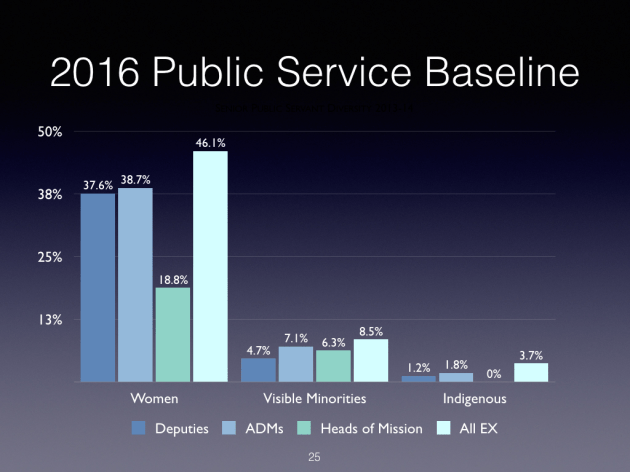
Election 2015 and Beyond- Implementation Diversity and Inclusion.001What does the data show? As seen in the chart above, representation of women is relatively close to gender parity, save for Ambassadors and their equivalents (Heads of Mission and other ADM-equivalent officials abroad).

However, visible minorities are less than half of the percentage of those that are Canadian citizens (15 percent) or in the House of Commons (14 percent).

The ‘all EX’ category has more junior executive positions (EX1-3) and thus the greater diversity in these feeder groups suggests that over time, diversity  at more senior levels should naturally increase.

The public service may feel compelled to take a more active approach given the Government’s commitment.

Likely early tests of the Government’s commitment to increased diversity will occur as deputy ministers retire and are replaced along with changes to Heads of Mission over the course of the year.

13 new Deputies have been named to date by the Prime Minister including 6 women (46 percent, reflecting in part the four women: appointed on International Women’s Day!) and one visible minority (8 percent). Future appointments will indicate whether this portends a trend.

By tracking this on an annual basis, along with changes to ADM ranks, progress can be assessed.

Diversity and inclusion agenda: impact on the public service

Marine Le Pen the untouchable?

One of the better English summaries of her visit:

The proverbial 10-foot pole has become a popular approach for Quebec politicians in dealing with the leader of France’s far-right party, who arrived in Montreal on Friday.

Marine Le Pen may be among France’s most popular politicians — polls suggest she has enough support to make the run-off stage in the country’s next presidential election — but she has yet to secure a meeting with a mainstream political figure in Canada.

That hasn’t stopped her from wading into federal and provincial politics, sending politicians scurrying for cover.

Canada’s immigration policy an ‘error’

At a news conference in Quebec City on Sunday, Le Pen criticized Canada’s immigration policy, calling it an “error” to admit 25,000 Syrian refugees.

“A multicultural society is a conflicted society,” she said during the news conference.

Le Pen described the current situation in France as warning for Canadians.

“We put out a welcome sign, but what conditions await them? The slums of Calais? This is a policy that makes no sense and is dangerous,” she said referring to a large informal refugee camp near the tunnel underneath the English Channel.

Le Pen has had trouble finding a receptive audience since she arrived in Quebec. A small group of protesters disrupted her Sunday news conference, shouting and unfurling banners with anti-fascist messages.

“Away children, go back to bed,” she told the protesters, saying their behaviour was “unacceptable in a democracy.”

PKP ‘shocked’ at meeting

Le Pen did manage to meet with people claiming to be from the Parti Québécois on Saturday. She told Radio-Canada that she has supporters within the party.

“The PQ is diverse and vast,” Le Pen said. “It’s not monolithic.”

PQ’s leader Pierre Karl Péladeau quickly took to Facebook to dissociate himself from Le Pen, saying he was “shocked” that anyone from his party would meet with her.

The Front National’s values “are diametrically opposed to the values of the Parti Québécois,” Peladeau said.

Source: Marine Le Pen the untouchable? – Montreal – CBC News

My friend Arun shared this article about the coverage in France:

FIASCO – Imaginez le scénario. Vous traversez l’Atlantique, tout content de partir en voyage au Québec, espérant renforcer votre stature internationale et en pensant rencontrer des personnalités politiques locales de premier plan, la présidentielle de 2017 en tête. Vous communiquez même sur ce dernier point. Mais, à peine débarqué de votre avion, vous commencez à déchanter car personne ne veut vous voir. C’est ce qui se passe avec le voyage outre-Atlantique de Marine Le Pen.

D’après divers articles de la presse canadienne, la présidente du Front national, de passage au Canada pour six jours, le temps de passer par Québec et Montreal, n’est pas la bienvenue pour la classe politique locale. Pourtant, le FN avait fait savoir que la candidate à l’élection présidentielle de 2017 allait rencontrer des “politiciens fédéraux” sans plus de précision.

Sauf que Le Devoir a contacté la plupart des hommes et femmes politiques de premier plan et aucun ne veut rencontrer Marine Le Pen. “Tous les partis contactés vendredi, tant au niveau provincial que fédéral, ont indiqué qu’ils n’avaient pas prévu de rencontre avec la politicienne de 47 ans”, écrit de son côté La Presse le 19 mars.

“Au Québec, le porte-parole du premier ministre Philippe Couillard, Harold Fortin, a déclaré que personne au gouvernement n’a l’intention de rencontrer Marine Le Pen”, écrit encore le Devoir sur son site et qui détaille les réponses similaires de nombre d’autres partis. Et Antonine Yaccarini, la porte-parole de l’aile parlementaire du Parti québécois, de résumer le sentiment prédominant chez les politiques québécois :

Nous n’avons pas une minute à consacrer à cette personne-là.

Comme le note également le Devoir, un député a même conseillé sur Radio-Canada à Marine Le Pen de plier bagage et de rentrer en France. Sollicités, les parti “La Coalition avenir Québec” et “Québec solidaire” ont refusé de rencontrer la patronne du FN. Idem du côté du maire de Montréal. Un fiasco.

En déplacement au Québec, Marine Le Pen peine à rencontrer des élus canadiens