Another good piece by Douglas Todd covering the different perspectives on ‘culturally appropriate’ seniors homes. From my perspective, I can understand this need given the importance of familiar food and that second-language fluency deteriorates with age:
Some critics say taxpayers should not be paying for such ethnically-specific seniors homes.
But Sood and Charan Gill, the dynamic founder of PICS, insist there is a third major reason, in addition to language and cuisine, to create residences specifically for South Asian and other visible-minority seniors: Widespread elder abuse in the immigrant population.
“It’s a huge problem,” says Gill, 80.
“We hear stories of financial and emotional abuse of elders every day here. But no one wants to talk about it,” he says, noting that members of immigrant communities are often ashamed their co-ethnics are not properly taking care of their elders.
Resident Saroj Sood peruses the day’s lunch menu at the Guru Nanak Niwas senior home in Surrey. ‘Food is most important’ as a cultural consideration for the residents.RIC ERNST / PNG
Even though Statistics Canada figures show South Asian grandparents in Canada are eight times more likely to live with their children and grandchildren than ethnic Japanese and Caucasian grandparents, many of Metro’s 250,000 South Asians still yearn to live separate from their offspring.
“Given a chance, these seniors would never leave their homes because of the strong sense of family and affinity towards their culture,” says PICS communications officer Shruti Prakash-Joshi.
“(But) PICS works very closely with seniors and we are witness to some horrific stories relating to financial and other abuse.”
PICS is lobbying the federal and provincial governments for more than $45 million to build a new “Diversity Village” on property it has bought in the Cloverdale area of Surrey. The 140-bed facility would have different sections for seniors of different ethnic backgrounds.
Meanwhile, leaders among Metro Vancouver’s 400,000-member ethnic Chinese population are also pushing for more of their own “culturally appropriate” seniors homes, which would employ Chinese-speaking staff.
As well, Muslim leaders in Burnaby and elsewhere are pressing the province for specialized seniors homes for immigrants from Muslim-majority countries.
With 45 per cent of the population of Metro Vancouver born outside the country, Canada’s National Household Survey reports one in six Metro residents do not speak English or French in their homes.
Are Canadians ready to support more ethnic-specific seniors homes? South Asian seniors who end up in mainstream seniors homes in Canada feel ‘totally isolated,’ says Charan Gill, founder of Progressive Intercultural Community Services. ‘Nobody talks to them. And they don’t get the food they’ve eaten their whole lives. Many give up and die quickly.’
Gill acknowledges providing ethnic-specific food “is a little bit more expensive than giving everybody the same food.”
And he admits that B.C. government’s health authority officials are “resistant” to spend more money than is absolutely necessary on language-specific facilities. He rejects suggestions “culturally sensitive” seniors homes may promote ethnic enclaves.
Former Canadian diplomat Martin Collacott, a Surrey resident, says there is little wrong with ethnic communities creating seniors homes that offer ethnic-specific language and food — as long as the ethnic groups themselves pay for the facilities.
The author of a Fraser Institute report titled Canadian Family Class Immigration: The Parent and Grandparent Component argues it is the federal policy that allows many immigrants to sponsor their parents and grandparents to come to Canada that makes such ethnic-specific seniors homes necessary in the first place.
“The problem with such facilities being provided for sponsored parents and grandparents is that the rationale for bringing them in is that it is traditional for them to live with adult offspring, often to babysit. On this basis it becomes questionable why they would be placed in such care facilities.”
Collacott, who has frequently advised the House of Commons on immigration policy, wrote a paper for The Association of Canadian Studies that showed sponsored parents and grandparents who arrive in their 50s or older are the least likely to work in Canada, pay income taxes or learn French or English.
Despite some opposition, Gill staunchly advocates for governments moving beyond the “Eurocentric model” of seniors homes to the “multicultural model.”
South Asian seniors who end up in mainstream seniors homes in Canada feel “totally isolated,” Gill says. “Nobody talks to them. And they don’t get the food they’ve eaten their whole lives. Many give up and die quickly.”
Remaining confident of his vision, Gill tells stories about South Asian seniors in Metro Vancouver who had to move to “Eurocentric” care homes and who die within months.
Good long-read profile of some of the pioneering Black women in police forces:
Over breakfast, senior officers Ingrid Berkeley-Brown and Sonia Thomas are chatting about a Toronto movement that has taken on the police.
Black Lives Matter came into prominence here in the spring, and both officers saw the images of the group, led primarily by black women, camped outside Toronto police headquarters for two weeks. The group’s members were furious over the decision by the Special Investigations Unit not to charge the police officer who last year shot and killed Andrew Loku, 45, while he held a hammer.
Thomas and Berkeley-Brown are black women, friends who met at Ontario Police College in the mid-1980s. They’re straddling two realities.
“Black Lives Matter makes me a little bit uncomfortable,” Thomas admits.
“Not only am I a member of the black community (who) strives for justice, but I’m also a member of the police service they’re accusing of racism. So yeah, (I’m) a little bit uncomfortable.”
But Berkeley-Brown says she doesn’t share that discomfort.
“If they have areas of concern and get together to voice those concerns, I think that’s legitimate,” she says.
Berkeley-Brown, 55, and Thomas, 52, share a bond. In 1986, they were the only two black women in their largely white, male class of about 300 recruits at the police college in Aylmer, where they met.
Now a superintendent, Berkeley-Brown is the officer in charge at 21 Division for Peel Regional Police, and Insp. Thomas is second in command at 53 Division for Toronto police. They’re among the highest-ranking black female officers in Canada, and the friends climbed steep hills to get there.
….In an interview, James, 61, who retired as a detective, says she’s pleased with her own career. But there were low points.Particularly the time she served on an undercover unit four years into her career, when a fellow officer (senior in years of service but not rank) “went out of his way to make life difficult for me.”
While on duty together — sometimes alone on stakeouts — he would make comments like “‘I’d rather go out with a hooker than a black woman,’ or ‘if a black woman ever comes to my house it’s just to clean it,’” James recalls. She eventually switched units.
Thomas says it hasn’t happened often but she has always challenged inappropriate comments and behaviour by fellow Toronto officers.
Berkeley-Brown believes that given her own past work in the black community, and with the race and ethnic relations bureau for Peel police, her colleagues have known “what to say and not say in my presence.”
On the subject of racial profiling, Berkeley-Brown says she hasn’t ever witnessed her fellow officers in Peel engaging in it. Officers with that service patrol alone.
But when she hears over the Peel police radio that a member of the public has called in about black males seen at such-and-such address, Berkeley-Brown says her ears perk up and her first question is “So what? Are they doing anything wrong?”
She believes it’s important that the public — as well as the police — be informed about bias-free law enforcement.
Thomas no longer does frontline patrol work in a cruiser in Toronto, but when she did she questioned some of the instances black people were pulled over by her fellow officers.
“I mean challenging, ‘Well, why are we stopping this car? Give me a good reason why we’re stopping this car.’
“If there was a valid explanation, we would continue (investigating). If there wasn’t, we may have disengaged,” Thomas says.
Over the years numerous voices from legal circles, academia and visible minority groups have actively pushed to stamp out racial profiling, but Thomas believes it is not a common practice by police in the province.
“The reality is police services across Ontario hire from our communities, and like communities there is going to be some discrimination, there’s going to be some racism. We’re going to have officers who are racist, who racially profile. But I can tell you those numbers are so minimal,” Thomas says.
As for their lasting friendship, Berkeley-Brown and Thomas say part of it is based on respect for each other’s rise through the ranks.
They often meet up at police-related functions, including networking and professional development events put on by the Association of Black Law Enforcers.
Berkeley-Brown attended Thomas’s wedding in 1989, and Thomas was a guest at Berkeley-Brown’s wedding in 1994.
Nearly 30 years after that meeting in police college, they’re still bound by their love for the badge.
Anecdotal but not surprising after such an ugly, divisive campaign:
A spate of racist incidents in the U.K. in the wake of Thursday’s vote to leave the European Union have Britons concerned the result is emboldening extremist elements in society.
Police are investigating a report of “racially-motivated” damage at the Polish Social and Cultural Association, a community centre in west London, a spokesman for the Metropolitan Police said on Sunday. Twitter users described graffiti that read “Go Home” daubed on walls and windows. In Cambridgeshire, police are investigating flyers left outside a primary school that said “Leave the EU, no more Polish vermin,” the Evening Standard reported.
After a bruising referendum campaign in which supporters of leaving the EU were accused of stoking xenophobia, these and other incidents will intensify worries about whether a generally tolerant country is becoming less so. While politicians on both sides of the vote have urged calm and said the result does not reflect prejudice toward migrants from Europe or elsewhere, some aren’t so sure.
“There is no question the U.K. is shifting to a more racist atmosphere and policies. This is a rhetoric that’s showing up in the lives of schoolchildren,” said Adam Posen, a former member of the Bank of England’s Monetary Policy Committee who now leads the Peterson Institute for International Economics.
British politics are in chaos after the vote in favour of a so-called Brexit prompted the resignation of Prime Minister David Cameron, spurred a rebellion against Labour Party leader Jeremy Corbyn, and opened the door to a second referendum on Scottish independence. On Sunday several senior Labour Party members resigned from Corbyn’s shadow cabinet to protest what they said was his lacklustre advocacy for staying in the EU.
The Leave campaign’s message was centred on reducing immigration, including by raising the spectre of Turkish EU membership — a prospect diplomats say is remote at best. A week before the referendum, U.K. Independence Party leader Nigel Farage unveiled a billboard showing a column of hundreds of refugees walking on a road, under the heading “Breaking Point.” A day later, Labour member of parliament Jo Cox, an outspoken advocate for Syrian refugees, was murdered in her Yorkshire constituency.
Some incidents are occurring in the heart of the U.K.’s cosmopolitan capital. Sebastien, a 26-year-old Frenchman, was walking in the Kensington district on Friday with a friend and her mother, who was visiting from Paris. Hearing them speaking French, a man walking his dog began shouting at them to “Leave, Leave!” said Sebastien, who declined to provide his surname for fear of retaliation.
The tone of some campaign discourse has “legitimized racist rhetoric,” said Jasvir Singh, a London lawyer and Labour Party activist. “There is now a vocal minority who feel emboldened to use the result of the referendum as a reason to spout their hatred.”
Schoolchildren were racially abused in a west London district this week, Seema Malhotra, one of Labour’s team of Treasury spokespeople, said on Saturday. “Someone shouted: ‘Why are there only 10 white faces in this class? Why aren’t we educating the English?’” she said, citing a letter from a teacher in her constituency about an incident on Wednesday. “Another went close up to the children and said: ‘You lot are taking all our jobs. You’re the problem.’ ”
Speaking to the BBC on Sunday, former Prime Minister Tony Blair said political leaders “have a big responsibility to help our country get through what’s going to be an agonizing process.” After a vote that largely pitted London, Scotland and a few other enclaves in favour of staying in the EU against the bulk of England and Wales, “we have a divided country but there is the possibility of bringing people back together if we are sensible about it.”
Britons have taken to Facebook and Twitter to report other racist incidents. One user, Fiona Anderson, described “an older woman on the 134 bus gleefully telling a young Polish woman and her baby to get off and get packing.” A professor at Coventry University, Heaven Crawley, said on Twitter on Friday that “This evening my daughter left work in Birmingham and saw group of lads corner a Muslim girl shouting ‘Get out, we voted leave’.”
But this hand-wringing is a distraction from the very real problems with artificial intelligence today, which may already be exacerbating inequality in the workplace, at home and in our legal and judicial systems. Sexism, racism and other forms of discrimination are being built into the machine-learning algorithms that underlie the technology behind many “intelligent” systems that shape how we are categorized and advertised to.
Take a small example from last year: Users discovered that Google’s photo app, which applies automatic labels to pictures in digital photo albums, was classifying images of black people as gorillas. Google apologized; it was unintentional.
But similar errors have emerged in Nikon’s camera software, which misread images of Asian people as blinking, and in Hewlett-Packard’s web camera software, which had difficulty recognizing people with dark skin tones.
This is fundamentally a data problem. Algorithms learn by being fed certain images, often chosen by engineers, and the system builds a model of the world based on those images. If a system is trained on photos of people who are overwhelmingly white, it will have a harder time recognizing nonwhite faces.
A very serious example was revealed in an investigation published last month by ProPublica. It found that widely used software that assessed the risk of recidivism in criminals was twice as likely to mistakenly flag black defendants as being at a higher risk of committing future crimes. It was also twice as likely to incorrectly flag white defendants as low risk.
The reason those predictions are so skewed is still unknown, because the company responsible for these algorithms keeps its formulas secret — it’s proprietary information. Judges do rely on machine-driven risk assessments in different ways — some may even discount them entirely — but there is little they can do to understand the logic behind them.
Police departments across the United States are also deploying data-driven risk-assessment tools in “predictive policing” crime prevention efforts. In many cities, including New York, Los Angeles, Chicago and Miami, software analyses of large sets of historical crime data are used to forecast where crime hot spots are most likely to emerge; the police are then directed to those areas.
At the very least, this software risks perpetuating an already vicious cycle, in which the police increase their presence in the same places they are already policing (or overpolicing), thus ensuring that more arrests come from those areas. In the United States, this could result in more surveillance in traditionally poorer, nonwhite neighborhoods, while wealthy, whiter neighborhoods are scrutinized even less. Predictive programs are only as good as the data they are trained on, and that data has a complex history.
Histories of discrimination can live on in digital platforms, and if they go unquestioned, they become part of the logic of everyday algorithmic systems. Another scandal emerged recently when it was revealed that Amazon’s same-day delivery service was unavailable for ZIP codes in predominantly black neighborhoods. The areas overlooked were remarkably similar to those affected by mortgage redlining in the mid-20th century. Amazon promised to redress the gaps, but it reminds us how systemic inequality can haunt machine intelligence.
And then there’s gender discrimination. Last July, computer scientists at Carnegie Mellon University found that women were less likely than men to be shown ads on Google for highly paid jobs. The complexity of how search engines show ads to internet users makes it hard to say why this happened — whether the advertisers preferred showing the ads to men, or the outcome was an unintended consequence of the algorithms involved.
Regardless, algorithmic flaws aren’t easily discoverable: How would a woman know to apply for a job she never saw advertised? How might a black community learn that it were being overpoliced by software?
We need to be vigilant about how we design and train these machine-learning systems, or we will see ingrained forms of bias built into the artificial intelligence of the future.
Like all technologies before it, artificial intelligence will reflect the values of its creators. So inclusivity matters — from who designs it to who sits on the company boards and which ethical perspectives are included. Otherwise, we risk constructing machine intelligence that mirrors a narrow and privileged vision of society, with its old, familiar biases and stereotypes.
If we look at how systems can be discriminatory now, we will be much better placed to design fairer artificial intelligence. But that requires far more accountability from the tech community. Governments and public institutions can do their part as well: As they invest in predictive technologies, they need to commit to fairness and due process.
While machine-learning technology can offer unexpected insights and new forms of convenience, we must address the current implications for communities that have less power, for those who aren’t dominant in elite Silicon Valley circles.
Currently the loudest voices debating the potential dangers of superintelligence are affluent white men, and, perhaps for them, the biggest threat is the rise of an artificially intelligent apex predator.
But for those who already face marginalization or bias, the threats are here.
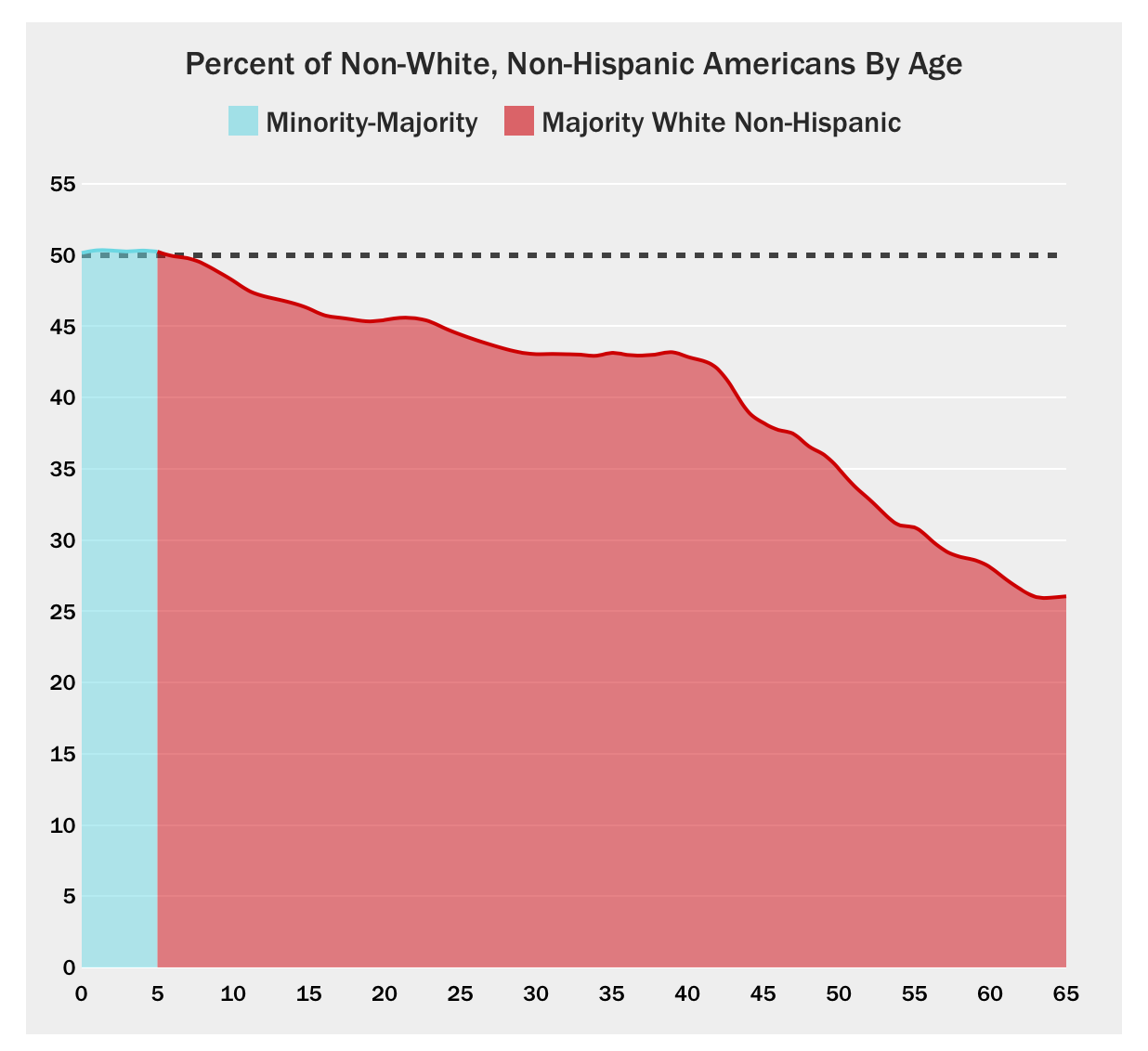
Pretty compelling chart and analysis of the changing nature of the USA:
For the sixth straight year, babies born in 2015 belong to a mini-generation that is “minority-majority,” meaning fewer than half of them are white and non-Hispanic, according to new figures released this week by the Census Bureau.
The nation as a whole is not expected to reach this distinction until 2044. But we can see the future by looking at the youngest Americans, who are naturally ahead of the curve.
It’s important to note that this data shows the diversity of Americans by their current age, not the historical data about the diversity of their cohort when they were born. Since data clearly shows that minorities still have shorter life expectancies, we would expect the figures for older Americans to be slightly exaggerated in the form of higher percentages for white, non-Hispanics.
The disparities are quite striking and like all studies, force questioning into the reasons why, including implicit bias:
New research that for the first time calculates disparity in Ontario’s child protection system has found that aboriginal and black kids are far more likely to be investigated and taken into care than white children.
The figures are especially stunning for aboriginal children. They are 130 per cent more likely to be investigated as possible victims of child abuse or neglect than white children, and 15 per cent more likely to have maltreatment confirmed.
Aboriginal children are also 168 per cent more likely to be taken from their homes and placed into care.
The huge disparity is “symptomatic of the system that’s failing our kids,” says Steven Vanloffeld, executive director of the Association of Native Child and Family Service Agencies of Ontario.
The study also found that black children are 40 per cent more likely to be investigated for abuse or neglect than white children, and 18 per cent more likely to have maltreatment confirmed. But the likelihood of going into care is lower. Black children are 13 per cent more likely to be taken from their homes and placed with foster parents or in group homes.
Margaret Parsons, executive director of the African Canadian Legal Clinic, blames the disparity on the “harsher lens” children’s aid societies use when investigating black families.
“What they might not consider abuse or neglect within a white or non-African Canadian family, they will consider abuse or neglect in one of our families,” she says. “This is not a matter of erring on the side of caution. We feel it is punitive.”
The provincial government, which regulates the child protection system, must make the development of an African Canadian child welfare strategy a priority, she adds.
The estimates were extracted from the government-funded Ontario Incidence Study of Reported Child Abuse and Neglect, compiled in 2013. A team of researchers, led by University of Toronto Prof. Barbara Fallon, examined a representative sample of 4,961 child protection investigations conducted by 17 children’s aid societies. The cases involved children up to age 14.
Of the dozen specific ethnic and racial categories examined, only black and aboriginal children were taken into care at rates higher than white kids.
The study was presented to more than 70 senior children’s aid society officials at a June 7 meeting in Toronto.
The disparity study calculated the relative likelihood of certain groups being involved with the child protection system. It differs from the study on disproportionate representation revealed by an ongoing Star investigation, which found that on a September day in 2013, 42 per cent of kids in the care of the Children’s Aid Society of Toronto had at least one parent who is black. Only 8 per cent of the city’s under-18 population is black.
The disparity results coincide with mounting outrage about the disproportionate number of aboriginal and black children in care. Parents and leaders in these communities have for years blamed discrimination and a lack of services for struggling families.
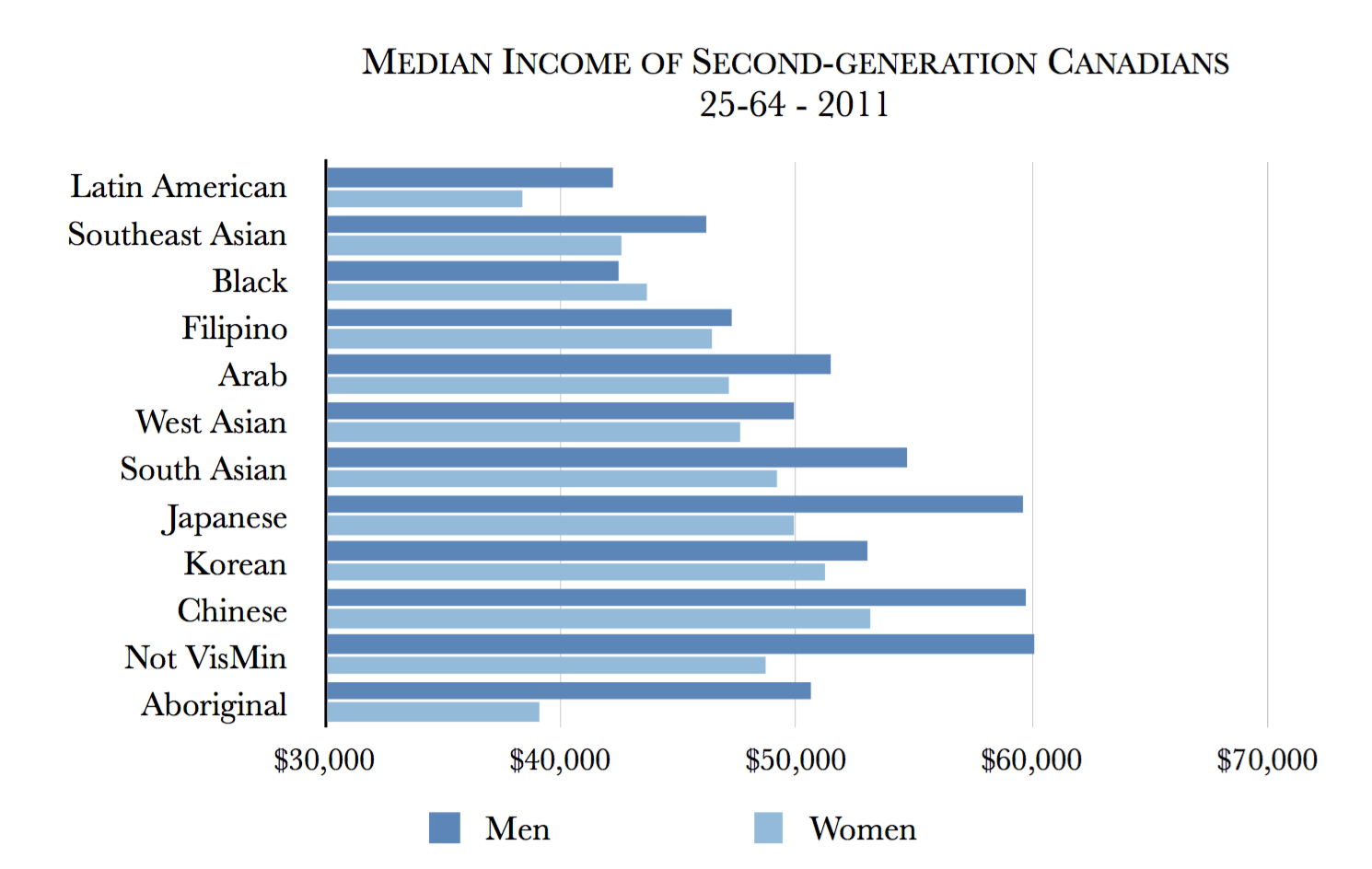
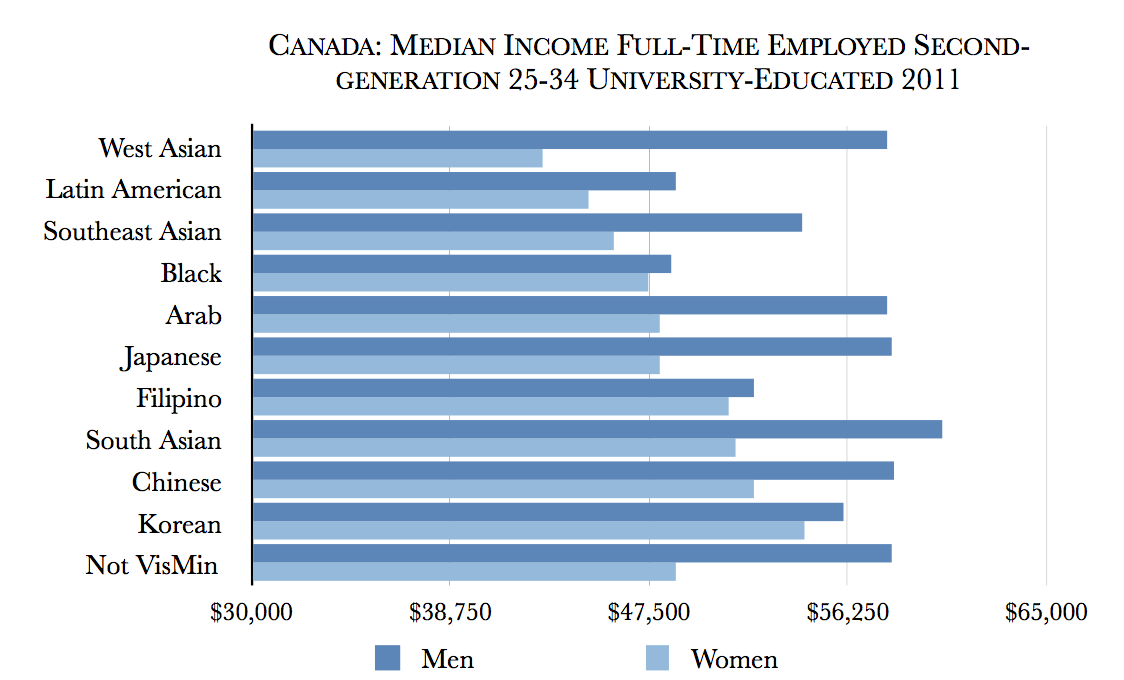
Interesting article by Jedwab on the ‘vertical mosaic,’ teasing with a brief discussion of cultural factors but not following up with any information about individual group disparities.
The two charts below, taken from INSERT, indicate the persistence of income differences in second-generation immigrants, both more generally and the university-educated young.
For all second-generation, the disparities with non-visible minorities and among different visible minorities groups are greater.
While for most groups, median incomes for the university-educated are broadly comparable to non-visible minorities, that is less the case for Latin American and Black Canadian men.
The redefinition of the ‘vertical mosaic’ needs to look more at both the overall and the group differences to assess the ongoing impact of external bias and discrimination along with any internal cultural factors and preferences that may also contribute to these disparities:
Porter made several significant observations about the economic inequality between people of British and French origins and “others” (what he called “minority ethnics”). Porter carefully documented the French population’s lower-income status and disagreed that their situation could be blamed entirely upon the British desire for economic dominance. He insisted that French-Canadian under-representation in the country’s economic elite was as much related to their values as it was to cultural discrimination.
A major part of the problem in French Canada was the dominance of the Catholic Church, which Porter felt reinforced cultural difference, encouraged separateness and diminished educational opportunity. Much has changed since the 1960s with the onset of Quebec’s Quiet Revolution and the ensuing rise to relative economic parity between French and English Canadians. Regrettably Porter said relatively little about the condition of indigenous peoples in Canada’s class structure, a persistent concern that 50 years later still badly needs national attention.
Porter was persuaded that persistent minority ethnic attachments were the principal obstacle to immigrant and minority economic advancement. This conviction was central to his ultimate objection to multiculturalism adopted by the Trudeau Liberal government in 1971. If the Canadian mosaic was vertical, Porter largely blamed it on the encouragement that multiculturalism offered to newcomers and their descendants to retain their ancestral identities. Most European origin post-war immigrants and their children would probably disagree with Porter’s assessment of multiculturalism as constituting such an obstacle.
Canada is now a much larger and more ethnically diverse country than the one Porter studied in 1965. The 1961 census reported that there were approximately 18.5 million Canadians compared with nearly 34 million in 2011.
Prior to the 1970s, immigrants from European countries accounted for over three-quarters of those coming to Canada. For many European origin groups, the story of their place in the vertical mosaic over the past fifty years ended up being one of noteworthy upward mobility. The groups that Porter saw as being locked into some lower status (Ukrainians, Italians, Poles, Finns and Czechs and Slovaks) have generally moved up the socio-economic ranks. The children of Southern and Eastern European immigrants who came to Canada in the late 1940s and 1950s are in retired age and, for the most part, they witnessed the erosion of the ethnically defined barriers to economic mobility.
Today, over three-quarters of immigrants to Canada hail from non-European countries and are defined as visible minorities. The growth in the visible minority population has seemingly changed the nature of the vertical mosaic and the portrait of inequality in Canada. The question that preoccupies researchers is whether the upward mobility experienced by most European origin groups can be replicated by non-European immigrants and their children. Several analysts are decidedly pessimistic about such prospects and argue that “race” has replaced ethnicity as the new dividing line within the Canadian mosaic.
But there are some important caveats to keep in mind when making observations about the economic dream of recent newcomers to Canada. Unlike the post-war immigrants that often came to the country with little formal education, most recent arrivals are a highly educated bunch. Data from Canada’s 2011 national household survey reveal that immigrants that arrived in Canada between 2001 and 2009 were twice as likely to have a university degree as a person born in Canada. Hence in most cases newcomer expectations for their own personal success is higher than was the case for the immigrants in the era Porter documented. While many newcomers want their children to do better than them, an increasing number will be satisfied if they do as well. That’s also a concern for many non-immigrants.
The contemporary version of the Canadian dream for many of us is perhaps more modest. It’s something akin to owning a home and staying out of debt (these two things may seem contradictory to many Canadians).
Recently, the earning power of many university degrees has stagnated. According to Statistics Canada’s 2012 Survey of Financial Security, student debt rose by 44.1 per cent from 1999 to 2012, or 24.4 per cent between 2005 and 2012. So too has the cost of owning a home in Canada. In the final quarter of 2015 Statistics Canada reported that the ratio of household credit-market debt to disposable income, the key measure of the debt load, rose to 165.4 per cent.
Sure interest rates are at record lows and there is fear that a slight rate hike will make the dream of personal debt reduction more elusive. The gap between the highest paid Canadians and others has widened in recent years. The wealthiest 20 per cent of Canadians hold 70 per cent of the country’s wealth.
As I am involved in the Pluralism Project and attended the Ottawa roundtable, interesting to see how the discussions in other centres reflect some of the regional concerns and issues, and the expectations for policy expectations:
In April, the Pluralism Project hosted a roundtable discussion with business leaders, industry associations and university administrators from Ontario’s Kitchener-Waterloo region. The meeting was the first in a series of roundtables organized across major Canadian cities by a research team at the Balsillie School of International Affairs, with the support of the Pierre Elliott Trudeau Foundation. The Pluralism Project seeks to understand how social diversity can be harnessed for greater economic advantage.
My particular challenge was to see how pluralism is working in this specific community, where the tech industry often reigns supreme. What I discovered is that acknowledging the social benefits of diversity isn’t so much the issue, but that the challenge is to attract and retain that diversity in what has been called Silicon Valley North.
The Global 2015 Start-Up Ecosystem Report ranked Waterloo among the world’s top 25 start-up ecosystems. The region’s success, in part, relates to ongoing collaboration between academic institutions, business, municipal government and settlement organizations like the Waterloo Region Immigrant Employment Network. Despite being a growing hub of innovation, however, Kitchener-Waterloo faces a set of unique challenges unlike other Canadian cities its size: attracting and retaining a diverse workforce with skills for specialized sectors.
Workplace diversity is a clear objective of all participants at the KW roundtable. Still, data gathered by the Canadian Centre for Policy Alternatives continues to rank KW as the worst city to be a working woman in Canada, partly relating to its male-dominated occupations. Data compiled and analyzed by Compass, a San Francisco based company, highlights further obstacles preventing the region from growing organically and, in turn, attracting and retaining diverse talent.
Kitchener-Waterloo’s current and projected growth spurt – in terms of population, housing and transportation infrastructure – speaks directly to these challenges. Companies like Google and Toyota have invested in the region, and with that investment comes the need for a globally competitive workforce and talent pool, one that reflects the globality of the products produced. It is unsurprising then that tech executives, city mayors and academics are looking to turn the 114-km stretch between KW and Toronto into an innovation corridor.
Better transportation infrastructure, roundtable participants argued, would allow companies to bring diverse talent – in terms of culture, ethnicity, religion, gender and sexual orientation – to Kitchener-Waterloo more easily and provide those living in the region with cultural and social outlets in Toronto.
Infrastructure is but one variable. The Waterloo region is also subject to a skilled labour shortage across industries, including the tech and automotive industry. While both the University of Waterloo and Wilfrid Laurier University produce top-notch students, the policy infrastructure to retain international students remains insufficient. The same holds true for qualified labour from outside Canada. The diagnoses put forward at the roundtable held across the board: immigration policy is too slow and labour intensive, credential recognition is often protectionist and bureaucratic, and international study and work experiences often go unrecognized. Again, this is problematic for workplace diversity.
The Canadian federal government continues to invest in Waterloo-based institutions like the Perimeter Institute, and its tech industry, with a vision to build Canada into a centre of global innovation. In a country celebrated for its pluralism, however, investing in a region like Waterloo without giving due consideration to its challenges in attracting and retaining diverse talent could leave Canada’s economy disadvantaged, and its innovation economy trailing its competitors. Actionable policy recommendations, based on hard numbers, produced by the Pluralism Project will aim to provide insight and solutions to such dilemmas.
Not surprising, both the increased prevalence and the lower use of mental services:
Ethnocultural minorities are more likely to report suffering from mental health issues but are less likely to access treatment, a study out of York University using Ontario Health Study (OHS) survey data has found.
Participation in the OHS includes an extensive online survey that asks each user to review a list of ethnocultural groups and check those they thought they belonged to. The survey also included questions related to common mental health problems such as depression, anxiety and social isolation. Researchers looked at self-reported data from some of Ontario’s most common minority groups, such as South Asian, East Asian, Southeast Asian and Black Ontarians, and measured them against a comparable group of OHS participants who identified as white.
“Minority groups were much more likely to report mental health problems and stressful life events,” said Professor Sherry Grace, also of the University Health Network. “And with the exception of Aboriginal Ontarians, we also found that they were less likely to use the mental health services that we have here. This is unfortunate because there are proven treatments for depression and anxiety that really work.”
The stresses of adapting to a new country could be one of the reasons driving this, suggests Professor Grace.
“Most people who immigrate are very healthy, but studies show that being away from family, as well starting over in one’s career, and the financial repercussions of this, are tough” she says.
Young and middle-aged immigrants to Canada, most of them from Asia, are countering the trend that sees homegrown Canadians becoming more secular.
I’ll write more in the future on a revealing Angus Reid Institute poll, which has found immigrants between the ages of 18 and 34 are more than twice as likely than the average Canadian to be actively religious.
While 21 per cent of people born in Canada attend religious services, that figure jumps to 49 per cent for young immigrants — whether they are Muslim, Christian, Buddhist or Sikh.
People born outside Canada are considerably more likely to attend religious services than people born in Canada (35% versus 21%).
Young arrivals aged 18-34 and 35-54 (increasing numbers of whom are coming from Asian and African countries) are much more likely to actively attend services than their older counterparts (49% for the young compared to 27% of those 55 and older).
Additional analyses shows a similar, though somewhat weaker pattern holds for the religious self-designations of younger arrivals from other countries: 42 per cent of those who are 18 to 34 say they are embracing religion.
Similarly, 38 per cent of 35 to 54-year-olds born elsewhere are embracing faith – also well above the level for their Canadian-born counterparts.
Interestingly enough, it looks as if the largest religious group among immigrants in recent times has been Roman Catholics.
The second largest religious group among immigrants is Muslims, who have a much lower average age.