Austria accepted its Holocaust guilt. So why is its far right on the rise? | Jewish Telegraphic Agency

Good long read:

When it comes to the Holocaust, Austria has made a lot of progress assuming responsibility.

In recent years, Austrian officials have consistently acknowledged their country’s support of Adolf Hitler, an Austria native, and his war of annihilation against Jews. In the early 2000s, the government dropped the claim that the country was mostly a victim of German Nazism, citing “the special responsibility imposed on Austria by its recent history.” Instead, teaching about the Holocaust has become mandatory, with visits to former death camps and teacher training in Israel.

The government has paid nearly $1 billion since 2005 in compensation to Holocaust victims, and since 2012, Holocaust memorial projects have popped up at an unprecedented rate. They include the opening of a learning center at the Mauthausen former death camp, a monument for Vienna’s deported Jews and an international exposition, commissioned by the national railway firm, on its own role in murdering some 65,000 Austrian Jews.

Yet in spite of this increased sensitivity, nationalism still has a firm grip on Austrian society: The far-right Freedom Party, which was founded in 1956 by a former Nazi SS officer, is on the rise. In last month’s national elections, the party garnered 26 percent of the vote with a platform that included denouncing “forced multiculturalism, globalization and mass immigration.

As a natural ally of the center-right People’s Party, which won the most votes, the Freedom Party is poised to enter Austria’s government for the second time — it was part of the governing coalition in 2000.

Amid the ascendancy of far-right populism across Europe, its revival in Austria is seen as particularly alarming, as it suggests a failure by society to learn from its recent history. After all, if a country that does nearly everything “right” when it comes to Holocaust education can fail to inoculate itself to the kind of hatred that makes genocide possible, what hope is there for other countries in the region, such as Hungary and Poland, which face rising nationalism amid complicated reckonings with their own Holocaust legacies?

Experts on Austria say the rise of its xenophobic far right is connected to fears over Muslim immigration, as well as a perceived need to protect the nation’s sovereignty from an increasingly interventionist European Union. But it’s also connected to the Austrian government, which deflected its guilt for decades and failed to purge Nazi supporters from positions of influence.

Unlike neighboring Germany, Austria did not have an organized, judicial denazification effort in the aftermath of World War II — in fact, no one has been convicted of Nazi war crimes in Austria in more than 35 years.

“In Germany, and quite a few of the countries that were under Nazi occupation, many people involved in Nazism were convicted or at least not permitted to be civil servants, teachers, police officers, etc.,” said Tina Walzer, a Vienna historian. “But this has never happened in Austria and we are witnessing the results of this crucial difference.”

This has entrenched populist ideas in a way that has seemed resistant to increased Holocaust awareness.

“When you look at the population as a whole, you don’t feel there has really been a change,” said Milli Segal, founder of the newly opened For the Child museum in Vienna honoring the young Holocaust refugees who fled to Britain through an arrangement known as the Kindertransport.

“Well, there’s change, but in very, very small steps,” she added after a pause. “It makes you feel voiceless.”

Many in Austria share Segal’s feeling of powerlessness over the Freedom Party’s recent successes. Its strong showing last month follows an even greater electoral feat in last year’s presidential elections in which the party’s candidate, Norbert Hofer, won 49.7 percent in the first round of voting. Hofer lost in the second round to the left-leaning candidate Alexander Van der Bellen, 53 percent to 46 percent.

The close election indicates that far-right populism is a “ticking political bomb,” warned Barbara Wesel, a senior Europe correspondent for Germany’s Deutsche Welle broadcaster.

The Freedom Party, for its part, rejects claims that it plays on Nazi and other racist sympathies. Party leader Heinz-Christian Strache has vowed to kick out members caught engaging in racist rhetoric, and has indeed done so to a former lawmaker who supported online the assertion that “Zionist money-Jews worldwide are the problem.”

The Jewish Community in Vienna considers the Freedom Party a racist entity, according to Oskar Deutsch, the community leader, who has called on Chancellor-elect Sebastian Kurz to prevent the Freedom Party from reaching power.

“It’s a facade,” Deutsch told JTA of Strache’s statements against anti-Semitism and racism. “Despite this talk, they position themselves as the go-to address for people with Nazi sympathies.”

A case in point: On Nov. 9, when the outgoing chancellor, Christian Kern, spoke in parliament to commemorate the 79th anniversary of Kristallnacht — a series of pogroms that the Nazis carried out in Germany and Austria — the Freedom Party’s lawmakers were the only ones who demonstratively did not applaud.

“These subtle signs are how they signal and excite their supporters,” Segal said. “If the Freedom Party will be part of the government, it will become difficult to commemorate the Holocaust in the same dignified way that we have now in Austria.”

The dissonance between Austria’s Holocaust commemoration efforts and the far-right’s popularity can be unsettling.

On Oct. 19, for example, a Vienna city official inaugurated a Holocaust memorial installation outside the Herminengasse subway station, near an alley in which the Nazis imprisoned hundreds of Jews during the war. From there they were taken to be deported as non-Jewish locals watched from their balconies. The inauguration ceremonies were held during election season; nearby hung a giant poster of a smiling Strache bearing the slogan “Fairness.”

Does the party’s recent success suggest that such commemoration projects are ultimately failing to make a difference politically?

“You might say so,” Deutsch said. “But the Jewish community will not remain silent.”

To Efraim Zuroff, a hunter of Nazis and historian for the Simon Wiesenthal Center who is based in Israel, the success of the far right in Austria reflects how Holocaust commemoration projects in urban areas hardly reach people who live in smaller towns — the Freedom Party base.

“Holocaust education, which only recently really began developing in Austria, happens there in pockets — in the big cities, in the artists’ scene,” he said. “It has big visibility but isn’t penetrating the way it has in Germany, where the effort was much more robust.”

Zuroff said this has a lot to do with Austria’s failure to prosecute Nazis.

“Holocaust education efforts in Austria are having limited impact because they are done in two voices,” he said. “There was a belated admission of guilt by politicians. But the judiciary, whose work sends a much stronger message in society, was a total failure.”

To some activists against racism, the Freedom Party’s rise is motivation to invest even greater efforts in Holocaust commemoration.

The far-right’s success in Austria “only strengthens our resolve,” said Brigitte Prinzgau, an artist who designed the newly inaugurated Aspang Railway Station Memorial, near where 47,035 Austrian Jews were dispatched from Vienna to death camps. “Now educators and artists will make even more monuments confronting fascism and xenophobic populism.”

via Austria accepted its Holocaust guilt. So why is its far right on the rise? | Jewish Telegraphic Agency

Australia: Multiculturalism must be reinvented in order to survive, study claims | SBS News

I am always a sceptic on calls to change terminology as, in many cases, it is not needed and it is generally preferable to focus on what a term means. In any cases, the terms multiculturalism, interculturalism, and pluralism are largely plastic terms which can be interpreted and implemented in integrative or divisive manners.

But the report is correct in noting the challenge is to ensure that multiculturalism (or interculturalism or pluralism) applies to all members of society, not just minority groups:

A majority of Australians, including those working in the multicultural sector, believe that multiculturalism is focussed too much on the celebration of diversity at the expense of social inclusion and participation, a new study claims.

The Doing Diversity report, authored by Deakin University’s Alfred Deakin Institute for Citizenship and Globalisation, and released on Thursday, set out to examine the current state of multiculturalism in Australia.

The research involved consultations with professionals and community members in the multicultural sector, focus groups, and a randomised online survey of 1000 Australians.

Its findings echoed other surveys such as the longstanding Scanlon Foundation’s Mapping Social Cohesion Survey, in which a clear majority of Australians routinely expressed a positive view about multiculturalism. But the Deakin study also suggested ‘identity politics’ – or political positions based on identifying with a particular race or nation – has gone too far.

“Around 64 per cent of survey respondents reported that Australia was a successful multicultural society and 68 per cent considered cultural/ethnic diversity as a fundamental positive characteristic of Australian culture,” said the Institute’s director, Alfred Deakin Professor Fethi Mansouri.

But he said that there is a strong perception, especially among those working in the sector, that multiculturalism was not working as well as it should be.

“A sizeable majority of participants in the multicultural sector [75 per cent] and the wider public [51 per cent] reported that multiculturalism, while positive for society, needed refocusing and reinvigoration,” Professor Mansouri said.

“While multicultural policies provide room for self-expression and belonging among minority groups, they have been limited by their exclusive focus on cultural minorities, leaving members of the dominant culture outside their radar.”

Multicultural sector focus group participants said they believed the majority Anglo-Australian group was highly disengaged from multiculturalism and viewed it as a peripheral concern.

From multiculturalism to interculturalism

Prime Minister Malcolm Turnbull says Australia is “the most successful multicultural country in the world”, with a high degree of social harmony despite half the population being born overseas or having a parent who was.

But the Deakin report claimed multiculturalism is under threat, particularly from Turnbull’s own government, citing the federal government’s stalled changes to citizenship and the apparently failed debate on weakening section 18c of the Racial Discrimination Act.

The researchers laid the blame at the feet of policymakers for cutting funding arrangements for multicultural services and for not communicating “a coherent vision of multiculturalism that stakeholders and more importantly the broader community can embrace.”

They propose a shift in Australia’s official multicultural policy framework – in place since the Whitlam government in the early 1970s – to something they call “intercultural dialogue”. This is defined as an approach “encompassing meaningful two-way engagement among majority and minority groups” manifested through “working together, interacting socially, and learning from each other’s respective cultural repertoires.”

This is distinct from multiculturalism which, focus group participants told the researchers, “reinforced the ‘othering’ of minorities and the dominance of the Anglo-Australian culture”.

Intercultural dialogue would foster cohesion and should be promoted through grass-roots efforts, cross-cultural competency within institutions and the national school curriculum, the report claimed.

via Multiculturalism must be reinvented in order to survive, study claims | SBS News

In An Era Of Colorlines, Are East Asians ‘Brown’? : NPR

Interesting discussion on “yellow” vs “brown” identities:

It’s time for another Ask Code Switch. This week, we’re getting into the gray area between yellow and brown.

Amy Tran, from Minneapolis, asks:

Can light-skinned Asians (East Asian) call themselves “brown”? I am East Asian, and have a friend who is South Asian. She is much darker than me, and told me that because of my skin color, I cannot identify as brown. I acknowledge that even though I am not technically brown, I do face similar challenges that people under the “brown” umbrella face – gentrification, unfair labor conditions, xenophobia, not to mention micro-aggressions and stereotypes, etc. – and that to exclude me from this “group” is excluding all light-skinned Asians from the oppression we face. What’s your take?

Hi Amy,

I think there are actually two different questions — both very important — that we have to parse out here. One of them is about skin color, and the other is about political identity. And in the conversation about who gets to claim the term “brown,” those are very different things.

So, to begin with, let’s get one thing straight — the colors that people use to differentiate people of different races have never really been about skin color. Black, white, brown, yellow, red? Those terms bear little resemblance to the actual spectrum of coloring found in humans, not to mention they create false distinctions between groups of people who have always overlapped.

And, of course, there are plenty of East Asians who have very brown skin, just as there are tons of South Asians who have very light skin. This cuts across racial groups. Some black people have skin the color of a chestnut, and others have skin the color of pink sand. In the U.S., Latinos with all different coloring refer to themselves as brown.

The racial categories we use today were largely the brainchild of eighteenth and nineteenth century European “racialist anthropologists,” who used things like skull measurements and hair texture to divide people into racial groups. For years, many of these anthropologists referred to four races: red, yellow, black and white. Then in 1795, Johann Blumenbach, a German naturalist, wrote about a fifth brown race (the “Malays”,) consisting of Southeast Asians and Pacific Islanders.

All that is to say, the way someone identifies racially has never been strictly about physical appearance and always about drawing (arbitrary) lines between groups of people.

So, the idea that you shouldn’t refer to yourself as brown because of your literal skin color, I think, is a bit misguided.

Having said that, Amy, there is a pretty compelling reason not to call yourself brown.

As you’ve rightly pointed out, identifying as “brown” (or black, or white, or yellow) is a political statement. To you, and many others, being brown is about a set of shared experiences, that include things like being subjected to discrimination and stereotyping.

But there’s some important history here, and it goes back to the Yellow Power Movement of the 1960s and ’70s. The Yellow Power Movement was instrumental in fighting for the civil rights of Asian-Americans. But not all Asian-Americans felt represented by the movement. And that’s where the East Asian/”Brown Asian” divide comes in.

The brown Asian movement was a response to the fact that “brown Asians are still really forgotten and marginalized within the Asian American umbrella, to this day,” says E.J.R. David. He’s a professor at the University of Alaska, Anchorage who studies the mental health consequences of colonialism. He also wrote Brown Skin, White Minds, a book about the psychological experiences of Filipino Americans.

David says that when people in the United States talk about Asian-Americans, they’re almost always referring to people of Chinese, Japanese, or Korean descent. But today, those groups only make up about half of all Asian-Americans. And those East Asians, David says, have different educational outcomes, income levels, immigration histories, health outcomes, access to resources and refugee status than brown Asians. (Brown Asians include Filipinos and South Asians, David has written.)

So while there certainly may be similarities between the experiences of East Asians and other Asian Americans, David says that the term brown Asians is meant to differentiate people who have felt invisible. It makes sense, he says, that some people might be offended if the term is taken on by someone of East Asian descent.

“To me, there are terms that only, because of the history of it, and because of the current reality of our situation, I think are best reserved for some people to be able to use, especially if they’re using it for their own empowerment, and for their own group’s empowerment,” David says. And for those people who are not part of it, he adds, “We cannot appropriate that if it’s not ours.”

via In An Era Of Colorlines, Are East Asians ‘Brown’? : Code Switch : NPR

‘Australia’s media is frighteningly white’, says The Monkeys’ Scott Nowell – AdNews

Good article on multicultural marketing – the ads are worth watching for the contrast (the humour on “boat people”):

The Australian media is “frighteningly” white and the nation is lagging behind in its representation of broader media, believes The Monkeys co-founder Scott Nowell and former Meat and Livestock Australia (MLA) top marketer Andrew Howie.

The pair were speaking at AdNews Live! Reframing Australia in Sydney yesterday (15 November) to address the changing face of Australia, and talk through how The Monkeys and MLA tackle multiculturalism in marketing.

For over a decade, MLA has been renowned for its Australia Day and spring lamb ads that for the past several years have focused on the theme of diversity and inclusion.

Howie, who recently announced he was joining Westpac, said that as Australia’s cultural variety has evolved, MLA has had to evolve its brand to target a diverse, younger Australia.

MLA has had to evolve its ads from its all-white cast in 1990

The result has seen the brand achieve significant earned media and significant uplift in sales, but it’s not been without controversy.

This year the MLA chose to move away from the Australia Day focus as it recognised that a significant segment of the population felt negatively about the date.

“MLA has been a brand that has been about Australia Day but it was starting to feel like it wasn’t right to talk about Australia Day from a brand that talks about unity,” Nowell said, adding it was a hard but clear choice for MLA.

“Our intention was to show the true face of Australia and not just the one we see on television,” Howie added.

The process of creating the ad was difficult, Howie and Nowell admitted. The ad focused on the settlement of Australia, which can be a sensitive subject for the indigenous, so the agency and brand were constantly in consultation with Reconciliation Australia.

The script was leaked, an actor refused to deliver his lines on the day of filming and there were some complaints made to the ad watchdog, but ultimately the campaign was a success, says Howie.

“Sometimes to find where the edge is you have to put your toes over the side,” Howie said, adding that its unlikely the brand will ever get everyone on side with the bold work its doing.

“We are not controversial for the sake of it but we are prepared to say what people won’t. Often they are things that people are talking about and the topics of conversation around water coolers but not said in the open.”

Howie and Nowell did admit they’ve gotten it wrong in the past, admitting that naming its 2016 campaign ‘Operation Boomerang’ was an oversight.

While this type of bold advertising is what we’ve come to expect from MLA under Howie’s leadership, he admits it’s probably not what you’ll see from Westpac when he joins in his new role.

“Banks don’t want controversy so don’t expect to see this stuff going on, but you can expect to see work that you enjoy watching,” Howie said, adding that he’d like to see the brand explore its purpose and own a time of year as MLA had previously owned Australia Day.

Source: ‘Australia’s media is frighteningly white’, says The Monkeys’ Scott Nowell – AdNews

Ottawa unlikely to send Quebec’s face-covering law to top court

Sensible approach:

Ottawa is unlikely to pre-emptively refer Quebec’s controversial face-covering law to the Supreme Court, where little evidence could be presented on Bill 62’s actual impact on individual Muslim women, federal officials said.

Senior government sources said all options are still on the table, but that Ottawa is likelier to intervene in a coming court challenge than refer the matter to the Supreme Court for an immediate ruling on the law’s constitutionality.

Prime Minister Justin Trudeau raised both of these options over the weekend as he continued to denounce the law that calls on Quebeckers to show their face when giving or receiving services in places such as libraries, university classrooms, daycares and on buses. Critics of the legislation have denounced the fact it affects Muslim women who cover their faces, with Mr. Trudeau stating governments shouldn’t tell women what to wear.

The quickest way to have a formal ruling on the constitutionality of the law would be to refer the matter directly to the Supreme Court. Still, federal officials and experts said a Supreme Court reference would feature more of a theoretical debate among lawyers on the constitutionality of Bill 62 than an actual exploration of the law’s effect on citizens.

“It’s difficult to get to the bottom of a question by looking at it in theory. It’s much better to look at the case in practical terms,” said a senior federal official, who spoke on condition of anonymity to discuss the government’s current thinking on the file.

Experts said it would be easier to gauge the impact of the law on individuals through the court challenge that is set to be heard by the Quebec Superior Court, where Muslim women will be appearing as witnesses.

“In a reference [to the Supreme Court], you don’t have testimony or evidence on the actual impact on people and any limits to their rights and freedoms,” retired Supreme Court justice Louis LeBel, who is now in private practice, said in an interview. “What you get to look at are legal and intellectual issues and the law’s overall impact on society.”

Supreme Court references have sporadically been used by the federal government over the years to gain clarity on issues such as a province’s right to unilateral secession. The Harper government also relied on the process in 2013 to determine the constitutionality of possible reforms to the Senate.

Daniel Proulx, a professor of constitutional law at the University of Sherbrooke, said sending Quebec’s face-covering law to the Supreme Court would be seen as an affront to the provincial government.

“A reference would be a frontal attack,” he said. “In my view, the federal government will intervene in the court challenge. … It would be less confrontational.”

There has been heated debate across Canada in recent weeks on the federal government’s proper response to Bill 62, which aims to promote “religious neutrality” in Quebec. The NDP and a number of Liberal MPs have said Ottawa should let the debate play out at the provincial level, while others have argued for a strong federal intervention.

Earlier this month, the National Council of Canadian Muslims and Canadian Civil Liberties Association launched a court challenge in Quebec Superior Court, seeking to suspend the application of the section dealing with uncovering one’s face until a full constitutional challenge is heard.

There will be a first hearing on the application for a stay on Friday. A federal observer will be in the room to monitor the process, but federal lawyers will not get involved in the groups’ request to suspend the application of the law, sources said.

A federal official said Ottawa has yet to decide whether to intervene in the challenge, and if it does, at which stage of the process federal lawyers would make their case.

“If you decide to intervene, when do you intervene? Right now? At the appeal stage? Or do you wait until you are at the Supreme Court?” the official said. “There is no rule, no magic recipe.”

On Saturday, Mr. Trudeau said his government is closely monitoring the application of the law adopted by the Quebec National Assembly last month.

“We’re listening to the questions being asked about it and, internally, we’re in the process of studying the different processes we could initiate or that we could join,” he said.

via Ottawa unlikely to send Quebec’s face-covering law to top court – The Globe and Mail

Mandate Letter Tracker: Delivering results for Canadians [diversity of appointments and lack of detail]

There has been justified critical commentary regarding the government’s mandate letter tracker. I was curious to see how the commitment to increased diversity in appointments was covered.

Surprisingly, the 2016-17 PCO Departmental Performance Report does not provide any data table to substantiate that claim, merely noting:

  • Almost 12,000 applications processed and 429 Governor in Council appointments made in 2016-17”

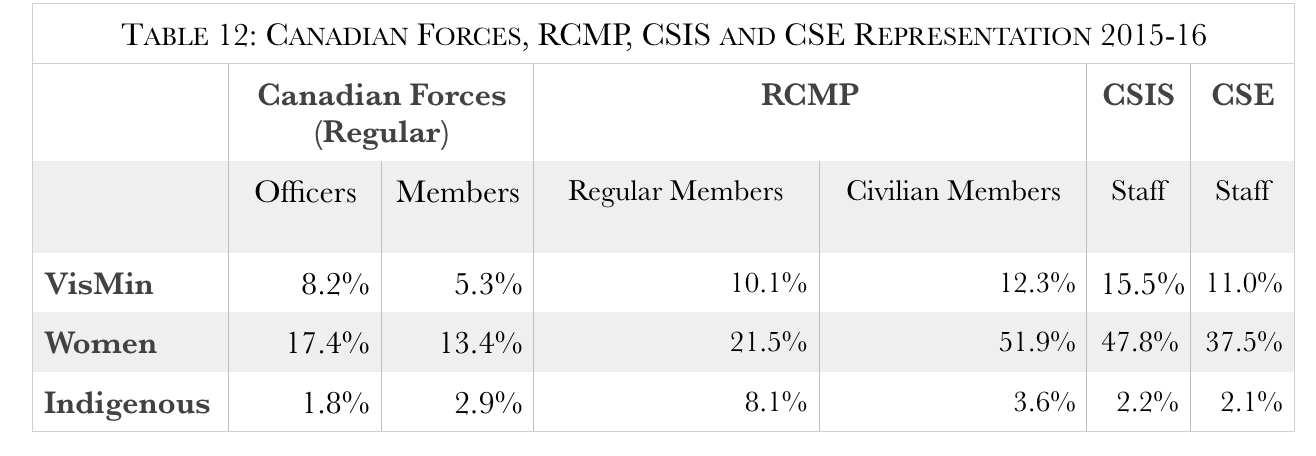
Strikingly, the focus appears only to be with respect to women, not the other employment equity groups (visible minorities, Indigenous peoples, and persons with disabilities). PCO should be providing such data (as Justice does for judicial appointments).

That being said, given HoM and judicial appointments to date, I think this one can be said to be on track.

via Mandate Letter Tracker: Delivering results for Canadians – Canada.ca

Massive fascist rally in Poland shows how the far right has perverted the word ‘patriotism’: Paradkar

Good commentary:

So much for “Never again.” So much for “Lest we forget.”

We have forgotten, and it is happening again. Amid rising intolerance around the world, ill winds are blowing across the West, revealing the ugly faces of white supremacists as they march in Europe, organize in the U.S. and peck at the social fabric in Canada.

They pontificate in the guise of defending free speech when they want to stifle dissent. They moralize on marriage, women’s rights and sexuality when they are threatened by change. They get wistful about a past when they didn’t have to face the consequences of their abusiveness. They mask their fear of others by claiming superiority to them. Then they take all this narrow-mindedness and deposit it into one hideous package, and call it patriotism.

Some 60,000 people, mostly men, took ] to mark its Independence Day, waving banners reading: “Clean Blood,” “White Poland,” “Pure Poland,” “Refugees get out!” A banner over a bridge read: “Pray for Islamic Holocaust.”

In Poland, mind you, that victim of racism and fascism in the Second World War, that most white, most Catholic of European countries with a 0.1 per cent Muslim population.

The country’s state broadcaster, conservative government mouthpiece TVP, called the demonstration a “great march of patriots.”

According to the Never Again association, the number of homophobic, racist or xenophobic incidents in Poland went from 20 a month to 20 a week in 2016.

History shows Europe certainly needs no help from the U.S. when it comes to fostering divisions to maintain white hegemony. Far-right parties have been rapidly gaining steam across the continent. Many European nations are victims of Russian propagandists spreading misinformation.

One year of ideological support from the world’s biggest military power hasn’t hurt, either.

In July when U.S. President Donald Trump was visiting Warsaw, he quoted the words of an old Polish religious song, “We want God,” and invoked the clash of civilizations rhetoric. “The fundamental question of our time is whether the West has the will to survive.”

“We want God” was the slogan for the Independence Day event this past weekend.

“We know that Donald Trump is not the most religious man, and I think that most of the organizers are not very religious, either,” sociologist Rafal Pankowski, and head of Never Again, told NBC. “But they use Christianity as a kind of identity marker, which is mostly about being anti-Islam now.”

Saturday’s demonstration was one of the largest of its kind in Europe, and included other far-right leaders, including Tommy Robinson from Britain and Roberto Fiore from Italy. American white supremacist Richard Spencer was invited, but he was too racist even for Poland’s government and he was kept out of the country.

There are those who will argue that even this putrid Polish crowd was not all bad. TVP said these were not extremists, but regular Poles expressing their love of Poland. These would be the ordinary people who hide behind those who own up to hatred. These are the ordinary folks, about as nice as the pus that flows out of a festering wound, who remain silent in the face of racist incursions on rights of their fellow citizens in the name of patriotism.

Patriotism came in handy for Trump who invoked its symbolism — but not its substance — while criticizing NFL players who knelt in protest during the national anthem. It’s bewildering how a respectful protest against anti-Black racism insults the flag, the country or the military, but that’s the consequence of redefining patriotism as a love of white America.

In the Second World War and after, patriotism was about the spirit of inclusion. Now, the far right has perverted it to make it about exclusion and white supremacy.

Canada is seeing its share of such patriotism. While attempts by a white supremacists to hold a rally in Peterborough and in Kew Gardens Park in the Beaches recently were shut down by anti-fascists, that’s no reason to be complacent: it took just seven years for Poland to go from sparsely attended far-right rallies to Saturday’s full-blown demonstration.

In Toronto, white supremacists caught trying to paste “It’s okay to be white” posters shouted sexist, homophobic slurs at the Torontoist photographer taking pictures. The message of the posters originate from a strategy called “Hiding your power level” or publicly disavowing Nazis and painting any opposition to this message as anti-white racism, the news site reported.

Anti-immigrant groups such as Quebec’s La Meute position themselves as patriotic. White supremacists groups such as the Heritage Front stake their patriotism as keepers of our traditions. And the name of German PEGIDA, which has a Canadian chapter, says it all: Patriotic Europeans Against the Islamization of the West.

The reality is these groups don’t represent patriotism, which, according to Merriam-Webster, has connotations of valour, bravery, duty and devotion. What they stand for is nationalism, and a return to unchallenged white supremacy.

Over our dead bodies.

via Massive fascist rally in Poland shows how the far right has perverted the word ‘patriotism’: Paradkar | Toronto Star

Hate Crimes Up In 2016, FBI Statistics Show : NPR

Relatively low numbers compared to the population, reflecting major data collection gaps:

The Anti-Defamation League, for example, noted that nearly 90 cities with populations of more than 100,000 either reported zero hate crimes or did not report data for 2016.

“There’s a dangerous disconnect between the rising problem of hate crimes and the lack of credible data being reported,” said ADL CEO Jonathan A. Greenblatt. He called for an “all-hands-on-deck” approach to get better nation-wide figures on the problem.

Sim Singh, the national advocacy manager of the Sikh Coalition, agreed. He noted that the FBI statistics count seven anti-Sikh hate crimes in 2016, which he said “represents the tip of the iceberg.”

“If law-enforcement agencies fail to document the true extent of hate crimes against our communities,” Singh said, “our nation will have a hard time mobilizing the political will and resources necessary to prevent and combat the problem.”

The only way to fix the data problem, he added, is for law enforcement to adopt mandatory hate crime reporting.

Still, the FBI data provides an overview of hate crimes across the country.

There were 7,509 victims of single-bias hate crime incidents, according to the reported numbers for 2016. A victim can be a person, a business, a government entity or a religious organization.

Nearly 59 percent of the victims were targeted because of their race. A further 21.1 percent were targeted because of religion, and 16.7 percent because of sexual-orientation.

Of the race-related incidents, more than half were anti-black, while some 20 percent were anti-white. More than half of the religious-related crimes, the statistics show, were anti-Jewish, while a quarter were anti-Muslim.

In cases where law enforcement was able to identify the perpetrator, 46.3 percent were white and 26.1 percent were black.

via Hate Crimes Up In 2016, FBI Statistics Show : NPR

B’nai Brith Canada condemns rash of pro-Nazi postering in B.C.

Another disturbing incident:

B’nai Brith Canada has condemned the actions of whoever put up anti-Semitic posters and chalkboard drawings at the University of British Columbia over the Remembrance Day weekend in Vancouver.

On Nov. 11, the student newspaper called the Ubyssey reported that the entrances to the War Memorial Gym were plastered with posters glorifying Nazi Germany.

One poster touts Nazi soldiers as the “true heroes of WW2” and offers links to hateful websites. Another bore a swastika and described Nazism as “anti-degenerate.”

The posters were found Saturday, the same day the school hosted Remembrance Day ceremonies.

Philip Steenkamp, vice-president of external relations for the University of B.C. — said campus security took down the posters as soon as they were made aware of them, and that the university takes incidents of hate and racism very seriously.

Two days earlier, on the anniversary of Kristallnacht or the “night of broken glass” on Nov. 9, 1938 in Germany — the night violence broke out against Jews which resulted in thousands of businesses and synagogues trashed and looted — a chalk drawing was found in the UBC forestry building with a “Heil Hitler” message.

RCMP investigated both incidents, but could not find any suspects, said UBC RCMP Const. Kevin Ray.

“Once again, we see anti-Semitism and neo-Nazism raising their ugly heads at a B.C. university,” said Michael Mostyn, chief executive officer of B’nai Brith Canada.

A neo-Nazi poster put up at the University of British Columbia just before Remembrance Day. (The Ubyssey)

“These disturbing incidents constitute a threat to Jewish students and other minorities on campus, as well as an unforgivable insult to Canadian veterans who made the ultimate sacrifice to defeat Nazi tyranny.”

Earlier in November, posters targeting Jews were found at the University of Victoria.

Publicity around the removal of those posters was followed by a “tidal wave” of hateful comments on social media, according to anti-racism activists, who fear the far-right rallies seen this summer in Charlottesville, Va. — which saw similar posters plastered around many U.S. universities — may be emboldening racists in Canada.

via B’nai Brith Canada condemns rash of pro-Nazi postering in B.C. – British Columbia – CBC News

Sexual Assault Charges Against Islamic Scholar Divide Europe’s Muslim Communities

Reaction to the accusations against Tariq Ramadan:

Sexual assault charges targeting a prominent Islamic scholar have left many European Muslims stunned, and triggered sharply disparate reactions within the multi-faceted community, even as many fear a broader backlash.

Swiss-born theologian Tariq Ramadan took a leave of absence from teaching at Oxford University last week, following complaints of rape and assault filed by two French women and reports of similar charges in Switzerland. A statement by the university said the decision was mutual. Ramadan denies the accusations.

While some analysts say Ramadan’s star has been waning in recent years, the impact of the accusations has been immense. Especially in French-speaking countries, 55-year-old Ramadan inspired a generation of young Muslims to believe Islam and citizenship were compatible in a distinctly secular Europe. Unlike many religious clerics here, he spoke in French rather than Arabic during meetings and symposiums that were usually packed.

“I think this affair is going to lead to big changes,” said Alexandre Piettre, a specialist in Islam at the Ecole Pratique des Hautes Etudes, in Paris. “He had a discourse of integration, and without it, it leaves space for political radicalism that was contained by it; those who reject public participation in the West and call for a return to Muslim countries — the Hijra — or even armed jihad.”

Double discourse?

The grandson of Egypt’s Muslim Brotherhood founder Hassan el-Banna, Ramadan has long been a polarizing figure. Critics claim he wielded a “double discourse,” hiding political Islam behind unifying rhetoric. He was temporarily banned from the U.S. under the Bush administration, a measure lifted under the Obama one.

Much of the debate surrounding him has taken place in France, where an estimated five million Muslims make up Western Europe’s biggest Islamic community.

In April, French authorities expelled Ramadan’s older brother, controversial Swiss preacher Hani Ramadan, on grounds he was a threat to public order.

The preacher also sparked outrage in 2002, by publishing an article in France’s Le Monde newspaper that supported stoning adulterers — a position condemned by his brother Tariq.

“Tariq Ramadan: double discourse or double personality?” France’s conservative Le Figaro newspaper asked last week, wondering if the “charming predator” was a sexual one as well.

Multiple accusations

The assault charges come amid a broader global outcry against sexual harassment, triggered by the Harvey Weinstein scandal that began in the United States. As the charges mounted last month, French activist and former Salafist Henda Ayari filed a police complaint accusing Ramadan of brutally raping her in a hotel room in 2012. Since then, another French woman has come forward with a similar story, according to media reports. French prosecutors are probing the accusations.

In neighboring Switzerland, a Geneva newspaper reported four young women said they had sexual relations with Ramadan as minors when he was teaching at their school — at least three of the incidents were said to be non-consensual. Media reported another rape claim in Belgium.

Meanwhile, Oxford University graduate Aymenn Jawad al-Tamimi posted a blog that gave voice to an American Muslim friend, who recounted an unwanted sexual advance by Ramadan in 2013. The account echoed a pattern described by the two French women: an initial interaction with Ramadan on social media to discuss religious matters, then an eventual meeting in a hotel room because Ramadan said he did not wish to be seen in public.

“For me it’s not about his political views,” said al-Tamimi, who works for a think tank opposed to Ramadan, but says he is not part of that debate.

via Sexual Assault Charges Against Islamic Scholar Divide Europe’s Muslim Communities