Private faith schools are resisting British values, says Ofsted chief | The Guardian

Significant report and issue:

Private faith schools run by religious conservatives are “deliberately resisting” British values and equalities law, according to the chief inspector of schools in England, who appealed for school inspectors to be given new powers to seize evidence during visits.

Source: Ofsted

Amanda Spielman, the head of Ofsted, listed a string of disturbing policies and literature used by private faith schools, detailed in the school inspectorate’s annual report published on Wednesday.

“We have found texts that encourage domestic violence and the subjugation of women. We have found schools in which there is a flat refusal to acknowledge the existence of people who are different, so for example lesbian, gay and bisexual people.

“We also find well-meaning school leaders and governors who naively turn to religious institutions of a particularly conservative bent for advice about religious practice, not realising when this advice does not reflect mainstream thinking,” Spielman said at the report’s launch.

The chief inspector – who took over running the watchdog from Sir Michael Wilshaw at the start of the year – said the discoveries made for uncomfortable reading, denying it amounted to criticism of faith schools in general.

“When I see books in schools entitled Women Who Deserve to Go to Hell; children being educated in dank, squalid, conditions; children being taught solely religious texts at the expense of learning basic English and mathematics, I cannot let it be ignored,” said Spielman, who argued that inspectors should be able to remove such texts from school libraries.

The Ofsted report detailed its recent inspections of private faith schools, with 26% rated inadequate and 22% as requiring improvement – Ofsted’s two lowest categories.

Of the 140 small Muslim private schools inspected by Ofsted in the year, 28% were graded as inadequate, along with 38% of Jewish private schools and 18% of Christian schools.

Spielman had praise for the bulk of state schools, noting that 90% of primaries and nearly 80% of secondaries were rated as good or outstanding.

“If this speech generates any headlines, I doubt they will be ‘English education is good’,” Spielman said.

But the report also focused on a group of schools that Spielman said remained “intractable” to improvement, including a group of nearly 130 that had failed to achieve a good rating in inspections this year or at any time since 2005.

via Private faith schools are resisting British values, says Ofsted chief | Education | The Guardian

Why Ottawa needs to nudge Canada’s boards toward greater diversity: Senators Massicotte and Omidvar

Agree – sensible amendments that provide latitude for companies to set their objectives with accountability and transparency provided through regular company and overall reporting:

This week, the Senate will vote on Bill C-25. The bill proposes to reform the process for electing directors of distributing corporations and co-operatives and modernize communications between corporations and their shareholders. It also requires distributing corporations to provide shareholders, at annual general meetings, information about diversity among directors and senior management.

The goal of the legislation is to increase diversity among corporate boards and among their executive ranks. The intent of the legislation is right. We need more diversity. But the measures proposed are not enough.

Three years ago, the Canadian Securities Administrators adopted a “comply or explain” model that is specific to the representation of women on boards and applies to most publicly traded companies in Canada. Bill C-25 emulates this approach.

Results have been disappointing: Only 14 per cent of board seats are now occupied by women, a meagre three-percentage-point progress from 11 per cent in 2015. Regarding senior management, only 15 per cent of positions are filled by women, a proportion that has not progressed at all since 2015.

Women are better represented on boards and in senior executive positions at larger firms. But even in FP500 companies, other groups are unacceptably underrepresented. Only 1.1 per cent of board members are Indigenous, 3.2 per cent are persons with a disability and 4.3 per cent are members of a visible minority.

Why would an approach that has yielded so few advances in recent years work better in the future? The government is asking Canadians to be patient, but shouldn’t we request an improved approach? We strongly believe we should.

This week, we will table an amendment in order to ensure we do more than what is timidly proposed in Bill C-25. This amendment puts forward an approach that is both progressive and respectful of corporations’ choices and strategies.

The term “diversity” is not defined in Bill C-25. When diversity is left undefined, even on the most basic level, as we saw in the United States, it loses its emphasis. It becomes experiential rather than identity-based. Given the myriad interpretations possible, the term risks being diluted beyond recognition, with very little accountability in place.

Our amendment would require publicly traded corporations to set self-determined numerical goals, such as percentages and timetables, to bolster the representation of at least four underrepresented groups within boards and senior management. It would specifically target the designated groups identified in the 1995 Employment Equity Act: women, Indigenous peoples, persons with disabilities and visible minorities.

To be clear: Companies would be allowed to establish numerical goals for these four groups, considering industry and company-specific factors and also include other forms of diversity if they so wish.

We know this approach works. According to the Canadian Securities Administrators, issuers that set themselves targets for the representation of women on boards do more than twice as well (reaching a 26-per-cent female composition of their boards) than companies that do not set such goals (12 per cent being their proportion).

So, by requiring corporations to report policies and goals to their shareholders, this amendment is designed to nudge them to accelerate change.

But if we are to know whether real progress is made, we need a periodical, complete, up-to-date picture of the situation in the upper echelons of the corporate world. That is why the amendment would require that corporations also send diversity and numerical goals information to the government. As well, each year, the minister would be required to prepare and publish a report presenting the aggregate data received.

The approach that we propose seeks better representation for women and other underrepresented groups, while leaving corporations free to take into account their particular circumstances. It is not a one-size-fits-all approach and it is a much better alternative than the wait-and-see approach proposed by the government.

This is an important piece of legislation. Diversity is our strength but inclusion is our choice. We need to make these changes to improve the bill and accelerate progress.

via Why Ottawa needs to nudge Canada’s boards toward greater diversity – The Globe and Mail

Senate passes bill to remove mention of ‘barbaric cultural practices’ from Harper-era law

Good.

For all the right reasons: keeping the substance while removing the identity politics bumper sticker title (Senator Salma Ataullahjan characterization of the short title as “incendiary and deeply harmful, as it targets a cultural group as a whole rather than individuals who commit the specific acts” worthy of note.

Assume the Liberal government may be considering the same approach with FGM and the upcoming citizenship guide (Conservative MP Rempel’s high profile efforts to press the issue with Minister Hussen ups the stakes):

The Senate has approved a bill that would remove mention of “barbaric cultural practices” from a law that outlaws forced marriage.

Liberal Sen. Mobina Jaffer introduced the bill in December 2015, shortly after the Liberals won the federal election and less than six months after the previous Conservative government passed the so-called “Zero Tolerance for Barbaric Cultural Practices Act” into law.

In a speech introducing her bill — which does nothing more than remove the title of that law — Jaffer said the use of the term “barbaric” is “insulting to cultures in Canada.”

“Can we reasonably call terrorists barbaric? Yes. Are certain acts against humanity barbaric? Yes. Would any reasonable person agree with these points? Yes. Do I agree with these points? Yes,” she said at the time.

“The issue here, frankly, is the pairing of the words ‘barbaric’ and ‘cultural.’ By pairing these two words, we are instead removing the agency from the individual committing an action that is clearly wrong and associating it instead with a cultural group at large. We are implying that these practices are part of cultures and that these cultures are barbaric.”

The Conservative law, called Bill S-7 when it went through parliament, sought to address the issue of forced marriage in a few ways, including by adding polygamy as a reason to deny someone’s admission to Canada, by setting 16 as the minimum age for marriage and by creating new offences related to forced and underage marriage.

It also removed provocation by “wrongful act or insult” as a partial defence in murder cases. The legislative summary for the bill cites a 2006 case at the Ontario Court of Appeal in which a man accused of killing an allegedly unfaithful wife cited “family honour” in arguing the defence of provocation was relevant. The court disagreed and said the premise that violence against women is sometimes accepted is “antithetical” to fundamental Canadian values.

The law itself remains subject to criticism from some quarters. Just this week, during a debate on archaic elements of the Criminal Code, Green Party leader Elizabeth May noted in the Commons that Bill S-7 had made illegal, or recategorized, some things that were already illegal. “I believe that the Zero Tolerance for Barbaric Cultural Practices Act belongs in the same category as banning witchcraft,” she said. (A bill going through parliament now removes pretending to practise witchcraft as a criminal offence.)

However, there is some cross-partisan consensus on the law’s title. Conservative Sen. Salma Ataullahjan agrees with Jaffer that “barbaric” is a problematic word.

The short title, “in my view, is incendiary and deeply harmful, as it targets a cultural group as a whole rather than individuals who commit the specific acts,” Ataullahjan said Monday evening in the Senate.

“Through conversations with my community, I heard from most that they felt the short title was directed solely at them and that from their perspective it served only to further stigmatize and alienate them from the community at large.”

This isn’t the first time a politician has taken issue with such language. When he was a backbench MP in 2011, now-prime minister Justin Trudeau made headlines for challenging the Conservative government’s use of the term in Canada’s citizenship guide, arguing the use of the term “barbaric” to describe “cultural practices” was not neutral enough.

“My problem with the use of the word barbaric is that it was chosen to reassure Canadians rather than actually change unacceptable behaviours,” he said on Twitter at the time, later clarifying that, yes, he did think that “all violence against women is barbaric.”

Trudeau repeated the word again last week as he responded to a question from Conservative immigration critic Michelle Rempel, taking issue with the government’s decision to remove a line about the illegality of female genital mutilation from the citizenship guide.

“We will continue to lead the way, pushing for an end to these barbaric practices of female genital mutilation, everywhere around the world and here in Canada,” he said.

Jaffer’s bill awaits first reading in the House of Commons.

via Senate passes bill to remove mention of ‘barbaric cultural practices’ from Harper-era law | National Post

Les minorités visibles se sentent moins en sécurité que les autres

GSS Selected Indicators Police Perception

Not surprising in the current climate but somewhat more so given that the GSS data dates from 2014:

Les minorités visibles – surtout les Arabes et les Asiatiques occidentaux – se sentent moins en sécurité que les autres au pays, révèle mardi une analyse de Statistique Canada.

Selon cette étude portant sur les perceptions des Canadiens à l’égard de leur sécurité personnelle, réalisée sur la base des données de 2014, les personnes ayant affirmé appartenir à une minorité visible étaient moins susceptibles que les autres de déclarer se sentir tout à fait en sécurité lorsqu’elles marchent seules dans leur voisinage quand il fait noir.

Elles n’étaient que 44% à se sentir en sécurité, par rapport à 54% pour les Canadiens qui ne sont pas des minorités visibles.

Cette notion de «perception de sécurité» est évidemment différente du taux réel de criminalité observé.

Statistique Canada a bien noté que les habitants des grandes villes se sentent généralement moins en sécurité que ceux des petites localités, et que la majorité des personnes se décrivant comme minorités visibles résident dans les grands centres. Même en tenant compte de ce facteur, les minorités visibles étaient moins susceptibles de déclarer se sentir en sécurité que les autres.

Parmi les différents groupes de minorités visibles, les Arabes (15%) et les Asiatiques occidentaux – par exemple les Iraniens et les Afghans – (16%) étaient les plus susceptibles d’indiquer ne pas se sentir en sécurité lorsqu’ils marchent seuls le soir.

Chez les femmes arabes ou asiatiques occidentales, cette proportion était encore plus élevée, à 25%.

Il s’agit d’un changement par rapport à 10 ans plus tôt, alors que les Arabes et les Asiatiques occidentaux affichaient des sentiments de sécurité semblables à ceux des autres groupes de minorités visibles, note l’organisme fédéral de statistiques.

De même, parmi les principaux groupes religieux, les musulmans (14%), en particulier les femmes musulmanes (21%), étaient aussi les plus susceptibles de dire qu’ils ne se sentaient pas très ou pas du tout en sécurité.

«Certaines études suggèrent que les crimes haineux peuvent avoir une incidence sur le sentiment de sécurité de l’ensemble de la communauté ciblée et non seulement sur la victime directe», note l’organisme fédéral de statistiques. Et puisque les plus récentes données policières font état d’une augmentation du nombre de crimes haineux ciblant les Arabes et la population musulmane, cela pourrait expliquer en partie le fait que les Arabes et les Asiatiques occidentaux soient maintenant plus susceptibles que les autres membres des minorités visibles de déclarer ne pas se sentir en sécurité lorsqu’ils marchent seuls quand il fait noir», est-il écrit, études à l’appui.

via Les minorités visibles se sentent moins en sécurité que les autres | Stéphanie Marin | National

Forget sovereignty, a new political divide is ready to split Quebecers – Macleans.ca

New political fault lines? Or just another variation of identity politics?

The divisions that once defined Quebec are dissolving before the eyes of its oldest political parties. Less than a year before the next election, fear of another referendum—or desire for one—is no longer top of voters’ minds, challenging the raisons d’être of both the ruling federalist Liberals and their rivals, the separatist Parti Québécois. Freed from the old worries, though, Quebecers might soon be following the worldwide trend of right-left polarization, splitting along populist and progressive lines.

The Liberals were elected with a majority in 2014 after the PQ’s attempt to capitalize on Quebec’s decade-long identity debate with the Charter of Quebec Values. It will go down as one of the worst misplays in the province’s political history, says François Pétry, a Université Laval political scientist, because much as they like debating the value of state secularism, Quebecers are disturbed by the idea of fighting with each other.

Now, after three years of focusing on the province’s economy, and pulling it out of deficit, Premier Philippe Couillard is wading into that same territory. Bill 62, a new law banning face coverings while receiving public services, was championed by the Liberals, and is already subject to two court challenges.

 It is drawing ire from all sides. Civil liberties advocates say it unfairly targets a tiny portion of Muslim women, while the nationalist opposition parties, Coalition Avenir Québec (CAQ) and the PQ, say it doesn’t go far enough. Premiers across the country have denounced it and Prime Minister Justin Trudeau has said the federal government is studying legal ways it could join the chorus. “It’s not a good initiative, purely on the electoral front,” Pétry says, adding the law figured nowhere in the Liberals’ election platform. “If you start to create conflicts between Quebecers, [you’re] probably going to suffer the consequences.”
It’s one of the few mistakes Couillard has made, according to Pétry, who tracks politicians’ promises and says Couillard has kept more of his than any premier in recent Quebec history. That and the government’s strong fiscal performance makes the Liberals’ recent slump in the polls a paradox. The most recent by Leger, published in October, had the Liberals running second to the four-year-old, right-of-centre CAQ on the question of voting intentions, with 29 per cent support compared to 34 per cent for the CAQ.

Couillard may be paying, says Pétry, for ethics blunders made by the party under its former leader, Jean Charest, which have tainted how voters view the party. What’s more, the Liberals have been in power since 2003, save for a two-year stint by the PQ under Pauline Marois, leaving many antsy for change.

“For the first time in 40 years, a party other than the PQ and the PLQ could be in power, and that’s a real feat,” says Dan Pelletier, a 45-year-old Laval security guard who plans to vote CAQ in the next election. Pelletier says he’s for legislation like Bill 62, as long as it’s done “with respect for the [minority] communities that live with us, without becoming authoritarian.”

Still, the CAQ, which has been criticized for sowing us-versus-them political division, has vowed to enact even further-reaching religious attire legislation, which would put Quebec at greater odds with the rest of the country. It’s a prospect that worries Emilie Nicolas, co-founder of Québec Inclusif and a Ph.D. candidate in anthropology at the University of Toronto, who says Quebec has seen “a progressive normalization of distrust of Muslim communities” since the early 2000s.

Discussions surrounding religious accommodations have long been placed in the context of Quebec’s separating of church and state in the 1960s. Some say that watershed moment can no longer be used to explain Quebec’s unease with those different from its French settlers. “In this day and age no society is an island,” says Arjun Tremblay, a postdoctoral fellow at the Université du Québec à Montréal who studies the politics of multiculturalism. He doubts any Quebec leader can steer clear of addressing identity for long—it “strikes an emotional chord in a lot of people,” he says, “and can be used to mobilize segments of the electorate.”

Tremblay, like others, points to the Trump administration’s “thinly veiled anti-Muslim” immigration and refugee bans. A far-right movement is gaining ground in the province, especially in Quebec City, where less than a year ago a mass shooting at a mosque left six dead and 19 seriously injured. The suspect, 27-year-old Alexandre Bissonnette, was said to have an affinity for Trump and the white nationalist groups supporting him.

The attack fuelled calls for the Quebec government to launch a formal commission looking into systemic racism in the province. But a month after it launched, Couillard changed its focus and name, ridding it of terms of reference relating to systemic racism in favour of vaguer language on discrimination and integrating immigrants. Nicolas says the move, compounded by Bill 62, shows how out of touch Quebec politicians are with the appetite among young voters to address social justice issues. “Millennials are not that young anymore,” she says, “and it turns out that they can vote if they feel like it makes a difference.”

Case in point: the Nov. 5 election of Valérie Plante, the first woman voted mayor of Montreal, who ran on a platform of progressive politics and on her independence from the political establishment. Her cheery demeanour helped. Plante’s predecessor, Denis Coderre, a former Liberal MP and cabinet minister, was seen as arrogant. Quebec’s main parties may be driven and divided by 1990s politics, Nicolas says, but that’s changing, “actually as we speak.”

Whether the Liberals find a way to renew themselves or dig deeper into old debates will determine how they do come October 2018, she predicts. Either way, the old guard remains in place and has 11 months to pick up the pieces. And if there’s one thing the experts agree on, it’s that 11 months in politics is a long time.

via Forget sovereignty, a new political divide is ready to split Quebecers – Macleans.ca

EU chiefs ‘IGNORE’ ethnic minority staff ‘despite promoting diversity’ | Express.co.uk

The numbers are telling:

Statistics published by the Politico website show minorities make up just one per cent of EU institutions.

Part of the reason for the EU’s deliberate colour blindness stems from countries like France where there is huge opposition to compiling statistics on race.

But critics say that has led the bloc to become a “bubble” for rich white people and no longer reflects the continent it purports to represent.

Is the EU too white?

British Conservative MEP Syed Kamall said there was a clear divide between those high up in Brussels and the staff performing low-level jobs.He told the site: “If you want to see diversity in the European institutions, look at the faces of the cleaners leaving the building early in the morning and contrast that with the white MEPs and officials entering.”

One MEP’s assistant, Rachael Moore, even accused politicians at the European Parliament of ignoring her as one of the few “black faces” andclaimed she was subjected to security checks for no good reason.

She said: “It’s like I am not even there — they just look straight at my boss.

“They don’t look or reply to me when I ask a question. I get looks like ‘you’re not supposed to be here’.”

She went on: “I don’t sound like anything in particular on the surface.

“There is shock, a blank stare when they see me for the first time. It plays on my daily life.”

There is a lack of diversity at EU institutions

British Conservative MEP Syed Kamall said there was a clear divide between those high up in Brussels and the staff performing low-level jobs.

And Sarah Chander from the European Network Against Racism (ENAR) told Politico there was an “audacity” in Brussels where “every single one” of those promoting multiculturalism were white.

She said: “Many working in the Brussels bubble feel that working on progressive issues gives them a sense of immunity for the overwhelming whiteness of their institutions and organisations.”

It is not the first time concerns have been raised about a lack of representation in the EU corridors of power.

The ENAR penned a letter to Jean Claude-Junker earlier this year calling for changes to its diversity strategy.

It came after the Commission published a new policy on boosting the number of women, people with disabilities and LGBT staff working at its buildings, but ignored their race.

The letter said: “The European Commission has been widely criticised for under-representation of racial, ethnic and religious minorities within its workforce.

“Many commentators have argued that the European Commission must better reflect the diversity of the European society.

“Particularly at senior levels, the issue of under-representation is acute.

“This points to a trend of structural discrimination within the European Commission and jeopardises the equal inclusion of racial, ethnic and religious minority staff.”

But last year Alexander Winterstein, deputy chief spokesman for the Commission, defended its policies.

He claimed: “If you walk through our corridors you will see people from all walks of life, from all over Europe.”

via EU chiefs ‘IGNORE’ ethnic minority staff ‘despite promoting diversity’ | World | News | Express.co.uk

Government hiring outside contractor to create Canada’s new citizenship test

This is encouraging as it means that the government is serious about maintaining some of the integrity measures introduced by the previous government such as multiple versions of the test to reduce potential cheating. It is also encouraging that the tender requires field testing of questions, one step the previous government largely skipped.

That the tender is out suggests that the revised study guide is close to finalization but that roll-out of the guide and test is unlikely before late 2018 or early 2019:

The federal government is turning to the private sector to help draft the latest version of the Canadian citizenship test.

A request for proposal went out on Tuesday morning, with Immigration, Refugees and Citizenship​ Canada (IRCC) explaining that it needs help to “develop a pool of (400) multiple choice official questions, a test blueprint, and 15 versions of the Canadian citizenship knowledge test.”

The value of the contract is, as of right now, undetermined. But bidders have until mid-January to submit their proposals and the contract is slated to last one year, likely ending in early 2019.

A spokesperson for IRCC said a rollout date for the new test has not yet been determined.

The Liberal government is also in the process of overhauling the study guide that is used by citizenship hopefuls to prepare for the test. That work is being done internally, however, and isn’t finished yet. It’s unclear how work on the test could begin before the guide is complete.

The request for proposal documents note that “significant revisions” are being made to the guide, and the citizenship test “will need to be updated to reflect the new version.”

“As we have done in the past, we will partner with testing experts to ensure that the test reflects the content presented in the completed study guide,” wrote department spokesperson Remi Larivière in an email.

“This will support the success of our clients while ensuring they obtain and demonstrate the knowledge required for citizenship.”

…The written test is just one of many steps toward citizenship. People hoping to become Canadian citizens must first prove they know about the country’s history, demographics, geography, politics and much more. Right now the test contains 20 multiple-choice questions, and applicants must get at least 15 correct to pass. That’s not expected to change.

via Government hiring outside contractor to create Canada’s new citizenship test – National | Globalnews.ca

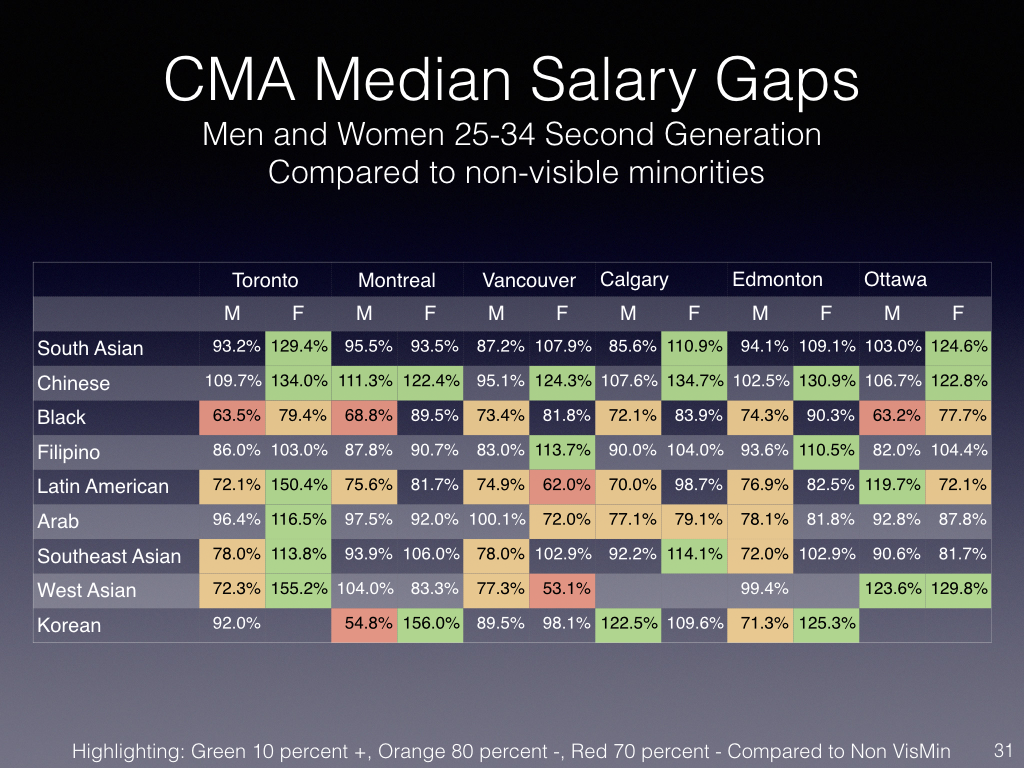
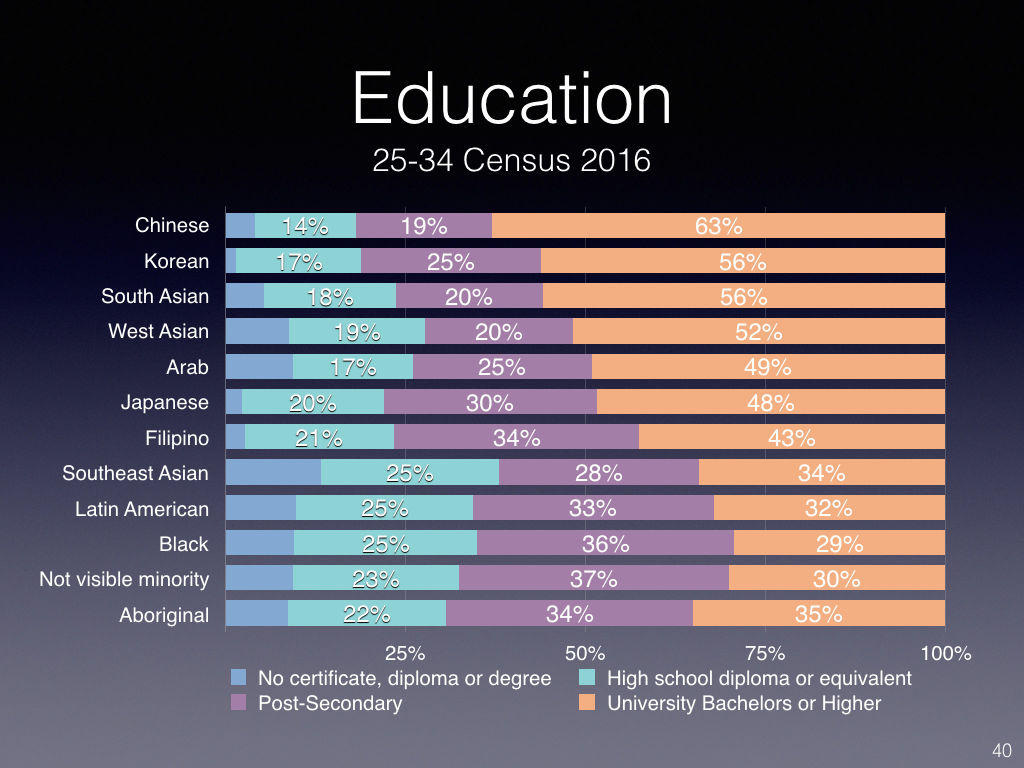
2016 Census Environics Presentation: Release 6 – Education, Labour, Journey to work, Language of work, Mobility, migration

Really good detailed series of slides on the latest Census release. Not just for policy and data nerds:

via 2016 Census: Release 6 Education, Labour, Journey to work, Language of work, Mobility, migration

Douglas Todd: Is it OK to ask, ‘Where are you from?’

I remember my mother always bristled when asked “where are you from,” as for her, as a former refugee, it somehow placed her as an “other” rather than Canadian.

That being said, if the question emerged later in a conversation, and was framed as a matter of interest in the person, it was less objectionable.

I often ask as I am curious about the life stories of people that I meet but leave it to later in a conversation and usual preface it with some words to minimize the risk of it being perceived as a micro-aggression. Asking about origins or ancestry generally works better:

One of the many troubles with the movement to eradicate micro-aggressions is it’s based on an “open concept” characterized by intrinsically fuzzy boundaries, says clinical psychologist Scott Lillienfeld of Emory University.

Microaggressions are distinct from explicit acts of racial discrimination and superiority. They are said to represent implicit prejudice, under-the-radar acts purported to damage their victims.

But, as Lillienfeld writes in the magazine, Aeon, there is no scientific evidence they harm anyone. And, perhaps worse, they put everyone in a double bind. People can be charged with being micro-aggressors, Lillienfeld says, for both showing interest (“Where are you from?) and for not showing interest (“I don’t see colour”).

In other words, a micro-aggression is entirely subjective, requiring what cognitive behavioural therapists term “negative mind-reading,” which they encourage clients to avoid.

I took the “where are you from?” issue to University of B.C. social psychologist Ara Norenzayan, a Lebanon-raised specialist in global diversity studies.

“As you can imagine, I’ve had my fair share of being asked this question! I guess I look and sound ambiguous, so people can’t easily place me,” Norenzayan said.

“It all depends on how it’s done. I’ve had experiences that were a wonderful opportunity to share different cultural experiences and backgrounds: When the question comes from a place of empathy and genuine curiosity.

“And I’ve had experiences that were quite annoying and the conversation hit a brick wall, when it was out of context and I sensed a lack of openness and curiosity. I think in a place like Vancouver, where half the population was born outside Canada, the question could be an excellent invitation to learn about and celebrate Canada’s diversity, if it’s … non-judgmental.”

So, somewhat like Norenzayan, I urge North Americans, and especially Metro Vancouverites, to err on the side of asking about national, ancestral or ethnic origins. It involves a social risk, of course, because whether one is being judgmental is in the eye of the person being asked.

But it’s probably better than succumbing to silence, not to mention mutual suspicion. We have to step up our social game to counter the slow death of community that appears to be occurring across question-phobic Metro Vancouver.

Even though it might be easy for me to say — since I’m a journalist and it’s our job to come up with questions — I’d urge residents to start asking about a whole variety of things.

Would it be so bad if we relaxed a little bit, and biased ourselves to getting to know one another? You never know, we might meet someone we like.

via Douglas Todd: Is it OK to ask, ‘Where are you from?’ | Vancouver Sun

The Politics of the Ostrich: On Pascal Bruckner’s “Un racisme imaginaire: La querelle de l’islamophobie et culpabilité” – Los Angeles Review of Books

Good long review and discussion of Islamophobia by Reza Zia-Ebrahimi, King’s College London, one of the more comprehensive ones I have seen.

Highly recommended for members of the Canadian Heritage committee studying Islamophobia, among others:

OVER THE PAST DECADE, the prominent French intellectual Pascal Bruckner has emerged as one of the figureheads of a sustained assault on any public discussion of Islamophobia and the consequences it may have on its victims. He has published op-eds with titles such as “L’invention de l’islamophobie” (the invention of Islamophobia) and “L’islamophobie n’existe pas!” (Islamophobia does not exist!), where he has outlined many of the ideas that the reader will find in Un racisme imaginaire. Thus, those familiar with the man’s writing will find little novelty in this book. To add perplexity to disappointment, the book also lacks focus: indeed, in addition to declaring Islamophobia imaginary, Bruckner devotes significant sections of his book to shadow-box and disparage all the usual scarecrows of the French neoconservative movement: the 1968 generation, multiculturalism, the left under all its manifestations, “political correctness,” sociologists, anthropologists, occasionally the anglo-saxons, and rather consistently — “Islam.” It would take me far more than the space I have been here granted to address all the issues he raises, and will focus on what is the central theme of Un racisme imaginaire: the existence or inexistence of Islamophobia.

Bruckner opens his book by declaring point-blank that his objective is to “delegitimize the term Islamophobia, instil doubt about it, flank it with permanent inverted commas.” He does not therefore even pretend that he is going to engage with objective data, or carry out empirical research. His first round of attack uses etymology to delegitimize the term Islamophobia, and in doing so Bruckner essentially paraphrases the French journalist Caroline Fourest, who claimed in 2003 that Islamophobia as a term was the brainchild of the Iranian 1979 Revolution. [1]According to this theory, the Iranian “mullahs” coined the term to suppress women who refused to wear the Islamic veil. The argument is put forth without a shred of evidence, and as a historian of modern Iran who is familiar with the 1979 Revolution and the discourse of its founders and ideologues, I can confidently assert here that the claim is simply a fabrication and widely acknowledged as such (even by Fourest herself who, embarrassed, edited the online version of her 2003 article accordingly). Undeterred, Bruckner continues to promote the now discredited theory, and another one, also initially made by Fourest, according to which Islamophobia re-emerged during the controversy surrounding Salman Rushdie’s book The Satanic Verses and the fatwa against his life. As with the previous claim, no evidence is to be found, no quotation is reproduced, no source is referenced. And for good reason: the claim is fallacious. It took me about 10 seconds and a simple Google search to find a 2015 article where Rushdie declares, “Today, I would be accused of Islamophobia.” Which means that back in 1989 he was not.

Although the term Islamophobia occurs in French texts as early as the 1920s (something recognized by Bruckner), its present-day use cannot be traced to the machinations of Islamists as the Islamophobia negationists would have us believe, but is rooted in a conceptual need to name forms of hostility and discrimination experienced by Muslims. The origins of the term’s present-day incarnation is thus to be found in a 1997 report called Islamophobia: A Challenge for Us All, by a UK-based think tank dedicated to the study of racism, the Runnymede Trust. This fact is widely acknowledged by the literature on Islamophobia, that Bruckner sadly ignores throughout his book, thus seriously weakening its core argument. The purpose of Bruckner’s genealogy is simply to suggest that the term Islamophobia is tainted by some original sin, its origins invariably leading to some mad, bearded fanatic. The Iranian mullah story also presents the added advantage of pitting Islamophobia against the struggle of women against the Islamic veil. Two conceptual birds are hit with the same rhetorical stone, but it remains that it is this genealogy, rather than Islamophobia itself, that is imaginary.

The second negationist argument put forth by Bruckner relates to the instrumentalization of Islamophobia, which then becomes — in his words — “a weapon of mass destruction of the intellectual debate.” Islamophobia, he claims, was maliciously coined by “fundamentalists and their Marxist allies” (or “Islamo-gauchisme” as he calls the alliance) to write off as racist anyone attempting to criticize or reform Islam. Of course, it is perfectly conceivable that if you criticize “Islam,” someone might label you an Islamophobe. Bruckner has not reinvented the wheel: Islamophobia, just like any other concept, designation, or idea, can be instrumentalized. Disappointingly, Bruckner does not come up with many examples to illustrate what he believes is a new form of blasphemy law: first, he refers to a few cases in which French Catholic groups sued film directors for blasphemy. That his first example is one from the world of catholic militancy is telling enough. His second example refers to the Organization of the Islamic Conference’s attempt — supported by many non-Muslims states — to ban the defamation of religions in international law. An attempt that — it is worth stressing — has so far miserably foundered, making one wonder why it is a relevant example in the first place. Indeed, no “legitimate criticism of Islam” has ever been “silenced” as a result of that effort. Bruckner mentions a few other cases of clashes in the polemics of Islam in Europe, but none in my view where the accusation of Islamophobia was either central to the controversy, or — indeed — succeeded in forcing anyone into silence. He is right in pointing out that the terrorists who opened fire on the staff of Charlie Hebdo in January 2015 silenced, for good, individuals that they considered to have blasphemed against Islam. Nobody disputes that murdering individuals in cold blood is criminal and shocking. But then again, why should our ability to discuss Islamophobia be undermined by the actions of murderous jihadists? Would we not let them win by doing so? By refusing to discuss Islamophobia, we make it impossible to challenge the jihadist view that Europe is fundamentally Islamophobic and that Muslims have no place there, a view that according to most serious scholarship is one of their top recruitment pitches.

I can think of a perhaps more convincing example, not of the charge of Islamophobia as a tool for censorship, but as a tool for political expediency. When Austrian authorities banned rallies in Austria in favor of President Recep Tayyip Erdoğan’s constitutional referendum in January 2017, the Turkish Foreign Ministry spokesperson called them racist and Islamophobic. No doubt, this is a case of political instrumentalization of the labels racism and Islamophobia, although I should rush to stress that the Turkish declaration had no effect whatsoever on the Austrian government, which seems to indicate that the accusation of Islamophobia is far from carrying the magical effects that Bruckner associates with it.

Provisional conclusion: Despite the paucity of Bruckner’s examples, instrumentalization is possible. That being said, Bruckner’s argument remains illogical. Ask yourself: Does the instrumentalization of a concept mean that the concept itself is inherently bankrupt? Does the phenomenon it refers to henceforth cease its tangible, objective, existence? The claim runs in the face of the most basic form of common sense. Let me illustrate my point. Many on the farther corners of the left liberally use the term “fascist” to discredit ideas or individuals that they find to be too far to the right of the political spectrum. For instance, many hard-left sympathizers in France routinely call the supporters of Marine Le Pen’s Front National party “fascists.” This is an instrumentalization of the concept of fascism designed to discredit one’s political adversaries. However, does this polemical usage mean that the concept of fascism is intrinsically flawed? Does it in itself negate the facts of history? Does it mean that Benito Mussolini was never born, and that the National Fascist Party never took power? Of course not, such flawed reasoning challenges basic rationality.

Another perhaps closer example: Few would deny that some instrumentalize anti-Semitism to silence any criticism of the state of Israel. Benjamin Netanyahu calls the BDS movement anti-Semitic. The Anti-Defamation League (ADL) calls Jimmy Carter (the US president who oversaw the Camp David Accords between Israel and Egypt) an anti-Semite because he criticizes Israeli policies. The ADL joined forces with the American Israel Public Affairs Committee (AIPAC) to push through a bill that would criminalize criticism of Israel in the United States as anti-Semitic (the legislation failed on the Congress’s floor). In all these cases, anti-Semitism is instrumentalized to pursue a political agenda: silence criticism of Israel. Yet, does this instrumentalization automatically invalidate the legitimacy of anti-Semitism as a concept, an analytical category, an objective historical phenomenon, and a lived experience for many Jews around the world? Are we to suddenly believe that Jews were never subjected to slander, hostility, discrimination, segregation, and an attempt at genocide? Of course not. But it is exactly such profoundly flawed arguments that Bruckner and his like-minded negationists put forth to have us believe that Islamophobia is imaginary. A word or a concept cannot be held hostage by those who use or abuse it.

The third argument is perhaps the most mystifying and audacious. Bruckner, again following Fourest and her fallacious Iranian genealogy of Islamophobia, claims repeatedly that Islamophobia is used by repressive Muslim states as “a tool of domestic police against Muslim reformers and liberals.” Here again, Bruckner does not provide a single example. And again for good reason: taking the claim at face value would mean that the religious police in Iran or Saudi Arabia initially had their hands tied in the back. They were incapable of repressing what they perceived as anti-Islamic deviance, because they lacked the wordthat would allow them to do so. And then one day, hallelujah, the term Islamophobia was invented and now they could freely repress religious reformers, secularizing intellectuals, and unveiled women. The reasonably critical reader is left flabbergasted by the daftness of the argument. One keeps reading, hoping that Bruckner will attempt to strengthen his case, or cover his tracks … in vain.

Islamophobia is not defined as criticism of Islamic practices in any dictionary, encyclopedia, or scholarly work on the topic. It is generally defined as hostility toward, and discrimination against, people perceived as Muslims. As such, it stands to reason that Islamophobia is a reality. The European Union and the United Nations have programs in place that attempt to quantify Islamophobia. The hostility aspect of Islamophobia manifests itself in acts of degradation or vandalism against mosques or Islamic centers and cemeteries. Hostility also manifests itself in daily acts of aggression, anything from verbal abuse to physical attack and even murder. The number of such acts is constantly increasing in spite of Bruckner’s claim (based on one single year) that the opposite is true: in my hometown of London alone, the Metropolitan Police registered 1,300 Islamophobic hate crimes in the 12 months leading to March 2017, a whopping 370 percent increase over 2013. We have also recently witnessed an unprecedented number of murderous acts: in January of this year, a gunman known for his anti-Muslim views opened fire in a Québec City mosque, killing six and injuring 19. Individuals carrying such acts are not criticizing Islamic practices, they target individuals that they perceive as Muslims for their “Muslimness” and nothing else. When in July of this year a man drove his car into a crowd leaving the Finsbury Park Mosque in London killing one, he shouted, “I want to kill all Muslims” and “This is for London Bridge,” indicating that he considered all Muslims as collectively responsible for an earlier jihadi attack.

Islamophobia can also kill people on the left, as they are seen as the natural allies of “Islam” (what Bruckner calls islamo-gauchisme). When in 2011 Anders Behring Breivik cold-bloodedly murdered 77 innocent people, mostly young members of the Norwegian Labour Party, he believed that by killing left-wing militants he was curtailing the Islamization of Europe. Like Bruckner, Breivik believes that the left and “Islam” are in bed together in an attempt to Islamize Europe. Interestingly, a flick through Breivik’s tedious manifesto 2083: A European Declaration of Independence shows that this latter’s criticism of the term Islamophobia is similar to Bruckner’s, thus revealing broader ideological affinities.

The second aspect of Islamophobia is the experience of discrimination. Some very serious studies show identifiable and quantifiable forms of discrimination against individuals with Muslim-sounding names in the practices of the state or of private entities. For instance, it has been shown by Patrick Simon that if you have a Muslim-sounding name you are at a disadvantage in the dispensation of public housing in France. [2] A compelling study by Adida, Laitin, and Valfort has shown that you are 2.5 times less likely to be shortlisted for a job if you bear a Muslim-sounding name than someone with identical qualifications but a non-Muslim-sounding name. [3] Again, theology has nothing to do with any of this; this type of discriminatory attitude proceeds from deep-seated prejudices against Muslims as a group, something that can reasonably be called Islamophobia so that the phenomenon has a name.

In light of these examples (that could be multiplied), the question is not whether Islamophobia exists, because it does beyond any doubt. Rather, the question is why are Bruckner and other negationists so keen to convince us that it does not. Why do they recoil in horror when they hear the term? I would like to offer an explanation. If one were to grossly divide the French opposition according to various forms of racism, one would end up with two camps. The first group includes the spiritual disciples of Hannah Arendt, who see totalitarianism as the main impetus behind the Holocaust, and are mainly concerned with anti-Semitism as the supreme form of racism. The second group includes the spiritual disciples of Frantz Fanon, who espouse one form or the other of anti-imperialism, and are more focused on colonial and postcolonial forms of racism, including Islamophobia. The two groups are obviously not as neatly separated as I make it appear: after all Hannah Arendt herself contended in the second volume of The Origins of Totalitarianismthat racism was made necessary by European imperialism, and that the two were part and parcel of the history of the totalitarian state. Be that as it may, one can consider Bruckner as a thinker clearly anchored within the first group, genuinely concerned about anti-Semitism, and consistently in favor of Israeli and American foreign policies, including this latter’s disastrous invasion of Iraq. He abhors third-worldism, which he scathingly (and indiscriminately) attacked in his 1983 book The Tears of the White Man. Bruckner is one of the most vehement critics of anything smacking of anti-racism, which he considers as racism (you have to admire the audacious inversion). Any acknowledgment of wrongdoing in colonial history is nothing more than “self-hatred.” Therefore, one could claim that Bruckner belongs to an exclusivist strand within the group concerned with totalitarianism, emphatically opposed to any discussion linking colonialism and racism, and rejecting out of hand any claim that postcolonial forms of racism matter or even exist. Beyond the sometimes wild exaggerations and hyperbolic language necessitated by such immoderate stances, the recurrent vocabulary of totalitarianism is an indication of Bruckner’s categories of analysis, perfectly valid otherwise, but here radically disconnected from the topic at hand: he repeatedly claims that Islamophobia is comparable to “totalitarian propaganda,” the censorship methods of the Soviet Union, and a world akin to Orwell’s dystopian novel 1984.

In a vision of the world influenced by Samuel Huntington’s The Clash of Civilizations, where a neat, clearly delimited, liberal and democratic “West” is pitted against an equally neat, delimited, but repressive and hostile “Islam,” Muslims can only be represented as oppressors, or as oppressed by other Muslims. He claims that even in Myanmar, Muslims are victimized by their own kind, a lie that is frankly detestable in light of current events. In this rigid mental straitjacket, there is no possibility of envisioning a Muslim being simply a victim, especially of a Westerner’s racism, and God forbids a French person’s racism.

It is this ideological baggage that explains the recurrent attempts to delegitimize any discussion of, or research on, Islamophobia. Not because Islamophobia does not exist — it obviously does — but because it is an inconvenient truth that challenges the rather simplistic us versus them, black versus white, ideational universe described above. Bruckner pours ridicule on Muslims who experience gratuitous antagonism or discrimination, by contending that being subjected to racism is not humiliating or traumatizing, but it is a prize, a status, a cachet, that Muslims cunningly seek. Worse, it is a usurpation of the status of the realand exclusive victims of racism: Jews. He contends that by complaining of Islamophobia, Muslims try to pass for Jews, or rather — as he scornfully puts it — “substitute Jews.” He rightly contends that Jews can be “racialized,” and that as a result anti-Semitism is a form of racism. However, he denies that racialization can be applied to Muslims. In other terms, you are born a Jew but being Muslim is voluntary. This curious contradictory claim runs in the face of a significant literature that highlights that anti-Semitism and Islamophobia are bothcharacterized by discursive dynamics that “racialize” the followers of a faith into a group with inherent psychological characteristics.

How can a thinker so genuinely touched by the plight of the victims of anti-Semitism be so insensitive to the plight of victims of Islamophobia? The answer is inescapable: for Bruckner, there is a hierarchy of racisms. Some are unacceptable, some are acceptable, a binary that reflects a hierarchy of humankind in Bruckner’s mind.

Anyone who opens Bruckner’s book hoping that he might be the long-awaited freethinker who will at long last transcend the above described divide between the opponents of anti-Semitism and colonial racisms, and make the overdue point that racism is always unacceptable, will be disappointed. Un racisme imaginaire is a collection of hackneyed attacks on the field of Islamophobia studies, and not a work concerned with objective facts. It is a cross between a long rant and an ideological pamphlet. Undoubtedly, there will be no shortage of readers happy to absolve its shortcomings and its ideological fanfare as the mostly positive reviews in the French media suggest. Yet, it remains that the book is addressed to a public that has already made up its mind on Islamophobia. For the rest of us, who expect claims to be backed up with a modicum of evidence or rational argumentation, the book is merely a primary source, a document that helps us gauge the state of the intellectual debate in the age of “fake news” and “alternative facts.”

via The Politics of the Ostrich: On Pascal Bruckner’s “Un racisme imaginaire: La querelle de l’islamophobie et culpabilité” – Los Angeles Review of Books