Neo-Nazi Groups Explode Under Trump, Southern Poverty Law Center Finds

Not encouraging:

Neo-Nazi organizations saw the greatest growth among hate groups last year, according to a new report by Southern Poverty Law Center released Wednesday.

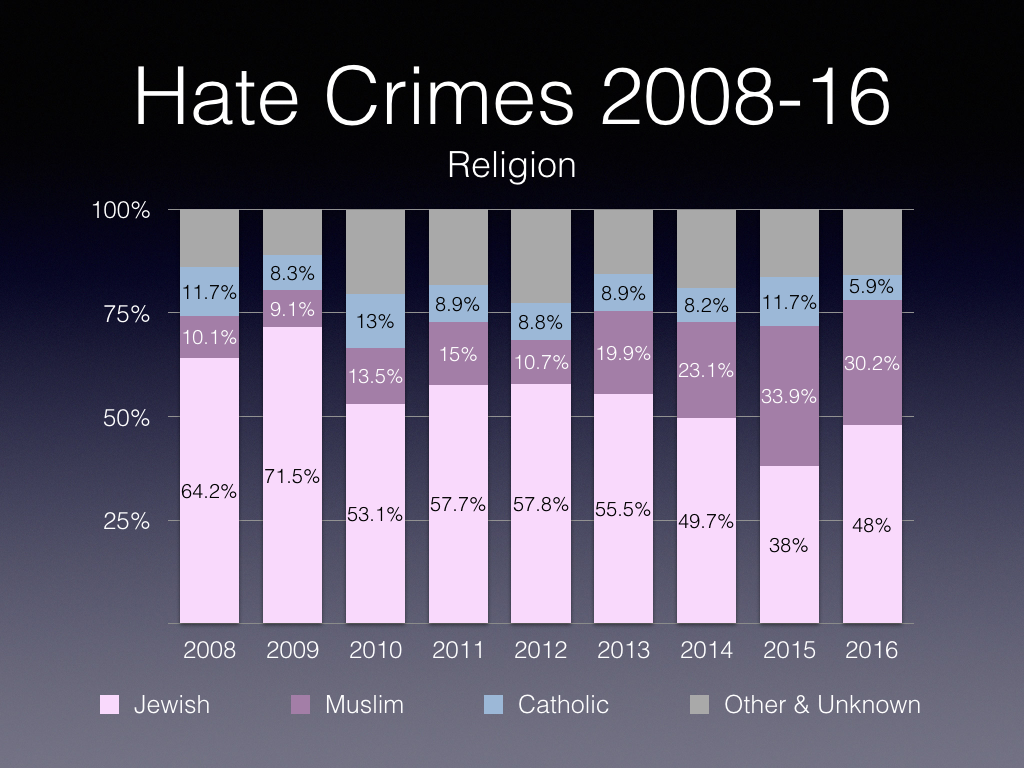
There were 954 active hate groups in the United States in 2017, SPLC found, the greatest total since 2011’s record-breaking year. About half of the groups are white supremacist groups, including Neo-Nazis, Neo-Confederates, white nationalists, skinheads, and Christian Identitarians. Almost one-quarter of 900 hate groups are black nationalists, and 114 groups are anti-Muslim. Other groups with specific hatred for the LGBTQ community, the government, and women have risen, albeit in smaller numbers.

“Within the white supremacist movement, Neo-Nazi groups saw the greatest growth—soaring by 22 percent from 99 to 121,” since 2016, according to the SPLC report.

“The overall number of hate groups likely understates the real level of hate in America,” SPLC said, “because a growing number of extremists, particularly those who identify with the alt-right, operate mainly online and may not be formally affiliated with a hate group.”

The report comes after a year of notorious violence by the so-called alt-right. In August 2017, white supremacists gathered for a “Unite the Right” rally in Charlottesville, Virginia that led to the deaths of Heather Heyer and two local law enforcement officials.  In January 2018, a California man who allegedly murdered his gay, Jewish high school classmate trained with Florida-based Neo-Nazi group Attomwaffen, ProPublica reported. In December 2017, a man who frequented alt-right forums and websites like The Daily Stormer killed three people including himself at a New Mexico school, The Daily Beast previously reported.

Since 2014, 43 people have been killed and 67 people have been injured by men associated with the alt-right or white supremacists, SPLC reported earlier this month. Dylann Roof, the man who murdered nine black churchgoers in Charleston nearly three years ago, regularly commented on The Daily Stormer and admitted to planning the race-based attack. “I chose Charleston because it is most historic city in my state, and at one time had the highest ratio of blacks to Whites in the country,” Roof wrote in a note used in his prosecution.

SPLC also counted the murders of Elliot Rodger, the California man who killed seven people, including himself, as one of the first massacres killings carried out by the “alt-right” before the movement went mainstream. Nikolas Cruz, the alleged Florida school shooter who killed 17 people on Valentine’s Day, commented “Elliot rodger will not be forgotten” on a YouTube video last year. Law enforcement said it is investigating whether Cruz was affiliated with a white supremacist group in Florida that initially claimed he was a member.

In a first for the organization, SPLC added two male supremacy groups to its annual report on extremism: Texas-based A Voice for Men and Washington, D.C.-based Return of Kings.  “The vilification of women by these groups makes them no different than other groups that demean entire populations, such as the LGBT community, Muslims or Jews, based on their inherent characteristics,” SPLC said in a statement.

Heidi Beirich, director of SPLC’s Intelligence Project, said that the organization compares male supremacy groups’ methods—using slurs and saying women are “destroying” men—to white supremacist groups like the New Century Foundation, which publishes a magazine that “focuses on the demonization of black people.”

President Donald Trump blamed “many sides” for alt-right violence in Charlottesville, and the SPLC report says Trump’s presidency has emboldened white supremacists. “They believed they finally had a sympathizer in the White House and an administration that would enact policies to match their anti-immigrant, anti-Muslim and racist ideas,” the report stated.

The only hate group that decreased its chapters in 2017 was the Ku Klux Klan, the oldest hate group in the country. “It’s clear that the new generation of white supremacists is rejecting the hooded movement that was founded after the Civil War,” the authors of the SPLC report wrote.

Source: Neo-Nazi Groups Explode Under Trump, Southern Poverty Law Center Finds

Canadian historian joins uproar in Israel over Polish Holocaust law

There is so often a Canadian connection given the number of immigrant and ethnic communities:

University of Ottawa history professor flew to Israel this week, right into the eye of a brewing diplomatic storm involving the Jewish state and Poland over a controversial bill dealing with remembering the Holocaust.

Jan Grabowski has spent years examining the Holocaust in Poland, where he was born, focusing on Polish-Jewish relations. His research has brought death threats against him and his family and angry letters to his employer demanding he be fired.

But in an interview with CBC News hours after arriving from Canada, Grabowski vowed to press on with his work, outlining the focus of his next book, which will examine the role of the Polish Blue Police during the Second World War.

“It’s about 20,000 people who were armed and who inflicted horrific suffering on the Jews,” he said.

Controversial Polish legislation

Israeli leaders are leading the charge against a piece of legislation passed by the Polish Parliament earlier this month that made it illegal to assert that Poland bore any responsibility for atrocities committed by Nazi Germany.

Six million Jews were killed during the Holocaust, and many of those victims were Polish. Some of the most notorious extermination camps — Auschwitz-Birkenau and Treblinka to name two — were built on Polish soil.

DV1949535

Many Poles have long complained when atrocities committed by Nazi Germany, such as the killings at the Auschwitz death camp, have been linked to the Polish nation. ( Janek Skarzynski/AFP/Getty Images)

But for decades Poles have chafed at references linking their nationals to the crimes of the Holocaust. Former U.S. president Barack Obama issued an apology in 2012 when he used the term “Polish death camp”.

While most scholars, including those at Yad Vashem, the official Israeli memorial to the Holocaust, agree that labelling concentration camps as Polish is misleading, critics say what’s more worrisome is the crux of the new Polish law that imposes fines or prison terms of up to three years for linking “the Polish nation” to crimes committed during the Holocaust.

‘No Polish bystanders’

Grabowski notes that the prison sentence is the same duration Poles could expect to serve behind bars before the Second World War for “insulting the Polish nation.”

At his Tel Aviv press conference. the Polish-Canadian dual citizen discussed a newspaper article from 1936, detailing the case of a Jewish woman who was evicted from a Polish university.

“As she was evicted, she shouted ‘Polish animals.’ They beat her up, but she was the one the police arrested,” Grabowski said. “She was put in prison for two months for insulting the Polish nation.”

Grabowski, who is in Israel for a conference on Holocaust history, has faced much criticism from some Polish historians for his years of research, including his controversial conclusion that 200,000 Polish Jews were killed — directly or indirectly — by Poles during the war.

“There are no Polish bystanders to the Holocaust,” he told reporters.

Poland’s embassy to Canada, in Ottawa, has criticized Grabowki for offering “groundless opinions and accusations.”

“In reality, there was no free Poland during the Second World War, and the Holocaust was the murder by Nazi Germany of six million Jews,” the mission wrote in a statement to Macleans magazine. “Poland, unlike many countries, was never an ally of Nazi Germany and never had a collaborative regime.”

While he questioned the legal effect of the new Polish legislation, calling it “nonsense,” Grabowski does worry about a chilling effect.

“This law was an embodiment of the growing frustration of nationalists in power [in Poland] who simply are trying to find tools with which to freeze the debate, knowing that they cannot refute historical evidence,” he said. “What they can do is they can try to silence people who would like to undertake research in these areas.”

Quebec: Les femmes en hijab et les hommes en turban pourront être candidats

Encouraging that this was unanimous vote in the Assemblée nationale:

Les parlementaires ont approuvé mardi un changement règlementaire qui permettra à une femme portant un hijab ou à un homme portant un turban de se porter candidats aux élections.

Le Directeur général des élections (DGEQ) a annoncé début février son intention de modifier le Règlement sur la déclaration de candidature. Il propose en outre d’exiger une photo à «visage découvert» dans le bulletin de candidature. Depuis 1989, le règlement exigeait des photos avec la «tête découverte», une disposition qui était jugée discriminatoire.

Le changement règlementaire permettra donc à une femme voilée ou à un homme portant un turban de briguer les suffrages. Il sera toutefois impossible à une femme portant un voile intégral de le faire.

La modification a été avalisée par une commission parlementaire mardi. Elle devrait être en vigueur aux élections d’octobre.

Lors des dernières élections, en 2014, le DGEQ a invoqué ce règlement pour refuser la candidature de Fatimata Sow, qui voulait porter les couleurs du Parti vert dans la circonscription de La Pinière. Mme Sow avait fourni une photo où elle était coiffée d’un hijab.

En vertu de la nouvelle mouture du Règlement, ce bulletin «pourrait» être accepté, a indiqué le DGEQ, Pierre Reid.

En point de presse, il a rappelé que l’objectif du Règlement était de faciliter l’identification des candidats. Selon lui, la disposition qui interdisait toute coiffure n’avait pas sa raison d’être.

«À partir du moment où vous avez un candidat qui s’identifie clairement, à visage découvert, comme c’est prévu pour les électeurs (…), on ne voyait pas d’utilité sans avoir d’autres explications de la présence de cette exigence», a expliqué M. Reid.

Les partis politiques ont exprimé à l’unanimité leur appui au changement règlementaire.

«Nos lois, nos chartes, doivent être respectées», a indiqué le premier ministre, Philippe Couillard.

De toute manière, a-t-il ajouté, peu importe qui se porte candidat, ce sont les électeurs qui décideront s’ils sont élus.

«Nous ne devrions pas être paternalistes vis-à-vis les citoyens et décider à leur place qui devrait être élu ou pas, a-t-il dit. Ils prendront la décision.»

«Le plus important est qu’on puisse voir le visage, a renchéri le chef du Parti québécois, Jean-François Lisée. Alors je n’ai aucun problème (avec cette mesure).»

La Coalition avenir Québec et Québec solidaire ont également approuvé le changement règlementaire.

via Les femmes en hijab et les hommes en turban pourront être candidats | Martin Croteau | Politique québécoise

L’Assemblée nationale peut interdire le port du kirpan, confirme la Cour d’appel

That parliamentary privileges permit such a ruling does not the ban appropriate or right:

L’Assemblée nationale du Québec a le droit d’interdire le port du kirpan dans son enceinte en vertu de ses privilèges parlementaires, a tranché lundi le plus haut tribunal de la province. Deux sikhs qui n’avaient  pu entrer dans l’Assemblée nationale en janvier 2011 en raison de leur petit couteau cérémonial tentaient de faire invalider une motion adoptée à l’unanimité par les élus pour exclure les kirpans.

Balpreet Singh et Harminder Kayr, deux membres de l’orgniasme World Sikh Organization of Canada (WSOC) se sont fait interdire l’entrée à l’Assemblée nationale pour des raisons de sécurité, le 18 janvier 2011, en raison de leur kirpan, un couteau porté par de nombreux sikhs pratiquants pour des raisons religieuses. Par conséquent, les deux hommes n’ont pas été en mesure de présenter leur mémoire devant la commission parlementaire qui étudiait un projet de loi visant à interdire le port du voile intégral dans les services publics.

L’affaire a alors rebondi à l’Assemblée nationale, si bien que trois semaines plus tard, tous les députés présents, dont le premier ministre Jean Charest, ont voté en faveur d’une motion appuyant la décision de l’équipe de sécurité « d’interdire le port du kirpan (…) appliquant ainsi le principe de neutralité de l’État ».

C’est cette motion que Balpreet Singh et Harminder Kayr tentaient de faire déclarer «inconstitutionnelle», puisqu’elle aurait brimé leur droit à la liberté de religion, protégée par la Charte canadienne des droits et libertés. Ils demandaient ainsi de permettre à toute personne qui «doit porter un kirpan pour des motifs religieux (de) le porter à l’intérieur de l’Assemblée nationale du Québec qu’il soit député, employé ou visiteur».

La séparation des pouvoirs au coeur du litige

En somme, deux droits fondamentaux s’affrontaient dans ce bras de fer juridique sur la séparation des pouvoirs : le droit à la liberté de religion et le principe du privilège parlementaire. En première instance, le juge Pierre Journet de la Cour supérieure a conclu que les privilèges parlementaires de l’Assemblée nationale permettaient aux élus d’exclure des citoyens de l’enceinte du peuple, même si des droits constitutionnels pouvaient être bafoués.

«Pour garantir la séparation des pouvoirs, la portée des révisions constitutionnelles par les tribunaux sont restreintes par la portée du privilège parlementaire des législatures», écrivent les juges de la Cour d’appel du Québec, dans leur décision majoritaire rendue lundi.

Selon le plus haut tribunal de la province, infirmer la décision du juge Journet signifierait de « faire effondrer la stricte séparation des pouvoirs et de subordonner le privilège parlementaire à l’autorité de la Charte. Ce n’est pas permis par la jurisprudence de la Cour suprême». Ainsi, même si l’exclusion du kirpan pourrait représenter une violation de la Charte, on ne peut mettre de côté la portée du privilège parlementaire, essentiel au «respect de la séparation des pouvoirs (…) dans une société libre et démocratique».

Le privilège parlementaire, qui tire son origine de la Loi constitutionnelle de 1867, octroie notamment aux élus la liberté de parole et l’immunité d’arrestation en matière civile à l’intérieur de l’Assemblée nationale.

via L’Assemblée nationale peut interdire le port du kirpan, confirme la Cour d’appel | Louis-Samuel Perron | Politique québécoise

Anti-immigration groups at protest demand apology from Trudeau | Ottawa Citizen

It would be interesting to know more about the background of the Asian Canadians at the protest as, at first blush, these appear to be curious bedfellows (the website listed below is largely unpopulated):

Hundreds of Asian-Canadian protesters, supported by several white, far-right, anti-immigrant groups stormed Parliament Hill on Sunday afternoon to demand an apology from the prime minister.

According to plans for the protest on voteforright.com, members of the Asian-Canadian community feel victimized by a Toronto girl’s false claim in January that an Asian man cut off her hijab and Prime Minister Justin Trudeau’s apparent rush to view the fictitious incident as a hate crime.

Anti-Muslim and anti racist protestors voiced their views on Sunday on Parliament Hill. Anti-Muslim protestors joined with a group of Chinese-Canadians who were upset about the controversial hijab news story in Toronto. Ashley Fraser/Postmedia ASHLEY FRASER/ POSTMEDIA

“As the real victim of the hijab hoax, our Asian community was completely ignored by PM Trudeau,” reads a statement on the website.

A man who identified himself as “Yuanyuan” said, “There are some out-of-town conservative Chinese racists and they are collaborating basically with some white nationalist groups here in Canada. As a Chinese Canadian, I’m pretty ashamed about that. That’s why I’m here.”

The large Asian group, with members coming from Toronto and Vancouver to join members of the Ottawa Chinese-Canadian community, chartered buses for the event.

“We want to oppose them,” Yuanyuan said. “We don’t want them on our Hill saying they get to represent Canadian values. We know that their rhetoric is basically trying to normalize violence against minorities and marginalized folk. It’s not really a discussion about whether or not multiculturalism is good or not. We know that they stand for genocide.”

About 100 anti-racist protesters — while denouncing white supremacy and chanting about how welcome Muslims are — also repeatedly screamed “f-ck the police.”

Providing security for the Asian protesters were several anti-immigration, ultranationalist groups such as Quebec’s La Meute — or Wolf Pack — and the Northern Guard. Several Proud Boys — a far-right men’s group — were also in attendance.

La Meute’s Stéphane Roch said his members — of which there are 42,000 in Quebec — were in Ottawa to support the Chinese community.

Roch called them “real Canadians” who have been in the country for hundreds of years. “The Chinese community are a very good community. Trudeau don’t listen to them.”

“The government has to work for the citizens, not for themselves,” Roch said. “The power has to go to the citizens. They have to listen to us.”

An organizer with the Chinese-Canadian community who asked a reporter to “just call me Monica” said the event was behind schedule and chose not to speak to a reporter from this newspaper.

Several Chinese-Canadian protesters were there with their children, who held signs condemning the “hijab hoax” and “fake news.” The signs urged the government not to “stir up ethnic disputes.” Multiple people approached by a reporter indicated they did not speak English.

But speakers urged respect for “human rights” and asked that all Canadians be treated equally.

Among the sea of protesters were several placards taking aim at Trudeau, not Muslims.

Evan Balgord, a journalist and researcher who is following the rise of the new far-right movement in Canada, said that what was branded as anti-Muslim is being re-purposed as anti-Trudeau rhetoric.

“They always were anti-Trudeau, anti-Liberal government, anti-multiculturalism, anti-M-103 (a motion to condemn Islamophobia in the country) but the anti-Trudeau rhetoric is coming more and more to the front.”

Police escorted members of both groups away from the demonstration and some were banned from the Hill.

RCMP officers made a handful of arrests during the demonstration, but several of those people were released. A large group of Ottawa police escorted both groups on and off the Hill.

via Anti-immigration groups at protest demand apology from Trudeau | Ottawa Citizen

Hungary′s Orban threatens pro-refugee NGOs, slams Muslim immigration | News | DW | 19.02.2018

Keeps getting worse:

Hungarian Prime Minister Viktor Orban amped up his anti-migrant rhetoric on Sunday as he geared up for national elections on April 8. To that end, Orban’s party has proposed new legislation that would penalize NGOs that assist refugees.

“If they do not stop their dangerous activities, we will simply expel them from the land, no matter how powerful or rich they may be,” he said during his annual State of the Nation address.

The new law would levy a 25 percent tax on all foreign funding for asylum seeker aid organizations, and bar their workers from entering settlement camps near the country’s borders.

Although the prime minister’s Fidesz party does not currently have the two-thirds majority in parliament needed to pass the bill, it will likely make significant gains in April’s vote.

Orban also used his yearly address to suggest that the increase of Muslims in Europe is a harbinger of the fall of Western civilization.

“Dark clouds are gathering over Europe because of immigration,” said Orban, who is hoping to be elected to a third term in April.

“Nations will cease to exist, the West will fall, while Europe won’t even realize that it has been invaded,” he ominously declared. “Christianity is Europe’s last hope.”

Since Europe’s refugee crisis began in 2015, Orban has emerged as one of the most high-profile nationalist voices in the European Union. During the height of the crisis, Hungary enacted some of the most draconian responses to the influx of people fleeing war and famine, such as constructing a razor-wire fence along the border with Serbia.

Orban’s time in office has also coincided with a clampdown on foreign influence in the country. Last spring, a bill was introduced to parliament that could potentially shut-down foreign-funded universities such as Budapest’s Central European University (CEU). Written under the auspices of putting Hungarian universities on a level playing field, many see the legislation as unfairly targeting CEU because it is largely financed by Orban critic George Soros.

via Hungary′s Orban threatens pro-refugee NGOs, slams Muslim immigration | News | DW | 19.02.2018

Montreal prelate fears “second class citizenship” for people of faith

Interesting commentary on some cross faith commonalities:

Last fall, the Canadian province of Quebec passed legislation, Bill 62, that would make it illegal for anyone to receive public services if they did not show their face. Dubbed as a “religious neutrality” law, critics claimed the bill discriminated against Muslims who wear headscarves as a part of their religious practice — and should be cause for concern for all people of faith.

In recent months another controversy has brewed over Canada’s summer jobs program — a popular funding initiative for businesses and organizations to hire students during summer break — when the government of Prime Minister Justin Trudeau announced that in order to receive funding, you must attest to supporting abortion rights in Canada. Last month, a group of Jewish, Catholic, and Muslim leaders joined together in protest of the decision and called on the government to reverse its policy.

In an interview with Crux, Archbishop Christian Lépine of Montreal said he feared both the example of Bill 62 and the Canadian Summer Jobs program are moving the country in the direction of relegating people of faith to “second-class citizens.”

CRUX: Bill 62 — which requires that people who receive public services to show their faces — will most concretely affect Muslims who wear the niqab or a burka if religious accommodations aren’t put into place. What principles of religious liberty do you believe to be at stake here?

Archbishop Christian Lépine: – The clear intention of the law is to affirm freedom of religion and conscience in the name of neutrality of the state. But what is neutrality? Neutrality can be understood — and it’s my understanding of it — that everyone is welcome. You don’t have to hold a particular belief and whatever your belief might be, generally, you are welcome — just as you are, as a person. When neutrality becomes “You’re welcome, but signs of your belief cannot be visible,” is this still freedom? Is this still welcoming? You are welcome, but not in every respect.

If you are a government official or civil servant, you might say that we are serving the goal of neutrality by excluding certain signs. But, in my view, I think neutrality would be better served by saying that everyone, along with their particular signs of belief, is welcome. In which case, pluralism becomes visible; one can see that we’re a pluralistic society. However, if you say we’re a pluralistic society but certain visible signs are not allowed, then pluralism becomes invisible. I don’t believe in a neutrality that excludes people.

Why should Catholics care about this case?

Well, first there is the issue of principle. You can say: “It doesn’t involve us, it’s for others.” But one day, it might be for us.

Another concern is the ripple effect. Laws have a socialization effect, sending signals about what society considers important. If we choose to exclude in the name of neutrality, then, perhaps one day, a person will be waiting in a line to be served — maybe at a drug store or some company — and someone will say: “What are you doing here with your burka or niqab? Go back to your country if you don’t like it here. Get out of the line or remove your sign.” The ripple effect of this law can affect people’s mentality and their capacity to welcome others and their beliefs.

Do you see this as a sign of a diminishing of religious tolerance in Canada?

It is a sign of diminishing freedom of religion and conscience. Some might say it’s not very much, but Pope Francis talks about “polite persecution,” and it could possibly lead to that. I don’t think that is the intention of the law, but if neutrality of the state is used to exclude the public manifestation of certain religious beliefs, somehow, you are moving in the direction of creating second-class citizens.

Do you think Pope Francis has helped build a bridge between interfaith communities in Quebec?

Some, in Quebec, were at work building interfaith bridges before the Second Vatican Council. But after the council, religious leaders and civil society made a conscious effort to do so. Pope Francis certainly helps in this regard with his focus on “a civilization of encounter.” Of course, encounter means encountering those within our own belief system, but it’s also about encountering people of other beliefs and other ways of life.

Speaking of interfaith issues, multiple faith-based groups have come together to protest the government’s changes to Canada’s Summer Jobs program guidelines requiring a pledge of support for abortion rights before receiving federal funding. How did this happen and what’s at stake here?

We need to go back to the United Nations Declaration of Human Rights in 1948, which is the model of our Charter of Rights. Not everyone around the table professed the same religious beliefs, philosophy or convictions. There were Christians, but there were also Muslims, atheists, and a Communist regime at the table. After two years of discussion, they had trouble drafting a common declaration regarding the grounds for respecting human rights. So, they made a decision to shift their focus, moving from their own unique starting positions and focusing, instead, on making a solid affirmation of the inherent dignity of every human person. That became the starting point, with each group with their own religions or philosophies justifying it their own way. It wasn’t about using the Declaration to create a belief system to judge other belief systems or to diminish them. It’s about creating a society which includes different belief systems and respects them. It’s not about imposing your belief system on others.

The Charter of Rights is there to protect pluralism and the diversity of religions, beliefs and ways of thinking. It’s not there so I can take my Charter and use it against the beliefs of others. In that sense, I don’t think you can use the Charter of Rights to say “Your beliefs, your ways of thinking are not mine, so you won’t receive any funding from the government.” Abortion is not in the Charter of Rights, so if you want to respect people who hold various beliefs, and if you want to be democratic, you don’t decide who receives funding or not based on matters related to their beliefs.

You mention that Pope Francis has talked about the “polite” persecution of Christians—do you think this is also an example of that?

In the example of the Summer Jobs Program, I would call it a form of exclusion. It says: “You are a part of society, but there are certain aspects of who you are that you should keep private, and we don’t want them to be part of society.” Our Charter of Rights was not made for that; it was made to prevent us from creating second-class citizens.

via Montreal prelate fears “second class citizenship” for people of faith

You’re Wrong! I’m Right! – Kristof, The New York Times

Good piece. We all need to get outside our bubble:

We live in two Americas.

In one America, a mentally unstable president selected partly by Russia lies daily and stirs up bigotry that tears our social fabric.

In another America, a can-do president tries to make America great again as lying journalists stir up hatred that tears our social fabric.

The one thing we all agree on: Our social fabric is torn. In each America, people who inhabit the other are often perceived as not just obtuse but also dangerous. Half of Democrats and Republicans alike say in polls that they are literally afraid of the other political party.

This is not to equate the two worldviews. I largely subscribe to the first, and I’m a villain in the second. But I do believe that all of us, on both sides, frequently spend more time demonizing the other side than trying to understand it, and we all suffer a cognitive bias that makes us inclined to seek out news sources that confirm our worldview.

A classic study offered free research to ordinary Democrats and Republicans. People on both sides were eager to get intelligent arguments reinforcing their views, and somewhat interested in arguments for the other side that were so silly they could be mocked and caricatured (it’s very satisfying to dismiss rivals as libtards or bigots). Neither Democrats nor Republicans were interested in intelligent arguments challenging their own views.

Decades ago, a media expert at M.I.T. named Nicholas Negroponte foresaw the emergence of a news product that he called “The Daily Me,” with information tailored to a user’s needs. Negroponte was thinking of local weather, sports, particular interests and so on, but what actually arrived with the internet was a highly political version of “The Daily Me.”

There’s not an exact parallel in the way the right and the left seek out like-minded news sources. The right has spawned conspiracy nuts like Alex Jones who believe that the Sandy Hook school shooting was faked, and one study found that the more people watched Fox News, the worse they did on a current events test.

So I’m not advocating that you waste time on Breitbart propaganda any more than I’m saying that it was worth listening to leftists in the 1970s who praised Chairman Mao. But wherever we stand on the spectrum, there are sane, intelligent voices who disagree with us — and too often we plug our ears to them.

Moreover, there’s some experimental evidence that our biased approach to getting news actually makes us dumb. For example, one experiment asked 1,000 people to look at a simple data set and draw conclusions about a skin cream’s effectiveness. Not surprisingly, Democrats and Republicans were about equally good at calculating the math and determining how well it worked.

But when the experiment offered the very same data set and said it referred to the effectiveness of a gun control measure, Democrats and Republicans alike went to pieces. In one version, the numbers showed that a gun control measure worked — and Republicans kept flubbing the math. In another version, the gun control measure was ineffective, and this time the Democrats couldn’t manage the calculations.

The evidence on these biases is complex, studies sometimes haven’t replicated well, and I don’t want to exhibit confirmation bias in my warnings of confirmation bias. Researchers also caution that it’s too glib to say we are all locked in our echo chambers, for most Americans still are regularly challenged by dissonant information.

But what does seem clear is that rigid ideological beliefs impair our cognitive functions. For many years, Philip Tetlock of the University of Pennsylvania has been running experiments measuring the ability of thousands of people to make sound predictions.

The best forecasters, Tetlock finds, are not experts or even intelligence officials with classified information, not liberals and not conservatives, but rather those instinctively empirical, nonideological and willing to change their minds quite nimbly. The poorest marks go to those who are strongly loyal to a worldview.

I wondered whether to write this column, for there are so many urgent — and progressive! — causes on the table that I want to thunder about: Dreamers, guns in American life, White House dismissiveness toward domestic violence, and so on. But the “Daily Me” problem also undermines the capacity of liberals to win these arguments. When we stay within our own tribe, talking mostly to each other, it’s difficult to woo other tribes to achieve our aims.

The ideological blinders may worsen because of our tendency to seek out like-minded people. A 2014 Pew survey found that half of consistent conservatives and 35 percent of consistent liberals say “it’s important to me to live in a place where most people share my political views.”

It should be possible both to believe deeply in the rightness of one’s own cause and to hear out the other side. Civility is not a sign of weakness, but of civilization.

via You’re Wrong! I’m Right! – The New York Times

How a broken jury list makes Ontario justice whiter, richer and less like your community

Good in-depth analysis and reporting:

A two-year Toronto Star/Ryerson School of Journalism investigation documenting the racial makeup of jurors in 52 criminal trials since 2016 in Toronto and Brampton reveals flaws in the jury selection process that skews towards property owners, fails to reflect the GTA’s growing diversity and excludes potentially millions of Ontarians from serving their civic duty.

The jury selection list is based on the province’s property assessment rolls, excluding many renters, boarders, students, seniors, spouses who are not named on property titles, transient and low-income people, Indigenous people and those unable to afford property in a red-hot real estate market.

What remains is a prospective juror list disproportionately comprised of white Ontarians able to afford the significant costs of serving in a system that often pays jurors less than minimum wage and does not cover expenses such as travel, parking, meals and child care. It is a particular hardship for hourly workers — Ontario has no law compelling companies to compensate employees for jury duty — the self-employed or those in temporary or contract jobs.

Seventy-one per cent of the 632 documented jurors were white in cities where more than half the population identifies as non-white (In Toronto, 51.4 per cent of residents identify as visible minorities; in Brampton, the figure is 73.3 per cent).

People who identify as Indigenous are not counted as visible minorities by Statistics Canada.

The finding of innocence or guilt by a jury of our peers is a pillar of Canada’s justice system that has been shaken by the recent verdict — delivered by an all-white jury — acquitting white Saskatchewan farmer George Stanley in the second-degree murder of a slain Cree man named Colten Boushie.

Following Stanley’s acquittal, Prime Minister Justin Trudeau said, “as a country we can and must do better,” and justice minister Jody Wilson-Raybould said the government is looking at peremptory challenges, which are used by the defence and prosecution to reject potential jurors without stating a reason. Reports say Stanley’s defence rejected five potential jurors who appeared to be Indigenous.

The Star/Ryerson investigation reporters did not watch jury selection in all 52 trials. The data in this story is based on sitting juries after the selection process, including peremptory challenges.

Beginning in February 2016, reporters attended GTA trials to document juries’ racial composition.

Because the Ministry of the Attorney General does not keep this data, and observers are denied contact with individual jurors, reporters decided upon a visual survey as the most complete possible method to gauge the racial makeup of juries.

Reporters noted jurors’ race based on their physical appearance, using the same categories as police: white, Black, Indigenous and brown, which includes South Asian people. Reporters added the categories Asian and other, which included Latin American, Middle Eastern or mixed-race jurors.

Of the juries documented, only three were composed of 50 per cent visible minority and 50 per cent white jurors. In most cases, white jurors represented the majority with as many as 11 of the 12 positions.

Of the 632 jurors surveyed by reporters, 451 (71 per cent) were white; 45 (7 per cent) were Black; 42 (7 per cent) were brown; 89 (14 per cent) were Asian; and 5 (less than 1 per cent) were listed as other. Reporters were unable to identify a single Indigenous juror.

Across the aisle, the visible ethnicity of the accused presented a very different picture: Of the 59 documented accused (some trials had more than one), 27 (46 per cent) were Black; 13 (22 per cent) were white; 11 (19 per cent) were brown; five (8 per cent) were Asian and three were counted as other.

Over the past decade, as the province’s cities grew increasingly diverse, the Ministry of the Attorney General has fielded many complaints and concerns about the Ontario jury system.

In 2013, Former Supreme Court judge Frank Iacobucci, who authored a report on the lack of Indigenous representationon jury rolls on First Nations reserves, recommended that the Ministry of the Attorney General “undertake a prompt and urgent review” of “using the OHIP database.”

That database, which better reflects Ontario’s population, is still not being used.

“There’s obviously a problem here,” says Ottawa defence lawyer Michael J. Spratt. “Trial by jury is a cold comfort when you’re told that you will be tried by a jury of your peers and no one on that jury looks like a peer. We’re unable to drag our courts into the 21st century and perhaps that explains why our jury system is still stuck in the 19th century.”

The first step in jury selection begins with a notice to Canadian citizens 18 years old and over from a database that generates property ownership and enumeration lists. It is managed by the Municipal Property Assessment Corporation (MPAC) and contains 9.5 million names of both property owners and non-owners.

The database is incomplete. But it has been used as the source for the jury pool for decades.

In a written statement, the Ministry of the Attorney General acknowledged the database used for jury selection, “does not capture everyone in the province” and that it is “committed to improving the provincial jury process.”

MPAC officials also concede shortcomings in the database including large groups of Ontarians who don’t own property.

Creating lists of prospective jurors is “not our core business,” said Syd Howes, manager of information services at MPAC. “This is a property assessment database, this is not a people database.”

Among the blind spots: “We don’t have very many resident students in our database,” says Howes. “And you have fairly large populations in nursing homes and retirement homes and again, we wouldn’t have a lot of those names in our system.”

MPAC doesn’t attempt to assess properties on First Nations reserves, since they are not subject to taxation. The Ministry of the Attorney General says those living on First Nations are entered into the pool from “other lists, like Band lists.”

It is unclear how those who don’t own property, such as renters, are captured. MPAC has mailed occupancy questionnaires to residential properties asking for information for non-owners but only about 20 per cent of the forms are returned, says Howes.

“We have no means of identifying when people move. People aren’t required to tell us … We don’t have access to good tenant information.”

The existing data on non-owners can be plagued with errors. After the 2014 election, MPAC reported 1.2 million revisions to the voter’s list, including changes to 20 per cent of its tenant list, according to a 2015 review obtained by the Star.

The faces that do make it into jury boxes across Toronto and Brampton often have one thing in common: they’re white.

In February 2016, reporters recorded a jury of 11 white people and one brown man hearing the case of a 25-year-old Black male. In March 2016, 10 white jurors, one brown and one Asian heard the case of a 40-year-old brown female. In January 2018, 10 white people and two Asians heard evidence in the trial of a 30-year-old Black male.

Harpreet Saini, a criminal lawyer who has been practising in the GTA for more than a decade, is not surprised.

“There is still a disparity between the communities that we serve and the different types of people who are represented in the criminal justice system.”

For Saini, a jury of peers is one that reflects “the place where you live.” That does not mean a jury must be “exactly like you,” but reflects “the diverse interest of your community.”

Anthony Morgan, a Toronto lawyer with Falconers LLP, says it’s time for the government to name the problem and take action.

“We’re never going to get to a place where we can fix this until we outwardly say, yes, there is an underrepresentation of Black people on juries but there is a dramatic overrepresentation of Black folks who stand charged of crimes,” he says.

In a Toronto jury selection pool of 119 people on Wednesday, reporters counted only three Black prospective jurors. The accused is a Black man in his 20s.

In 2016, Toronto lawyer Steven Hinkson represented a 36-year-old Black man charged with drug and weapons offences. Eleven of the 12 jurors were white.

His client had a question: How come there aren’t any Black people on the jury?

“I tried to explain to him, that’s all we had to choose from,” says Hinkson. “Justice has to appear to be fair and equal. If persons who are in the system don’t see themselves reflected in the system they aren’t going to have much faith in the system.”

Hinkson, who rarely sees more than one or two non-whites on a jury, says that jurors, who are not “culturally sensitive to a racialized person’s experience,” are likely to look upon defence witnesses with “undue scrutiny.”

Jurors unfamiliar with a dialect or accent, for example, “may not look upon the testimony as being equal to somebody who doesn’t have an accent or have a negative perception of them as a consequence.”

The trial of Hinkson’s Black client ended in a hung jury.

Hinkson suspects the majority of the jury was aligned against his client with the exception of the lone non-white member who he says was of East or West Indian descent.

“I think the person of colour was the one that saved us. I think that’s because he could relate more to what the defence was saying. The jury was coming back saying there was one member of the jury that was problematic. And you can see dynamics, the body language. It’s clear to my observation that he was the problem in this jury because his views were not what they wanted.”

In the second trial, his client entered into a deal to reduce the charges in exchange for a guilty plea on lesser charges.

Vanessa MacDonnell, a University of Ottawa law professor, says lawyers have a “professional responsibility, and I would say a constitutional obligation, to ensure that they don’t discriminate against people as part of jury selection process.”

She supports a switch to the more comprehensive OHIP database which could be done “without too much difficulty because these are lists (the government) compiled anyway.”

Former Ontario chief justice Patrick Lesage, retired after serving for nearly three decades on the bench, agrees property ownership is an inappropriate starting point for jury selection.

“If that is the case, it should not be the case,” he said. “It should be (representative of) a cross section of the community at large.”

Provincial health cards, he says, “may be the most universal list that exists. I can’t think of anything that each of us is more certain to have than a health card.”

Ottawa defence lawyer Michael Spratt sees the same jury faces all the time — white, middle class and older.

“I don’t care who makes (the juror list) as long as it is complete and as long as it is a full and accurate representation of the community, and that all individuals — whether you are poor, rich, white, Black, homeless or a homeowner — have an equal probability of forming that list,” he says.

Toronto lawyer Brian Eberdt, who is with Lockyer Campbell Posner, predicts 90 per cent of those involved with the criminal justice system would agree jury selection is a problem.

“I think it’s something that all members of the justice system — from defence, Crown, the court, the judges, and the ministry — I think it’s incumbent on all of us to make sure that the impact of race in distorting a jury’s deliberations is kept to a minimum … We’ve got a long way to go.”

Eberdt points to a jury selection in Brampton last year for a trial involving allegations against his Black client.

“In the entire room of several hundred jurors, I think I saw maybe half a dozen Black people. I know for sure that’s not entirely representative of the cultural mix of Brampton. There’s an unfairness to my client in that.”

Tale of two wards

The Toronto Star compared City of Toronto ward demographics for voting-age adults with ward data provided by the Municipal Property Assessment Corporation from its list of eligible voters — the same list that serves as a starting point for the selection of jurors.

Of the 17 wards examined, most in the old city of Toronto, two stand out.

In Ward 32, which includes the tony Beach neighbourhood, a Star analysis found the difference between the number of voting-age adults living there and the total on MPAC’s list was the smallest, with a 13 per cent variation.

In Ward 11, which includes the neighbourhoods of Weston and Mount Dennis and is among the poorest areas of the city, the difference was the largest, with a variation of nearly 95 per cent.

via How a broken jury list makes Ontario justice whiter, richer and less like your community | Toronto Star

Ontario puts moratorium on suspending racialized public servants

Strong step:

The province has put a moratorium on suspending racialized public servants while it reviews how it processes complaints on racial discrimination.

The announcement came a day after more than 20 Black employees, mostly women, brought their concerns directly to Michael Coteau, Ontario’s minister of children and youth services, who is also in charge of the province’s anti-racism initiatives.

At a meeting Jan. 18, past and present public servants said they suffered racial harassment and faced reprisal when making complaints.

Coteau heard stories from Black employees who said their roles were steadily diminished despite years of positive reviews. Others had trained new staff, only to see those new employees be given higher, more lucrative positions. Some said their complaints about racial discrimination were mishandled. A majority of the participants said they had been suspended, demoted or fired while the staffers they had complained about faced no repercussions.

“When I started at the ministry, I was confused for the hired help,” Hentrose Nelson, who has worked in the public service since 2004, told Coteau. Nelson was one of the organizers of the meeting and she spoke about her experience with the complaints and suspension process.

Nelson is also a plaintiff in a lawsuit against provincial Citizenship and Immigration Minister Laura Albanese, alleging systemic racism in the department.

None of the accusations has been tested in court.

Boafoa Kwamena, a spokesperson for the Ontario Public Service — which encompasses over 60,000 employees in the province’s ministries, agencies and Crown corporations — would not comment on specific complaints. She also declined to answer Metro’s questions about what prompted the moratorium or how long it will last, saying in an email this week only that it is in place pending the review of existing policies and procedures.

Where there is a clear case of wrongdoing such as theft or violence against another staff member, the moratorium does not apply as those cases are reviewed by the province’s Public Service Commission.

“Creating a safe, inclusive and respectful environment for everyone in the OPS is a top priority,” Kwamena wrote in an email.

She added that officials are working with the Black OPS Network, an internal employee network, on a three-point plan. It includes an independent third-party review of complex cases; an independent review of the Workplace Discrimination and Harassment Prevention policy with an anti-racism methodology; and developing an anti-racism policy. Attendees of the January meeting also called for these actions.

The review of the complaints process is intended to start by this March. A private sector lawyer will manage the review of complex cases. The OPS has declined to name the lawyer until a contract has been finalized.

“This is really something that we wanted to do for other Black women,” explained Jean-Marie Dixon, who has worked as a lawyer in the civil service.

Dixon says the action employees are taking now is for future generations. She wants to see people who have engaged in racism and discrimination fired as well as more funding and support for Black women going through a grievance, complaint or lawsuit.

Nelson welcomes the news of the moratorium and echoes the hope for more change to come.

“It’s not about our struggle only,” she said in an interview following the announcement. “It’s a systemic beast which we are trying to fight. It’s a huge win.”

via Ontario puts moratorium on suspending racialized public servants | Toronto Star

x