Blogging break 7-10 Feb
2019/02/07 Leave a comment
Working site on citizenship and multiculturalism issues.
2019/02/07 Leave a comment
2019/02/06 Leave a comment
When the recess bell rings at Toronto’s Africentric Alternative School, kindergartners file out of a classroom and past a bulletin board with their latest class project on full display.
In it, the five-year-olds were asked to list and explain, “the best part of me.” A quick scan of the board reveals the most common answer, which make up about half of the responses: “I love my hair.”
The answer isn’t surprising to longtime students at the school, which began accepting applications 10 years ago this month.
“They encourage us to love ourselves,” said Grade 8 student Kyeron Banton, who started at the school in September 2009.
“I can walk out, wherever I am, no matter who’s around me, confident in my skin and confident in who I am,” she added.
‘2nd home’ to students
The Africentric Alternative School is one of 19 alternative elementary schools run by the Toronto District School Board. It operates in a wing of the Sheppard Public School, but unlike its neighbour, the curriculum includes a focus on the perspectives, experiences and histories of people of African descent.
It is the only public school of its kind in Canada.
During their time at the school, students learn about African contributions to science and mathematics, and the history of black people in Canada.
In the school’s hallways, posters of Oscar Peterson, Viola Desmond and Colin Kaepernick dominate the walls. Its music room is filled with dozens of African drums and steel pans, which come alive in a rich medley during music class.
Michelle Hughes, who has sent all three of her children to the school, credits the teachers and curriculum for boosting their self-confidence while making her life easier as well.
Hughes enrolled her oldest daughter in 2009, after she experiencing racist bullying at her previous school.
“One thing I don’t have to worry about here is the racism,” she said. “That’s one less thing off my plate.”
Andwele Osbourne James, a boisterous and outgoing Grade 5 student, turns serious when asked about what the school means to him.
“This could be like my second home,” he said. “Students around here are really helpful. They might not be my real siblings but they treat me like it.”
Enrolment struggling after 10 years
Despite glowing reviews from students, graduates and parents, enrolment at the school appears to be declining as it approaches its 10th anniversary this September.
The school has also been dogged by funding challenges and critiques around its vision and mandate.
For the current year, a record-low 107 students attend the Africentric Alternative School, down from a high of 202 in 2012 and 128 in its inaugural year.
The TDSB says fluctuations in enrolment are common at alternative schools, which can generate buzz in their first few years of existence before interest sometimes tapers off. The board also does not provide busing service to its alternative schools.
Principal Luther Brown, who is entering his second year leading the school, says its mission remains as vital and ambitious as it was 10 years ago.
“A lot of people are afraid of the idea of racism and racists. It is a fact that we live in a society that projects a lot of that,” Brown said.
He moves around the school with what might be described as a gentle but unmistakable authority.
“The hope is that [the students] become truly productive citizens who are proud of themselves, who know who they are, who are not afraid to meet the variety of injustices that will come their way,” Brown explained.
While the reasons for flagging enrolment are complex, some parents point to the school’s location near Downsview Park as a major hurdle for families. Students attend the school from as far away as Pickering and Mississauga.
Go wider with Africentric lessons?
Parent Paul Osbourne, who lives in Scarborough, said other areas in the city would benefit from similar schools.
“It has been a huge barrier for those from around the city that want to access the learning,” Osbourne said. “If the model is successful, we should be trying to replicate it in as many spaces and places across the city that we can.”
The TDSB says there are no current plans to open more Africentric schools, but people at the school say the school’s progressive curriculum could instead be better incorporated across the board.
Doing so could help students of all backgrounds feel represented and included in the classroom, they say.
“It’s important, not only black culture, but Indigenous, all the minorities who are not being represented well, they should be learned about so people that come from that can have self-confidence,” said Sekou Osbourne James, a graduate who now attends high school in Scarborough.
Over the next 10 years, Brown says he’d like to see more Africentric schools open around the city, along with a transformation of the TDSB’s standard curriculum to better account for Toronto’s diversity.
At his own school, the goals is to reverse sagging enrolment and have multiple classes at each grade level, and to keep pushing for a more progressive, inclusive learning.
“This could be your lab school, this could be where you test things out,” he said.
Source: Toronto’s Africentric school draws consistent praise — so why is enrolment flagging?
2019/02/06 Leave a comment
Money was in the 2018 budget so it appears the issue is more with respect to implementation. Given the previous hollowing out of the multiculturalism program and the time needed to rebuild capacity, not that surprising expect perhaps to MPs and stakeholders:
Federal efforts to address systemic issues affecting black Canadians appear to have stalled one year after the prime minister made it an issue, says the head of Parliament’s black caucus as he put words to simmering frustrations with the slow pace of change.
It was a year ago that Prime Minister Justin Trudeau called for action to ensure equal opportunity and treatment for the more than one million black Canadians to address the “very real and unique challenges that black Canadians face,” including anti-black racism.
The cross-party caucus chairman, Greg Fergus, a Liberal MP from Quebec, described Sunday how the words were the culmination of a long lobbying effort that included politicians from different parties, political assistants and grassroots organizations.
Fergus said he thought the speech would mark a change in how the federal government interacted with black communities.
Instead, he said, the bureaucracy, which moves the machinery of government, doesn’t seem to have responded.
“I thought once you get the prime minister saying it, the whole system responds. But I have discovered how mistaken I was,” Fergus said during a panel discussion at a national summit Sunday.
“If there is not buy-in from the public service — if the public service, the machinery of government is not reflective of the diversity of the country, and doesn’t see that the black community is an important community that you want to deal with — it’s like Astroturf … it exists on the top but there are no roots.”
The two-day National Black Canadians Summit, which was the second one organized by former governor general Michaelle Jean’s foundation, kicked off Saturday.
The first summit laid out areas where the federal government needed to prioritize for work or strengthen efforts.
This time around, the aim is to connect different groups to mobilize the voices of the 1.2 million black Canadians to effectively lobby politicians as the country lurches towards a federal election in the fall.
Fergus’s comments put into focus frustrations voiced during the summit about federal efforts under the banner of the United Nations’ International Decade for People of African Descent, which requires governments to address systemic barriers in laws, services and housing, for instance, for black communities.
Fergus suggested his experience over the last year shows that lobbying isn’t a one-time event, but a constant push.
The Liberals have promised $19 million over five years for mental health and youth programs for black communities, and $23 million more over two years that included money for a broader anti-racism strategy, as part of its efforts.
The election is a chance to amplify the voices of black Canadians, said Richard Picart from the Federation of Black Canadians.
“This community, my community, is becoming more active politically,” he said.
“It’s becoming more difficult to ignore the black elephant in the room.”
A lobby day is planned for Monday where dozens of representatives attending the summit will meet with cabinet ministers and MPs to put forward specific asks and put black voices into the political conversation.
“The message is nothing can happen without us. We’re in. We are in and we need to be considered,” Jean said.
“We’re saying here we are and you need to listen to what we are bringing to the conversation.”
The federal government has been able to hire more blacks into the public service, but once in, they don’t seem to rise to the upper ranks, said Liza Daniel, a founding member of the Federal Black Employees Caucus.
She said the employees caucus is finalizing a report about a gathering in Ottawa last month, where participants talked about ways to improve the system for black civil servants.
Source: MP says feds stall promise to act on anti-black racism one year after Trudeau pledge
2019/02/05 Leave a comment
Have seen some of these initiatives in the Canadian context for language (second language fluency can decline), community and food choice reasons:
Indian community members joined local politicians and aged care providers recently at the launch of Planning Permits for an ethno specific, Indian aged care facility in Melbourne. The Australian Federal Government has approved a $1 million dollar grant towards the 108-bed facility in the south-eastern suburb of Noble Park.
According to Petra Neelman, Executive Director of MiCare (Formerly Dutch Care), the facility will ensure availability and access to linguistic and cultural needs, social activities and food choices for the residents. The plans include four prayer rooms, a vegetarian kitchen and a 300-seat capacity community hall among other culturally sensitive features.
Years of persistence in attempts to provision aged care services from an ethno specific Indian perspective finally saw some promising development with this launch. As all the dignitaries that attended the event pointed out, the credit for this exciting development goes to community leader and Multicultural Ambassador Vasan Srinivasan, who worked persistently to bring the plans to fruition.
Alan Tudge MP, Minister for Cities, Urban Infrastructure and Population, commended Vasan for his persistence in spearheading projects that included the development of the Museum India in Dandenong, where the aged care facility launch was held.
‘Energiser Bunny’ and ‘Organiser Extraordinaire’ were the terms used to describe Vasan as the Minister acknowledged his hard work in negotiating with both the Federal and State Governments in relation to the proposed facility.
According to the Minister, ethno specific services provide enhanced connectedness and mental wellbeing for older people from diverse backgrounds. He thanked everyone involved for getting this up and running and officially declared the planning approvals as completed.
Roz Blades, Mayor, City of Dandenong, joined the Minister in launching the plans along with Neil Angus, Shadow Minister for Citizenship and Multicultural Affairs and Matt Fregon, Member for Mount Waverley.
Despite the melting heat, the event was well attended by multicultural leaders, community representatives and local media. MC Aneka and Swati admirably kept their cool through the entire event as they invited the dignitaries to say a few words.
Rakesh Malhotra (Consul General of India in Melbourne), Dr Dinesh Parekh (Artistic Director of Museum India) and Dr Sharad Gupta (President of FIAV) also addressed the audience briefly. A traditional Indian wrap and flowers were presented to all the dignitaries.
A light vegetarian meal was served after the event.
Speaking to the guests post event, Vasan Srinivasan shared his experience of the challenges that were faced and the multiple attempts made before reaching this stage of approval.
He is optimistic that the combination of MiCare’s experience of working with ethnic backgrounds, Federal and State Government funding and community support will ensure the realisation of this project. “As the population of Indians in Melbourne continues to grow it is imperative that the community has access to ethno specific aged care in order to age and live well,” said Vasan.
According to him, availability of an ethno-specific and multicultural aged care, bilingual workforce and health educators will play a pivotal role in promoting healthy ageing and community capacity building.
Source: Melbourne gets nod for $1bn ethno specific aged care
2019/02/04 Leave a comment
Thoughtful discussion on how sometimes the focus on the individual provides a means to avoid some of the more uncomfortable discussions regarding systemic barriers:
Racism isn’t new and will not go away. What is new is the interest in pointing it out and calling out its perpetrators through both mainstream and social media. Especially white racists. What explains the need to do this? And why do incidents go viral so quickly?
Take for instance the case of Nick Sandmann, a white teenager from Kentucky whose picture and video many will have now seen. In a video, Sandmann is standing across from Native American demonstrator, Nathan Phillips, who is holding a rawhide drum. Sandmann is smiling or smirking at Phillips. From the videos, we don’t know which it is.
What we do know is that Sandmann has been widely condemned for disrespecting Phillips. Sandmann was wearing a Make America Great Again (MAGA) cap. And many people believe wearing the MAGA cap proves that Sandmann is a racist.
Maybe, as everyone seems loathe to do, instead of asking whether Sandmann is a racist or not, we might ask another question: Why is there so much interest in this story?
Why are so many people interested in pointing out and shaming individual white racists? There have been dozens of these events highlighted on social and mainstream media this year. Here are a few of the incidents that went viral and sparked outrage: a video of Fort McMurray teens mocking Indigenous dance, another of a North Carolina woman’s racist rant and the racist tirade against a Muslim family at the Toronto Ferry Terminal.
Why are people less interested in calling out the systems that prime them to act in racist ways and foster lifelong inequities.
Easy targets
We think the reason lies in the fact that by pointing out other individual racists, people can feel good about themselves without actually doing very much. In this way, individuals do not need to question how they must change their lives to create the more just society they say they want.
White people can feel good about themselves because, unlike what is claimed about Sandmann, they probably aren’t overtly racist.
These days most people are not overtly or publicly racist. And being labelled a racist can lead to social stigma. The individual (who may or may not be white) racist and their story, however, provides easy answers and easy targets.
Structural racism and colonization are not seen as the problem. It also allows people to ignore broader trends, such as the recent rise of hate crimes. Instead the focus is often on the spectacle of the incident and the problem is pinned on just one individual or a group of individuals.
In the Sandmann case, many see the problem as the individual racist, not the context that created the MAGA movement.
Ignored in the process of labelling people racists and shaming them is that the shaming fails to condemn actions. Instead, it focuses on a single person. Condemning people gives them little room to change, grow or learn from their mistakes. Humility is needed on all sides.
The move to innocence
Pointing out and condemning individuals for their racism is popular because it exemplifies what scholars Eve Tuck and Wayne Yang would call a “move to innocence.” Moves to innocence are the rhetorical moves that people use to distance themselves from genocide and colonization.
Those who have privilege and power can just tell themselves that they are one of the “good ones” because they aren’t racist like the people in the videos.
In pointing out others as racist, people don’t then have to ask themselves difficult questions about their own privilege or do the work of fostering social humility. Those of the dominant society don’t have to think about the ways that they benefit from slavery, colonialism and land theft.
They don’t have to think about pipelines and stolen land. They don’t have to think. They can just point.
If we want to move forward, we need to stop taking an aggressive punitive approach to individual racism. This only divides the right and the left. No side is “innocent” when it comes to discrimination or colonization.
2019/02/04 Leave a comment
Good discussion regarding the two different forms of liberalism: in English Canada, the state should not involve itself in value conflicts between individuals (as long as no violation of the law or adverse impact on the rights of others) and in Quebec, that the state can play a more proactive role in imposing liberal values:
« Alors que le premier modèle véhicule l’idée que l’État ne doit pas s’immiscer dans des conflits de valeurs entre individus, dans le second, l’État doit être proactif pour imposer les valeurs libérales auprès des individus », détaille Luc Turgeon.
Au Québec, un citoyen qui défend des valeurs sociales libérales est plus prompt à appuyer des restrictions au port de signes religieux. Dans le reste du Canada, un citoyen qui défend ces mêmes valeurs est plus susceptible de s’opposer à toute restriction touchant le port de symboles religieux.
C’est la conclusion, à la fois étonnante et instructive, à laquelle en sont venus quatre politologues canadiens dans le cadre d’un projet de recherche lancé en 2014 dans la foulée du débat entourant la charte des valeurs du Parti québécoiset dont les résultats seront publiés prochainement dans le Canadian Journal of Political Science.
« On a testé les mêmes valeurs [appui à l’égalité homme-femme, au droit à l’avortement, à la légalisation de l’euthanasie, entre autres], on a posé les mêmes questions dans un sondage et ça prédit de façon diamétralement opposée la relation qu’entretiennent les deux communautés avec les symboles religieux », résume Antoine Bilodeau, professeur de science politique à l’Université Concordia à Montréal.
Ainsi, contrairement aux idées reçues, ce n’est pas un sentiment de xénophobie, une insécurité culturelle ou encore un niveau de religiosité plus faible qui expliquerait pourquoi l’appui à ces restrictions est plus fort au Québec qu’ailleurs au pays.
« Ce qui explique au bout du compte cette différence, c’est le fait qu’être socialement libéral au Québec et dans le reste du Canada a des effets opposés », poursuit Luc Turgeon, professeur de science politique à l’Université d’Ottawa.
Un vaste sondage
Les conclusions des chercheurs — qui signent l’article « A Tale of Two Liberalisms ? Attitudes toward Minority Religious Symbols in Quebec and Canada » conjointement avec les politologues Stephen White de l’Université Carleton à Ottawa et Ailsa Henderson de l’Université d’Édimbourg au Royaume-Uni — reposent sur des données issues d’un sondage en ligne réalisé par la firme Léger pour le compte des chercheurs et auquel ont participé 6400 Canadiens en janvier et février 2014.
Ce sondage mesurait l’appui des répondants à trois scénarios de restriction au port de symboles religieux chez les groupes minoritaires. Résultats ? L’appui aux interdictions était systématiquement plus élevé chez les Québécois.
Ainsi, 74 % des Québécois appuyaient le bannissement de signes religieux pour les policiers contre 45 % dans le reste du Canada ; 59 % des Québécois soutenaient l’interdiction pour les enseignants du réseau public, contre 29 % pour les autres Canadiens ; et 37 % des Québécois étaient d’accord avec une proscription pour les élèves des écoles publiques, contre 20 % pour les autres Canadiens.
L’enquête évaluait également l’adhésion des répondants à différentes valeurs libérales (égalité homme-femme, droit à l’avortement, légalisation de l’euthanasie, légalisation de la prostitution), mesurait leur sentiment à l’égard de l’immigrationet de la diversité ethnoculturelle et quantifiait l’importance de la religion dans leur vie.
Deux libéralismes
En analysant ces données, les quatre chercheurs ont été en mesure de conclureque le seul facteur expliquant cette différence en ce qui a trait au soutien aux restrictions est la relation qu’entretiennent les deux communautés aux valeurs libérales, des effets opposés qui s’expliquent par le fait que deux types de libéralisme se sont développés au pays au cours des trente dernières années.
Pendant que dans le reste du Canada un discours axé sur le libéralisme multiculturel a pris racine, au Québec, un libéralisme des lumières, inspiré par le modèle français, a gagné en influence.
« Alors que le premier modèle véhicule l’idée que l’État ne doit pas s’immiscer dans des conflits de valeurs entre individus, dans le second, l’État doit être proactif pour imposer les valeurs libérales auprès des individus », détaille Luc Turgeon.
Certes, la xénophobie peut mener à une volonté de restreindre les symboles des minorités religieuses dans l’espace public. « Mais ce facteur-là est aussi important au Québec que dans le reste du pays », précise Antoine Bilodeau.
Et c’est précisément là que réside l’essentiel de l’incompréhension entre le Québec et le reste du Canada dans ce fastidieux débat. « Dans la dynamique canadienne-anglaise, l’essentiel des gens qui veulent restreindre les symboles religieux, ce sont des gens qui sont mal à l’aise avec la diversité ethnoculturelle, alors qu’au Québec, ce n’est pas seulement ça », explique Antoine Bilodeau.
« Mais dans leur prisme de compréhension du monde, si tu veux restreindre les symboles religieux, la seule raison qui peut exister, c’est l’intolérance », pointe-t-il.
UNE ALLIANCE CONTRE NATURE À L’ASSEMBLÉE NATIONALE
L’appui à la charte des valeurs reposait sur une « alliance insolite » (« strange bedfellows ») entre conservateurs nationalistes(« conservative nationalists ») et partisans d’un libéralisme des lumières (« liberal nationalists »), avancent les quatre universitaires.
Une idée — inspirée des travaux de Jocelyn Maclure, professeur de philosophie à l’Université Laval — que les chercheurs ont étayée dans un autre article, intitulé « Strange Bedfellows ? Attitudes toward Minority and Majority Religious Symbols in the Public Sphere », publié dans la revue Politics and Religion en 2018.
Une coalition contre nature dont le point de rupture se situe au niveau de la place réservée au crucifix à l’Assemblée nationale. « On se disait que ceux qui étaient pour la charte et pour le retrait du crucifix à l’Assemblée nationale (« liberal nationalists ») ne le faisaient pas pour les mêmes raisons que ceux qui étaient pour la charte, mais contre le retrait du crucifix (« conservative nationalists ») », explique Luc Turgeon.
Incidemment, les travaux des chercheurs ont permis de démontrer que les Québécois qui se sont prononcés en faveur de la charte, mais contre le retrait du crucifix avaient des attitudes plus négatives envers les minorités et l’immigration et avaient un sentiment de menace culturelle plus fort que ceux qui étaient contre la Charte.
« Mais ceux qui étaient pour la charte et pour le retrait du crucifix n’avaient pas une attitude plus négative par rapport aux minorités culturelles et aux gens issus de l’immigration. Ce sont des gens qui, du point de vue du libéralisme social, sont plus progressistes que les gens qui étaient contre la charte », remarque Luc Turgeon.
Alors que le débat sur le port de signes religieux est sur le point de rejaillir à l’Assemblée nationale, la question du crucifix risque encore de soulever les passions.
« Si l’opinion publique n’a pas changé par rapport à ce qu’elle était en 2014, ce sera un grand défi pour le gouvernement caquiste de régler la question du crucifix, relève Antoine Bilodeau. C’est un enjeu au potentiel de division énorme, en raison de sa sensibilité, mais aussi parce qu’il définit la ligne de démarcation, presque à parts égales, entre les deux groupes qui forment cette coalition. »
2019/02/04 Leave a comment
Good municipal level data:
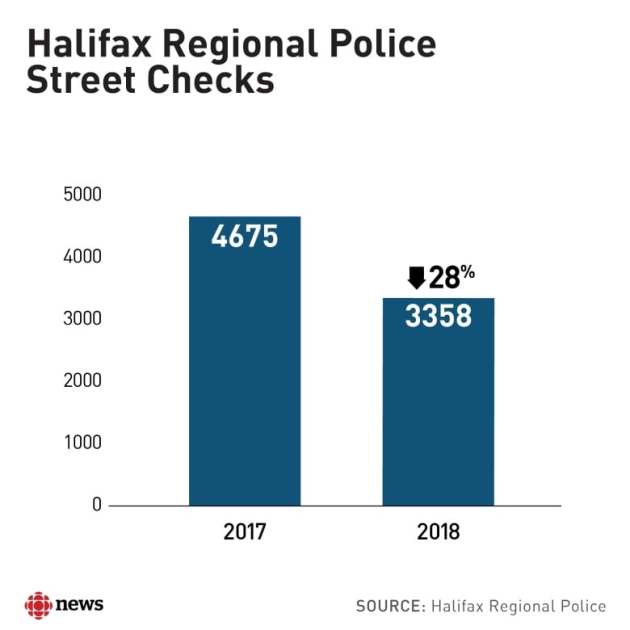
Halifax Regional Police are performing fewer street checks but new numbers released by the force show that visible minorities, especially black people, are still more likely to be stopped by an officer.
The data shows street checks dropped by 28 per cent between 2017 and 2018, part of a continuous decline since 2012.
Despite that decrease, a CBC News analysis of the data found black people were four times more likely to be street checked than white people in 2017 and 2018.
People identified by police as Arab or West Asian were nearly three times more likely to be street checked.
The figures “are alarming in the sense that they’re very high,” said Michael Kempa, chair of criminology at the University of Ottawa.
“It’s not a morally good thing. But they’re consistent with the numbers right across the country.”
In Halifax, police checks can take one of two forms: a face-to-face interaction between police and an individual or group, or observations made at a distance. The figures released by police don’t differentiate between the two.
Checks are recorded with details such as age, gender, location, reason and ethnicity.
CBC’s analysis was based on 4,579 people who were street checked a single time by police between Jan. 1, 2017 and Dec. 31, 2018.
Kempa said similar studies from other Canadian cities have shown visible minorities are street checked at three to four times the rate of whites.
“Looking at [CBC’s] statistical analysis, you made conservative assumptions in your data,” he said. “So if anything, you’re underestimating slightly.”
‘Still the target’
Ashley Taylor, who’s black and works as a support worker for African-Nova Scotian high school students, said street checks make him feel like “an enemy.”
He said he believes he draws police attention attention because he’s black, wears his hair in dreadlocks and drives a Mercedes Coupe. His job as a social worker often takes him to higher-crime areas of the city.
CBC News interviewed Taylor in January 2017 when a different CBC analysis showed black people were 3.2 times more likely to be street checked than whites between 2005 and 2016.
At that time, Taylor said he was being street checked approximately three times a year. Since then, Taylor said he’s been street checked maybe once.
“The frequency [of street checks] might have changed, but the stats are still the same,” he said. “I guess we’re still the target.”
Following CBC’s street check coverage in 2017, the Nova Scotia Human Rights Commission hired criminologist Scot Wortley from the University of Toronto to study how street checks impact visible minority populations in Halifax.
His study is scheduled for release on March 27.
The Halifax Regional Police said it would not grant any interviews before the report’s release.
“Out of respect for Dr. Wortley’s process, we are not commenting on issues related to street checks,” said spokesperson Const. John MacLeod.
Fear of complaints
Kempa attributes the overall decline in street checks to a number of factors.
“Street checks … have really leapt into the public consciousness. People have become sensitized to it and aware that there’s something not quite right going on there. They’re more adamant about pushing their rights with police officers,” he said.
Individual officers may be less likely to stop and question citizens because they’re worried about complaints being filed against them, said Kempa.
“They’re tending to pull back a little bit in engaging the public at all, most especially with a formal street check.”
Taylor’s experiences with street checks have left him hyper-vigilant when he’s behind the wheel. He said he switched from driving a white car to a black one to “blend in and stay under the radar.”
If he notices a police car around, Taylor assumes he’s being followed.
“Is that me thinking, that I guess, I’m losing my mind?” he said.
“It’s not. It’s just something that, you know, your sixth sense takes over, and those are the things that you feel while you’re driving … It just feels like it’s very tough sometimes to be who you just want to be.”
Source: Fewer street checks in Halifax but black people still more likely to be stopped
2019/02/04 Leave a comment
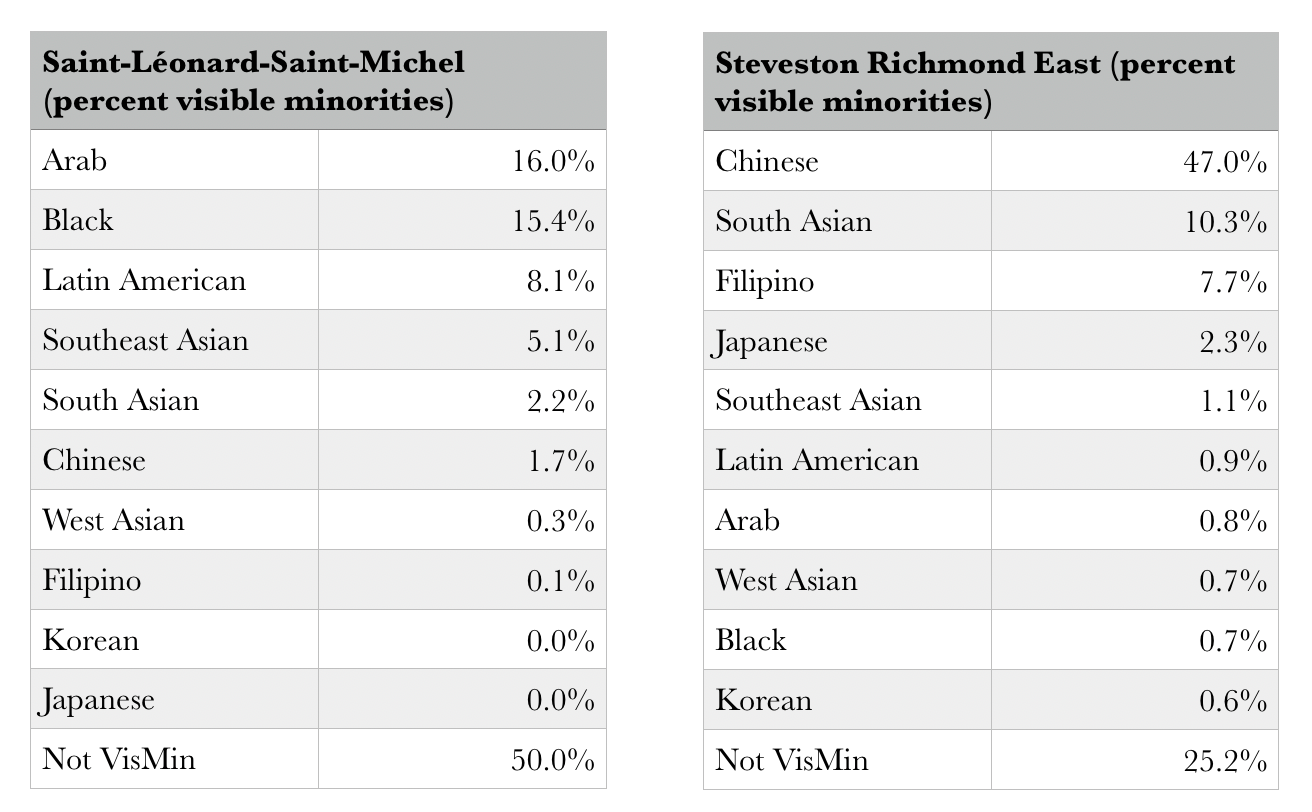
For background data on the riding demographic, economic, social and political characteristics, see: February By-elections: Matching Census Data with Ethnic Media Coverage (1-18 January 2019).
Ethnic Media Coverage
The absence of controversy in Burnaby South following previous weeks resulted in fewer articles in the ethnic media, with again the focus being on Burnaby South, with only 18 articles compared to 41 and 97 in previous weeks .
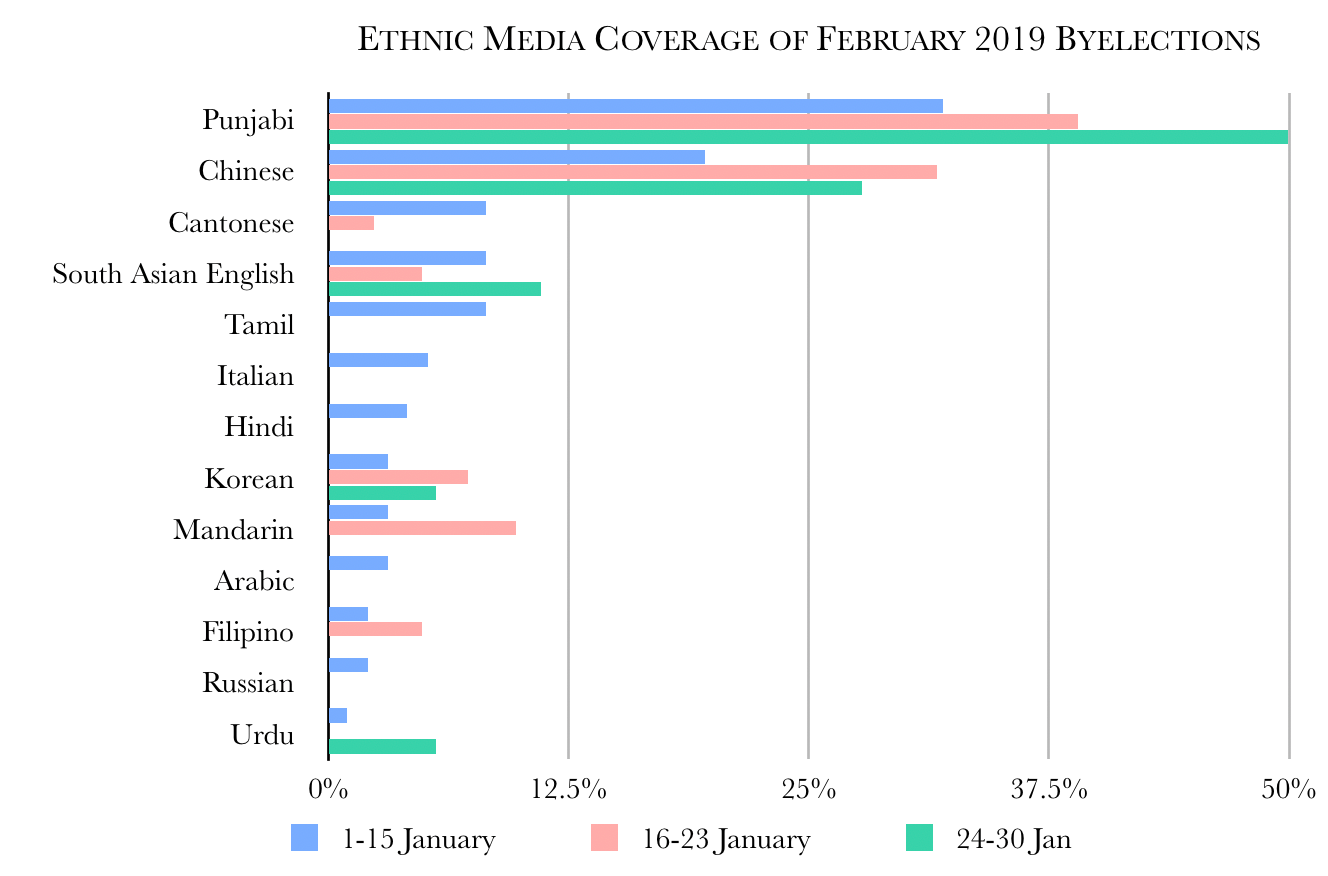
Media coverage was overwhelmingly in Punjabi (50 percent) and 27.8 percent in Chinese, Cantonese and Mandarin language media. Punjabi media covered the belated resignation of Liberal MP Di Iorio (Saint-Léonard-Saint-Michel). Chinese media covered the opening of the campaign office of PPC candidate Laura-Lynn Thompson and the nomination of James Seale in Outremont.
NDP leader and candidate Singh’s focus on affordable housing received widespread coverage in Punjabi media and was the focus of the one article in Korean media, with no coverage in Chinese media. The one article in Urdu media referenced immigration as an issue given Singh’s pledge to end the Safe Third Country Agreement with the USA and the number of asylum seekers.
In terms of commentary (including analysis and opinion pieces), Punjabi and South Asian English media predominated with two items apiece and Chinese one.
Three pieces were neutral in tone while an editorial in Punjabi media was sharply critical of “cheap minority politics and the cry for Canadian values.” In Chinese media, one commentary accused the mainstream media of “deliberately alienating ethnic groups from each other” in terms of how they characterized criticism of former Liberal candidate Karen Wang’s divisive remarks on WeChat.
In general election coverage, the government’s announcement of measures to reduce foreign interference in the federal election received widespread coverage in virtually all languages.
Other stories include the PPC having raised $300,000 was covered in Gujarati media and former Liberal candidate Wendy Yuan having “jumped ship” to seek the nomination for the Conservatives in Steveston Richmond East (she had previously run for the Liberals in Vancouver Kingsway in 2008 and 2001 and had sought the nomination in Steveston Richmond East in 2015).
See the MIREMS blog for some of the stories being covered: MIREMS blog.
2019/02/02 Leave a comment
More discouraging news from Hungary:
Flick through a Hungarian history book for high school students, and you’re left in no doubt about the government’s view on migrants.
The section on “Multiculturalism” opens with a photo of refugees camped under a Budapest railway station. Flanking the image is a speech given by strongman Prime Minister Viktor Orban on the perils of migration: “We consider it a value that Hungary is a homogenous country,” he says.
The state-sanctioned textbooks are part of a government shakeup of Hungary’s education system that is causing deep unease among some teachers and publishers.
Critics say the textbooks are just one front in a government crusade to remake the education system — and the country — in its Christian, nationalist image. Orban has also scrapped academic programs that don’t fit with his conservative values, effectively forcing one of Hungary’s leading universities to move its courses abroad.
Education ‘straight from the state’
The shake-up comes amid weeks of street protests against Orban’s hardline policies, signaling cracks in his grip on the central eastern European nation.
Since Orban’s populist Fidesz Party swept into power in 2010, and most recently won a landslide victory again in April last year, it has been at the helm of a “major educational reform,” government spokesman Zoltan Kovacs told CNN when it visited Hungary late last year.
Previously, local municipalities oversaw the country’s public schools. But in recent years the state has taken over responsibility — and that includes supplying textbooks, said Kovacs of the measure to tackle funding “insufficiencies.” He said that “finally, after almost 20 years of struggle of how to finance and run the education system, we have taken responsibility.” The government hoped to introduce a new curriculum by fall this year, Kovacs added.
School books are created in the state-run Education Research and Development Center (OFI) by various contributing experts, explained Ildiko Repárszky, a history teacher and author of some of the earlier versions.
These days, the books don’t bear the name of a single author on the cover. Instead, a board of editors reportedly handles the texts from contributors “completely freely, as raw material, reshaping them at will,” said Repárszky.
The reforms come as the country’s Central European University — founded by billionaire philanthropist and well-known Orban foe George Soros — announced last month it had been “forced out” of Hungary by a hostile government and was moving its US-accredited courses to the Austrian capital Vienna.
The internationally renowned university called it a “dark day” for Hungary and Europe — something the government dismissed as “nothing more than a Soros-style political bluff.”
But some educators in Hungary told CNN that Orban’s hardline policies were already having a deep impact on the nation’s children, long before they entered university.
‘This is just everyday politics’
In his small office in central Budapest, chairman of Hungary’s Association of History Teachers, Laszlo Miklosi, opens a history book for 14 and 15-year-olds covered in Post-it notes.
He turns to the page on multiculturalism and points to a speech Orban gave to the European Parliament in Strasbourg in May 2015 that laid out Hungary’s position on migrants.
In the speech, the Prime Minister said Hungarians considered it a value that their country was homogenous in terms of its “culture,” “traits” and “way of thinking.” “This is just everyday politics,” said Miklosi, adding “It doesn’t say anything about the actual reasons for existing problems of migration — instead it’s what the current prime minister thinks about it.”
Orban’s defiant relationship with the European Union also plays out in a cartoon showing Germany as a giant sow feeding piglets representing Greece, Spain, Belgium and Portugal. Standing apart from the rest and happily munching its own grass, is the Hungary piglet.
In the same geography book under the chapter on “Population Decline and Migration,” another cartoon shows a Hungarian boy and girl with the caption: “The number of those who think Hungary is the best place to live has significantly increased.”
The illustration includes statistics like “67% of young people can only imagine their future in this country.” And “every 4th young person lives in a marriage or a permanent relationship and 68% of those who don’t, would like to,” with no clear source for the findings.
The image “enlarges the patriotic feelings of young people in Hungary, their contentedness with their country, their willingness to get married and start a family — while also downplaying their willingness to move abroad,” said Repárszky, who is also part of the Association of History Teachers, which has around 400 members.
Government spokesman Kovacs dismissed the teachers’ concerns as a “political opinion,” adding that the government always welcomed “criticism, contribution, observations and comments” from “professional organizations.”
‘Migrant’ and ‘Soros’ are schoolyard taunts
Miklosi, who has reviewed school textbooks for more than 30 years, believes Orban’s anti-migrant rhetoric has filtered down to classrooms and playgrounds.
“‘Migrant’ has become a swear word for many people, including many children,” he said.
Should a teacher say the words “Jewish” or “gypsy” or “Slovak” they are often met with students “giggling and nudging each other” and the teacher has to “actively fight for space to discuss these categories in a neutral way,” Miklosi added.
It’s a view shared by English teacher Juli Karolyi, who said for some students the words “migrant” and “Soros” had become “swear words used in schoolyards and playground conflicts.”
But she added that children’s views were “mostly decided in the home” rather than in the pages of textbooks. “If the parents fall for the government propaganda, the kids will follow suit — especially the younger ones,” she said.
A few blocks from Miklosi’s inner-city office, 18-year-old student Akos Blaskovics has just finished a morning history class at his high school, Fazekas Mihály Gimnázium. The quietly-spoken teenager told CNN that he “hasn’t really seen a difference in the messages of textbooks in recent years.”
But he did think the government has tried to “make people focus on the question of migrants,” rather than “more important things like education, healthcare and social problems.”
Five textbook publishers, 123 trials
In a small village 30 minutes’ drive east of Budapest, publisher András Romankovics’ home office is packed with bookshelf after bookshelf of rainbow-colored spines arranged by decade.
The former teacher and his wife started publishing school textbooks in 1978, and he estimates around 10 million copies have been printed over the years.
Hungarian school textbook licenses must be renewed every five years. Romankovics is one of five independent textbook publishers who are suing the government after it rejected their requests to extend their licenses, which were due to expire at the end of 2018.
The court case relates to 123 books in total — meaning 123 separate trials for each book. Needless to say it’s a lengthy process, and since the trials began in September, around 20 books have been granted permission to extend their licenses, said Romankovics.
Meanwhile the licenses of state-sponsored textbooks were extended, he said.
Kovacs, the government spokesman, would not comment on why the government had rejected the independent textbook publishers’ license requests, saying only that it was an “ongoing case” and “going through a higher level of decision-making.”
But Romankovics, who is also chair of the National Textbook Association, which represents 20 publishers, warned that without a true diversity of books, children’s education would suffer.
‘There is a deeper problem here’
While independent publishers battle to keep their textbooks in schools, university professors are battling to keep their programs in Hungary.
Inside the grand, high-ceilinged offices of Budapest’s CEU, gender studies associate professor Eva Fodor is dismayed that the government has scrapped her program which has been running for over 20 years.
The university offers US- and Hungarian-accredited gender studies degrees — or at least it did, until the government struck gender studies from its list of accredited programs in October.
While the US-accredited program will continue in Vienna, the Hungarian-accredited degree no longer exists, affecting around 45 MA students enrolling each year, said Fodor. The only other Hungarian university to offer gender studies — Eötvös Loránd (ELTE) — was also forced to scrap its program.
“It’s a clear and unprecedented violation of academic freedom,” said Fodor, adding that it wasn’t just gender studies that didn’t fit with Orban’s world view.
“It indicates that there is a deeper problem here,” she said. Orban wants to create a strong ideology that people can hold on to, based on “national pride and his idea of very simple Christian values,” Fodor said. “And (he’s) eliminating everyone else who is not willing to subscribe to this ideology,” she added.
According to Kovacs, gender studies degrees were scrapped because of low enrollment, scarce job opportunities, and the government’s “philosophical approach.”
“We believe there are only two sexes — men and women,” he said. Kovacs added that students were still free to research gender issues from the perspective of other disciplines, such as philosophy or sociology. “But we don’t believe that gender is an independent discipline in itself.”
Students who see it otherwise had better look for classrooms outside Hungary.
Source: Why Hungary’s state-sponsored schoolbooks have teachers worried
2019/02/02 Leave a comment
Walking back his earlier remarks which nevertheless revealed his lack of understanding and awareness:
Y a-t-il ou non des manifestations d’islamophobie au Québec ? Oui, a concédé le premier ministre Legault vendredi, au lendemain d’une déclaration controversée qui lui a valu de vives critiques — mais aussi le soutien inattendu d’une élue municipale. Mais de là à reconnaître qu’il y a un « courant islamophobe » dans la province, il y a un pas que François Legault refuse de faire.
Jeudi, le chef caquiste était catégorique : « Il n’y a pas d’islamophobie au Québec. »
Il mettait ainsi un terme à la discussion autour de la création possible d’une Journée contre l’islamophobie.
Vendredi, le cabinet du premier ministre a précisé que « M. Legault voulait dire qu’il n’y a pas de courant islamophobe au Québec. Il existe de l’islamophobie, de la xénophobie, du racisme, de la haine, mais pas de courant islamophobe. Le Québec n’est pas islamophobe ou raciste. »
Cette décision de ne pas faire du 29 janvier (date anniversaire de la tuerie de la mosquée de Québec) une journée dédiée à la lutte contre l’islamophobie a été saluée vendredi par la mairesse suppléante de Gatineau, Nathalie Lemieux.
Dans une entrevue au quotidien Le Droit, l’élue a soutenu que « ce mot n’existe même pas. Justin Trudeau pense que l’islamophobie existe, mais c’est lui qui invente ce problème. Il tente de provoquer des problèmes où il n’y en a pas. Les Québécois ne sont pas aussi racistes que certains voudraient le faire croire. Quand un peuple veut s’intégrer, il s’intègre. [Mais] ce peuple ne s’intègre pas. »
Mme Lemieux a aussi ajouté que « ces gens-là font beaucoup de choses mal, avec leurs camions et toutes ces choses-là, et c’est normal d’en avoir peur ».
Ses propos ont été immédiatement dénoncés par le maire de la ville, Maxime Pedneaud-Jobin. « Je me dissocie complètement et je dénonce les propos tenus par la conseillère Nathalie Lemieux à l’égard de la communauté musulmane. Je lui ai immédiatement demandé de se rétracter et de s’excuser », a indiqué M. Pedneaud-Jobin sur Twitter. Le député libéral André Fortin, élu dans la région, a pour sa part écrit que la mairesse suppléante « représente bien mal notre Gatineau, notre Outaouais, notre Québec ».
Des propos peçus comme une «trahison»
Même avec la précision de vendredi, les propos de François Legault ont été perçus comme une « trahison » par Boufeldja Benabdallah, le président du Centre culturel islamique de Québec. Un « coup de massue », même.
Dans une lettre envoyée aux médias, il a écrit vendredi que la sortie du premier ministre a représenté une « insulte à notre intelligence, nous qui luttons sans cesse pour abolir l’attitude de certains contre les citoyens musulmans afin que notre société soit la meilleure et la plus juste qui soit ».
« Avec tout le respect que j’ai pour vous, indique M. Benabdallah à l’intention du premier ministre, je me permets de vous dire que vous n’avez pas mesuré la gravité de cette phrase, 48 heures à peine après la deuxième édition de la Commémoration de la tuerie de la Grande Mosquée. »
En entretien avec Le Devoir, M. Benabdallah a « salué le fait que M. Legault se soit rectifié ». Mais sur le fond, ses critiques demeurent.
« Je me suis senti trahi parce que le 29 janvier, M. Legault a eu la grande amabilité de venir aux commémorations, il était compatissant et a eu des mots extraordinaires. Mais quand il dit qu’il n’y a pas de courant islamophobe tout en reconnaissant qu’il y a des gestes graves d’islamophobie, je lui demande : d’où viennent ces gestes ? Ils viennent de l’islamophobie. »
M. Benabdallah fait valoir que reconnaître l’existence de l’islamophobie au Québec ne revient pas à dire que le Québec est islamophobe. Il dit craindre que les propos de M. Legault « ne redonnent vie à l’amalgame que les islamophobes adorent, à l’effet que nous traitons toutes les Québécois d’islamophobes ».
Le « courant est soutenu par une minorité », estime le président du centre islamique. « Mais il existe et il faut en prendre conscience, ne pas cacher une évidence. Il y a eu six morts et des blessés ici. Il y a eu plusieurs gestes haineux [pamphlets, croix gammées sur les murs de la mosquée, tête de porc tranchée, etc.]. Doit-on nier tout cela pour dire qu’il n’y a pas d’islamophobie au Québec ? »
M. Benabdallah précise autrement qu’il n’a pas « d’objection au refus de la proposition d’une Journée contre l’islamophobie. Je ne me sens ni frustré ni trop malheureux, quoique déçu. »
Barrette nuance
Plus tôt dans la journée, le député libéral Gaétan Barrette avait lui aussi fait valoir que « l’islamophobie existe [au Québec] comme partout ailleurs. Je ne dis pas que c’est systémique, je ne dis pas que la société est islamophobe. Je dis qu’il y a des gens, sans aucun doute, qui le sont. De faire une affirmation aussi catégorique que celle de François Legault, ça m’apparaît être une assez courte vue d’esprit », a-t-il indiqué.
Son chef, Pierre Arcand, a bien accueilli la précision faite par M. Legault vendredi. « Il reconnaît qu’il s’est trompé […], c’est pas mal une excuse, il a corrigé le tir et moi je suis satisfait. »
Le Conseil national des musulmans canadiens (CNMC) avait quant à lui dénoncé des commentaires jugés offensants et inexacts.
Selon Statistique Canada, le nombre de crimes motivés par la haine déclarés à la police a fortement augmenté en 2017 au pays. Les incidents ciblant les Noirs, les juifs et les musulmans ont été à l’origine de la majeure partie de cette hausse.
Source: Le débat sur l’islamophobie au Québec fait des flammèches
In the Globe:
Quebec Premier François Legault has clarified his controversial comments about Islamophobia, now saying such discrimination exists but that it is not widespread.
In a statement Friday, the premier’s office said Legault meant to say that there isn’t an “undercurrent” of Islamophobia in Quebec.
“Quebecers are open and tolerant and will continue to be,” the statement said.
“Unfortunately, too many racist acts still occur today in our society, and everything must be done to denounce and combat hatred and intolerance. We will continue to honour the memory of the six victims of the tragedy of the Quebec mosque on Jan. 29.”
Friday’s statement comes after the premier told reporters Thursday that there’s no need for a day devoted to action against Islamophobia because it’s not a problem in the province. Legault was responding to calls for the anniversary of the Quebec mosque shooting to be established as an anti-Islamaphobia day.
“I don’t think there is Islamophobia in Quebec, so I don’t see why there would be a day dedicated to Islamophobia,” he said Thursday.
Those comments prompted an outpouring of criticism from Muslim groups. They want the province to take a stronger stance against anti-Muslim actions and rhetoric.
‘Out of touch’
Ihsaan Gardee, executive director of the National Council of Canadian Muslims, said Legault’s initial comments were “clearly out of touch with the realities of Islamophobia on the ground in Quebec.”
Karim Elabed, an imam at a mosque in Lévis, a small city across the river from Quebec City, said the premier’s comments were irresponsible.
“The general opinion is that there is no problem in Quebec. But the problem is real,” he said.
The province should be striving toward educating the future generations and teaching youth to accept cultural differences, said Elabed.
Liberal MP Gaétan Barrette also said Legault’s comments were out of touch with reality, though he too cautioned the problem isn’t “systemic” in Quebec.
“I’m not saying that society is Islamophobic. I say there are people, no doubt, who are,” he said.
At the federal level, the Commons heritage committee recommended last year that Jan. 29 be declared a “national day of remembrance and action on Islamophobia and other forms of religious discrimination.”
Toronto Mayor John Tory announced this week that the city was proclaiming Jan. 29 a day of remembrance and action on Islamophobia.
Like the ruling Coalition Avenir Québec, Quebec’s previous Liberal government also rejected the idea of setting aside a day against Islamophobia.
Former premier Philippe Couillard said last year he preferred to make a commitment against racism and discrimination, rather than single out a particular group or religion.
The latest controversy comes amid a renewed focus on the province’s longstanding debate over the accommodation of religious minorities.
Legault has promised legislation early this year blocking public servants in positions of authority, including police officers, judges, prosecutors, prison guards and teachers, from wearing religious symbols at work.
Source: As controversy swirls, François Legault concedes Islamophobia exists in Quebec

Click image for book purchase