The Roman Catholic Church and Rome’s Jewish community expressed dismay on Thursday after rightist parties refused to back the creation of a parliamentary commission to investigate hate, racism and anti-Semitism.
The idea of the committee was put forward by Holocaust survivor and life senator Liliana Segre in response to a regular stream of abuse hurled her way on social media.
The ruling 5-Star Movement and center-left Democratic Party (PD) backed the motion, but the far-right League and its allies, the Brothers of Italy and former prime minister Silvio Berlusconi’s Forza Italia, all abstained.
“The abstention of some parties is a bit dismaying. It’s a decision that we consider wrong and dangerous,” said the president of Rome’s Jewish community, Ruth Dureghello.
The Vatican’s powerful number two, Cardinal Pietro Parolin, also weighed in.
“I am worried, in the sense that on some things like fundamental values we should all be united,” he told reporters. “There is a danger that all this gets politicized. We need to break clear of this,” he said.
Segre was deported from Italy to Auschwitz in 1944 when she was 13 – one of some 776 Italian children under the age of 14 who were sent to the Nazi concentration camp. Only 35 survived.
She said this month that social media haters posted an average 200 messages a day against her. “They should be pitied or treated,” she said this week.
The League and its allies said they abstained in Wednesday’s vote because Segre’s motion was ambiguous, in citing, for example, nationalism and ethnocentricity as possible driving forces behind racial hatred.
“By doing that you are outlawing Brothers of Italy,” said one of the party’s senators, Giovanbattista Fazzolari. “This is not a commission on anti-Semitism, as they want you believe, but rather a commission aimed at political censorship.”
While Brothers of Italy and the League, led by Matteo Salvini, have both positioned themselves on the far-right of the political spectrum, Forza Italia sees itself as center-right and some of its leaders were dismayed by the decision to abstain.
“We are betraying our values and changing our skin,” said lawmaker Mara Carfagna, who is widely seen as a possible party leader when Berlusconi finally steps away from the helm.
She has voiced alarm at Berlusconi’s recent efforts to patch up differences with the League and hand effective control of the rightist bloc to Salvini. “We are being dragged along without defending our identity,” Carfagna wrote on Twitter.
The rightist bloc triumphed in a local election in Umbria on Sunday, beating a candidate put forward by the PD and 5-Star by 20 percentage points and ousting the center-left from power in the central Italian region for the first time in 50 years.
The Senate committee will be set up despite the abstention from the rightist bloc, but the 5-Star and PD both denounced their stance.
“This abstention seems to legitimize a culture of hatred that is reflected in society. It is a shameful page in our political life,” said 5-Star lawmaker Elisa Tripodi.
A battle for public opinion over China and the protests in Hong Kong is playing out at schools in British Columbia.
Last week, supporters of greater democratic freedoms in Hong Kong set up an information booth at an annual professional development conference attended by hundreds of social studies teachers in the province. At the event, activists with the Vancouver Society in Support of Democratic Movement, a non-governmental organization, handed out information kits to educators.
The pamphlets, which organizers hoped would reach mainland Chinese students, draw attention to the Tiananmen Square killings in 1989 as well as information about the Hong Kong protests, criticizing China’s increasing suppression of the city’s freedoms.
“We are not against China, we are against the communist regime,” says one flyer.
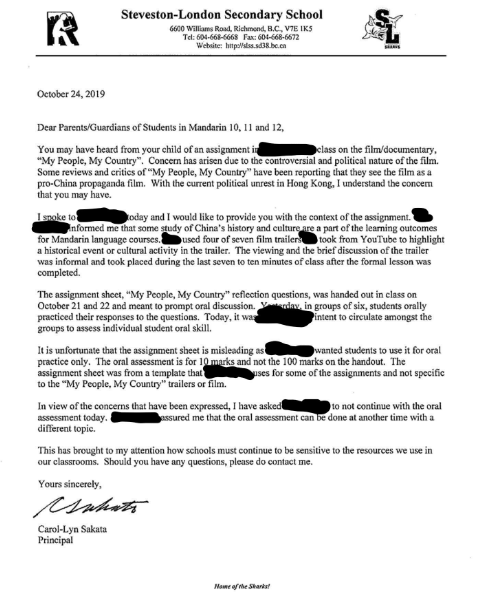
The campaign took place days after a teacher at Steveston-London Secondary School in Richmond, just south of Vancouver, showed her Mandarin class students trailers for a patriotic Chinese film celebrating the 70th anniversary of the founding of the People’s Republic of China. The students were given a list of questions to discuss the trailers, but the assignment sparked complaints from parents that the trailers were pro-China propaganda and the school asked the teacher to withdraw the assignment. The principal sent a letter to parents saying the teacher intended to use the trailers to show students a historical event or cultural activity in China and the assignment was for “oral practice only.”
The two events were not linked, but are both examples of heightened tensions in B.C. around Hong Kong’s struggle for greater democratic rights from China – an inflammatory subject in the sizable ex-pat community in Vancouver. The tensions spilled out in demonstrations on Vancouver street corners this summer, with pro-Hong Kong activists squaring off against pro-Beijing demonstrators. Scuffles over the destruction of pro-Hong Kong signs have also been videotaped and posted to social media.
According to Greg Neumann, vice-president of the B.C. Social Studies Teachers Association, 46 organizations, including Amnesty International and the Vancouver Holocaust Education Centre, set up booths on Friday to hand out materials to the province’s educators.
“We would not accept any organization that promotes any sort of illegal activity, or hatred in any form toward any group, especially those which are marginalized. We will not censor the messages of those promoting peace, justice, love, democracy, or any of the key values we have in our Charter of Rights and Freedoms,” Mr. Neumann said in an e-mail.
He added it is up to the teachers attending the conference to judge for themselves the usefulness and appropriateness of the resources provided by the exhibitors.
Prof. Wanda Cassidy, director of Simon Fraser University’s Centre for Education, Law and Society, said the topic of the materials being offered to teachers by the pro-Hong Kong society fits with social studies education.
“Social studies education encourages debate and discussion about all sorts of current local and world topics and teachers generally introduce students to a variety of perspectives on any given controversial topic,” she wrote in an e-mail.
“This might include examining different sorts of materials and messages that various groups convey. This fosters critical thinking, a main goal of social studies.”
Mabel Tung, chair of the pro-democracy society, said her group has been spreading the history of Tiananmen Square protests and massacre for years and providing tools and resources for teachers, but last week’s campaign was their first attempt to promote information about Hong Kong protests to B.C. educators.
“We want to tell the message to all Canadians to stand up for Hong Kong, to stand for the Hong Kong people, to fight for democracy,” she said. “Whatever is happening in Hong Kong, it may be happening anywhere in the world.”
One flyer distributed to teachers listed several reasons why many Hong Kongers are protesting, and why they fear Hong Kong being governed by the Chinese Communist Party.
“Because the Hong Kong government and the Chinese Communist Party is eroding Hong Kong’s autonomy: Communist infiltration of Hong Kong legislature; suppressing journalistic freedoms and free speech …” the flyer says.
Ms. Tung said her group hopes teachers can help reach students from mainland China with what she said was the correct information about the protests, such as that the movement isn’t demanding independence.
Officials with the Chinese consulate in Vancouver objected to the pamphlet campaign, saying it’s an effort by agitators from a foreign country trying to interfere in Hong Kong affairs, which they consider China’s domestic affairs.
“We think this should also be brought to the Canadian authorities’ attention and should be stopped from happening again. Furthermore, the indicated behavior should be condemned as it has nothing to do with freedom of expression but purely attempts to provoke political dispute by using public platform,” the statement reads.
When asked for comment, a spokesman with the Ministry of Education provided a statement noting that B.C. boards of education are responsible for choosing the resources that are used in their local schools.
Ken Tung, former chair of social service organization SUCCESS and a volunteer for the pro-democracy group, said activists also discussed modern China with participants at the teachers’ event.
“People need those backgrounds to talk about our international relationship – Sino-Canada relationship,” he said.
“The students definitely need to understand the international relationship, international trade, [and] how we work with Canadian values with those countries.”
Some valid questions, written from a conservative perspective:
Anyone observing academia from within would know that most of the research coming out of a majority of social science departments is meaningless and irrelevant. It’s a self-referential racket that squanders money on bureaucratic nonsense and on research subjects completely dissociated with normal life and policy.
Had it not been so, right now there would be scores of scholarships and funding to find out the causality behind a single puzzling phenomenon: What explains otherwise virulent, hyper-activist, and volatile Islamic countries and jihadist groups being completely subservient to China?
It is, of course, unthinkable that India, the United Kingdom, the United States, Israel, Russia, or any European Union country would get away with what China is doing without a response from Islamic countries. After all, China is routinely, systematically, and violently attacking the Islamic countries’ fellow religious practitioners.
Islamic states and civil society are not otherwise shy about showing their displeasure and have resorted on other policy priorities to collective action via proxy forces, demonstrations, and active funding of jihadist groups. China has trade and military ties with all the major Islamic states, with major investments in Pakistan, Central Asia, Iran, and the Middle East.
So how did China manage to earn the subservience, when more than 1 million Muslims are interned in Chinese concentration camps? And what does that mean for Western policy that we couldn’t manage that feat through continuous appeasement?
The West Is in Too Deep with China
China has compromised and infiltrated Western big corporates and universities. For decades since the end of the Second World War, in the West among both libertarians and conservatives, the market has been worshiped as something larger than the nation-state, and now that the market has decided China’s money is more important than Western social cohesion, the fault lines are increasingly becoming prominent.
As Jim Antle recently wrote in The American Conservative, this is the modern metaphorical version of the proverbial corporatists selling the rope to Lenin by which he plans to hang them. But China should ideally shock both liberals and leftists as well and align them with conservatives. As Matthew Walther wrote, the barbarism in China is incomparable and unprecedented but should ideally bring the left and right together. The fact that it doesn’t shows how compromised the situation is.
Walther writes:
“I cannot believe I am typing this about a man who eight years ago said he would be walking on Mars by now, but Newt Gingrich is absolutely right. Our leaders are not prepared to deal with China. Not only do they lack the cunning and the willpower — they lack the requisite bargaining tools. We are in too deep, and China knows it. Any concession we could possibly demand of them will require a corresponding one that we are unable to grant.
Besides, it is not clear to me that a substantial number of Americans particularly wants to see our relations with China change. We are happy to buy cheap water bottles and Halloween decorations and licensed cartoon merchandise and mobile phones. We want our movies shown in Chinese theaters and our sports leagues to have large Chinese fan bases. From our home in this consumer paradise hell looks impossibly remote.
Very well. That’s on us to fix. But what explains the muted reaction from the Islamic world? This is an important question. While for liberals and neoconservatives every two-penny authoritarian looks like the next Adolf Hitler, only one great power that we know of is actively running concentration camps, where reportedly more than 1 million people are enslaved with no rights or freedom, women are being raped, and Mengeleian experiments are being conducted on live human subjects.
Now, as with any news this gruesome, there is always a need for caution on how much to believe and what to ignore. But no smoke can exist without some fire, and if even a quarter of the news coming out of dissidents is true, the reality is horrific.”
Why Are Islamic Leaders Silent?
The strangest part is the deadly silence from Islamic leaders. Naturally, this leads to a few questions. Are the Islamic countries afraid of China more than they are of the West? Is that because they worry about losing Chinese investment, or is that because they know that if they provoke China to the point of a war, Chinese military will not follow human rights rules during engagement?
It is unlikely that Chinese military in a war situation would follow the careful “minimal-civilian-casualty” mode of warfare or counterinsurgency the West currently practices. Is that a deterrent?
From Pakistan, to Iran, to Saudi Arabia, to Turkey, all the leading Islamic powers are silent about literally millions of their fellow religious practitioners being brutalized, as are the countless jihadist groups from Indonesia to Iraq. This could mean only one thing: that the Islamic states and jihadist groups are more afraid of China than they are of anyone else.
Consider any other power — the EU, the U.S., the U.K., Russia, India, or Israel — acting like China, and imagine what the reaction would be. Where are the mass protests? Where are the flag burnings? Where are the embassy attacks? Where are the jihadist bombings of Chinese economic interests in Africa and elsewhere? That question as to why there aren’t any needs to be probed for strictly strategic reasons. What did the Chinese manage to do that we couldn’t, after billions in aid, hundreds of thousands of refugees resettled, and humanitarian wars?
For liberals, neoconservatives, or Trotskyists, and anyone else who prefers values more than interests, the answer is always more universalism and internationalism. Tyranny and despotism need to be confronted forcefully at every juncture, even to the point of overstretching militarily and financially. National conservatives and realists, for example, believe in narrow realpolitik. To them, interests matter more, and only when interests are threatened.
China’s Rise Should Trouble Liberals and Conservatives
In one current case, however, everyone should agree that the rise of China should concern both conservative-realists and liberals. Liberals should be worried about human rights in Hong Kong, which Ben Domenech chronicled here, as well as the influence of Chinese authoritarianism within Western institutions. Conservative realists should be worried that China is a growing peer rival great power with hegemonic aspirations in Asia, a growing navy, and powerful research in AI and genetics unhindered by gender-diversity nonsense.
China is a power determined to hollow out the West from within. This is something the Soviets couldn’t do due to their economic model. One shudders to think, however, how much manufacturing the Western corporate sector then would have funneled to cheap Russian labor to hollow out heartland England and America, had the autarkic Soviets been more like globally integrated state-capitalist China.
Even for the sake of academic and strategic inquiry, both liberals and conservatives should focus on trying to find the answer to the question: What is the Chinese secret strategy through which they conquered the entire Islamic world and managed to earn its submissive obedience without firing a single shot or losing a single life in futile humanitarian wars, such as the ones fought with blood and treasure, since Bosnia-Herzegovina in the 1990s?
Look forward to seeing the questions and, in a few years, any government or other evaluations on the effects:
La décision, publiée mercredi dans la Gazette officielle, indique que les ressortissants étrangers et les membres de leur famille qui souhaitent s’établir au Québec (à l’exception d’un enfant à charge de moins de 18 ans ou d’une personne ayant une condition médicale) devront obtenir une « attestation d’apprentissage des valeurs démocratiques et des valeurs québécoises exprimées par la Charte des droits et libertés de la personne ». Le score minimum pour réussir l’évaluation est fixé à 75 %.
En vertu d’un accord entre Québec et Ottawa, le gouvernement du Québec est responsable de la sélection des immigrants économiques qui s’établissent sur son territoire. Pour immigrer au Québec en vertu du programme régulier des travailleurs qualifiés, un ressortissant étranger doit soumettre son intérêt au ministère de l’Immigration du Québec, qui évalue les candidatures selon une liste de critères socio-économiques. Un travailleur qualifié dont le profil correspond aux besoins du Québec est ensuite invité à présenter une demande formelle pour obtenir un certificat de sélection du Québec (CSQ), un document essentiel pour obtenir d’Ottawa le statut de résident permanent afin d’immigrer au Québec.
Dès janvier, Québec exigera désormais qu’un travailleur qualifié qui souhaite immigrer au Québec réussisse également son test des valeurs dans les 60 jours suivant sa demande de CSQ.
Qu’arrive-t-il en cas d’échec ?
Un ressortissant étranger qui ne réussirait pas son test des valeurs une fois qu’il a été invité par Québec à présenter sa demande pour obtenir un CSQ pourrait reprendre l’évaluation une première fois. Dans le cas d’un deuxième échec, il pourrait refaire l’examen une deuxième fois ou suivre, au Québec, un cours administré par le ministère de l’Immigration.
Or, si le ressortissant étranger choisit toutefois de tenter sa chance en passant le test une troisième fois, sans suivre le cours, celui-ci renoncerait à son droit à suivre le cours, explique-t-on dans la Gazette officielle.
L’imposition d’un test des valeurs aux immigrants est une promesse de longue date du gouvernement Legault. En campagne électorale, François Legault promettait toutefois d’imposer ce test aux immigrants une fois ceux-ci arrivés sur le territoire québécois. Ceux qui auraient échoué l’examen auraient été expulsés du territoire canadien. Or, Québec ne dispose pas de ce pouvoir et Ottawa a fermé la porte à un tel scénario.
La Gazette officielle ne présente pas mercredi des exemples de questions qui seront demandées aux ressortissants étrangers. Par le passé, le ministre de l’Immigration, Simon Jolin-Barrette, a affirmé que celles-ci seraient fondées sur les valeurs exprimées par la Charte québécoise des droits et libertés de la personne.
The far-right Alternative for Germany party on Sunday celebrated a strong showing in the former Communist East, more than doubling its support in a state election held two weeks after an attack on a synagogue that some tied to the party’s use of hateful language.
The party won 23.5 percent of the vote in Thuringia, according to preliminary returns, up from 10.6 percent in 2014. That left it in second place, behind the Left Party but ahead of Chancellor Angela Merkel’s conservatives.
The party, known by its German initials AfD, has no hope of governing, since all the other parties have ruled out cooperating with it. But its strong showing is likely to reverberate in other ways. The election outcome could further strengthen the power of Björn Höcke, the party’s leader in Thuringia and its most notorious figure.
It has been described by people both in China and outside as the best propaganda film that country has ever produced and it may be the first Chinese-produced film to earn more than US$1 billion.
So it’s not surprising that parents and others are questioning the appropriateness of the trailers for My People, My Country being used as teaching material in Grade 10, 11 and 12 Mandarin language classes at a high school in Richmond.
The film is a 254-minute, patriotic review of seven historic high points since Mao Zedong and the Communist Party came to power 70 years ago.
Co-produced by a state-owned company, there is no mention of the Cultural Revolution or the 1989 Tiananmen Square crackdown. The return of Hong Kong to Chinese control is portrayed as a triumph.
The South China Morning Post’s review described the film as a “jingoistic anthology,” while the Chinese news agency Xinhua said the film’s aim was to “awaken shared memories of Chinese people around the world.”
“After 70 years, our culture and propaganda departments finally figured out how to combine propaganda with art,” Yan Feng, a Chinese literature professor at Shanghai’s Fudan University wrote in a Weibo post quoted by the New York Times.
Even without English translation, the YouTube trailer is nothing like what you might imagine propaganda looks like — aside perhaps from the Hollywood patriot movies like Top Gun.
That’s what makes it so powerful.
There are seven trailers in all for the film and four were shown to Grades 10, 11 and 12, Mandarin-language classes at Steveston-London Secondary School.
After viewing them, students had a brief informal chat about what they saw before being handed written questions as a prompt for another discussion the following day, according to an Oct. 24 letter that principal Carol-Lyn Sakata sent to parents.
A copy of the principal’s letter with the teacher’s name redacted that was posted to the Canada Hong Konger Facebook page.
That discussion was cancelled because of parents’ concerns about using Communist Party propaganda in the school.
“We believe the teacher intended to engage students in an informal and open discussion to ‘analyze personal, shared, and others’ experiences, perspectives, and world views through a cultural lens,’ as contemplated in the provincial curriculum,” Richmond School District spokesman Dave Sadler wrote in an emailed response.”
But is propaganda culture? Or is it simply politics?
There’s a plausible argument to be made that My People, My Country is a cultural and even historic phenomenon. Certainly, it’s being widely shown and widely seen.
Released on Oct. 1 to coincide with 70th anniversary celebrations, it had 135,000 daily screenings on the first weekend, earning US$102 million, according to Variety. Online reviewers in China scored it as high as 9.7 out of 10, but as Variety diplomatically pointed out “in the past there has been doubt about the reliability of such scores.” Still, Variety suggests, it may be the first Chinese film to earn US$1 billion.
But if the teacher’s intent was to talk about it as cultural phenomenon, that’s not evident from the principal’s letter or from the assignment itself.
Under the Chinese caption “I love my motherland,” students were given “reflection questions.” Among them were: How did this movie make you feel? What words or phrases made you feel good? What was your favourite part? What four adjectives would you use to describe the movie? Does it remind you of your life?
Further down, there were questions about what they thought the movie’s message is and why it was produced.
Sakata noted the “controversial and political nature of the film” in her letter to parents. “With the current political unrest in Hong Kong, I understand the concern that you may have.”
There’s no doubt that that may be what has made parents and students more acutely aware of what is being taught in Mandarin classes.
But to suggest that is the only reason for concern is a disservice to both students and parents who are raising important questions far beyond a single teacher, some trailers and three classrooms.
What is being taught under the guise of Mandarin language learning in British Columbia’s public and private schools? How are teaching materials chosen? Who chooses them? Are they being supplied at no cost by the Chinese government?
While the provincial government sets curriculum, it doesn’t choose the resources used in local schools. That’s up to the school districts using the province’s rather vague criteria.
According to an education ministry spokeswoman, teaching materials must: support learning standards and outcomes of the curriculum; make connections with real-life examples; be age appropriate; meet copyright and privacy requirements; and, content must be socially acceptable.
There’s enough leeway that the Coquitlam School District, for example, has partnered directly with the Chinese government to set up a Confucius Institute with teachers and teaching resources provided by China at no cost.
It’s not clear how the choices are made in Richmond. Sadler wasn’t able to provide the answers Friday as it was a professional development day and the people who deal with curriculum issues were away.
But it begs the question of the province’s responsibility.
Canadian students and foreign students studying in Canada deserve an education untainted by political influence or interference especially from another country’s government. And that should be something the province is doing.
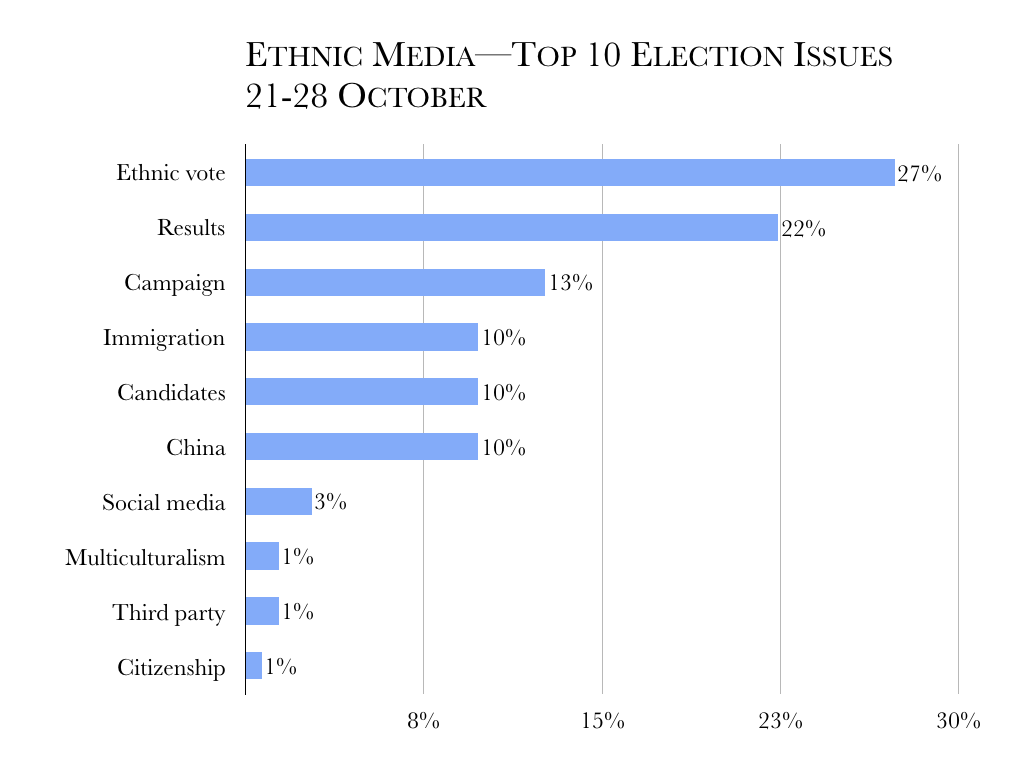
About 15 percent of the PPC candidates were visible minority:
Kulbir Singh Chawla really doesn’t like when he’s connected with a customer service representative with a foreign accent.
This, despite having a accent himself.
“Here in Canada, I would say don’t even employ Kulbir,” Chawla said of customer service jobs.
“Because I still don’t have that Canadian way of (speaking) fully.”
The most recent federal election saw a small but distinct cadre of people of colour and immigrants such as Chawla supporting and in some cases even running for far-right populist parties such as the People’s Party of Canada, the National Citizens Alliance and the Canadian Nationalist Party.
All of these parties wanted to reduce immigration and scrap Canada’s official multiculturalism policy.
Despite being an immigrant himself, Chawla says he supports these policies.
Chawla, an industrial engineer, came to Canada from India with his wife and daughter in 1999. He currently lives in Nova Scotia and calls himself a Canadian nationalist. When he first moved here, he considered himself left-leaning, but over the past two decades, he’s experienced what he calls a political awakening.
It led to him attending yellow vest rallies at the movement’s peak, where he would wear a matching yellow turban. And people would call him racist.
“The left media would say this is a racist movement. And there I am with my turban. And it just breaks their narrative,” he said.
He was first drawn toward the Conservatives, then toward far-right, fringe parties such as the National Citizens Alliance, which in addition to advocating for lower taxes and the abolishment of the Bank of Canada Act, wants to reduce immigration levels to about 50,000 a year. Chawla previously ran for the National Advancement Party of Canada, the NCA’s predecessor, in Calgary Midnapore in a 2017 byelection.
He says some reasons his political stance shifted are political correctness and liberal “indoctrination” about issues such as white supremacy and racial profiling (the former he says doesn’t exist, the latter he believes is valid in some cases).
“It started with the yellow vest movement … It’s come up as a big, I will say wake-up movement for Canada and Canadians. It brought them together as well. So there’s a great deal of populism and nationalism going on,” Chawla said.
He compares nationalism to working for a corporation; the ultimate goal should be the betterment of the company, rather than advancing one’s own personal fortune. The same goes for living in a confederation.
It’s where his deep distaste for call centres that employ people with accents stems from. He said he believes it hurts Canada both economically and in terms of its national identity.
In particular, he is opposed to customer service being outsourced to other countries, for economic reasons — it takes jobs out of Canada and hurts the country’s GDP. It inspired him to create a Change.org petition urging the government and corporations to “Create call centres in Canada!”
But he acknowledges there’s an important cultural component as well.
“When I come here, if I found my own type of people speaking on the call … then it’s no different from being in India,” he said.
“We immigrants came to Canada for a whole different outlook on life. And we find it’s all changing, back to the same old Punjabi style.”
For parties such as the People’s Party of Canada that were accused of harbouring racist candidates and policies, there’s an obvious benefit to having candidates and supporters of colour, says Akaash Maharaj, a former senior resident at Massey College and CEO of the Mosaic Institute, an organization that helps bring together immigrants who have come to Canada from countries affected by conflict.
“There has been an effort by extreme right parties to try and play a game of blackface and brownface to inoculate themselves against accusations of racism by demonstrating that they have at least one or more members of their parties or candidates who are not white,” Maharaj said.
But the allure of anti-immigration policies for immigrants themselves is more complex.
“On the face of it, it looks absurd and I think it is absurd … I wouldn’t say it’s widespread,” Maharaj said. “But it’s more common than one might expect.”
“It’s the old pull-up-the-ladder syndrome,” he added. “Now that they have made it in, they want to protect themselves from people exactly like themselves that harbour the same ambitions. They are afraid more people benefiting from Canada means that their share of the pie will somehow diminish.”
This phenomenon is even more common among recent immigrants when compared to first-generation Canadians or the descendants of immigrants, Maharaj noted.
Peter Loewen, a populism expert at the University of Toronto’s Munk School of Global Affairs and Public Policy, said when immigrants move to Canada, integrate into mainstream society and accept the status quo, there’s a quick transition to viewing themselves as Canadian — and therefore, different from the rest of the people coming here.
He points to the 2015 federal election, where the support for a niqab ban was higher among immigrants than native-born Canadians.
“That’s largely underwritten by a sense that immigration is tough and once you’ve gone through it, you expect people to go through it without any more accommodations than you’ve had,” he explained.
Populism sells well to immigrant communities because at its heart, it’s about a deep disaffection with the political class who are seen as unsympathetic or even antagonistic toward everyday people. Immigrants can often come from countries with political corruption.
But populism comes in different forms, says Drew Fagan, professor of public policy at Munk School and a former deputy minister in the Ontario government.
“The new strain of right-wing populism increasingly pits itself against subsets of the population like immigrants and minorities. Whereas left-wing populism pits itself against what is viewed as an unfair system,” he said. “It’s about structure as opposed to people.”
And what is emerging around the world, and in Canada, is far-right populism, Fagan added. Its members are largely religious, have reservations about diversity, and are disdainful of institutions or perceived elites.
From there, populism can devolve into nativism, a policy of promoting the interests of native inhabitants of a country against those of immigrants.
As you may have noticed, I have been critical of the planning committee for the International Metropolis Migration conference decision to select Beijing as the site despite the country’s regime has been a producer of refugees and the UN and Amnesty International recognizing it is actively supressing China’s ethnic minority populations.
Examples can be seen with the Muslim Uighur minority through prison camps as well as suppression of the Tibetan minority.
The regime also regularly interferes with academic freedom both at home and abroad and uses such venues to legitimize its practices.
For these reasons, Howard Ramos and I have started a petition the International Metropolis conference steering committee to reconsider the location of the next conference.
We write to you to consider signing and endorsing our petition. More information and the petition can be found here:http://chng.it/PR5HX5ZsyH
Juan Hernandez-Villafuerte’s parents identified as Christian, so he didn’t understand why, by family tradition, they abstained from pork, washed their hands thoroughly before and after meals and covered the mirrors in the home after someone died.
“You had to do it, but you never knew why,” he says at age 41. “I wasn’t aware of my Sephardic heritage at (any) point, even though I knew there was something different about us.”
Before immigrating to Canada in 2012, he grew up in northeastern Mexico. His mother suspected they might have Jewish roots, so this fall, he left his home in Montreal and spent most of his vacation in the municipal archives of Mexico City. He found police and church records, as well as a yellowish paper — a property record from the year 1610 — bearing the name of his great-great-great-great-great-great-great-great-great-great-great grandfather.
“I was actually able to touch it,” he says. “I always wanted to know who I was.”
He was prompted to begin his research after the Spanish Parliament unanimously passed a law in 2015 to grant citizenship to the descendants of Sephardic Jews, meaning Jews with Iberian roots. The deadline for applications passed at the end of September, at which point the Ministry of Justice said it had received more than 130,000 applications, of which approximately 6,000 had been approved.
Spain’s initiative is part of a trend across Europe to repatriate Jewish families who faced persecution. Beginning in the 1300s, Sephardic Jews were forcibly converted to Catholicism, and during the Spanish Inquisition beginning the 1400s, the converts were investigated under suspicion that they may be continuing to practice judaism. Some historians estimate 2,000 converts were burned alive, while others faced different punishments, and after the Inquisition was established, an estimated 100,000 remaining Jews were expelled. Portugal also enacted a similar citizenship law in 2015, and countries including Germany, Austria and Poland have been granting citizenship to the descendants of Jews persecuted in the lead up to the Holocaust and during the Holocaust.
Spain’s initiative has led people to discover their family identities, but many of them have spent $6,000 on the application process, and the program is politically and economically charged. While some people commend Spain’s gesture as a way to rectify historical violence — or at least a way to secure a passport to the European Union — critics point out the expense of the application and question the country’s motives.
“They took everything from us — our identity, our possessions, any property that we had,” says Maria Apodaca, a Sephardic Jew who lives in Albuquerque, NM. “I don’t have $6,000 a pop to do this, and I don’t see how it would benefit me,” she says. “I was planted in the United States, and in the United States I’ll stay.”
Applicants do not need to be practicing Jews, but they do need to prove Sephardic heritage with evidence such as census documents and records of birth, baptism, marriage and death. Applicants must have these records translated by a translator recognized by the Spanish government, and they must travel to Spain to sign with a Spanish notary.
“It’s almost like a huge, many, many months-long scavenger hunt,” says Daniel Romano, a lawyer in Montreal who applied for citizenship with his wife. In his legal profession, he recently worked on an immigration case of a Venezuelan refugee, and he says her refugee claim was “100 times more simple” than his Spanish citizenship application.
Romano has always identified as a Sephardic Jew, and he had a sense of duty to accept the Spanish government’s offer of reconciliation. “It’s odd, but I felt the need to reciprocate. They cannot make amends through our mutual ancestors … if the descendants do not take up the offer,” he says.
Some applicants have sought rabbis to vouch for their heritage. Shlomo Gabay, the rabbi at Beth Hamidrash, a Sephardic synagogue in Vancouver, says he received eight or more requests per month to write letters for Spanish citizenship applications. The requests came mainly from South Americans, Mexicans and the occasional Canadian, with some people showing him original scripts from the time of the Inquisition.
“People really, really took this seriously,” says Gabay.
Though not subject to the Inquisition, Jews who refused to convert or leave Spain were called heretics and could be burned to death on a stake.Henry Duff Linton (1815-1899)/Creative Commons
In Britain, some Jews have seen repatriation programs as a ticket to work, study and travel in the European Union after Brexit. Ben Shapiro, a 26-year-old man who works at an interfaith charity in London, considered applying for Spanish citizenship but instead applied for German citizenship because the process was easier given that his relative was already applying, and it achieves the same access to the E.U.
“There’s definitely a lot of Jewish people that feel like their Spanish or Sephardic expression of Judaism is important to them, so being validated by Spain is something that’s pleasing,” says Shapiro, “but I think also Brexit is just having a big (impact on) young, liberal European-liking people who don’t want to give that up if they don’t have to.”
Spain could be taking this measure as an effort to boost its population and economy. The country’s fertility rate is far below replacement level at 1.3 children per woman, and its population is predicted to decline by 9.4 million between 2000 and 2050, according to the United Nations Population Division in 2000. The country has introduced pro-natal policies to encourage Spaniards to have more children and has accepted increasing numbers of refugees. Since applicants for the Jewish repatriation program must pass a language and citizenship test — and in many cases must hire a lawyer and genealogist to help with their claim — the initiative could attract migrants of affluence, as could repatriation programs elsewhere in Europe.
“There’s a sense certainly toward the Jews of some sort of historical debt, some sort of reckoning,” says Howard Adelman, an associate professor of history at Queen’s University, specializing in Jewish history, “but if I can be more cynical, I think there’s also an element of an attempt to bring people with assets and affluence to the countries and also to offset some of the refugees that are arriving at these countries.”
An original land grant from 1610 given to Marcos Alonso de la Garza in northeastern Mexico. His descendant, Juan Hernandez-Villafuerte, searched for the document to prove his Sephardic Jewish heritage.Juan Hernandez-Villafuerte
He notes that Muslims also endured forcible conversion in Spain, and in the 1600s, he says, hundreds of thousands of converts, known as Moriscos, were expelled. Yet, “no country has it on the table to talk about repatriating Muslims.”
Adelman says some Jews are disillusioned by antisemitism during the Trump administration, while some Jews are leaving Israel due to its unstable democracy.
“Many of them are having an awakening that they have to have another place to go, and I think that Israel used to be that escape hatch, but now Israel is in as much chaos as the United States,” he says.
Applications for Spanish citizenship surged at the time of Donald Trump’s election, says Schelly Talalay Dardashti, who works with the Spanish Citizenship Committee of the Jewish Federation of New Mexico, which received 50 to 75 calls per day before the deadline from people inquiring about Spanish citizenship. Some applicants have showed up at her office and cried, she says, having observed family customs all their lives but never having understood that the customs were Jewish.
“That is a bombshell that goes off in someone’s head. That is a real identity crisis,” she says. “Citizenship is like getting this badge: yes, we are who we are.”
When Dardashti meets with people, she asks them to write down family customs related to death, food and even cleaning the home, but many applicants get DNA testing and hire genealogists to help their claim.
Dennis Maez, a genealogist in New Mexico, was so overwhelmed with requests from Sephardic applicants that he had to put on hold his day job, running businesses that sell cars and cattle. He researched family trees for approximately 250 applicants, tracing some families back as far as the year 910.
As the deadline approached, he was “absolutely burnt out,” he says. “I would just work tremendous hours putting the (genealogies) together. I just finally had to quit.”
In Montreal, Hernandez-Villafuerte did his genealogy research himself. Even if his application is approved, he never intends to live in Spain.
“I think this is something I had to do for my ancestors,” he says. “They went through a lot of pain. They were expelled from their land … To me, it’s not about, What I can do with that citizenship? It’s more about restoring something that I love, or we loved, hundreds of years ago.”