Federal judiciary edges closer to gender parity, but numbers of minorities drop


Hmm. Effect of change in Minister?:

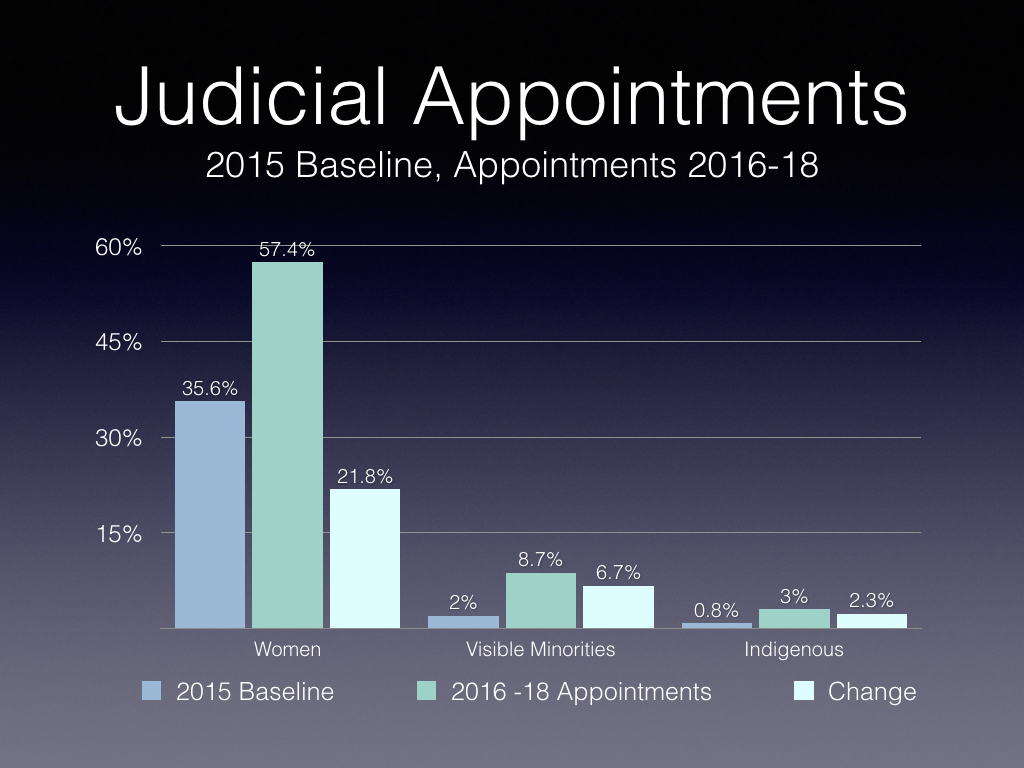
The federal judiciary is edging closer to gender parity after the second consecutive year in which more women than men were appointed judges, new data show. Women now make up 43 per cent of the 905 full-time judges.

But the numbers of minorities dropped, also for the second year in a row. There were just four members of visible-minority groups chosen, and two Indigenous persons, out of 86 new judges.

In the wake of the new statistics, some members of the legal community are urging the government to do more to appoint minorities to the bench.

“I think it is time now to redefine what we mean by merit,” said Daphne Dumont, a former president of the Canadian Bar Association who practises law in Charlottetown.

“I think you can be highly meritorious for all sorts of reasons that aren’t necessarily the reasons given in the application form that you have to fill in.” For instance, Indigenous lawyers who have returned to their home communities to bring them access to justice have shown merit. The process, she and others said, typically rewards those who are perceived as leaders through volunteering, teaching and participating on boards of legal associations.

The Liberal government revised the appointment process in 2016, with a stated emphasis on diversity. For the first time, the government asked judicial applicants whether they are disabled, a member of a visible minority or an ethnic/cultural minority, LGBTQ2 or Indigenous.

Each year, the Office of the Commissioner for Federal Judicial Affairs reports on the numbers of applicants and appointments from each of the groups. The numbers cover federally appointed courts such as the superior courts of provinces, the Federal Court of Canada and the Tax Court.

From October, 2016, to October, 2017, an equal number of men and women – 37 – were appointed to these courts, although men far outnumbered women among applicants. The following year, female applicants for the first time outnumbered males, and the numbers appointed also exceeded those of males – 46 to 33. This year, appointments were 47 women, 39 men.

By contrast, the numbers went down among the minority groups. This year (from October, 2018, to October, 2019), there were 20 appointees – 14 from ethnic/cultural groups; four visible minorities; two Indigenous; and zero categorized as LGBTQ2 or disabled. (There were 19 LGBTQ2 applicants and six disabled ones. Applicants can stay in the pool for two years.) The previous year, there were seven visible minorities, three Indigenous and 29 overall. The first year of the reports, in 2017, there were 32 – including nine visible minorities.

Rachel Rappaport, a spokeswoman for Justice Minister David Lametti, said the minister has met with legal organizations since his appointment early this year to encourage applicants from visible-minority, Indigenous, linguistic-minority and LGBTQ2 communities. The meetings were also a chance to identify barriers and work together on solutions to further expand the pool of candidates, she said.

Lori Anne Thomas, president of the Canadian Association of Black Lawyers, said the appointments of black and Indigenous judges have been “woefully lacking.” She said she was singling out those two groups because they are overrepresented in the criminal-justice system, and among families in the child-protection system.

“The women who are appointed are white women. It shows there have been a lot of efforts in the legal community to create fairness and equality when it comes to gender, but it’s still not there in terms of race, or Indigenous persons,” she said in an interview.

Ms. Thomas said she would like to see “more consideration” given to members of overrepresented communities – for instance, for overcoming obstacles.

“Those who are racialized won’t be given the same kind of opportunities to speak on panels, to lead cases in the same way that especially their white male counterparts would be given.”

On that point, Scott Maidment, president of the Advocates’ Society, a lawyers’ group, said change needs to come from within the legal profession, too. To become a judge, “You need opportunities for leadership within the profession.” The Advocates’ Society has revised its leadership principles to stress inclusivity, he said.

Source: 43 per cent of federal judges

The diversity racket

While over-blown, including her claims about misleading data, the call for more meaningful and open conversations around what diversity means, and confronting one’s internal biases, whether right or left, is valid:

People of all stripes are undergoing an identity crisis. Although identity crises have long existed as part of the human condition, today’s crisis has emerged in tandem with, and in part as a reaction to, the diversity movement — or as proponents call it, diversity and inclusion (D&I).

Industry experts and D&I leaders comprise primarily of educated and ideologically homogeneous Westerners who dictate social norms, policies and the correct usage of language. Everyone else is forced to agree, or else be labelled an oppressor. Ironically, these experts are able to agree on a consistent ideology, precisely because diversity of thought is so lacking. Real diversity would mean inviting everyone to the conversation, not reaching a moral conclusion in an invite-only group and then forcing everyone else to adopt it because ‘that’s just the way it is now’.

D&I has created an immense pressure to use only socially approved language. A fear of offence runs so deep that censorship of speech is an inevitable outcome, both within and outside these circles. Language is changing so quickly – what was acceptable yesterday is racist today. For instance, in the consultation process to develop Canada’s latest anti-racism strategy, some of the participants said that once neutral words like ‘multiculturalism’ and ‘visible minority’ could be contributing to racism. For everyday people who don’t keep a pulse on these trends, this high turnover of acceptable language can be overwhelming and alienating. Unsurprisingly, this can also lead to further resistance and can tempt people towards the right, where there is less concern about being politically correct.

Big business and academia have jumped on the diversity train. ‘Inclusion strategists’ and ‘equity experts’ are highly sought after by multinational companies who want to inject diversity into their workplaces. Irshad Manji describes the emptiness of this phenomenon in her book, Don’t Label Me:

‘In America’s transactional culture, diversity amounts to slapping labels on individuals. People wind up packaged like products – crammed into prefabricated molds, presumed indistinguishable from others in the same category, handy for a momentary purpose and destined to be disposed of afterward.’

Governments follow closely behind industry, pouring millions of dollars into the diversity cause.

While the outpouring of support for marginalised groups is an important step towards equality and fair representation, these programmes continue to mask the structural cracks growing in society. These fault lines ready to slip at a moment’s notice. Government creates programmes to combat racism, but doesn’t make any attempts to understand the root causes of racism and discrimination in late capitalism in the first place.

Not only are social norms, language, and policy dictated by a few people at the table, but the structure and implementation of these D&I programmes is largely based on subjective individual accounts and self-reported questionnaires. These non-quantifiable assessments have been used to fund entire D&I departments in academia, business and government, where D&I experts are paid generously by unwitting taxpayers and students.

At one diversity and inclusion workshop I attended, the white female facilitator spoke at length about her white privilege and her internalised guilt as a white person. Through her own guilt, the certified D&I practitioner made the other white participants in the room feel ashamed and guilty on the basis of their whiteness alone. By the end of the training, I also felt culturally insignificant and ashamed of my own ‘whiteness’ – despite being an immigrant.

When the woke wonder why diversity rubs so many people up the wrong way, I want to point them to the above incident. I have heard variations of this time and again. Some people may feel guilty, while others may react defensively when they are told that their very existence is oppressive. ‘These days’, Irshad Manji writes, ‘to be labelled “white” is to learn that you’re a cultural non-entity’. What’s more, D&I advocates are eager to admonish white privilege while conveniently ignoring an entire group of underprivileged white people: the working class.

If we want to move beyond labels and have deeper conversations about diversity, we have to be willing to make mistakes and forgive each other when we do. To risk giving offence is the most concrete way we can bridge gaps together.

In 2017, the German newspaper Die Zeit organised a day of mass conversation. Hundreds of strangers were paired with people who held completely opposing political views. A total of 1,200 people showed up to have a simple conversation. The experiment was an overwhelming success. It has since inspired a global initiative called ‘My Country Talks’. The programme has provided a critical opportunity for people to re-learn how to talk to each other. Participants overwhelmingly reported having a better understanding of the ‘Other.’ They said that having a simple face-to-face conversation was enough for them to reconsider their own beliefs and be more understanding of those with opposing views. The experiment proved that an open conversation can pave the way towards greater understanding and empathy with each other.

Perhaps this is the most effective way diversity can be implemented – by the active participation of everyday people in real life circumstances. It’s a simple, but powerful starting point, and offers an opportunity for real exchange and insight.

At present, we funnel so much money into diversity while continuing to fail at it, despite good intentions. In my circles, where terms like ‘diversity,’ ‘oppression’ and ‘privilege’ are uttered on a daily basis, it is our responsibility to reflect on how our own biases and actions may be harmful to others – like preaching our dogmatic ideologies and expecting others to follow, or silencing others who disagree by using dangerous labels (no, not everyone to the right of you is racist).

As someone who genuinely believes in diversity, I’m often disappointed with both its advocates and critics for refusing to work together to bridge divides. For diversity to have any meaning at all, it needs to include people of all ideological stripes. Yet, here we are, excluding many of the people that need to be included in this global conversation. The diversity cause has turned into another excuse to engage with others who already fit into our own tightly sealed ideological bubbles and do away with everyone else.

Diversity and inclusion advocates are right to say that diversity is critical to a healthy democracy. But if we are going to continue selectively handpicking which types of diversity matter the most, and ignore the most significant inequalities and differences, then we really won’t progress much at all.

Source: The diversity racket

What Don Cherry forgets about Remembrance Day, hockey and what unites Canada

Great column by Shireen Ahmed, one of the best on Cherry, and appropriate call-out. To my surprise, Rogers and Sportsnet fired him – because it’s 2019?:

Arguably the most joyous day for my parents was not their kids’ university graduations nor the birth of their grandchildren (sorry, kids.) It was the day my mother met her sports hero, Guy Lafleur. She had purchased a brand new red hijab to match her Habs jersey. My father, a white-bearded Muslim man took dozens of photos, and met Elise Beliveau, the wife of Canadian legend Jean Beliveau. Later, I could hear the lump in his throat as he recalled the moment. My parents, immigrants to Canada, were received with happiness and pride that day at the Bell Centre.

In my world, that defined what hockey should be. On Saturday night in a segment for Hockey Night in Canada, Don Cherry showed precisely what hockey isn’t.

The NHL coach turned Coach’s Corner commentator went on a rant about why, in his opinion, there are fewer poppies worn. He targeted those living in downtown Toronto – who he once dismissed at “left-wing Pinkos”- and newcomers specifically.

“You people … you love our way of life, you love our milk and honey, at least you can pay a couple bucks for a poppy or something like that,” Mr. Cherry said. “These guys paid for your way of life that you enjoy in Canada, these guys paid the biggest price.” Any sentence that starts with “you people” should immediately raise red flags – but not for co-host Ron MacLean, who nodded along.

My maternal grandfather was in Burma fighting in the trenches with the Royal Indian Army. My paternal grandfather was in the Royal Indian Air Force. They sacrificed a tremendous amount, with the other allied nations. For Mr. Cherry to point at immigrant communities and blame them for a perceived lack of respect is disgusting and unacceptable. This, too, from a man who has never served a day in his life.

And how, precisely, does Mr. Cherry know there are fewer poppies being worn this year? And that immigrants aren’t donning them? Did he go out and survey the tin cans of donations from youth and community members selling poppies? Has he checked the lapels of people’s coats?

Further still, has Don Cherry ever acknowledged the many vets who are suffering from homelessness, substance abuse, mental health issues who get so little support? Has he commented on the Indigenous peoples who fought on the front lines only to come back to Canada and not be allowed to vote? Or the black men who served and were not welcomed in the sport he claims to love?

Does he know who has or has not supported the vets and their families with kindness, monetary gifts, and social supports? Is he familiar of the histories of black and brown bodies who were made to serve in wars created by rich, powerful white men?

If he is going to use a hockey platform, Mr. Cherry better get his facts straight.

Mr. Cherry is using his own politicized agenda to vilify people of colour and claim we are uncaring and disrespectful. His claims are not only untrue but disingenuous and unpatriotic. His sidekick, Ron MacLean, sat there nodding quietly affirming Cherry’s comments. Mr. MacLean allows his co-host to spew bigotry and is therefore complicit. I would be satisfied with Mr. Cherry being fired, but even happier with both being replaced. Perhaps with one of the amazing CWHL players – who are intelligent and talented athletes but without a league. If not them, then the fantastic team of Hockey Night Punjabi who do a fantastic job of sharing important stories and joy through hockey, in a manner that is desperately needed.

Sportsnet issued a lame apology Sunday morning, claiming that Mr. Cherry’s views are discriminatory and do “not reflect their values,” yet they continue to pay Mr. Cherry huge sums of money to share such views. If that doesn’t represent who they are as a media outlet, I’m not sure what does. Sunday evening, Ron MacLean also issued an apology and stated “I wished I had handled myself differently.” But he spoke for himself and on behalf of Mr. Cherry- and underlined that they “love hockey,” which made me uncomfortable. He called Mr. Cherry’s comments “divisive.” He spoke about making amends and in order to make amends, the mic needs to be passed. And for once, these men need to sit down, and just listen. A way to move forward is to simply get out of the way of progress.

Mr. MacLean also expressed that “our diversity is one of our country’s greatest strengths.” I agree with that; that diversity needs to be reflected in hockey media, and on Hockey Night in Canada.

It is time for Sportsnet to cut ties with Mr. Cherry unless they are keen on bankrolling the intolerant, unacceptable systems of discrimination that ruin sport. Fighting for justice and equality is what hockey needs. Don Cherry is the enemy of this fight. He needs to be muted – permanently.

For many Canadians, Remembrance Day is a time of solemn reflection, and on how to make this country better. I will honour my late grandfathers by fighting against bigotry.

We don’t need to be lectured on how to respect veterans and remember sacrifices – and certainly not by Don Cherry. Hockey deserves far more. Hockey is for everyone.

Italy Has an Intolerance Problem. Does It Still Have a Moderate Right?

Good if disturbing analysis:
When Liliana Segre, the face of Italy’s historical memory of the Holocaust, was named a senator for life last year, it was something of an honorary title for the 89-year-old grandmother. Segre, who was deported to Auschwitz at 13, No. 75191 tattooed on her arm, has spent her life speaking about her experience. She could easily have remained a figurehead in her new role. Instead, she has used her platform to speak up about minority rights in Italy in the face of rising right-wing populism. In the process, she has become a moral authority and a woman in a position of prominence, in a country that often lacks both.

Today Segre finds herself in the middle of one of the most intense national debates about anti-Semitism and intolerance in Italy in decades, at a time when the country’s right-wing League party has dominated the political conversation with an “immigrants out” rhetoric. Segre has been the direct target of thousands of anti-Semitic messages online, a center that monitors anti-Semitism in Italy said last week. On Thursday, she was assigned a police escort because of threats against her, and after neo-fascists unfurled a banner that read antifa acts, the people submit near an event where she had been scheduled to speak. Two Carabinieri must now accompany her every move.

That anti-Semitism is alive and well in Europe, both online and in real life, and that Jewish sites and community leaders require police protection are, alas, nothing new. But the notion that an octogenarian Holocaust survivor is under threat and is now required to have a police escort stirred strong feelings in Italy and led the front pages of the country’s leading dailies on Friday. A headline on Wired summed up the response: “What Kind of Country Is This Where a Death Camp Survivor Needs a Police Escort?”What’s at stake here is whether Italy, one of the pillars of the European Union, is capable of having a moderate political right, or whether the far right, with its “us versus them” attitude toward ethnic and religious minorities, has definitively absorbed the center.

Britain’s Labour Party has been convulsed by debates about anti-Semitism. In France, Islamist terrorists have singled out and killed Jews. In Germany, a leader in the Alternative for Germany partyasserted that the Holocaust was a “speck of bird poop” in the country’s long history. Italy stands out in this landscape because the most vocal and agenda-setting politician in the country, the League’s leader, Matteo Salvini, has been extremely ambiguous about his party’s stance on Italy’s fascist past. Salvini, who was the interior minister until August and who now leads the opposition, often cites Mussolini, has delivered a speech from a balcony where the fascist leader once spoke, and has held rallies in front of other fascist-era monuments. At a League rally in September, supporters shouted “Get out of here, Jew” to Gad Lerner, a prominent Italian journalist, and Salvini never addressed the issue.

That same ambiguity was on full display last week, when the League and the entire right-wing opposition abstained from a Senate vote on a committee that Segre had proposed to investigate hate speech, racism, and incitement to violence on ethnic and religious grounds. The vote passed and the committee itself is somewhat symbolic, but the abstentions were significant. Not only did the League abstain, but the once philo-Semitic center-right Forza Italia party, led by former Prime Minister Silvio Berlusconi, also abstained, as did the far-right Brothers of Italy party. Salvini said it was because he worried that the committee would restrict free speech, such as the League’s slogan of “Italians first.” After Segre was given a police escort, Salvini said he had one too—suggesting that this was no big deal for public figures—then later amended his comments to say anti-Semitism should be condemned.

Giorgia Meloni, the leader of Brothers of Italy, said she didn’t think the committee would adequately address intolerance and anti-Semitism on the part of Muslims. She said that Salvini had denounced anti-Semitism, and that suggesting her party indulged in nostalgia for fascism was ridiculous. But she has also posed in front of a fascist-era monument, to endorse a descendant of Mussolini.

This goes beyond political posturing. The fact is, Italy’s right-wing parties draw support, both moral and electoral, from far-right elements. CasaPound, a far-right group that organizes the demolition of Roma encampments, has supported the League. Salvini hasn’t endorsed its support, but he hasn’t disavowed it either. Abstaining from voting for the committee fits in this pattern. “When you propose a parliamentary committee to investigate language which is useful for the League, it’s impossible for the League to vote for it,” says Gadi Luzzatto Voghera, the director of Milan’s Center of Contemporary Jewish Documents, which conducted the study into anti-Semitism that found Segre was a target.

“The direct and continuous attacks on Liliana Segre, in my view, is not haphazard anti-Semitism,” he told me. They are aimed at Segre “because she has started to do politics. And she’s doing it in a very weighty and direct and intelligent way.”

Segre proposed the Senate committee to monitor hate speech afterspeaking out this month about how she sometimes receives hundreds of anti-Semitic messages a day. (According to the study, the slurs include: “professional Jew”; “jerk”; “senile old lady”; “senator with no merits who profits off the Holocaust.”)

In a recent interview, Segre said that she thought her online attackers were troubled people who needed treatment. “They’re serial haters who need to hate someone,” she said. “Wasting time writing to wish death on a 90-year-old, anyway nature will soon take care of that.” “I don’t forgive,” she added about her experience at the hands of the Nazis. “I don’t forgive and I don’t forget, but I don’t hate.”

The populist right today in Italy and elsewhere derives much of its power from anger and hate, especially toward immigrants. The attacks on Segre are part of a broader wave of intolerance here. Last weekend, fans shouted racist slurs and made monkey noises at Mario Balotelli, a soccer player for Brescia and a star of Italy’s national team. Balotelli, who was born in Italy to Ghanaian parents and raised by Italian foster parents, has emerged as a critic of Salvini, and has spoken out against the racism he has faced.

Late Friday, Italian media reported that Salvini met with Segre that afternoon at her home in Milan. What words the two exchanged aren’t yet known. Salvini didn’t post anything about the meeting on his active Facebook, Twitter, or Instagram accounts. Last weekend, Segre told Corriere della Sera that “if he comes, I’ll offer him tea, cookies, a coffee, but certainly not a mojito”—a reference to Salvini’s appearance last summer shirtless at a beach club, drinking his cocktail of choice. How Salvini and his allies respond to Segre publicly will determine what kind of country Italy wants to be: one that reckons with its fascist past, or one that celebrates it or banalizes it for political gain.

Source: Italy Has an Intolerance Problem. Does It Still Have a Moderate Right?

The battle against Quebec’s Bill 21

Good article by Paul Wells:

Sure, the leaders of Canada’s federal political parties didn’t have much to say during the election campaign when reporters asked what they planned to do about Quebec’s Bill 21. The law, which prohibits public servants in the province from wearing religious headgear and other symbols, is so popular politicians are reluctant to challenge it directly.

But that doesn’t mean nobody is challenging the law. Controversial laws usually find their way into a courtroom. One of the most pointed legal cases has been filed by the English Montreal School Board (EMSB), which released the text of its Quebec Superior Court challenge three days after the federal election.

Unfortunately, lately the English Montreal School Board is a bit of a mess. On Wednesday the Quebec government placed the board under trusteeship. Education minister Jean-François Roberge appointed Marlene Jennings, a former federal Liberal Member of Parliament, to take over the board’s management.

As further reaction to “an appalling situation” that included apparent contracting irregularities and the use of taxpayer money to buy alcohol and jewelry, Roberge handed the board’s financial statements over to the anti-corruption unit of the Sûreté du Québec.

This is all a handy reminder that history sometimes rests on unsteady shoulders. But the Quebec government is allowing the board to proceed with its Bill 21 challenge, which these days is just about the most popular thing the EMSB does.

Bill 21, “An Act Respecting the Laicity of the State,” was one of the first laws passed by the government of Quebec premier François Legault, the founding leader of the popular, centre-right Coalition Action Démocratique (CAQ) party. It sets out a long list of government-affiliated jobs—certain members of the legislature, police, prosecutors, teachers and others—whose holders are henceforth banned from wearing “religious symbols” on the job.

The law defines a “religious symbol” as “any object, including clothing, a symbol, jewellery, an adornment, an accessory or headwear” that is “worn in connection with a religious conviction or belief” or that is “reasonably considered as referring to a religious affiliation.” That’s really broad, but in practice it will most often be a device to keep female Muslim clerks, cops and teachers from wearing headscarves or veils at work.

At the end of October, before the government took most of the board’s powers away, I visited Montreal to discuss the impact of Bill 21 with EMSB officials. Angela Mancini, the board’s chairwoman, met me for breakfast.

Mancini said the board has had to turn down three teacher candidates it would otherwise have hired because Bill 21 doesn’t permit them to teach while wearing a headscarf. She worries about the message the law sends to students.

“When you tell a student that a teacher can’t wear her veil, or his kippa (a Jewish head covering for men) because it’s wrong, it’s almost like you’re telling them that when they wear those religious symbols, it’s a wrong thing. So we risk having a generation of students grow up thinking, if you wear a religious symbol, there’s almost something wrong with it,” she said.

Bill 21 is broadly similar to bills that were introduced by Quebec’s short-lived Parti Québécois government, led by then-premier Pauline Marois, in 2013 and, in milder form, by the Liberal government of Philippe Couillard in 2017. Defenders of such measures say it’s important for the Quebec government to show no religious preference in its relations with citizens. It’s often said to be justified by the fact that, until a half-century ago, Quebec was in many ways a Roman Catholic theocracy. The text of the law says it is “important that the paramountcy of State laicity”—an absence of religious affiliation—“be enshrined in Quebec’s legal order.”

The EMSB’s Mancini isn’t impressed. “I think the separation of state and religion has been going on for a while, regardless of whether teachers wear symbols in a classroom,” she said. “In my mind it goes back to fundamental rights. People are allowed to wear the symbols that they choose to wear.” In a school setting, parents and students should rest easy, she said. Wearing a headscarf or a crucifix “doesn’t mean teachers are going to impart” their religious convictions to their students, she said.

The board has retained the services of Power Law, a prominent Montreal firm, to challenge Bill 21. The lawyers’ argument is novel and promising, as we’ll see. And it’s probably for the best that the file has been turned over to outside experts, because Mancini and her colleagues have a lot of other concerns on their minds these days.

In January the majority on the board voted to cut Mancini’s pay from $38,000 to $10,000 after she missed a series of events in preceding months. She is unapologetic. “I’ve gone on record as saying I feel intimidated and harassed by certain members of the board,” she told Maclean’s.

The board was created in 1998 after a constitutional amendment replaced Catholic and Protestant boards in Quebec with French- and English-language boards. With 42,000 students, the EMSB is the largest English-language board in Quebec. Under Quebec’s language laws, only students whose parents were both educated in English in Canada, or the children of foreign professionals on short-term postings in Quebec, are permitted to receive an English-language education.

The EMSB’s administration has been factious for as long as the board has existed. In 2000 one commissioner attacked another, who had to be carried out on a stretcher and sent to hospital. But the board delivers results despite the fireworks, Mancini said. At 92 per cent, it has the province’s highest share of students who complete high school within seven years of beginning. The province-wide seven-year success rate is 79 per cent, well behind.

That record of school success despite distractions might bolster the board’s case in challenging Bill 21.

The board’s lawyers, Perri Ravon, Mark Power and Giacomo Zucchi, face a substantial obstacle: the law invokes the controversial “notwithstanding” clause of the 1982 Charter of Rights to affirm its effect despite the protections of Sections 2 and 7 through 15 of the Charter. Those are all the big Charter rights. Section 2 lists “fundamental freedoms” including freedom of conscience and religion, thought, belief, opinion and expression, and free association. So you can’t tell a judge the law defies freedom of religion. The Quebec government has already made full use of its ability to say, “We know, but we’re doing this anyway.”

Ravon, Power and Zucchi need to shop further down, in more obscure regions of the Charter that the “notwithstanding” provision can’t reach, for support. They’ve settled on two paragraphs. Section 23 guarantees minority-language educational rights. The EMSB’s lawyers argue that Bill 21 “impermissibly infringes” the delivery of an education under Section 23, because it limits whom the board can hire and promote.

The lawyers’ second line of attack is more novel and promising. They point to Section 28 of the Charter, which demands that rights be delivered equally to both men and women. It’s a short paragraph: “Notwithstanding anything in this Charter, the rights and freedoms referred to in it are guaranteed equally to male and female persons.”

In the Charter’s 37 years, very little jurisprudence has built up around Section 28. Most of the action has been around Section 2, the sweeping guarantee of fundamental rights. And when Section 2 isn’t swept aside by the “notwithstanding” provision, which it almost never is, courts don’t need to consider Section 28. But in the case at hand, Section 28’s guarantee of gender equality may prove powerful indeed.

Ravon and her colleagues point out that 88 per cent of preschool and elementary teachers in the EMSB are women and that 53 per cent of all Muslim women in Canada, according to some public-opinion surveys, wear headgear. They further note that Simon Jolin-Barette, the cabinet minister who steered Bill 21 through the National Assembly, specifically restricted the law’s applicability to men when he said facial hair, such as the beards of Jewish or Sikh judges or police officers, is exempt from the law.

The government’s repeated assertion, the board’s lawyers write, is that Muslim women are “subjugated” into wearing religious garb. “No consideration is given to women’s agency and autonomy”—to the possibility that they simply want to dress as they do, the lawyers write.

The first two words of Section 28 are “notwithstanding anything.” Kerri Froc, an assistant law professor at the University of New Brunswick who’s made a career out of studying the parts of the Charter everyone else ignores, wrote her doctoral thesis on Section 28. She notes that it almost certainly trumps Section 33, the “notwithstanding” clause. A 1982 federal government guide to the charter calls Section 28 “one guarantee that cannot be overridden by a legislature or Parliament.”

What judges will do with all this, we’ll have to wait and see. To add to the EMSB’s internal struggles, there’s a government-imposed, potentially existential problem. Bill 40, another proposed law introduced by Legault’s CAQ government and making its way through the legislative process, aims to eliminate school boards in Quebec altogether. It’ll probably be law early in the new year.

Can the EMSB’s challenge to Bill 21 continue past the legal demise of the board that launched it? “Short answer: We don’t know,” an EMSB spokesman said when I asked.

Meanwhile, Bill 21 contains sunset provisions that protect the jobs of public servants who were already in place when the bill became law. In the school-board setting, that means teachers who wear headscarves can’t be hired (or promoted), but they can keep the jobs they already had.

On my visit to Montreal I visited Carlyle Elementary School, a richly multicultural school in the leafy northwestern Montreal suburb of Town of Mount Royal. I met Haniyfa Scott, a kindergarten teacher. She grew up a few kilometres from the school. She and her husband converted to Islam in the 1970s. She has adult daughters who were raised in the faith until they were 18, after which they could make their own choices. They have continued as observant Muslims.

Scott showed me an agenda she uses to keep track of plans and appointments, the sort of richly-decorated spiral-bound thing you see in schools all over. This one contains a note on one page which she read aloud to me. “Canada is multicultural. In 1971 we made a rule to be multicultural. People come here from the whole world. In Canada, we like to respect everyone.”

Scott looked up from the page. “Did the CAQ not read that? Did they not understand that?”

That’s actually the crux of the controversy, I reminded her. Supporters of Bill 21 intend it precisely as a rebuttal to multiculturalism “à la Trudeau,” a reference to the belief, widespread in Quebec nationalist circles, that Pierre Trudeau introduced his multiculturalism policy as a way to contain Quebec nationalism. The state has no religion, the argument goes. Multiculturalism’s prerogatives end, or should, where Quebecers’ collective right to define the terms of their distinct society begin.

Haniyfa Scott is skeptical of such claims. “I’m listening to you,” she said slowly as I repeated these arguments, then paused. “I don’t know. Talk is cheap. I don’t know.” She says she has a daughter with two young children, one of them a four-year-old girl. “She dresses just as I do. She goes on the bus or Métro every day, and she is never offered a seat. Never offered a seat. Doesn’t that strike you as a little strange? And it brings me to tears.”

As an emissary of the Quebec state, shouldn’t she be religiously neutral? “I don’t think I’m going to persuade anybody in my classes to become a Muslim. I don’t think I have that much influence. I might influence them to do better in their math or their language or study science, that’s what I would aspire to, but my job is not to convert anybody.”

I followed Scott into her classroom, where she quizzed a roomful of 5-year-olds on the sound the letter U makes. Some of them were mightily distracted by the presence of a Maclean’s photographer. None remarked on the wardrobe choices of their teacher, whom they’ve never seen dress otherwise. Around them, all unseen, swirled a political, social and legal controversy that won’t end anytime soon. The kids paid all of it no mind. Does the word “cup” have a U sound? Yes, they agreed solemnly, it sure does.
Source: The battle against Quebec’s Bill 21

India’s Supreme Court awards disputed religious site to Hindus in landmark ruling

Will be seen as another manifestation of Modi’s Hindu bias:

India’s Supreme Court on Saturday awarded a bitterly disputed religious site to Hindus, dealing a defeat to Muslims who also claim the land that has sparked some of the bloodiest riots in the history of independent India.

The ruling in the dispute between Hindu and Muslim groups paves the way for the construction of a Hindu temple on the site in the northern town of Ayodhya, a proposal long supported by Indian Prime Minister Narendra Modi’s ruling Hindu-nationalist party.

Representatives of the Muslim group involved in the case criticized the judgment as unfair and said it was likely to seek a review of the verdict.

In 1992 a Hindu mob destroyed the 16th-century Babri Mosque on the site, triggering riots in which about 2,000 people, most of them Muslims, were killed across the country.Court battles over the ownership of the site followed.

Jubilant Hindus, who have long campaigned for a temple to be built on the ruins of the mosque, set off fire crackers in celebration in Ayodhya after the court decision was announced.

Thousands of paramilitary force members and police were deployed in Ayodhya and other sensitive areas across India. There were no immediate reports of unrest.

“This verdict shouldn’t be seen as a win or loss for anybody,” Modi said on Twitter.

“May peace and harmony prevail!”

Still, the verdict is likely to be viewed as win for Modi’s ruling Bharatiya Janata Party (BJP) and its backers.It comes months after Modi’s government stripped the Muslim-majority Jammu and Kashmir region of its special status as a state, delivering on yet another election promise to its largely Hindu support base.

Neelanjan Sircar, an assistant professor at Ashoka University near New Delhi, said the court ruling would benefit the BJP, which won re-election in May, but a slowing economy would ultimately take centre stage for voters.

“In the short term, there will be a boost for the BJP,” said Sircar. “These things don’t work forever … Ram Temple isn’t going to put food on the table.”

Hindus believe the site is the birthplace of Lord Ram, a physical incarnation of the Hindu god Vishnu, and say the site was holy for Hindus long before the Muslim Mughals, India’s most prominent Islamic rulers, built the Babri mosque there in 1528.

‘Milestone’

The five-judge bench, headed by the Chief Justice Ranjan Gogoi, reached a unanimous judgment to hand over the plot of just 2.77 acres, or about the size of a soccer field, to the Hindu group.

The court also directed that another plot of 5 acres in Ayodhya be provided to the Muslim group that contested the case but that was not enough to mollify some.

“The country is now moving towards becoming a Hindu nation,” Asaduddin Owaisi, an influential Muslim opposition politician, told reporters.

Modi’s party hailed the ruling as a “milestone.”

“I welcome the court decision and appeal to all religious groups to accept the decision,” Home Minister Amit Shah, who is also president of the BJP, said on Twitter.

Appeals for calm

The Sunni Muslim group involved in the case said it would likely file a review petition, which could trigger another protracted legal battle.

“This is not a justice,” said the group’s lawyer, Zafaryab Jilani.

Muslim organizations appealed for calm.

The Hindu group Rashtriya Swayamsevak Sangh – the parent organization of Modi’s party – had already decided against any celebrations to avoid provoking sectarian violence between India’s majority Hindus and Muslims, who constitute 14 per cent of its 1.3 billion people.

Restrictions were placed on gatherings in some places and internet services were suspended. Elsewhere, police monitored social media to curb rumors.

Streets in Ayodhya were largely deserted and security personnel patrolled the main road to Lucknow, the capital of the northern state of Uttar Pradesh.

Ayodhya residents were glued to their televisions and mobile phones for news of the ruling, which delighted Hindus when it came.

“Everyone should come together to ensure that the construction work begins at the site without any delay,” roadside vendor Jitan Singh said over the chants of “Jai Shri Ram” (hail Lord Ram) from fellow shop-keepers.

Source: India’s Supreme Court awards disputed religious site to Hindus in landmark ruling

Response to our petition to reconsider location of the 2020 International Metropolis migration conference in Beijing

Further to our petition on change.org, the co-chairs of the Conference, Jan Rath of the University of Amsterdam and Paul Spoonley, Massey University New Zealand, provided the following response:

The International Metropolis Project has been made aware of a petition urging that Metropolis change the location of our 2020 annual conference which is  planned for Beijing in June. The argument that the petition expresses concerns about  the position and actions taken by the Government of China with respect to some of the country’s ethnic minorities and with respect to freedom of expression. Let it be said that Metropolis understands these concerns, which have long been voiced, and takes them seriously. But let it also be said that Metropolis has always been – and remains – an apolitical network that believes in the value of international exchange among a whole range of migration players and stakeholders, to enhance mutual understanding. It also believes in engagement and dialogue over isolation. We, therefore, stand by the decision to accept the offer of the Beijing-based think tank, the Centre for China and Globalization, to host the Metropolis Conference in 2020.

China has emerged not only as a major economic power in the world, but also as a country with a significant role in migration, whether in Asia or globally. For us to understand regional and global migration means understanding China’s role in migration, both as a country of origin and, more recently, a country of destination. To ignore China in the field of migration today is to have but a partial understanding of global migration phenomena. An International Metropolis Conference there offers a direct opportunity for members of the Metropolis network to meet and engage with their counterparts in that country and in the region, and vice-versa. We trust that this will foster an enhanced mutual understanding of migration developments.

The petition that asks Metropolis to re-locate the 2020 conference originates in Canada, which is now engaged in a sensitive and difficult diplomatic matter with China. This is no matter for Metropolis to get involved with. Furthermore, that Metropolis should choose to hold its conferences in any particular country is not to be taken as support for the policies of our host country, regardless of which country it is. No country is without blemishes in its policies and actions, not even those with enviable reputations regarding migration. That is why, engaging in international exchanges of the kind that Metropolis conferences facilitate is important to keep the dialogue going and to map out issues of interest  and concern in an informed manner. The 2020 Metropolis Conference in Beijing is being organized jointly by the Metropolis International Steering Committee and the Centre for China and Globalization. The Government of China is not involved in setting the agenda or the terms of the debate. As always, the program is set by the International Steering Committee, specifically its Chairs in consultation with the local host in Beijing, China. This will therefore be a regular International Metropolis Conference located in a country that, owing to its current migration dynamics, offers a range of pertinent insights for those who take part.

As we said, although we understand the concerns expressed in the petition and we take them seriously, we regard the petition as mistaken in its position that it is better to isolate than to engage.

We will, in due course, post a formal response but suffice to say, to make the assertion that:

“The Government of China is not involved in setting the agenda or the terms of the debate. As always, the program is set by the International Steering Committee, specifically its Chairs in consultation with the local host in Beijing, China.”

The Chinese host is, of course, the Center for China and Globalization (CCG), part of the United Front Work Department, a branch of the Chinese Communist Party, that aims to project Chinese government influence.

Once again, grateful that you consider signing the petition (change.org) and spreading the word as the more signatures we get, and the broader the geographic coverage, the better (as of November 8, we have about 140 signatories, about three quarters from Canada with the vast majority of the rest being from the US.


P&G eyes billion-dollar multicultural opportunity | WARC

Meanwhile, market realities and opportunies:

Procter & Gamble, the fast-moving consumer goods manufacturer, believes that multicultural audiences represent a billion-dollar opportunity for its brands.

Marc Pritchard, P&G’s chief brand officer, discussed this subject at the Association of National Advertisers’ (ANA) 2019 Multicultural Marketing & Diversity Conference in San Diego, California.

The company, he reported, has long “known it was important to respect and serve” all consumers, both from a societal perspective and an economic one.

“But we haven’t always appreciated the relative opportunities across multicultural consumer groups,” he said. (For more, read WARC’s in-depth report: Procter & Gamble’s four steps for enhanced multicultural marketing.)

In quantifying the scale of the opportunity, he asserted, “we had to disaggregate the data to get a clear view of the situation.”

And in measuring the performance of its brands among Black, Latino and Asian consumers in the US compared with the average across the general population, it made some profound discoveries.

“We established a system to measure market share, the market share ‘gap’ versus the national average, user growth, and sales growth among multicultural consumers,” said Pritchard.

And P&G, in fact, recorded a strong performance among these demographics – with 17 of its top 20 brands ranking first or second, and positive results also taking shape at the granular level with distinct cohorts.

“That’s encouraging, but we still have substantial gaps to close and opportunities to realise – especially when you consider the demographic and spending power growth projections of multicultural consumers,” Pritchard said.

Elaborating on this theme, he explained that if P&G’s brands matched their general-market performance with multicultural audiences, the financial impact would be considerable.

“The size of the prize is big – up to $1 billion in extra sales just by achieving market shares equal to the national average on all of our brands.

“That could represent up to three extra points of sales growth on our North American business and would significantly contribute to more market growth.”

Source: P&G eyes billion-dollar multicultural opportunity | WARC

A memo for Canada: back off of Quebec’s Bill 21

Struck a nerve.

But seriously, it is one thing to argue that comments from English Canada may not be helpful to some of the internal debates within Quebec, another to argue that English Canadians have no right to comment on discriminatory laws whether in Quebec or elsewhere.

But Ontario MPPs take a shot at Quebec with unanimous vote supporting religious freedom may be an example where this may not be helpful.

Not to mention, that there are international human rights conventions and practices that presumably Quebec adheres to:

Let me say to all the bien pensants in the “Rest of Canada” who make up the growing chorus of critics of Quebec’s Bill 21 provisions on the wearing of religious symbols by certain public servants: Have a care. You are playing with fire, and your knee-jerk reaction to legislation supported by a vast majority of Quebeckers risks starting a major conflagration that might consume our country.

First, you should actually read the bill. You should note its very narrow application, only to certain officials who must interact with the public, only while in the exercise of their official duties, and only to people newly hired in these positions.

Second, you should remember that most of Quebec’s French schools, colleges and universities were largely operated by Roman Catholic teachers and administrators, all of whom wore religious garb, until the 1960s. When I attended law school at Laval University from 1960-63, the rector was future cardinal Louis-Albert Vachon, who was named to the Order of Canada and the National Order of Quebec. He is the last of an unbroken line of distinguished clerics to hold this position. Quebec’s famous and progressive Quiet Revolution was largely about escaping the influence of the Catholic Church in this and many other areas.

Third, you should pay attention to the increasing expressions of incredulity, anger and outrage in Quebec’s French-language media over your virtue signalling and self-righteous condemnations of a legitimate act of Quebec’s National Assembly, which is legislating well within its constitutional authority.

And fourth, you should consider that on Oct. 21, 33 per cent of Quebeckers (555,000 more than in 2015) voted for the Bloc Québécois, which had almost disappeared until resistance in the Rest of Canada to Bill 21 reignited the long-dormant but always smouldering view among many Quebeckers that they can never be fully understood and accepted in this country. From there, it is but a step, if Quebec Premier François Legault should ever conclude that public opinion demanded it, to a third referendum on Quebec independence.

It is argued that those likely to be most affected by Bill 21 are some Muslim women living in Quebec who may be forced to choose between a possible future career in Quebec’s public service and their desire to wear religious garb at all times, and that the bill is therefore racist and specifically directed against devout Muslims.

One might ask whether such women would agree to have their own children taught by nuns or priests or monks wearing Roman Catholic religious symbols? Or whether such devout Muslim women might not agree, as did many devout Roman Catholic teachers in Quebec after the secularization of Quebec’s education system during the Quiet Revolution, to forgo wearing religious garb or symbols during working hours in order to be hired in future for certain public-service jobs?

I was raised and educated largely in Quebec. I lived for 20 years in London, Ont., and 10 years in Banff, Alta. I still have family in both places, as well as in Nova Scotia and British Columbia. I have worked in the Premier’s office in Quebec City, the Prime Minister’s office in Ottawa and for a large media corporation in Toronto. For the past 15 years, I have lived in Quebec’s Eastern Townships. It cannot be said that I am ignorant of my country.

I warn the Rest of Canada, in the words of columnist Richard Martineau writing on Saturday in Le Journal de Montréal, Quebec’s most widely read daily, that we are now suddenly on track towards a head-on collision. Mr. Martineau quotes the famous words of Quebec’s Liberal premier Robert Bourassa after the defeat of the Meech Lake accord: “Whatever we say and whatever one may do, Quebec is, today and for always, a distinct society, free and able of assuming its destiny and its development.” We are once again shouting past one another in a dialogue of the deaf. Will Canada accept Quebec as it is, or persist in interfering in Quebec’s internal affairs of which it is largely ignorant? Or will Quebeckers conclude, once and for all, that they are not welcome in this country and must reluctantly leave it?

25% of citizenship applicants under Sephardic law of return are not Jewish

Pretty high number:

At least a quarter of those who have applied for Spanish nationality under the country’s law of return for descendants of Sephardic Jews are not Jewish, according to the local media.

Of the 153,767 applicants, 52,823 are from four Latin American countries — Colombia, the Dominican Republic, Venezuela and Ecuador — the La Razon newspaper reported Sunday. Their combined Jewish population is smaller than 10,000, according to the World Jewish Congress.

That means that nearly 43,000 applicants, or 27 percent of the total who applied before the closing of the deadline for applications in October, are not Jewish based on the relatively liberal definition of who is a Jew applied by the World Jewish Congress.

Only 4,313 applicants, or 2.8 percent, are Israelis and more than one-fifth, or 33,653, come from Mexico, which has the highest number of applicants. Colombia was next at 28,314. The United States had 5,461 applicants and Turkey had 1,994.

Only 31,222 applications had been approved by Oct. 1 and the rest are still pending. September had the most applicants, no fewer than 71,789, since the opening of the window in January 2018.
Spain passed its law of return for descendants of Sephardic Jews in 2015 shortly after Portugal.

Thousands of applicants have asked to be naturalized in Portugal, where the law is open ended.

In both countries, the government described the law as an act of atonement for the persecution and mass expulsion of Jews during the Inquisition that began in the 15th century. Many Jews were forcibly converted to Christianity.

Source: 25% of citizenship applicants under Sephardic law of return are not Jewish