Liberal candidate Peter Yuen, chosen to replace Paul Chiang, linked to pro-Beijing groups, events 

Sigh, can’t they get this right for a change:

The Liberal candidate selected by Mark Carney to replace one who was dropped over a China-related controversy is a member of a Beijing-friendly lobby organization and has given talks at events honouring a Toronto group that advocates for the annexation of Taiwan by China.

Onetime Toronto police deputy chief Peter Yuen, who is now carrying the Liberal banner in the Toronto-area riding of Markham-Unionville, succeeded Paul Chiang. The former MP stepped downApril 1 after news broke that he had talked to reporters about how someone could take a Conservative candidate and human-rights advocate to the Chinese consulate to claim a bounty put on him by Hong Kong authorities.

Foreign interference has been a significant topic in this federal election campaign, including this week when Ottawa’s election-interference watchdog announced that it had detected an information operation from Beijing aimed at shaping public opinion among Chinese-Canadians about Mr. Carney.

Mr. Yuen appears to have a strong relationship with China’s diplomatic mission in Toronto. In 2014, the consulate held an event to mark his promotion to Toronto police superintendent. He has attended consulate celebrations, including one in January, 2020, that included a photo display on Xinjiang province that did not acknowledge Beijing’s brutal treatment of its Muslim Uyghur minority there. Canada’s Parliament adopted a motion in 2021 that declared China’s treatment of its Uyghurs a genocide….

Source: Liberal candidate Peter Yuen, chosen to replace Paul Chiang, linked to pro-Beijing groups, events

Une pause du projet de loi sur l’intégration nationale, «ça n’arrivera pas», dit Roberge

Not surprising both in substance and political positioning:

Le ministre de l’Immigration, Jean-François Roberge, ne mettra pas « sur pause » l’étude détaillée du projet de loi 84 sur l’intégration nationale, comme l’ont demandé plus d’une centaine d’organismes et de personnalités dans une lettre ouverte. « Ça n’arrivera pas », a-t-il déclaré en mêlée de presse.

« Le projet de loi sur l’intégration nationale est extrêmement important. C’est une réponse au multiculturalisme », a-t-il ajouté.

Selon M. Roberge, également ministre de la Langue française, le projet de loi 84 viendra jeter les bases de comment le Québec accueillera les immigrants, soit en tout respect de la langue et de la culture communes. « Moi, je suis ouvert à avoir certains amendements, mais sur le fond, sur le cœur du projet de loi, on va de l’avant », a-t-il souligné.

Mardi, Le Devoir rapportait que dans une lettre ouverte, plus d’une centaine d’organismes d’aide aux immigrants et de personnalités, telles que Gérard Bouchard et Charles Taylor, ont demandé au ministre d’arrêter l’étude du projet de loi afin de tenir une consultation publique « large et inclusive ». Car celui-ci est loin de faire l’unanimité, avait déclaré la Table de concertation des organismes au service des personnes réfugiées et immigrantes.

Dans la foulée de son dépôt en janvier dernier, le projet de loi 84 avait suscité des inquiétudes chez une trentaine de personnalités publiques, dont d’ex-ministres du Parti québécois et du Parti libéral, qui en avaient critiqué les « accents assimilationnistes ».

D’autres, comme la Centrale des syndicats du Québec (CSQ), avaient dit craindre qu’il ne limite les immigrants dans la défense de leurs droits devant les tribunaux.

Source: Une pause du projet de loi sur l’intégration nationale, «ça n’arrivera pas», dit Roberge

The Minister of Immigration, Jean-François Roberge, will not “pause” the detailed study of Bill 84 on national integration, as requested by more than a hundred organizations and personalities in an open letter. “It won’t happen,” he said in a press scrum.


“The national integration bill is extremely important. It’s a response to multiculturalism,” he added.
According to Mr. Roberge, also Minister of the French Language, Bill 84 will lay the foundations for how Quebec will welcome immigrants, in full respect of the common language and culture. “I am open to having certain amendments, but on the substance, on the heart of the bill, we are going forward,” he stressed.


On Tuesday, Le Devoir reported that in an open letter, more than a hundred immigrant aid organizations and personalities, such as Gérard Bouchard and Charles Taylor, asked the minister to stop the study of the bill in order to hold a “wide and inclusive” public consultation. Because it is far from unanimous, said the Consultation Table of organizations serving refugees and immigrants.


In the wake of its filing last January, Bill 84 had raised concerns among about thirty public figures, including former ministers of the Parti Québécois and the Liberal Party, who had criticized its “assimilationist accents”.


Others, such as the Centrale des syndicats du Québec (CSQ), said they feared that it would limit immigrants in defending their rights in court.

Yakabuski: Le parti de la Charte

Right signal on pre-emptive use of the Charter:

…Lorsqu’on lui a demandé si son gouvernement avait l’intention d’intervenir devant la Cour suprême du Canada dans l’éventualité où cette loi se trouverait devant le plus haut tribunal du pays, M. Carney a répondu par l’affirmative. « Mon gouvernement a un malaise avec l’utilisation [préventive] de la “clause nonobstant” », a-t-il affirmé à propos de la disposition de dérogation enchâssée dans la section 33 de la Charte canadienne des droits et libertés. « L’enjeu est [de savoir si] on a des droits ici au Canada ou non. Un droit est un droit. Si on utilise trop souvent la “clause nonobstant” de manière [préventive], on dit qu’on n’a pas de charte des droits ici au Canada. C’est une question pour la Cour suprême. Ce n’est pas plus compliqué que cela. »

Or, la Cour suprême s’apprête déjà à examiner la question du recours préventif à la disposition de dérogation dans le dossier de la Loi sur la laïcité de l’État québécois, la loi 21. Cette cause sera entendue bien avant que toute contestation de la loi 96 puisse arriver devant le plus haut tribunal du pays.

S’il s’oppose uniquement à l’utilisation préventive de cette disposition, pourquoi M. Carney souhaite-t-il intervenir dans le dossier de la loi 96 si la question doit être, selon toute probabilité, réglée avant même que la Cour suprême n’accepte d’examiner ce texte législatif ? Est-ce que le chef libéral aurait plutôt sauté sur l’occasion de se prononcer sur la loi 96 afin d’envoyer un signal affirmant qu’il entend défendre la minorité anglophone du Québec ? Lui seul le sait.

Ce qui est toutefois clair, c’est qu’un gouvernement fédéral mené par Mark Carney chercherait à éliminer la capacité des gouvernements provinciaux à recourir préalablement à la disposition de dérogation. Ce n’est pas un détail. Le délai entre l’adoption d’une loi provinciale et le moment où la Cour suprême détermine si elle viole la Charte canadienne des droits peut s’étendre sur plusieurs années. La loi 21 fut adoptée en 2019, et on ne sait toujours pas ce qu’en pense le plus haut tribunal du pays.

En interdisant aux provinces de recourir de manière préventive à la disposition de dérogation, la Cour suprême imposerait une limite fondamentale à la souveraineté des provinces dans leurs champs de compétence. C’est ainsi que le constitutionnaliste Guillaume Rousseau qualifie la proposition de M. Carney de « radicale ». Une loi québécoise « pourrait être suspendue pendant six ou sept ans, en attendant un jugement de la Cour suprême, et ce, même si cette loi vise à régler un problème immédiat », a écrit Me Rousseau dans une chronique publiée cette semaine dans Le Journal de Montréal.

Professeur à l’Université de Sherbrooke, Me Rousseau a été nommé le mois dernier coprésident du nouveau Comité d’étude sur le respect des principes de la Loi sur la laïcité de l’État sur les influences religieuses par le gouvernement caquiste. C’est un fervent défenseur de la souveraineté parlementaire du Québec. Il n’en demeure pas moins qu’il soulève une question importante sur la pertinence de la disposition de dérogation si on interdit son utilisation préventive — surtout au Québec, où la suspension d’une loi linguistique pendant plusieurs années (en attendant que la Cour suprême détermine son sort) pourrait avoir une incidence non négligeable sur le déclin du français.

« Nous sommes le parti de la Charte, et nous allons intervenir à la Cour suprême dans les cas qui [pourraient] venir », a déclaré le chef libéral la semaine dernière lorsqu’il a été interrogé pour la première fois sur la loi 96. Qu’on se le tienne pour dit : le Québec a beau être « incroyable » aux yeux de M. Carney, il n’a pas l’intention de le laisser faire.

Source: Le parti de la Charte

… When asked if his government intended to intervene before the Supreme Court of Canada in the event that the law was before the highest court in the country, Mr. Carney answered in the affirmative. “My government is uncomfortable with the [preventive] use of the ‘notwithstanding clause’,” he said about the exemption provision enshrined in section 33 of the Canadian Charter of Rights and Freedoms. “The issue is [to know if] we have rights here in Canada or not. A right is a right. If we use the “notwithstanding clause” too often in a [preventive] way, we say that we do not have a charter of rights here in Canada. This is a question for the Supreme Court. It’s not more complicated than that. ”

However, the Supreme Court is already preparing to examine the issue of the preventive recourse to the derogation provision in the file of the Act respecting the secularism of the Quebec State, Bill 21. This case will be heard long before any challenge to Bill 96 can come before the highest court in the country.

If he opposes only the preventive use of this provision, why does Mr. Does Carney wish to intervene in the file of Bill 96 if the matter must, in all likelihood, be settled even before the Supreme Court agrees to examine this legislative text? Would the Liberal leader have rather jumped at the opportunity to vote on Bill 96 in order to send a signal stating that he intends to defend Quebec’s English-speaking minority? Only he knows.

What is clear, however, is that a federal government led by Mark Carney would seek to eliminate the ability of provincial governments to use the waiver provision beforehand. It’s not a detail. The time between the adoption of a provincial law and the time when the Supreme Court determines whether it violates the Canadian Charter of Rights can extend over several years. Law 21 was adopted in 2019, and we still do not know what the highest court in the country thinks of it.

By prohibiting the provinces from making preventive use of the waiver provision, the Supreme Court would impose a fundamental limit on the sovereignty of the provinces in their fields of jurisdiction. This is how the constitutionalist Guillaume Rousseau describes the proposal of Mr. Carney of “radical”. A Quebec law “could be suspended for six or seven years, pending a Supreme Court judgment, even if this law aims to solve an immediate problem,” wrote Me Rousseau in a column published this week in Le Journal de Montréal.

Professor at the Université de Sherbrooke, Me Rousseau was appointed last month as co-chair of the new Study Committee on Respect for the Principles of the Act on the Secularism of the State on Religious Influences by the Caquist Government. He is a fervent defender of Quebec’s parliamentary sovereignty. Nevertheless, it raises an important question about the relevance of the derogation provision if its preventive use is prohibited — especially in Quebec, where the suspension of a language law for several years (pending the Supreme Court’s fate) could have a significant impact on the decline of French.

“We are the Charter party, and we will intervene in the Supreme Court in cases that [may] come,” the Liberal leader said last week when he was first asked about Bill 96. Let’s take it for said: Quebec may be “incredible” in the eyes of Mr. Carney, he has no intention of letting him do it.

Akbar: Canada’s labour market is failing racialized immigrant women, requiring an urgent policy response

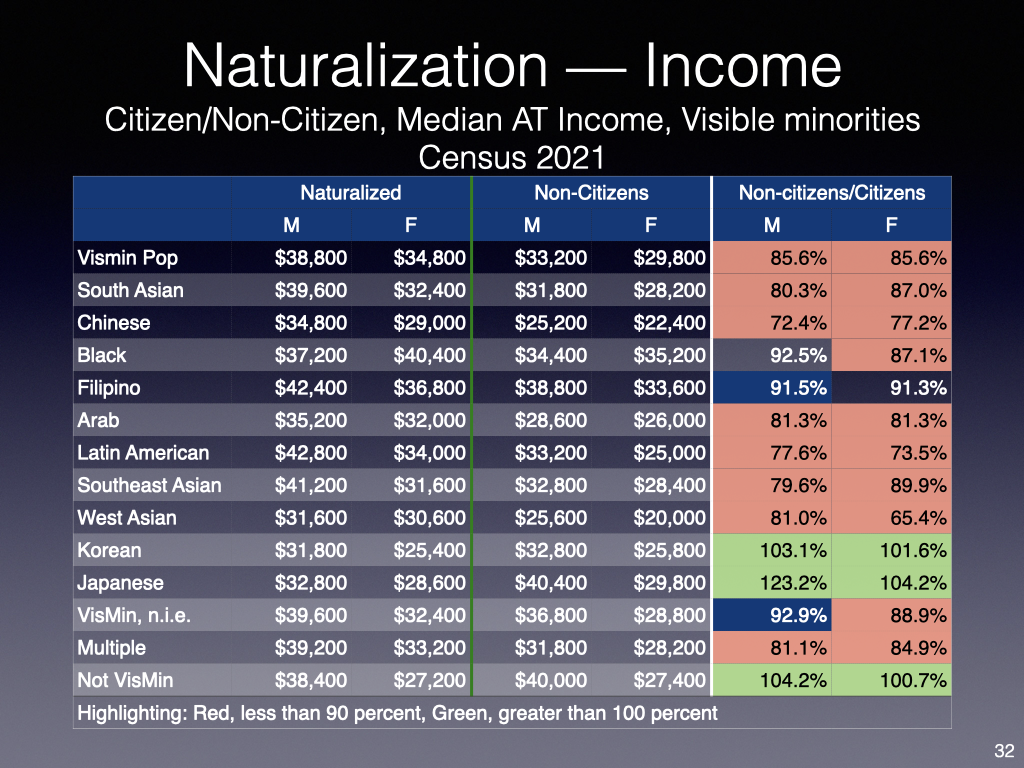
Would be helpful to have breakdowns by visible minority groups as they are significant (chart below compares citizens and non-citizens by visible minority group and not visible minority):

…To address these challenges, future research should adopt a problem-solving approach to address the root causes. Simultaneously, a comprehensive policy response is needed to tackle the systemic barriers in the labour market. 

Targeted solutions are needed to help racialized immigrant women. Strengthening credential recognition, for instance, can help employers assess transferable skills across countries. Implementing equitable hiring practices and workplace integration policies are also essential. 

Digital technology and artificial intelligence can also help eliminate bias in hiring and job matchingSettlement programsshould account for the intersecting identities of racialized immigrant women to provide tailored support.

Most importantly, it’s crucial to recognize that ensuring equitable access to meaningful employment is not only vital for advancing gender and racial equity, but also essential for unlocking Canada’s full economic potential.

Source: Canada’s labour market is failing racialized immigrant women, requiring an urgent policy response

Immigrants and visible minorities also have biases, national poll finds

No real surprise here, people are people, same pattern has existed even before my time at the multiculturalism program, many years ago under the Harper government:

Immigrants and visible minorities have negative views of other groups in Canada at similar, and sometimes higher, rates as the general Canadian population, a new survey has found.

The poll by Leger for the Association for Canadian Studies challenges the conventional view that prejudice in Canada follows a simple “majority vs. minority” pattern, revealing that negative sentiment is more widespread and complex. The survey, which was conducted ahead of the International Day for the Elimination of Racial Discrimination on March 21, suggests that prejudice exists across multiple demographic groups and varies by factors such as age, language and immigration status.

Jack Jedwab, president and CEO of the Association for Canadian Studies, says these results challenge how policy-makers and the public discuss discrimination.

“Too often, we assume that those who experience prejudice do not express it themselves, but the data show a more complicated reality,” he said. “If we truly want to address discrimination, we need to move beyond the idea that prejudice is always about a dominant majority versus a marginalized minority.”

The survey found that overall, Arab Canadians face the highest levels of negative sentiment, with 26 per cent of respondents reporting unfavourable views of them. Black Canadians were viewed the least negatively at 11 per cent, while 14 per cent expressed negative views of Jewish and Indigenous Canadians, and 15 per cent for Chinese Canadians.

The results also highlight that while racial and religious minorities continue to be the primary targets of prejudice, negative sentiment is not limited to one group expressing bias toward another. It is expressed across multiple ethnic and racial groups.

Twenty-two per cent of visible minorities and 20 per cent of immigrants held negative views of Jewish Canadians, compared to 11 per cent of “not visible minorities” and 12 per cent of non-immigrants.

Seventeen per cent of visible minorities and 15 per cent of immigrants expressed negative views of Indigenous people, compared to 14 per cent each for not visible minorities and non-immigrants.

For Black people, 19 per cent of visible minorities and 16 per cent of immigrants expressed negative views, compared to nine per cent of not visible minorities and 10 per cent of non-immigrants.

Chinese people were viewed negatively by 19 per cent each of visible minorities and immigrants, compared to 11 per cent of not visible minorities and 14 per cent of non-immigrants.

Arabs were the only group viewed similarly by the four categories. For immigrants and not visible minorities, 27 per cent had unfavourable views and it was one per cent lower for not immigrants and visible minorities.

Additionally, 26 per cent of South Asians held negative views of Arabs, while the same percentage of Arabs expressed negative views of South Asians.

Jedwab said these findings demonstrate that prejudice is not limited to one group targeting another, but rather exists in complex, intersecting ways across Canadian society.

“Social tensions are often framed as ‘them vs. us,’ assuming that people instinctively know who ‘them’ and ‘us’ refer to,” he said. “But the reality is much more complicated.”

The study also examined views on religion and found Islam is viewed significantly more negatively than Christianity and Judaism. Nearly half of respondents (49 per cent) reported a negative view of Islam, compared to 27 per cent for Christianity and 25 per cent for Judaism.

The study found a strong link between religious prejudice and ethnic bias.

A majority of Canadians who hold very negative views of Islam also hold negative views of Arab Canadians (62 per cent). The same is true for Jews. Of those who hold very negative views of the religion, 65 per cent have negative views of Jews.

Jedwab warned that if policymakers and institutions continue relying on outdated assumptions about prejudice, efforts to promote equity and inclusion may be ineffective.

“As we grow more diverse, our approach to inclusion must also evolve,” he said. “Otherwise, terms like ‘diversity’ and ‘equity’ risk becoming empty slogans rather than meaningful commitments to social progress.

The online Leger poll surveyed 1,539 Canadians on March 1 and 2. A margin of error cannot be calculated for an online poll, but a probability sample of this size would yield a margin of error plus or minus 2.5 per cent, 19 times out of 20.
Source: Immigrants and visible minorities also have biases, national poll finds

The winding tale of the Sugihara visas, that saved Jews from the Holocaust, led them to Japan and landed them in Canada 

Interesting. Impressive courage to refuse direction from superiors, not sure I would have had the courage to do so:

Akira Kitade was about to retire after a lifetime of service at Japan’s tourist bureau, when his boss took a scrapbook off the shelf in his home and showed it to him. In it were photographs of his boss as a young man on a boat bound for Japan with Jewish refugees during the Second World War.

The discovery of the scrapbook, which included seven passport photos of young people, with personal messages in French, Bulgarian, Norwegian and Polish inscribed on the back, set Mr. Kitade on a quest spanning decades to find out who they were.

This week in Ottawa, at an event hosted by Kanji Yamanouchi, Japan’s ambassador to Canada, Mr. Kitade told how the mystery had finally been solved in Canada. A Montreal photographer had recognized a photo of a beautiful young woman in the scrapbook, sparking a train of other discoveries.

In an interview, Mr. Kitade described how the passport photograph, signed Zosia, with a note scrawled in Polish – “To a wonderful Japanese man – please remember me” – had haunted him. Her expression seemed to embody the anguish of Jews persecuted by the Nazis, he said, and he was compelled to learn her story….

Source: The winding tale of the Sugihara visas, that saved Jews from the Holocaust, led them to Japan and landed them in Canada

McCauley and Wang: In this time of crisis, let’s make better use of Canadians abroad to build our future

Perennial call, but greater urgency.

But there may be limits.

For example, the authors argue that the number of expat Canadians who are engaged politically has increased dramatically (62 percent) without the absolute numbers which show only 56,000 registrations, 26,000 votes counted and 12,000 submitted late and thus not counted. Minimal numbers, and statistical malpractice to cite the percentage increase without actual numbers:

…Today, a growing number of Canadians overseas are engaged politically, as evidenced by the 62 per cent of registered overseas voters who cast ballots in the 2019 federal election, a significant increase over previous years. Many Canadians abroad remain keen to give back and contribute their ideas, expertise and networks to build our country’s future. For some, that means moving home and searching for meaningful ways to engage with our social and civic fabric. Those who remain abroad are left to find mechanisms to participate in and shape Canadian policies….

This is our call to action. To our leaders: develop a national strategy to engage Canadians abroad. To our businesses: tap into our global talent pool for nation-building at home. To Canadians living outside our borders: stay engaged, demand inclusion and bring your ideas and energy home when Canada needs them most. At a time of nation-building at home, we should recognize that our country’s future is also global – and it’s time we start acting like it.

Adam McCauley is a Canadian journalist and academic based in Ottawa. He writes about international relations, defence and security, and technology.

Steven Wang is a Canadian lawyer based in Toronto and an adjunct professor at the University of Toronto Faculty of Law and Harvard Law School.

Source: In this time of crisis, let’s make better use of Canadians abroad to build our future

Nicolas | Victoire antiwoke

A reminder but yes, there have been excesses:

…En toute transparence, un sentiment de colère m’habite alors que je parcours et reproduis ici ces mots. Une colère saine, que je travaille à exprimer sainement. C’était écrit dans le ciel que l’obsession pour les wokes et le wokisme manufacturés de toutes pièces par Fox News et les autres grands médias de la droite républicaine visait le rétrécissement des libertés d’expression, d’association et universitaire. Les campus ont été des lieux cruciaux dans les luttes pour les droits de la personne dans l’histoire américaine : s’attaquer à l’université, c’était autoriser un recul des droits, et vice versa.

Je trouve lourd qu’il soit même nécessaire de rappeler que le wokisme est la clé d’une guerre culturelle inventée par la droite républicaine pour servir ses intérêts, et que c’est à partir du combat contre le danger woke — renommé parfois EDI de manière à peu près interchangeable — qu’on assoie présentement cette attaque contre la raison, la science, le langage et des pans entiers de la population.

Certains auront de la difficulté à admettre qu’en alimentant ces chasses aux wokes, ils sont tombés dans un piège extrêmement grossier dont on voit maintenant le résultat. Je crois que, derrière cette colère, il y a surtout une tristesse, une forme de deuil. Une déception aussi.

Marginalisé. Marijuana. Minorités. Multiculturel. Noir. Non binaire. Obésité. Opioïdes. Oppression. Orientation. Polarisation. Politique. Pollution. Personne enceinte. Populations clés. Préférences sexuelles. Préjugés. Privilège. Promouvoir. Pronoms. Prostituées. Qualité environnementale.

Si j’établis l’obsession pour les wokes comme le début de la fin des haricots, c’est parce que je citais Hannah Arendt la semaine dernière, et je vais me répéter : « La mort de l’empathie humaine est l’un des premiers signes et des plus révélateurs d’une culture sur le point de sombrer dans la barbarie. »

Et que le mot « woke », à la base, ne signifie qu’une sensibilité pour la justice sociale et un engagement actif dans la lutte contre la discrimination et les inégalités.

En écrivant semaine après semaine de manière négative à partir de ce concept, des chroniqueurs ont contribué à associer le souci des personnes vulnérables au ridicule, voire au danger ou au mal. On a stigmatisé l’empathie — sans prévoir que ça allait finir par revenir au nez d’à peu près tout le monde. Parce qu’on a tous des éléments de vulnérabilité en nous, d’une manière ou d’une autre.

C’était ça, le piège.

Des personnalités médiatiques américaines, européennes, canadiennes et québécoises ont passé une partie de la dernière décennie à cibler des personnes, principalement des jeunes, qui exprimaient des préoccupations pour le bien commun à partir de profondes réserves d’empathie, déclenchant souvent à leur égard une pluie de messages haineux qui a contribué à les faire taire. Il y avait bien sûr parfois des maladresses dans la manière de s’exprimer, maladresses qui ont servi de justificatif à cette dureté. Mais le traitement médiatique a tellement été dur envers les jeunes empathiques qui s’exprimaient de manière parfois maladroite dans l’espace public qu’il n’y a pratiquement plus de jeunes empathiques qui osent s’exprimer dans l’espace public. Problème réglé, je suppose ?

Race. Racisme. Rougeole. Santé mentale. Science climatique. Ségrégation. Sexe. Sexualité. Socioculturel. Socio-économique. Sous-représentés. Sous-représentation. Sous-estimés. Stéréotypes. Sujets à enquête fédérale. Sujets qui ont récemment reçu l’attention du Congrès. Sujets qui ont reçu une grande attention médiatique.

Il y a quelque chose d’obscène dans le silence des gens qui ont fait leur pain et leur beurre avec la « liberté d’expression » et l’antiwokisme à Fox News ces dernières années, face à cette censure — cette vraie censure —, c’est-à-dire ce bannissement de mots par legouvernement de manière à limiter la distribution des ressources. Mais une fois la colère, la tristesse et la déception exprimées, je retrouve accès à mes instincts plus généreux, voire optimistes, sinon sereins, dans l’interprétation de ce silence. Je me dis — j’espère — que certains ont entamé une réflexion sur la machine infernale dans laquelle ils ont mis le doigt.

Systémique. Trans. Transgenre. Traumatisme. Traumatique. Vaccins. Victimes. Violence fondée sur le genre. Vulnérable.

Au fond, la seule question qui importe vraiment, c’est : qu’est-ce qu’on est en train d’apprendre de tout cela ?

Source: Chronique | Victoire antiwoke

USA: A new study quantifies how a #citizenship question would likely hurt census accuracy

Contrast with Canada where citizenship has been part of the census for many years. But in current US political context, understandable how this would affect response rates:

Adding a citizenship question to U.S. census forms — a change that many Republicans in Congress and President Trump have wanted — would likely undermine the accuracy of the country’s population counts, a new peer-reviewed study shows.

The findings, published last week in the Journal of Policy Analysis and Management, build on earlier research by the Census Bureau and quantify longstanding concerns among opponents of the question, who fear it could derail the once-a-decade tally of U.S. residents that’s used to redistribute political representation and federal funding to communities.

Census participation levels have long varied among different demographic groups. For example, in the 2020 census, those differences helped drive the overcounting of people who identify as white and not Hispanic and the undercounting of Latinos.

Source: A new study quantifies how a citizenship question would likely hurt census accuracy

HESA: EDI and the Measurement of Merit

Good primer on EDI/DEI considerations:

…Now it is not obvious (to me at least) that the overall results of such a system are any worse than the overall results of the current system. You gain a little bit of equity in one direction and (perhaps) lose it in another. But there are winners and losers when switching from one system to another and the losers tend to scream louder than the winners.

In an ideal world, of course, one would be able to measure everyone individually by distance travelled, without the use of proxies. That way, “elites” from disadvantaged groups would not be unduly rewarded, and financially disadvantaged whites’ underprivileged position would be recognized. There would still be screaming, of course—people who were in danger of losing their position of privilege would still claim that a context-free, single-point-in-time definition of merit is “better” and “more objective” than a context-dependent one (this is more or less the position taken by the Students for Fair Admissions in the Harvard admissions case decided by the US Supreme Court in 2023). But it would have fewer drawbacks than other schemes which measure disadvantage via proxies.

Why don’t we do that? Well, I would argue it is for two reasons. The first is simply that using proxies to measure disadvantage is a whole heck of a lot cheaper than measuring it at an individual level. With proxies, you can reduce disadvantage to a set of categories that can be indicated by a tick in a box, something that reduces complexity and obviates the need to treat each case individually.

But the second and probably more important reason is that distance travelled is not an entirely straightforward and measurable proposition. It is by no means impossible to create methodologies to look for it: the Loran Scholarships and McGill’s McCall-MacBain scholarships both train assessors to look for precisely this (which is a very good reason why the former is so good at picking future Rhodes Scholars). But the problem is that there is no hard-and-fast algorithm here. You have to put selectors in a position where they can exercise judgment. And frankly, in an increasingly low-trust society, that’s hard to do (Phillip K. Howard’s Everyday Freedom: Designing the Framework for a Flourishing Society is very good on the unfree consequences of depriving administrators of the ability to exercise judgement).

And so here’s the thing: if you don’t want to measure disadvantage individually because you are too cheap to do so, and/or you can’t allow people freedom of judgement in assessing disadvantage for the purpose of measuring distance travelled, then what you’re left with as options are measurement by proxy, or settling for a definition of merit that unabashedly favours the members of the lucky sperm club. There is not really a fourth option.

Source: EDI and the Measurement of Merit