Black Canadians more likely to be hesitant about COVID-19 vaccines, survey suggests

Not just governments but governments do have a role in reducing economic barriers to vaccination (paid time off work etc). Access has become less of an issue given pop-up and other clinics, compared to earlier periods when it was more significant:

Black Canadian leaders say governments must do more to help overcome vaccine hesitancy in their communities.

Toronto orthopedic surgeon Dr. Ato Sekyi-Otu, leader of the health-care task force of the Black Opportunity Fund, says a new survey confirms unpublished public health data that hesitancy is higher among Black Canadians than among white or non-Black racialized people.

“There’s a 20-point gap with respect to the rate of vaccination in Black Canadians compared to the Canadian average,” Sekyi-Otu said in an interview. “When you look at vaccine confidence, unvaccinated Black Canadians are least likely to say that they’ll definitely get the vaccine.”

Sekyi-Otu said the Black Opportunity Fund partnered with the African Canadian Civic Engagement Council and the Innovative Research Group to try to understand why Black Canadians appeared to be getting vaccinated in lower numbers.

The survey found that as of early June, when more than 60 per cent of Canadians had received at least one dose of the COVID-19 vaccine, 45 per cent of Black Canadians surveyed said they were at least partially vaccinated, compared with 65 per cent of white Canadians and 43 per cent of non-Black visible minorities.

Sixty per cent of Black Canadians surveyed who didn’t have at least one dose expressed some level of hesitancy to get vaccinated, compared with 55 per cent of white Canadians and 44 per cent of non-Black visible minorities.

The figures are in line with vaccination data in Toronto, where the neighbourhoods with the lowest vaccination rates also have some of the largest Black populations.

Dunia Nur, president of the African Canadian Civic Engagement Counsel based in Edmonton, said addressing hesitancy in Black communities will require “a variety of policy shifts” from government that take into consideration language needs, as well as differences in education and socio-economic disparities.

“These include investing in strategies that work with Black-led and Black-focused community organizations to address COVID-19 vaccine knowledge gaps and related trust barriers,” Nur said in a statement.

Black Canadians responding to the survey were less likely to be hesitant about vaccines if they trusted their health-care providers and the vaccine makers, could take paid time off work to get vaccinated, and were confident in where and how to go about getting a shot.

“When we talk about hesitancy, we speak about the ABCs,” said Sekyi-Otu. “I’m talking about access, belief and confidence.”

He said access is affected when Black Canadians are more likely to work in jobs where taking paid time away to be vaccinated is difficult or impossible. Belief in the vaccines can be eroded if you don’t trust the people providing the information about them, and confidence that the vaccines work is harmed when people who are already less trusting of the health-care system get mixed messages about vaccine safety and effectiveness.

“It’s not surprising that if someone has a bad experience with one institution, for example, criminal justice, when he or she is 19 years old, he or she may not want to take the vaccine in 2021 when he or she is 45 years old,” he said.

Sekyi-Oto says governments need to ensure that people can take time off work to be vaccinated and take immediate steps to provide culturally sensitive and appropriate delivery and education about vaccines in Black communities.

“You have to build a system where the people who are leading the system look like the people using the system,” he said. “And so we want to create a culturally sensitive system, engage with the community so that they can come up and take the vaccine.”

The survey is being released as the Public Health Agency of Canada reports new data showing COVID-19 death rates in the first eight months of the pandemic were highest in communities with lower incomes and higher visible minority populations.

The data is the latest report from the agency that outlines the inequities surrounding COVID-19 in Canada.

Source: Black Canadians more likely to be hesitant about COVID-19 vaccines, survey suggests
Education minister under fire after introduction deleted from Ontario’s new Grade 9 math curriculum

Appears that the substantive aspects related to systemic barriers and inclusion remain while the ideologic reference to “non-Eurocentric mathematical knowledges” has been dropped. Much of math has non-European roots (numerals, algebra etc):

Premier Doug Ford’s government has deleted a preamble to Ontario’s new Grade 9 curriculum that said math “has been used to normalize racism and marginalization of non-Eurocentric mathematical knowledges.”

While the updated syllabus remains unchanged, introductory language for teachers was quietly edited earlier this week.

The modernized curriculum was introduced June 9 as the first step of ending the streaming of students so early in high school. That practice that has been tied to poor outcomes for Black and Indigenous youth.

As first reported by the Toronto Sun on Saturday, the Progressive Conservatives initially approved of a curriculum introduction that said “a decolonial, anti-racist approach to mathematics education makes visible its historical roots and social constructions.”

“Mathematics is often positioned as an objective and pure discipline,” said the preamble to the curriculum, which was made public last month.

“The Ontario Grade 9 mathematics curriculum emphasizes the need to recognize and challenge systems of power and privilege, both inside and outside the classroom, in order to eliminate systemic barriers and to serve students belonging to groups that have been historically disadvantaged and underserved in mathematics education.”

But within the past few days, that entire 124-word paragraph entitled “An equitable mathematics curriculum recognizes that mathematics can be subjective” was deleted.

Sources told the Star that “while the section referenced is not in the core curriculum taught to students, we revised it to ensure there is no confusion when it comes to making sure our students are being taught fundamental math concepts.”

“The curriculum did not change. It continues to educate on cultural understandings of math, of the history of these concepts, and attempts to advance that lens throughout the curriculum. What changed was language in the preamble only,” an official said.

In a statement Wednesday, Education Minister Stephen Lecce’s office said the Tories “ended streaming in the Grade 9 math curriculum — a system that disproportionately affected Black, racialized and Indigenous students — along with launching new and specialized supports to ensure these students graduate, enter post-secondary education and get good-paying jobs.”

But the new president of the Ontario Secondary School Teachers’ Federation, which supports destreaming, said the education minister “needs to take responsibility” for the episode.

“It’s time for a mea culpa. If you make a mistake, you have to own up to it,” said Karen Littlewood, who took over the union’s presidency on June 22.

Littlewood said “it seems to be very reactionary” for Lecce to amend the language in the wake of media coverage.

“The preamble really sets the stage for the changes to the curriculum and why it was necessary,” she said.

Despite the editing, the lesson plan still addresses inequities in society.

The revised curriculum emphasizes “there are groups of students (for example, Indigenous students, Black students, students experiencing homelessness, students living in poverty, students with LGBTQ+ identities, and students with special education needs and disabilities) who continue to experience systemic barriers to accessing high-level instruction in and support with learning mathematics.”

“Systemic barriers, such as racism, implicit bias and other forms of discrimination, can result in inequitable academic and life outcomes, such as low confidence in one’s ability to learn mathematics, reduced rates of credit completion, and leaving the secondary school system prior to earning a diploma,” it states.

“Achieving equitable outcomes in mathematics for all students requires educators to be aware of and identify these barriers, as well as the ways in which they can overlap and intersect, which can compound their effect on student well-being, student success, and students’ experiences in the classroom and in the school,” it continues.

“Educators must not only know about these barriers, they must work actively and with urgency to address and remove them.”

Still, the New Democrats expressed concern about the deletion.

“The Grade 9 math program was changed specifically because Ontario had to finally recognize that the existing system treated Black, Indigenous and racialized students inequitably,” NDP MPPs Laura Mae Lindo (Kitchener Centre) and Marit Stiles (Davenport) said in a joint statement.

“It’s pretty clear we need more of an equity and anti-racism lens in schools, not less.”

Source: Education minister under fire after introduction deleted from Ontario’s new Grade 9 math curriculum

For the first time in decades, major changes are coming to Canada’s workplace equity laws

Of note as would also apply to federal public service (where TBS is lead). Hopefully the focus will be on the substantive issues, not just the terminology:

Federal legislation that aims to ensure equal opportunities for employees from under-represented groups is heading for its most significant overhaul since its introduction 35 years ago.

The Liberal government announced today that it has convened a new task force to review the Employment Equity Act, which the government describes as “an important tool to promote fairness, equality and diversity in federally regulated workplaces.”

The legislation states that no person should be denied employment opportunities for reasons unrelated to ability. It says that creating those conditions “requires special measures and the accommodation of differences.”

Labour Minister Filomena Tassi said the legislation has improved the standing of various groups that have been marginalized in the workplace, but that the act was overdue for an update.

“It’s about bringing the act into the 21st century,” Tassi said.

Future changes to the legislation, she added, “are absolutely going to result in more equitable workplaces.”

The 13-member task force conducting the review is being asked to come up with recommendations to “modernize” the legislation. The task force will host its first meeting on July 15 and is expected to have a final report by early 2022.

About 1.3 million people, representing about six per cent of Canada’s workforce, are employed in federally regulated industries and workplaces.

Review could result in more precise categories of marginalized workers

The existing Employment Equity Act identifies four groups that have faced additional barriers in workplaces: women, Indigenous Peoples, people with disabilities and members of visible minorities.

Those categories were defined when the act was introduced in 1986. The legislation was largely inspired by the 1984 Royal Commission on Equality in Employment, which was led by Rosalie Abella before she was appointed to the Supreme Court.

Among other things, the task force will be charged with reviewing those groups, which likely will result in the creation of more precise and varied categories of under-represented workers.

Adelle Blackett, a law professor at McGill University who was named chair of the task force, said LGBTQ people, for example, probably will need representation in the next iteration of the act.

“The time is now,” Blackett told CBC News. “We have a really important opportunity to achieve equality.”

Blackett said the national reckoning over the atrocities committed in Canada’s residential school system, and the murder of George Floyd in the United States, are driving the effort to address systemic inequalites.

“It’s hard not to be thinking about how to build a legacy of meaningful inclusion, including in our workplaces,” Blackett said.

According to the latest report on equity within federally regulated workplaces, women, Indigenous Peoples and people with disabilities remain underrepresented in federally regulated workplaces.

Representation of visible minorities is more favourable, with those workers filling slightly more jobs than expected based on their overall share of the workforce.

Unifor says existing act has ‘failed to deliver’

The launch of the review task force comes following recent efforts by the Liberal government to reduce inequities across a range of sectors — including new pay equity legislation that will go into effect at the end of August.

Critics, including the federal New Democrats, have described some of the announcements as pre-election manoeuvring.

NDP critic for women and gender equality Lindsay Mathyssen said last week’s news on pay equity follows the Liberal’s recent track record of providing “pretty words instead of substantive actions.”

Unifor, the largest union representing workers in the federally regulated private sector, said changes to the act are badly needed.

“Despite being in force for 35 years, the Employment Equity Act has failed to deliver on its promise,” Unifor national president Jerry Dias wrote on Twitter. He called on the federal government to ensure that input from workers is considered during the review.

“Updating terms, expanding inclusion and prioritizing enforcement will go a long way,” Dias added.

Source: For the first time in decades, major changes are coming to Canada’s workplace equity laws

Candidate diversity is high on the agenda as Canada’s political parties prepare for a federal election

Of note, pending a more complete analysis:

During what’s widely expected to be an election year, Canadians have been confronted with the realities of discrimination, racism and reconciliation as never before.

That’s something major federal parties are thinking about as they craft their slates of candidates, who, if elected, will need to represent the interests of a diverse electorate.

The Liberals, Conservatives, New Democrats and Greens have all made efforts to connect with under-represented communities, mostly through updated recruiting requirements and fundraising initiatives.

But they’re less forthcoming about the specific targets they’re hoping to hit, such as what proportion of racialized or LGBTQ+ candidates would indicate a successful and representative nomination process.

Women, for example, make up just over half of Canada’s population, but it took until 2020 for just 100 of its 338 MPs to come from that group. Millennials are one of the largest populations in Canada, yet most federally elected officials are much older. And visible minorities, Indigenous people, the LGBTQ+ community and disabled Canadians are all under-represented in the House of Commons.

“Parties are largely vote seeking, organizational machines,” said Erin Tolley, Canada Research Chair in Gender, Race and Inclusive Politics at Carleton University.

“So if a party is looking out into the public landscape and sees that issues related to equity or to diversity or to representativeness are something that the public is hungering for … parties will respond to that in a way that is consistent with their ideological vision.”

Here’s how four major federal parties are looking at tackling the balance this time around. (The Bloc Québécois did not reply to requests for comment.)

The Liberals

As of Tuesday, the Liberals had nominated 191 candidates, with more announcements expected throughout the week. Women make up 43 per cent of that total, with racialized Canadians accounting for more than 20 per cent of those nominated. Seven candidates are Indigenous.

Navdeep Bains, who is chairing the Liberals’ national campaign along with Economic Development Minister Mélanie Joly, has been tasked with seeking out candidates for the governing party.

One of the changes the party has made is to widen requirements within its nomination process. Previously, local riding associations needed to prove they had sought out female candidates. Now, associations must show how they’ve attempted to bring anyone from an equity-seeking group into the fold.

“You’ve got to document, and really have to engage and have a thorough search for potential candidates,” Bains said. “We’re talking about women, Black and Indigenous (candidates), people of colour, the LGBTQ community, people with disabilities.”

The party is also dipping into two pre-existing funds to assist with that work. One is the Judy LaMarsh Fund, which supports female candidates running for the federal Liberals. The other is the Indigenous Electoral Endowment Fund, which is intended to help recruit and support Indigenous candidates.

The Conservatives

The Conservatives had nominated 240 candidates as of Monday. The party did not provide a breakdown of the groups to which those candidates belong because it’s still compiling that information, but party spokesperson Cory Hann identified several as Muslim.

Hann said party supporters and staff have been asked to “work their networks and encourage people from all backgrounds to get involved” as either candidates or campaigners.

“The candidates we’ve nominated so far all have varying backgrounds both professionally and personally, ensuring that, as (Conservative Leader Erin) O’Toole has said, Canadians from all over the country see themselves in our Conservative party.”

Where representation is concerned, the party appears to be focusing most on building bridges with racialized and Indigenous communities, although the party is tight-lipped on the specifics of those plans.

Conservative MP Garnett Genuis has been leading engagement efforts with “cultural and religious minority communities,” telling the Star he is “excited about the potential that we have for growth in that area in the upcoming campaign.”

Genius would not expand on which communities he was specifically courting, or how those efforts look in practice, citing the Tories’ “inside strategy.”

The NDP

In 2019, the New Democrats led the charge when it came to candidate diversity, hovering near the gender parity benchmark and reaching or surpassing representative levels for Indigenous, racialized and LGBTQ+ groups.

For the next election, the party is trying to ensure more than 50 per cent of its candidates are women — the only specific target cited by any federal party for any equity-seeking group.

The party has nominated 97 candidates so far, half of whom are women. Racialized Canadians make up 33 per cent of that total, while six per cent are Indigenous and 18 per cent are LGBTQ+. People living with a disability account for 12 per cent of nominated candidates, and 11 per cent have been identified as “youth.”

As with the Liberals, riding associations must demonstrate how they’ve sought to recruit diverse candidates. The party is also now requiring that any outgoing incumbent is replaced with someone from an equity-seeking group. Departing MP Jack Harris, for example, will be succeeded by one such candidate.

“This is a huge priority for us. It’s part of our DNA,” NDP national director Anne McGrath told the Star.

McGrath said that because the party has more resources heading into the next election than it did in 2019, more emphasis is being placed on recruitment.

The Green party

There may be no party for which running a diverse roster of candidates is more important than the federal Greens.

While Annamie Paul is the first Black and Jewish woman to lead a major federal party, she is currently embattled within a party structure that insiders charge is perpetuating racism and sexism.

What’s more, a confidential report prepared for the Greens and obtained by the Star found the party fell short of recruiting and supporting diverse candidates in the last general election. In 2019, the party ran fewer visible minority candidates than the far-right People’s Party, according to a report by The Canadian Press.

That’s something Paul is committed to changing, despite opposition she says she’s faced from some party officials.

“There’s a tremendous amount of power in making the invitation. Just making an open invitation to say we see you, we value you, we want you,” Paul told the Star.

As of Monday, 148 applicants had been approved through the drive and other recruitment streams, though only 39 have been formally nominated. Of the approved applicants, 41 per cent are women, followed by racialized Canadians at 19 per cent and youth under 30 at 15 per cent. Six per cent of approved applicants are Indigenous, while 17 per cent belong to the LGBTQ+ community and 12 per cent are persons with disabilities.

Source: Candidate diversity is high on the agenda as Canada’s political parties prepare for a federal election

Is American Economic Freedom Determined by Ancestry, Ethnicity, and Immigrant Countries of Origin?

Interesting study and methodology by Cato Institute that counters some of the populist and academic rhetoric:

The best potential counter argument against vastly expanding legal immigration is that immigrants might bring the less-efficient economic institutions, political systems, or cultural mores of their homelands with them to the United States. Ultimately, the United States and other rich countries are prosperous because of our economic and political institutions with some variation potentially explained by culture.

Most immigrants come from poorer countries with worse economic institutions, especially as measured by the Economic Freedom of the World Index. My co-author Benjamin Powell and I investigated whether immigrants worsened domestic economic institutions in our new book Wretched Refuse? The Political Economy of Immigration and Institutions, and we found it either to be unsupported by the evidence or that the evidence suggests that more immigration can sometimes increase economic freedom and improve institutions. There’s not much worry that immigrants would kill the institutional goose that the lays golden eggs of economic growth.

Some supporters of the so-called deep roots hypothesis, that events many thousands of years ago affected culture, genes, or both in such a way that our economic outcomes were basically determined long ago, are also worried that immigrants could undermine our institutions. Proponents of this view argue that it’s impossible for immigrants to not bring support for the bad economic institutions of their ancestral homelands with them. Although economic institutions have changed substantially over time, even recently in some countries, and the deep roots theory can’t explain why economic institutions change, it’s still a thoughtful counter argument.

To test whether there is support for it, we created a predicted economic freedom index for a hypothetical United States whose economic freedom is entirely a product of the economic freedom of the countries where immigrants and their ancestors came from. In other words, a native-born American of Irish descent and a native-born American of Italian descent would each support economic freedom in the United States to the extent that economic freedom exists in Ireland and Italy, respectively. For example, if half of a country’s population were of Irish ancestry and half were of Italian ancestry then the predicted economic freedom score of that country would be 7.82 ((8.13+7.51)/2) under this theory. Thus, we created an average weight of the U.S. population by ancestry, attributed the economic freedom scores of those countries to those Americans, and then took the weighted average of economic freedom for the United States in 1980 and 2019. The former date was the first year that the U.S. Census asked about ancestry.

We obtained ancestry data from the American Community Survey (ACS). We used the Economic Freedom of the World (EFW) index to gather data on the economic freedom of the United States and other countries over time. The EFW estimates a country’s economic freedom by looking at five variables: size of government, legal system and property rights, sound money, freedom to trade internationally, and regulation.

The ACS data is reported using either demonyms, broader regional terms, or ethnic terms. As a result, we had to interpret some proportionally. For example, if an ACS respondent said that he was “Eastern European,” we calculated his inherent EFW score as coming from all Eastern European countries proportionally. Similarly, we combined some terms together. For example, both English and Scottish were combined into British. We then applied the EFW score for the United Kingdom to them, since EFW is reported by country. The biggest challenge was apportioning the ancestry of Black Americans who are the descendants of slaves. We know the general area where they came from but not the specific countries. Thus, we followed the general methods here for allocating black American ancestry. The different allocations made in this study are listed in Table 1.

In order to perform later calculations, we needed to determine which countries were relevant to the study. To be relevant, ACS and EFW data needed to both be available in each year. Some countries did not qualify, but their exclusions did not impact the final result as they were generally smaller countries with few historical immigrants to the United States. All demonyms and ethnic terms were interpreted by their national association to match the ACS and EFW data, but this was straight-forward.

To predict the ancestry-only EFW score for the United States, we multiplied the proportion of the population of ancestry by the EFW score in that country for that year. We then simply added up the results.

If ancestry alone determined the United States’ EFW score, it would have had a score of 6.32 in 1980 and 7.46 for 2019. In reality, the United States’ EFW was 8.13 in 1980 and 8.22 for 2019 – 1.8 and 0.76 points higher than what the ancestry-only score would predict. The economic freedom of the United States is substantially higher than its ancestry adjusted EFW score would predict if the deep roots theory were correct. For example, if American ancestry determined our EFW score then we should have the economic freedom score of Hungary in 2019 (7.44) rather than the much higher actual score of 8.22.

Interestingly, the average EFW score of the ancestral homelands of Americans and immigrants has increased considerably over time from 6.32 to 7.45. If deep roots really did drive our economic destiny by affecting economic freedom, we should be much less concerned today than in the recent past, as the ancestral homelands of immigrant groups are much freer today than in the past.

Ancestry and country of origin are not destiny, at least not in the United States in these two years.

Source: Is American Economic Freedom Determined by Ancestry, Ethnicity, and Immigrant Countries of Origin?

USA: Immigrants Healthier Than Native-Born, But Advantage Fades

Likely similar in Canada although medicare and a more generous social safety net likely attenuates the effect. One of the negative aspects of integration:
Immigrants to the U.S. are healthier and have better health outcomes on average than native-born Americans, according to a new study in the journal Health Affairs.But the longer that immigrants live in the U.S., the more their health profiles resemble those of the native-born.

These findings are among a wealth of details about immigrants’ self-reported health and access to health care included the study. The researchers analyzed data from two large surveys, one national and the other focused only on California. The latter survey was used because it included data on undocumented immigrants that was lacking in the national poll.

Four groups of adult immigrants were compared to native-born adults: naturalized citizens, noncitizen immigrants in the U.S. for more than 5 years, noncitizen immigrants here for 5 years or less, and undocumented immigrants.

Self-reported health status among naturalized immigrants — who, by definition, must be in the country for at least 5 years — was similar to that of citizens born in the U.S., the study found. “In contrast, a higher share of noncitizen immigrants who had been in the U.S. for more than 5 years (30.1%) and who had been in the U.S. for 5 years or less (41.6%) had ‘excellent’ health compared with U.S.-born adults (27.1%).”

Both naturalized and noncitizen immigrants had lower rates of high blood pressure, heart disease, arthritis, asthma, and mental conditions, compared with U.S.-born adults. But naturalized citizens were more likely than the native-born to have type 2 diabetes.

The story was different for undocumented people. In the California survey, twice as many undocumented immigrants (33%) reported being in fair or poor health than native-born citizens (16.5%), and only 29.3% of the undocumented said they were in very good or excellent health, compared to 54.2% of native-born Californians.

In the national survey, the noncitizen adult immigrants were considerably younger, on average, than the U.S.-born adults, which partially explains their better health status. In addition, the study notes, “Chronic conditions are likely to be underdiagnosed among underserved immigrants because of poor access to health care.”

Arturo Vargas Bustamante, PhD, a professor of health policy and management, at UCLA’s Fielding School of Public Health, and the paper’s lead author, told WebMD that a third reason for the disparity between the health status of immigrant and native- born populations is the “healthy immigrant effect.” What this means is that people who choose to face the rigors and challenges of emigrating to a foreign nation tend to be stronger, physically and mentally, than other people from their home country.

Why Health Problems Increase

The biggest reason for the narrowing of differences in health status between immigrants and native-born Americans over time, Bustamante explains, is the aging of immigrants, which is linked to the same kinds of health problems that people born in this country have as they enter middle age.

In addition, he says, exposure to the U.S. lifestyle can harm immigrants’ health. “In their native countries, they might have walked to work or used public transport; here, they drive a car,” he notes. “They get hungry at night and start eating fast food, because it’s convenient. So the process of integrating into the U.S. society also comes with the process of assuming the American lifestyle and behavior.”

Finally, he observes, many immigrants live in low-income areas where there are food deserts, environmental hazards, and poor access to health care. “The longer they live in this country, the more exposed they are to these social determinants of health,” he says.

Higher Uninsured Rate

Compared with 11.4% of U.S.-born adults who lacked health insurance, uninsured rates were 12.3% among naturalized immigrants, 43% among noncitizen immigrants in the U.S. for more than 5 years, and 36.4% among noncitizen immigrants in this country for 5 or fewer years.

Although the Affordable Care Act made more legally authorized immigrants eligible for health care and allowed more of them to have insurance coverage, it left out undocumented immigrants. Unsurprisingly, 45% of undocumented people in the California survey were uninsured.

More noncitizen immigrants who had been in the U.S. for at least 5 years (12.3%) were covered by Medicaid than noncitizen immigrants who had been here for a shorter time (7.5%) or U.S. born adults (9%). Private insurance was the main source of coverage across all immigrant groups, except for the undocumented in California, who were more likely to have public coverage.

Fewer Doctor and ER Visits

Uninsured immigrants, naturally, had less access to health care than the insured did. While 71% of U.S.-born adults reported having made a visit to a doctor, only 50.5% of noncitizen immigrants who had been in the U.S. for over 5 years and 44.2% of those in this country for 5 years or less had seen a doctor.

In addition, naturalized immigrants and both groups of noncitizen immigrants were less likely than native-born citizens to use an emergency room.The underuse of health care cannot be explained purely by the high percentage of immigrants who lack insurance, Bustamante says. Even if immigrants have insurance, they may not seek help from a doctor because they may not get paid for the time taken off from work. In addition, they may be unfamiliar with how the U.S. health care system works. If they don’t speak English, they may not even be able to make an appointment.

Aging Population

Partly due to restrictions on immigration, the immigrant population in the U.S. is aging and therefore subject to worsening health, the study notes. While only a small portion of immigrants are over 65 today, “the process of immigrant aging is going to go really fast if the population of immigrants isn’t replaced by continued flows of new immigrants,” says Bustamante.

The U.S. health care system is poorly prepared to take care of aging immigrants, according to the study. In most states, legally authorized immigrants are subject to a 5-year waiting period before they become eligible for Medicaid, and undocumented immigrants are ineligible for Medicaid and Medicare. “Aging documented immigrants may even find it challenging to qualify for Medicare because they need to account for at least 10 years of Social Security earnings to be eligible,” the study says.

Three of the states with the largest immigrant populations — Texas, Florida, and Georgia — severely restrict Medicaid coverage for immigrants, Bustamante says. In contrast, California, Illinois, and New York, which are also home to many immigrants, offer generous Medicaid coverage. In Illinois and California, there are proposals to cover some undocumented people.
What will happen to aging, uninsured immigrants when they get sick?

“That’s a big question,” says Bustamante. “A lot of the care will fall on their families, which are not necessarily high-income families. In some families, the younger people are citizens who will be called on to take care of their grandparents. This could limit the social mobility of U.S.-born family members.”

Source: Immigrants Healthier Than Native-Born, But Advantage Fades

Huq: The Conservative Case Against Banning Critical Race Theory

Good questioning conservative “snowflake” discomfort:

By the end of June, 29 Republican-led state legislatures had considered and nine had enacted laws to penalize schools or teachers teaching critical race theory(CRT). Whether or not such laws would stifle anything taught in public schools today is uncertain because existing legislative control over curricula is already extensive. But the war against CRT is spilling into new arenas: Florida’s anti-CRT law forces colleges to survey how “competing ideas and perspectives” are presented, threatening funding cuts if a university is “indoctrinating.”

A paradox lies at this largely conservative campaign against CRT. If you slice through the rhetoric, it rests on a view of free speech that the political right, until now, stridently and correctly rejected: That speech can and should be curtailed because it makes some people feel uncomfortable or threatened. As a result, perhaps the most powerful argument against CRT’s critics is located on the political right, particularly in a recent opinion by Justice Samuel Alito, one of the most conservative members of the Supreme Court.
[time-brightcove not-tgx=”true”]

Consider first how varied and inconsistent the portrayals of CRT on offer are. The Republic Study Committee defines CRT as a belief in “racial essentialism.” In contrast, Ellie Krasne of the Heritage Foundation postulates that CRT is “rooted in Marxism,” and so defines race as “a social construct, enforced by those in power (white men).” Similarly, the Manhattan Institute’s Christopher Rufo talks of CRT as “identity-based Marxism.” He detects it whenever terms such as “social justice” and “diversity and inclusion” are used, and so sees it “permeat[ing] the collective intelligence and decision-making process of American government” in advance of a socialist uprising.

Turn to the newly-minted laws, and one finds yet other, quite different depictions. Florida’s, for example, defines it as any “theory that racism is not merely the product of prejudice.” Idaho’s characterizes CRT as teaching that treats people as “inherently responsible for actions committed in the past by other members of the same … race.”

These definitions of CRT can’t be reconciled. None offer clear guiderails to what precisely it means to ban CRT—No more talk of race as an identity? No discussion of laws or institutions that create racial stratification? Taken literally, some of the definitions also extend absurdly far. Florida’s could prohibit Nobel Prize-winning University of Chicago economist Gary Becker’s work on discrimination, because Becker identifies market concentration and education (not “merely” prejudice) as causal predicates of discrimination.

Perhaps it’s a mistake to look for a stable definition of CRT threading together the case against it. For at the core of the case against CRT is instead the simple idea that people shouldn’t be made to feel uncomfortable about their advantages or others’ disadvantages. This is a version of the “belief in a just world” that psychologists long ago identified. But here it has a partisan edge: it is about appealing to people—especially those in “swing districts” targeted by Republicans in 2022—who feel unease in their present relative advantage, but find it costly to dissect such discomfort.

Both the Idaho and the Florida laws target suggestions that someone should be responsible for disadvantages now faced by Blacks and other minorities, beyond a narrowly defined coterie of ‘bad’ discriminators. Similarly, Krasne centrally objects to being made to feel that she is “an enemy of all that is good.” Rufo complains in a similar vein about people having to write “letters of apology”—since whites have nothing to feel culpable about. As one (white) letter writer to the Laconia Daily Sunplaintively said, the problem with CRT is that it surfaces the possibility of “systems and rules that work in my favor, benefiting me every day, month and year, that are not available to anyone else in America.” Indeed.

The case against CRT, in short, is not about a fixed set of ideas. It is about wanting to avoid certain feelings of discomfort or even shame. But the right has encountered this idea before—and seemed not to like it. Until recently, commentators on the political right have claimed that universities are captured by “leftist” students who “don’t think much” about free speech, or who “don’t want to be bothered anymore by ideas that offend them.” A “jargon of safety” in universities, complained commentator Megan McCardle, is then used to “silence” those who don’t agree.

Conservatives disparage arguments made by “snowflake” college students. But the case against CRT is made of the same stuff. As such, it is subject to the same response. Hence, in a recent opinion concerning off-campus student speech, Justice Alito explained why a student’s crude rant about being excluded from a cheerleading squad could not be punished in simple terms: “Speech cannot be suppressed just because it expresses thoughts or sentiments that others find upsetting.” This is indeed the law: The Supreme Court has not allowed the state to prohibit or punish speech because it riles up an audience since 1951.

The idea that audience discomfort provides a justification for censorship, that is, is at profound odds with our free speech tradition. The case against CRT shows why: Because it turns on how an audience feels, this argument for speech bans has an indefinite, elastic quality, one that accommodates an endlessly voracious appetite for censoriousness. One of the lessons of the CRT debate, indeed, is that offense can and is taken at indubitably true facts. In many educational contexts, this would mean that either side of a hot-button issue would have the right to shut the other down.

Ironically then, if there is a lesson to be learned from the war on CRT, it has nothing to do with how to talk about race—and everything with how the Trumpian revolution continues to devour the principles of American conservatism.

Source: The Conservative Case Against Banning Critical Race Theory

USA: There Are 11,073 Muslims In Federal Prisons But Just 13 Chaplains To Minister To Them

The previous conservative government largely cancelled the chaplain program with respect to non-Christian chaplains in 2012 (Non-Christian prison chaplains chopped by Ottawa). Not sure what the current situation is:

Abdul Muhaymin al-Salim converted to Islam during his incarceration on drug charges at a federal prison in South Carolina from 2004 to 2014. In his first year there, the 49-year-old remembers a Muslim volunteer coming to the prison a couple of times a month to lead religious services.

Then, in the second year, during Ramadan, a holy month for Muslims, the volunteer was no longer allowed in the prison. Al-Salim never found out why.

“There were instances where we could have been denied or not received the proper representation or resources that we needed,” he said.

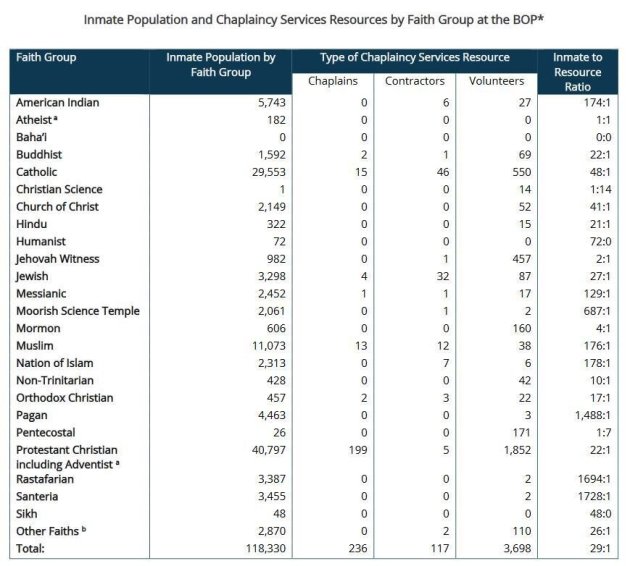
Muslims, the third-largest faith group in federal prisons, are significantly underrepresented among the chaplaincy, according to a Department of Justice inspector general report released last week. Currently, 6% of federal prison chaplains are Muslim, while 9.4% of inmates identified as Muslim.

As of March 2020, 199 of the 236 federal prison chaplains, or 84%, were Protestant Christian, even though that faith group makes up only 34% of inmates. There were no more than 13 Muslim chaplains in the past six years working at federal prisons — and that number remains today, even though the number of Muslim inmates has grown during that time, to 11,073.

Table showing federal inmates by religion

The challenges in recruiting Muslim chaplains have persisted within the Federal Bureau of Prisons for years, the report says. In response to a 2004 inspector general report that highlighted a significant shortage in Muslim chaplains, the bureau said it tried to attract a greater number through an on-site program that allowed prison employees to acquire the necessary skills to become a chaplain. But those efforts were unsuccessful, resulting in only one Muslim chaplain trained since 2006. And the number of Muslim inmates has more than doubled since then.

“Oftentimes, this will have a negative effect because you’re left to the whims of whoever is in charge of the chaplain’s department,” said al-Salim, who now works at the Tayba Foundation, where he mentors incarcerated Muslims. “There’s nobody there to help them gain that grounding that they need.”

The needs of the federal prisons’ Muslim population are underserved without chaplains, Muslim leaders say. Because most religious services have to be led by a chaplain, not having Muslim clergy means the services get canceled. When Muslim chaplains are employed, they also make sure Muslim inmates have access to books, prayer rugs and halal meals and that they can freely practice their faith.

Why prospective prison chaplains have been discouraged from applying

“The Bureau of Prisons is committed to ensuring that inmates of all faiths can practice their religion and participate in religious services while also maintaining appropriate safety and security measures,” spokesperson Donald Murphy told NPR in a statement.

Based on recommendations from the inspector general’s office, the bureau is “making changes to improve management and oversight over its chaplaincy program,” Murphy added.

To recruit additional Muslim chaplains, the bureau said it is working with current prison chaplains and seminaries to find candidates.

The bureau is also considering waiving requirements that chaplains must be a certain age, have a graduate-level theological degree and have completed coursework in interfaith study. That would make it easier for religious leaders like Imam Sami Shamma. A chaplain at the Connecticut Department of Corrections for over eight years, Shamma said he hasn’t been eligible for a federal position because he is 65 — over the 37-year age limit for appointment. Neither could Imam Abu Qadir al-Amin, who wanted to be a chaplain at a federal prison in Dublin, Calif., where he volunteered. But he couldn’t qualify because he didn’t have access to higher education.

“Some of the more effective leaders are not necessarily people who went to school for what they’re doing now,” al-Amin said. “They’re more inspired leaders that can make a real contribution to people’s lives who are in that restricted environment and need someone who understands their lifestyle, what led them to be there in the first place, and then can more appropriately develop strategies that address the needs of them returning.”

There’s another reason it’s difficult to recruit Muslim chaplains: Ordination is required by the bureau, but Muslims do not formally ordain religious leaders. And often Muslim communities live far from the prisons, requiring the chaplains and their families to relocate. In addition, Muslim chaplains in correctional facilities often face criticism by people claiming that they are spreading an extremist interpretation of Islam to the prisoners, according to a Harvard University report.

In the meantime, the prisons are filling the gap through contracted religious services providers and trained chapel volunteers. But even with volunteers and contractors, who don’t work full time, there is only one Muslim chaplain per 176 inmates, according to the latest inspector general report.

“If they’re actively recruiting Muslim chaplains and they want to employ Muslim chaplains in the federal system, then they should maybe sit down with Muslim leaders in the community and discuss a strategy for filling that vacuum,” al-Amin said.

Despite the chaplain shortage, the bureau has made incremental progress in accommodating Muslims’ religious practices. In 2019, for instance, it changed its guidelines to allow Muslim inmates to pray in groups.

State prisons face a similar shortage of Muslim chaplains

There’s also a shortage of Muslim chaplains at state prisons, Shamma says. While he used to rely on volunteers to help, they have not been allowed to do so during the pandemic. That has sometimes meant canceled services for the almost 200 inmates he serves.

Some state prisons, with larger Muslim populations, have better resources.

Tariq MaQbool, a 44-year-old Muslim incarcerated at the New Jersey State Prison, told NPR through the Prison Journalism Project that the Muslim chaplain there is a “blessing.” He regularly attends Friday prayers and Islamic talks led by the chaplain.

But MaQbool is still advocating for other ways to practice his faith, including access to halal meals and Islamic literature.

Source: There Are 11,073 Muslims In Federal Prisons But Just 13 Chaplains To Minister To Them

Taking Action to Address Potential Barriers in Staffing: Public Service Employment Act amendments receive Royal Assent

Some interesting changes announced by the Treasury Board of Canada Secretariat.

I think the change that will have the earliest and largest impact will be Canadian citizens and Permanent Residents having the same preference in external advertised hiring processes.

We will see over the next few years the extent to which this has an impact through the annual EE reports and which groups, given disaggregated data, are impacted most:

Too many Canadians continue to face bias, barriers, and discrimination based on their race, national or ethnic origin, colour, religion, age, sex, sexual orientation, gender identity or expression, disability, or other factors.

The Government of Canada has amended the Public Service Employment Actto address systemic barriers for equity-seeking groups in public service staffing.

These amendments represent foundational work that will help departments take measures in their staffing actions to reduce barriers and encourage more inclusive recruitment practices. 

Over the past several months, the Treasury Board Secretariat worked with employee networks, bargaining agents and senior officials for Employment Equity, Diversity and Inclusion to better understand the experiences of members of equity-seeking groups in public service staffing.

Amendments to the Public Service Employment Act reaffirm the importance of a diverse and inclusive workforce and strengthen provisions to address potential bias and barriers in staffing processes.

With these changes:

  • All new or revised qualification standards must be evaluated for bias and barriers for members of equity-seeking groups. 
  • Permanent residents now have the same preference as Canadian Citizens when appointments are made through external advertised hiring processes.
  • The design and application of assessment methods must include an evaluation of bias and barriers, and reasonable efforts for mitigation.
  • The Public Service Commission now has explicit authority to audit for bias and barriers that disadvantage members of equity-seeking groups.
  • The Commission and deputy heads will have explicit authority to investigate bias and barriers for members of equity-seeking groups. 

These Public Service Employment Act amendments form one part of a set of initiatives and activities to increase diversity and inclusion in the public service so that it is reflective of the Canadian population it serves and a place where all public servants feel a true sense of belonging.

The work of eradicating bias, barriers, and discrimination, which have taken root over generations, demands an ongoing, relentless effort. The Government of Canada is committed to this effort and will use all available levers to improve the experiences of public servants in their workplace and ensure that they are able to realize their full potential.

Source: https://www.canada.ca/en/treasury-board-secretariat/news/2021/07/taking-action-to-address-potential-barriers-in-staffing-public-service-employment-act-amendments-receive-royal-assent.html?utm_campaign=tbs-sct-20-21&utm_source=lnkn&utm_medium=smo&utm_content=7-27l122-en

How the White Press Wrote Off Black America

Good historical account:

Newspapers that championed white supremacy throughout the pre-civil rights South paved the way for lynching by declaring African Americans nonpersons. They embraced the language once used at slave auctions by denying Black citizens the courtesy titles Mr. and Mrs. and referring to them in news stories as “the negro,” “the negress” or “the nigger.”

They depicted Black men as congenital rapists, setting the stage for them to be hanged, shot or burned alive in public squares all over the former Confederacy. These newspapers entered their bloodiest incarnations during the late 19th and early 20th centuries, inciting hellish episodes of violence during which white mobs murdered at will while sometimes destroying entire Black communities.

African Americans who fled these Southern horrors found the white Northern press only marginally less hostile. Yankee papers that congratulated themselves for opposing lynching in the abstract justified it in practice by depicting the victims as naturally disposed toward heinous crime.

As the historian Rayford Logan writes in his iconic study of this period, the white Northern press cemented the stereotype of the Negro barbarian by making Blackness synonymous with crime. Headlines included phrases like “Negro ruffian,” “colored cannibal,” “dissolute Negress” and “African Annie.” By portraying Black people as less than human, the white popular press justified the reign of terror that the South deployed, while stripping African Americans of the rights they had briefly enjoyed during the period just after the Civil War known as Reconstruction.

Since the early 2000s, historically white newspapers in Alabama, California, Florida, Kentucky, Mississippi, Missouri and North Carolina have apologized with varying degrees of candor for the roles they played in this history. When read end to end, these statements of confession attest to blatantly racist news coverage over a more than century-long period that encompasses the collapse of Reconstruction, the rise of Jim Crow, the two world wars, the civil rights movement, the urban riots of the 1960s, the Vietnam era and beyond.

The Raleigh News & Observer in North Carolina has admitted to engineering a landmark episode of racial terrorism — the 1898 white supremacist coup that overthrew the government of the majority-Black city of Wilmington. The Montgomery Advertiser in Alabama, once the voice of the Confederacy, acknowledges being complicit in racial terrorism through the 1950s. The Lexington Herald-Leader in Kentucky could well have spoken for hundreds of newspapers when it confessed that it had “neglected” to cover the civil rights movement at a time when that movement was changing the face of the country.

The Orlando Sentinel touched on a familiar theme of the struggle for racial justice when it repented for supporting the wrongful prosecution of Black defendants, known as the Groveland Four, who were charged with rape in 1949. The paper was known as The Orlando Morning Sentinel when its bloodthirsty coverage featured a front-page editorial cartoon that depicted four empty electric chairs under the headline “No Compromise!” A threatening editorial warned that “innocent Negroes” might suffer if civil rights lawyers sought to free the defendants based on “legal technicalities.”

The Los Angeles Times apologized for being “an institution deeply rooted in white supremacy” for most of its history and admitted to a record that included indifference and “outright hostility” toward the city’s nonwhite population.

The Kansas City Star confessed that it had “disenfranchised, ignored and scorned generations of Black Kansas Citians” and “robbed an entire community” of “dignity, justice and recognition.” While showing keen interest in military operations abroad, the paper noted, it remained silent when bombs exploded in the homes of Black people not far from its own offices.

The Star shut out even world-famous Black Kansas Citians like the saxophonist Charlie “Bird” Parker, who did not get a significant headline in The Star until he died, in 1955 — “and even then, his name was misspelled and his age was wrong.” When a flood devastated the city in 1977, The Star and its sister paper focused on businesses and suburbs, all but ignoring the fact that the flood had also swallowed homes of residents in Black areas. The newspapers showed more concern for missing pets than for Black citizens whose lives had been swept away in the torrent.

The apology movement is historically resonant on several counts. It offers a timely validation of the besieged academic discipline known as critical race theory — by showing that what news organizations once presented as “fair” and “objective” journalism was in fact freighted with the racist stereotypes that had been deployed to justify slavery. It lays out how the white press alienated generations of African Americans — many of whom still view the leading news outlets of the United States as part of a hostile “white media.”

The movement illustrates what President Lyndon Johnson’s National Advisory Commission on Civil Disorders — also known the Kerner Commission — was talking about in 1968 when it criticized the press for writing and reporting “from the standpoint of a white man’s world.” It also vindicates the hundreds of African American men and women who established anti-racist newspapersduring the late 19th and early 20th centuries and engaged in open combat with the white press over how Black life would be represented.

The white press in the South dictated how anti-Black atrocities were viewed all over the country by portraying even the most grotesque exercises of violence as necessary to protect a besieged white community. White news organizations elsewhere rubber-stamped this lie. The editors of small, struggling Black publications often risked their lives to refute what they rightly saw as white supremacist propaganda masquerading as news.

Ida B. Wells of the fiery Memphis weekly known as The Free Speech was the best known of these Black press paladins. Her investigations showed that mobs regularly lynched innocent victims as part of a terror tactic that was intended to keep the Black community on its knees. Her most explosive finding was that the Black men who were charged with raping white women were often involved in consensual relationships with them.

Her editorial calling the common rape charge a “threadbare lie” conveyed more truth than the white aristocracy could bear. The white-owned Daily Commercial called for the writer of the editorial to be lynched without using the term. The Evening Scimitar presumed the editorial writer male and called for him to be tied to a stake at the intersection of Main and Madison Streets, his forehead branded with a hot iron and castrated “with a pair of tailor’s shears.” Ms. Wells was fortunately out of town when a mob destroyed the Free Speech office.

John Mitchell Jr. of The Richmond Planet, a Virginia weekly, had been born into slavery, as had Ms. Wells. He was known in his time as the “the fighting editor” — a posture that The Planet reflected with a logo depicting a muscular Black arm whose clenched fist radiated lightning bolts. During the late 19th century, Mr. Mitchell was acutely aware of the connection between the lynching fever that was sweeping the former Confederacy and the fact that Southern cities were filling their public squares with monuments to Confederate soldiers who had plunged the country into war with the goal of preserving slavery.

Speaking of a monument erected in Richmond to the Confederate general Robert E. Lee, Mr. Mitchell said that it would “ultimately result in handing down to generations unborn a legacy of treason and blood.” He foresaw more than a century ago that this and other monuments to white supremacy might not stand in perpetuity. Speaking of the African American labor used to erect monuments, he said of the Black man, “He put up the Lee Monument, and should the time come, he’ll be there to take it down.”

Mr. Mitchell and his Virginia contemporaries were no doubt watching when the white press in North Carolina began to campaign for the interracial government of Wilmington to be overthrown. On the eve of the coup, the majority-Black city was a stronghold of African American economic and political success and home to a thriving community of Black craftsmen and businesses owners, as well as African American public servants who included aldermen, magistrates and mail carriers.

The News & Observer rallied the white press beyond the carnage by relentlessly equating Black voting rights with corruption, anti-whiteness and, inevitably, the rape of white women. The paper ran infamous editorial cartoons like the ones depicting a giant Black foot crushing a white citizen and another showing a Black vampire bat labeled “Negro Rule” hovering over the state.

This toxic campaign yielded fruit on the morning of Nov. 10, 1898, when a mob marched into the city and burned the offices of The Wilmington Daily Record, widely thought to have been the only Black-owned daily newspaper in the United States at the time. The vigilantes swept through the streets shooting some African Americans and exiling others, along with their “white nigger” allies, from the city.

The New York Times referred obliquely to the overthrow of the Wilmington government as necessary for restoring “law and order.” The Richmond Planet — under the headline “Horrible Butcheries at Wilmington” — made clear that the coup was aimed at removing Black officeholders and restoring white control of the city.

The Planet described unarmed Black people being shot dead in the streets or driven into the woods, making clear that the carnage had resulted from “a concerted conspiracy which has been underway for several weeks,” with the goal of securing “the reins of the city government by treasonable practices.” In his characteristically acid tone, Mr. Mitchell admonished President William McKinley for failing to restore the legally elected government of the city and observed that the “good white people” of the Wilmington vicinity had either acted as “aiders and abettors of murder” or fallen “painfully silent” in the face of a treasonous attack on democracy.

A similar scenario — complete with distorted news accounts — played out two decades later after the massacre of Black sharecroppers in Elaine, Ark. The sharecroppers had angered their white landlords by banding together to demand a fair price for the crop. After a shootout instigated by whites, as the historian David Levering Lewis has written, “enraged white planters and farmers chased down Black men and women in the high cotton of Phillips County in a frenzy lasting seven days, until the count of the dead approached 200.”

It was widely — and falsely — reported in the white press that the sharecroppers had intended to kill every white person they could and take control of the county. The African American press pointed out soon after the bloodletting that the sharecroppers had been slaughtered for contesting a form of slavery under which white overlords swindled them out of their earnings.

The white Southern press degraded African Americans in a variety of everyday ways. One of the humiliations that continued into the 1950s involved denying Black adults the courtesy titles Mr. and Mrs., and referring to them by first name only, at a time when African Americans could be beaten or even lynched for addressing white people in this fashion. By identifying married Black women by their first names, instead of as Mrs., white newspapers denied the legitimacy of African American marriage and reinforced a racist slander that labeled women of color morally “loose.” Jim Crow society used this defamation to justify the rapacious conduct of white men who targeted Black women for sexual assault.

Black newspapers like The Baltimore Afro-American, The Chicago Defender and The Pittsburgh Courier served as a haven against white press hostility, while incubating and advancing the early civil rights movement.

At a time when African Americans had to commit crimes to appear in the white press, The Defender and its sister papers filled their society pages with scenes of the Black middle class succeeding at business, convening civic organizations or taking their leisure at tony vacation spots. In other words, the Black press was a century ahead of the news media generally in discovering the African American middle class as a marketable subject of journalism.

Black news organizations started to wither as segregation eased and the white press became interested in the civil rights movement. Nevertheless, it would take decades for that interest to extend beyond stories about crime. The Kerner Commission underscored this problem when it admonished the news media to “publish newspapers and produce programs that recognize the existence and activities of the Negro, both as a Negro and as part of the community.”

News organizations that were not moved to address this problem when the business represented a license to print money have come to see things differently since the business model began its collapse. The apology movement represents a belated understanding that these organizations need every kind of reader to survive. The challenge is that the gap news providers are eager to close is vast and was generations in the making.

Source: https://www.nytimes.com/2021/07/10/opinion/sunday/white-newspapers-african-americans.html