Culturally focused dementia care needed for Canada’s senior immigrants, researchers say

A reminder that immigrants also age and thus do not do much, if anything, to address longer-term demographics. Striking that immigrants now form almost one-third of all seniors (earlier waves) and thus not surprising that more supports needed (e.g., language, foods):

It all began when Navjot Gill’s grandmother started to mistake her for her aunt.

That’s what happens when you get older, said Gill’s family, but as time went on, it happened more often.

As a student studying dementia, Gill, who lives with her family in Hamilton, Ont., knew it wasn’t that simple — something more was going on and it was going to be hard on everyone.

For South Asian families, it’s understood that family takes care of its own. And it’s not uncommon for many to assume, said Gill, that when an elder first encounters symptoms of dementia, it’s just a normal part of aging — denial that is often driven by a lack of awareness and cultural stigma.

There’s no word for dementia in Gill’s mother tongue, Punjabi, and most of the resources she could find to share with her parents were in English and not culturally specific.

“I’m engaged in dementia research, I know these things, and even I’m not able to fully [explain it],” said Gill, who is 27 and now working on her PhD at the University of Waterloo. “It took a while to come to the point of this is not a normal part of aging … dementia is something that is outside the realm of normal.”

Dementia is an overall term for a set of symptoms, including memory loss and difficulty performing tasks, caused by disorders affecting the brain. Alzheimer’s is the most common type of dementia, with risk of developing the disease growing as people age.

Canada’s senior immigrant population now makes up over a third of the overall population of older people, and that has Gill and other advocates calling for more culturally appropriate care and dedicated dementia research to serve these individuals as they enter long-term care homes — to make the transition easier on the entire family.

Ngozi Iroanyah went through a similar experience when her father was diagnosed with dementia in 2007.

“My community is Nigerian and we also don’t talk about dementia, we don’t talk about seniors’ mental health. It’s heavily, heavily stigmatized,” she said.

Iroanyah said stigmatization can lead to isolation and discourage families from seeking the right treatments.

Having worked in health care for over two decades, and as manager of diversity and community partnerships with the Alzheimer Society of Canada, she knew what the next steps were, and even then, it was a “minefield,” she said.

“Then when you add the cultural piece on top of that, it was even more so: What do we do? What do we need? Where can we go? What are the supports? And there weren’t any supports,” said Iroanyah.

Supporting the older immigrant population

Organizations like the Alzheimer Society and the Research Institute for Aging recognize more work is needed to better understand and support the diverse needs of older adults with dementia.

Canada’s senior immigrant population is growing. According to Statistics Canada, in 2016, senior immigrants represented 31 per cent of the total senior population over age 65.  Asia and Africa were among the top continents that sought immigration to Canada.

The Alzheimer Society estimates 500,000 people are living with dementia, a figure that is estimated to grow to 912,000 by 2030.

“Because we have an aging population that is more culturally, ethnically diverse and racially diverse, are we prepared in Canada? We see that our younger population is not increasing as plentiful, so who is going to be taking care of these older populations?” said Iroanyah.

She said the Alzhiemer Society is developing more education and awareness resources for culturally diverse groups and their caregivers, as well as other groups that are underrepresented in dementia research, including the LGTBTQ population and rural communities.

A BIPOC research program is also expected to launch this year, Iroanyah added, to support researchers who want to better understand the impacts of dementia within BIPOC populations.

“We need statistics, we need data and numbers to be able to understand what is happening, to be able to understand what these experiences are, and to be able to understand what the need is,” she said.

Specialized care programs uncommon

Finding culturally specific care and programs for Gill’s grandmother became an impossible task, she said. Nowhere could she find a place that would feel familiar.

“At one point I was looking at nursing homes, just to see, and there is no way my grandmum would be able to survive in that [environment] because everything would be alien to her,” she said, from language, to activities — even the food.

A spokesperson for the Ontario Ministry of Long-Term Care said in a statement that the province “realizes the importance of homes providing culturally specific services to meet the needs of their residents,” and though individual homes may choose to provide culturally specific services or programs, that information is not tracked by the province.

Of the 36 long-term care homes in the Waterloo-Wellington area, some have catered to the Mennonite community’s needs, said a spokesperson with Home and Community Care Support Services Waterloo Wellington. None, however, provide culturally specific care for Chinese, South Asian or Black residents — the region’s three most populous cultural groups.

“Co-ordinators work with patients and families to complete care needs assessments including determining what is important in individuals’ care experiences such as ethnocultural, language and religious aspects,” the spokesperson said, adding they can help find a more suitable care home elsewhere in the province.

For now, Gill is dedicating her studies to understanding the impacts of dementia within the South Asian community and their caregivers.

“The further you move from the GTA [Greater Toronto Area] the more scarce culturally appropriate services become and the South Asian community is the biggest visible minority according to Statistics Canada,” she said.

“I’m bilingual and can speak the local language, so I can use that to my benefit to interview people and remove that first barrier, where they might not participate in our research because they don’t speak English.”

Gill and her family are doing what they can to care for her grandmother at home, where she can stay in an environment that is familiar to her and communicate with people in her own language.

As she continues with her research, Gill hopes her work will bring more awareness and ultimately help support more older adults and their caregivers in her community.

Source: Culturally focused dementia care needed for Canada’s senior immigrants, researchers say
The 2020 census had big undercounts of Black people, Latinos and Native Americans

More on the census and undercounts:

The 2020 census continued a longstanding trend of undercounting Black people, Latinos and Native Americans, while overcounting people who identified as white and not Latino, according to estimates from a report the U.S. Census Bureau released Thursday.

Latinos — with a net undercount rate of 4.99% — were left out of the 2020 census at more than three times the rate of a decade earlier.

Among Native Americans living on reservations (5.64%) and Black people (3.30%), the net undercount rates were numerically higher but not statistically different from the 2010 rates.

People who identified as white and not Latino were overcounted at a net rate of 1.64%, almost double the rate in 2010. Asian Americans were also overcounted (2.62%). The bureau said based on its estimates, it’s unclear how well the 2020 tally counted Pacific Islanders.

The long-awaited findings came from a follow-up survey the bureau conductedto measure the accuracy of the latest head count of people living in the U.S., which is used to redistribute political representation and federal funding across the country for the next 10 years.

Other estimates the bureau released on Thursday revealed that the most recent census followed another long-running trend of undercounting young children under age 5.

COVID and Trump administration meddling hurt the count’s accuracy

While the bureau’s stated goal is to “count everyone once, only once, and in the right place,” miscounts have come with every census. Some people are counted more than once at different addresses, driving overcounts, while U.S. residents missing from the census fuel undercounting.

Disruptions from the coronavirus pandemic and interference by former President Donald Trump’s administration raised alarms about the increased risk of the once-a-decade tally missing swaths of the country’s population. COVID-19 also caused multiple delays to the bureau’s Post-Enumeration Surveythat’s used to determine how accurate the census results are and inform planning for the next national count in 2030.

During the news conference announcing the follow-up survey results, Census Bureau Director Robert Santos — who, before becoming the agency’s head, told Bloomberg CityLab that he believed the census was “being sabotaged” during the Trump administration to produce results that benefit Republicans — acknowledged “an unprecedented set of challenges” facing the bureau over the last couple of years.

“Many of you, including myself, voiced concerns. How could anyone not be concerned? These findings will put some of those concerns to rest and leave others for further exploration,” Santos, a Biden administration appointee, said during the news conference announcing the follow-up survey results.

The bureau said previously that it believes the census results are “fit to use” for reallocating each state’s share of congressional seats and Electoral College votes, as well as redrawing voting districts.

Census numbers are also used to guide the distribution of an estimated $1.5 trillion each year in federal money to communities for health care, education, transportation and other public services. Some tribal, state and local officials are considering ways of challenging the results for potential corrections that would be factored into future funding decisions.

The report the bureau released on Thursday only provided a national-level look at the count’s accuracy, and the agency says it’s planning to release state-level metrics this summer.

“There are a lot more states for us to check and review and look through,” said Timothy Kennel, assistant division chief for statistical methods, during a webinar before Thursday’s release.

Civil rights groups are looking for remedies

Still, these national-level metrics resurfaced concerns among civil rights organizations and other census watchers who have warned for years about the risk of racial gaps in the census numbers leading to inequitable allocations of political power and federal money.

In response to the bureau reporting that American Indians and Alaska Natives living on reservations continued to have the highest net undercount rate among racial and ethnic groups, Fawn Sharp, president of the National Congress of American Indians, said the results “confirm our worst fears.”

“Every undercounted household and individual in our communities means lost funding and resources that are desperately needed to address the significant disparities we face,” added Sharp, who is also the vice president of the Quinault Indian Nation in Taholah, Wash., in a statement.

Marc Morial, the president and CEO of the National Urban League, which led a federal lawsuit in 2020 to try to stop Trump officials from cutting counting efforts short, said the group’s lawyers are considering returning to court to try to secure a remedy.

“We’ve talked about voter suppression. Now we see population suppression,” Morial said on a call with reporters. “And when you tie them together, it is the poisonous tree of seeking to diminish the distribution of power in this nation on a fair and equitable basis.”

Other longtime census watchers see this moment as a chance to reimagine what the next count in 2030 could look like

Arturo Vargas, CEO of the National Association of Latino Elected and Appointed Officials Educational Fund, said the next census should be taken in a “much more modern and effective way” to address the persistent undercounting of Latinos and other people of color.

“This whole notion of coming up with a master address file and mailing everybody an invitation to participate and hoping that they respond, and if they don’t, you go knock on their doors, that’s an obsolete way now of counting the U.S. population. We need a better way. I don’t have the answer to what that better way is, but I want to work with the Census Bureau to figure it out,” Vargas added.

In addition to looking ahead to the next decade, Vargas noted a more immediate concern: how to improve the annual population estimates that the bureau produces using 2020 census data and that states and local communities rely on to get their shares of federal funding.

Asked by NPR if there are any plans to factor the new over and undercounting rates into those estimates, Karen Battle, chief of the bureau’s population division, replied the agency is “taking steps in that direction.”

“But we have to do research so that we can understand whether or not we can do that,” Battle said.

Source: The 2020 census had big undercounts of Black people, Latinos and Native Americans

Russian-language propaganda stations spread hate in Canada for Ukrainians, say critics

Of note:

A group of Russian-language journalists in Canada are demanding the federal government remove from this country’s airwaves a pair of Russian-language television channels the journalists say spread hate and propaganda.

Last week, Canadian television providers pulled English-language network RT, formerly known as Russia Today, from their services. But Russian-language channels, RTR Planeta and Channel One Russia, are still available and spreading “weapons grade war-mongering,” says a letter from the Canadian Association of Russian Language Media.

“This aggressive propaganda is used to justify Putin’s invasion, spread anti-Ukrainian hate and radicalize parts of the Russian speaking community in Canada,” reads the letter, signed by 18 journalists from a number of outlets including Russian Canadian Broadcasting, Russian Infotrade LTD and Russianweek.ca.

“Even though we are fully committed and desperately trying to deliver to our viewers, listeners and readers the truth about unfolding events, in accordance with the international journalistic practises and standards, our voices are simply no match to the 24/7 Kremlin war propaganda machine.”

The organization has sent the letter to Prime Minister Justin Trudeau, Deputy Prime Minister Chrystia Freeland and Heritage Minister Pablo Rodriguez. It asks that a directive be issued to the Canadian Radio-television and Telecommunications Commission (CRTC) to pull all channels approved, controlled or owned by the Russian state from public airwaves.

RTR Planeta, an international service of Russian state-owned broadcaster VGTRK, and Channel One Russia are a source for Russians around the world of news and commentary in their language. However, the channels deliver mistruths more than anything, argues Alla Kadysh, a Russian-language radio and podcast host in Toronto who signed the letter.

“It’s been going on for years; it’s basically lies and projections,” Kadysh said of RTR Planeta, whose recent broadcasts have not been seen by the Star. “It’s basically hate-mongering. It’s got to the point where you can’t watch it three or four minutes, you’d go crazy.”

Earlier this week, Canadian television operators announced they were removingRT, the English channel, from their channel listings. That state-backed English-language news network has been accused by analysts of spreading disinformation meant to undermine democracies around the world.

But RTR Planeta and Channel One Russia are still carried by Rogers and Bell, according to the Canadian companies’ websites. (Neither Bell nor Rogers answered requests for comment.)

Critics of the channels say RTR Planeta is particularly sinister. Kadysh said she concerned it is radicalizing its viewers, as presenters frequently call Ukrainians “Nazis” and report false news about the Russian invasion of Ukraine. She fears it is stoking hatred that may lead to violence here in Canada as the war continues.

She said many in the Russian community have bought into the rhetoric.

“I talk to people like this every single day,” Kadysh said. “They don’t believe anything you say because they are already conditioned to believe only Russian propaganda. You talk to these people and there’s something wrong with them.”

RTR Planeta’s signal hasn’t been available since last week due to an unknown reason; a message on the screen blames technical difficulties. The channel’s website has also been down.

The Star has made attempts to speak to the channel’s representatives, but has not been successful.

Marcus Kolga, a disinformation expert with the Macdonald-Laurier Institute, shares Kadysh’s concerns. Often Russian news programming has engaged in a nationalistic stance meant to keep Russians abroad loyal, and uses distorted news as part of the approach, he said, adding that the channels are a major source for news.

“The shows that they have on there are using extremely inflammatory language to describe the Ukrainians today,” Kolga said, referring to RTR Planeta. “They’re calling them dogs, dogs that need to be put down, this is the kind of language you hear where governments and organizations are about to engage in genocide.”

Last week, the Star asked The Department of Canadian Heritage if it planned to address the concerns about RTR Planeta and was told in response that the government was requesting that the CRTC investigate RT, the English and French channels removed by Canadian satellite-TV providers earlier this week.

“We will continue to listen and be led by affected communities,” wrote David Larose of Canadian Heritage media relations. He pointed out the CRTC has said in a statement about its preliminary view of RT that the channel’s programming “may not be consistent with the Commission’s broadcasting regulations, in particular, the abusive comment provisions.”

The Star pointed out the question was about RTR Planeta, the Russian-language channel, and got no response. Some countries have already taken the step of banning RTR Planeta.

Last week, Lithuania banned the broadcaster along with a number of other Russian stations. A majority of the country’s population speaks Russian, causing the government concern.

Lithuania’s ambassador to Canada, Darius Skusevicius, told the Star the Lithuanian government didn’t want the country subjected to the “lies” of Russian television.

“We don’t want our population to get poisoned,” Skusevicius said. “Simple.”

He said during the invasion the network has reported the Russian military is being welcomed with open arms in Ukraine, even as the country maintains a ferocious resistance to Moscow’s troops.

“It’s just unacceptable, it’s a continuation of the glorification of Putin,” he said of the programming.

Meanwhile on Friday, Russia passed a draft law threatening 15 years in prison for those publishing information counter to Moscow’s version of events in Ukraine.

State media in Russia refers to its attack on Ukraine as a “special military operation” instead of calling it a “war” or “invasion.” Moscow also blocked Twitter and Facebook from Russian internet.

The move was no surprise to Kolga, who pointed out Russian leader Vladimir Putin has been working to silence dissent against his rule in the country for years.

Kolga not only wants the network removed from the airwaves, but said Canada needs to apply sanctions to dissuade people from participating in it. He said it’s not a matter of free speech, but one of national security.

Source: Russian-language propaganda stations spread hate in Canada for Ukrainians, say critics

Immigration Canada probing claims of systemic racism at two offices, union says

Notable that these complaints are related to the Montreal call centre, and the pressures described are likely common to most call centres. On the stereotyping mentioned by one staffer regarding “liars,” completely inappropriate but one has to recognize that fraud and misrepresentation occur, and that this may be more prevalent from certain source countries or areas:

Immigration, Refugees and Citizenship Canada (IRCC) is investigating claims of systemic racism at two of its offices, says the union representing its employees.

Meanwhile, the department has hired an outside company, Charron Human Resources, to conduct a workplace audit at IRCC’s call centre in Montreal — the department’s only Canadian call centre — where employees have been working to fulfil the federal government’s commitment to bring in 40,000 refugees from Afghanistan.

The Canada Employment and Immigration Union (CEIU) — which represents employees at IRCC, Service Canada, Employment and Social Development Canada (ESDC), and the Immigration and Refugee Board (IRB) — says the IRCC’s internal racism probes stem from complaints filed by employees.

The news comes after the IRCC released a damning report late last year. That report cited employees complaining of repeated instances of staff and supervisors using offensive terms with racialized colleagues, and of limited opportunities for advancement for racialized minorities.

“We are going to be proving that there is a national problem at the IRCC across the workplace,” said Crystal Warner, the CEIU’s national executive vice-president.

“IRCC is committed and believes in creating a workplace free from racism, harassment, discrimination and marginalization of any kind,” the department said in a statement, adding it could not comment on the probes due to confidentiality issues.

The union said workplace issues at the Montreal call centre — the subject of Charron Human Resources’ workplace audit — go back years but have been aggravated by Canada’s daunting commitment to bring in 40,000 Afghans after the Taliban took over Afghanistan.

“[Staff] are telling us that all the new employees that are getting hired are leaving within a few months because of the pressure to produce, to stay on the call and take the next call,” Warner said.

“You could be on the phone and you could hear someone telling you about a sibling being beheaded or a relative that had been raped and all these horrible situations,” she said, adding employees aren’t permitted to take a moment to decompress before taking the next call.

The investigations came as little surprise to two federal civil servants who, fearing workplace reprisals, spoke to CBC News on the condition they not be named.

One staffer — who is Black — started her career at the IRCC call centre in Montreal in 2017 and now works in a different federal department.

Pressure to produce

She described an office of overworked staff constantly being monitored by management — where the pressure to field as many calls as possible affected everything, even bathroom breaks.

“If you took more than the allotted surplus time that you had in order to do your bodily functions, you would get an email saying, ‘You’re really off your stats today, what’s going on?'” she said.

“Am I supposed to ask like in a kindergarten? Raise my hand and say, ‘Ma’am, can I please go to the bathroom?'”

She reported racist attitudes toward immigration applicants from certain countries — particularly those from Cuba and Nigeria.

“That came from the top, how we were instructed to deal with people from certain countries,” she said. “There was a lot of stereotyping going on … ‘People from this country, people from that country, they’re all liars, you know?'”

The report the IRCC released last October spoke of employees referring to a group of 30 African countries as the “dirty 30.”

‘Plebeian tasks’ left to people of colour, staffer says

The unnamed staffer also said there were few career advancement opportunities at the call centre for people of colour.

“The plebeian tasks were left to the people of obvious ethnic background and the higher-ups were homogeneous in their colour and culture,” she said.

The second employee who spoke to CBC — who is also Black — started his career at the call centre in Montreal in 1998 and now works as an immigration officer.

He said he noticed a reluctance to promote employees of colour within the department over the years. He said he went through about a dozen applications before he got a promotion.

“They would find ways to tell me, ‘You’re not qualified, come and we’ll discuss about the failure and we’ll tell you exactly what to do next,'” he said.

Farahldine Boisclair, director of the IRCC’s anti-racism task force, admitted the department has a lot of work to do.

“Racism is a factor in Canadian life,” Boisclair said.

The department created her position and the task force after George Floyd’s death at the hands of Minneapolis police in 2020 triggered widespread protests against police violence targeting people of colour.

She said the department has been working hard to stamp out workplace racism through training for managers. She said IRCC has introduced programs to help emerging talent from racialized minority groups move up the ranks.

“The higher you move up, the less diverse it gets at the top,” she said. “What we’re trying to do is really empower employees to share their experiences with us, in whatever fashion.”

External audit expands scope

According to emails seen by CBC News, the scope of Charron’s audit expanded over the past two months.

A message sent to staff by Charron on Jan. 6 explaining the nature of the audit was limited to employees who had lodged workplace complaints, as identified by an IRCC director-general.

A second email, dated Feb. 7, went to everyone at the call centre. Like the first, it promised to keep all information confidential and suggested interview dates for later in the month.

Charron did not return requests for comment.

The CEIU said it has little faith in the department’s internal processes or its impartiality.

“It’s like you’re your own judge and jury,” Warner said, adding that as a result, many staff choose not to report individual complaints. “If your complaint is founded, you basically get an email saying, ‘We agree that you have been harassed.'”

The union says it intends to file a collective grievance about workplace discrimination and harassment.

It said it has more faith in the external audit performed by Charron since it’s a third party.

Source: Immigration Canada probing claims of systemic racism at two offices, union says

Why it’s hard to know how accurate the 2020 census was

Of interest:

No census in the U.S. has been perfect.

Exactly how imperfect the national head count was in 2020 may start to be revealed in a report the Census Bureau is set to release Thursday.

While the 2020 census may now seem like a distant memory, any confirmed over or undercounts carry both near and long-term implications on how political representation and federal money are distributed in the United States.

Disruptions from the coronavirus pandemic, historic hurricane and wildfire seasons and years of interference by former President Donald Trump’s administration made it especially difficult for the bureau to try to count every person living in the country. These extraordinary challenges have also made it harder to pinpoint the tally’s accuracy.

For the next decade, any census errors would be baked into the data used to reallocate each state’s share of congressional seats and Electoral College votes; redraw voting districts for every level of government; help distribute an estimated $1.5 trillion a year in federal funds for public services; and form the country’s understanding of who lives in the United States.

Here’s what else you need to know to decode the Census Bureau’s upcoming data quality report:

The over or undercount of the total population masks racial inequities

After the 2010 count, the bureau’s director at the time, Robert Groves, called the tally “an outstanding census” for having a net overcount of the total U.S. population of 0.01%, which translates into overcounting by about 36,000 people.

Focusing on just that sliver of a percent, however, would mean overlooking a stark flaw along racial and ethnic lines: Decade after decade, the U.S. census has overcounted people who identify as white and not Latino, while undercounting people of color. The 2010 tally was no exception.

Civil rights organizations and other census watchers are concerned this trend is likely to have continued in 2020, perpetuating inequitable distributions of political power and federal money for another 10 years.

COVID-19 made it harder to measure who was left out of the count

Just as the pandemic disrupted door knocking for the census, it also delayed in-person interviews for the follow-up survey the bureau relies on to determine over and undercounting rates by race, ethnicity and other demographic characteristics.

That has many census watchers worried about how accurate the results of the Post-Enumeration Survey will be.

Faced with many households’ reluctance to speak with strangers at their doors and general census fatigue, the bureau extended the survey’s interviewing schedule. The shifts raised the risk of households not accurately recalling who was living at their home address on Census Day, which was April 1, 2020.

Still, bureau officials have said that despite the challenges, they believe the survey’s estimates “will produce a helpful picture.”

Quality metrics at the state level and lower would tell a fuller story

The bureau says Thursday’s report – the first of a series on the quality of the 2020 census data based on Post-Enumeration Survey estimates – will provide only a national-level look.

Counting efforts can range greatly from neighborhood to neighborhood, which means to get a fuller story on the accuracy of the 2020 tally, metrics at the state level and lower are needed.

Estimates by state are expected from the bureau this summer. However, the survey is not conducted in remote areas of Alaska. It also does not include people experiencing homelessness or those living in college dorms, prisons or other group quarters, where residents were particularly difficult to count accurately in the early months of the pandemic.

In December, the bureau announced it is not planning to release new over and undercounting rates for counties and smaller local communities and needs to do more research on how to produce those quality metrics below the state level.

Source: Why it’s hard to know how accurate the 2020 census was

ICYMI: Nawaz-The freedom convoy, and now Putin, are making Muslims look good

Of note:

Over the past few weeks, I watched the siege of Ottawa along with millions of Canadians. Trucks choked the downtown, crowds waved giant Canadian flags, firecrackers went off at night, men lounged in hot tubs and hot dogs were grilled on the BBQ, all against a backdrop of incessant, deafening honking. It was like witnessing a block party, crashed by middle-aged white men with a penchant for military fatigues and giving the occasional sieg heil.

I never thought I’d live to see the day when words generally ascribed to Muslims would be used to describe white people. I could hear the incredulousness in reporters’ voices, because for them, it was the first time the narrative of who is dangerous was changing.

I was incredulous, too: Listening to flabbergasted news pundits using phrases such as “radicalized,” “domestic terrorists” and “threat to democracy,” while expressing fear that they were going to influence others to destabilize countries around the world, shocked and surprised me.

Why? Because diversity and inclusion are finally being extended to the world of terrorism.

Newspapers used to be filled with stories about radicalized young Muslims streaming into Syria to join ISIS. People want to believe that Muslims naturally gravitate toward violent groups, turn to anarchy and try to destroy democratic institutions. As Azadeh Moaveni writes in Guest House for Young Widows, her seminal book about political machinations in the Middle East: “Slowly ISIS became, in the Western imagination, a satanic force unlike anything civilization had encountered since it began recording histories of combat with the Trojan Wars.” 

And then Donald Trump was elected president. Overnight news stories involving Muslim terrorists were replaced with stories about QAnon and the Proud Boys. It was as if our brown fairy godmother waved her magic wand and said, “Muslims will no longer dominate the headlines.” We had done our time. Media were breathlessly covering white men in buzz cuts roasting marshmallows over a burning cross. For the first time, I could point to white extremists, such as those who helped hold Ottawa hostage for weeks, not to mention the rioters who, a year ago, ransacked Capitol Hill, leaving five people dead.

White supremacists are changing the global mythology that has always pitted people of colour against the forces of civility and order. When the media used words such as “insurrection” and “occupation,” for the self-described “freedom convoy,” I was astonished. I’ve never lived in an era when white people were watching other white people behaving badly on a such an epic scale. They were making Muslims look good.

It’s a relief because study after study has shown that terror attacks by Muslims receive far more attention than those by non-Muslims, which in turn fuels Islamophobic hate crimes. Canadian Muslims are all too familiar with what happens with such oversaturated coverage.

In 2017 Alexandre Bissonnette, a young, radicalized Quebecker, went on a shooting rampage in Quebec City’s largest mosque, killing six men. He said in court that he wanted to save Canadians from Muslim immigration and was visibly taken aback when the interrogating officer mentioned that he might be charged with terrorism. Just last year, another white man, 20-year-old Nathaniel Veltman, hit with his truck a Muslim family taking a walk in London, Ont., killing four of its members.

I am often asked if I thought that creating Little Mosque on the Prairie would help humanize Muslims. This question has always rankled me. Muslims are already human, so why do we need to prove it?

But it turns out we do. Sohad Murrar, an assistant professor of psychology at Governors State University, organized a study where one group of people watched six episodes of Little Mosque while another group watched episodes of Friends. Dr. Murrar said that those who watched my show “were a lot more positive towards Muslims both on explicit and implicit measures of prejudice” – results that remained true weeks afterward. Unsurprisingly, the control group that watched Friends showed no change in bias against Muslims.

This bias plays out in the way white Ukrainian refugees are being treated. “These are not the refugees we are used to,” said Bulgarian Prime Minister Kiril Petkov earlier this week. “These people are intelligent, they are educated people. This is not the refugee wave we have been used to: people whose identity we are not sure of, people with unclear pasts, people who could have been terrorists.” 

We have seen media reports on how Black and brown refugees are being pushed back at border crossings to leave Ukraine, denied food and water, and sleeping outside in the cold, while white Ukrainians are given priority on trains and buses. This give credence to how non-white migrants are seen as a threat. The hashtag #AfricansinUkraine and social-media handles such as @blackpeopleinukraine have sprung up to highlight these double standards.

As pundits talk about the dangerous rise of white nationalism in Canada, and how Russian President Vladimir Putin’s invasion has destabilized the world in a way that no other conflict has threatened to do in recent memory, I hope this is an opportunity for people to reflect on how Muslim people have been treated. My greatest hope is that despite the differences in colour and faith, we begin to see each other as people deserving full and complete humanity, willing to give everyone the refuge and support they need.

Zarqa Nawaz is a writer and filmmaker who created Little Mosque on the Prairie. She is the author of the new novel Jameela Green Ruins Everything.

Source: The freedom convoy, and now Putin, are making Muslims look good

Pew: The Changing Political Geography of COVID-19 Over the Last Two Years

Interesting trends regarding how COVID has progressed in different counties with the general correlation between higher COVID rates and support for Trump:

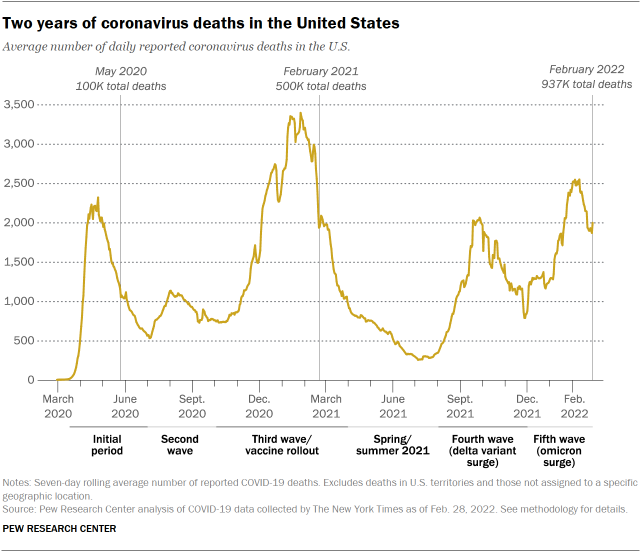
Over the past two years, the official count of coronavirus deaths in the United States has risen and is now approaching 1 million lives. Large majorities of Americans say they personally know someone who has been hospitalized or died of the coronavirus, and it has impacted – in varying degrees – nearly every aspect of life.

Chart shows two years of coronavirus deaths in the United States

A new Pew Research Center analysis of official reports of COVID-19-related deaths across the country, based on mortality data collected by The New York Times, shows how the dynamics of the pandemic have shifted over the past two years.

A timeline of the shifting geography of the pandemic

The pandemic has rolled across the U.S. unevenly and in waves. Today, the death toll of the pandemic looks very different from how it looked in the early part of 2020. The first wave (roughly the first 125,000 deaths from March 2020 through June 2020) was largely geographically concentrated in the Northeast and in particular the New York City region. During the summer of 2020, the largest share of the roughly 80,000 deaths that occurred during the pandemic’s second wave were in the southern parts of the country.

The fall and winter months of 2020 and early 2021 were the deadliest of the pandemic to date. More than 370,000 Americans died of COVID-19 between October 2020 and April 2021; the geographic distinctions that characterized the earlier waves became much less pronounced.

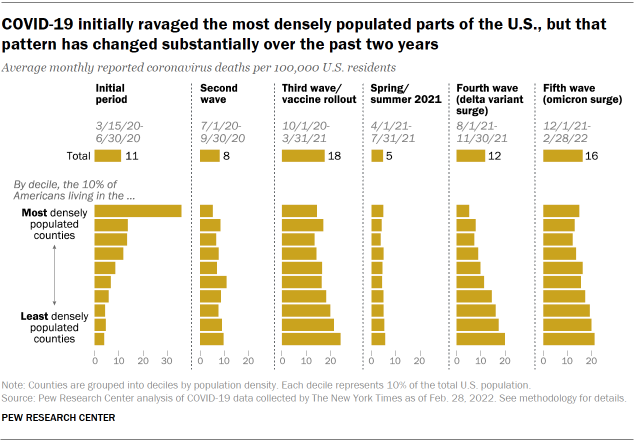
Chart shows COVID-19 initially ravaged the most densely populated parts of the U.S., but that pattern has changed substantially over the past two years

By the spring and summer of 2021, the nationwide death rate had slowed significantly, and vaccines were widely available to all adults who wanted them. But starting at the end of the summer, the fourth and fifth waves (marked by new variants of the virus, delta and then omicron) came in quick succession and claimed more than 300,000 lives.

In many cases, the characteristics of communities that were associated with higher death rates at the beginning of the pandemic are now associated with lower death rates (and vice versa). Early in the pandemic, urban areas were disproportionately impacted. During the first wave, the coronavirus death rate in the 10% of the country that lives in the most densely populated counties was more than nine times that of the death rate among the 10% of the population living in the least densely populated counties. In each subsequent wave, however, the nation’s least dense counties have registered higher death rates than the most densely populated places.

Despite the staggering death toll in densely populated urban areas during the first months of the pandemic (an average 36 monthly deaths per 100,000 residents), the overall death rate over the course of the pandemic is slightly higher in the least populated parts of the country (an average monthly 15 deaths per 100,000 among the 10% living in the least densely populated counties vs. 13 per 100,000 among the 10% in the most densely populated counties).

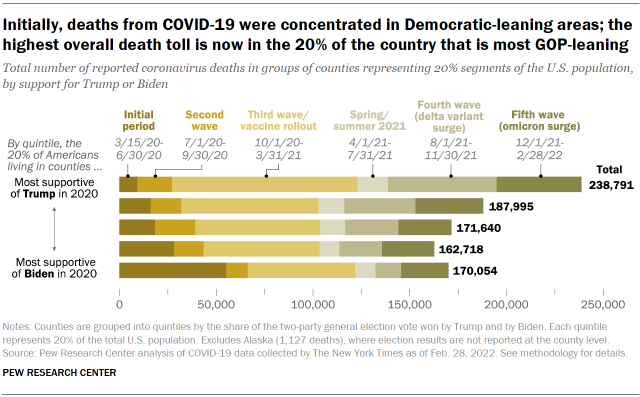
Chart shows initially, deaths from COVID-19 were concentrated in Democratic-leaning areas; the highest overall death toll is now in the 20% of the country that is most GOP-leaning

As the relationship between population density and coronavirus death rates has changed over the course of the pandemic, so too has the relationship between counties’ voting patterns and their death rates from COVID-19.

In the spring of 2020, the areas recording the greatest numbers of deaths were much more likely to vote Democratic than Republican. But by the third wave of the pandemic, which began in fall 2020, the pattern had reversed: Counties that voted for Donald Trump over Joe Biden were suffering substantially more deaths from the coronavirus pandemic than those that voted for Biden over Trump. This reversal is likely a result of several factors including differences in mitigation efforts and vaccine uptake, demographic differences, and other differences that are correlated with partisanship at the county level.

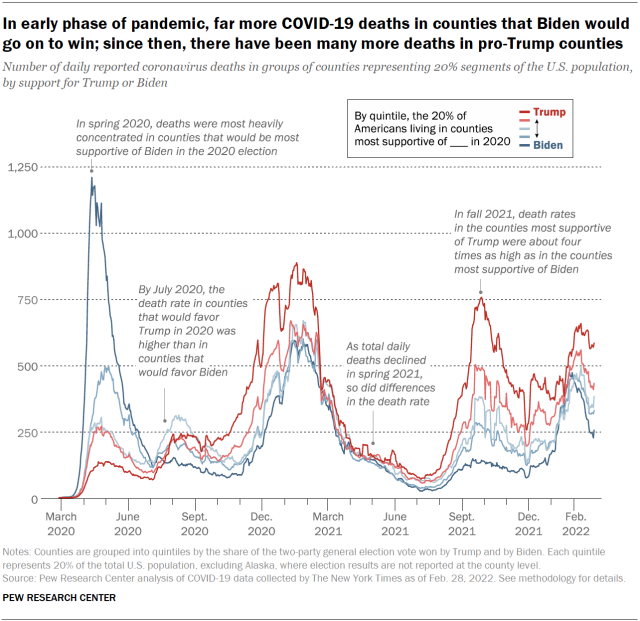
Chart shows in early phase of pandemic, far more COVID-19 deaths in counties that Biden would go on to win; since then, there have been many more deaths in pro-Trump counties

During this third wave – which continued into early 2021 – the coronavirus death rate among the 20% of Americans living in counties that supported Trump by the highest margins in 2020 was about 170% of the death rate among the one-in-five Americans living in counties that supported Biden by the largest margins.

As vaccines became more widely available, this discrepancy between “blue” and “red” counties became even larger as the virulent delta strain of the pandemic spread across the country during the summer and fall of 2021, even as the totalnumber of deaths fell somewhat from its third wave peak.

During the fourth wave of the pandemic, death rates in the most pro-Trump counties were about four times what they were in the most pro-Biden counties. When the highly transmissible omicron variant began to spread in the U.S. in late 2021, these differences narrowed substantially. However, death rates in the most pro-Trump counties were still about 180% of what they were in the most pro-Biden counties throughout late 2021 and early 2022.

The cumulative impact of these divergent death rates is a wide difference in total deaths from COVID-19 between the most pro-Trump and most pro-Biden parts of the country. Since the pandemic began, counties representing the 20% of the population where Trump ran up his highest margins in 2020 have experienced nearly 70,000 more deaths from COVID-19 than have the counties representing the 20% of population where Biden performed best. Overall, the COVID-19 death rate in all counties Trump won in 2020 is substantially higher than it is in counties Biden won (as of the end of February 2022, 326 per 100,000 in Trump counties and 258 per 100,000 in Biden counties).

Partisan divide in COVID-19 deaths widened as more vaccines became available

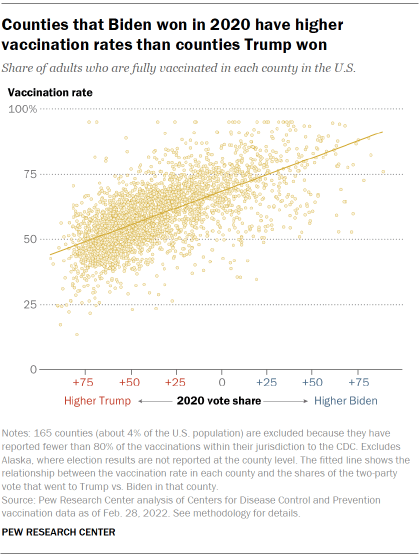
Partisan differences in COVID-19 death rates expanded dramatically after the availability of vaccines increased. Unvaccinated people are at far higher risk of death and hospitalization from COVID-19, according to the Centers for Disease Control and Prevention, and vaccination decisions are strongly associated with partisanship. Among the large majority of counties for which reliable vaccination data exists, counties that supported Trump at higher margins have substantially lower vaccination rates than those that supported Biden at higher margins.

Counties with lower rates of vaccination registered substantially greater death rates during each wave in which vaccines were widely available.

Chart shows counties that Biden won in 2020 have higher vaccination rates than counties Trump won

During the fall of 2021 (roughly corresponding to the delta wave), about 10% of Americans lived in counties with adult vaccination rates lower than 40% as of July 2021. Death rates in these low-vaccination counties were about six times as high as death rates in counties where 70% or more of the adult population was vaccinated.

More Americans were vaccinated heading into the winter of 2021 and 2022 (roughly corresponding to the omicron wave), but nearly 10% of the country lived in areas where less than half of the adult population was vaccinated as of November 2021. Death rates in these low-vaccination counties were roughly twice what they were in counties that had 80% or more of their population vaccinated. (Note: The statistics here reflect the death rates in the county as a whole, not rates for vaccinated and unvaccinated individuals, though individual-level data finds that death rates among unvaccinated people are far higher than among vaccinated people.)

Source: The Changing Political Geography of COVID-19 Over the Last Two Years

GM takes new approach to worker diversity as Oshawa production returns

Of note:

The hulking grey shell of GM’s Oshawa assembly plant looks just like it did when the company shut down production on a frigid December day in 2019, but much of what’s inside is strikingly new. 

There’s a new product — as of the November restart, the plant makes huge (and hugely profitable) Chevy Silverado pickup trucks — fancy new robots to swing them about the plant, and kilometres of new conveyor lines to usher them through to completion. But maybe the biggest change is a workforce that is not only largely new to the plant, but to the manufacturing sector at large after the automaker made a concerted effort to hire women for about half of the 1,200 line positions.

“I didn’t even know how to use a hammer until I came here,” said Adriana Wilkinson, who is now a production team leader in the body shop.

Like many of the new hires, Wilkinson’s previous job — she ran an escape room — was disrupted by the pandemic, so she said she jumped at the “life-changing opportunity” for her and her family when GM started hiring last year, and now says she’s here for life. 

“I never thought I’d be working with vehicles, never knew how to use a tool, and totally out of my comfort zone, but I jumped right in and I love it.”

Others on the line include people like Heather MacLeod, who is starting a new career after retiring from the RCMP; Honey Panchal, a controls system engineer who moved to Canada from India last year; and Crystal Cooper, who moved from customer care at GM to working as a group leader on the final assembly line because she wanted to get out of her element. 

“Coming into the manufacturing world was completely different, but it was challenging, and I really wanted to be a part of something bigger,“ said Cooper. 

The gender parity on the production line is a big shift for an industry where in Canada, women make up only about 23 per cent of auto assembly jobs, according to the Future of Canadian Automotive Labourforce Initiative. 

GM Canada president Scott Bell said diversity has been a priority for some time at the company, which is led by Mary Barra and has a gender-balanced board, but he said it was the restart of the plant that led to the push for gender balance.

“We just recognized the fact that we’ve got a unique opportunity, and let’s put the effort in.” 

To encourage more women to apply to the job, GM highlighted stories of women who had already worked there as part of its campaign, as well as made sure to do targeted social media advertising, They hardly had to worry though, with some 13,000 people in total applying from across Canada as well as internationally for about 1,800 positions including skilled workers. 

The opportunity to hire a whole new workforce, however, came at the expense of the many early retirements, layoffs and disruptions to those who thought production would never return.

“I am not thrilled that GM closed our plant,“ said Rebecca Keetch, who is back working at the plant after choosing to stay on standby when production was suspended.

She said she’s excited that production is back, but that the rapid closure and reopening was disrespectful to workers and the community, and led to the loss of higher-paying senior positions. Workers at third-party suppliers were also hit without getting the same supports as GM workers. 

Keetch is active in a group pushing for electric vehicle production in Oshawa, and was disappointed that the plant didn’t get new commitments from GM on that front.

“I just don’t see a sense of long-term security unless they decide to make Oshawa part of their autonomous, electric, connected vision of the future.”

GM Canada’s Bell said the 2019 plantclosure was unfortunate, but that it was part of a wider restructuring. With better-than-expected demand for pickup trucks, GM has spent $1.3 billion on Oshawa as part of its commitment to the plant, he said, that will help fund the company’s transition to electric. 

“It’s a substantial investment. Trucks are going to be around for a long time, so we feel good about that. From an EV perspective, you know, we’ve got to fund that business.”

Demand for pickups has increased during the pandemic, with plants working overtime to produce them, said Sam Fiorani, head of global vehicle forecasting at AutoForecast Solutions LLC.

He said that with GM already twice announcing the closure of Oshawa, first in 2008 and then in 2018, it’s risky to bet on the plant’s future, but he also doesn’t see pickup truck demand waning, and Oshawa is the only GM plant that can produce both light and heavy-duty models.

“This is the most hopeful outlook for any plant in Canada, any Detroit Three plants in Canada, for a longer-term future.”

Many in the plant are hoping that’s the case.

“I plan to be here for the next 30 years,” said Stephanie Waudby, 38, a production team leader on the trim line.

Waudby had her own cleaning business before the pandemic slowed things down and she jumped into manufacturing for the first time. She wasn’t entirely unfamiliar with the auto manufacturing though, asshe isa now third-generation GM worker at the plant.

She said she’s proud to carry on the family legacy, and that everyone’s excited about building trucks again in Oshawa.

“It was really heartbreaking for a lot of people when the plant had to shut down, so just being able to bring that back to this area is amazing.”

Source: GM takes new approach to worker diversity as Oshawa production returns

China seeing new surge in cases despite ‘zero tolerance’

Of note (assuming numbers are reported correctly). According to John Hopkins, actual numbers are close to 600,000 infections and 7,000 deaths:

China is seeing a new surge in COVID-19 cases across the vast country, despite its draconian “zero tolerance” approach to dealing with outbreaks. 

The mainland on Monday reported 214 new cases of infection over the previous 24 hours, with the most, 69, in the southern province of Guangdong bordering on Hong Kong, which has been recording tens of thousands of cases per day

Another 54 cases were reported in the Jilin province, more than 2,000 kilometers (1,200 miles) to the north, and 46 in the eastern province Shandong. 

In his annual report to the national legislature Saturday, Premier Li Keqiang said China needs to “constantly refine epidemic containment” but gave no indication Beijing might ease the highly touted “zero tolerance” strategy.

Li called for accelerating vaccine development and “strengthening epidemic controls” in cities where travelers and goods arrive from abroad. 

“Zero tolerance” requires quarantines and lockdowns on entire communities and sometimes even cities when as few as a handful of cases have been detected. Chinese officials credit the approach — along with a vaccination rate of more than 80% — with helping prevent a major nationwide outbreak, but critics say it is taking a major toll on the economy and preventing the population from building up natural immunity. 

No new cases were reported in Beijing and the city was largely back to normal, although masks continue to be worn in public places indoors. 

One area that continues to feel the effects of tight COVID-19 control is the religious sector. Three of Beijing’s most famous Catholic churches, Buddhist temples and mosques stated Sunday they had been ordered closed in January with no date given on reopening. 

Even before the pandemic, such institutions were under heavy pressure from the Communist authorities to follow through on demands from leader Xi Jinping that all religious centers be purged of outside influence, including the physical appearance of places of worship. 

The latest daily case numbers mark some of the highest since the initial outbreak in the central city of Wuhan in late 2019 that is believed to have sparked the pandemic. 

They bring China’s total to 111,195 with 4,636 deaths, according to the National Health Commission. At present, 3,837 people are receiving treatment for COVID-19, many of them infected with the omicron strain. 

Source: China seeing new surge in cases despite ‘zero tolerance’

Delaware is shrinking racial gaps in cancer death. Its secret? Patient navigators

Of interest:

Sussex County, in the heart of southern Delaware’s poultry-farm country, is home to many people like Michelaine Estimable, a 62-year-old native of Haiti who came to work on the factory lines of a chicken-processing plant.

But Estimable hasn’t worked in two years, because of a leg injury that made it impossible for her to drive. Now, she relies on family members she lives with to get rides to medical appointments — one of the logistical headaches that’s kept her from scheduling her mammogram for the past year.

Luckily for her, she’s getting some help this year accessing preventative care from the state of Delaware. At the clinic where she gets primary care, she meets with Margarette Osias, a patient navigator for the Delaware Breast Cancer Coalition, who sets up shop here every Tuesday, hoping to find people in the community due for mammograms or other cancer screenings.

Osias schedules exams for patients, sends them reminders, and arranges rides for them to get there. A bilingual Haitian Creole speaker herself, Osias also deals with insurance — or even goes with patients to appointments to serve as a translator.

Whatever obstacles the patient faces, “I am basically the connection between that individual and receiving that care,” Osias says.

Patient navigators like Osias play a critical role in how the state of Delaware has reduced its cancer death rates, and narrowed — even eliminated — racial disparities in some forms of cancer. Both are high priorities for the Biden administration, which last month relaunched the Cancer Moonshot initiative, pledging to cut cancer deaths in half in 25 years and address persistent disparities in screening and treatment among people of color. Nationally, cancer kills Black people at higher rates than other groups.

Delaware’s approach to cancer care stands out in the U.S. Two decades ago, the state had one of the highest cancer death rates in the country, so it used funds from the 1998 tobacco settlement to set up universal cancer screening and treatment for its residents. Its Screening for Life program will pay for all cancer screenings and, if cancer is found, will also cover up to two years of treatment — even for residents who are undocumented, have no insurance, or earn up to 6.5 times the federal poverty rate.

Now, that program is a model for addressing racial inequity in health care.

But access to screening and treatment can only help if residents like Estimable, who’s lost a sister and a cousin to cancer, know about it — which is where patient navigators like Osias come in.

Osias schedules exams for patients, sends them reminders, and arranges rides for them to get there. She also helps patients with insurance and translates for them at medical appointments.

Every five years, the state identifies zip codes where screening rates run lowest. Navigators then fan out across grocery stores and laundromats in those communities, dropping flyers, setting up booths, and meeting with religious leaders. They arrange mobile screening vans to factories and other workplaces during work hours.

The process is neither quick, nor easy; it takes time to be seen and develop a rapport with people who have a distant or skeptical view of the medical system, says Mary Jo Vasquez, another patient navigator.

People will often approach only after seeing her multiple times, at their church, or where they shop. “They need to trust you,” she says. “They have to learn that we’re there for them, that we want to help them and that we’re not going to abandon them.”

Having patient navigators on the front line is essential, says family nurse practitioner Nadya Julien.

Julien opened Tabitha Medical Care three years ago, and started working with navigators like Osias. The clinic serves mostly her fellow Haitians, as well as some Latino immigrants. She says many are illiterate and didn’t grow up with preventative medicine back home, which puts them at especially high risk of getting late-stage cancers.

The role of navigators isn’t just logistical, she says, they also reduce fears and help people feel supported through a scary and unfamiliar journey, whether it’s screening or treatment.

“When you have the navigator that speak the language that’s can schedule the appointment, that can go to the house and pick them up and also be there with them to translate it gives comfort,” Julien says.

Delaware’s progress against cancer inequities has been slow and steady, and not without its challenges. The state’s overall cancer death rate has gradually fallen from the 2nd highest among states in the 1990s to the 15th highest. Black men’s improvements stand out: From the period of 2003-2007 to that of 2013-2017, the death rate from all cancers declined 26% for non-Hispanic Black men in Delaware, compared to a 15% decline for white men.

The success varies by cancer. The state’s colorectal cancer mortality rates declined 37% among Black men in that time, and compared to 20% for white men. On the other hand, death from breast cancer only decreased by 3% among Black women compared to 15% for white women in that same period.

And a new challenge emerged in the pandemic: screening rates dropped off, temporarily hampering outreach efforts, so — like many other places — the state is now focusing on making up for lost ground.

But solving shifting challenges has always been a big part of navigators’ work. Through trial and error, they’ve discovered they get fewer no-shows if they conduct free screening events on Thursdays, instead of Fridays, for example. They’ve learned to confirm appointments by text instead of by phone, after noting texting helped cut back on confusion and missed appointments.

Learning and tweaking the program like that has helped remove more roadblocks to care, says Stephen Grubbs, a medical oncologist and a founding member of the advisory council of the Delaware Cancer Consortium, which developed the state’s approach.

“This program has been so successful I think because it’s built on data and evidence,” Grubbs says. The state didn’t just screen more people, it also got them into earlier treatment, which ultimately saved lives, he says: “The final end point was, did we change mortality? And the answer was yes. And that’s where you’ve got to get to. If you don’t get there, the other stuff really doesn’t matter, does it?”

Grubbs says it helps that the economics of the program work, too. Catching cancers earlier means less invasive, less costly treatment with better outcomes which, in turn, helps reduce overall cancer costs. All that is possible, he says, because of patient navigators.

“We took the barriers down, the navigators grease the system and made sure it all flowed through — that’s exactly what it was,” he says.

The state now hopes to build on its success, getting more funds to hire more navigators to target other cancers.

Delaware benefitted from having a unified approach, with support from politicians, physicians, community health centers and patient advocates, says Karen Knudsen, CEO of the American Cancer Society. “Having a state cancer plan is something they embrace, and that 20 years of work is starting to bear fruit,” she says.

The state demonstrated the importance of patient navigators, who now play big role in cancer care nationally.

“Everybody knows it’s the right thing to do,” Knudsen says. “And I think there’s a good, strong business case for it as well because of the lower cost of care for patients who are navigated.”

The problem, she says, is insurance doesn’t cover navigation services, which means cancer treatment centers or nonprofits like hers have to fund the cost.

She says she hopes that will change, especially after she spoke to President Biden last month at the White House’s Cancer Moonshot announcement.

“He did not specifically talk about navigators using that word, but he did talk about eliminating disparities and increasing access,” she says. “What I hear when I hear that, I hear “navigation.”

Back at Tabitha Medical Care, after patient navigator Margarette Osias completes scheduling her mammogram, she tells Michelaine Estimable she will call her and send her a text message to remind her.

Then, as she does with every patient she sees, Osias turns to Estimable to ask her to help spread the word: “If she goes to a church or if she’s in the community, if she can share that information with maybe other women that she can let them know that they can come.”

Will she do that?

“Yes,” Estimable answers emphatically. “Yes.”

Source: Delaware is shrinking racial gaps in cancer death. Its secret? Patient navigators