While the understandable focus is with respect to those of Indian descent holding leadership and senior positions, there is a larger group of workers in such industries as agriculture and trucking. From a political perspective, the outsized influence of Sikh and other Indo-Canadians reflects their geographic concentration: 47 ridings in Canada have 10 percent or more South Asian residents (2016 Census).
India is on the rise across the United States and Canada — in education, high-tech and politics.
The CEOs of five of the most powerful high-tech companies in North America have origins in India. They’re heading Microsoft, Google, IBM, Twitter and Match Group (which owns Tinder).And people of Indian ancestry are punching above their weight in politics in the U.S. and Canada. “There may well be an Indian-American president before there is an American Indian one,” says The Economist.
The educational achievements of people of Indian origin are above the norm in North America. And their are among the strongest of any ethnic group in the U.S. and Canada. This is not to mention one study showing people of Indian origin are almost four times more likely to own a home than the average Canadian.
India is the second highest source country for immigrants to the U.S., where 4.6 million have Indian origins, or 1.4 per cent of the total. They are mostly from southern India and tend to live in the U.S. South and East.
In Canada, India is the No. 1 source country for immigrants by far, accounting for 30 per cent of all newcomers since 2016.
There are 1.4 million people with Indian roots in Canada, most of whom are immigrants. They make up four per cent of the population. Generally from Northern India, most live in Toronto, Vancouver, Calgary and Edmonton.
Even though many are already flying high in U.S. high-tech, the impact of people of Indian background on Canadian business, especially, is growing sharply.
The influence of Indo North Americans is destined to expand further. Let’s look at why.
The tech sectors in Toronto, Montreal and Vancouver are expanding on the strength of a workforce where two of five are foreign born. And U.S. immigration rules designed to protect homegrown workers means our southern neighbour is losing thousands of Indian high-tech experts and others to Canada.
With the U.S. restricting its coveted H-1B working visa (including with a rule that no one country can be the source of more than seven per cent of recipients), many computer specialists are among the more than 217,000 people from Indian who can work in Canada as foreign students (they make up 30 per cent of all international students).
Canada also accepted 128,000 people from India last year as new immigrants, many of them programmers. And it’s on track for a similar number in 2022. That compares to just 39,000 immigrants from India in 2015, when Justin Trudeau’s Liberals were first elected.
Such business success is made possible in large part because educational levels soar among those of Indian descent.
In the U.S. three of four of adults of Indian background have bachelors degrees or better, according to Pew Research. That’s the highest of any Asian immigrant group, with Chinese Americans coming in at 57 per cent. The overall bachelor’s degree average in the U.S. is 38 per cent.
In Canada, educational achievement is also pronounced. A recent Statistics Canada study by Theresa Qiu and Grant Schellenberg found 50 per cent of South Asian-Canadians (mostly from India) had bachelors degrees or more. The portion rose to 62 per cent among South Asian women.
The portion of bachelors degrees among Canadians with origins in South Asia is much higher than the 24 per cent for white men and 38 per cent for white women, as well as the 17 per cent for Latin American men and 28 per cent for Latin American women. One of the few ethnic groups scoring higher than South Asians are Chinese Canadians.
And wages reflect education levels. The median household income in the U.S. of Indian households is by far the highest of any ethnic-Asian group, at US$119,000, according to Pew.
The typical Chinese American household brings in US$82,000. The median household income across the U.S. is US$67,000.
While U.S. figures on housing are not readily available, a consumer survey by Vivintel, based in Toronto, found that South Asians, a solid majority of whom are from India, are almost four times more likely to buy a homethan the average Canadian.
“Home ownership is very important to South Asians … because they’re told by their parents that renting is just throwing away your money,” says Rahul Sethi, a 38-year-old director of Vivintel who immigrated to Canada from India with his family.
One of the most intriguing aspects of the rise of Indians in North America is their oversized affect on politics.And it’s not just because of U.S. vice-president Kamala Harris, who went to an English-language high school in Montreal after her scientist mother from India, Shyamala Gopalan Harris, got a job researching breast cancer at McGill University.
Even though Harris is a front-runner as a future Democrat presidential nominee, she’s far from alone in U.S. halls of power.
Karthick Ramakrishnan, who surveys Asian American attitudes from the University of California, maintains Indo Americans are far likelier than other immigrant groups to get involved in politics as donors, voters and candidates. They tend to favour Democrats by a margin of three to one.
Ram Villivalam, a state senator in Illinois, says having Harris running to be president gives confidence to Indo Americans. Pramala Jayapal, the first woman of South Asian descent to preside over the Congress, is now one of four influential Indo American politicians, dubbed the Samosa Caucus, in the House.
A similar movement is happening in Canadian politics.
The Indo Canadian population, like the Indo American, leans liberal-left. More than 38 per cent of respondents to a 2021 YouGov poll would cast a vote for the Liberals — twice the number that planned to go with the Conservatives.
One in five backed the left-wing New Democratic Party, the country’s third largest party, which has been lead for five years by Indo Canadian Jagmeet Singh.
More than 12 per cent of cabinet ministers in the Liberal government of Prime Minister Justin Trudeau are Indo Canadian, including Harjit Sajjan and Anita Anand. At least 14 Liberal MPs are Indo Canadian.
This impact list goes on in politics, as well as in business and education. Indo North Americans are on a roll.
SFU professor Darren Byler has been frequently attacked by China’s state media, which accuses him of being an agent of the U.S. government. Something he denies.
During four groundbreaking expeditions into China, the latest in 2018, Byler has witnessed many colleagues and research subjects disappear into the mass “re-education” camps and forced labour factories endured by more than 1.5 million Uyghur Muslims.
The author of In the Camps: Life in China’s High-Tech Penal Colony, was interviewed during a downtown Vancouver conference about the clampdown in Xinjiang. It was attended by 60 people, including Uyghur Canadians, international students from China, Muslim academics and activists.
Participants at the Simon Fraser University event required Postmedia’s commitment to protect their identities, so their families would not be harassed or threatened by police in China. There are about 400 ethnic Uyghurs in Metro Vancouver, the largest group of any Canadian city.
China’s authoritarian leaders are engaged in a planetary campaign to challenge and intimidate anyone who points to the incarceration, mass surveillance and draconian clampdown of the Uyghurs, which the Canadian government has called a “genocide.”
The Global Times, a tabloid newspaper arm of the Chinese Communist Party, has accused Byler of being an “anti-China figure” who makes “fabricated” allegations about “genocide and crimes against humanity” in the Xinjiang region of western China, which is inhabited by about 11 million Uyghur Muslims. The professor is sure China’s agents have attended his classes.
Byler has been with Uyghur people on the streets of China when police have stopped them, taken their mobile phones and demanded, “What is the password for your phone?” A specialist in high-tech surveillance, he says China uses 9,000 police surveillance hubs to routinely search personal data for evidence of resistance and what they consider a dangerous commitment to Islam.
Facial recognition technology is widely used in Xinjiang. Byler has first-hand knowledge of Uyghur students who have studied in North America being detained in China after omnipresent cameras found them walking outside their confinement. Families are often broken up when a Uyghur whom authorities deem suspicious is sent to a work camp, many of which produce textile goods for the West. The U.S. and Canada have laws banning such goods, but many argue they’re ineffective.
A prolific author and widely cited scholar, Byler, 40, is among the Western researchers who argue that China’s Han ethnic majority has in the past decade been escalating a colonialistic internal effort to smear the Uyghur people and systematically erase their Indigenous culture and faith. Chinese authorities often label the Uyghurs as “separatists” and “terrorists,” as well as lazy and slow.
One frequent tactic of the state-controlled Global Times is to try to silence Canadian criticism of the treatment of Uyghurs by condemning this country’s residential-school system for Indigenous children, which the federal government began in 1881 and for the most part ended by the 1970s.
This month, The Global Times enthusiastically reported on Pope Francisrecently referring to Canada’s attempt to assimilate First Nations through residential schools as “a genocide,” even while the Truth and Reconciliation Commission has referred to it as “cultural genocide.”
The Global Times article cited how Canada’s Inquiry into Missing and Murdered Indigenous Women and Girls also called it a “genocide,” while reporting that last year “more than 1,100 unmarked graves have been discovered at former residential school sites.” Canadian media outlets now largely refer to them as “suspected” graves.
The Global Times and China’s diplomats are making a clear attempt to claim, “You in the West have no right to criticize us, because look what you did to Indigenous people,” Byler said. “They’re kind of saying, ‘You did it. So we are doing it, too.’”
While Byler believes Canada’s residential-school system was a colonialistic attempt at assimilation, he notes the Truth and Reconciliation Commission has formalized a decades-long process of restitution in Canada, unlike in Australia and the U.S. And definitely unlike 21st-century China.
During the several years that Byler, a German American who is now a permanent resident of Canada, has spent living among Uyghur people in Xinjiang, he came to realize how outward-looking and sophisticated they were before China accelerated efforts to wipe out their culture.
One of many of his research papers that is drawing global attention explores how Uyghurs had been keenly taking courses from 2004 to 2014 in the English language, with students developing a special interest in novels about totalitarianism, like Animal Farm and 1984 by George Orwell.
Han Chinese prejudices often portray Uyghurs as “backward,” so the language students especially devoured books about Black Americans like Malcolm X, Muhammad Ali and Barack Obama. The paper, co-written with an unnamed Stanford professor, reveals the Uyghur valued learning about a society in which members of a minority could hold power.
But the English-language schools were shut, and teachers Byler knew were detained, after a 2014 visit by President Xi Jinping.
Even though most attendees at the SFU conference demanded anonymity, Byler introduced one local Uyghur who was willing to be interviewed because he has already gone public as an activist. Now a high-school science teacher in Surrey, Kabir Qurban came to Canada with his family from Afghanistan as a refugee.
Since he has become a high-profile activist in Canada, including with his own websites, Qurban said that sometimes he has attended Uyghur events, such as weddings, where attendees have asked that he not sit at the same table with them.
In this era of facial recognition technology, the Uyghur Canadians fear Chinese authorities could catch them together in a photo with the staunch critic of China. That could easily lead to a brother, sister, mother or father back in Xinjiang getting harassed by police. Or worse.
“It’s unfortunate,” Qurban said, “but I have to respect their stance.”
Pendant qu’on débat pour la millionième fois sur le port du hidjab au Québec — cette semaine à cause de réactions à une publicité de HEC Montréal —, une nouvelle étude sur la Loi sur la laïcité de l’État vient d’être publiée.
Produite par l’Association des études canadiennes, en collaboration avec SurveyMonkey et la firme de sondage Léger, cette étude a été menée auprès de 1828 adultes québécois, dont 632 musulmans, 165 juifs et 54 sikhs. Léger a utilisé les données de Statistique Canada pour que l’échantillon sondé soit représentatif de la population étudiée.
L’étude confirme que la majorité de la population (63,7 %) appuie la « loi 21 ». Ce chiffre tombe à 60 % si on inclut l’option « je ne sais pas », et à 57 % si l’on spécifie « telle qu’elle s’applique aux enseignants ».
Mais l’étude innove en comparant les arguments souvent entendus pour défendre la Loi sur la laïcité de l’État avec les données amassées. L’effet de contraste est saisissant.
D’abord, on avance souvent que la « loi 21 » est « neutre » — c’est-à-dire qu’elle ne vise aucune religion en particulier — et que ses appuis ne sont pas liés à une animosité particulière envers une religion ou une autre. Or, l’étude calcule que 75 % des partisans convaincus du texte législatif ont une opinion négative de l’islam ; 66 % du sikhisme ; 49 % du judaïsme ; 36,5 % du christianisme.
Il se dégage donc ici, selon la chercheuse principale de l’étude, Miriam Taylor, une « hiérarchie de négativité » envers les religions particulièrement marquée.
Parallèlement, la proportion des opposants convaincus à la Loi sur la laïcité de l’État qui ont une opinion négative de ces quatre mêmes religions oscille entre 18 % et 20 %, sans conviction que certaines valent mieux que d’autres.
Ensuite, on dit souvent que les appuis à « loi 21 » sont motivés par une méfiance particulière envers la religion en général ; l’étude a par conséquent voulu mesurer si les personnes elles-mêmes peu religieuses étaient plus nombreuses à soutenir cette législation. Or, on n’a trouvé aucun lien majeur entre la religiosité des répondants et leur appui ou opposition à la loi. Même qu’au contraire, les Québécois qui s’identifient comme catholiques seraient « légèrement plus favorables » à la loi que ceux qui se disent athées.
Fossé hommes-femmes
Par ailleurs, on entend souvent que la Loi sur la laïcité de l’État québécois est profondément féministe, et que c’est au nom de l’égalité hommes-femmes qu’elle a été mise en avant. L’enquête s’est donc intéressée à l’écart dans les appuis à la loi selon le genre.
On a calculé que 68,5 % des hommes et 59 % des femmes au Québec appuieraient la loi, un écart de près de 10 points de pourcentage. Chez les plus jeunes, l’écart est encore plus marqué : 51,7 % des hommes de 18 à 24 ans appuient la loi, alors que seulement 31,5 % de leurs consoeurs font de même. Seules les femmes de 75 ans et plus sont plus favorables à la loi que les hommes de leur groupe d’âge.
L’étude avance également que les femmes québécoises sont plus nombreuses à trouver que « la loi est discriminatoire envers les femmes », que les femmes sont « plus touchées » par cette mesure législative, et que la loi « divise les Québécois ». Les femmes seraient aussi moins nombreuses à trouver que les Québécois qui s’opposent à la Loi sur la laïcité de l’État sont « déloyaux » et à souhaiter qu’une personne qui ne s’y conforme pas perde son emploi.
Existe-t-il une seule autre politique publique dite « féministe » moins appuyée par les femmes que par les hommes ? Ou serait-ce que, dans ce cas-ci, les femmes savent moins bien discerner que les hommes ce qui est bon pour elles ?
Vivre-ensemble
De plus, on répète souvent que la « loi 21 » exprime une volonté collective, et donc que les tribunaux ne devraient pas se « mêler » des décisions de l’Assemblée nationale sur la question.
Pourtant, 64,5 % des Québécois sondés croient qu’il serait important « que la Cour suprême émette un avis sur la question de savoir si la loi 21 est discriminatoire », et seuls 46,7 % des répondants continueraient à l’appuyer si les tribunaux « confirment » qu’elle « viole les chartes des droits et libertés ». On parlerait donc ici d’une chute de 18 points de pourcentage dans les appuis en cas d’une décision négative des tribunaux sur la question.
Finalement, la Loi sur la laïcité de l’État est souvent présentée comme un outil favorisant l’harmonie sociale et le vivre-ensemble.
Or, en sondant spécifiquement les Québécois musulmans, juifs et sikhs, l’étude a trouvé qu’une majorité dans les trois groupes rapporte « un déclin dans leur sentiment d’acceptation en tant que membres à part entière de la société québécoise » depuis l’adoption du texte législatif. Quelque 64 % des femmes musulmanes, 67 % des hommes sikhs et 87,5 % des femmes sikhs qui ont participé à l’étude ont dit avoir senti leur capacité à participer à la vie sociale et politique du Québec se détériorer depuis 2019. Et 67 % des femmes musulmanes, 50 % des hommes juifs et 67 % hommes sikhs ont aussi déclaré avoir été exposés à des incidents et à des crimes haineux.
Cette portion de l’étude inclut d’ailleurs des témoignages qui donnent froid dans le dos. Bien qu’il s’agisse de la plus vaste enquête sur cette question conduite auprès des minorités religieuses québécoises depuis l’adoption de la loi, l’échantillon total reste modeste.
Espérons que d’autres recherches encore plus ambitieuses seront mises en avant pour faire la lumière sur ces enjeux cruciaux.
Would be interesting to see the breakdown between Montreal and the rest of Quebec, where immigration is low as is the number of visible and religious minorities:
New research shows that three years after Quebec’s secularism law — commonly known as Bill 21 — was adopted, religious minorities in the province are feeling increasingly alienated and hopeless.
“Religious minority communities are encountering — at levels that are disturbing — a reflection of disdain, hate, mistrust and aggression,” Miriam Taylor, lead researcher and the director of publications and partnerships at the Association for Canadian Studies, told CBC in an interview.
“We even saw threats and physical violence,” Taylor said.
Bill 21, which passed in 2019, bars public school teachers, police officers, judges and government lawyers, among other civil servants in positions of authority, from wearing religious symbols — such as hijabs, crucifixes or turbans — while at work.
Taylor and her colleagues at the association worked with polling firm Leger to gather a unique portrait of attitudes toward Bill 21 in Quebec.
The association surveyed members of certain religious minority communities including 632 Muslims, 165 Jews and 56 Sikhs.
Those results were folded into a Leger survey of the Quebec population as whole, and then weighted to ensure the sample was representative of the entire population.
That allowed Taylor to compare and contrast the attitudes toward Bill 21 of Quebecers who are religious minorities with the attitudes of Quebecers as a whole.
In total 1,828 people were questioned in the online survey.
Taylor shared an advance copy of her final report, which is being released today, with CBC.
Muslim women most affected
Although all three religious minority groups surveyed said they’ve experienced negative impacts due to Bill 21, the effects are being most acutely felt by Muslims and, in particular, Muslim women.
“We saw severe social stigmatisation of Muslim women, marginalization of Muslim women and very disturbing declines in their sense of well-being, their ability to fulfil their aspirations, sense of safety, but also hope for the future,” Taylor said.
Of the Muslim women surveyed, 78 per cent said their feeling of being accepted as a full-fledged member of Quebec society had worsened over the last three years.
Fifty-three per cent said they’d heard prejudicial remarks about Muslims from family, friends or colleagues.
People surveyed were given the opportunity to share examples of comments they’d heard or behaviours they’d experienced.
One reported hearing: ”These Muslim women with rags on their heads, if they are not able to integrate, let them return to their country.”
Forty-seven per cent of Muslim women said they’d been treated unfairly by a person in a position of authority.
One person reported being called a “dirty immigrant” by a police officer in Quebec City. Another reported that a teacher told disparaging anecdotes about Islam in class.
Two thirds of Muslim women said they’d been a victim of and/or a witness to a hate crime. Seventy-three per cent said their feeling of being safe in public had worsened.
Taylor found that nearly three quarters of Muslim women surveyed felt their comfort about safety in public had worsened in the three years since Bill 21 was adopted. (Association for Canadian Studies)
People surveyed offered examples ranging from racist remarks to death threats, having hijabs ripped off and being spat on. One person reported that a man deliberately tried to run over them and their three-year-old daughter with a pickup truck.
A majority of Muslims also reported feeling less hopeful, less free to express themselves in public and less likely to participate in social and political life.
“For a law that’s supposed to be very moderate and only touch a very small number of people, we were shocked at the responses,” Taylor said.
She said the response she found most upsetting was that 83 per cent of Muslim women surveyed said their confidence in their children’s future had worsened since Bill 21 passed.
Taylor said the figure that most upset her was the lack of hope Quebec Muslims have for their children’s future. (Association for Canadian Studies)
“It’s one thing to say: ‘you know what, I’m experiencing a lot of unfair treatment because I’m not understood,'” Taylor said. “It’s another thing to project forward and have no hope for your children.”
Law reinforces existing prejudices
Taylor believes Bill 21 alone isn’t responsible for the feelings of alienation and insecurity Quebec Muslims and other religious minorities feel.
She said prejudicial attitudes have been gestating in Quebec for nearly 20 years, when the debate over so-called “reasonable accommodations” for religious minorities first took hold.
“Malaise, fear and anxieties get provoked over time,” Taylor said.
She said often those anxieties are based on ignorance.
“By their own admission, Quebecers in general have very little contact with members of religious minorities,” Taylor said. “All of these negative opinions are based on lack of knowledge.”
Taylor said Bill 21 has enabled those prejudices — rooted in ignorance — to become the norm.
“We end up with a situation where the malaise of the observer trumps the deep convictions of the person actually wearing the religious symbols,” Taylor said.
“We’re validating and reinforcing those opinions, and then we’re politicizing the symbols. Those symbols are lightning rods,” she said.
“And so we end up dehumanizing the people wearing the symbols,” Taylor said.
Women generally less supportive of Bill 21
Taylor said that Bill 21 has consistently maintained the support of about two thirds of Quebecers since it was adopted, with a dip last January after the high-profile case of a hijab-wearing teacher in Chelsea who was removed from the classroom and reassigned.
But she said that support is nuanced and full of contradictions.
Women in Quebec, for example, are generally less supportive of Bill 21 than men. Sixty-eight per cent of men support the law compared to 58 per cent of women.
Taylor said the research showed that women, and in particular young women, are less supportive of Bill 21 than men. (Association for Canadian Studies)
And the younger women are, the less likely they are to support the law. Just 31 per cent of women aged 18-24 support Bill 21.
Taylor said that raised questions for her.
“It’s touted as a feminist law by the people who support it. So why is it that particularly the younger women of Quebec are so much less in favour of it when one would expect the reverse proportion?” she said.
Support for the law but not for enforcement
Another statistic that surprised Taylor: even Quebecers who support the law don’t necessarily want to see it enforced.
Only 40 per cent of people surveyed believe a public servant who does not comply with the law should lose their job.
“The law is supported and liked by Quebecers. But they seem much less keen to see it actually applied,” Taylor said.
“I think that we’re a human society and we care about people. We all need income to survive and I think people are aware of what a heavy price that would be to pay,” she said.
Quebecers care about what courts say about Bill 21
Taylor was also surprised that the survey showed that Quebecers care deeply about what courts have to say about Bill 21.
When drafting the law, the Quebec government, recognizing that it would likely violate both the Canadian and the Quebec charters of rights, pre-emptively invoked the constitutional notwithstanding clause, and altered the Quebec charter to try to shut down court challenges.
But those challenges came anyway, and now both the government and groups that oppose the bill are challenging a 2021 Quebec Superior Court ruling that upheld most of the law before the Quebec Court of Appeal.
It’s widely expected the law will eventually be challenged in the Supreme Court of Canada.
The bill’s architect, Justice Minister Simon Jolin-Barrette, has argued that it’s up to elected politicians in the National Assembly — and not the courts — to decide how they want to organize relations between the state and religion.
But Quebecers seem to feel differently.
Sixty-four per cent, roughly the same percentage that support the bill, also feel it’s important for the Supreme Court to issue an opinion on whether Bill 21 is discriminatory.
And if the courts were to confirm the law is discriminatory, support for the bill would plummet.
Only 46 per cent of people surveyed — less than half — said they would continue to support the law if the courts confirmed it violates the Charter of Rights.
Debate not over
Jolin-Barrette has portrayed Quebecers as united in support of the bill, and has accused detractors of trying to divide Quebecers.
But Taylor’s survey shows that a majority of Quebecers — 56 per cent — believe the law itself is divisive.
When Bill 21 was adopted, Jolin-Barrette said it would “permit a harmonious transition toward secularism” for Quebec.
Taylor said that clearly hasn’t been the case.
“The debate is very far from closed,” she said. “Bill 21 is having devastating impacts on citizens in our province. It’s tearing apart our social fabric and I think it’s undermining our democracy.”
“If national unity is achieved at the expense of labelling minorities as in some way harmful or a threat, these are signs of the degeneration of democracy,” she said.
Taylor said as a Quebecer, she finds this distressing.
“We live in a very distinct province. We’re different. It’s an experiment that on some level should never have succeeded: a thriving French society on an English continent,” she said.
“In all my years, I associate that distinct nature with a humanity, with understanding how important identity is,” Taylor said.
She said Bill 21 threatens that.
“I feel like we’re doing major harm to those values that we hold dear and that make us special,” Taylor said.
Companies that are underperforming in comparison to their competitors or to their goals are more likely to experience a decrease in racial and gender diversity rates on their boards, a newly released study has found.
Researchers at Imperial College Business School in London tracked data from more than 700 U.S. firms from 1996 to 2013 to make the assessment.
Dr. HeeJung Jung, Assistant Professor of Entrepreneurship at Imperial College Business School, and lead researcher of the study, tells TIME that this phenomenon is not deliberate, but rather a result of the pressure firms face to better adapt and begin performing well. Leaders search for a quick solution, but boards can become less inclusive as executives minimize their boards, or unconsciously seek directors that have similar ascriptive backgrounds.
[time-brightcove not-tgx=”true”]
“The board deliberately seeks new expertise and new perspectives among a variety of industries and backgrounds in the belief that it might rescue the company. But while this expertise came from a range of sectors, that’s as far as the diversity goes, in terms of race and gender,” Jung says.
Despite ongoing conversations about racial equity becoming more prevalent across the U.S., particularly after the murder of George Floyd in 2020, when companies made public pledges to better address racial inequality, Jung says that there is still a lot of fluctuation when looking at racial and gender diversity rates across corporate America.
In 2021, women comprised just 27% of board seats among the 3,000 largest publicly traded companies incorporated in the U.S., and only 6% of those seats were held by women of color, according to a report by the Women Business Collaborative. Men of color held 9% of board seats in the same year. Black board membership increased by nearly a third in 2021, but accounted for only 6.4% of directors overall.
Jung notes that companies will always experience periods of growth and decline, making more consistent strides for diversity and inclusion among the workforce difficult. The problem is, diversity is not a priority for companies when profits decrease, Jung says. “In their view, diversity efforts or DEI [diversity, equity and inclusion] matters last, it becomes a second matter or a second goal.”
Some countries in Europe have safeguards in place that would prevent progress on board diversity being rolled back. Gender diversity quotas are common in nations like France, Norway, Spain and Iceland, where women must make up at least 40% of boards at publicly traded companies, according to the Harvard Business Review.
While research about the benefits of gender-based diversity in the U.S. has shown mixed results, Jung says this may be because, despite great strides in female leadership, American corporate culture has not yet normalized it. One of the roadblocks to progress that female CEOs often face is pushback from teams, including constant cross-checking of their decisions to verify that they are acting “correctly,” Jung says.
“That causes an efficiency problem, and in a time of crisis where speed is important for any corporation, having this is a delay in decisions [and] makes directors [from underrepresented backgrounds] doubt their leadership too,” Jung told TIME.
Diversity efforts in corporate America
Currently, the U.S. has no federal policy that mandates inclusivity, though that has not stopped local governments from attempting to implement changes. States like Washington, for instance, require at least a quarter of a public company’s board to be women. In California, a law, passed in 2020, requiring public companies to have greater racial and gender diversity on their boards, was struck down in April, according to the New York Times, but the state still has a 2018 law in effect that forces companies to have at least one woman on their board.
In some cases, business leaders have created their own solutions. Last year, Nasdaq secured regulatory approval for plans to require listed companies to share diversity data about their boards of directors. Companies without at least two diverse directors, including one who self-identifies as a woman and one who identifies as an underrepresented minority or LGBTQ+, are required to explain their lack of diversity.
Having executives from underrepresented backgrounds in positions of leadership helps too. Jung’s study found that when board member chairs come from underrepresented groups, they are less likely to sacrifice the gender and racial diversity of their board in response to a downturn.
But, as Jung states, retaining diverse talent requires companies to take the important first step of creating corporate norms that recognize the value of having diverse teams. “It’s not only about bringing [diverse candidates] in but also making them play an important role in the board and change the norms,” she says. “There’s a lot of positive benefits and corporations have to be very sensitive about and must pay attention to make a better strategy for their boardroom structures and who they are going to appoint.”
Sigh… The usual over-reaction over what should be a non-issue:
Une publicité de HEC Montréal montrant une femme qui porte le hidjab et dénoncée par l’ex-politicien Jean-François Lisée a continué de susciter de nombreuses réactions mardi.
Alors que deux avocates de confession musulmane témoignaient dans nos pages de leur désaccord avec la position de M. Lisée, qui considère que la publicité présente un « signe religieux misogyne », la présidente du Rassemblement pour la laïcité, Nadia El-Mabrouk, abonde plutôt dans le sens de l’ex-politicien et dénonce la publicité.
[Montrer le voile dans la publicité], c’est un point de vue favorable à l’islam intégriste, c’est mettre de l’avant des pratiques intégristes
« Ce n’est pas neutre de faire ça. Ça vient avec une vision de la diversité et de la représentativité des signes religieux », plaide-t-elle en entrevue téléphonique. La Québécoise d’origine tunisienne, qui est aussi professeure au Département d’informatique et de recherche opérationnelle à l’Université de Montréal, croit qu’« on n’a pas à représenter toutes les idées » dans des campagnes publicitaires. « [Montrer le voile dans la publicité], c’est un point de vue favorable à l’islam intégriste, c’est mettre de l’avant des pratiques intégristes, assène-t-elle. Quand les femmes disent “c’est mon choix” [de porter le voile], ça ne répond pas à la question “pourquoi c’est mon choix ?” »
En entrevue avec Le Devoir la veille, l’avocate de formation et autrice Dania Suleman a soutenu que « certaines femmes portent le hidjab par choix, et ça leur permet de se sentir beaucoup plus libres ». Elle a également estimé la position de M. Lisée « désolante », jugeant qu’elle « continue à aliéner les femmes qui portent le voile ».
Mme El-Mabrouk, autrice du livre Notre laïcité, paru en 2019, est fortement en désaccord. « On ne peut pas prendre un symbole clair de l’islamisme et prétendre que ça dit exactement le contraire », soutient-elle.
Sur les réseaux sociaux
De nombreux citoyens se sont indignés du tweet de Jean-François Lisée, tandis que plusieurs lui ont apporté leur appui, dont notamment Ensaf Haidar, ex-candidate du Bloc québécois dans Sherbrooke et femme du blogueur Raif Badawi. « En tant que musulmane pacifique, j’insiste sur le fait que le voile ne vient pas de l’Islam et qu’il est un symbole de l’esclavage et de l’oppression des femmes. Arrêtez d’abuser des femmes avec des publicités aussi stupides », a-t-elle écrit sur Twitter.
Le député néodémocrate de Rosemont–La Petite-Patrie, Alexandre Boulerice, s’est néanmoins montré très critique de la position de M. Lisée. « Donc science et islam seraient incompatibles ? Alors que science et pas de signe religieux apparent de christianisme serait correct ? » a-t-il questionné. M. Lisée a répondu : « Tu crois que le Coran est fondé sur la science? La Bible? La Torah? Qu’une institution de haut savoir scientifique doit promouvoir leurs symboles ? »
Par courriel, la conseillère principale en relation avec les médias de HEC Montréal, Émilie Novales, a confirmé que la femme dans la publicité est une « étudiante au parcours international » et que l’institution accueille « un nombre croissant d’étudiants internationaux » chaque année. « Nous tenons à ce que tous les membres de notre communauté étudiante puissent être mis en valeur sur nos plateformes, reflétant toute notre diversité », ajoute-t-elle.
Kristyn Wong-Tam just made history. They became the first Asian-Canadian, queer and non-binary person elected to Ontario’s legislature, significantly expanding the vision of what a politician looks like in this country.
Wong-Tam joins other recent Canadian political “firsts,” including Bhutila Karpoche, the first elected official in North America of Tibetan descent, and Doly Begum, the first Bangladeshi-Canadian woman to be elected in the country.
These leaders share a similar journey that first began with meaningful participation in civic engagement and community work, increasing political engagement, culminating in the decision to run for elected office.
Why does the political engagement of people like Wong-Tam, Karpoche and Begum matter so much?
Seeing a visibly powerful immigrant woman or non-binary person in an elected, decision-making role in the political arena empowers others to do the same. Emerging research shows that visibility and role modelling increases political participation and results in a stronger democracy from more diversified representation.
Higher engagement from traditionally under-represented groups strengthens our social and political fabric, creating more trust in our institutions. This is particularly important now when our democracy is threatened by the rise of misinformation, low voter turnout and a growing distrust of authorities and institutions.
We found newcomers often become involved in local community-based activities before engaging in formal political activities like voting and running for office.
Unsurprisingly, voter turnout amongst immigrants is higher the longer someone has been in Canada. Elections Canada even acknowledges that language can be a barrier to voting for new Canadians, alongside a lack of knowledge of the election process, less awareness of early voting opportunities and a lack of trust in the Canadian political process. However, once immigrants and refugees overcome settlement challenges, they are more likely to vote.
Immigrant women in the past have been less likely to participate in formal political processes, however, they are much more likely to participate in informal civic activities, which often act as a critical stepping-stone to formal participation through actions like voting, writing to your elected representative or running for office.
So how can we bolster opportunities for formal and informal civic participation for immigrants, and particularly immigrant women?
Building social networks has been proven to strengthen integration and belonging and is critical to help immigrants establish trust with fellow Canadians. Enabling community engagement is another key piece of the puzzle.
Creating and strengthening civic education and engagement that is tailored to newcomers, particularly women, would be important to build the skills, knowledge, capacity and confidence that would enable newcomers to engage more fully in Canada’s democracy.
In our interviews and group sessions with immigrants and refugees over the last two years, we found three recurring sources of community: religious spaces, community-based organizations and post-secondary institutions.
Academic literature also tells us that community-based organizations may act as mobilizing agents for civic participation. Delivering programs through these places of community important to newcomers in their early years would be critical for success.
Supporting programs that bolster opportunities for newcomers to engage in a wide range of community initiatives, such as volunteering, participating in local community events, or joining social clubs, will help foster a sense of trust and belonging in our political processes and institutions, and ultimately lead to an increase in formal political participation.
Canada already benefits greatly from the labour of immigrant women — something that has been highlighted throughout the pandemic. It’s time we included their voices, expertise and experiences in the political process.
Good overview, particularly the comments by Erin Tolley. Looking forward to the October Census release that will allow for updating of riding demographics in terms of ethnicity, visible and religious minorities:
The conventional wisdom around the potential for so-called “ethnic voting blocs” to swing elections is often overstated, but “parties make a big mistake when they perceive of immigrant and racialized voters as a passive voting bloc,” says political science professor Erin Tolley.
“These are groups that are very politically savvy, and they understand their power and they understand the influence that they can have,” said Tolley, the Canada Research Chair in gender, race, and inclusive politics at Carleton University. “And when parties don’t repay that support by listening to their preferences or by acting to advance their interests, they take that power and they put it elsewhere.”
As communities like Italian Canadians, Sikh Canadians, and Tamil Canadians have each become more established in the country, Tolley said they have “flexed their political muscles” in order to get what they wanted from political parties, and to enter the political arena themselves.
Political commentator Seher Shafiq, a co-founder of the non-profit group Canadian Muslim Vote, said when Canadian Muslims became more organized and dramatically increased their voter engagement levels in the 2015 elections, “all of a sudden we had politicians engaging way more than before.”
“There’s a definite change of tone that wasn’t there before 2015,” said Shafiq, referring to how politicians “at all levels” now pay attention to hate crimes against Muslims, and even to Muslim holidays. Shafiq credits the grassroots organizing of several groups, including the National Council of Canadian Muslims, with increasing community engagement and with grabbing the attention of political parties.
“There’s something to discuss and maybe something to study about how a community that wasn’t organized in the way that the Sikh community or the Ismaili community is, became organized, and how that coincided with a dramatic shift in tone from government, and even to some extent action,” said Shafiq.
Sherry Yu, an associate professor at the University of Toronto who studies multiculturalism, media, and social integration, emphasized the role that so-called ethnic media play in helping new immigrants learn about the Canadian political process, and in boosting civic participation among older immigrants who have been more passive.
Yu told The Hill Times that many communities, especially those that are more concentrated in particular regions, have media outlets and community organizations that reinforce each other, with so-called ethnic newspapers being distributed at local shops and grocery stores.
The Conservatives and the Liberals each had periods during the 20th century where one or the other seemed to have the upper hand in terms of support from immigrants, with John Diefenbaker’s and Pierre Trudeau’s governments each assembling different coalitions of support over the decades. With the Conservatives in the midst of a leadership race, supporters have debated whether the party is doing enough to appeal to a broader voter base and which leadership hopeful can lead the way on that front, with the now-booted Patrick Brown regarded as the candidate who had the strongest ties to cultural and religious minorities.
Tolley said the idea of appealing to immigrant and racialized voters “is not a new idea. It didn’t start with Patrick Brown, it didn’t start with Jason Kenney.”
Under prime minister Stephen Harper and then-immigration minister Jason Kenney, the Conservative Party of Canada made a concerted effort to appeal to communities that had previously been assumed to be steadfastly Liberal out of gratitude for Pierre Trudeau’s policies on immigration and multiculturalism.
The strategy was reportedly born out of a conversation between Harper and Kenney over a pint at the Royal Oak Pub on Bank Street in Ottawa in 1994, when Kenney tried to convince the future prime minister that Canada’s conservative movement should seek out immigrants who shared its values.
Kenney’s packed schedule of visits to temples, gurdwaras, festivals, and other community events, which began during the party’s first mandate when he was secretary of state for multiculturalism and Canadian identity, earned him the moniker of “secretary of state for curry in a hurry.”
But Tolley warned against giving too much credence to sweeping narratives about so-called ethnic voting blocs. “Immigrant and ethnic and racialized Canadians have policy preferences just like other Canadians,” she said, “and they vote for a variety of reasons. Their ethnic or immigrant background is not the only reason and it’s often not even the most important one.”
“Community by community, some parties and some leaders have had success, but when you look in the aggregate, what they gain from appealing to one community, they often lose from a separate community.”
Tolley said there is “a bit of urban lore” that tends to oversimplify the Harper Conservatives’ success at reaching out to immigrant and racialized voters. She said the Conservatives saw a boost in their vote share from particular communities, mostly non-racialized communities such as Ukrainian Canadians, Italian Canadians, and Jewish Canadians, but that they saw very little support from other groups, such as Muslim Canadians.
“And in the aggregate it didn’t really budge the vote share one way or the other when you compare with other parties.”
Drilling down further into the data, Tolley pointed out that the Conservatives under Harper “were quite successful with Cantonese-speaking Chinese Canadians, but less so with Mandarin-speaking Chinese Canadians.”
Political campaigns looking for cohesiveness and geographical concentration
Carleton University political science professor Erin Tolley says former prime minister Stephen Harper used Senate appointments to boost his party’s connection with immigrant communities. Photograph courtesy of Erin Tolley
For political campaigns looking for the most efficient way to turn community support into seats in Parliament, not all immigrant or racialized communities are created equal. Political organizers are focused on winning ridings, said Tolley, more so than they are interested in expending finite resources on driving up their party’s overall vote count.
“Groups that are larger in number and are cohesive, and who reside together in a district, that’s the kind of group that a party is going to find very attractive,” said Tolley, “because that is how elections are won and lost.”
“I think that’s why you see parties tapping into Ismaili Muslims or Punjabi Sikhs,” said Tolley, “rather than courting the Black vote.”
“One reason that I think parties have largely ignored Black Canadians is that they don’t know how to tap into that community because it is such a diverse community. It is geographically spread out. And that stands in the way of parties figuring out how to effectively organize within that community.”
Shafiq concurred, saying that the fact that much of the Muslim Canadian community is concentrated in key swing ridings in the Greater Toronto Area contributed to creating a perception among political parties “that this is a community they need to engage.”
Sikh Canadians have been elected in ridings where the community forms a substantial segment of the local population, such as Vancouver and Surrey in British Columbia and Brampton and Mississauga in Ontario, with growing populations around Edmonton and Calgary also electing Sikh MPs.
After the 2015 election, The Globe and Mail reported there were 17 Sikh Canadians elected to Parliament–16 for the Liberals, including several who made it in cabinet, like International Development Minister Harjit Sajjan (Vancouver-South, B.C.)–making Punjabi the third-most spoken language in the House of Commons.
The fact that multiple political parties have sent Sikh Canadians to Parliament means those MPs can serve as a pool of knowledge within their community, and an avenue through which the parties can make further connections within the Sikh community. The first waves of Ukrainian Canadian MPs and Italian Canadian MPs filled the same functions in previous decades.
But getting that first generation of leaders elected to Parliament remains a challenge for communities that are less established on the Canadian politician landscape. In these cases, said Tolley, political parties look to other elected bodies, such as school boards, to identify up-and-coming leaders.
As prime minister, Harper also used Senate appointments as a way “to cultivate leadership within the party,” said Tolley, appointing community leaders to generate goodwill and to make inroads into communities that did not yet have representation in the House of Commons.
For all the complaints that Harper’s government shut out the press during its time in power, it actively sought out and tracked political coverage in the so-called ethnic press. In 2012, Kenney told Alec Castonguay, then chief political reporter for L’actualité, that he made it a habit to read translated versions of the ethnic press every morning, before reading the mainstream national papers.
When Kenney was immigration minister, The Canadian Press reported that the department of citizenship and immigration spent $745,050 between March 2009 and May 2012 tracking media coverage by so-called ethnic or multicultural outlets, including assessments of campaign events and perceptions of Kenney. Yu, whose research includes comparisons of the Vancouver Sun and the Vancouver Province with two local Korean community newspapers, said this media monitoring was an acknowledgement of the significance of ethnic media, but said she was concerned that the information gathered was not shared with the public. “Until the release of these documents, we did not know that monitoring was done,” said Yu.
Maturation of a community leads to new demands
As communities become more established in Canada, however, they may no longer be satisfied by a meet and greet with a prominent politician or with a promise that a party will consider a particular policy proposal, said Tolley. “There is definitely evidence of a transformation in political behaviour among community members. Some refer to it as a maturation of one’s political involvement.”
The Tamil community has had several decades to establish itself in the political landscape. It has elected MPs from different parties in ridings in Scarborough, Ont., including Liberal MP Gary Anandasangaree (Scarborough-Rouge Park, Ont.), a three-term MP first elected in 2015 who has served as president of the Canadian Tamils’ Chamber of Commerce. Many Tamil Canadians arrived in Canada in the 1980s, during the civil war in Sri Lanka.
Ken Kandeepan, a member of the advisory board for the non-partisan Canadian Tamil Congress (CTC), told The Hill Times that “many people in the Tamil community are actively involved in politics” and that community members have provided “considerable support” to various parties at the federal level.
But, he added, it was “a pet peeve” of his that once the elections are over, “the quid pro quo is somewhat absent.” As an example, Kandeepan mentioned appointments to directorships for government corporations.
“It is unfortunate that once the elections are over, these kinds of outreach are not made to the Tamil community. In asking them for appropriate candidates and individuals to be appointed to these positions, at least to the best of the knowledge of the CTC.”
“So the attitude seems to be ‘please help us,’ and ‘thank you for your help, and we’ll see you at the next election.’”
Tolley said Kandeepan’s comments are an example of a case where members of a particular community “don’t want to be seen as just a set of votes.”
“They want to be taken seriously, they want to have a voice. They want to be able to run and be successful as candidates supported by parties. And when they are successful, they would like to see themselves in positions of influence. Parties that don’t take that seriously learn pretty quickly that, sure these are potential voting blocs in one’s favour, but they can also shift alliances.”
Some advocates and the Opposition NDP say the Alberta government’s anti-racism action plan avoids taking important action.
Released on July 18, the Alberta government’s 20-page anti-racism action plan, presented as a “living document” that will change based on feedback, outlines three years’ worth of initiatives, including some the government has already done or begun to work on.Irfan Chaudhry, director of MacEwan University’s office of human rights, diversity and equity, said in an interview with Postmedia Wednesday the plan offers some constructive initiatives, but he doesn’t have much hope in it achieving its goals.
“I think it’s really weak,” he said
The action plan comes more than a year-and-a-half after the Alberta Anti-Racism Advisory Council, whose membership has since shifted, submitted a report to the government in January 2021. The public report with 48 recommendations was released last June, after the government had already announced action, including creating a hate crime liaison, a Hate Crimes Coordination Unit and the rollout of a grant program for religious and ethnic organizations to boost security against potential hate crimes.
Some recommendations of the council, however, including to mandate the collection of race-based data across government departments and police services, appear to have been either rejected, or relegated to another day.Over the next three years, the latest plan commits to developing data standards, and commissioning an expert report to guide the potential collection and use of race-based data
“There’s likely zero to no commitment from this government to any collection of race-based data … to me that just sounds like kicking the can down the road,” said Chaudhry.
In April, a UCP-led committee rejected a bill from NDP MLA David Shepherd that would have required the collection of race-based databy government.
Roy Dallmann, press secretary to Labour and Immigration Minister Kaycee Madu, said the government wants to get the collection of race-based data right, citing the historic misuse of such information.Alberta NDP multiculturalism critic Jasvir Deol said in a statement he was “deeply disappointed” the government sat on the recommendations of the council for a year and a half, and then failed to deliver a comprehensive action plan, including avoiding committing to data collection
“The UCP has not carefully or mindfully consulted with community members on the actions that would improve the lives of racialized Albertans,” said Deol.
The plan promises to tackle public education and cultural awareness, enable skills training for racialized and Indigenous peoples, create new grant and recognition programs for racialized and newcomer Albertans, and help remove barriers to cultural organizations applying for grants.
Bukola Salami, an associate professor in the faculty of nursing at the University of Alberta whose research focuses on health and immigration policies, said in an interview with Postmedia there are good elements, including promised grant funding.“It’s basic, it’s general, but at least it’s better than nothing,” she said, adding there is much to still be addressed in terms of accountability measures, including protection from backlash for those reporting injustices.
“The question is will it push the needle? Will it make any much difference, without having an accountability piece?” she said.
Chaudhry said helping cultural organizations apply for grants is a critical step that can help address systemic bias. However, he said he finds it disingenuous for the government to commit to new grants,since in 2019 the UCP removed the Human Rights and Multiculturalism Grants program.
“I have a hard time buying what’s being sold on this one, because there has been a patterned, sustained removal of a commitment to anti-racism from this specific government,” he said.While the plan promises to act to ensure “inclusion and diversity training” for law enforcement officers, it does not make clear whether that training might be mandatory, and for whom.
The government said it’s currently reviewing the Police Act to modernize policing, including officer training requirements, but it referred specific questions about recruiting and in-service training to police services.
Chaudhry said a focus on further discussion with community groups can put off taking action.
“I don’t think communities want more talking or discussion, I think they’ve already ‘been there, done that,’ so to speak, and that’s where I think a lot of this is going to fall flat.”
While the government’s release noted that the actions “build on” the work of the council, Postmedia did not receive a response to an email to the current advisory council asking for comment on how the action plan relates to its work.Madu said in the news release announcing the plan that his government has shown a proven track record in dealing with racism, discrimination and systemic racism, but there is more to be done.
“This action plan serves as a road map for our province to confront and take steps to eliminate racism to ensure Alberta is a free, fair and prosperous place for everyone,” Madu said. In the document, Madu acknowledges the effort of the council, and of Associate Minister of Immigration and Multiculturalism Muhammad Yaseen, who did the work developing the plan
Heather Campbell, a former co-chair of the advisory council, said in a Twitter thread shortly after the plan’s release that it’s “terrible and offensive.”
“There is so much ugly ‘collect information’ and ‘do nothing with the information’ in the document,” she wrote.
Dallmann said that kind of reaction to the first such anti-racism plan from any Alberta government is “unfortunate” because it downplays the importance of steps being undertaken.
“Given that this plan is rooted in the recommendations from the former (council) chair, we’re surprised she doesn’t recognize that this is a huge step forward to set Alberta up for increasingly successful diversity, inclusion, and equity efforts in the future,” Dallmann said.
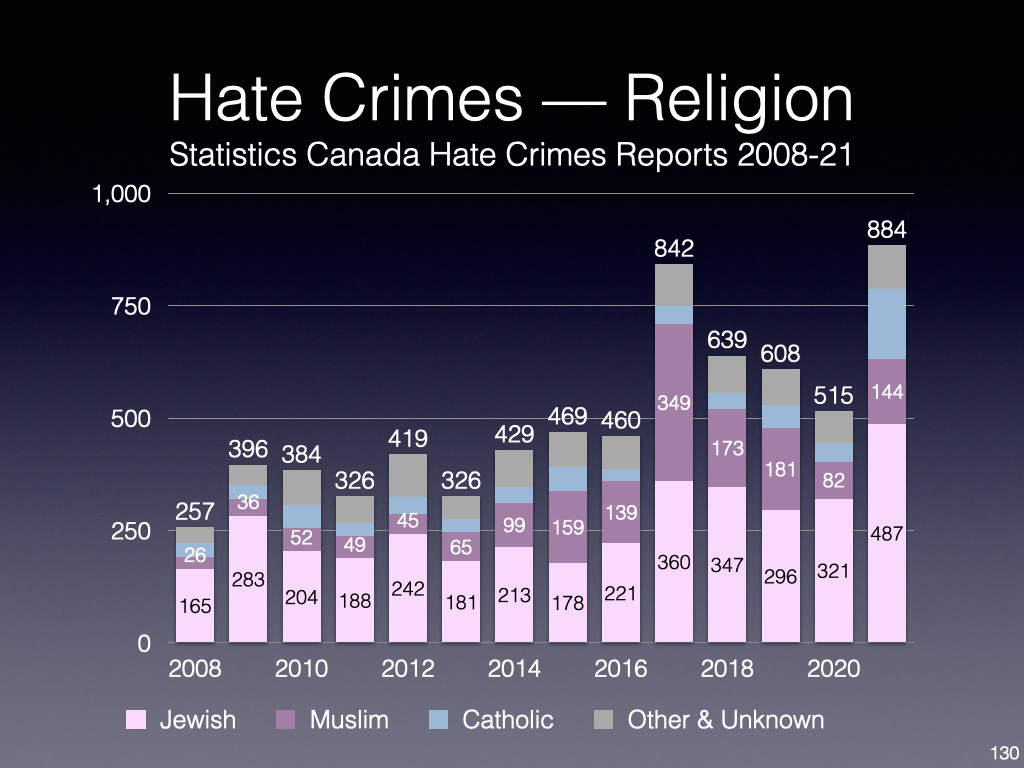
Latest numbers by StatsCan, showing particularly high increase in 2021 of religiously motivated hate crimes, with biggest relative increase for Catholics, likely due to the discovery of unmarked graves. In terms of ethnicity motivated, the rise of anti East and SE Asian hate crimes during pandemic stands out:
The number of police-reported hate-motivated crimes in Canada increased by 27%, up from 2,646 incidents in 2020 to 3,360 in 2021. This follows a 36% increase in 2020. In total, the number of police-reported hate crimes rose 72% from 2019 to 2021. Higher numbers of hate-motivated crimes targeting religion (+67%; 884 incidents), sexual orientation (+64%; 423 incidents) and race or ethnicity (+6%; 1,723 incidents) accounted for the majority of the increase. All provinces and territories reported increases in the number of hate crimes in 2021, except for Yukon, where it remained the same.
Police data on hate crimes reflect only those incidents that come to the attention of police and that are subsequently classified as hate crimes. As a result, fluctuations in the number of reported incidents may be attributable to a true change in the volume of hate crimes, but they might also reflect changes in reporting by the public because of increased community outreach by police or heightened sensitivity after high-profile events. Reporting may also be influenced by language barriers, issues of trust or confidence in the police, or fear of further victimization or stigma.
The head of the Canadian Race Relations Foundation is calling for action to combat hate and more federal help for victims, as new statistics show that hate crimes in Canada rose by 27 per cent last year.
Executive director Mohammed Hashim warned that unless action is taken to combat hate-motivated abuse, including online, it will continue to spread.
He said the “slew of hate” online is so prevalent it risks becoming normalized and those affected are changing their behaviour to deal with it, including by not reading social media comments.
“It is a firehose of hate that is growing, honestly, like a wildfire,” he said. “And unmitigated it will grow even further to a point where we will normalize being in a wildfire.
“That is because we have left this environment unchecked.”
Statistics Canada reported a dramatic increase in hate crimes in 2021. Last year, the number of hate-motivated crimes reported to the police rose to 3,360 incidents from 2,646 in 2020. This followed a 36 per cent rise in 2020.
In total, the number of hate-motivated crimes recorded by the police has gone up 72 per cent since 2019, according to the agency.
Four Muslim Canadians from the same family were killed in June last year when a man rammed a truck into them in London, Ont. Police have said the attack was motivated by Islamophobia.
Public Safety Minister Marco Mendicino said the figures are “further evidence of the alarming and unacceptable rise of hate that marginalized communities have experienced in recent years.”
Mendicino said the federal government is taking action on a variety of fronts, led by new legislation to tackle the rise of hate speech and hate crimes.
“We will not rest until all Canadians feel safe in their communities,” he added.
A report by the race relations foundation, published Tuesday, calls for greater federal help for victims of hate, many of whom do not qualify for financial compensation because their abuse does not count as a crime.
Hashim warned that “not supporting victims and leaving hate to proliferate freely disintegrates Canadian multiculturalism as a whole and a sense of collective belonging to this nation.”
Hate-motivated crimes targeting a person’s religious affiliation were up 67 per cent last year, according to Statistics Canada. Crimes based on a victim’s sexual orientation were up 64 per cent year over year. Another 1,723 recorded incidents targeted a person’s race or ethnicity, a six per cent increase, and together these categories made up the majority of the overall rise.
Marvin Rotrand of B’nai Brith Canada said Jews were the No. 1 target of hate crimes aimed at religious minorities.
“All Canadians should be worried about the alarming explosion of hate crimes witnessed in 2021,” Rotrand said. “Our community comprises 1.25 per cent of the Canadian population but were the victims of 56 per cent of hate crimes aimed at religious minorities. That is more than all other religious groups combined.”
Shimon Koffler Fogel, president and CEO of the Centre for Israel and Jewish Affairs, said incidents targeting the Jewish community have risen by 47 per cent since 2020.
“Statistically, Canadian Jews were more than 10 times more likely than any other Canadian religious minority to report being the target of a hate crime,” he said.
All provinces and territories reported increases in the number of hate crimes in 2021, except for Yukon, where the numbers remained the same.
Hashim, who regularly tours the country speaking to victims of hate as well as community groups and police forces, said more focus must be put on victims. He said young women are facing huge amounts of abuse online, particularly young Black women.
“Right now we talk a lot about hate crime statistics, how police are dealing with it or not dealing with it, being reported or not being reported,” he said. “What we are constantly missing is what is the effect on victims.”
The Department of Canadian Heritage is working on drafting an online hate bill to set up a framework to combat abuse online.
A previous anti-hate bill, introduced at the tail end of the last Parliament, died when the election was called.
Heritage Minister Pablo Rodriguez appointed an expert panel to make suggestions for a future bill, including faster takedown obligations on platforms, in particular over child pornography.
During a consultation by the federal government last year, some minority groups raised concerns about directly involving the police to combat hate speech online.
Hashim warned against “digital carding” and a mass trawl of content online. He acknowledged there is concern about whether police should be able to access all takedown materials for investigative purposes.
“I don’t think that is the proper way of doing online safety. There need to be checks and balances between how much information is accessible to the police. That is why we have warrants,” he said.
“Just creating open access for all police, for all takedown data, for all social media platforms is overkill in my opinion.”
The report commissioned by the Canadian Race Relations Foundation, and written by PricewaterhouseCoopers, said 80 per cent of hate crimes go unreported each year.
The report recommends Canada mirror Germany’s model for supporting victims of hate with millions of dollars of funding for community groups, which people who encounter hate “instinctively” reach out to, as well as a further victims fund.
It says the government’s current compensation schemes exclude many victims of hate because few hate-motivated acts are designated as criminal.
The report also suggests the government establish an emergency response fund for communities hit by hate attacks on a large scale, as well as a central national support hub for victims.