DiManno: Halton school board’s failure to deal with prosthetic-breasts controversy makes a mockery of equity

Good test for reasonable accommodation. IMO, fails the test given health and safety concerns (they teach shop):

The biggest breasts on record belong to one Annie Hawkins-Turner, from Atlanta, measuring 70 inches across and weighing 65 pounds each. Size 102 ZZZ.

But an allegedly transgender Halton teacher is giving Hawkins-Turner a good run for her tatas.

Of course Hawkins-Turner’s bosom was a naturally occurring endowment. The medical condition is called gigantomastia — a rare phenomenon that causes breasts to grow excessively large. Kayla Lemieux, an industrial arts instructor who apparently began identifying as female last year, showed up at school this term with oversized knockers, prosthetics that sag below her waistline, with protruding nipples the size of your knuckles. These features have been accentuated by tight-clinging sweaters.

Students were shocked, although presumably they’ve since grown accustomed to their teacher’s dimensions. Parents, upon learning of the situation — from clandestinely recorded videos that exploded on social media in September, making headlines around the world — protested in front of Oakville Trafalgar High School and complained to the Halton District School Board. I doubt whether any, or many, would be objecting to Lemieux’s gender transition. Gender identity and gender expression are protected grounds under the Ontario Human Rights Code.

That’s not the point. And frankly I don’t know the point that Lemieux seems to be making, unless this is all a bollixed misreported story driven by right wing media and reactionary organizations. If this is how she wishes to present herself to the world, so be it. Although I do wonder if such large breasts are a safety hazard whilst teaching shop.

A reasonable conclusion would be that Lemieux, for reasons known only to her, is making an exhibitionistic and provocative spectacle of herself. That too might be entirely within her rights. You might recall that women in Ontario won the right to go topless way back in 1996, a legal fight that went all the way to the Court of Appeal. The appellant, who’d been convicted by a lower court judge of committing an indecent act — she’d removed her top on a sweltering summer day — had argued against the double-standard that permitted men to go topless but not women. At rallies across the province, women came out to decry the original charge, and part of that movement was aimed at desexualizing female breasts. They’re not always, certainly not exclusively, about sexual arousal — despite what you might think, walking into any strip club.

The Halton school board was singularly incapable of resolving the controversy and, in September, passed a motion asking director of education, Curtis Ennis, about the feasibility of introducing a dress code for teachers. Education Minister Stephen Lecce also asked the Ontario College of Teachers to review professional conduct for teachers, arising from Lemieux’s pendulous udders.

Last week, after a report was presented to trustees, the board claimed it couldn’t implement a teacher dress code, although students are routinely subjected to restrictions.

I’ve read the report, signed by Ennis and Sari Taha, superintendent of human resources at the board. It makes no direct reference to a specific teacher or concern, as if the whole tizzy sprang out of nowhere. Instead, it pivots on the broader issue of a non-discriminatory dress code, its permissibility. Since the parameters of the report don’t address the elephant in the classroom, it’s impossible to speculate whether any such dress code would prohibit exceedingly humongous prostheses.

Upshot: Any dress code for teachers — which clearly was a roundabout way of getting to Lemieux’s dramatically emphasized breasts/nipples — would purportedly expose the board to “considerable liability” for violating the human rights code. Read: lawsuit. Further — and this sounds very much like gilding the liability lily — new rules can’t even be considered at this moment because of ongoing collective bargaining with teacher unions.

The Ontario Labour Relations Act imposes a “statutory freeze” during periods when there is no governing collective agreement, prohibiting employers from altering working conditions during negotiations.

Saturated in diversity and inclusion buzz phrases, the report, abysmally written — bureaucracies are averse to plain-speak — leans heavily into the province’s human rights code. Did they not take a close read of the Commission’s policies on workplace dress codes? Workers in Ontario, and everywhere else, are commonly held to dress code provisos — from restaurant employees to lawyers appearing robed in court to airline crews to health care staff wearing scrubs.

Some places — Hooter’s for instance — compel female employees to wear skimpy butt-cheek exposing outfits and hosiery. It is this kind of wardrobe to which the OHRC draws disapproving attention. “Some Ontario employers require female employees to dress in a sexualized or gender-specific way at work, such as expecting women to wear high heels, short skirts, tight clothing or low-cut tops,” the Commission states on its webpage. “These kinds of dress codes reinforce stereotypical and sexist notions about how women should look and may violate Ontario’s Human Rights Code … They contribute to an unwelcome and discriminatory employment environment for women.”

On the issue of preventing discrimination because of gender identity and gender expression, specifically addressing the trans community: “Dress code policies should be inclusive and flexible. They should not prevent trans people and others from dressing according to their expressed gender.”

Which it seems the Halton board wasn’t pursuing. Lemieux is completely free to dress in a dress, to use the personal pronoun of her choice, and to have her dignity respected.

But this situation is the inverse of what the Commission is promoting by calling out “stereotypical and sexist” dress codes or in any way interfering with trans rights to dress according to their expressed gender. What the Commission doesn’t address, far as I can tell and probably because they never saw it coming, is whether that respect should extend to in-your-face breast prostheses, which wouldn’t necessarily apply only to trans individuals.

Now, I understand the Halton board’s leeriness in taking a dress code risk that could result in a costly human rights wrangle. I’m dubious, however, that directing a teacher to knock off the buxom exhibitionism violates anybody’s human rights.

From the report: “To the extent that workplace policies mandate that employees dress in a particular manner, it is important for those policies to be gender neutral in their application, and that they impose similar dress standards and requirements for all employees, regardless of gender.”

What, pray tell, would be the cisgender, gay, lesbian or trans yin to Lemieux’s extravagant prosthesis yang?

It makes no rational sense. It is folly.

But, it does makes a mockery of equity.

Source: Halton school board’s failure to deal with prosthetic-breasts controversy makes a mockery of equity
USA: Religious groups with immigrant members grew fastest over past decade

Similar as in Canada as Douglas Todd has reported on:

A decennial study of U.S. religious life shows what many demographers and others have long known: Participation in congregational services has not kept up with overall population growth. However, religious groups drawing large numbers of immigrants have seen steady growth.

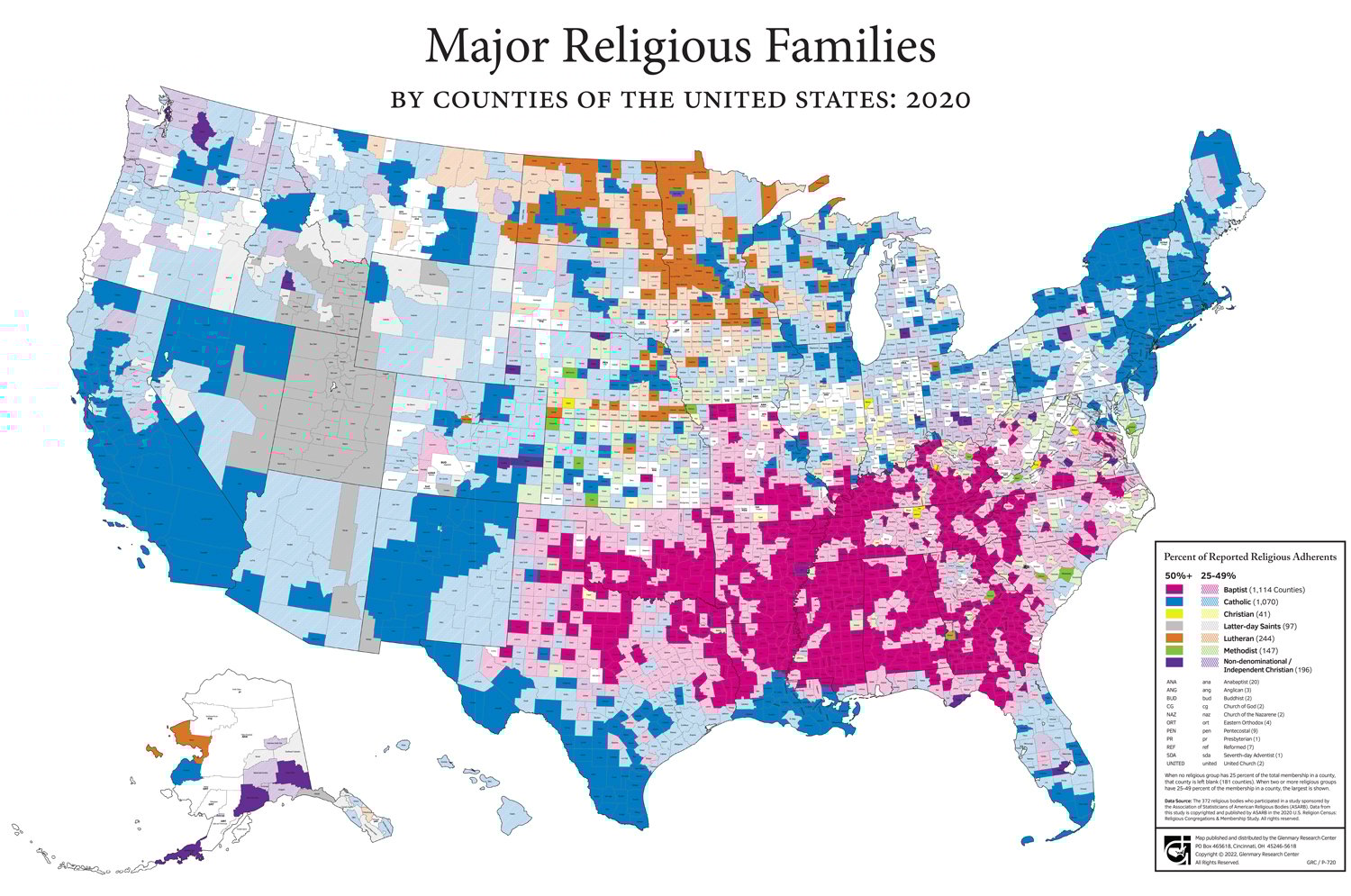
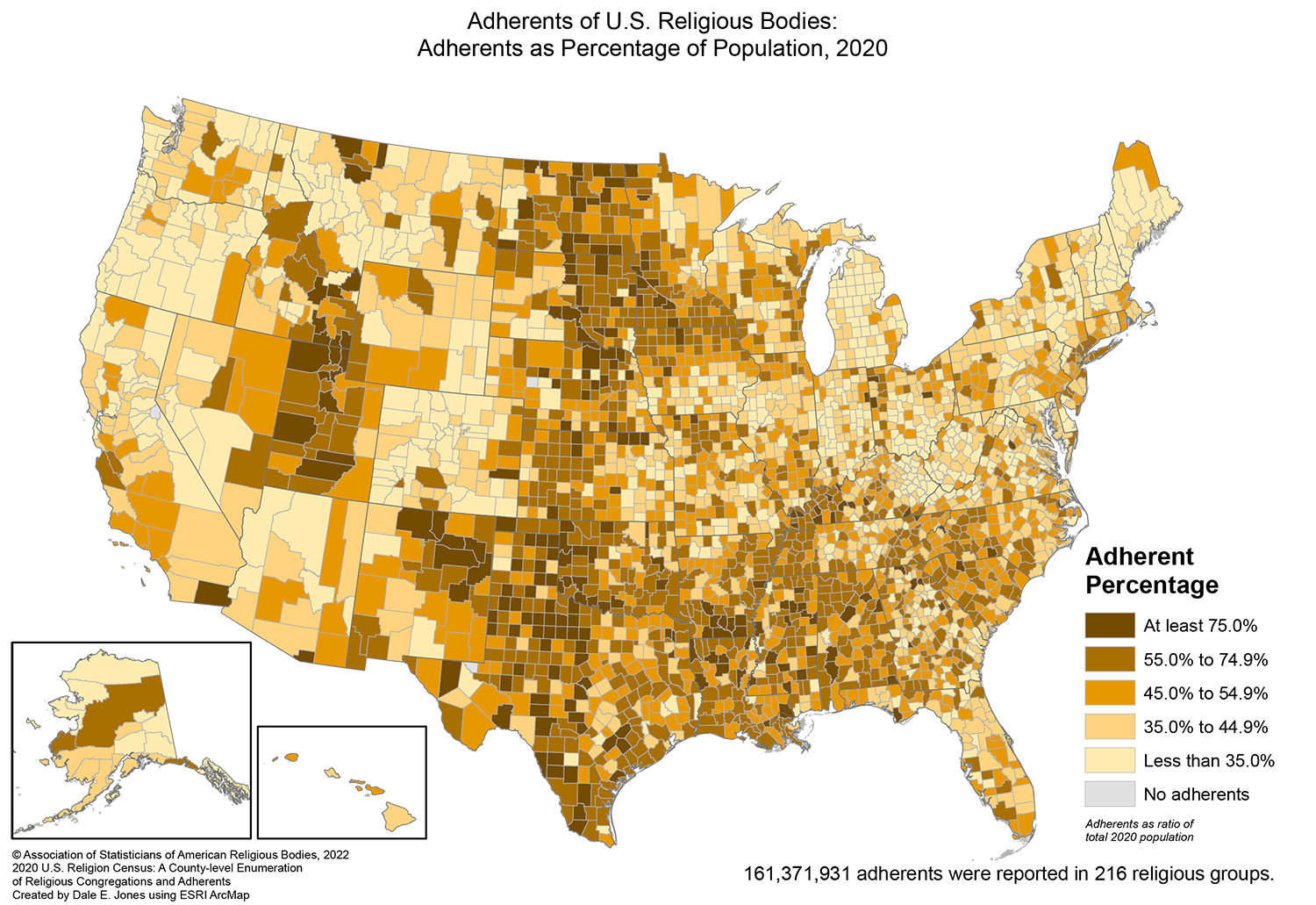
The U.S. Religion Census, conducted every 10 years by the Association of Statisticians of American Religious Bodies, concluded there were 356,739 religious congregations across the nation, and 161 million adherents, including children, in 2020. (Adherents is the formula researchers used to count those with an affiliation to a congregation, including children and people who attend but may not belong.)

Unlike polling, which asks questions from a small sample of the population and extrapolates to the general population, the religion census gathers information from denominations and other religious bodies and maps out the number of congregations and adherents on a county-wide basis. In the 2020 study, researchers collected data from 372 religious bodies, mostly denominations, but also 44,000 independent nondenominational churches. The count included synagogues, mosques and temples of Jewish, Muslim, Buddhist, Hindu, Sikh and Jain traditions

Courtesy Chart

Courtesy Chart

The study finds that the Catholic Church in the U.S. is the largest religious body, with 61 million adherents in more than 19,000 churches, comprising close to 19% of the U.S. population. That’s a modest growth of 2 million adherents from 2010, when the church had nearly 59 million adherents.

Sociologist who worked on the census said growth is almost entirely made up of Hispanic immigrants.

“If you took away the Hispanic population in the Catholic Church, it would look as bad as mainline denominations,” said Scott Thumma, director of the Hartford Institute for Religion Research, who counted independent churches for the census. (Mainline denominations, such as Episcopalian, Lutheran and Presbyterian, have been declining for more than 50 years.)

Perhaps the most striking growth was among Muslims. The number of Muslims who participate in mosque prayer increased from 2.6 million in 2010 to 4.5 million in 2020, a 75% increase. (Pew Research estimates there were 3.85 million Muslims in the U.S. in 2020, but those numbers do not include children.)

That growth is due mainly to immigration, said Ihsan Bagby, associate professor of Islamic Studies at the University of Kentucky, who collected the data for Muslims. Higher birth rates may be a secondary reason.

Bagby estimated the number of U.S. mosques at 2,771, a jump of 871 mosques in just a decade.

He suggested Muslims may be in a kind of golden age in the U.S. They are younger than the American population overall, and the Boomers among them are financially well off and able to contribute to the construction of new mosques. (First-generation mosques were often in retrofitted churches or warehouses.)

Mosques, Bagby said, “have mellowed and matured and become more moderate in their understanding of Islam and that has also been an attraction,” he said. “Many Muslims who had kept away feel more comfortable coming.”

Courtesy Chart

Courtesy Chart

U.S. mosques, like those overseas, do not typically keep memberships. Bagby said he arrived at his estimates by asking for information on weekly Jumah prayers as well as holiday or Eid prayers. (Muslims make up about 2.8% of all religious adherents and about 1.3% of the total population, the study estimates.)

Much of the value of the census is its county-level aggregation, which corresponds to how researchers in other fields, such as population studies and public health, collect and analyze data, said Rich Houseal, secretary-treasurer of the sociological group that conducted the study.

Houseal said the data is also useful to businesses, too. Walmart, he said, has contacted him to help determine what books to stock in their stores based on the dominant religious group in a county.

Among other interesting data points in the study:

  • Southern Baptists have the most churches of any religious group: 51,379.

  • There are some 44,319 nondenominational churches, a jump of nearly 9,000 over 10 years ago, and about 9 million adherents. Still, overall, they account for only 13% of the total number of religious adherents in the U.S.
  • Southern Baptists and United Methodists each lost 2 million members from 2010 to 2020.

“Denominational brands have weakened, and divisions have increased over issues such as female clergy or sexual orientation, Thumma said. “This likely led some adherents to seek or even start new nondenominational churches.”

Source: Religious groups with immigrant members grew fastest over past decade

Tensions rise in Toronto’s Persian community as activists try to expose regime links in Canada

Of note. More coverage on regime links and immigration:

As the uprisings continue in Iran, tensions between supporters of the regime and those who aspire to revolution are being felt in the Iranian diaspora.

In Toronto, anti-regime activists have moved to expose government insiders who they say live with impunity in Canada.

“This man sent me, along with many other students, to prison,” said Ardeshir Zarezadeh, an Iranian-born Toronto lawyer, pointing to his computer screen.

On the website of his organization, the International Center for Human Rights, the photo of Morteza Talaei, the former police chief of Tehran and officer of the Islamic Revolutionary Guard Corps (IRGC), seen on a treadmill, in a gymnasium in Richmond Hill, Ont., in January.

Since the beginning of the uprising in Iran, Zarezadeh has called on members of the Iranian diaspora in Canada to send him information concerning relatives of the Iranian regime who visit or live in Canada in order to expose them on his website.

There is an expression in Iran that Canada is the regime’s paradise.— Mohammad Tajdolati, Iranian journalist based in Toronto

“We all know that many people affiliated with the Iranian regime live in Canada. They come and go.”

“They take advantage of life in Canada,” maintains the lawyer who spent nearly six years in Iranian prisons for his involvement in student movements.

For Mohammad Tajdolati, there is no doubt that the presence of supporters of the Iranian regime in Canada has exacerbated tensions within the Iranian diaspora since the beginning of the uprising.

“There is an expression in Iran that Canada is the regime’s paradise,” says the Iranian journalist based in Toronto.

The activist claims to have contacted the federal government on several occasions in recent years to denounce the presence of relatives of the regime on Canadian territory, without concrete measures being taken by Ottawa.

“They tell us, ‘We know, we’re watching them,’ but that’s not enough. […] That is why we are taking matters into our own hands,” he said.

On Oct. 29, in a long-awaited speech by the diaspora, Prime Minister Justin Trudeau promised to maintain sanctions against the Iranian regime and its leaders. A promise received with skepticism by Zarezadeh.

You can’t do much legally, but by identifying them and exposing them, you can make people cut ties with them, or with their business.– Marjan

“We know that there are people today in Canada who have benefited from this horrible and corrupt regime and who are hiding in the middle of the community enjoying the opportunities that Canada offers. They are using the wealth they stole from the Iranians. We say: enough is enough,” Trudeau said.

He is not the only one. It was this same frustration that prompted Marjan* (her name has been changed) to begin investigating Iranian regime supporters in Canada. The young Torontonian left Iran to escape repression.

Radio-Canada granted her anonymity, because she fears reprisals against her or her family who still lives in Iran.

After arriving in Canada, she says she kept her distance from her home community. The uprising in Iran, however, ignited a new flame within her. On the opiran.toronto Instagram account, she now speaks out against government insiders whose families she says live freely in Canada.

“When I see these people here, it’s like post-traumatic stress disorder for me. I see them near my home, in the street, I see their children playing freely when I did not have this luxury in my country,” she said.

“You can’t do much legally, but by identifying them and exposing them, you can make people cut ties with them, or with their business.”

Even if he understands the anger of his compatriots, Tajdolti is worried about the abuses that some of their actions could cause, such as the denunciation of individuals online. “You have to be very careful because we live in a country of law. You can’t accuse someone very easily,” he warns.

Zarezadeh says he is aware of the risk of defamation. “We make sure that the information we publish is true,” he said, assuring that he will continue his fight.

Exacerbated tensions, broken wall of fear

Beyond online denunciations, tensions are also crystallizing in the community. In “Little Tehran,” a neighborhood located north of Toronto and which owes its name to its large population of Iranians, certain incidents have multiplied since the beginning of the uprising.

Opposite the famous Plaza Irania, in the heart of the Iranian quarter, a butcher shop has been the target of online vandalism and intimidation by netizens accusing it of having links with the Iranian regime.

Graffiti in Farsi saying “death to the mullahs,” for example, was painted on the walls of the Imam Mahdi Islamic Centre in Thornhill, north of Toronto. The mosque was quick to refute any political allegiance.

Both the butcher shop and the mosque declined our offer to comment on the matter.

In front of the same mosque, however, signs with the portrait of the young Mahsa Amini, whose death was the spark of the movement, have been removed, according to a video widely shared on the WhatsApp network. And still in the same place, a motorist tried to rush into anti-regime demonstrators before fleeing and being arrested by the police.

York Regional Police, which serves the territory, says it is not concerned about a possible increase in hateful acts related to the situation in Iran. However, the police say they are aware of the divisions that exist within the Iranian community in the Greater Toronto Area.

According to Tajdolati, tensions have always been underlying in the community, with supporters of the two ideologies living together. What changes this time is that fear has changed sides, according to the journalist.

“The people you see on the streets now, before, they didn’t come to demonstrations because they were afraid,” he said, explaining that being photographed at an event like this could make it difficult afterward to travel to Iran or could make things difficult for their families back home.

“Now, he continues, the situation is so atrocious in Iran, it is so brutal, so inhuman, that these people say to themselves, ‘No, that is enough. I want to participate, I want to do my duty as a human being, as an Iranian.”

“The wall of fear has broken down.”

Source: Tensions rise in Toronto’s Persian community as activists try to expose regime links in Canada

Phillips: Don’t brush off attempts to undermine our democracy. We should know which politicians got China’s money

Indeed:

Can we take a break from lecturing Americans about the state of their democracy and focus for a bit on problems with our own?

Canadians love to watch from a safe distance when all the horrors and glories of the American political system are on display, as they are this week as we comb through the results of their midterm elections.

We especially love to pat ourselves on the back for the fact that our system is, for the most part, mercifully free of the most extreme elements of U.S. politics. That’s mostly just good for our national self-regard, but it would be a shame if it distracts us from the disturbing possibility that a foreign power has been actively interfering in our own recent national elections, even changing the outcome in at least one case.

Put like that, it sounds far-fetched. But Global News reported this week that Canada’s intelligence service, CSIS, warned federal ministers in January that China has targeted this country with a “vast campaign of foreign interference.”

According to the report, CSIS told the government that Beijing funded a “clandestine network” of at least 11 federal candidates, including both Liberals and Conservatives, in the 2019 federal election. It also placed “agents” in the offices of MPs to influence policy and mounted “aggressive campaigns” to punish Canadian politicians it saw as threats to its interests.

Asked about this, Prime Minister Justin Trudeau didn’t deny it. Instead, he essentially confirmed the report by saying some “state actors,” including China, continue to “play aggressive games with our institutions, with our democracies.”

The government then went on, through a speech by Foreign Minister Mélanie Joly, to sketch out its long-awaited Indo-Pacific strategy. This is the famous “eyes wide open” approach, whereby Canada will take a more cautious stance toward China and try to deepen links with other Asian nations, in particular India.

But hang on a moment — let’s not change the channel quite so fast. Those CSIS briefings were pretty specific, according to Global’s Sam Cooper. They alleged that the Chinese government funnelled money through proxies to almost a dozen candidates in a federal election and worked to undermine others.

So many questions. Which candidates got the money? How many of them won, and how many lost? For those who did get money, did they know who was ultimately behind it or were they ignorant of what was going on? And which candidates did China work against? What happened to them?

Finally, was this activity limited to just the 2019 election, or was it happening before or after? A former Canadian ambassador to China, Guy Saint-Jacques, says he believes “several Conservative MPs” lost their seats in the 2019 and 2021 elections because China targeted them through social media networks in the Chinese community.

We know the name of at least one who was probably singled out. Conservative MP Kenny Chiu lost his Vancouver-area seat in 2021 after he introduced a bill to set up a registry of agents for foreign governments (something Canada should certainly have). He immediately found himself labelled as anti-Chinese in Chinese-language social media, and is convinced Beijing’s operatives were behind the campaign to defeat him.

Now it seems he wasn’t the only one, if the CSIS briefing to the government is to be believed. It’s in line with many warnings over the years from Canada’s top intelligence officials that China has been actively meddling in our domestic politics, partly by working through sympathetic politicians and partly by manipulating votes in Chinese communities.

Isn’t this something we should know more about? The government received that CSIS briefing in January, but as far as we know it did nothing. 

It’s important to look at the big picture by elaborating a new Indo-Pacific strategy. And judging by Joly’s speech this week, the government seems to be broadly on the right track. 

But in the meantime, we shouldn’t brush off a real attempt to undermine our democracy. Let’s start by asking where that Chinese money went, and to whom.

Source: Don’t brush off attempts to undermine our democracy. We should know which politicians got China’s money

Blogging break

Back on the 14th.

Iran’s protesters find inspiration in a Kurdish revolutionary slogan

Interesting background to the slogan used by Iranian and other protesters:

For 41 days, thousands of Iranians have taken to the streets in anger over the death of a young Kurdish woman in police custody, even as authorities continue their violent crackdown against them. The demonstrations — honoring the memory of 22-year-old Mahsa Amini, whose Kurdish first name was Jina — have become the largest women’s rights movement in Iran’s recent history.

One resounding slogan has become the movement’s rallying cry: “Jin, jiyan, azadi!” — or “Woman, life, freedom!”

First chanted by mourners at Amini’s burial in her hometown of Saqez, the slogan quickly spread from the country’s Kurdish cities to the capital, Tehran. It took on new life in its Farsi translation — “Zan, zendegi, azadi” — and the message continues to reverberate across solidarity protests from Berlin to New York. Even fashion brands like Balenciaga and Gucci have posted the slogan to their Instagram feeds.

The words “jin, jiyan, azadi” and their various translations have unified Iranians across ethnic and social lines. They have come to signify the demand for women’s bodily autonomy and a collective resistance against 43 years of repression by the Iranian regime.

But Kurdish activists say that some Iranians and the media are overlooking key elements of the Kurdish background of both Amini herself and the slogan pulsing through the mass protests sparked by her death.

“It’s meant to be a universal slogan for a universal women’s struggle. That was what was always intended with it,” says Elif Sarican, a London-based anthropologist and activist in the Kurdish women’s movement. “But the root needs to be understood, at the very least in respect towards the people who have sacrificed their lives for it, but also to understand what this is saying. … These aren’t just words.”

The slogan was popularized during women’s marches in Turkey in 2006

The slogan originated with the Kurdish Freedom Movement, led by the Kurdistan Workers’ Party (PKK), an armed group carrying out an insurgency against Turkish authorities since the 1980s. The State Department has long designated the PKK as a terrorist organization.

The slogan was inspired by the writings of Abdullah Ocalan, the PKK’s cofounder, who said that “a country can’t be free unless the women are free.”

Ocalan advocated for what he called “jineoloji,” a Kurdish feminist school of thought. That ultimately led to the development of an autonomous women’s struggle — the Kurdish women’s movement — within the broader Kurdish Freedom Movement, Sarican explains.

She says the slogan was first popularized during International Women’s Day marches across Turkey on March 8, 2006. Turkey, with about 15 million Kurds, is home to the largest population of Kurds in the Middle East. Although they make up an estimated 18% to 20% of the nation’s population, they face discrimination and persecution.

Since 2006, Sarican says, “Every year, based on ‘jin, jiyan, azadi’ as the philosophy of freedom, there’s been various different campaigns that have been announced and declared to the world by the Kurdish women’s movement on each 8th of March — to say that this is our contribution, this is our call and this is our encouragement for a common struggle of women against colonialism and patriarchal capitalism.”

Five years ago, Kurdish female guerrilla fighters with the YPJ militia chanted the slogan during the Kurdish-led Rojava revolution in northern Syria that began in 2012.

Kurds in Iran face discrimination and many live in poverty

Ignoring the slogan’s political history contributes to the long-standing erasure of Kurdish people’s identity and struggle, activists say.

That’s also been the case in international coverage of Amini’s death, they contend, in which Mahsa — Amini’s Iranian state-sanctioned first name — is used. In interviews, Amini’s parents have used both her Iranian and Kurdish names.

Like many Kurds in Iran, Amini was not allowed to legally register her Kurdish name, which means “life.”

“I felt like she died twice because no one really was mentioning her Kurdish name or her Kurdish background, which is so relevant,” says Beri Shalmashi, an Amsterdam-based Iranian Kurdish writer and filmmaker.

Besides facing ethnic discrimination, Kurds, who make up an estimated 15% of Iran’s population, are marginalized as Sunni Muslims in a Shia-majority country. Their language is restricted and they account for nearly half of political prisoners in Iran. The country’s Kurdish regions are also among its most impoverished.

The Iranian government has blamed Kurds for the current unrest in Iran, according to news reports, and has attacked predominantly Kurdish cities, like Sanandaj and Oshnavieh. Some Persian nationalists, meanwhile, continue to ignore the lived experiences of Kurds in the country.

Shalmashi believes it’s vital to highlight Amini’s Kurdish identity, and the Kurdish roots of “jin, jiyan, azadi,” as a reminder of the need for greater rights for all people in today’s Iran — no matter their ethnicity or gender. Without inclusion and unity, she warns, the current protests risk becoming meaningless.

“Because if you don’t make room for people to be in this together,” she says, “then what are you going to do if you even succeed?”

Source: Iran’s protesters find inspiration in a Kurdish revolutionary slogan

Once wary of immigrants, Canadian town sends out global labor SOS

After all the fuss over the code and the debates over reasonable accommodation, reality intrudes:

Herouxville, a small town in Canada’s Quebec, hit the headlines 15 years ago when it issued a code of conduct for would-be immigrants, warning them not to stone women or burn them alive, and to only cover their faces at Halloween.

Fast forward to 2022, and it’s actively courting new arrivals.

The town council’s once deep-seated fear over accommodating immigrants at the expense of its French-speaking identify has given way to a more pressing concern: a need for more families to help fill jobs, attend its schools and sustain its population.

Herouxville now wants to be known for its inclusion. It’s considering measures like subsidised housing to lure more immigrants.

“A new family, no matter where they are from, if we can welcome them here we are pleased to do it,” said Bernard Thompson, mayor of the town of 1,300 people in central Quebec. “The needs are huge in the rural areas.” 

Herouxville’s outreach is a response to a wider quandary facing Quebec, Canada and many other countries, to varying degrees, as governments from London and Washington to Canberra and Tokyo balance public and political pressure to curb immigration against crippling labour shortages.

Ageing populations, a surge in workers retiring and Covid travel and business chaos are among factors contributing to the sta! crunch hitting both low-paid and skilled occupations, from hospitality and manufacturing to transport and agriculture.

Canada has the worst labour shortages in the Western world, according to the latest OECD data from late 2021. Its plight has been exacerbated by a record wave of retirements this year. The problem is particularly dire in rural Quebec, o”en overlooked by a limited pool of newcomers who prefer to stay in Montreal.

The latest Canadian census data puts new numbers to Prime Minister Justin Trudeau’s drive to ramp up immigration to plug the sta! and skills gaps, which economists say are pushing up wages and threaten to drag down productivity.

Immigrants now account for 23 per cent of Canada’s population, up from 21.9 per cent in 2016, with newcomers accounting for 80 per cent of the country’s labour force growth over the last five years, the census released by Statistics Canada on Wednesday showed.

The census also paints a portrait of urban landings, with more than 90 per cent of recent immigrants living in a city, leaving smaller towns and rural areas grappling to attract newcomers to replace aging factory workers, grocery clerks and doctors.

QUEBEC’S IMMIGRANT CAP

Quebec, a mostly French- speaking province with broad control over its own immigration policy, is resisting change more than elsewhere in Canada. Just 14.6 per cent of its 8.3 million people were born overseas, far below the national average, the new data showed.

The Coalition Avenir Quebec government was re-elected this month pledging to cap permanent arrivals at 50,000 a year to safeguard the region’s language and culture. Immigration has been kept flat at around that level for years, even as Canada’s has risen 49 per cent since Trudeau’s Liberals took o!ice in late 2015.

Reflecting torn local sentiment, Quebec Premier Francois Legault has described immigrants as a source of wealth, though has also said

that allowing more people in without ensuring they speak French would be “suicidal”.

But Legault extended an olive branch to immigrants last week, setting a cabinet that included a trilingual immigration minister and a Black anti-racism minister.

RED CARPET TO NEWCOMERS

Quebec had 246,300 job vacancies as of July 2022 and just 185,100 unemployed people. The labour gap is particularly dire in manufacturing, where the region’s industry association estimating sta! shortages had cost them C$18 billion ($13 billion) in two years.

“Our labour force participation is under more pressure than elsewhere, because we are just not seeing the foreign workers to replace those that are retiring,” said Jimmy Jean, chief economist at financial services firm Desjardins Group in Montreal.

Jean said he expected the Quebec government to come under pressure from businesses to raise the immigration cap, adding that the province risked being le” behind economically by neighbouring Ontario and other large provinces Alberta and British Columbia.

It’s Quebec’s rural towns that are feeling the most acute pain as they have far less migrant pulling power than diverse Montreal, the province’s biggest city, which itself faces deep labour shortages.

That’s why local authorities are taking it upon themselves to roll out the red carpet to newcomers in places like Herouxville, which has long abandoned its code of conduct for immigrants.

Mayor Thompson said the code – unanimously approved by the town council in 2007 – was consigned to the town archives in 2010 by the council that he has run since 2009.

“It was never a legal document … and it is now a historical document,” he added. “It’s been a long time since the citizens and my town put this episode aside.”

Source: Once wary of immigrants, Canadian town sends out global labor SOS

Stephens: Thank Ye Very Much

Good column:

Dear Kanye West, or “Ye”:

We’ve never met and I hope we never will.

Still, I’d like to express a sort of gratitude. With a few outbursts in a few days — you threatened in a tweet this month to go “death con 3” on “JEWISH PEOPLE” and it’s been downhill from there — you’ve probably done more to raise public awareness about the persistence, prevalence and nature of antisemitism than any other recent event.

It’s remarkable how long it took us to get here. For 2020, the F.B.I. reports that Jews, who constitute about 2.4 percent of the total adult population in the United States, were on the receiving end of 54.9 percent of all religiously motivated hate crimes. On many nights in New York City, Hasidic or Orthodox Jews are being shoved, harangued and beaten.

So far, this has been one of the most underreported stories in the country — itself a telling indicator in an era that is otherwise hyper-attuned to prejudice and hate.

At times, the reporting has all but accused Jews of bringing the violence on themselves, with lengthy stories about allegedly pushy Jewish neighbors or rapacious Jewish landlords. At other times — such as after the attack in January on a Texas synagogue by a British Muslim man who had traveled 4,800 miles to get there — reporters seem to have gone out of their way to find non-antisemitic motives for nakedly antisemitic attacks.

More often, attacks on Jews are treated as regrettable yet somehow understandable expressions of anger at Israel. In May 2021, Jewish diners at a sushi restaurant in Los Angeles were physically assaulted by a member of a group that, according to a witness, was chanting “Death to Jews” and “Free Palestine.” A KABC report of the event was headlined, in part: “Mideast tensions lead to L.A. fight.”

To suggest that “Mideast tensions” led to a “fight” is to obscure both the nature and motive of the assault. Imagine the absurdity of a headline that read: “High Levels of Crime in Minority Neighborhood Lead Police Officer to Kneel on Man’s Neck for Eight Minutes.”

Actually, Ye, you probably can imagine it, since you’ve also blamed George Floyd for his own death. But it’s worth pondering the extent to which, in American culture today, Jews are excluded from inclusion and included in the excluded. That is, the Jewish people’s status as an oft-persecuted minority goes increasingly unrecognized, while the Jewish people’s position as a legitimate target for contempt and ostracism is becoming increasingly accepted.

Take Hollywood, where the new Academy Museum of Motion Pictures opened its doors last year with a panel dedicated to “Creating a More Inclusive Museum.” Yet, as The Times’s Adam Nagourney reported in March, “Through dozens of exhibits and rooms, there is barely a mention of Harry and Jack Warner, Adolph Zukor, Samuel Goldwyn or Louis B. Mayer” — the Jews who essentially founded the modern movie industry. (After an outcry, the museum now plans a permanent exhibition for them.)

Or take the law school of the University of California, Berkeley, where nine student groups announced in August that they would not host any speakers who support Zionism, a move that is tantamount to the exclusion of most Jews. In an astonishing defense, law school dean Erwin Chemerinsky noted that the bylaw, which he acknowledged was “discriminatory,” had been adopted by only “a handful of student groups” and had not yet been acted upon — as if Berkeley or any other public law school would tolerate for one instant a single student group that announced its intention to exclude, say, a speaker who believes in trans rights.

Or take Israel itself. Is the Jewish state so uniquely evil that, alone among 193 U.N. member states, it has no moral right to exist? Or is it the unique evil of antisemitism that directs this kind of obsessive hatred at one state only — while generally ignoring or downplaying the endless depredations of regimes in, say, Caracas, Ankara, Havana and Tehran?

These are surely not the things you had in mind when you decided to go “death con 3” on my people. Nor were they necessarily top-of-mind for many of the celebrities who denounced you in tweets and Instagram posts. But your bigotry is as good a place as any to begin to have an honest conversation about antisemitism — one that will hopefully last longer than your own career’s self-destruction.

Honest would be to acknowledge that antisemitism is as much a left-wing phenomenon as it is a right-wing one. Honest would be coming to grips with the fact — as Henry Louis Gates Jr. did in these pages in 1992 — that antisemitism infects corners of Black politics as much as it infects the politics of white supremacy. Honest would be holding to account people who were complicit in your antisemitism — such as Tucker Carlson, who praised your “bold” beliefs while editing out your antisemitic remarks from his interview with you. Honest would be coming to terms with the extent to which anti-Zionism has become the antisemitism of our day, echoing the same sordid conspiratorial tropes about Jews as swindlers and impostors.

Honest would also be admitting that you speak for more people than many Americans would have cared to admit. For that, but only that, you deserve thanks.

Source: Thank Ye Very Much

Ibbitson: Immigrants are the great insulators against the worst economic and political threats we face

Consistent with his various earlier columns with no recognition of the externalities and costs of further increases:

According to census data released Wednesday, almost one-quarter – 23 per cent – of the people living in this country were not born here, the highest percentage since Confederation. That is the best possible news.

Along with helping ease labour shortages and soften the impact of an aging population, this latest generation of pioneers will help insulate our democracy from the demagogic threats that confront other Western nations. Immigrants will help save us from the worst of ourselves.

Almost every region of the country is taking in newcomers. According to Statistics Canada, more and more immigrants are settling in Atlantic Canada, which is helping to prevent population decline while bolstering the regional economy.

The worrying exception is Quebec. Resistance to immigration in French Canada, where preserving the language and the culture matters more for many than growth and renewal, is showing up in the census data.

Immigrants make up 15 per cent of the province’s population. The figure for Ontario is 30 per cent; for British Columbia 29 per cent; for Alberta 23 per cent.

Quebec will pay a price for partially closing its doors. Immigration can’t reverse the effects of an aging society, but it can help smooth the transition, providing workers to fill gaps in the labour market and to pay taxes that sustain social services.

But immigration’s greatest impact might be intangible. Many Western nations are grappling with populist, nativist movements that threaten democracy.

Put bluntly, some white people resent non-white newcomers and vote for politicians who promise to keep them out. Those politicians, in turn, often seek to corrupt democratic norms. For their supporters, social cohesion matters more than democracy.

A slew of Republican candidates in the Nov. 8 midterm elections refuse to accept the outcome of the 2020 presidential vote. Donald Trump clearly hopes to return as president. The republic might not survive that return.

Italy’s new prime minister, Giorgia Meloni, leads the most far-right government since Mussolini was deposed. In parts of Eastern Europe, democracies are fading away. The far right is on the rise in Sweden, Spain, Belgium and elsewhere.

Nothing like that is happening here. Yes, the so-called freedom convoy produced a great deal of sound and fury when it occupied downtown Ottawa in the winter. But Maxime Bernier’s People’s Party, the only party that flirts with the white protest movement, received 5 per cent of the vote in the 2021 federal election.

High levels of immigration help insulate us from the worst of the far right. For one thing, people who are most opposed to immigrants – the sort who harbour false notions that newcomers take away jobs, end up on welfare and fail to integrate – tend to live in communities where they never see immigrants. But there aren’t many of those places left.

Nine per cent of the people in Moncton are immigrants. Thunder Bay is at 8 per cent. The figure is 14 per cent in Lethbridge, Alta. No wonder a recent poll showed seven in 10 Canadians are comfortable with the current immigration levels. The more people become used to living in diverse communities, the more at ease they are with diversity.

As well, it’s hard for a white nativist to win an election in a country where almost a quarter of the population is not native-born. Immigrants and their children are not going to vote for a political party that wants to limit their numbers and rights. The ballot box is a weapon that immigrants use to protect their interests, as they should.

The new census predicts that if present trends continue, within a couple of decades immigrants will make up about a third of the country. I predict the share will be higher. The Liberal government will be releasing its immigration targets shortly; we should expect a steady increase in intake even above the 451,000 planned for 2024. Conservative Leader Pierre Poilievre says he is committed to high levels of immigration. He’d better mean it, if he ever wants to become prime minister.

Governments and the markets will be challenged to find places to put all these newcomers. It’s worth the challenge. Immigrants are the great insulators against the worst economic and political threats we face. The more we can bring in, the better.

Source: Immigrants are the great insulators against the worst economic and political threats we face

Police can’t pull over a driver without cause, Quebec Superior Court rules in racial profiling case

Of note. Significant:

Police motor vehicle stops without cause are a violation of the Canadian Charter of Rights and Freedoms, Quebec Superior Court ruled Tuesday.

The decision won’t put an end to racial profiling overnight, Judge Michel Yergeau wrote in his ruling, but the court is allowing a six-month delay until the rules allowing random stops are officially invalid.

“Racial profiling does exist. It is not a laboratory-constructed abstraction. It is not a view of the mind. It is a reality that weighs heavily on Black communities. It manifests itself in particular among Black drivers of motor vehicles,” Yergeau said.

“Charter rights can no longer be left in thrall to an unlikely moment of epiphany by the police. Ethics and justice must go hand in hand to turn this page.”

The time has come for the judicial system to recognize and declare that this “unbounded power” violates some right guaranteed to the community, the court said.

Montrealer leads charge for change

This decision comes after Montrealer Joseph-Christopher Luamba, a 22-year-old Black man, told the court he gets ready to pull over whenever he sees a police cruiser.

In the 18 months after he got his driver’s licence in March 2018, Luamba said he was stopped by police around 10 times for no specific reason. He said he was driving a car during about half the stops and was a passenger in another person’s car during the other police stops.

Those traffic stops were at the heart of the lawsuit that he filed against the Canadian and Quebec governments. The case began in May of this year.

Luamba said he believes he was racially profiled during the traffic stops — none of which resulted in a ticket. Common law has long allowed Canadian police to stop people for no reason, but Luamba has been fighting for the practice to be declared unconstitutional.

“I was frustrated,” he told the court. “Why was I stopped? I followed the rules. I didn’t commit any infractions.”

Lawyers for Luamba and the Canadian Civil Liberties Association, which has intervener status in the case, told the court that the power of police to randomly stop drivers, outside of drunk driving checkpoints, is unconstitutional and enables racial profiling.

The court ruled on Tuesday that this practice violates the rights guaranteed by Sections 7 and 9 and paragraph 15 of the Canadian Charter of Rights and Freedoms.

“The preponderant evidence shows that over time, the arbitrary power granted to the police to carry out roadside stops without cause has become for some of them a vector, even a safe conduit for racial profiling against the Black community,” wrote Yergeau in his ruling.

Challenging Supreme Court ruling

Yergeau’s ruling challenges the rules established by a 1990 Supreme Court decision, R. v. Ladouceur, where the high court ruled that police were justified when they issued a summons to an Ontario driver who had been stopped randomly and who had been driving with a suspended licence.

The high court ruled that random stops were the only way to determine whether drivers are properly licensed, whether a vehicle’s seatbelts work and whether a driver is impaired.

But Yergeau wrote it was time for the justice system to declare this power, which violates certain constitutional rights, obsolete and inoperable, as well as the article of Quebec’s provincial Highway Safety Code that allows it.

Still, Yergeau wrote that the ruling applies specifically to the random stops. He said the ruling is not meant to be an inquiry report on systemic racism involving racialized or Indigenous peoples.

The judge also said the ruling is not about racism within police forces, saying the court heard no evidence in this regard, nor did it draw a conclusion.

But he noted that “racial profiling can sneakily creep into police practice without police officers in general being driven by racist values.”

Lawyers for the Canadian and Quebec governments argued that the Supreme Court was right to uphold the rule allowing random stops, which they say is an important tool for fighting drunk driving.

Police forces testified about the different efforts made to curb racial profiling and diversify their rank and file.

There was no immediate word on a possible appeal.

At the federal level, a spokesperson for Minister of Justice David Lametti said in an email that the ministry is aware of the decision and “will take the time to study it before commenting further.”

Source: Police can’t pull over a driver without cause, Quebec Superior Court rules in racial profiling case