Organ donations remain a hard sell among some groups

Of note. Wonder whether this changes for the second generation:

Religions, beliefs, culture, and even local history influence what Canadians — especially immigrants — think should happen to the body after death. These beliefs and traditions surrounding death could impact medical research opportunities. 

In Ontario, medical schools depend on donated bodies to train future medical professionals. ‘Body donation’ involves a whole body given to schools of anatomy for educational and research purposes.

Western University in London, Ont., is among the Canadian universities feeling the impacts of a lack of body donations, reporting that cadaver availability is down by 20 per cent during the COVID pandemic. Medical schools have been scrambling for bodies and even resorting to synthetic alternatives to continue their studies. 

Low supply

Although cadaveric whole-body donations are of utmost importance for medical education, the number of persons who choose to donate bodies remains low.  Organ donors, on the other hand, have more willing participants. According to a survey conducted by Ipsos Reid, 81  per cent of Canadian respondents are willing to donate their organs after death. Although most are willing and support the idea, the survey found that only 54 per cent actually carry documentation that indicates their consent to organ donation and 39 per cent have not discussed with their families their wishes when it comes to organ donation. 

Immigrants in Canada mostly stay clear of whole-body donations, and their numbers hardly make a dent in body supplies. Most of them owe allegiance to their faiths, religious practices and culture which do not encourage body donations.

According to 2017 study, families of immigrants in Ontario are less likely to provide consent for organ donation compared with families of longterm residents (46.4 per cent versus 68.8 per cent). Another study shows that immigrants were much less likely to register for deceased organ and tissue donation in Ontario (11.9 per cent versus 26.5 per cent). The largest numbers of unregistered immigrants were from India, China and the Philippines.

Respect for dead bodies manifests itself in diverse ways in different cultures. According to Nazira Tareen, a prominent community builder and spiritual caregiver of Ottawa’s Muslim community, Muslims do not donate bodies for religious reasons.  

“[The] Quran wants bodies to be interred as soon as possible after death. Islam forbids defilement of the body whether by dissection, removal of tissues or organs. A dead body deserves dignity with a timely burial,” said Tareen.

“We pay spiritual importance to an ‘intact’ body by following the standard practices of shrouding the body with five yards of white cloth and a coffin,” according to Tareen.
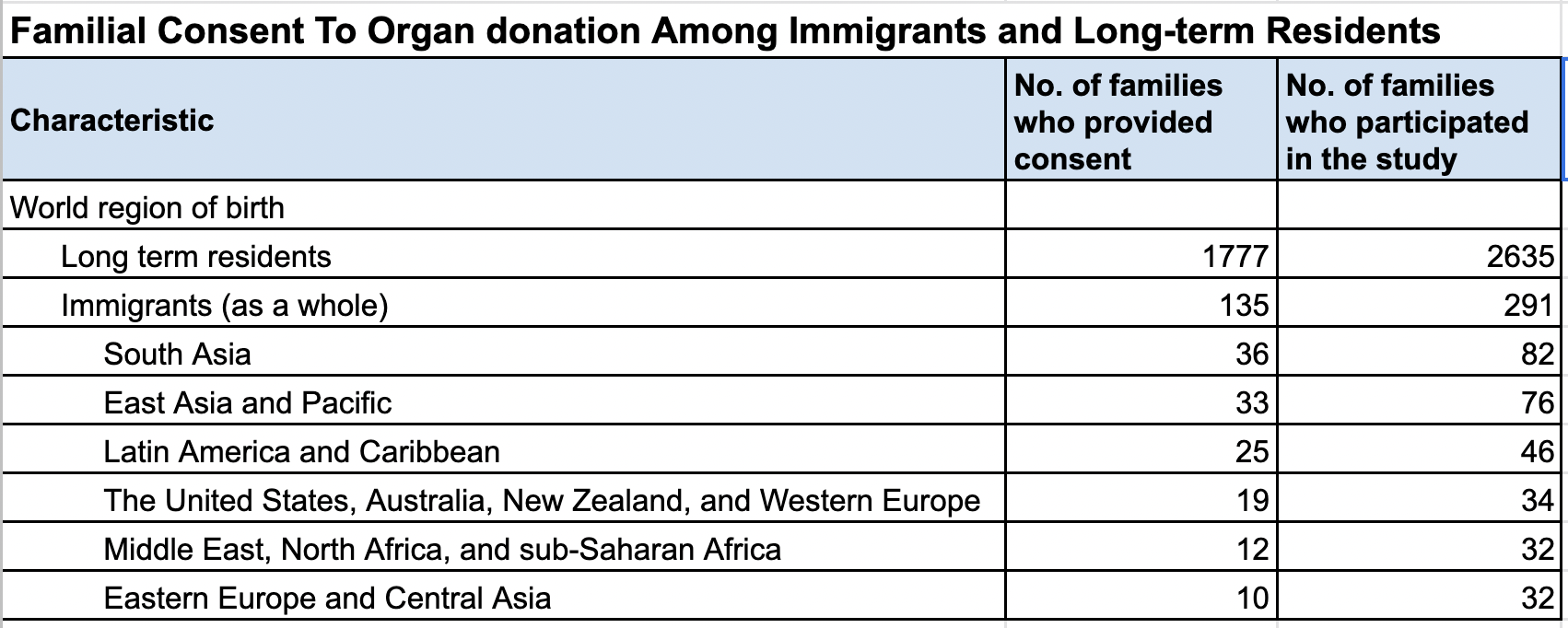
Table above shows that families of immigrants were less likely to provide consent compared with families of long-term residents (46.4% [135 of 291] vs 68.8% [1777 of 2582]). It also showcases the number of immigrant families who provided consent to organ donation by region of birth. Table made by Daphné Dossios with data found on Familial Consent for Deceased Organ Donation Among Immigrants and Long-term Residents in Ontario, Canada: A Population-Based Retrospective Cohort Study

Another study with interviews and focus groups about Chinese Canadian beliefs toward organ donation found that among its participants, religion or spiritual beliefs, a lack of knowledge about donation, and generational impressions of organ donation were factors that influenced decisions on organ donation after death. The study notably found that values and beliefs about keeping a body intact after death is a major barrier to organ donation.

“There’s a saying in Chinese that in order to rest in peace, one needs to have everything intact in the body after one is dead. So if you take away something and then it’s considered to be something missing after death, then the person would not enjoy good after death or after life”, explains a participant of Chinese descent, interviewed for the study.

A similar study among Indo-Canadians in British Columbia also found religion and beliefs about dying and death could influence decision-making in organ donation. The study also highlights that Indo-Canadians have little information and are not familiar with the B.C. system of registering as an organ donor, which could constitute a hurdle. According to some participants, language could possibly be another barrier, as presentations about organ donation in B.C. are not provided in Hindi.

Vijay Dhavale, an Indian-born Canadian — who is a four-time recipient of two prestigious Government medals — chose to donate his parents’ bodies to medical colleges (in 2006 and 2009) and also donated his wife’s body in 2019.

Dhavale, who has been in Canada for 49 years and is currently based in Ottawa, is a Hindu. 

“My family believed in being useful even after death. In my will, I have asked that my body be donated for learning purposes.”

Dhavale said his decision to go for body donations was influenced by the example of Sage Dadhchi (a figure in Hinduism) who willingly gave up his life so that Lord Brahma (God of creation in Hinduism) could fashion weapons from his bones to defeat the demons. “In death, I am celebrating life, I want my body to be useful too like the Sage’s.”

In Canada, another challenge often faced by bereaved immigrants is the choice to inter the deceased in the host country or repatriate the remains for burial in the country of origin. Most often parents of immigrant students ask that the bodies are returned to the mother country so that they can conduct the last rites.

Impacting medical education 

The dearth of cadavers is causing a disturbing deficiency directly impacting the quality of medical education in Canada. Practicing on cadavers helps with the sensory modalities — the touch, the feel, the perception of depth.  “Students can listen to theories about the structure of the heart, see pictures of the structure, but it’s not until they hold the heart in their palm that they can really appreciate it,”  according to an anatomy professor at Queen’s University, Dr. Leslie Mackenzie. Queen’s University in Kingston, which actively runs donor campaigns and educates the public, receives 20 to 40 body donations every year. 

The University of British Columbia (UBC) on its website states that more than 1,000 students every year in different medical programs are trained in anatomy using cadavers. During pre-pandemic times, UBC received 80 to 120 human cadaver donations a year, “but programs now receive 50 per cent of that number,” observed Dr. Olusegun Oyedele, associate professor of teaching in the UBC department of Cellular and Physiological Sciences. 

In Canada, bodies can be donated by bequeathing the body to universities across the country. Haley Linklater who oversees the body bequeathal program at the Schulich School of Medicine and Dentistry, London, Ont., confirmed in an email the urgent need for bodies. 

“The University is currently accepting new donors,” Linklater wrote, “We need 100 or more every year to be able to assist in all of our teaching and to contribute to research, but we get a few less than that, usually 75 to 85.” 

Linklater isn’t sure what to attribute to the drop in body donations except for the fear of infection during the pandemic period. In many cases, she found the bereaved relatives desired to have the body available for conducting a traditional rite, and hence they held back on body donations. According to Linklater. In 2021 and 2022 thus far, “we’ve only had 60 to 65 donors.” 

In face of this cadaver shortage, some medical schools are using high-tech mannequins, computer software and digital simulators as an alternative. In 2018 for example, Wilfrid Laurier University (WLU) in Waterloo, Ont., received two full-sized, multi-functional synthetic human models from SynDaver making WLU the first institution in Canada to possess two full-body synthetic humans. As one can read on the company website, “the tissues are [even] a better representation of live tissue than the dead tissue of a cadaver.”

Source: Organ donations remain a hard sell among some groups

Two years after signing BlackNorth Initiative, majority of companies have failed to make substantial progress on diversity, survey shows

Good to see the tracking. Good highlighting of some of the better practices that can be more broadly applied (both for Blacks and other minorities):

Some of the largest companies in Canada that announced high-profile commitments to address anti-Black systemic racism two years ago have made major strides in improving the number of Black employees hired and elevated into executive roles, a Globe and Mail analysis has found.

But those companies remain among a minority of signatories of the BlackNorth Initiative – a 2020 pledge aimed at tackling systemic racism – to make substantial progress toward the diversity goals they committed to meet over five years.

On three prominent metrics – the number of Black employees, Black executives and Black directors – only about 10 per cent of the 481 companies that signed on have reported an improvement in any of those categories over the past two years.

Among 145 companies that responded to The Globe’s survey in the spring of 2022, the median percentage of Black employees increased to 4.8 per cent, up from 3.7 per cent in 2020, before companies signed the BlackNorth pledge.

But 70 per cent of companies that signed the pledge either did not respond to The Globe’s survey this spring about the racial composition of their work force, or said they did not track that data. Thus, improvements in the number of Black and other racialized employees since 2020 were only apparent among the minority of companies that responded to The Globe with detailed data.

“I think it’s safe to say that a low response rate correlates to the slow amount of change that is happening,” said Kike Ojo-Thompson, founder and chief executive of the KOJO Institute, a Toronto-based diversity, equity and inclusion consultancy.

While projects such as the initiative encourage companies to assess themselves and provide external accountability, they also highlight areas in which corporate Canada has yet to improve.

To Dahabo Ahmed-Omer, executive director of the BlackNorth Initiative, it’s no surprise that many companies are slow to make progress. “It’s not just about putting a signature on the dotted line. That’s not what this initiative is about,” she said.

The initiative, a Toronto-based non-profit organization, was founded by Bay Street financier and philanthropist Wes Hall in July, 2020, amid a wave of global Black Lives Matter protests sparked by the murder of Minneapolis resident George Floyd by a white police officer. Broadly speaking, the initiative encouraged employers to commit to targets to raise the number of Black employees, and to ensure no barriers exist for Black employees trying to advance.

Companies were challenged to commit to a seven-pronged pledge over five years, including promises to have at least 3.5 per cent of board and executive roles occupied by Black people by 2025, and ensure Black student hires make up 5 per cent of the overall intern population of a workplace. Signatories also committed to investing at least 3 per cent of corporate donations in organizations that create economic opportunities in the Black community.

The initiative was swiftly embraced by corporate Canada. Within days of its launch, more than 200 prominent companies, including Rogers Communications Inc., most of the Big Five banks, and multinational heavyweights such as Coca-Cola and Adidas signed on. Many were quick to issue news releases, reiterating their commitments to diversity, and promising to address anti-Black systemic racism within their workplaces.

Over the following 12 months, close to 500 companies of all sizes – including The Globe – signed on. BlackNorth itself expanded – in headcount and the value of corporate donations it received – as it became the pre-eminent entity advising corporate Canada on diversity and equity.

This spring, The Globe surveyed all 481 companies that have signed the pledge to assess progress toward the five-year goals. The survey was similar to The Globe’s survey last yearof 209 companies that signed the pledge in July, 2020.

The Globe asked companies to respond to an 18-question survey based on the seven goals in the pledge, and gave companies roughly six weeks to respond.

The questions were designed to determine how the diversity of the companies’ work forces – particularly the composition of Black employees – has changed since the summer of 2020. The Globe also collected data on the number of Black directors and executives.

The Globe showed some improvement itself in the number of Black executives and BIPOC (Black, Indigenous and People of Colour) employees in its work force. Currently, 10 per cent of executive roles are held by Black employees, up from zero in 2020.

The Globe doesn’t track the total number of Black employees, but says 30 per cent of employees are now BIPOC, up from 25 per cent before The Globe signed the pledge in late 2020. However, as a private company with a small board, The Globe does not have a Black board member.

Critically, just 30 per cent of BlackNorth signatories – or 145 companies – responded to The Globe’s survey, significantly lower than last year’s response rate. Twelve additional companies did not respond, but provided separate written submissions on how they worked toward meeting their diversity goals.

Among the companies that responded, many either chose not to disclose numerical data on the racial composition of their organizations, or said they did not track it.

However, almost all the companies that responded, even those that did not last year, said they have established diversity leadership councils and come up with a strategic “diversity and inclusion plan,” which were two requirements of the BlackNorth pledge.

Other key findings of The Globe survey from the 145 companies that responded:

  • The median number of Black employees across those companies increased over the past two years – from 3.7 per cent in 2020, to 4 per cent in 2021, to 4.8 per cent in 2022.
  • The median number of BIPOC employees also increased – from 25.6 per cent in 2020, to 31.9 per cent in 2021, to 33 per cent in 2022.
  • The median number of Black executives increased from 0 per cent in 2020, to 1 per cent in 2021, to 2 per cent in 2022.
  • A majority of companies tracked the number of Black directors on their boards. The median percentage increased from 0 per cent in 2020 and 2021, to 0.5 per cent currently.
  • There was a marked improvement in the number of companies that tracked diversity data since signing the BNI pledge. For example, before signing, just 40 per cent of the 145 companies said they tracked data on the number of Black employees. In 2022, the proportion increased to 60 per cent.
  • 30 companies with more than 5,000 employees – including Manulife Financial Corp., SickKids hospital and HSBC Canada – made significant gains in the number of Black directors. The median number of Black board members was 6.5 per cent in 2022, increasing from 2.35 per cent last year.

The results were, for the most part, better than last year, when a majority of companies made little to no improvement in hiring or elevating the number of Black people, mainly because they did not have the right systems in place to track diversity data.

Source: Two years after signing BlackNorth Initiative, majority of companies have failed to make substantial progress on diversity, survey shows

Jamie Sarkonak: Some are more equal than others, according to Canada’s immigration ministry

One of the early mainstream media commentaries on IRCC’s anti-racism strategy (see my earlier post (IRCC Anti-Racism Strategy 2.0: “Energy, Conviction and Courage” [too preachy for my taste]).
While I did not read it the same way as Sarkonak, reflecting my perspectives, reading this reminded me of my experience when working under the Conservative government and Jason Kenney when I was confronted with a very different worldview (shameless plug for Policy Arrogance or Innocent Bias: Resetting Citizenship and Multiculturalism).And while many of the specific provisions in the strategy are fairly standard anti-discrimination and anti-racism tools to help identify biases and discrimination, understandable that the framing of them would attract attention as being overly “woke” given the frame of CRT and the “wheel of privilege and power.”

In terms of some of Sarkonak’s specific solutions to IRCC, some are stronger than others. It makes sense to publish approval rates by country of citizenship as differences in approval rates may, but not necessarily, indicate biases. Similarly, monitoring of staff for arbitrary decision-making makes sense pending the development of more AI and other tools that can provide consistent decision making (as Kahneman and others argue in Noise). On the other hand, simply bolstering staff to address backlogs avoids the necessary policy and administrative changes needed to reduce future backlogs.

Sarkonak criticizes tying EX bonuses to DEI and anti-racism and ensuring targeted career development programs for minority staff but these types of policies have been in place for some time in one form or another (I remember in the early 1990s that Global Affairs identified women with potential to address the gender gap with considerable success).

But perhaps one statement in the strategy is the one that would provoke a possible future Conservative government the most, the policies are intended to survive “regardless of changes in government” as it smacks of bureaucratic arrogance rather than a more neutral phrase of something like “establishing the basis for further inclusion:”

In a corporate plan for an anti-racist “systems change,” Canada’s immigration ministry says it isn’t fair to treat people equally regardless of background. Instead, people should be treated according to their level of innate privilege.

In other words, Immigration, Refugees and Citizenship Canada (IRCC) has embraced critical race theory — or diversity, equity and inclusion (DEI), as it’s called in practice — with a plan called Anti-Racism Strategy 2.0. It openly signals a shift to the ideological left.Unfortunately, concerns about racism within IRCC aren’t unfounded. An external review reported dozens of openly racist comments in the workplace. Perhaps the worst allegation was that those within IRCC often refer to African countries as “the dirty 30” — an embarrassing display of prejudice for a department welcoming new citizens into a country that’s supposed to respect the right to equality.

It’s therefore no surprise that the question of racism comes up when rejection rates for applications vary by country. With few explanations from officials, advocates understandably come up with their own: systemic racism. This was the case when study permit applications from Nigeria were found to be disproportionately rejected by IRCC. Elsewhere, critics have correctly pointed out that Canada committed to taking an unlimited number of refugees from Ukraine, while capping Afghan applicants at 40,000.

The solution should be to bolster staff so that applications can be processed in a reasonable time (the immigration backlog is an astronomical 2.7 million) and to enforce workplace rules against instances of racism in the office.The department can also publish approval rates by country of origin, as it does with approval rates for foreign student study permits. If applications from certain countries are being disproportionately rejected, explanations should be offered as to why.

There isn’t a duty to accept an equally proportionate number of immigrants from each country in the world, and it’s quite possible that acceptance rates are lower for some countries simply because more applicants from there aren’t meeting our requirements — that’s not systemic racism, that’s just the fair application of the rules to everyone.

But Canadians have a right to know what’s going on, and the government can’t have its employees acting out of bigotry. Individual immigration officials should be monitored through annual performance reviews to ensure they aren’t arbitrarily rejecting would-be immigrants due to their country of origin. If unfair discrimination is going on, disciplinary action should be taken.

IRCC’s solution is more complicated. Instead of investigating bad managers and disproportionate immigrations outcomes between countries, it’s adopted the explanation of unconscious and systemic racism that stems from critical race theory. Racism isn’t just hatred, IRCC says, but includes unconscious and unintended actions that lead to any discrimination or prejudice against any group. Similar policies have emerged in Canadian public institutions, including schools (where anti-racist material is beginning to be taught to students), universities (where white males are barred from applying for certain jobs), the military (where applications from diverse candidates are prioritized) and even the Bank of Canada (where DEI is to be kept in mind when setting monetary policy).

Equality isn’t fair anymore, says IRCC. Fairness is traditionally thought to involve treating people equally, but it’s been redefined as a matter of outcome. Unfair outcomes happen when a group of people is “overrepresentative” of their population statistics. IRCC’s plan to “eradicate racism in all its forms” is paradoxical, because it requires identity-based discrimination (what we used to call racism) to achieve this version of a “fair” outcome (elimination of racism).

The ministry doesn’t limit this kind of thinking to race, ranking various identity genres according to privilege to help “correct power imbalances.” These include education level, Indigeneity, skin colour, brain structure, sexual orientation and gender.

It’s a dehumanizing way to look at people. Even so, the IRCC wants to permanently embed identitarianism into every aspect of the ministry, “regardless of changes in government.”

The idea is to transform everything from finances and organizational procedure to the relationships between people in the ministry and the way people think and talk. A number of practical goals are set out to achieve this, which will be monitored by report cards.

For management, IRCC wants to tie bonuses and promotions to anti-racist performance.

For staff, identity-specific career development programs will be made to help certain groups get promotions; “Indigenous, Black, Racialized, Persons with Disability, LGBTQ2+ and individuals with intersecting identities” are to be given special attention for staffing. Targeted workshops and focus groups are planned to teach the ministry’s expansive theory of racism within the ranks.

For the actual business of immigration, IRCC plans to fund resettlement initiatives that promote DEI, or the practice of critical race theory. Any community organization that resists will be risking precious grant dollars.

For the millions of people waiting in Canada’s immigration backlog, government commitments to reshape staff thoughts and civic ideology are about as useful as thoughts and prayers. Worse, these changes to the public service are political. Perhaps it sounds nice to those who believe in this version of social justice, but it’s a radical paradigm shift away from the Canadian values of fair procedure and equality.

If these basic values are going to be completely redefined in government, perhaps they should at least be debated in the House of Commons first. Instead, these political changes to the function of government are being made out of public view. The immigration ministry acknowledges they’re being made at the direction of the Clerk of the Privy Council and the Prime Minister’s Office (PMO), which have demanded more DEI in the public service.

It sends a bad message to those seeking to come to Canada for equal freedom of opportunity and open debate: Major changes aren’t up for discussion, but are instead the business of the PMO and the unaccountable ministry bureaucrats who write up corporate plans.

Source: Jamie Sarkonak: Some are more equal than others, according to Canada’s immigration ministry

Moreau: Êtes-vous caucasien ?

More word games than anything else. Whatever the label or term, being able to analyse and understand differences in socioeconomic outcomes between groups, whether by ethnic ancestry, visible or religious minority or affiliation, is important:

Comme on sait, le terme « caucasien » est utilisé depuis plus d’un siècle aux États-Unis pour qualifier la population d’origine européenne. J’ai eu récemment la surprise de le voir également mentionné, à titre d’exemple, dans un formulaire rempli ici à Montréal, où l’on me demandait, comme cela se fait couramment chez nos voisins du Sud, de décliner mon « identité » ethnique ou raciale.

Ce que l’on sait moins, c’est que ce terme étrange, qui réfère à cette chaîne de montagnes située au sud de la Russie, entre la mer Caspienne et la mer Noire, provient des thèses de Johann Friedrich Blumenbach (1752-1840), scientifique allemand qui, à la fin du XVIIIe siècle, distinguait cinq « races » humaines, dont la « race caucasique », autrement dit la « race blanche ».

Pourquoi situait-il l’origine de celle-ci dans le Caucase ? Cela remontait à l’idée selon laquelle l’humanité était née dans la région caucasienne, idée qui découlait notamment d’une lecture littérale de la Bible, où il était raconté que l’Arche de Noé, lors de la décrue qui avait fait suite au Déluge, s’était échouée sur le mont Ararat, donc non loin de l’isthme caucasien. On peut constater au passage à quel point la manière d’établir des « preuves » scientifiques pouvait être en ce temps assez éloignée de celle qui prévaut de nos jours.

Qu’il fut impropre et douteux d’un point de vue scientifique n’empêcha pas le mot « caucasien » de connaître un succès durable et de se retrouver même au coeur d’un imbroglio juridique qui l’amena jusque devant la Cour suprême des États-Unis.

Entre la fin du XIXe siècle et le début du XXe, la possibilité d’être naturalisé citoyen américain avait été restreinte, puis totalement interdite aux immigrants d’origine asiatique (à l’exception des Philippins, puisque les Philippines furent, entre 1898 et 1946, une colonie états-unienne). Elle était donc réservée aux « personnes blanches », ainsi qu’aux Noirs, en raison du Quatorzième amendement adopté au lendemain de l’abolition de l’esclavage lors de la guerre de Sécession.

Un immigrant japonais, M. Ozawa, argua du fait qu’il avait le teint clair pour revendiquer le droit de devenir citoyen. Les juges de la Cour suprême le déboutèrent toutefois, en alléguant que la notion de « personne blanche » renvoyait moins à la couleur concrète de la peau qu’à l’appartenance à la « race caucasienne ». En tant queJaponais, M. Ozawa, ajoutèrent-ils, appartenait à la race « mongole » (autre « race » définie par J. F. Blumenbach) et ne pouvait donc prétendre à la naturalisation.

Ce jugement donna alors l’idée à un immigrant d’origine indienne de se présenter à son tour devant la cour afin de revendiquer le droit d’accéder à la citoyenneté. M. Bhagat Singh Thind avait un excellent argument : dans l’anthropologie de l’époque, les Indiens, en tant qu’« Aryens », étaient en effet classés dans cette fameuse « race caucasienne » ou « caucasique ».

La Cour suprême le débouta cependant lui aussi et, répudiant l’appareil « scientifique » mobilisé quelque temps plus tôt pour repousser l’argument de M. Ozawa, décréta, à l’encontre du demandeur, qu’il fallait entendre « caucasien » dans le sens que donnerait à ce mot un « homme ordinaire », autrement dit comme désignant une personne dont la peau était « blanche », ce que l’épiderme de M. Bhagat Singh Thind n’était pas.

Il fallut finalement attendre 1952 pour que la loi McCarran-Walter supprime, dans le droit états-unien, toutes ces barrières à la naturalisation fondées sur la « race ».

Catégories raciales

Que peut-on tirer comme conséquence de ces deux jugements que résume Daniel Sabbagh, dans un article sur « Le statut des “Asiatiques” aux États-Unis » paru dans la revue Critique internationale, en 2003 ?

Primo, qu’il n’est pas judicieux d’user du mot « caucasien », hormis pour désigner les populations variées de trans et de subcaucasie (Tcherkesses, Tchétchènes, Ingouches, Ossètes, Koumyks, Géorgiens, etc.).

Secundo, que les cours, même suprêmes, ne méritent peut-être pas l’idolâtrie dont elles font l’objet actuellement : les juges, y compris les plus hauts magistrats du pays, étant assujettis eux aussi aux préjugés, aux biais cognitifs, aux passions politiques qui sont ceux de leurs concitoyens et de leur temps.

Tertio, que l’on a beau user de termes qui se veulent scientifiques ou de tous les euphémismes que l’on voudra, les catégories raciales en usage sont toujours incohérentes, voire absurdes.

Quarto, peut-être faudrait-il en déduire finalement que ces supposées « races » ne sont pas un bon moyen de classer les humains.

Quinto, si un jour, on vous demande de cocher la case « caucasien » dans un quelconque formulaire, refusez ; à moins, bien sûr, que vous ne soyez tcherkesse, tchétchène, ingouche, ossète, koumyk, géorgien, etc.

Patrick Moreau est professeur de littérature à Montréal, rédacteur en chef de la revue Argument et essayiste. Il a notamment publié Ces mots qui pensent à notre place (Liber, 2017) et contribué à l’ouvrage collectif dirigé par R. Antonius et N. Baillargeon Identité, « race », liberté d’expression, qui vient de paraître aux P.U.L.

Source: Êtes-vous caucasien ?

‘Showing his real face’: Outrage at Viktor Orban’s ‘race-mixing’ comments

Speaks for itself (former Canadian PM Harper, chair of the International Democrat Union (IDU), of which Orban’s party Fidesz is a member, has been silent to date on Orban’s authoritarian and xenophobic policies):

Hungarian prime minister Viktor Orban has long posed as a defender of “western civilisation” against outside influences he deems invasive.

The populist has dismissed multiculturalism as an illusion and argued that Christian and Muslims “will never unite” in a single society – a view he has used as grounds for rejecting refugees and strengthening border control.

Now 12 years into his reign and recently emboldened by the biggest election victory in post-Soviet Hungarian history, the Fidesz party leader has again spoken out against diversity, this time shocking even longtime observers with his comments.

In a speech at Romanian university Baile Tusnad on Saturday, he said: “We [Hungarians] are not a mixed race… and we do not want to become a mixed race,” adding that western European countries could no longer be considered nations due to intermingling among Europeans and non-Europeans.

Opposition politicians recoiled at the prime minister’s segregationist tone. Katlin Cseh of the centrist Momentum Movement party tweeted: “To all ‘mixed race’ people in Hungary, whatever this senseless racist outburst means: your skin colour may be different, you may come from Europe or beyond – you are one of us, we are proud of you.

“Diversity strengthens the nation, it does not weaken it.”

She added: “His statements recall a time I think we would all like to forget.”

Guy Verhofstadt, MEP for Renew Europe and a persistent critic of Mr Orban, said the Hungarian leader was “showing his real face because he knows from experience Europe is too weak to confront him”.

Though Hungary remains in the European Union, the republic’s shift to “illiberal democracy” under Mr Orban has grated against the bloc’s stated fundamental principles of freedom, democracy and equality.

Mr Orban’s Fidesz party has grabbed control of around 80 per cent of independent media in Hungary and was this year warned by the EU to respect the rule of law after trying to force through constitutional changes despite judicial opposition.

Former vice president of the European Commission, Viviane Reading, said she feared Mr Orban’s government planned to use the two-thirds majority it won in the April national elections to claim public support for overruling Hungary’s independent courts.

Though the bloc has moved towards a potential funding cut for Hungary, commissioners are yet to bring anything like the fines imposed on Poland for its breaches of judicial independence.

Besides the views of his opponents, Mr Orban’s comments raise questions for American conservatives charmed by the Hungarian leader’s zeal for Christian dominance, which he punctuates with warnings that all other routes spell western decline.

His Romanian speech came a little less than a fortnight before his scheduled appearance at the Conservative Political Action Conference(CPAC) taking place in Texas on 4-7 August, set to be the biggest event in the American right-wing calendar.

The prime minister will share a bill with former US president Donald Trump, right-wing talk show host and former politician Nigel Farage and many of America’s other right-wing darlings including Republican senator Ted Cruz and strategist Steve Bannon, who last week was found guilty of contempt for ignoring a subpoena from the US Congress examining events of 6 January 2021.

Explaining Mr Orban’s invitation to the conference, Matt Schlapp, head of CPAC, said: “What we like about him is that he’s actually standing up for the freedom of his people against the tyranny of the EU.

“He’s captured the attention of a lot of people, including a lot of people in America who are worried about the decline of the family.”

In May, CPAC held its first conference in Europe, choosing Hungary as its host and Mr Orban as a headline speaker.

The prime minister used his speech to promote Hungary as “the bastion of conservative Christian values in Europe” and urged US conservatives to defeat “the dominance of progressive liberals in public life” as he said he had done at home.

The alignment of views appears to have a deep bond between the two conservative movements but experts speculate that it is only superficial and the true appeal of Mr Orban to America’s right-wing lies in his peaceful consolidation of authoritarian power.

Source: ‘Showing his real face’: Outrage at Viktor Orban’s ‘race-mixing’ comments

Calls to combat Islamophobia prominent in record-setting June for federal advocacy

Of note. Reflects the anniversary of the London killings:

Representatives of Canada’s Muslim population were on Parliament Hill in June calling on Ottawa to do more to combat Islamophobia during an advocacy event held on the anniversary of the fatal attack against an Ontario Muslim family.

“That attack forever changed the way that Muslims view their relationships with Canada and the country as a whole, and so we noticed a need for more,” said Fatema Abdalla, the communications coordinator with the National Council of Canadian Muslims (NCCM). “We placed our call for more to be done against systemic Islamophobia, and we’ve been calling for that for many years, but there’s so much more that needs to be done.”

The NCCM led the way in federal lobbying in June, filing 64 communication reports for the month. This was more than twice the number of communication reports contributed by other leading advocacy groups during the month, which included the Grain Farmers of Ontario (GFO), which filed 29 reports, and the Canadian Association of Petroleum Producers (CAPP), which filed 26.

All but three of the NCCM’s communication reports for last month were for activity on June 6, when the organization’s representatives were on the Hill for a federal advocacy day.

Communities across Ontario held marches and vigils on June 6 to commemorate the lives of a Muslim family killed on the same date last year in London, Ont., On June 6, 2021, Yumna Afzaal, 15, her mother Madiha Salman, 44, father Salman Afzaal, 46, and her grandmother, Talat Afzaal, 74, were killed when a vehicle jumped a curb while they were out for a Sunday walk. Police believe the driver targeted the family because of their Muslim faith.

The youngest son, who family members have asked not to be named, was injured but survived.

Abdalla told The Hill Times that this wasn’t the only attack of its kind in Canada, and referred to the terrorist attack on Jan. 29, 2017, where 27-year-old Alexandre Bissonnette shot and killed six worshipers at a mosque in Québec City.

To help protect Canada’s Muslim population, the NCCM’s representatives are pushing for the Liberal government to develop a national action plan to combat Islamophobia. The plan should include a national support fund intended to help survivors of hate-motivated crimes, and funding to improve security at mosques, according to Abdalla. NCCM members would also like the federal government to create a provision in the criminal code that mandates a special process to deal with hate crimes, including stiffer penalties for violent offenders and a rehabilitation path for specific and relevant offenders.

NCCM representatives met with Prime Minister Justin Trudeau (Papineau, Que.), Deputy Prime Minister Chrystia Freeland (University-Rosedale, Ont.), and nine other federal ministers during the advocacy event on the Hill. The NCCM is represented on the federal lobbyists’ registry by CEO Mustafa Farooq and assistant advocacy officer Amar Abdisamed.

During the advocacy day, Minister of Diversity and Inclusion Ahmed Hussen (York South-Weston, Ont.) announced that Ottawa has begun the hiring process to find a Special Representative on Combating Islamophobia. This announcement fulfilled a Liberal government commitment made in January, according to an NCCM press release from June 27.

Islamophobia is a daily reality for far too many Muslim communities in Canada and around the world, according to Daniele Medlej, the director of communications in Hussen’s office, in an emailed statement to The Hill Times on July 20.

“From the Quebec Mosque shooting to the London attack just last year, we are reminded of the devastating consequences Islamophobia can have,” said Medlej in the email.

Medlej did not provide details on when the federal government is hoping to have filled the role of Special Representative.

In the email, Medlej said the Special Representative will serve as “a champion, advisor, expert and representative” to the Liberal government, and will collaborate with domestic partners, institutions and stakeholders to support Canada’s efforts to combat Islamophobia, anti-Muslim hate, systemic racism, racial discrimination and religious intolerance.

The Liberal government is committed to getting the appointment of the Special Representative right, and will share more details as they become available, she added.

“[The Special Representative] will impact Canada’s fight against Islamophobia by enhancing our efforts, addressing barriers faced by the community, and promoting awareness of the diverse and intersectional identities of Muslims in Canada,” said Medlej in the emailed statement. “Our government stands with, and continues to support, Muslim communities across Canada. We unequivocally condemn Islamophobia, hate and discrimination of any kind.”

Also on June 6, the NCCM welcomed an announcement by Liberal MP Salma Zahid (Scarborough Centre, Ont.), who said she plans to begin public consultations on a private member’s bill that would aim to hold intelligence and justice officials accountable for breaches of the “duty of candour” they have towards the Federal Court. The duty of candour refers to the responsibility that the Canadian Security Intelligence Service (CSIS) officials and Department of Justice lawyers have to present a judge with all the relevant facts, including information that may sway the judge against their request.

Zahid’s announcement followed complaints she has received from her constituents and from racialized Canadians in general about being unfairly targeted by CSIS, as previously reported in The Hill Times.

The NCCM argued in the June 27 press release that violations of the duty of candour by intelligence officials has caused serious and long-term harm to marginalized communities.

June was a record-breaking month for federal lobbying, with 2,587 communication reports in total posted for that month, according to a search of the federal lobbyists’ registry on July 21. June had the highest total of communication reports for that month since at least 2009, which is the earliest that online records are available for June. The previous record for June was 2,468 communication reports filed in June 2021.

Source: Calls to combat Islamophobia prominent in record-setting June for federal advocacy

ICYMI – Australia: Spike in racism compels national strategy

Of note:

Spikes in anti-Asian sentiment and discrimination against Indigenous, Jewish and Muslim groups since the COVID-19 outbreak have triggered moves for a new national framework to combat racism.

Incidents targeting Aboriginal and Torres Strait Islander people, amplified by the Black Lives Matter movement, and the rise of far-right extremism have also highlighted a need for change.

With no current coordinated national strategy to curb racism, the proposed framework – uniting governments, NGOs, businesses, educators, human rights agencies and civil society – sets out legislative improvements, and upgrades data collection and discrimination protections.

While the UK and the US have systems to collect data on racist incidents, Australia has no official statistics, instead adopting ad hoc indicators, all of which point to spikes in racism since the start of the pandemic.

Race Discrimination Commissioner Chin Tan says there is limited understanding of anti-racism and racial equality measures and their impact across Australia, increasing the need for improved data collection, evaluation and sharing.

“A National Anti-Racism Framework will provide a central reference point for actions on anti-racism to be undertaken by all sections of Australian society,” Mr Chin told AAP.

“It will identify opportunities to address racism through coordinated strategies, set measurable anti-racism targets and provide tools and resources to address racism.

“It’s not enough to simply condemn racism. We need clear goals and the means to ensure accountability to commitments if we are to make progress on tackling racism.”

Over the past year, the commission has held more than 100 consultations for the framework with about 300 organisations nationwide and received 171 submissions.

During COVID-19 restrictions right-wing extremist groups tried to further embed anti-government sentiment by portraying administrations as overreaching and “globalisation, multiculturalism and democracy as flawed and failing”, according to ASIO.

At a 2021 parliamentary inquiry into extremist movements and radicalism in Australia, the national security agency confirmed investigations into ideologically-motivated violent extremism comprised about 40 per cent of its cases, compared to 10 to 15 per cent in 2016.

Jewish communities have been documenting racist incidents since a 1989 national inquiry into racist violence, spokesman Jeremy Jones from the Australia/Israel & Jewish Affairs Council told AAP.

The inquiry was established by the then-Australian Human Rights and Equal Opportunity Commission.

“Since then, every Jewish organisation and Jewish person in Australia who experiences or hears about an anti-Semitic incident sends it to a central database,” he said.

“So we have a long-term way of saying what sort of incidents are happening and where, is the situation getting better or worse in a particular year, and what is effective, or what isn’t.”

Racial incidents taken to court in three states under the federal Racial Hatred Act delivered positive outcomes with anti-Semitism decreasing in those geographic areas.

Mr Jones said telephone threats which led to abusers’ identities being divulged also reduced anti-Semitic incidences.

It’s difficult to compare exact numbers of verbal incidents originating overseas because many were online, but the global trend shows more people are getting away with hate crimes and harassment.

“Particularly during the COVID lockdown, there were horrific anti-Semitism conspiracy theories and propaganda than at any time during the post-war period,” Mr Jones said.

The Jewish community is also addressing the rise in incidents in various ways through the Australian National Dialogue of Christians, Muslims and Jews – which aims to foster respect and mutual understanding of other faiths – and by multicultural dialogue and Jewish-Indigenous relations.

Any national anti-racism framework must balance freedom of expression with state and federal laws that protect people from racism, Mr Jones said. It should also look at overseas experiences for examples of best practice.

“It’s far too early to say whether this will be a successful campaign or if it was one well-intentioned,” Mr Jones said.

Racist attacks against Asians and Asian Australians surged after the outbreak of COVID-19, as Wuhan in China was recognised as the source of the virus.

Since April 2020, the COVID-19 Coronavirus Racism Incident Report, partnering with several groups including the Asian Australian Alliance, collected more than 410 reports of virus-related Asian racism.

Most involved physical and verbal attacks.

Of those, 37 per cent were in NSW, followed by 32 per cent in Victoria and 13 per cent in Queensland, with most attacks occurring in the capital cities.

Federation of Ethnic Communities’ Councils of Australia CEO Mohammad Al-Khafaji said incidents of racism were generally under reported, “so the same goes for reporting of Islamophobia”.

Fears over anti-Muslim sentiment were exacerbated by the 2019 Christchurch mosque attack in New Zealand and reflected in an Islamophobia Register Australia report.

In collaboration with Charles Stuart University Centre for Islamic Studies and Civilisation, the latest 2018-19 report found offline cases increased four times and online cases rose 18 times two weeks after the Christchurch killings.

The report analysed 247 verified incidents from January 2018 to December 2019 and found 138 occurred in physical circumstances, while 109 occurred online.

The research aims to raise awareness of the increase and normalisation of Islamophobia and take action to counter it.

“What is disturbing … is that Islamophobia continues to occur and that many of the victims are women, distinctively wearing hijabs,” Mr Al-Khafaji said.

“What is appalling is that Islamophobia and racism, in general, seems to still be socially acceptable to some Australians.”

A revamped Human Rights Commission advertising campaign has been designed to increase awareness of racism and equip Australians the tools to respond.

Source: Spike in racism compels national strategy

IRCC Anti-Racism Strategy 2.0: “Energy, Conviction and Courage” [too preachy for my taste]

Apart from the overly preachy tag line, this strategy reflects considerable work and reflection (disclosure I know some of the people involved). Like so many government reports, far too much emphasis on process and general messaging, but the strategy includes 24 specific action items under four pillars: leadership accountability, equitable workplace, policy and program design, and service delivery.

While it may be churlish to note, reading this detailed over 30 page strategy that clearly involved significant resources across the department is in sharp contrast with IRCC’s inability to deliver on its core responsibilities as seen in immigration and citizenship backlogs and the lack of oversight over Service Canada’s failures on passport.

A large department like IRCC should, of course, be able to “walk and chew gum” at the same time, but, as in so many areas, these kinds of initiatives, valid as they are, further distract or make it harder to deliver on core responsibilities.

Concrete measures highlighted in the report are highlighted below.

Starting with representation, the main gap is with respect to executives with the greatest gap being non-Black visible minorities.

In relation to the overall populations (Census 2016) – Indigenous 4.9 percent, visible minorities 22.3 percent of which Blacks represent 3.5 percent – Black representation at all three levels is the strongest. While the population of Black and non-Black visible minorities will likely be about 10 percent higher in the 2021 Census, the revised numbers are unlikely to change the overall picture significantly.

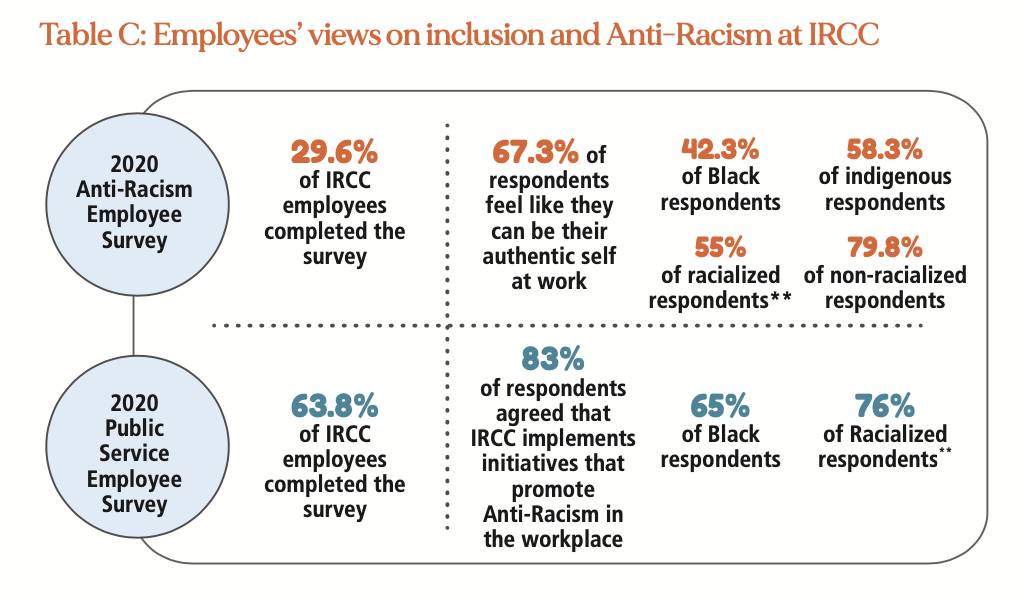
Usefully, the report provides a clear benchmark to measure success: the degree to which IRCC anti-racism initiatives moves the needle on the percentage that feel that “IRCC implements initiatives that promote anti-racism in the workplace.” Current numbers highlight the issue – only 65 percent of Blacks and 76 percent of non-Black visible minorities compared to 83 percent of not visible minorities.

But if the range of initiatives, engagement and comprehensiveness do not move the needle and reduce disparities, one will have to question their effectiveness, the reasons for lack of progress and the reasons why the perception by employees that not much has changed.

Failure to move the needle may also call into question the Clerk’s Call to Action on Anti-Racism, Equity, and Inclusion in the Federal Public Service, as in many ways IRCC was a model department in responding to the call.

And of course, service delivery failures in immigration and citizenship have a greater impact on Black and other visible minorities than than IRCC employees.

Source: Anti-Racism Strategy 2.0

Health care researchers need to ask, ‘Who is Black?’ University of Ottawa professor says

Why not just use Statistics Canada definitions, both visible minority and ethnic ancestry? Are the various terminologies used really that different or significant?

The real challenge lies more with respect to integrating this data with health card information, to allow this king of analysis and treatment, which of course will likely raise privacy issues.

For immigrants, I understand there is work underway to integrate immigration and health data but anonymized to allow for this kind of analysis in relation to health outcomes, information that could then hopefully be available through CIHI:

The inability to find a common term to describe Black people in Canadian health research can perpetuate inequities, a University of Ottawa professor says.

We need precise, accurate language because research informs public health policies, training for health-care workers and culturally appropriate and antiracist health-care practices, says Dr. Jude Mary Cénat, an associate professor of psychology and the director of University of Ottawa’s Interdisciplinary Centre for Black Health, Canada’s first academic research centre dedicated to studying the biological, social and cultural determinants of health for Black communities.

In Canadian health-care research, the definition of “who is Black” can vary widely. Terms such as “African-Canadian,” “Caribbean” and “African” are inconsistent and make it difficult to compare studies, he says.

The terms may include people who do not identify as Black, such as those who are from North Africa, and people from Caribbean nations including Cuba, the Dominican Republic and Puerto Rico, who consider themselves to be Latin American.

From a health research point of view, that can be a problem, Cénat says. One example: A 2019 review of breast and cervical cancer among “Black Canadian” women included 23 studies, but only seven had unambiguously Black participants. Some studies considered “Africa” as a single block and included participants from North Africa, who may self-identify as Arab.

“Most people from Africa are Black. But you can’t assume they are Black,” Cénat says. “You can’t say Elon Musk (who was born in South Africa) is Black.”

Meanwhile, studies rarely differentiate between Black people whose ancestors have lived in Canada for centuries and those who are recent immigrants, he says. The 2016 census found that the 10th most commonly listed country of origin for people in Canada self-identifying as Black was the United States.

Getting a more precise answer may be as simple as asking people “What is your skin colour?” says Cénat, whose commentary was published this week in the Canadian Medical Association Journal.

Researchers have to ask multiple questions, but the first one is how the subject identifies themselves, he says.

Cénat suggests asking research subjects the basic question: What is your skin colour? From there, it can lead to unraveling other questions about origins and ancestry. It’s also important to give research participants the opportunity to give more than one answer so that multiracial people can self-identify.

Asking questions related to race, ethnicity and region of origin may make some people uncomfortable. “We avoid that question. We ask people about their origin, not their skin colour,” Cénat says.

But health researchers can preface their questions by explaining why the questions are being asked and saying that the answers may help to improve health care for Black people in Canada.

“Researchers don’t have to be afraid of it,” he says.

If Black health research continues to be based on data that are unclear or inaccurate, there’s a risk that policies and programs will not meet the real needs of Black communities, Cénat warns.

Asking the right questions can also tease out more nuanced answers. For example, while the prevalence of diabetes is higher in Black communities than in the general population, some Black communities in Canada may be at more or less risk than others.

Cénat points out that, in Ottawa, racial minorities represent more than 30 per cent of the population.

“We need this because our population is a diverse population. We need to know more about the risk factors and the protective factors,” says Cénat, who studies the role that cultural factors play in vulnerability, trauma and resilience.

“We need to work with racial data that is precise. We need to say 10, 20, 30 years in the future that we have done something for these communities.”

Source: Health care researchers need to ask, ‘Who is Black?’ University of Ottawa professor says

Nepal’s Parliament endorses bill to amend Citizenship Act

Long time coming:

Nepal’s Parliament has endorsed the bill to amend its much-awaited Citizenship Act, 2006 through a majority vote, a decisive step that will help grant citizenship to the thousands of children born to naturalised Nepalese citizens.

Various provisions regarding granting status to foreign women married to Nepali men and children born in Nepal or from a Nepali mother were discussed by lawmakers before it was endorsed. The bill was endorsed in the House through a simple majority.

It will now move to the National Assembly before the president enacts this to become a part of the citizenship law. Once it passes the National Assembly, it will pave the way for thousands of children of parents who got citizenship by birth to acquire citizenship by descent.

All eligible Nepalis born before September 20, 2015, the day when the Constitution of Nepal was promulgated, were granted naturalised citizenship, according to media reports.

However, their children haven’t got citizenship in the absence of a law as the Constitution said the provision to grant them citizenship would be guided by federal law, it said. The federal law hasn’t been prepared even seven years after the promulgation of the statute, the report added.

The proposed amendment which takes the form of law and comes into effect, those who have not been able to get their citizenship through their mother will also be given citizenship by descent if he/she is living in Nepal.

The bill has been under discussion in the House of Representatives since 2020, but it failed to be endorsed due to differences among the political parties over various provisions. In 2018, the then KP Sharma Oli government registered the bill at the Parliament Secretariat.

Source: Nepal’s Parliament endorses bill to amend Citizenship Act