Government moves to dismiss class-action suit filed by Black civil service employees

Of note – jurisdiction grounds:

The federal government has filed a court motion calling on a judge to dismiss a class-action lawsuit filed by Black civil service employees on jurisdictional grounds.

The proposed class action — launched in December 2020 — accuses the federal government of systemic racism, discrimination and employee exclusion. It alleges that, since the 1970s, roughly 30,000 Black civil services employees have lost out on “opportunities and benefits afforded to others based on their race.”

The statement of claim says the lawsuit is seeking damages to compensate Black federal employees for their mental and economic hardships. Plaintiffs also are asking for a plan to diversify the federal labour force and eliminate barriers that employment equity laws have been unable to remove.

But a motion filed on behalf of the federal government this week says the court doesn’t have jurisdiction over the case and the claim should instead be pursued through labour grievances.

The motion says that all related claims should fall under either the Federal Public Sector Labour Relations and Employment Board or the Canadian Human Rights Act.

A statement from the Treasury Board of Canada, which oversees the federal workforce, said the government is working to create an inclusive and diverse public service but the issues brought forth in the class action shouldn’t be addressed in court.

“There is an existing process to deal with harassment and discrimination in the public service,” the statement said, adding that the government’s position is consistent with previous government responses to class actions.

Nicholas Marcus Thompson is executive director of the Black Class Action Secretariat, the group that filed the suit. He said he is “extremely disappointed” by the government’s motion.

“[The government] has acknowledged these harms and now they’re moving to strike the entire claim, to deny workers their day in court,” Thompson told CBC.

Thompson disputed the government’s suggestion that the claims could be dealt with as labour grievances.

“These systems are not equipped to address systemic discrimination, and within them … there’s inherent biases. The systemic discrimination exists in all of the institutions,” he said.

NDP MP Matthew Green called the government’s motion “callous” in a tweet on Tuesday.

“They’ve been working to dismiss the harms they have caused through perpetrating anti-Black racism within the public service for decades,” he said.

Group files UN complaint

Last week, the secretariat filed a complaint with the United Nations Commission for Human Rights Special Rapporteur on racism, racial discrimination, xenophobia and related intolerance.

“With this complaint, we are elevating Canada’s past failures and failure to act in the present to an international body,” Thompson told a press conference in Ottawa last Wednesday.

Thompson said the secretariat hopes the UN special rapporteur investigates its claims and calls on Canada to meet its international obligations to Black employees by establishing a plan to increase opportunities for Black women in the government and develop specific targets for hiring and promoting Black workers.

In response to the UN complaint, Mona Fortier, president of the Treasury Board, said that far too many Black Canadians still face discrimination and hate.

“The government is actively working to address harms and to create a diverse and inclusive public service free from harassment and discrimination. We passed legislation, created support and development programs and published disaggregated data — but know there is still more to do,” Fortier said in a media statement last week

Source: Government moves to dismiss class-action suit filed by Black civil service employees

Visible Minority Students and Professorial Time Use

Interesting notes on methodology and the opportunities:

Unfortunately, I’m not here to announce that Canada has overtaken Nigeria or Burkina Faso for the time it takes to release national-level enrolment data (we still lag, sadly).  But the only national statistical agency we have has still managed to put out a couple of interesting pieces of interest to higher education over the last few months.  Together they make a neat little post.

Let’s start with the Profile of Canadian graduates at the bachelor level belonging to a group designated as a visible minority, 2014 to 2017 cohorts, by Sylvie Brunet and Diane Galarneau.  This is a fascinating piece, but also, as I will show in a moment, because it shows all the amazing stuff that StatsCan is capable of producing through new data-matching techniques but is choosing not to.

So, the data first: among other things, the authors show that:

a) students belonging to a group designated as a visible minority made up about 30% of all graduates of Canadian universities between 2014 and 2017– a figure which mostly lines up with previous estimates from the Canadian Undergraduate Survey Consortium which suggested that 25% of incoming students in 2010 and 36% in 2013 were self-identified visible minority.

b) visible minority students as a whole are slightly overrepresented in the graduate population compared to non-visible minorities, but this is not true of all individual ethnicities in the sample (tl;dr Chinese students are significantly over-represented, others much less so).

c) visible minority students – especially those of Chinese origin – are somewhat more likely than non-visible minorities to be enrolled either in business or STEM programs – but this effect appears to be more pronounced among female rather than male students. 

d) visible minority students were much less likely to be living apart from their parents than were non-visible minority students.

e) Black, Arab and Latin American students were much more likely to have children of their own than were non-visible minority students or other visible minorities.

Not earth-shattering, but interesting.  There is some pretty cool methodology in here, which identifies students’ ethnicities by linking their record-level student data with data from the 2016 census, and their financial status by linking to the T1FF tax file.  In fact, it is so interesting that one must ask: why in the hell isn’t StatsCan using this data more regularly and to better effect?

For instance, using exactly this technique, one could report on the ethnic composition of the student body, nationally and by province, annually.  This is data we currently do not have, but apparently now it is possible to generate.  So why don’t we?  Similarly – and MUCH more importantly – the link to the T1FF means that it should be possible to identify incoming students every year and compare their parents income to the incomes of all families with kids aged 18.  That would allow us to annually monitor not only the extent to which the student body is economically representative of the population as a whole (nationally and in each province) but also stratification between institutional types and even among fields of study.

Technically, StatsCan has opened a gold mine with these linkage techniques, but they have yet to make these crucial links. The potential for genuinely useful data to drive accountability agendas in higher education is immense, and they are just sitting on it.  It’s kind of mind-bending.

Anyways, on to the second piece from StatsCan, which is a data release from a couple of years ago that somehow slipped my notice.  Every decade or so, StatsCan asks professors how they use their time.  Believe it or not, they do this solely to derive a largely fictious number for international comparison: namely, to derive how much of the national research enterprise is “paid for” by the higher education sector (as opposed to the government sector or the private sector).  Basically, this number is calculated by multiplying professors’ salaries by the fraction of the time they claim to spend on research, and you can’t do that without knowing anything about time-allocation, so…

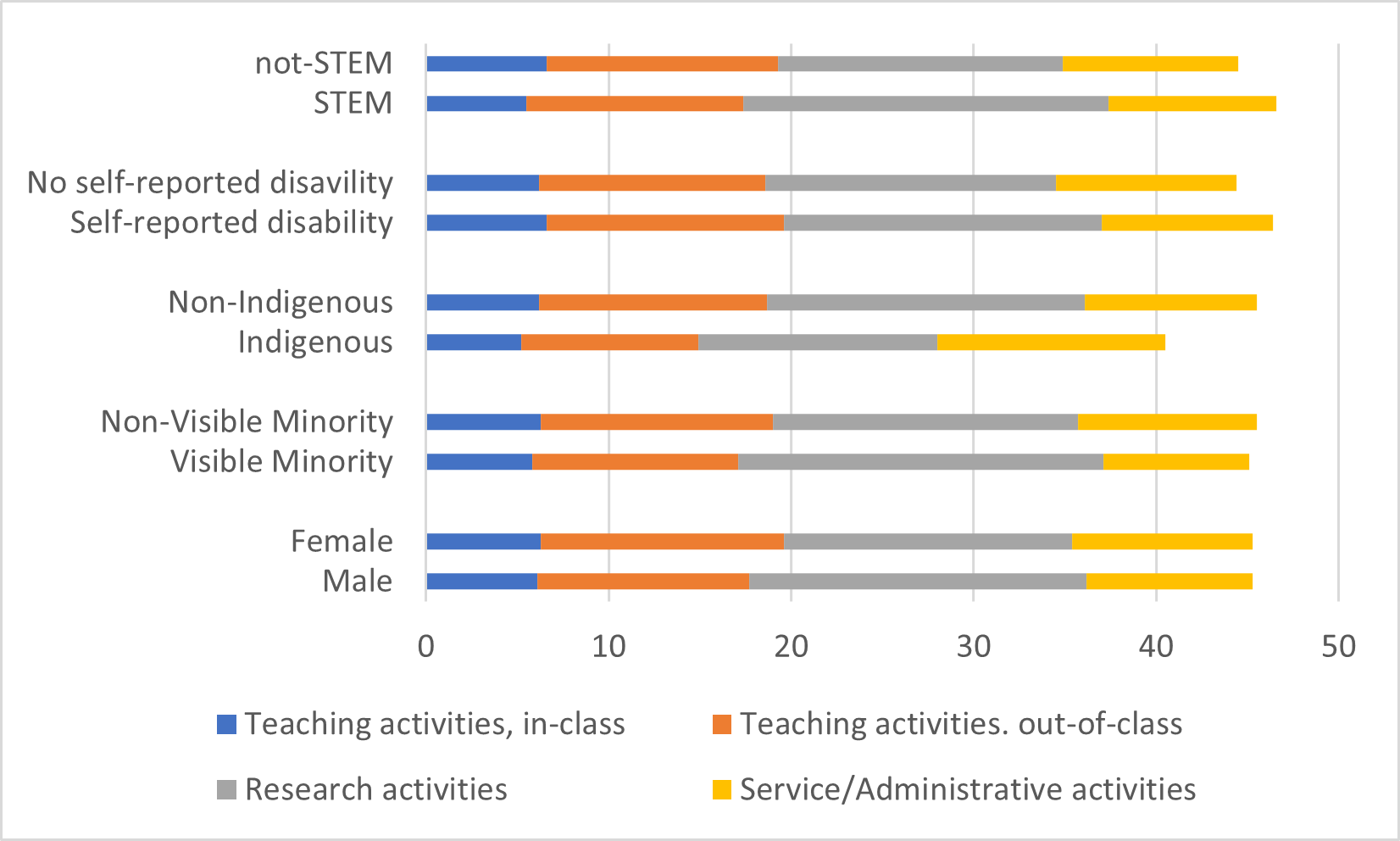
Figure 1 shows average hours per week spent by university professors on four different types of activities: teaching (in-class), teaching (outside the class), research, and service/administration (which includes everything from committee work to reviewing articles for journals.  Basically, it shows a profession that works a few more hours per week than other professions, on average, but not inordinately so (46 hours per week).  Remember: this is a self-report survey by professors, so if you disagree with what’s shown here, blame your fellow profs (though, to be fair, my guess is that had they split out some categories to include more specific categories on things like “keeping up with the literature”, the numbers probably would have been higher). 

Figure 1: Hours per Week, by Task, Full-Time Professors, 2019

This data shows us that professors work consistent hours across a range of factors.  There are not huge differences based on sex, disability, or visible minority status.  Even between professors in STEM fields and those not in STEM fields, the difference is only about two hours per week less on teaching and eight hours per week more on research than their colleagues in other fields.  The most significant gap listed here is between Indigenous and non-Indigenous profs, but I suspect the difference is at least partially accounted for by not accounting specifically for work in the community. 

(There is also data in this release for college teachers, but frankly it is much less interesting: they work about twice the teaching hours as university staff, 20% of the research hours and 60% of the admin hours for, in total, a work week which is about five hours shorter, on average, than that of university instructors).

Anyways, there you have it.  A national statistical agency which is by turns utterly infuriating yet technically skilled and occasionally illuminating.   

Source: https://myemail.constantcontact.com/One-Thought-to-Start-Your-Day–Visible-Minority-Students-and-Professorial-Time-Use.html?soid=1103080520043&aid=2db13gLh7vY

Khan: To the ruling elites, be they secular or religious: Just leave Muslim women alone

Of note:

A long while back, a good friend of mine decided to take a stand on the hijab. She was Muslim, and grew up in a Muslim household. She had thought long and hard about her decision, and decided to start wearing it.

Her father disagreed, berating her. When that didn’t work, he beat her. But she would not be cowed by the physical abuse. She could have filed a complaint with the authorities here in Canada, but decided, for personal reasons, against it. These were deeply personal choices made under difficult circumstances. But they were hers to make.

I thought of my friend upon hearing of the death of Mahsa Amini, a young Iranian woman who died after being taken into custody by Iran’s “morality” policy for allegedly violating the country’s hijab laws. The authorities claim that the 22-year-old woman had a heart attack at a re-education centre. Her family disputes the account, indicating that she was in perfect health. Autopsy reports were not made public. The official account defied credibility, given endemic institutional corruption. The allegations are that Ms. Amini was beaten to death.

That a woman was arrested and died for showing wisps of hair is reprehensible. That such a law exists is a travesty to basic human dignity. Iranian women are rightfully fed up with edicts that suffocate their lives and violate their personal agency. But it goes beyond women. You cannot shove religion down peoples’ throats without missing the point entirely. As the Quran succinctly puts it: “There is no compulsion in religion.”

While the current upheaval in Iran is partially the result of a population chafing against a ruling elite, it is also, at its heart, about the position of women in Iranian society. Half the population could more fully help their country to flourish, provided they were given the opportunity to do so. Instead, women have been suppressed and society has suffered as a consequence.

Some believe one of the solutions to ending the suppression of women is to ban the hijab. But this simply repeats the initial cardinal violation of taking away a woman’s agency in making her own choices. In any instance, a grown woman is fully capable of weighing the necessary information, consulting her peers, if she’d like, and reaching to the inner recesses of her conscience to make a decision that suits her.

Back in grad school at Harvard, one of my closest friends was an Iranian exile, whose family had suffered under the rule of Ayatollah Khomeini. Understandably, she hated state-sanctioned “Islam,” and, in particular, the hijab. We used to debate long into the night about the place of religion in society. I learned a great deal from her. When I chose to wear the hijab during the final year of my doctorate, she was mortified, and tried ardently to dissuade me. Another Pakistani friend tried to do the same. He hated the mullahs and their edicts; an imam had tried to sexually assault him when he was a child.

I clearly saw that both of my friends’ choices were informed by their respective experiences. However, as I explained, my choice was predicated on my own path – not theirs. It was deeply personal, and remains so. I do not impose it on anyone. Nor do I appreciate when others try to impose their choices on me or other women. Many years ago, I stood by my friend who was beaten by her father for choosing to wear the hijab. I stand by my Iranian sisters for the right to choose not to wear it, and their right to be free from coercion and violence.

In the end, it is about power and control. This summer, a Leger poll found that as a result of Quebec’s Bill 21, which bans the wearing of “religious symbols” (including the hijab) by public-sector workers, more than 70 per cent of Muslim women in the province feel less safe and more than 80 per cent said they feel less hopeful for the next generation.

To the ruling elites, be they secular (in Quebec and France) or religious (in Iran and Afghanistan), I say this: Just leave Muslim women alone. Let us live our lives and contribute to society. We have so much to offer, and we want to be part of the greater whole. We are not enemies of the state.

To my sisters in humanity: As women, we rarely see life as a zero-sum game. Let us respect individual choices. Let us be supportive of each other and band together against the haters. Let us remember Mahsa Amini and the many women who struggle on the path of freedom. Our inner voice is our strength – and no one can take it away.

Source: To the ruling elites, be they secular or religious: Just leave Muslim women alone

Why Quebec’s election turned into a slugfest over immigration

Not a bad overview. Election will likely demonstrate the weakness of first-past-the-post in situations of one dominant party and a number of smaller parties:

David Heurtel walked into the room and immediately spotted the angry man at the back.

It was November 2017 and the Quebec Liberal Party’s immigration minister was hosting a town-hall meeting in Sainte-Claire, a town across the river from Quebec City, in a rural region that is considered the province’s nationalist conservative heartland.

The man he spotted was typical of the local population. Older, white and francophone.

And he emanated a lingering, pent-up frustration.

“I said, ‘Oh, that guy is going to give me trouble at some point,’” Heurtel, a lawyer, recalled in an interview.

And he did.

Toward the end of the meeting, the man raised his hand. Heurtel braced himself and invited the man to air his grievance.

But it was not what he was expecting.

Not a complaint about Muslims or hijabs. Not about clashes of cultures and Quebec values. Not about the thousands of asylum seekers who had begun streaming across the border the previous summer. Not about the French-language abilities of newcomers to the province.

Not about any of these sinkhole political debates that appear with troubling regularity in Quebec, sucking in elected officials, media commentators, activists and community associations.

“He says, ‘For Christ’s sake, I need workers! I don’t give a damn if they’re red, purple, yellow or green. I need workers right now and I’ll teach them French myself!’” Heurtel recounted, speaking in Quebec’s working-class joual to fully express the colourful language.

Five years later, after the economic ravages of the pandemic and the continued aging of the population, the “Workers Wanted” refrain has only grown in desperation. In this sense, Quebec is no different from Ontario, Alberta or any other Canadian province or territory.

Which is why the combination of political punches launched this week by candidates, in the final days of an otherwise sleepy Quebec election campaign that will be decided next Monday, was so difficult to comprehend.

The sequence opened with an innocuous jab, the likes of which have sadly become a routine occurrence in Quebec politics.

A candidate for the sovereigntist Parti Québécois, Lyne Jubinville, was exposed by Montreal’s Le Devoir and forced to apologize for anti-Islam rants about “hijabs” that “increasingly invade our public space,” and about mosques and Muslim calls to prayer taking the place of emptied Catholic churches and silenced church bells.

It was followed by a hook from Jean Boulet, Heurtel’s successor as immigration minister, who belongs to the governing centre-right party Coalition Avenir Québec. In a clip from a local election debate held a week prior, he appeared to write off newcomers to Quebec as good-for-nothings.

“Eighty per cent of immigrants go to Montreal, don’t work, don’t speak French or don’t accept the values of Quebec society,” he said in the debate.

Boulet apologized for the tone of his comments, which he said were not an expression of his beliefs, but he was denounced by Quebec Premier François Legault, who said the minister had talked himself out of his ministerial post if he is re-elected on Oct. 3.

But then Legault himself delivered the roundhouse shot that left so many in this province seeing stars.

He delivered a speech to the Metropolitan Montreal Chamber of Commerce — an audience of employers and big-business owners — and spoke about this summer’s census report, which showed declines in the number of people who speak French across the country.

Legault said that if his party is re-elected, it would put in place tougher French-language requirements for immigrants and try to ensure that more of them settle in outlying regions of Quebec.

“But until we have stopped the decline of French,” he continued, “I think that for the Quebec nation that wants to protect its language it would be a little suicidal to go and increase immigration levels.”

“Suicidal.” The comments set off waves of anxiety among Quebec immigrants and second-generation Quebecers.

A journalist with the TVA network, Chu Anh Pham, wrote on Twitter about her parents, who fled the Vietnam War and settled in Montreal.

“Since they arrived here, they have always worked. We all learned French in Montreal and have never relied on social assistance. I have a tonne of other examples.”

Mamadou Doukara replied to her message and expanded on his experience in a radio interview. He explained how he spent his father’s inheritance to get from Mali to Quebec on a student visa, but immediately set about looking for work to reduce the financial burden on his family.

“Every provincial election was a source of stress,” noted Bao Long Hoang, another immigrant to Quebec, who wrote that he now lives in Ottawa. “So much stupidity voiced without shame.”

Dr. Joseph Dahine, an intensive care specialist who immigrated with his family to Montreal when he was a young child, said he likely never would have been able to afford his studies in medicine if his family had parents had immigrated to the United States.

He said Quebec should be celebrating what it has to offer — affordable daycare, publicly funded health care, low tuition fees and other attractions — rather than eternally fretting about cultural differences and religious backgrounds and mastery of the French language.

“Language is not the menace. It’s not the threat,” Dahine said in an interview. “It’s actually the reason why people come here. It’s usually their second language and they feel they could get by. They see an opportunity.”

Dahine likened the immigration process to joining a team and wanting to fit in. “You want to see people having fun, celebrating their culture. You want to look at these people and be inspired and say, ‘I want to be just like them,’” he said.

“As long as it’s a speech about the fear of losing something, it’s not an inspiring speech. Who wants to fit in with a group that is always talking about the fear of losing?”

Apart from the message such comments send to immigrants and homegrown Quebecers alike, Legault’s dark, defeatist tone is at odds with the great efforts and investments that the CAQ has made as a government, said Catherine Xhardez, an assistant professor of political science who specializes in immigration at Université de Montréal.

“They have this discourse that is a little alarmist and make these dark declarations,” she said. “In fact, the numbers are good and with (the Coalition Avenir Québec’s) policies they have invested a lot of money in francization (teaching French to newcomers) and integration.”

She also noted that the number of permits for temporary foreign workers has “exploded” under the CAQ. Recent statistics show the number of permits more than doubled from 13,030 in 2017 — the year before Legault’s party came to power — to 30,340 in 2021, the CBC reported.

“That’s what I find a little paradoxical with these dark speeches,” Xhardez said. “Do they think it’s useful to make comments that are much harsher than their policies? Because their policies have not been hard on immigration.”

It’s not just the CAQ, though. The immigration platforms of three of the five major parties competing in Monday’s elections hit similar notes.

The Parti Québécois, a diminished political force in recent years, proposes that knowledge of the French language, Quebec culture and the obligations and expectations that accompany citizenship be mandatory before immigrants set foot in the province.

And the newly significant Quebec Conservative Party, led by former radio shock jock Éric Duhaime, has suggested that new immigrants be screened to ensure they are “civilizationally compatible” with Quebec’s values, though Duhaime has taken steps in the campaign to distance himself from the term.

The other two parties, the Liberals and Québec Solidaire, have pro-immigration platforms. The left-wing QS promises to make it easier to have foreign education and employment credentials recognized; the Liberals suggest that priority be given to immigrants to immediately fill the gaps in health care, education and other in-demand sectors of the economy.

“Immigration is a solution. It’s not a problem,” said Heurtel, who said he is no longer an active member of any party. “Companies want them. Society wants them in general and the fact is that they’re a positive, not a negative.”

But for now, that ugly “Make Quebec Great Again” discourse persists, if only to drive the votes of those who feel most threatened by living on a French-speaking island in the midst of an English-speaking ocean.

Heurtel said the tendency will only be reversed by a radical change in the province’s political culture or a change to the voting system. As things stand ahead of Monday’s vote, the Coalition Avenir Québec are expected to win about 99 of the National Assembly’s 125 seats with just 39 per cent of the votes, according to opinion poll aggregator QC125.com.

The Liberals (16 per cent) are projected to take about 20 seats, Québec Solidaire (15 per cent) 10 seats and the PQ (15 per cent) just three. Despite having 14 per cent support, the Conservatives are not projected to win any seats.

But in politics, opinions and policies and allegiances are always shifting.

In politicians’ attitudes toward immigration, toward newcomers, there will be changes as well, said Dahine, the doctor. It just might take a while.

“As immigration happens — because it’s going to happen, because people need workers and brains and hands and arms — kids are going to grow up with a different picture of what society is. It’s going to be the new normal and one day it won’t be about where you come from but, ‘Hey! You’re from here as well,’” he said.

“It’s as though you’ll have a different flavour you add to the original Quebec recipe. Let’s put it that way.”

Source: Why Quebec’s election turned into a slugfest over immigration

New immigrants to Canada are building bridges with Indigenous Peoples. Here’s why that matters

Small scale and personal, along with a mix of practical and woke:

At the South Vancouver Neighbourhood House, Indigenous Elders Al Houston and Travis Angus are taking centre stage.

The pair walk into the full meeting room and smudge it, with the ritual burning of sacred plants.

“If we’re going to listen to one another, we’re going to be able to keep going forward,” Houston, president of the Greater Vancouver Native Cultural Society, tells those in attendance. “Your perfect example is right here in front of you. You’re asking questions and we are responding.”

Their audience at the community hub is a couple of dozen eager newcomers from Afghanistan, Egypt, Hong Kong, Nepal and the Philippines, who sit in a circle.

For the new immigrants, this “info and orientation circle” is their first look at the Indigenous past of the land where they have just settled.

For Houston, an Ojibwe Cree, and Angus of the Nisga’a Nation, this community program, The First Nations of Canada, is part of the mending of a broken relationship.

It is an example of reconciliation at its most essential, person-to-person level. For both communities, Indigenous Peoples and newcomers, it is uncharted territory.

Generations of immigrants settling in Canada have been kept away from the country’s horrific Indigenous history. For generations, Indigenous communities have been blamed by those unfamiliar with the history of this land for their social ills, whether it’s their poverty, substance abuse, health or relationship issues.

That distrust is often mutual. Some in the Indigenous communities view immigrants as continuing the relentless colonization of their ancestral lands.

But recent years, in the wake of the racial reckoning that made headlines in 2020 and the shock over the discovery of probable unmarked graves near residential school sites, have spurred the interest in relationship building with Indigenous people among new immigrants, the latest wave of settlers if not colonists.

“It’s kind of a watershed moment,” said Antje Ellermann, founding director of the University of British Columbia’s Centre for Migration Studies. “A lot of things are coming together. I’m hoping that and I do think that there will be a real generational difference.

“There is a lot of positive energy coming from newcomers, and openness and less defensiveness, because they don’t have family going back generations with that kind of pioneer spirit.”

And Vancouver — the unceded territory of the Musqueam, Squamish or Tsleil-Waututh peoples — seems to be leading the way.

Elders Houston and Angus both sit on the Indigenous Advisory Council at the South Vancouver Neighbourhood House and facilitate the orientation circle with newcomers, where they go over cultural practices and the travesties, such as residential schools, faced by Indigenous people in Canada.

“Let’s talk protocol,” Houston said. “In our culture, we can appreciate the applause, but technically in our culture we don’t like to clap because the spirits are awakened.” In the evening, whistling is also avoided, for the same reason.

Much of these teachings, he said, are passed down from Elders, but much of this culture was lost, due to the residential school system.

He tells bits of his own personal history, starting with his mother’s stay in a residential school and his own situation of being taken from his mother during the Sixties Scoop.

It was supposed to be for a short period while she dealt with her own challenges from her time in residential school, but Houston said the ordeal lasted years. Authorities told both the children and the mother they each did not want to be reunited. He did not see his mother again until she showed up at his hospital bed after he’d been hit by a car.

The accident made the newspaper and was the only reason his mother knew where to find him.

Silence settles down over the circle of chairs in the room.

“I looked at her and said, ‘I’ve waited all my life for this day to happen,’ ” said Houston. “That was the relationship rekindled right there because of the hope we never let go of.”

It used to make the 44-year-old man angry when he saw other Canadians taking more interest in newcomers and their culture than the issues faced by the first people on this land.

“We’ve become a minority in our own country. There’s still that stigma of First Nations that we’ve lived through,” noted Houston, who has become a regular guest in community events to talk about residential schools, history and cultures.

“People now are seeking us out. It never used to be like that. It’s a great feeling. Now we are getting a lot of compassion. People are wanting to understand and ask, ‘How can we help?’ ”


Toronto Metropolitan University geography professor Harald Bauder, himself an immigrant from Germany, has published numerous papers about immigration, settlement, colonialism and indigeneity.

He said he’s surprised immigration policy has garnered little attention within the Indigenous communities.

Among the 94 recommendations by the Truth and Reconciliation Commission, the last two address “newcomers to Canada” — revising the citizenship study guide and test to include more Indigenous content, and updating the oath of citizenship to observe treaties with Indigenous Peoples — and none deals with immigration policy.

“To me, as an immigration researcher, this is a core issue because immigration policy and selection is what has led to the conflict that we’re dealing with in settlement and colonialism to begin with,” he said. “Without immigration, you wouldn’t have settler colonialism. So why is the underlying force always just an afterthought?”

Bauder said immigrants and Indigenous people can forge great alliances with their respective experiences of colonization. While not every newcomer is a colonist, he adds, many themselves have lived the colonial legacies or have been displaced and oppressed due to their race and ethnicity.

“There’s a great deal of potential to forge alliances and I think there are some alliances being forged already in some cases.”

Born and raised in East Vancouver, Norm Leech has ancestry in the T’it’q’et community of the St’at’imc Nation and has been a frequent speaker on the Indigenous experience with colonization.

He likes to start his talk with the land acknowledgment because the land is a “relative” and “ancestor” that came before all humans and has provided people with everything. In his presentation, he always stresses the need to care for the land just like their kin.

He explains how that relationship with the land has been disrupted by colonization and replaced by systems that reduced it to property to be owned and abused.

“Colonization teaches us that we only have five senses,” said Leech. “We know we have a sense of connection to our land. We have a sense of connection to our ancestors. We have a sense of connection to our family. We know we are connected to everything, everywhere, all the time.

“We are absolutely part of this planet and everything on it. We are not separate at all. To be separate is essentially the roots of western philosophy … We’re in this colonized system that separates us and divides us and isolates us and tells us you’re alone.”

Leech said many immigrants come from places with a much longer history of colonization than Canada, suffering different forms of “intergenerational trauma,” and his workshop attempts to help participants re-imagine their relationship with the land and relating to one another before colonists came.

“The more we can have the conversation, extend and magnify the conversation, the better. Immigrants are going to be our greatest pool of allies once we make them understand we’re not their enemies.”

Binish Ahmed was 11 when she and her family fled to Canada in the 1990s from Kashmir, a disputed region under the control of India, Pakistan and China ever since the partition of India in 1947, when British colonial rule ended.

An Indigenous Kashmiri, the Toronto Metropolitan University doctoral student says foreign powers seized the land of her people and still oppress them under their rules, much like what happened to the Indigenous people in North America and around the world.

“I did not voluntarily want to come here as a kid,” said Ahmed, who lives in Toronto. “I wanted to stay with my relatives, with my cousins, with my friends on my land. My land is very sacred to me. I love the smell of my land, I love the birds, the bees, the flowers, the lakes, the mountains.

“We consider ourselves gardeners. In our language, the land is called ‘mouj Kasheer,’ which means ‘mother Kashmir.’ We feel pride and a sense of fulfilment in caring for Mother Earth.”

It was around 2010 when Ahmed, then a university student, saw smudging performed at an equity conference in Toronto. It reminded her of “isband,” a similar ceremony in her own culture.

Ahmed began reading about Indigenous history, culture and traditions, and contacting Indigenous leaders and activists. That inspired her to pursue a doctoral degree in Indigenous governance and policy, immigration and migration, anti-racism and anti-colonial practice.

In her activism, she and friends always take a stand for their Indigenous kins in Canada.

There’s a lot of self-education required of new immigrants, said Ahmed, especially those who come from a privileged background, who can’t expect the Indigenous community to teach them.

“My responsibility here is to be in good relations with people whose land I’m on. What immigrants and newcomers should do is learn about the campaigns that are led by Indigenous Peoples themselves and lend your support,” she said. “We don’t have to come up with something new.”


The Punjabi word for Indigenous people — “tiake,” which means a relation of my father’s older brother — was originally coined in small towns in B.C., where a lot of Indigenous people and Punjabi migrants worked in lumber mills.

To Vancouver-based activist Harsha Walia, the hundred-year-old word that is now in the Punjabi language expresses the relationship with Indigenous Peoples.

“Those are the kinds of historic alliances and solidarities and relationships and kinship that I think we have to actively work to unearth because they’ve been buried,” said Walia, who came to Canada in the 1990s as an international student.

Born in Bahrain to Punjabi parents, Walia has been involved in grassroots immigrant rights, migrant justice and social movements, but soon decided it’s not enough just to fight for citizenship rights for immigrants and refugees.

“That anti-racist fight cannot erase settler colonialism,” Walia explained. “It cannot erase the realities of genocide against Indigenous Peoples. The home that I am building is built on top of the home of other peoples. It is built on the dispossession of other peoples. The safety and the life that I am seeking for myself and for my family cannot be built on the ruins of other people.

“That is part of the ethical orientation that compels me to be in relationship to Indigenous Peoples fighting for their homes, fighting for their homelands, fighting for clean water and the right not to be dispossessed.”

But there is so much learning to do in the process.

Walia remembers joining others in an Indigenous land blockade in Ontario and offering her service along with other non-Indigenous supporters. They showed up in the community kitchen and worked there but soon sensed that it wasn’t received well.

“We just thought to ask, ‘Should we be somewhere else?’ In that instance, we got the feedback that us being there was displacing some Indigenous people who took their role in their kitchen and in serving food and providing for the front line seriously,” she recalled.

“And that was really eye-opening. We thought ‘we’re going with good intentions,’ ” she said, adding that solidarity is “going to look different in each context. Always being humble, never assuming.”

Elder Angus, whose traditional name is Niis Miou, says neighbours in the Little India area of Vancouver were not friendly to him and his family when they first moved into the neighbourhood, possibly because he’s an Indigenous, two-spirit single parent of three.

But he insisted on getting involved in the community and making it clear he wasn’t going to leave, till one day when neighbours asked him why he was there.

“I’d ask them the same thing, ‘Why are you here?’ It’s just being who you are as an individual, no matter where you live, and really recognizing that strength and that power that you have to stand up … to carry on with the community and to be able to help,” said Angus.

At the onset of the pandemic, Angus became aware of the food-security needs among his neighbours and started providing others with non-perishables from his own pantry and fresh vegetables from his garden. Soon, South Vancouver Neighbourhood House approached him and offered its support, which started a trusting partnership.

Angus was then invited to speak and perform traditional ceremonies.

That intent to initiate and build a relationship has to be genuine and authentic, he said. He gave the example of land acknowledgments that have slowly become a feature at the beginning of hockey games, community events and parliamentary meetings.

While it’s great to see the recognition, he said what’s more important goes beyond the manifestations of those practices but the meanings behind them.

“By explaining it to the newcomers, it gives them more of an understanding in that perspective of Indigenous people.”

It’s a steep learning curve but being consistent in offering the support to the community is key to sustaining the fledgling relationship, said Angus. “Don’t do it just because it’s filling up a week in our calendar.”


When reports from the Truth and Reconciliation Commission and the National Inquiry into Missing and Murdered Indigenous Women and Girls emerged, community members and staff at the neighbourhood houses in B.C. — which provide local social, educational and recreational activities — were shocked and asked how they should respond.

As the Association of Neighbourhood Houses of B.C. was developing a new strategic plan, it seized on the opportunity to achieve the transformation that they had already been pushing toward.

“We’re being really intentional about evolving as an anti-racist organization and actively learning what decolonizing our work needs to look like. And so that has accelerated,” said its CEO, Liz Lougheed Green.

“Another big accelerant was the discovery of mass graves. There’s no way that you can come away from that and not be completely moved to action.”

The strategic plan focuses on creating “brave spaces” to talk about racism, recognizing the harm of colonization and taking a stand against injustice.

Despite the commitment, Green said it’s a long journey and no one knows it is going to take the community.

“I’d love to be able to say we’re going to be done in two months but what we’re learning is it takes what it takes because everybody is at a different place.”

It also took a different mindset from the traditional management approach of pinning down the budget, steps, timeline and outcomes.

“What I’m learning more than anything is that there is an incredible importance to dialogue, to getting in and tucking into all these pieces deeply and trying to understand with each other … It’s going to be the journey and that’s where it’s going to take time.”


Neeham Sahota, CEO of DIVERSEcity Community Resources Society, said it’s key to create a safe space to “unlearn” what has been learned in a colonial system.

Last year, the Surrey First Peoples Guide for Newcomers was launched as a resource about First Peoples in Canada created from an Indigenous perspective on protocols, histories and government policies toward the community.

“This type of curriculum that is developed by Indigenous communities to welcome those that are the newest citizens of our land is such a strong, powerful bridge,” says Sahota of the 32-page guide that’s been translated into Chinese, Punjabi and Tagalog.

“We hope future generations are going to have less unlearning to do.”

Source: New immigrants to Canada are building bridges with Indigenous Peoples. Here’s why that matters
How Quebec’s 1995 referendum was a turning point for racist comments in political discourse that’s still felt

Of note:

Standing on a stage in Montreal Wednesday night, singer Allison Russell recalled what it was like to live in the city after the Parti Québécois lost the referendum 27 years ago.

“I was spat on, called a monkey and told to go back to Africa,” Russell, who is Black and was born in Montreal, told the audience.

In defeat, former premier Jacques Parizeau had blamed the 1995 loss on “money and ethnic votes.”

Russell, who was 17 at the time, said the comments sparked racist acts in the streets and contributed to her decision to move away shortly afterward. She compared the remark to recent comments about immigration made by Coalition Avenir Québec candidate Jean Boulet and party leader François Legault.

The topic has dominated political discourse in the last days and weeks of the campaign.

In a local debate on Radio-Canada last week, Boulet — who serves as both the province’s labour and immigration minister —  said “80 per cent of immigrants go to Montreal, don’t work, don’t speak French or don’t adhere to the values of Quebec society.”

After Radio-Canada brought the comments to light this week, Boulet issued an apology on Twitter, saying he misspoke and that the statement about immigrants not working and not speaking French “does not reflect what I think.”

Legault said Boulet didn’t deserve to keep the immigration file if re-elected. But Legault himself said Monday that welcoming more than 50,000 immigrants per year would be “a bit suicidal,”referring to the protection of the French language.

Earlier this month, Legault apologized for citing the threat of “extremism” and “violence” as well as the need to preserve Quebec’s way of life as reasons to limit the number of immigrants to the province.

Aly Ndiaye, a Quebec-city based historian and rapper also known as Webster, said he sees the 1995 referendum loss and Parizeau’s remark as a turning point for Quebec nationalism that made way for the kind of things Boulet and Legault have said this election campaign.

From inclusive nationalism to a change in Quebec identity

In the 1960s and 70s, Quebec’s nationalist movement was intent on being progressive and inclusive, Ndiaye said. The movement was inspired by decolonization and revolutions happening across the world at the time — it was looking “outward,” he said.

“After Parizeau, there was a closure,” Ndiaye said. Quebec nationalism turned inward, he added.

“There started to be a more exclusive vision of Quebec identity… That’s what Legault represents.”

What worries Ndiaye is the fact that such comments are rarely labelled as racist, despite the fact that they stem from a vision of society that sees immigrants and their descendants as “second-class citizens.”

“The Legault government is a racist, xenophobic and Islamophobic government,” Ndiaye said. “It’s aberrant.”

Hate calls

Fo Niemi, who founded the Montreal Center for Research-Action on Race Relations (CRARR) in 1983, said he remembers the Parizeau moment clearly.

“I almost fell off my chair,” he said.

Niemi said the centre received hate calls in the days following the Oct. 30, 1995 vote and stopped answering the phone for two or three days as a result.

When it comes to racist comments made in this year’s provincial election, Niemi said that while there is a possibility they could lead to violence, or aggression against immigrants, they could also lead to an overall negative attitude in Quebec toward immigration and immigrants.

“Let’s be clear, we’re not talking about all immigrants. We’re talking about immigrants who are clearly identifiable, i.e. non-white immigrants.”

He agrees with Ndiaye about the hesitation to name racism.

“They don’t call a spade a spade,” Niemi said, calling the CAQ remarks “dog whistle politics,” which refers to the use of messages that convey a particular — usually racist — sentiment to a target audience.

Evelyn Calugay, who runs PINAY, a Filipino women’s rights group, said she remembers hearing about comments made to people in her community as well as to people of Chinese descent in 1995.

Stuff like, “You don’t know how to speak French? Go back to where you belong, where you came from,” Calugay said.

“They will always have somebody to blame and the people they have to blame are always the minorities, the marginalized — because they are a bunch of racists to me!” she said with a bit of a laugh.

Calugay came to Quebec in 1975 to work as a nurse. She is 76.

What happens after the election?

The CAQ isn’t the only party to have come under fire for anti-immigrant sentiments. Comments about Quebec Muslims from Parti Québécois candidates Lyne Jubinville, Suzanne Gagnon and Pierre Vanier and his wife Catherine Provost have surfaced in the past two weeks.

Vanier, the candidate for Rousseau, and Provost, the candidate for neighbouring L’Assomption, were both suspended by PQ Leader Paul St-Pierre Plamondon Friday for posts they made on social media, one of which questioned the intelligence of Muslim women who wear head scarves.

Whatever the election result Monday, Niemi says his concern is what will happen afterward.

“Are we going to talk about the negative fallout of all of these, shall we say, hateful statements?” he said. “What credibility will the government have to address racism and xenophobia and any other negative consequence of these statements?”

As for Russell, the Quebec-born singer now lives in Nashville with her family and recently, after playing in well-known American folk bands, began a solo career with her album Outside Child.

Source: How Quebec’s 1995 referendum was a turning point for racist comments in political discourse that’s still felt

Lederman: Stop telling women what to wear – in Iran, but also here at home

Of note. More nuance needed, with the question being more what are reasonable dress codes for professional vs personal situations, recognizing that these evolve over time. But would Lederman be comfortable if Ginella Massa, for example, would want to wear a niqab rather than a hijab on CBC? And what about the recent transgender case of a teacher wearing large prosthetic breasts?

Agree with the principle but its application is

The hijab protests in Iran are among the most courageous movements we have seen in contemporary times.

On Sept. 16, 22-year-old Mahsa Amini was arrested in Tehran for not wearing her head scarf properly, as determined by so-called morality police – men, of course. She died in custody. Now, women and men are – without hyperbole – risking their lives by standing up against a tyrannical regime that forces women to cover up.

But the uprisings have illuminated something else: the comfort level of the public (high, revolting) with telling women how to dress – and not just in Iran, or other countries with similar laws regarding female dress.

Last week, on the CBS show 60 Minutes, veteran journalist Lesley Stahl wore a head scarf, loosely, for an in-person interview with Iranian President Ebrahim Raisi in Tehran. Ms. Stahl does not normally wear a head scarf, but did so in order to secure the interview. “I was told how to dress,” Ms. Stahl said in her report.

This sparked some outrage on social media. Nina Ansari, an Iranian-American author, historian and human-rights activist, noted on Twitter that not long after Ms. Amini’s death, Ms. Stahl wore “the veil in deference to oppressive laws of a misogynistic regime.”

The regime is misogynistic and oppressive. But Ms. Stahl was doing her job: to expose that – and to underscore the need to keep close watch on Iran, its domestic human-rights abuses and its nuclear aspirations, which potentially know no borders. She managed to do so, in an important interview. If the cost of doing it was wearing the head scarf, well, that was Ms. Stahl’s decision to make.

Later that week, CNN journalist Christiane Amanpour was also set to interview Mr. Raisi, this time in New York. Through an aide the President suggested, 40 minutes after the interview’s scheduled start time, that she should wear a head scarf. She refused, and Mr. Raisi cancelled.

Good on her. Her head, her choice. But good on Ms. Stahl, too. Her head, her choice.

In Canada, too, we’ve been volunteering our own opinions around the hijab, to the point that CBC broadcaster Ginella Massa, who chooses to wear it, felt it necessary to explain herself on Twitter.

“I usually try to let my work speak for itself but apparently this needs to be said explicitly,” Ms. Massa wrote, noting she has interviewed women fighting for their right to remove their hijab in Iran, as well as women fighting to wear theirs in Quebec, where Bill 21 bars some public servants from wearing religious symbols. “What they are both demanding is autonomy and personal choice, and my job is to offer them a platform to speak their truth. I can be in solidarity with a woman’s right to choose what she does with her body, without changing what I have personally chosen to do with mine.”

Ms. Massa owes us no explanation. How she chooses to present herself in no way affects her abilities at work, and it is none of our business. Yet somehow, people feel it is their right to weigh in.

Whether Lisa LaFlamme’s grey hair directly contributed to her ouster at CTV News remains unclear, but what is certain is how comfortable management (and the public) felt in making it an issue. Just ask any woman who has worked in TV news about the hair comments to which they are subjected – Black women, in particular.

This isn’t confined to TV, and it doesn’t start in adulthood. There are schools that still enforce strict dress codes aimed at girls: skirts must be a certain length, bra straps can’t be showing, no bare midriffs et cetera. In one case earlier this year, a North Carolina charter school was found to have violated the rights of female students by forcing them to wear skirts. The parent/student handbook says the dress code is meant to “instill discipline and keep order so that student learning is not impeded.”

Dictating how women should dress is an indicator of a society that feels comfortable dictating how women should live, and what they can do with their bodies. This regressive thinking can only lead to regressive law – the revoking of abortion rights in the U.S., for instance.

If Ms. Massa or a teacher in Quebec wants to wear a hijab at work, if Ms. LaFlamme wants to go grey, if a Grade 11 student wants to wear a crop top – it is not our concern. It does not affect the lessons, the news, the world. But telling students, teachers, broadcasters – women, anyone – how to dress does. It colours the world.

I can understand why the hijab might incense someone such as Dr. Ansari – a strong advocate who is fighting not simply against mandatory veiling but for the liberation of the country.

But let’s remember who the real villain is here.

Godspeed to the courageous women in Iran burning their head scarves. As the protesters have chanted on the streets: women, life, freedom.

Source: Stop telling women what to wear – in Iran, but also here at home

Inequality in higher education: the American Dream is over

Of interest:

Can College Level the Playing Field: Higher education in an unequal society’ by Sandy Baum and Michael McPherson is published by Princeton University Press. ISBN: 978-0691-171-807

No doubt, Sandy Baum and Michael McPherson, authors of Can College Level the Playing Field: Higher education in an unequal society, were pleased by United States President Joe Biden’s recent announcement that the US government was forgiving US$10,000 of student debt held by people earning less than US$125,000 and US$20,000 of debt held by those who received Pell Grants, which are made to the nation’s poorest students – and by the plan to increase Pell Grants from by over US$2,000 to US$8,670. 

Likewise, New Mexico’s recent decision to make the first two years of higher education free to its residents fits well within their recommendations. 

Their scepticism about online education, especially for less prepared students, has become a leitmotif in the news because the impact of online education during the many COVID-19-caused shutdowns of universities, colleges and schools becomes clear.

For readers outside the United States, however, the strength of this book is not so much in its common sense recommendations but, rather, in its devastating portrait of inequality – in education, achievement and incomes – in America today. 

The Gini coefficient, a figure used by political scientists to show inequality, is 0.390 in the United States. The closer a country is to 1.0, the more its economy is inequitable; accordingly South Africa’s number, 0.623, indicates it is 62% more inequitable than is the US. By contrast, Canada’s number is 0.300 while Norway’s is 0.264.

“The correlation between socioeconomic background and educational attainment has more serious implications in the United States than in many other nations because not earning a four-year college degree has more significant implications for lifetime earnings than it does elsewhere,” write Baum and McPherson. 

Baum is a non-resident senior fellow at the Center on Education Data at the Washington DC-based Urban Institute and emeritus professor of economics at Skidmore College (Saratoga Springs, New York), and McPherson is a non-resident fellow at the Urban Institute, former economics professor and former president of Macalester College (St Paul, Minnesota).

Among the other studies Baum and McPherson use to show that the “American Dream”, which holds that the next generation will climb higher on the socio-economic ladder, has become a nightmare, is the aptly named “Gatsby Curve”. 

At its top is the United States (closely followed by Britain and Italy). This visual representation is deceiving, for the higher the country is on the Gatsby Curve the less intergenerational improvement there is. At the top of the league table, so to speak, are Finland, Norway and Denmark, countries not normally associated with dynamic social change.

The higher education premium

Readers of this publication are used to seeing figures showing the premium higher education provides. The median income for a high school graduate in the United States is US$37,000 a year, or US$18 dollars an hour, a dollar over the minimum wage in New York. For someone with a bachelor degree it is US$62,000 and for those with advanced degrees it is US$82,000. 

However, as Baum and McPherson show, the benefits of higher education accrue to a minority of Americans. This fact, incidentally, is one of the reasons the Republicans oppose Biden’s plan to forgive student debt. 

95% of whites and 89% of blacks complete high school. However, only 40% of white people and 26% of black people hold bachelor degrees. Accordingly, the pay received by 60% of white people and 75% of black people are in jobs where they earn around the minimum wage.  

In fact, in reality, the income of black people is even worse than it appears. For the “median earnings of black 35- to 44-year-old bachelor degree recipients are about $14,000 less than the median for whites”. Instead of earning US$62,000, therefore, blacks with bachelor degrees earn US$48,000 a year, or US$23 per hour.

More than half of white students whose parents hold bachelor degrees go on to graduate from a four-year college or university. The figure is even more striking for children of doctorate holders: 70% of them go on to earn a doctorate. Only 5% of those whose parents graduated from a two-year community college go on to earn a doctorate. 

A meritocratic class

While perhaps predictable, what these figures show is that within families education builds on education, creating a meritocratic class quite separate from the majority of Americans.

Like the “sorting hat” that assigns students to their house at Hogwarts (Harry Potter), a number of America’s high school graduates are sifted by family income and race. 53% of students with very high scores on the Scholastic Aptitude Test (SAT) are admitted to highly selective schools like Harvard or University of Chicago. 

These are the same students who, Baum and McPherson show, tend to come from families in which the parents hold degrees. 

They are also the students who come from families with the financial means to have sent them to private school – or to live in wealthy areas where public schools are well-funded – and to provide extras such as travel, a bookish home environment and SAT preparatory courses. Not surprisingly, only 31% of students with middling scores are admitted to highly selective schools. 

When looked at through the prism of race, Baum and McPherson show the figures are even more striking. Of the admissions to highly selective schools, 89% are Asian, 78% are white, 38% are Latinx and 25% are black. The order, it is worth noting, is the same as it is on charts they show indicating the income of each group.

Growing inequality

One of the most interesting parts of Can College Level the Playing Field is the graph Baum and McPherson use in their discussion of growing inequality, a topic which has been much discussed in the media in recent years.

Since 1969 the bottom 20% of American households (by earnings) saw the percent of their income, relative to the national income, drop from 6% to 4%. The next fifth dropped from 12% to 9%. The third fifth also dropped three percentage points to 15%. The fourth fifth remained at 24%. The highest fifth saw the percentage of their income rise from 41% to 48%; the top five percent, who are part of the highest fifth, saw their incomes rise from 16% to 20%.

At first glance, the drop in income for the poorest Americans from 6% to 4% does not seem that much. It is, however, a 33% decline. While large, when set against the fact that between 1969 and 2019 the US economy grew almost five-fold, from US$4.9 trillion to US$19.4 trillion, it might seem as though this lowest quintile is still doing fairly well economically. 

However, the cumulative inflation rate over the six decades beginning in 1969 is eight-fold: what cost US$100 in 1969 would have cost US$800 in 2019. Accordingly, the poorest Americans have absorbed approximately a 50% decrease in their buying power.

Lowering admission requirements

In the chapter titled, “What Can Colleges and Universities do?” Baum and McPherson make several suggestions. The first is for the elite schools to enroll more poor students. They urge elite schools to lower the SAT expectations from 1,600 to 1,250 for poor students. 

To those who would howl that the schools would be selling out to lower expectations, Baum and McPherson point out that elite schools routinely make such arrangements for star athletes – the ones who will fill these schools’ expensive stadia. Further, they note, such arrangements are routinely made for what’s known as “legacy applicants”, many whose parents just so happen to have made large donations to the alma mater their son or daughter is applying to.

Baum and McPherson urge other state universities to adopt a programme similar to the Texas Top Ten Percent rule. In the “Lonestar State”, the top 10% of high school graduates – even from poor areas where the high schools are lower on the league tables – are guaranteed admission to the state’s public universities, including the state’s flagship institution, the University of Texas at Austin. 

“Outcomes were no worse for the students they replaced, who attended less selective institutions but did not have lower enrollment rates, graduation rates, or earnings than they would have otherwise had,” they write.

For several decades, the United States Supreme Court has whittled away at the affirmative action efforts colleges and universities have used to address the racial imbalance on America’s campuses. In simplified terms, the court has said that quotas cannot be used to address historic or present discrimination – because doing so discriminates against the plaintiff. 

Baum and McPherson propose an interesting way around the court’s rulings. Instead of affirmative action based on race, colleges and universities can create affirmative action programmes based on economic class. 

These would “not [be] vulnerable to a legal challenge based on the Fourteenth Amendment” and, since black people and Latinx Americans make up a disproportionate share of poor people, programmes aimed at the economic class would benefit a large number of them.

Academic support

Their recommendation for mid-tier universities, which educate the vast majority of America’s higher education students, includes increasing state grants that will keep tuition as low as possible. 

Larger state grants will also allow these colleges and universities to provide academic support services that are needed by a disproportionate number of poorer students (because the schools they went to were themselves poorly funded).

Absent from Biden’s announcement about changes to Pell Grants was something Baum and McPherson consider important : however necessary for student success, remediation classes use up Pell Grant room and do not count towards graduation. 

In other words, if students need 64 classes to graduate, but have taken four remediation classes, they will have to take a total of 68 classes to graduate because the remediation classes do not count towards graduation. 

The effect of this is that many poor students have to remain an extra semester to graduate, with the attendant economic costs and no further Pell assistance.

Source: Inequality in higher education: the American Dream is over

Raj: NDP puts minority rights aside as it courts Quebec

Of note:

The federal NDP and the Green Party’s Elizabeth May voted to endorse the use of the notwithstanding clause and Quebec’s controversial Bill 96 Wednesday, by supporting Bloc Québécois legislation that strips the rights of non-francophones in the province.

The Bloc sought to amend several pieces of federal legislation to impose French as the dominant language in the province and tried to prevent Ottawa from contesting Quebec’s contentious language moves.

Its bill C-238, which was defeated Wednesday, would have changed the Citizenship Act so that Quebec residents can only become citizens if they have “adequate knowledge of French.” Everywhere else in Canada, residents must only demonstrate they speak either French or English. 

The bill also amended the Canada Labour Code, the Official Languages Act, and the Canadian Business Corporations Act by subjecting them to Quebec’s French language charter. 

Whatever the government of Quebec put into its charter would tie Ottawa’s hands.

This is concerning when you consider the nationalist Coalition Avenir Quebec — which is likely to be re-elected with a sweeping majority Monday — passed Bill 96 earlier this year. That legislation amended the French language charter to prevent many English speakers from speaking to each other in English at work (or in a language other than French); made it difficult for employers to require employees know any language other than French; and banned many people from accessing government services in English — even when they are available. It even gave the province the right to enter private businesses without a warrant to ensure emails, for example, are being sent in French and gave individuals the right to seek damages in court if their language rights are breached.

Quebec’s charter also imposes unnecessary hardship on newcomers, forcing them to learn French within six months of their arrival — after which the government only communicates with them in French. Expecting new arrivals to learn a language in six months is not only unrealistic but sets them up for failure.

And yet, this is what NDP Leader Jagmeet Singh and his MPs voted for Wednesday. This from a party that prides itself on standing up for minority rights.

Quebec Premier François Legault has pre-emptively used the notwithstanding clause twice now to avoid legal challenges arising from obvious reaches of the Canadian Charter of Rights and Freedoms, most recently with Bill 96 and previously with Bill 21, a law that prevents Quebecers employed in certain professions such as teachers, judges, and police officers from wearing religious symbols. Just last year, an elementary teacher in Chelsea, Que., was removed from her classroom for wearing a head scarf.

It’s hard to believe this is the kind of behaviour the NDP — or Elizabeth May, now a candidate for the leadership of the Green Party — wants to be associated with.

The decline of French in Quebec is a real concern. It is one shared by many allophones and anglophones in Quebec too. But subjecting federal laws to a provincial government, especially one that has questioned publicly why it should be subject to the Charter of Rights and Freedoms is another thing altogether.

And while the NDP wants to have it both ways — by claiming it is standing up for the protection of the French language and respecting anglophone minority rights — its actions this week show it isn’t doing both. It also raises questions about whether the party is ready to contest for power if it is unwilling to assert Ottawa’s jurisdiction.

New Democrats note that they’ve always supported the idea that federal institutions operating in Quebec should be subject to the province’s language charter. The NDP’s only Quebec MP, Alexandre Boulerice, noted last spring that it made little sense for credit unions in the province to operate under different laws than federally-regulated banks. Bill 96, however, has changed that conversation.

Language is touchy in Quebec. The vast majority of Quebecers support Bill 96. Most of the province’s political parties do too. In fact, Quebec Liberals are polling in the single digits with francophones, likely due to their opposition to Bill 96 and Bill 21. 

For nearly two decades now, the NDP has embraced asymmetrical federalism with Quebec, including supporting the principle that 50 per cent plus one vote is enough to split the country. That position is credited for the party’s big win in 2011. Perhaps we shouldn’t be surprised that yet again the NDP places chasing francophone support in Quebec above all else.

Montreal Liberal MP Anthony Housefather, who helped convince his own caucus and lobbied opposition MPs to vote against the bill, said he was “very relieved” by its defeat. “Using the notwithstanding clause to deny people rights … is just very alarming,” he told the Star.

The silver lining in Wednesday’s vote came from the Liberals and notably Conservative MPs who unanimously stood opposed. Just 18 months ago, on a similar motion, all but one Conservative voted with the Bloc.

A new leader and a 2021 election that saw the Conservatives’ hopes for a big win in Quebec dashed seem to have contributed to an epiphany. That or Pierre Poilievre realized there are more votes to be had fighting the notwithstanding clause outside Quebec than endorsing it inside the province.

Source: NDP puts minority rights aside as it courts Quebec

Boisvert: La peur de l’étranger [Quebec’s immigration minister’s comments]

Good commentary on Quebec’s immigration minister that begs the question of his competence and knowledge:

Imaginons un ministre de l’Éducation qui ne connaît pas la différence entre une école primaire et secondaire. Un ministre des Transports confondant un aéroport et une autoroute. C’est trop gros ?

Dans ce gouvernement, vous pouvez être ministre de l’Immigration et ne pas connaître les faits les plus élémentaires sur les immigrants.

François Legault et tout son entourage ont sauté au plafond en entendant Jean Boulet dire que 80 % des immigrants sont à Montréal et « ne travaillent pas, ne parlent pas français ou n’adhèrent pas aux valeurs de la société québécoise ». Le ministre s’est « disqualifié », a dit François Legault à Midi Info.

Il a sauté au plafond d’abord parce que c’est faux, archifaux. Les immigrants ont à peu près le même taux d’emploi que les Québécois nés ici. Et la vaste majorité parlent français.

Le ministre se base sur quoi pour dire qu’ils « n’adhèrent pas aux valeurs de la société québécoise » ? Ils doivent pourtant passer un test… S’ils sont venus ici, c’est généralement qu’ils ont voté avec leurs pieds pour adhérer à cette société. L’histoire de l’immigration au Québec est largement une histoire de succès, quoi qu’on en dise.

Mais non, le ministre de l’Immigration lui-même véhicule de fausses informations et renforce les préjugés. Il suinte de tout ça une ignorance profonde, une peur sourde de l’étranger.

Ce ne serait déjà pas acceptable comme candidat de plonger aussi joyeusement dans la piscine des préjugés et des fausses informations.

Mais quand on est ministre, et ministre de l’Immigration, c’est impardonnable. D’autant que ce gouvernement insiste sur la capacité d’accueil, sur la difficulté d’intégrer, sur la menace qui pèse sur le français.

Coudonc, leurs politiques (quotas, apprentissage de la langue en six mois, etc.) sont-elles basées sur des données, ou sur des chroniques anti-immigration du Journal de Montréal ?

Jean Boulet n’est pourtant pas un idiot, loin de là. Il est sans doute parmi les politiciens les plus sympathiques à Québec. Il est depuis son élection un ministre du Travail compétent. Lui-même avocat spécialisé dans le domaine, il était « sur son X ».

Quand il a été question de délester Nadine Girault de l’Immigration, l’an dernier, François Legault a voulu choisir un ministre fiable. Qui de mieux que Jean Boulet ? Un ministre de région (la Mauricie), pour envoyer un message de « régionalisation » de l’immigration.

Pourquoi pas ?

Comme la CAQ veut arrimer l’immigration aux besoins économiques, fusionner Travail et Immigration chez un même ministre, c’était le plan logique.

Mais le ministre (le troisième en quatre ans) a-t-il la moindre connaissance de la réalité immigrante à Montréal ? Et ailleurs ? Est-ce qu’il en a rencontré ? Ou est-ce une masse informe de « capital humain » à « intégrer » ?

On tentera de blâmer une vision des « régions », mais je n’accepte pas ça. Il suffit de se promener un peu pour voir que les gens de toutes les régions du Québec veulent accueillir plus d’immigrants. Le discours anti-immigrant le plus fort vient souvent de quelques chroniqueurs montréalais qui n’ont jamais le moindre mot positif à dire sur l’immigration, cultivent une détestation pour Montréal, sa diversité, et selon qui « y a pas moyen de se faire servir en français à Montréal » – autre mensonge tenu pour vérité scientifique parce que répété assez souvent.

N’allez pas croire que cette « gaffe » était préméditée. Ça date d’une semaine, dans un débat à la radio locale. Et ça ne fait pas du tout l’affaire de François Legault.

Jean Boulet a piteusement présenté ses excuses, disant que ces propos ne reflétaient pas sa « pensée ».

Quelle pensée ? Il faisait des affirmations statistiques, du haut de son autorité de ministre de l’Immigration. Ça n’avait rien d’une opinion. Si le ministre des Finances dit qu’il y a un taux de chômage de 25 % à Québec, il n’exprime pas sa « pensée ». Il trompe les gens.

C’est comme si les peurs et les préjugés refoulés sortaient au grand jour.

La journée avait pourtant bien commencé pour François Legault, à la Chambre de commerce du Montréal métropolitain.

Aller visiter une chambre de commerce pour lui, c’est un peu comme aller faire un tour dans un cégep pour Gabriel Nadeau-Dubois : ça met de bonne humeur.

François Legault était dans sa matière forte à jaser PIB et productivité devant un auditoire réceptif, avec ses ministres économiques. Clair, convaincu, confiant, de bonne humeur.

On lui reproche de ne pas parler d’éducation. Il est d’accord. Mais chaque fois qu’il veut parler de l’augmentation « historique » du salaire des profs, de maternelles 4 ans ou d’orthopédagogie, les médias en font fi. Dans les points de presse, c’est toujours des questions sur l’immigration, ou le troisième lien. Troisième lien, immigration. Immigration, troisième lien.

Vrai.

C’est pourtant bien lui qui dit, comme mercredi, qu’une augmentation des seuils d’immigration serait « un peu suicidaire » pour la « nation québécoise ». Et je ne reviens pas sur tout le reste.

C’est lui qui a nommé Jean Boulet. On est obligé de se demander comment ils parlent d’immigration entre eux, au plus haut niveau, quand le titulaire est aussi mal informé. Est-ce que c’est juste des faux chiffres et des histoires de peur ?

Ce sujet est trop important pour l’avenir du Québec pour être traité avec autant d’incompétence. Si, comme prévu, la CAQ forme le prochain gouvernement, surtout, ne « continuons » pas ça.

Source: La peur de l’étranger