Balan and Packer: Supporting minority languages requires more than token gestures

Like so many advocates and academics, the authors speak more in generalities and principles rather than specifics.

While the situation of Indigenous languages is different, for immigrants and their descendants the working assumption of integrating into an English or French speaking environment remains relevant, with government information generally available in other languages with some translation or interpretation where needed in healthcare.

Having a common language, while allowing for and accommodating other languages, is important not only for overall social cohesion and inclusion but also to improve opportunities for minority groups:

In August 2022, Statistics Canada released the latest census data on languages in Canada. According to the data, over nine million people — or one in four Canadians — has a mother tongue other than English or French (a record high since the 1901 census). 

Twelve per cent of Canadians speak a language other than English or French at home. Statistics Canada observes that the country’s linguistic diversity will likely continue to grow into the future.

Yet, recent developments in language policy and practices in Canada reveal that there is confusion and misunderstanding among government officials and the general public about language use, international language rights and their implications.

In Canada, there must be greater understanding of the cultural and linguistic rights of minorities. According to universally accepted human rights, persons belonging to majorities and minorities should have equal rights. Minorities are entitled to equal conditions and services to enable them to maintain their identity, culture and language.

The 1966 International Covenant on Civil and Political Rights, a human rights treaty to which Canada is a party, provides that “In those States in which ethnic, religious or linguistic minorities exist, persons belonging to such minorities shall not be denied the right, in community with the other members of their group, to enjoy their own culture, to profess and practise their own religion, or to use their own language.”

The 1992 UN Declaration on Minorities clarifies and expands on this treaty provision. It stipulates that UN member states should enact legislative and other measures to protect minority identities.

Confusing words

Two words are often confused in Canada: integration and assimilation. When speaking about immigrants and refugees, Canadian law’s stated objective is integration. And the default framework for integration is the majority culture and language. 

Non-anglophone and non-francophone immigrants are expected to adapt and conform to the Canadian way of doing things, learn Canadian history, celebrate Canadian holidays and speak in one or both of Canada’s official languages.

But these languages reflect the cultures of Canada’s two historically dominant groups. For many Indigenous people and immigrants, histories, holidays and languages differ from the majority of Canadians.

Involuntary assimilation is prohibited under international law. This is a colonialist and imperialist practice which ultimately forces people to alter or surrender their identity, culture and dissolve into the majority. 

Canada’s notorious residential schools were one of the harshest examples of such assimilationist policies. Other essentially assimilationist practices continue to this day. For example, the law states that provinces must provide education to English or French-speaking minorities in their own language. But there is no similar legislation for Indigenous languages, nor for those spoken by people who immigrate from all around the world. These policies will increasingly conflict with growing diversity as Canada seeks to welcome 1.5 million immigrants over the next three years.

In contrast, integration is based on recognition of diversity. Integration is a two-way process through which minorities and majorities learn about and engage with each other’s cultures and languages. 

While maintaining their own distinctiveness, majority and minority groups contribute to shared foundations and institutions of the society out of common interest and for mutual benefit. This is important for the many individuals who possess multiple or overlapping identities.

In 2012, the Organization for Security and Co-operation in Europe, of which Canada is a participating state, released Guidelines on Integration of Diverse Societies, in which it explained:

“Integration is a process that requires that all members of a given society accept common public institutions and have a shared sense of belonging to a common State and an inclusive society. This does not exclude the possibility of distinct identities, which are constantly evolving, multiple and contextual. Mechanisms aiming at mutual accommodation are essential to negotiate the legitimate claims put forward by different groups or communities.”

Integration requires accommodation of diversity. It also means that governments should invest proportionally in the promotion of majority and minority cultures and languages with a view to facilitating full lives in dignity and equal rights for everyone. This requires more than token support for cultural activities such as traditional food and dance.

There is also confusion around the issue of minority language status. In Canada there is a common belief that the only minority language(s) entitled to protection are the ones with official or other recognized status. But according to international human rights principles, all minority cultures and languages should be protected regardless of whether they hold “official” status

This means that the languages of Indigenous Peoples as well as of other people living in Canada should be acknowledged and facilitated. This is essential for their well-being and for genuine equality in rights.

Not a zero-sum game

Genuine integration should respect and promote diversity in the languages used in various contexts of public life. This does not necessarily require changing the number and status of official languages; it’s not a zero-sum game. But it does require adjusting language policies to reconcile with existing realities in reasonable and meaningful ways. The aim is real and effective equality. 

Technological innovations (such as easily accessible real-time translation) make this more possible and cost-effective than ever.

In order to live together peacefully and embrace diversity, Canadians need to understand that languages are not just a means of technical communication, but are often at the core of people’s identity and culture. Taking away a person’s languageoften amounts to taking away their sense of self, dignity and community belonging. It also suppresses the remarkable linguistic assets that Canada possesses.

Building a Canadian nation through assimilation of minorities in the face of increasing diversity only generates social tensions and conflicts. It is not democracy, it is majoritarianism. It is contrary to fundamental human rights and signals social regression rather than progress. 

Instead, Canada should foster a forward-looking, human-centred and dynamic society that embraces diversity, multiculturalism and multilingualism. This is to our advantage. Canada’s rich linguistic diversity is an asset that should be valued. We must cast off the old colonialist thinking and seize the rich possibilities that are at hand.

Source: Supporting minority languages requires more than token gestures
An art treasure long cherished by Muslims is deemed offensive. But to whom?

Abject surrender to extremists and a further closing of minds:

It is a beautiful painting found in a 14th-century Persian manuscript, the “Compendium of Chronicles”, a history of Islam. It shows the Prophet Muhammad receiving his first Quranic revelations from the angel Gabriel. Christine Gruber, professor of Islamic art at Michigan University, describes it as “a masterpiece of Persian manuscript painting”.

Last October, an instructor at Hamline University, Minnesota, displayed the painting during an online class on Islamic art. The instructor (who has not been named) had warned of what she was about to do in case anyone found the image offensive and did not wish to view it. No matter, a student complained to the university authorities.

David Everett, Hamline’s associate vice-president of inclusive excellence, condemned the classroom exercise as “undeniably inconsiderate, disrespectful and Islamophobic”. A letter written by Mark Berkson, chair of the department of religion, defending the instructor and providing historical and religious context for her actions, was published on the website of The Oracle, the university’s student newspaper, and then taken down because it “caused harm”. The instructor was “released” from further teaching duties.

It is a depressing but all too familiar story. From The Satanic Verses to the Danish cartoons to Charlie Hebdo, the last decades have spawned a succession of often murderous controversies over depictions of Islam deemed blasphemous or racist.

What is striking about the Hamline incident, though, is that the image at the heart of the row cannot even in the most elastic of definitions be described as Islamophobic. It is an artistic treasure that exalts Islam and has long been cherished by Muslims.

Yet, to show it is now condemned as Islamophobic because… a student says so. Even to question that claim is to cause “harm”. As Berkson asked in another (unpublished) letter he sent to The Oracle, after his first had been removed: “Are you saying that disagreement with an argument is a form of ‘harm’?”

That is precisely what the university is saying. “Respect for the observant Muslim students in that classroom should have superseded academic freedom,” wrote Fayneese Miller, the university’s president, and Everett in a letter to staff and students. In what way was showing the painting “disrespecting” Muslims? Those who did not wish to view it did not have to. But others, including Muslims who desired to view the image, had every right to engage with a discussion of Islamic history.

Universities should defend all students’ right to practise their faith. They should not allow that faith to dictate the curriculum. That is to introduce blasphemy taboos into the classroom.

Hamline has effectively declared whole areas of Islamic history beyond scholarly purview because they may cause offence. And not just Islamic history. As Audrey Truschke, associate professor of South Asian history at Rutgers University, observed, Hamline’s action “endangers… professors who show things in class, from premodern Islamic art to Hindu images with swastikas to Piss Christ”.

One can only wonder that the university bureaucrats who declared representations of Muhammad to be proscribed by Islam did not ask themselves why, if this was true, there were figurative Islamic paintings to show the class in the first place? There has developed a historical amnesia about the many Islamic traditions, especially Persian, Turkish and Indian, which have celebrated portrayals of Muhammad; portrayals found in manuscripts, paintings, postcards, even in mosques.

While there have always been debates on this issue within Islam, the strict prohibition on picturing Muhammad is primarily Sunni and relatively recent. The growth of Wahhabism, a fundamentalist strand of Islam that developed in the 18th century and came eventually to be the ideological cement of modern Saudi Arabia, has been particularly important. Saudi petrodollars have allowed the fanatically austere character of Wahhabism to find greater global purchase.

Even so, Gruber observes, as late as 2000, a senior Saudi-based legal scholar recognised certain portrayals of Muhammad as both “permissible and laudable”. Only in the wake of 9/11, and the emergence of more fundamentalist forms of Islam, did the absolute prohibition of images of Muhammad become more widely accepted.

The actions of Hamline University are a threat not just to academic freedom but to religious freedom, too. They implicitly disavow the variety of traditions that constitute Islam and condemn those traditions as in some sense so bigoted that they cannot be shown in a class on Islamic art history. University bureaucrats are, as non-Muslims, taking part in a theological debate within Islam and siding with the extremists.

That is why, the historian Amna Khalid observes, it is as a Muslim she is most offended by Hamline’s actions that have “flattened the rich history and diversity of Islamic thought” and “privileged a most extreme and conservative Muslim point of view”. In an age in which there are demands for the syllabus to be “decolonised”, she adds, “Hamline’s position is a kind of arch-imperialism, reinforcing a monolithic image of Muslims propounded by the cult of authentic Islam”.

Perhaps the most damaging aspect of Hamline’s action is the use of the language of diversity to eviscerate the very meaning of diversity. This is an issue not confined to Hamline. Too many people today demand that we respect the diversity of society, but fail to see the diversity of minority communities in those societies. As a result, progressive voices often get dismissed as not being authentic, while the most conservative figures become celebrated as the true embodiment of their communities.

Here, liberal “anti-racism” meets rightwing anti-Muslim bigotry. For bigots, all Muslims are reactionary and their values incompatible with those of liberal societies. For too many liberals, opposing bigotry means accepting reactionary ideas as authentically Muslim; that to be Muslim is to find the Danish cartoons offensive and the depiction of Muhammed “harmful”. Both bigots and liberals erase the richness and variety of Muslim communities.

The Hamline controversy shows how the concepts of diversity and tolerance have become turned on their head. Diversity used to mean the creation of a space for dissent and disagreement and tolerance the willingness to live with things that one might find offensive or distasteful. Now, diversity too often describes a space in which dissent and disagreement have to be expunged in the name of “respect” and tolerance requires one to refrain from saying or doing things that might be deemed offensive. It is time we re-grasped both diversity and tolerance in their original sense.

Kenan Malik is an Observer columnist. His book, Not So Black and White, is published by Hurst (£20).

Source: An art treasure long cherished by Muslims is deemed offensive. But to whom?

National physicians regulator aims to fast-track certification of more foreign-trained doctors

Overdue. Will be interesting how they assess cultural competencies, not just the technical given the importance to patients. I developed more awareness if their importance during my various cancer treatments, and reminded myself of the challenges to new Canadians when receiving treatment as well, given language and culture:

The Royal College of Physicians and Surgeons is making it easier for internationally trained specialists to work in Canadian hospitals as it responds to the country’s doctor shortage, and to complaints that some of its policies discriminate against people with overseas medical degrees.

The college, a regulatory body that sets national standards for doctors who specialize in fields such as surgery, cardiology and emergency medicine, has been under pressure to streamline the way it assesses foreign-trained physicians and determines their eligibility to write certification exams. Getting these doctors accredited to work in Canada has become a critical issue as the country’s health care system has strained under pronounced staffing problems.

Glen Bandiera, the college’s executive director of standards and assessment, said the regulator is working to remove barriers to licensing for internationally educated doctors by increasing its capacity to review their applications and grant them exam eligibility. Once those changes are complete, he said, the college is planning to provide more flexibility for doctors with foreign training who don’t meet all the Canadian requirements to work in their disciplines. It will do this by allowing them to apply their training to more general disciplines, he said.

The college is also expanding a program called the Practice Eligibility Route, which can take years off the amount of time required for an internationally trained physician to be approved to work in their field. The college, which certifies all specialists in Canada except for family doctors, says this pathway could allow doctors to be cleared to work in as little as two years, instead of seven.

“We want to make it as easy as possible for people who have that competence to demonstrate that competence, regardless of where they trained,” Dr. Bandiera said. “We’re really cognizant of the current health human resources strains in the system.”

A Globe and Mail investigation revealed that Canada is increasingly losing physicians to other developed countries because of shortages of postgraduate residencies for internationally trained medical grads, as well as long delays in assessing their training.

In most provinces, specialist physicians who graduated outside Canada or the U.S. can’t be licensed until they’ve completed five years of practice in their fields, at least the last two of those in Canada. The new alternative path being developed by the college would reduce that five-year requirement to as little as 12 weeks, or up to two years if an applicant requires more time.

Similar practice assessment programs are already used in seven provinces to allow internationally trained specialists in family medicine, psychiatry and internal medicine to enter the work force more quickly – although those programs are limited in capacity and add only about 120 doctors to the country’s medical system each year. Ontario recently announced plans to develop its own assessment program, which it had previously cancelled as a cost-saving measure.

Dr. Bandiera said the college will use that same approach, which puts internationally trained doctors under 12 to 16 weeks of supervision in clinical settings to determine if their training meets Canadian standards, for a range of specialties that don’t have assessment programs in place. This will mean international physicians will spend less time operating under restricted or provisional licences, and it will allow them to help address staffing shortages more quickly, he said.

The regulatory body told The Globe it will take three to five years to make the Practice Eligibility Pathway available in all 64 specialist disciplines it oversees. The program is now available to about 20 disciplines, and had 250 applicants last year. It is administered by the college, but the expansion will require the co-operation and some funding from provincial health ministries, Dr. Bandiera added.

“The mechanisms already exist. We want to tie them all together in one unified, standardized approach across Canada,” he said. “In some jurisdictions, it would require identification of resources and capacity to do this assessment.”

Clinical assessment programs, while they offer more internationally trained physicians entry into the Canadian system, are not without their detractors. British Columbia recently announced it would triple the number of positions in its on-the-job assessment program to 96 by March, 2024 – but only for people with two years of residency training. Many countries offer only 18 months of residency training to their doctors, with longer periods of clinical training – experience not recognized by the B.C. program.

Rosemary Pawliuk, a lawyer and the president of the Society of Canadians Studying Medicine Abroad, an advocacy group, said internationally trained physicians who want to practise in Canada still face significant barriers. They experience overwhelming discrimination from a system designed to favour graduates of Canadian medical schools and protect the interests of the country’s medical faculties, she said.

The doctors who must cope with those obstacles include thousands of Canadians who have gone to medical schools overseas, she said. They must compete for a separate and much smaller stream of residencies if they want to return home to practise medicine, or spend years longer than domestic grads proving their ability to work as specialists, she said.

Canadian regulators claim all of these barriers are necessary to safeguard Canadians, Ms. Pawliuk said. But she argued that the dangers to Canadians who can’t access health care in a timely manner because of physician shortages are far more serious.

“That narrative of competence is so powerful. But people should be judged based on their individual talents, not where they graduated from,” she said. “That’s why we have to ask: Is this really about protecting the public, or the profession?”

Source: National physicians regulator aims to fast-track certification of more foreign-trained doctors

Survey: Religiously, Congress doesn’t reflect America

Of interest. Haven’t seen a comparable analysis of Canadian MPs but in general Canadian MPs are relatively more diverse than their American counterparts:

Religiously speaking, the incoming 118th Congress looks like America — that is, the America of decades past, rather than today.

Congress is far more Christian, and religious overall, than today’s general population.

Even though nearly three in 10 Americans claim no religious affiliation — a rate that has steadily risen in recent years — only two of the 534 incoming members of Congress will admit to as much.

Those are among the conclusions of an analysis by Pew Research Center of the 118th Congress, which was expected to start this week pending a House leadership vote.

The Congress “remains largely untouched by two trends that have long marked religious life in the United States: a decades-long decline in the share of Americans who identify as Christian, and a corresponding increase in the percentage who say they have no religious affiliation,” said the Pew report, released Tuesday. It was based on a CQ Roll Call survey of members of Congress.

Nearly 88% of members of Congress identify as Christian, compared with only 63% of U.S. adults overall. That includes 57% of congresspersons who identify as Protestant and 28% as Catholic, both higher than national rates. Also, 6% of members of Congress identify as Jewish, compared with 2% of the overall population.

While 29% Americans claim no religious affiliation, they’d have to squint to see themselves reflected in Congress. The only overtly non-religious members are U.S. Rep. Jared Huffman, D-Calif., who identifies as humanist, and Sen. Kyrsten Sinema, independent of Arizona, who says she’s religiously unaffiliated.

Pew listed 20 other members of Congress as having unknown religious affiliations, either because they declined to answer CQ Roll Call’s query or because the answers are otherwise muddled (such as in the case of New York Republican George Santos, along with much else in his background).

Historically, lacking a religious identity was seen as a political liability.

Only 60% of Americans told a Gallup survey in 2019 that they’d be willing to vote for an atheist — fewer than would vote for gays or lesbians or various religious or ethnic groups.

But Huffman said he experienced no political blowback.

“If anything, there’s a political upside,” he said. “People appreciate the fact that I’m just being honest.”

He said many colleagues in Congress find religion to be politically useful, “particularly across the aisle, how so many of them exploit and weaponize religion but seem to be totally divorced from any authentic connection to the religion they’re weaponizing.”

The ranks of Christians in Congress has dipped only slightly over the decades, though it’s a different story with the general population. Since 2007, Christians have gone from 78% to 63% of the population, while the non-affiliated rose from 16% to 29%, according to Pew. The trend line is even more dramatic when looking back to 1990, when nearly nine in 10 Americans identified as Christian, while less than one in 10 identified as non-religious, according to researchers at Trinity College in Connecticut.

In some ways, the two political parties conform to perception.

The Republican congressional delegation is a staggering 99% Christian, with the rest Jewish or unknown. Republicans — who have long embraced Christian expressions in their political functions and where an aggressive form of Christian nationalism has become more mainstream — include 69% Protestants, 25% Catholics and 5% other Christians (such as Mormon and Orthodox).

Democrats have more religious diversity, at about 76% Christian (including 44% Protestant, 31% Catholic and 1.5% Orthodox) and 12% Jewish. They have about 1% each of Buddhist, Hindu, Muslim and Unitarian Universalist representation.

But Democrats’ paucity of openly non-affiliated members contrasts starkly with a constituency to which it owes much.

Religiously unaffiliated voters opted overwhelmingly for Democrats candidates in the 2022 midterms. They voted for Democrats over Republicans by more than a 2 to 1 margin in House races, according to AP VoteCast, an expansive survey of more than 94,000 voters nationwide. And in some bellwether races, the unaffiliated went as high as 4 to 1 for Democrats.

“The fact that the (Democratic) leadership doesn’t reflect an open, secular identity is paradoxical, but I think it’s the nature of realpolitik,” said Phil Zuckerman, professor of sociology and secular studies at Pitzer College in Claremont, California. He said Democrats know that non-religious voters align with them on the issues, but party leaders also don’t want to alienate other, more religious parts of the party’s base, particularly Black Protestants.

Party leaders “speak to the politics of secular people but don’t want to take on the identity,” he said.

Zuckerman added that conservative Christians face the “branding problem” similar to what atheists once faced. Many voters, he said, have reacted against Christian nationalism, and young voters in particular are alienated by conservative Christian stances against LGBTQ people, while many voters of all ages have reacted against Christian nationalism.

He cited a prominent incident in 2020 when authorities forcibly cleared Black Lives Matter protesters in Lafayette Park in Washington, after which President Donald Trump walked to a nearby church and held up a Bible.

“When Trump held up that Bible in front of that church in D.C., he did more damage to the Christian brand than Hitchens and Dawkins and Harris combined,” Zuckerman said, referring to popular atheist authors.

In 2018, Huffman helped found the Congressional Freethought Caucus. It had a roster of about 15 members in the previous Congress.

“It’s people of different religious perspectives, but what brings us together is a common belief that there should be a bright line of separation between church and state and that we should make public policy based on facts and reason and science, and not religion,” he said.

He predicted that in time, more members of Congress would identify with secular values.

“It’s going to be a trailing reflection of this change that has been happening for a couple of decades now,” he said. ”It takes a while for politicians to figure out that it’s OK to do things like this.”

The Pew report analyzed one short of Congress’ capacity of 535 because one member, Rep. A. Donald McEachin, D-Va., died in November after being re-elected

Source: Survey: Religiously, Congress doesn’t reflect America

Order of Canada 2013-22 Diversity Analysis

For the last ten years, I have been tracking the diversity of Order of Canada appointments, from the perspective of gender, visible minorities and Indigenous peoples, along with regional and occupational backgrounds.

In many ways, these appointments are emblematic of other recognition and award programs in that they generally reflect the views and perspectives of those nominating and, in the case of the Order, a medium and longer-term track record and contribution in contrast to awards programs focussed on new talent.

In many ways, this results in an understandable backward looking perspective. Moreover, unlike employment equity programs where managers are empowered to factor diversity in hiring and promotion decisions, awards programs have less latitude to do so as they have to make their assessments based upon the nominations received.

The Governor General’s Office has over the years made several attempts to encourage more diverse nominations, including funding under the Conservative Government in 2015 to encourage more nominations for more business and regional nominees. The data suggests that these efforts had limited effect in the longer term.

The most striking findings of this analysis are that women appointees average around one third of the total, ranging from a low of 29 percent (2019, 2022) to a high of 46 percent in 2015 and visible minority appointees have increased from a low of 4 percent in 2014 to an exceptional high of 13 percent in 2021 before reverting to a more typical 7 percent. The two groups that are over-represented in comparison of their share of the population are men and, more recently, Indigenous peoples in 2021 and 2022 at eight percent.

Of note, while visible minority appointments are 71 percent men, Indigenous peoples appointments are equally balanced between men and women.

Occupation data ranges from categories that are clear such as arts, health and sports, and those that have less clear “boundaries” such as business and philanthropy and I have tried to be as consistent as possible.

Advisory council correction.

For those interested in the nomination process and the review committee the links are: Nominate someone, Advisory Council. The Advisory Council has gender balance, 20 percent visible minorities and 10 percent Indigenous. In terms of the Office of the Governor General (the public servants) which review nominations for the Advisory Council, 14.9 percent are visible minorities with the number of Indigenous public servants is 5 or less (out of a total of 141).

ICYMI – Khan: Banning education for Afghan women runs counter to Islamic teachings

Of note:

Soon after the Taliban took back power in Afghanistan last year, they issued a “temporary” policy requiring all Afghan women to stay at home until their fighters could be trained to respect women. During the 20 years it had taken to reforge an army, the Taliban had failed to instill this basic notion among its troops. And they had no shame in admitting it.

That policy has since become permanent and, clearly, there was never any real intention to develop respect for women within the Taliban’s ranks. The group has gradually reverted to the oppressive policies of its previous rule during the late 1990s, including reneging on its promise to provide education to girls and women, among other rights.

In the fall of 2021, the Taliban allowed women to attend university courses in gender-segregated classrooms, with instructors who were either female or old men. A dress code requiring loose-fitting clothing and a hijab was imposed. Then last spring, it rescinded a promise to allow girls to attend high school. Soon after, all Afghan women were ordered to wear a niqab in public, told to not leave their homes unless “necessary,” and banned from travelling without a male relative.

This past August in Kabul, women protested these draconian rules, chanting “bread, work and freedom,” as many had been relegated to poverty because of the imposed mobility restrictions. They, along with journalists who covered the protests, were beaten by Taliban fighters. In November, parks, gyms, public baths and theme parks were declared off-limits to women at all times.

The latest salvo in female erasure: Women have been “suspended” from attending university entirely, in order to preserve the “national interest” and “women’s honour,” according to the Taliban. There have been heartbreaking scenes of female students sobbing as they are turned away from university gates by Taliban guards. Dreams of getting an education, and hopes of serving their country, have been shattered. The Taliban have also banned women from working with NGOs, leading some to suspend operations.

There is no theological basis for the outrageous ban on female education in Afghanistan – the only country where such a prohibition exists. The Quran’s first revelation was the command, “Read!” It exhorts followers to reflect, to study the natural world, and to offer the prayer: “My Lord, increase me in knowledge.” Islamic history is replete with female scholars and judges. The world’s oldest university, according to UNESCO, is Al Quaraouiyine in Fez, Morocco, which was initially built in the 9th century by Fatima al-Fihri, who was highly educated in Islamic jurisprudence.

It is clear that the Taliban see nothing honourable in women, nor have any interest in their historical role or contemporary presence. Rather, they are viewed through the lens of misogyny, and seen as being troublesome and a source of fitnah (temptation). The Taliban believe that women should be removed from the public sphere, confined to their homes and kept illiterate.

International criticism of the women’s education ban has been swift and damning, especially from Muslim countries. Turkey’s government called the university ban “neither Islamic nor humane,” while Saudi Arabia has expressed “astonishment and regret” over the decree, joining Qatar and the United Arab Emirates in calling for the Taliban to reverse their decision.

The Organisation of Islamic Cooperation (OIC), on behalf of its 57 member states, expressed “deep frustration.” The Gulf Cooperation Council not only condemned the decision as a clear violation of human rights, but also pointed out the obvious: that denying women’s education can “doom the economic future of Afghanistan, relegating half of its people to a life of poverty and ignorance.” There is no “national interest” – only national disaster – in banning education for women and girls.

Afghans are courageously standing up to this oppression. Male students walked out of their exams at several universities, in solidarity with their female counterparts. Protests have broken out in Kabul and Herat, as women, armed with their voices and moral conviction, demand a reversal of the ban. They have been met with arrests and water cannons.

Here in Canada, Muslim leaders can do their part by reminding communities that education is a right for all, that seeking knowledge is a duty, and that banning such opportunities for women is antithetical to Islamic teachings.

We must support all efforts to overturn the Taliban’s education ban while providing Afghan girls and women with online educational opportunities or even university placements until their full rights are restored. We must also support the women of Iran in their struggle. Once again, I say to the ruling elites, be they religious or secular: Leave Muslim women alone.

Sheema Khan is the author of Of Hockey and Hijab: Reflections of a Canadian Muslim Woman.

Source: Opinion: Banning education for Afghan women runs counter to …

Adams and Parkin: Canadians aren’t just adapting to diversity – there’s data to show we’re embracing it

Of note, the general consensus with relatively few exceptions (CPC views on CBC and official bilingualism, Quebec differences):

This past year offered Canadians plenty of reasons to question their national identity. The angry occupation of Ottawa last winter, on the edge of Parliament Hill, clashed with our stereotype of Canadians as polite compromisers. Day-long emergency room wait times quashed any urge we might once have had to brag to Americans about our public health care system. Provincial governments started behavinglike our beloved Charter of Rights and Freedoms was merely a suggestion, not a set of binding rules. Even the death of Queen Elizabeth II had a disruptive effect, as some of us balked at swearing allegiance to a new heir.

Other signs of change came from the steady stream of new census numbers published over the course of 2022 by Statistics Canada. We learned that a greater proportion of our population than ever before (23 per cent) is made up of immigrants – people who are increasingly from Asia and Africa rather than Europe. More than one in four of us are now racialized, and one in 20 is Muslim. Our Indigenous population is growing almost twice as fast as the non-Indigenous population and will soon surpass two million.

It would be reasonable to assume that the combination of change, anxiety and conflict we have experienced in the past year is straining the common bonds that have previously held us together. Our research shows some evidence of this, if we look at the popular appeal of the traditional symbols of the Canadian state, such as our flag or national anthem. Both are a little less likely than they were 20 years ago to be seen as very important to the Canadian identity.

Other iconic institutions, such as the RCMP and the CBC, have also lost some of their appeal as symbols of a shared identity. Even the game of hockey has been declining in its importance to the Canadian sense of self since it hit a peak in 2010, the year of the Vancouver Winter Olympics.

But in actuality, the Canadian identity is not weakening – it is shifting. The Charter of Rights and Freedoms now appeals to more Canadians than any other symbol or institution. The concept of multiculturalism has become more popular than ever: Almost two in three Canadians now say this uniquely Canadian concept is very important to our identity (30 years ago, it was closer to one in three). And in just the past decade, there has been a striking increase in the extent to which Canadians see Indigenous peoples as being very important to the country’s self-image.

This last finding may stir controversy. Some Indigenous peoples may object to their being positioned as a symbol of the country whose existence their own nations predate by many thousands of years. And framing our relationship with Indigenous peoples in terms of Canadian identity might strike some as papering over the long list of injustices that remain to be addressed.

But it is also possible to interpret the survey in a more positive light. The events of recent years – from the disruption of the railways in early 2020 in support of the land claims of the Wet’suwet’en First Nation, to the discovery of unmarked graves on the sites of former residential schools, to the prevalence of violence inflicted upon Indigenous women and girls – have not prompted Canadians either to turn their backs or cover their ears. They have led instead to a concept of what it means to live in a country that puts learning from our mistakes ahead of tradition, and that is thereby becoming more inclusive than ever before.

Significantly, these shifts in the Canadian identity are most pronounced among younger generations. But older Canadians themselves are hardly clinging to an image of the country that their children or grandchildren find outdated. The fact is that Canadians in all age groups are increasingly framing their sense of national identity in terms of diversity. The proportion of Canadians over the age of 60 who say that multiculturalism is very important to the Canadian identity has never been higher than it is today; the proportion in the older age group who say the same of the Canadian flag has never been lower.

Other historic cleavages, however, remain. Almost all the traditional symbols of the Canadian identity have far less appeal to Quebeckers than to Canadians living in the rest of the country (the main exception being bilingualism, which naturally is much more popular among francophones). It is no surprise that the monarch and O Canada, for instance, stir fewer hearts in Quebec than elsewhere.

The fact that a growing proportion of Quebeckers – about twice as many as 25 years ago – recognize multiculturalism as very important to the Canadian identity, may be more of a surprise (it might certainly be news to the province’s Premier). The Charter of Rights and Freedoms, and Indigenous peoples, are also at the top of the list in Quebec in terms of importance to identity, just as they are in the rest of Canada.

There are also gaps between the views of new Canadians, and those who were born in this country. Predictably, immigrants are more likely to value multiculturalism as part of their new country’s identity. But notably, almost everything associated with Canada has more appeal to immigrants than to “old stock” Canadians, including the flag, the national anthem, the monarchy – and even hockey. What distinguishes immigrants from other Canadians is not so much the appeal of the value of diversity. Rather, it is their level of enthusiasm for the country that has welcomed them.

It would also be a mistake to attribute the growing popularity of multiculturalism in Canada to the growth in the country’s immigrant population. Regardless of whether they were born here or abroad, Canadians are increasingly likely to see multiculturalism as an important part of their shared identity.

The one divide that is more jarring is between supporters of different political parties. There is no doubt that the more traditional symbols of Canadian identity, such as the flag and the national anthem, have more appeal to Conservatives than to Liberal and NDP supporters (which has some irony, as the flag was procured by a Liberal government over Conservative opposition in the 1960s). Importantly, this is not because Conservatives are reverting toward tradition or turning away from diversity; it is rather because the attitudes of non-Conservatives are evolving more quickly. Today’s NDP supporters, in particular, embrace a very different image of the country than they did 20 years ago.

What is revealing, though, is the comparison between those who back today’s unified Conservative Party, with those who backed either of its preunification parties in the 1990s. The views of today’s Conservatives on multiculturalism and the Charter of Rights and Freedoms are closer to those of yesterday’s Progressive Conservatives (that is to say, today’s Conservatives hold what would have been considered somewhat progressive views on these matters a few decades ago). But on two other symbols – the CBC and bilingualism – the conservative movement’s 1990s Reform Party heritage shines through. In fact, today’s Conservatives are even less likely than past Reform Party supporters to say that the CBC is very important to the Canadian identity – something which bodes well for the Conservative Party’s new Leader, Pierre Poilievre, and his promise to defund the public broadcaster.

The fact that the base of the united federal Conservative Party looks a little more like the old Reform Party on official bilingualism, however, presents a bit of a problem. Mr. Poilievre speaks French well, but today’s Conservatives are less likely than their Brian Mulroney-era predecessors to see bilingualism as important. This could make it difficult for Mr. Poilievre to make a breakthrough with voters in Quebec should francophones sense that the Conservative Party doesn’t see official bilingualism as an important part of the Canadian bargain.

These differences notwithstanding, we are emerging from a period of unparalleled, pandemic-induced strain with a sense of Canada that is much more unifying than divisive. Nine in 10 of us express at least some pride in being a Canadian. The strength of this pride is weaker in Quebec, but it is not absent. There are pockets of anger: Among those who are dissatisfied with the way the country is going, the proportion who are not proud of being a Canadian reaches 16 per cent; among supporters of the Bloc Québécois, who dream of living in a different country, it reaches 20 per cent. That still leaves most of us feeling that there is a lot to celebrate.

What is most important about these trends, though, is that our image of the country, and its demographic reality, are evolving in the same direction. Diversity has become more important to us as we have become more diverse. Canadians are not only adapting to change, they are embracing it.

As we look to the new year, Canadians can prepare to engage in arguments over very Canadian things, such as the appropriate size of the Canada Health Transfer. And there will be clashes over serious problems that affect people’s livelihoods, such as interest rates and carbon taxes. But most of us won’t be arguing about who belongs here. We will leave xenophobia to others. In Canada, we will be feeling our way forward toward xenophilia.

Michael Adams is the founder of the Environics Institute and the author of Unlikely Utopia: The Surprising Triumph of Canadian Multiculturalism. Andrew Parkin is the institute’s executive director.

ICYMI: Is the Art World Entering the Age of ‘Anti-Woke’ Backlash? Here’s …

Of interest, particularly in the context of the National Gallery of Canada controversy:

We are in a backlash period—or, at least, the early stages of it, with new consensus about the “excesses” of the social justice movements of the past few years percolating through the discourse. Whether this backlash will look like previous ones is what I have been asked to comment on in this article.

The nostalgia cycle is about 30 years—long enough for the past to feel fresh again as a new generation ages (hence: That ‘90s Show). There is also an edgier kind of political nostalgia cycle. Contemporary debates about representation in the museum are experienced as a repeat of debates over “multiculturalism” from the 1990s, themselves experienced as a return to the combative confrontations of the 1960s. Indeed, so much of the politics of the present feels like a kind of replay of the ‘90s—alt-right “culture wars” as an even darker reboot of Pat Buchanan’s classic ‘90s version; the debates over “wokeness” replaying early-‘90s panics over “political correctness,” etc.

The Trump administration touched off dramatic debates, changing the texture of the conversation within the U.S. art world. Blue-chip galleries added Black artists to their programs, important overlooked female artists have been rediscovered at a brisk clip, museums shook up their schedules, and biennials reversed polarities so that the once-drastically overrepresented white Euro-American male demographic has been rendered a near non-presence in almost every such recent survey, from New York to New Orleans, and from Arkansas to Italy.

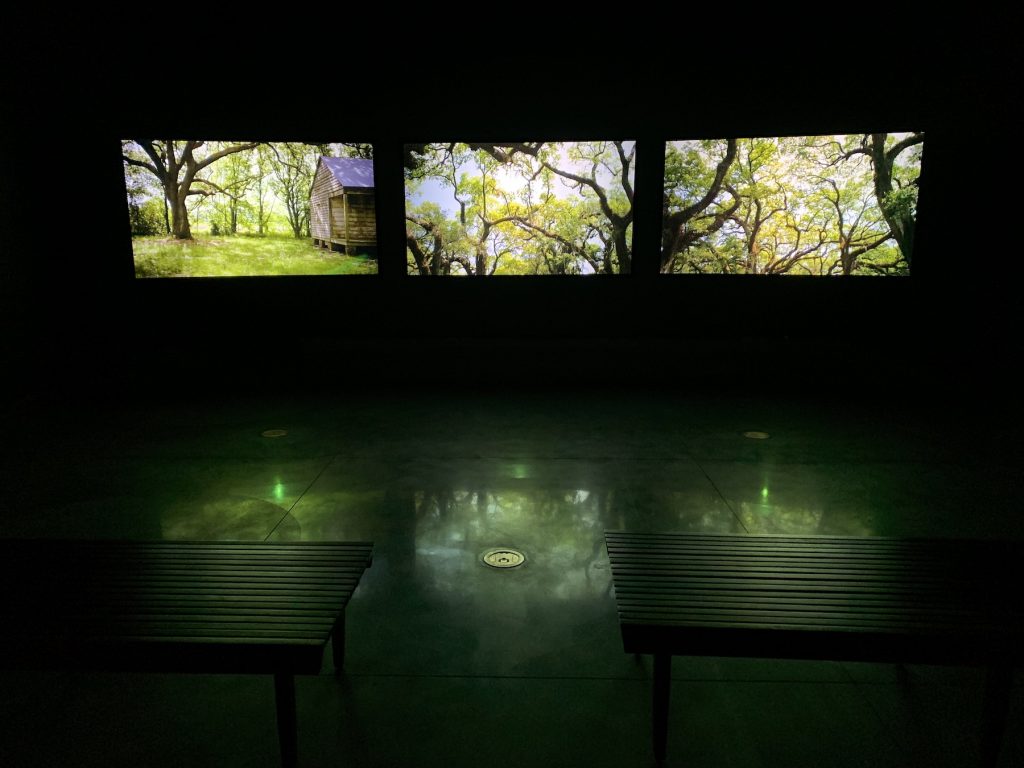
Video by Dawoud Bey at the Historic New Orleans Collection. Photo by Ben Davis.

Video by Dawoud Bey at the Historic New Orleans Collection during Prospect New Orleans. Photo by Ben Davis.

Yet from the beginning, all this has been haunted by an awareness that backlash is incoming. For art observers looking at the intense focus on identity in recent biennials, the obvious reference is the 1993 Whitney Biennial, the so-called “identity politics biennial” (in fact, the recent 2022 Whitney Biennial self-consciously returned to many of the artists from 1993). This event remains a touchstone, having surfaced a large number of non-white, queer, and feminist voices. The ’93 biennial caught the angry zeitgeist of a liberal art world at the end of 12 years of Reaganite rule, in the wake of the most intense period of the AIDS crisis and the ‘92 conflagration in L.A. (VHS footage of Rodney King being beaten by the LAPD was included in the show.)

It was a watershed. But it was also a high-water mark, signaling the inflection point after which backlash officially took the wheel.

The ’93 biennial was panned by critics. Conceptual artist Daniel J. Martinez produced a series of pins given to Whitney visitors that read “I Can’t Imagine Ever Wanting to Be White.” In Who We Be, Jeff Chang’s history of the rise and cooption of multiculturalism, he quotes Martinez on what came next: “’93 was the last shot of the war. We lost right at the moment we thought we were winning.” Coco Fusco, another star of that show, remembered recently the shift that marked the second half of the decade: “In the art world of the late ‘90s and early ‘00s there was a shift away from the moral argument about empowerment and civil rights, which was widespread in the 1980s and early ‘90s, to an emphasis on visual talent and success.”

Daniel Joseph Martinez created these entry badges for the Whitney Museum of American Art's 1993 biennial exhibition.

Daniel Joseph Martinez created these entry badges for the Whitney Museum of American Art’s 1993 biennial exhibition.
Photo courtesy the artist and Simon Preston Gallery, New York.

What can we learn from this moment? How is today different or the same?

An uncomfortable fact is that periods of advance tend to coincide with moments when the kinds of cultural liberals who make up the base of the art world feel that they are in crisis, politically. The spectacle of conservatives in power puts more pressure on culture, as rage at political disempowerment is channeled into gestures of cultural activism and symbolic atonement. The ’90s wave came out of the anger with Reagan and Bush, just as the recent climate grew out of reaction to Trump’s election. (There was some of this vibe under Bush II, but 9/11 and the Iraq War really defined the politics of that period in a different way.)

Conversely, while it flatters the liberal art world to focus on right-wing culture warriors as the driver of regression, it was actually Bill Clinton’s ascent to power in 1992 that was the harbinger of the quietist turn in 1990s cultural discourse. He and the Democratic Leadership Council had made it their mission to represent the Democratic party as pro-business, distancing it from unions and social movements. Toni Morrison may have quipped that Clinton was “the first Black president” in the New Yorker, but during the campaign, Clinton staged his own version of the “culture wars” on Democratic party terrain, deliberately baiting Jesse Jackson into a battle over rapper Sister Souljah and making a big show of condemning “anti-white” rhetoric to prove that he was the safe hand for mainstream (read: white, pro-business, and business-as-usual) America.

As a parallel, more recent talk of a “vibe shift” in culture following the #Resistance moment coincides with the election of Joe Biden, who literally promised on the campaign trail that, were you to elect him, you wouldn’t have to think about politics too much anymore. “The 2010s were such a politicized decade that I think the desire people have to be less constrained by political considerations makes a lot of sense,” Sean Monahan, whose blog 8Ball touched off the “vibe shift” talk, told New York Magazine.

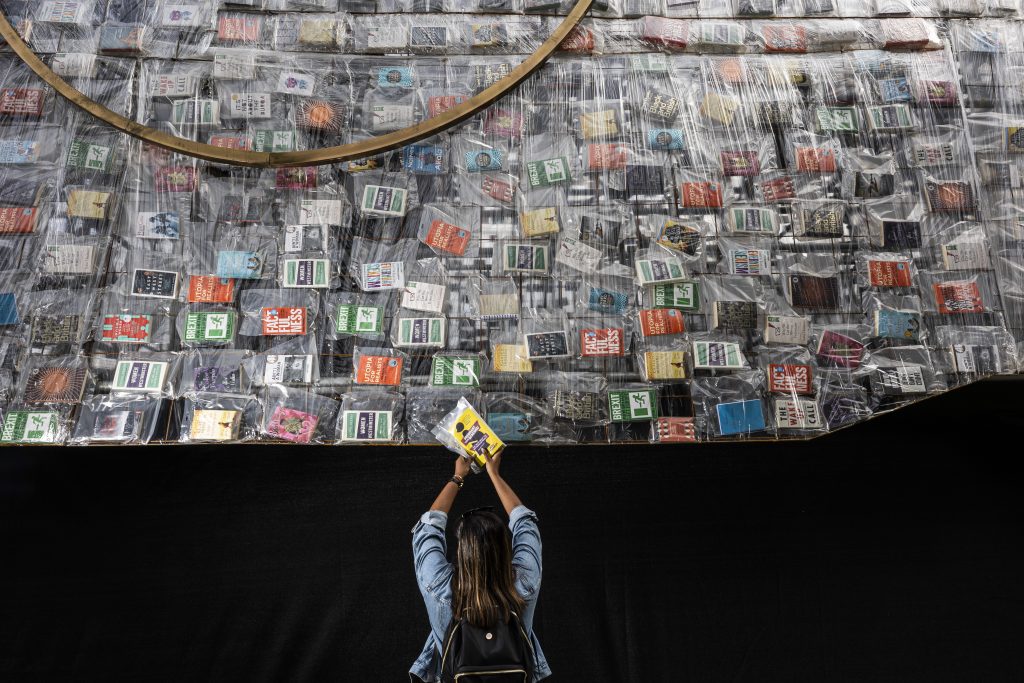
Claire Govender adds the 20,000th book to "Ben Ben Lying Down with Political Books" by Marta Minujin, Photo: Fabio De Paola/PA Wire.

Claire Govender adds the 20,000th book to “Ben Ben Lying Down with Political Books” by Marta Minujin, Photo: Fabio De Paola/PA Wire.

The Burns Halperin Report shows just how vulnerable to rollback recent advances in representation may be. Permanent collections, they show, are not so deeply affected by the social justice zeitgeist—indeed, they are little affected (although contemporary museums seem to be making solid progress towards gender parity in collecting, at least). As one mechanism for this inertia, the report points to the fact that 60 percent of the objects that enter museum collections come from gifts or bequests; these, in turn, presumably form the basis of exhibition programs. Among other things, the blockage thereby represents the embedded malaise and biases of wealth, and its accumulated power (a point theorist Nizan Shaked also argues in her important treatise from this year, Museums and Wealth).

Researching the 1990s backlash, I found this quote from David Lang, the cofounder of the Bang on a Can festival: “If you’re giving an organization $10,000, you can say, ‘In return to that we expect you to have a social face.’ If you’re cutting them from $10,000 to $1,000, you can’t say, ‘Oh by the way for this $1,000 we’d like you to change your organization.’” Lang was speaking about how arts funding cuts took the wind out of the sails of diversification efforts in the mid-‘90s, but the line could also apply to the contemporary challenge of turning arts institutions around despite the considerable reputational and commercial incentives to do so. Compared to the 1990s, even big museums today are actually much more crisis-ridden, symbolized by the last year of protests and strikes over barely livable conditions for ordinary staff.

Without money behind social justice demands, you are left with fleeting gestures and moralistic browbeating, ultimately preparing the ground for cynicism and backlash.

The United States is much less white than it was in 1990s, meaning there is more of a self-interested business case for institutions to change. But on the other hand, inequality is much worse than in the 1990s. Private wealth has today accumulated much more power and is thus even more arrogantly disconnected from the experiences of ordinary people and convinced of its own rightness. How these two dynamics interact is going to shape what the future of what museums look like. My feeling is that they point to an intensified fragmentation of the arts rather than a return to the ideological status quo.

The long-term movement towards a more diverse country is a fact. Even if you are very cynical, it is not impossible to think that bequest patterns will evolve, with a time lag to account for changing generational sensibilities. Since the huge Black Lives Matter protests of 2020, it does feel as if diverse cultural consumption has been firmly established as a virtue for high-status individuals (whether it is embedded remains to be seen).

Last year’s strange, guilt-ridden Sex in the City reboot, And Just Like That…, had the merit of unintentionally underlining this newly mainstream mindset for premium cable consumers. Erstwhile gallery owner Charlotte proves her good ally status—and relieves the anxiety she and her husband Harry feel at a dinner where they are the only white people—when she explains to her friend’s critical mom that the Black artists her daughter collects are truly investment quality (including “an early Derrick Adams!”)

Still, there is a very real limit to guilting patrons into “Doing Better” on voluntaristic moral grounds. It alienates as many would-be patrons as it moves.

Burns and Halperin write, “At the current rate of change, it may be a simpler task to build entirely new museums and market structures than to create the necessary change within the existing systems.” Melissa Smith has reported on one of the most intriguing developments of the past years: Black artists, experiencing an unprecedented market windfall, are putting funds into building up their own alternative institutions, from Titus Kaphar’s NXTHVN to residencies from Derrick Adamsand Mcarthur Binion.

But alternative institution-building is also happening on a much bigger scale—and it is not necessarily progressive. As Georgina Adam writes in her recent book The Rise and Rise of the Private Art Museum, the major trend of the past decade around the world has been stagnation in public museums, and the parallel creation of new personal founder-driven museums (the so-called “ego-seum”), born out of “a distrust of public institutions, and in some cases more problematic aims: self-aggrandizement, hyping the value of their collection, getting better access to desirable art and getting whopping tax breaks.”

Here’s a case study for the limits of the moral appeal to patrons in an age of runaway inequality. Back in 2008, billionaire Eli Broad first backed L.A. MOCA when it needed a bailout, prompting fears, from New York Timescritic Roberta Smith, that he would merge “the museum’s exemplary collection of art with his own, more predictable, market-driven one.” That turned out not to be what happened at all. After debates over the museum’s direction, Broad simply withdrew from supporting L.A. MOCA to build his own glitzy Broad Museum across the street—with free admission and Jeff Koonses galore.

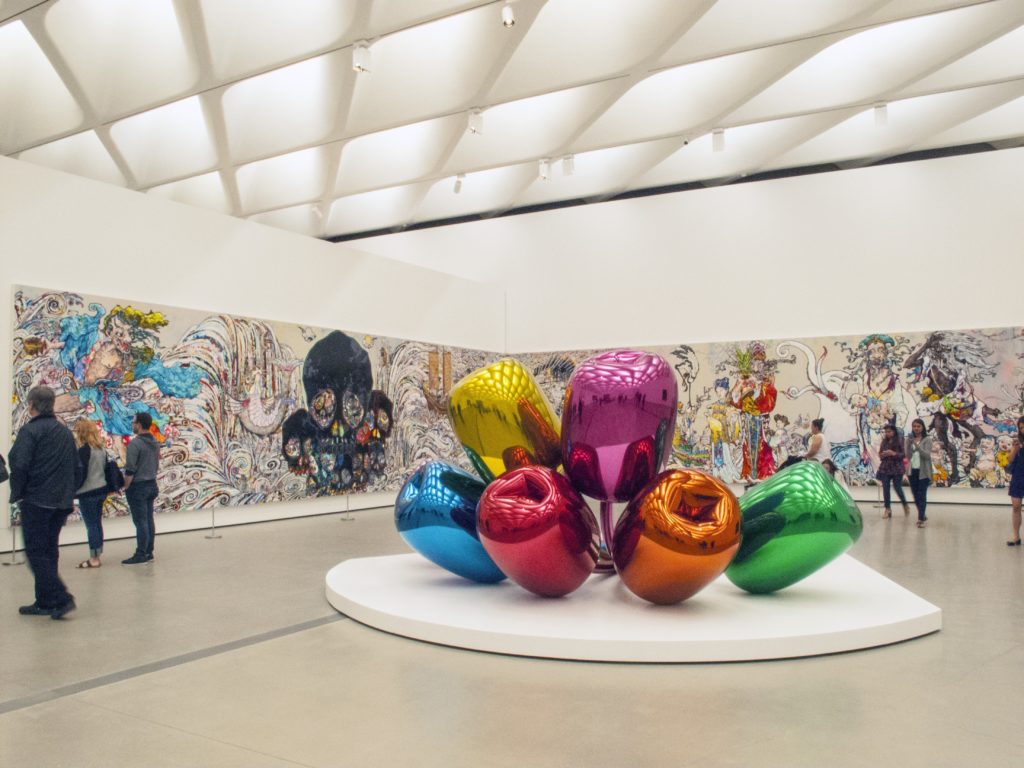
Jeff Koons’s tulips sculpture at the Broad. Photo by Santi Visalli/Getty Images.

The new political demands on culture from one direction are likely to produce new cultural moves that are equally unprecedented in the other. Until very recently, you used to be able to assume that Silicon Valley was a lock for liberals. But the kinds of new tech fortunes that the art industry has been unsuccessfully courting for over a decade—the bulk of new wealth creation, before the recent tech downturn—now seem to be flirting with reaction. In opposition to the Bernie Sanders-style social-democratic wave, Black Lives Matter, and #MeToo, techie libertarianism seems to be mutating into a turbo-charged Nietzschean neo-monarchism, militantly hostile to traditional liberal institutions, creating a new political bloc with the alt-right trolls.

Contemporary cultural backlash may not look like a return to a cozy, oblivious cultural center. It may take its cues more from Elon Musk buying Twitter to “defeat the woke mind virus” or Peter Thiel funding an “anti-woke” downtown film festival out of his pocket change.

When art observers think of backlash in the 1990s, they often think of the 1995 Whitney Biennial. It is often considered a “return to beauty” biennial, where representation snapped back towards the historical norms after the aberration of ‘93. The Guerrilla Girls printed fliers and posters summing up the feeling, declaring ironically, “Traditional Values and Quality Return to the Whitey [sic] Museum.”

A translation of the Guerrilla Girls’ banner. Photo: Courtesy Guerrilla Girls.

But the more relevant example of culture-wars backlash for today possibly came one year later: the 1996 founding of Fox News. Its boss Roger Ailes had served as a media guru to George H.W. Bush in the period of the infamous, race-baiting Willie Horton ad. He officially ejected himself from politics after Bush’s defeat in the 1992 election. And yet, all that reactionary political energy, instead of being neutralized, deflected into the cultural sphere. In Fox News, Ailes masterminded the creation of a free-standing ideological universe, one that openly challenged the idea that you could assume a mainstream “liberal media bias.” We know what its effects have been.

Given this potential shape of backlash and the structural flaws at the heart of the traditional art system, where to look for hope for real progress? I’ll give the last word to Cornell West. In his 1990 essay on “The New Cultural Politics of Difference,” West described the “double bind” of cultural producers within academia and museums, critical of institutions that they were nevertheless materially dependent on.

I think invoking it here is the opposite of nostalgia—it may be even more apt in the 2020s than it was in 1990s:

Without social movement or political pressure from outside these institutions… transformation degenerates into mere accommodation or sheer stagnation, and the role of the “coopted progressive”—no matter how fervent one’s subversive rhetoric—is rendered more difficult. In this sense there can be no artistic breakthrough or social progress without some form of crisis in civilization—a crisis usually generated by organizations or collectivities that convince ordinary people to put their bodies and lives on the line. There is, of course, no guarantee that such pressure will yield the result one wants, but there is a guarantee that the status quo will remain or regress if no pressure is applied at all.

Source: Is the Art World Entering the Age of ‘Anti-Woke’ Backlash? Here’s …

ICYMI: Biden outpacing Trump, Obama with diverse judicial nominees

Of note.

In Canada, the Trudeau appointments 2016-22 are (2016 baseline in parentheses): 56 percent women (36 percent), 10 percent visible minorities (2 percent), and 3 percent Indigenous peoples (1 percent):

For the Biden White House, a quartet of four female judges in Colorado encapsulates its mission when it comes to the federal judiciary.

One of the judges, Charlotte Sweeney, is an openly gay woman with a background in workers’ rights. Nina Wang, an immigrant from Taiwan, is the first magistrate judge in the state to be elevated to a federal district seat. Regina Rodriguez, who is Latina and Asian American, served in a U.S. attorney’s office.

Veronica Rossman, who came from the former Soviet Union with her family as refugees, is the first former federal public defender to be a judge on the 10th U.S. Circuit Court of Appeals.

With these four women, who were confirmed during the first two years of President Joe Biden’s term, there is a breadth of personal and professional diversity that the White House and Democratic senators have promoted in their push to transform the judiciary.

“The nominations send a powerful message to the legal community that this kind of public service is open to a lot of people it wasn’t open to before,” Ron Klain, the White House chief of staff, told The Associated Press. “What it says to the public at large is that if you wind up in federal court for whatever reason, you’re much more likely to have a judge who understands where you came from, who you are, and what you’ve been through.”

The White House and Democratic senators are closing out the first two years of Biden’s presidency having installed more federal judges than Biden’s two immediate predecessors. The rapid clip reflects a zeal to offset Donald Trump’s legacy of stacking the judiciary with young conservatives who often lacked in racial diversity.

So far, 97 lifetime federal judges have been confirmed under Biden, a figure that outpaces both Trump (85) and Barack Obama (62) at this point in their presidencies, according to the White House and the office of Senate Majority Leader Chuck Schumer, D-N.Y. Among them: Supreme Court Justice Ketanji Brown Jackson, that court’s first Black woman, 28 circuit court judges and 68 district court judges.

Three out of every four judges tapped by Biden and confirmed by the Senate in the past two years were women. About two-thirds were people of color. The Biden list includes 11 Black women to the powerful circuit courts, more than those installed under all previous presidents combined.

“It’s a story of writing a new chapter for the federal judiciary,” said Paige Herwig, a senior White House counsel.

The White House prioritized judicial nominations from the start and Democratic leaders in the Senate moved quickly on them. Particular focus was placed on nominees for the appellate courts, where the vast majority of federal cases end, and those coming from states with two Democratic senators, who could find easier consensus in a process where there’s still significant deference given to home-state officials.

Democrats hope to speed up confirmations next year, a goal more easily accomplished by a 51-49 Senate that will give them a slim majority on committees. In the past two years, votes on some of Biden’s more contested judicial nominees would deadlock in committee votes.

Schumer said he also hopes to install more judges in appeals courts that shifted rightward under Trump, an effort that the majority leader described as rebalancing those courts.

“Trump loaded up the bench with hard right ‘MAGA’ type judges who are not only out of step with the American people, they were even out of step with the Republican Party,” Schumer said in an interview, using shorthand for Trump’s 2016 campaign slogan, “Make America Great Again.”

Despite their limited power to derail Biden’s judicial picks, some Republicans have fought ferociously against many of them, arguing that their views were out of the legal mainstream. The precarious 50-50 Senate meant several Biden nominees languished for months and were never confirmed before the Senate wrapped up its work this year.

Democrats also say certain judicial nominees, particularly women of color, were unfairly made into lightning rods by their GOP critics.

“The Republicans have just got a problem with this,” Sen. Dick Durbin, D-Ill., chairman of the Judiciary Committee, told the AP. “Not all of them, some do.”

Sen. Josh Hawley, R-Mo., a committee member, said Biden’s picks were “very, very left, but unapologetically so” and that his colleague’s assertions about Republicans were “absurd.”

Despite the strengthened Democratic majority. the White House could nonetheless struggle to seat some judges over the next two years.

For instance, Biden has made barely a dent in the number of vacancies for district court judges in states that have two Republican senators, confirming just one such person: Stephen Locher, now a judge in the Southern District of Iowa. Home-state senators still get virtual veto power over district picks. Advocates want Democrats to discard that tradition, arguing it only allows for Republican obstructionism.

Durbin has said he would reconsider the practice if he sees systematic abuse of it. But such roadblocks have been rare, he said, and influential Republicans give some deference to Biden on judges.

One matter Biden has not been willing to address: the structure of the Supreme Court.

Any push to reshape the high court has found little footing at the White House despite its the court’s tilt farther right under Trump.

In June, the 6-3 conservative majority overturned the landmark decision Roe v. Wade, eliminating the constitutional protections for abortion that had existed for nearly 50 years. In the same term, it also weakened gun control and curbed the U.S. Environmental Protection Agency’s ability to manage climate change.

Biden has argued the court is more of an “advocacy group these days.” But he has not embraced calls to expand the court, impose term limits or mandatory retirement, or subject justices to a code of conduct that binds other federal judges.

“I wouldn’t, in any way minimize the progress and the importance of what President Biden is doing on the lower courts,” said Chris Kang of Demand Justice, an advocacy group leading the push to expand the court. But “we need to look at the core problem, which is the Supreme Court.”

Source: Biden outpacing Trump, Obama with diverse judicial nominees

2022 in review and looking ahead: immigration and related issues

2022 was characterized, in many ways, by the failure of governments to anticipate and respond to changed circumstances. Whether it be backlogs in immigration, citizenship and passports, or the overall failure of governments to address pressures on housing, healthcare and infrastructure, virtually every level of government failed to some extent.

What has been encouraging has been greater public commentary on the need for governments to address these pressures (externalities) even if the most governments remain in denial or at least silent, with the current approach, across all governments save Quebec, being the “more the merrier,” both permanent and temporary residents.

As I recently argued, the government’s Annual Report on Immigration needs to include a discussion of these externalities as well as including temporary residents in its planning and targets.

I have continued my monthly updates of immigration-related programs and have been pleased to work with the Institute for Canadian Citizenship in making some of this data more easily accessible. Summary of the recovery across programs below, comparing January-October 2022 with full year 2018, showing already well ahead of 2018 in most programs.

Issues I expect to continue following are foreign interference by governments like China, Iran and Russia, exploitation of international students and ill-guided policies that make this more-and-more a lower-skilled immigration stream, the contrast between Ukrainian refugees and others, the ongoing federal-provincial immigration arguments over relative shares, and, of course, the evolution of public opinion on immigration-related issues.

It will also be interesting to see whether or not the the proposed class action lawsuit by Black public servants is allowed to proceed along with the complaint to the United Nations Commission for Human Rights. Whenever I look at the numbers (and will do so again in 2023), Black representation is relatively better than South Asian, Chinese, and Filipino for the EX category, and better than all other groups overall, although there are significant differences among the different occupations. 

The other broader development to watch will be the expected revision of the Employment Equity Act, an act that has, IMO, facilitated and resulted in increased diversity among designated groups.

Citizenship will remain a focus and I am still waiting for the revised citizenship study guide to be released (under the fourth immigration minister!). It will also be interesting to see if the government fulfills its campaign commitment in both the 2019 and 2021 elections to eliminate citizenship fees (that were increased 5 fold by the previous government). Given the current financial pressures, will be interesting to see if the government walks that commitment back, implement it in the forthcoming budget, or do nothing and assume no one will notice (not placing any bets but inaction is the most likely outcome).

I have requested a number of citizenship Census specialized data sets to allow me to update and track change compared to 2016, looking at variety of socioeconomic factors and outcomes.

Lastly, some good news, the complete switch of attitude among political leaders in Hérouxville, the small town that convulsed Quebec with its 2007 xenophobic code of conduct for immigrants, to welcoming immigrants given demographics. Overtime, will likely have broader reverberations and somewhat weaken the differences between Montreal and the regions.

Lastly, on a personal note, we became grandparents for the first time, welcoming a new life into our family.

Best wishes for the holidays and will restart up in January.

Article roundup

Citizenship 

Is birth tourism about to return now that travel restrictions have been lifted (Policy Options, 2022), my annual update, showing a further decline compared to pre-pandemic numbers, given the legacy of Canadian travel and Chinese government restrictions.

Disconnect between political priorities and service delivery (The Hill Times, 2022), commentary on a “missing link” between policy and service delivery/implementation.

Passport delays risk undermining our trust in government (The Star, 2022), op-ed on the passport delivery fiasco.

Immigration 

Has immigration become a third rail in Canadian politics? (Policy Options, 2022), my latest, arguing for improvements in the annual levels plan to incorporate temporary workers and include considerations of the externalities of housing, healthcare and infrastructure impacts.

Public opinion on migration could sour amid food insecurity and climate change (Policy Options, 2022), This commentary was developed in the context of a Ditchley conference on food insecurity.

How the government used the pandemic to sharply increase immigration (Policy Options, 2022) My analysis of the government’s actions.

Diversity and Employment Equity

Do MPs represent Canada’s diversity? (Policy Options, 2022) Written jointly with Jerome Black, this analysis confirmed ongoing increases in political representation.

Forthcoming articles early in the new year will look at the political impact of increased diversity at the federal riding level and a comparison of provincial government political representation for the last two provincial elections.