McWhorter: Today’s Woke Excesses Were Born in the ’60s

McWhorter’s reflections always of interest, including these on the “performative” aspects of activism:

Various books I’ve been reading lately have me thinking about 1966. I have often said that the history of Black America could be divided between what happened before and after that year.

It was a year when the fight for Black equality shifted sharply in mood, ushering in an era in which rhetoric overtook actual game plans for action. It planted the seed for the excesses of today’s wokeness. I wouldn’t have been on board, and I’m glad I was only a baby that year and didn’t have to face it as a mature person.

The difference between Black America in 1960 and in 1970 appears vaster to me than it was between the start and end of any other decade since the 1860s, after Emancipation. And in 1966 specifically, Stokely Carmichael made his iconic speech about a separatist Black Power, the Student Nonviolent Coordinating Committee he led expelled its white members (though Carmichael himself did not advocate this), the Black Panther Party was born, “Black” replaced “Negro” as the preferred term, the Afro went mainstream, and Malcolm X’s “The Autobiography of Malcolm X” (written with Alex Haley) became a standard text for Black readers.

I doubt most people living through that year thought of it as a particularly unique 365 days, but Mark Whitaker, a former editor of Newsweek, has justified my sense of that year as seminal with his new book, “Saying It Loud: 1966 — the Year Black Power Challenged the Civil Rights Movement.” Whitaker has a journalist’s understanding of the difference between merely documenting the facts and using them to tell a story, and his sober yet crisp prose pulls the reader along with nary a lull.

But one question keeps nagging at me: Why did the mood shift at that particular point? The conditions of Black America at the time would not have led one to imagine that a revolution in thought was imminent. The Civil Rights Act of 1964 and the Voting Rights Act of 1965 had just happened. The economy was relatively strong, and Black men in particular were now earning twice or more what they earned before World War II. As the political scientist and historian duo Abigail and Stephan Thernstrom noted in their book “America in Black and White,” “Before World War II, Black bank tellers, bookkeepers, cashiers, secretaries, stenographers, telephone operators or mail carriers were rare. By 1970 they were very common, though far more in the north than in the south.”

And as to claims one might hear that Black America was uniquely fed up in 1966, were Black people not plenty fed up in 1876, or after World War I or World War II?

What Whitaker so deftly chronicles strikes me less as a natural development from on-the-ground circumstances than as something more elusive for the historian: the emergence and influence of that mood shift I referred to. Carmichael memorably said: “The only way we gonna stop them white men from whuppin’ us is to take over. We been saying freedom for six years and we ain’t got nothin’. What we gonna start saying now is Black Power!”

The dramatic impact was obvious. But what did Black Power mean, and how much change on the ground did this kind of rhetoric ever actually result in? What were Carmichael’s concrete plans for action in the first place?

There was always a certain performative element in the man: not for nothing was he referred to as Starmichael. Whitaker recounts Carmichael’s proposing having Harlem “send one million Black men up to invade Scarsdale” — but really?

The N.A.A.C.P. head Roy Wilkins was infuriated at a crucial summit meeting between leading Black groups where Carmichael referred to Lyndon Johnson as “that cat, the president” and recommended publicly denouncing his work. This was a key conflict between an older style seeking to work within the only reality available and a new style favoring a kind of utopian agitprop.

Figures like Carmichael and Black Panthers Huey Newton, Eldridge Cleaver and H. Rap Brown fascinate from a distance, with their implacable fierceness and true Black pride shocking a complacent “Leave It To Beaver” America. Plus their fashion sense — the berets, the leather jackets — was hard not to like. It all made for great photos and good television. But at the time, affirmative action and the Fair Housing Act of 1968, supported by those white “cats” responding to the suasion of people like Wilkins and Martin Luther King Jr., were making a real difference in Black lives, central to encouraging the growth of the Black middle class.

This difference between mood and action is relevant to the historian Beverly Gage’s magnificent new biography, “G-Man: J. Edgar Hoover and the Making of the American Century.” The book’s 800-plus pages are so Caro-esque in detail, context and narrative energy that I have dragged the hardback across the Atlantic and back; Gage somehow makes a page turner out of the life of a man with the stage presence of a toad.

Where Hoover comes in on the 1966 issue is a common observation of his, which was that the Black-led urban riots of the Long, Hot Summer, and the general change in mood from integrationist to separatist, was not solely a response to the frustrations of poverty. Of course, Hoover couldn’t get much further than seeing Black people as having simply given in to a general anti-establishment degeneracy, egged on by Communist influence. That was one part nonsense (the Communist one) and one part racism.

Hoover was bred in a Southern city (D.C.) at the turn of the 20th century, post Plessy v. Ferguson. He came of age embraced by a fraternity steeped in post-Reconstruction “lost cause” ideology about Black people. His late-career persecution of the Panthers with F.B.I. technology and tactics was nastier — and more reckless with people’s lives — than his earlier witch hunt against white Communists had been.

Yet, his sense that the new developments were not caused by socioeconomics was not entirely mistaken. Rather, I suspect that much of why leading Black political ideology took such a menacing, and even impractical, turn in the late 1960s was that white America was by that time poised to hear it out. Not all of white America. But a critical mass had become aware, through television and the passage of bills like the Civil Rights Act, that there was a “race issue” requiring attention.

It’s a safe bet that if Black leaders had taken the tone of Carmichael and the Panthers in 1900 or even 1950, the response from whites would have been openly violent and even murderous. The theatricality of the new message was in part a response to enough whites now being interested in listening.

The problem was that so much of the message, at that point, was a kind of Kabuki, as the Black essayist Debra Dickerson memorably put it a while ago. Savory, dramatic poses were often more important than plans. This was perhaps a natural result of the fact that the remaining problems were challenging to address. With legalized segregation, disenfranchisement and residential Balkanization now illegal, the question was what to do next and how. “Black Power” did not turn out to be the real answer: It all burned out early — Whitaker identifies signs that this would happen as soon as the end of 1966.

Daniel Akst’s lucid group biography, “War By Other Means: The Pacifists of the Greatest Generation Who Revolutionized Resistance,” demonstrates people of the era engaging in action that brings about actual change. Following the lives and careers of the activists Dorothy Day, Dwight Macdonald, David Dellinger and Bayard Rustin, one senses almost none of the detour into showmanship that so infused 1966. While Carmichael made speeches that, to many, were suggestive of violence, and later moved to Africa, Rustin, for example, essentially birthed the March on Washington.

I hardly intend that Carmichael’s brand of progressivism has only been known among Black people. Today it has attained cross-racial influence, serving as a model for today’s extremes of wokeness, confusing acting out for action. One might suppose that the acting out is at least a demonstration of leftist philosophy, perhaps valuable as a teaching tool of sorts. But is it? The flinty, readable “Left is Not Woke” by Susan Neiman, the director of the Einstein Forum think tank, explores that question usefully.

Neiman limns the new wokeness as an anti-Enlightenment program, despite its humanistic Latinate vocabulary. She associates true leftism with a philosophy that asserts “a commitment to universalism over tribalism, a firm distinction between justice and power and a belief in the possibility of progress” and sees little of those elements in the essentializing, punitive and pessimistic tenets too common in modern wokeness. Woke “begins with concern for marginalized persons, and ends by reducing each to the prism of her marginalization,” she writes. “In the focus on inequalities of power, the concept of justice is often left by the wayside. Woke demands that nations and peoples face up to their criminal histories. In the process it often concludes that all history is criminal.”

Neiman critiques pioneering texts of this kind of view, such as Michel Foucault’s widely assigned book, “Discipline and Punish,” and his essay “What is Enlightenment?,” in which he scorns “introducing ‘dialectical’ nuances while seeking to determine what good and bad elements there may have been in the Enlightenment.” In this cynical and extremist kind of rhetoric, Neiman notes that “you may look for an argument; what you’ll find is contempt.” And the problem, she adds, is that “those who have learned in college to distrust every claim to truth will hesitate to acknowledge falsehood.”

All of these books relate to a general sense I have always had, that in 1966 something went seriously awry with what used to be called “The Struggle.” There is a natural human tendency in which action devolves into gesture, the concrete drifts into abstraction, the outline morphs into shorthand. It’s true in language, in the arts, and in politics, and I think its effects distracted much Black American thought — as today’s wokeness as performance also leads us astray — at a time when there was finally the opportunity to do so much more. I will explore what that more was in another column, but in the meantime, Whitaker, Neiman, Akst and — albeit more obliquely — Gage are useful in showing why 1966 was such an important turning point in the story.

Source: Today’s Woke Excesses Were Born in the ’60s

‘Nobody in the Chinese Canadian diaspora was surprised’: Diaspora communities balance fears of foreign meddling with political organizing

Of note:

As revelations continue to surface about interference by the Chinese government in recent Canadian elections, Canada’s diaspora communities say they’ve been warning about this issue for years.

They also insist that their communities have every right to organize politically and influence policy at every level of government and hope the recent revelations don’t cast a pall over these efforts.

Many members of the Chinese community said they had been warning government and security officials about foreign political interference from the Chinese government for years. 

“I can say with confidence that nobody in the Chinese Canadian diaspora was surprised at all when Global News first broke the story,” says Karen Woods, a co-founder of the Canadian Chinese Political Affairs Committee, a Toronto-based non-profit. 

Workers at the Chinese consulate in Toronto helped mobilize Chinese-Canadian voters to vote for Liberal candidate Han Dong in the riding of Don Valley North, according to recent reporting by Global News. Also reported were similar actions on behalf of the Chinese government in B.C. that contributed to the defeats of Conservative incumbents Alice Wong and Kenny Chiu in their Richmond ridings.

A string of stories by Global News and the Globe & Mail paint a picture of an intricate interference network set up by Chinese government actors to influence the 2019 and 2021 federal elections to ensure a Liberal victory. 

Calgary-based political scientist and Hub contributor Rahim Mohamed believes diaspora politics are organized to obtain greater cultural recognition within a country, or to influence a country’s foreign policy towards the “homeland,” which he notes is the right of any Canadian. 

“It may be an unseemly sort of politics to some, but it generally falls within the bounds of legitimate democratic activity,” says Mohamed. “If the recent intelligence leaks are to be believed, this is a clear-cut case of a hostile foreign power meddling in our democratic process, which is a totally different ball game.” 

Nonetheless, Mohamed believes diaspora politics can open the door to foreign interference in democratic elections.

“New Canadians have democratic rights just like all other Canadians. If they want to mobilize organically to influence public policy, I take no issue with that,” says Mohamed. “The challenge for policymakers will be dealing with the opportunities these diaspora networks give interloping foreign powers to meddle in our democratic processes.” 

With over 300,000 Cantonese speakers, 500,000 Mandarin speakers, and families that arrived last year or five generations ago, Woods says the Chinese-Canadian community is far too diverse to ever be fully under the sway of the Chinese government. 

“The Chinese-Canadian diaspora consists of people who have settled in Canada for more than five generations or people like me, who came to Canada at 12,” says Woods, who says most Chinese Canadians do not like the Chinese government. “We are no different than your everyday Canadian…we certainly are part of Team Canada.” 

Within the Chinese-Canadian community, Woods says some fault lines have developed between those whose families have lived in Canada for decades and new arrivals, as well as those born in Hong Kong, Taiwan, the Mainland, or outside China. 

“Based on these factors, your attitude toward Beijing and the CCP is going to be very different. And that is why you now have HK, Taiwanese voters that will never vote for a mainland candidate in elections,” says Woods. 

However, Woods says the Chinese government’s influence has helped silence divergent points of view on Hong Kong’s anti-extradition movement and the treatment of the Uyghur Muslim minority in western China. 

Hong Kong-born Canadians and residents, and pro-democracy activists more generally, are often confronted by supporters of the Chinese government when conducting demonstrations in cities like Vancouver and Toronto.

At the height of the 2019 anti-extradition protests in Hong Kong, crowds of pro-democracy and pro-Chinese government demonstrators at a busy Vancouver intersection had to be physically separated by the police

Kash Heed, a city councillor in Richmond, where over half of the population is of Chinese descent, says that diaspora communities have attempted to influence Canada’s relations with their ancestral homelands for hundreds of years, and this is present in every democracy. He says there is a marked distinction between members of a diaspora community attempting to influence Canadian politics and a foreign government directly interfering in Canadian elections. 

“If I can directly relate it to a foreign government, I don’t have a strong indication that they’re actively involved in it (electoral interference),” says Heed. “If I could relate it to foreigners that have come to Canada (and) that have settled in Canada, trying to influence which way we go, yes absolutely,” says Heed. 

When the Chinese government does target the diaspora in Canada, Woods says it is mostly the Mandarin-speaking community from Mainland China. 

“A large percentage of the Chinese Mainland diaspora certainly still supports Beijing, but I would also like to add that is not necessarily an ideologically driven affinity to the CCP,” says Woods, who notes there are many economic interests at play with China being Canada’s second-largest trading partner. “That adds a lot of weight.”  

Mohamed says one example of diaspora politics was the political shift of the Chinese-Australian community in the country’s 2022 federal election. 

Pointing out that Australian electoral districts with the largest Chinese-Australian populations swung heavily towards the Labor Party, Mohamed says it was reported as a response to the Liberal-National government’s deteriorating relationship with China. 

Labor, which ultimately unseated the Liberal-National government, has pursued a more moderate relationship with Beijing but has not reneged on regional security agreements aimed at countering China’s geopolitical ambitions in the Pacific region.

Source: ‘Nobody in the Chinese Canadian diaspora was surprised’: Diaspora communities balance fears of foreign meddling with political organizing 

Human rights commission acknowledges it has been dismissing racism complaints at a higher rate

More on the CHRC with a note of caution to those advocating for direct access to the Canadian Human Rights Tribunal, rather than going through the Commission from Cindy Blackstock, the main advocate for the First Nation children harmed by Canada’s discriminatory child welfare system:

The Canadian Human Rights Commission’s recent numbers show it has been dismissing racism-based claims at a higher rate than other human rights complaints — but the commission insists it’s working to change that.

Numbers the commission provided to CBC News show that in most of the past five years, it reported a higher rejection rate for claims based on racism than for other complaints.

The statistics released by the commission show that during the first three years of the 2018-2022 period, the commission dismissed a higher percentage of race-based claims than it did others.

The year 2020 saw the largest disparity. The percentage of racism-based complaints the commission rejected — 13 per cent — was almost double the percentage of other types of claims it rejected (7 per cent).

The commission accepted more racism-based claims in subsequent years, referring them either to mediation or to the Canadian Human Rights Tribunal. Last year, for example, the commission dismissed only nine per cent of racism-based claims, compared with a 14 per cent rejection rate for other types of claims

The commission describes itself as Canada’s human rights watchdog. It receives and investigates complaints from federal departments and agencies, Crown corporations and many private sector organizations such as banks, airlines and telecommunication companies. It decides which cases proceed to the Canadian Human Rights Tribunal.

The commission released the data after the federal government concluded recently that the commission had discriminated against its Black and racialized employees.

The Canadian government’s human resources arm, the Treasury Board of Canada Secretariat (TBCS), came to that conclusion after nine employees filed a policy grievance through their unions in October 2020. Their grievance alleged that “Black and racialized employees at the CHRC (Canadian Human Rights Commission) face systemic anti-Black racism, sexism and systemic discrimination.”

“I declare that the CHRC has breached the ‘No Discrimination’ clause of the law practitioners collective agreement,” said Carole Bidal, an associate assistant deputy minister at TBCS, in her official ruling on the grievance.

A group of current and former commission employees who spoke to CBC News said they’ve noticed all-white investigative teams dismissing complaints from Black and other racialized Canadians a higher rate.

CBC has requested interviews with the CHRC’s executive director Ian Fine and interim chief commissioner Charlotte-Anne Malischewski. The commission has declined those requests because it says the matter is in mediation.

In a media statement, the commission has said it accepts the TBCS’s ruling and is working to implement an anti-racism action plan.

Véronique Robitaille, the commission’s acting communications director, said the commission has been compiling data in the course of that work. The latest figures, she said, show the commission is taking action to address the concerns.

“The following data … shows the results of our ongoing actions to address concerns related to the handling of complaints filed on the grounds of race, colour, and/or national or ethnic origin,” Robitaille said in a media statement to CBC News.

Robitaille said the percentage of race-based complaints referred to the Canadian Human Rights Tribunal has doubled between 2017 (9 per cent) and 2021 (18 per cent). In 2021, the commission said it implemented a modernized complaint process that modified how it screens complaints based on race, colour and/or national or ethnic origin.

‘Racism runs amuck’

The people behind the cases the commission dismissed in recent years say they’re still waiting for justice.

Rubin Coward is one of them. The former member of the Royal Canadian Air Force told CBC News that he filed a complaint with the commission in 1993 alleging he experienced racism and was repeatedly called the N-word while stationed at CFB Greenwood in Nova Scotia. His claim was rejected.

Now a Nova Scotia community-based advocate for military, RCMP members and seniors, he regularly helps people file human rights complaints. He said he’s noticed that the ones that have nothing to do with race tend to be more successful.

“I was severely disappointed but I wasn’t surprised,” said Coward, reacting to the news that the CHRC discriminated against its employees.

“Regrettably, I have had the opportunity of dealing with [the Canadian Human Rights Commission] for over 30 years now. I am not surprised racism runs amuck inside there because, in individuals that I have assisted over the course of the last 30 years, that’s precisely what they and I have run into.”

The experiences of people like Coward have prompted law sector organizations to call for changes to Canada’s human rights system.

Both former Supreme Court justice Gérard La Forest and the United Nations have called on Canada to give Canadians direct access to the without having to go through the commission.

“We believe it is time to heed the advice of Justice LaForest and the UN. It is time to finally move to a direct access model federally. The current model has not and is not working for racialized Canadians,” said the Canadian Association of Black Lawyers (CABL) in a 2021 letter.

Almost 30 other organizations signed the letter, which was sent to Justice Minister David Lametti.

The Canadian Association Labour Lawyers (CALL) has called for similar reforms.

“Right now, the commission acts as a gatekeeper, and the commission has demonstrated that it needs to get its own house in order before it starts determining whether other people’s claims are meritorious,” said labour lawyer and member of CALL Immanuel Lanzaderas.

CALL also calls for the cap to be lifted on the sum of penalties the tribunal can impose. Currently, the maximum that can be awarded to victims is $40,000.

As calls for change grow louder, some are urging caution.

The Canadian Human Rights Commission was a key player in the early days of a landmark discrimination case that resulted in the federal government agreeing in principle to cover $40 billion in compensation for people harmed by Canada’s discriminatory child welfare system. The settlement also required the federal government to reform the system that tore First Nations children from their communities for decades.

Cindy Blackstock represents one of the groups that launched that human rights challenge. She said the commission played a key role in making sure First Nations children received justice.

“If you are a person who is discriminated against or are part of … a group that’s being discriminated against, there aren’t a lot of options for you to get justice,” said Blackstock, executive director of the First Nations Child and Family Caring Society.

“I think we need to be really careful about not introducing ideas that may have the unfortunate side effect of gutting our human rights system when we need it the most.”

Blackstock said the fact that the commission discriminated against its own employees is still “disturbing.” She said the human rights system needs leadership with a track record of treating employees and the public with dignity.

In a statement, the commission defended its model, which triages complaints before they move to mediation at the tribunal stage.

“The commission’s model supports access to justice by working with complainants to articulate their experiences in a way that meets the requirements of the law, including identifying systemic discrimination,” said Malischewski.

“Commission mediators work closely with parties to empower them to reach speedy resolutions of their own design. When cases are referred to tribunal, commission lawyers regularly represent the public interest throughout the process, from the tribunal all the way to the Supreme Court.”

Source: Human rights commission acknowledges it has been dismissing racism complaints at a higher rate

Why Ontario needs to collect race-based health data

While written from the perspective of Black Canadians, applies to all visible minority groups:

Statistics Canada has published mortality data for the Black population for the first time. The findings highlight the urgent need for systematic collection, analysis and use of race based data if we are going to deliver equitable health care.

Statistics Canada merged census data and death certification and reported that Black people in Canada are more likely than white people to die from HIV/AIDS, diabetes, hypertension, stroke, kidney disease, endocrine disorders and prostate, stomach and uterine cancers. 

Black men and women are five and 22 times, respectively, more likely to die from HIV/AIDS than the white population. But there was also a 10 to 70 per cent increased death rate for the Black populations compared to the white populations for other illnesses. 

For Black men, the risks of prostate cancer death were increased 30 per cent, diabetes 35 per cent and cerebrovascular disease 10 per cent. For women, there were increased risks for dying from stomach cancer (76 per cent), uterine cancer (78 per cent), and diabetes mellitus (48 per cent). 

Socio-economic factors are part of the reason for differences in death rates. But even when these are taken into account, significant disparities persist. 

Our health-care system lacks the foresight to identify those who need the most help and building services that meet their needs. We are currently witnessing efforts to move on from COVID-19, though infections persist; we have a health-worker shortage that will exacerbate problems of access to care, and this could all be made worse by a focus on privatization.

These crises affect us all. But, some will be more impacted than others and we have no way of knowing the true extent of the harm because we do not routinely collect sociodemographic data in the health system.

As of Jan. 1, all Ontario school boards were required to collect race-based data. Our health-care system should commit to the same as there is evidence that collecting race-based data is an effective tool for improving health.

A 2019 study found that Black women were under-screened for cervical cancer, which increased their risk of worse outcomes. To address this, TAIBU Community Health Centre developed a highly effective Afrocentric cancer screening program. The rates of breast, colorectal, and cervical cancer screening increased from 17 per cent to 72 per cent, 18 per cent to 67 per cent, and 59 per cent to 70 per cent, respectively. 

Without the data from research on racial health disparities, the health concerns and needs of Black communities would have been ignored.

The Black population was at higher risk of getting COVID-19 during the first year of the pandemic. One third of employed Black women worked in health or social assistance jobs compared to 22 per cent of nonvisible minorities and because the Black population has the second highest poverty rates in Canada they were more likely to be using public transit and living in crowded housing.

Because Ontario public health units collected race-based data during contact tracing in the early pandemic, health officials were able to identify that Black populations had higher rates of infection. They used this information to develop community-based strategies to decrease infection, hospitalization and death.

Sadly, Ontario public health units no longer collect race-based data systematically. Contact tracing stopped as COVID-19 rates rose and no other system of race based data was put in its place. Further, Ontario did not mandate vaccination sociodemographic data collection.

Data collection by public health across Ontario was possible when the harms of anti-Black racism were on full display in 2020, and political will and public attention spotlighted community concerns. But this was short-lived, focused only on COVID -19 infection and ended mid 2021.

Without the collection, utilization and proper governance of race-based data, our disproportionate pain and deaths go unacknowledged, unaddressed and invisible.

We cannot afford to wait for another racial justice reckoning to reach popular discourse for change to happen.

Fiqir Worku, Paul Bailey and Kwame McKenzie are members of the Black Health Equity Working Group.

Source: Why Ontario needs to collect race-based health data

Le «Québec bashing» pour faire avancer l’agenda islamiste

Of note:

Je suis arrivée du Maroc en 2005 accompagnée de mes deux jeunes garçons de un et trois ans. Je ne me sauvais pas d’une situation de violence particulièrement grave, mais d’un état de dépendance et de soumission assez banal pour une femme dans une culture arabo-musulmane.

Cela n’a pas été facile de redémarrer une vie de mère de famille monoparentale dans un nouveau pays, mais le Québec a été pour moi une destination de rêve, et je suis reconnaissante de l’accueil dont j’ai bénéficié. J’ai toujours trouvé injustes les accusations de racisme et d’islamophobie dont les Québécois sont la cible. Je me sens plus respectée au Québec que je ne l’étais dans mon pays d’origine. C’est ici que je me suis sentie citoyenne à part entière, libre de mener ma vie comme je l’entendais, sans jugement, et j’ai le sentiment d’avoir bénéficié de l’égalité des chances.

On parle beaucoup d’islamophobie, mais on ne parle jamais de la pression communautaire qui pèse sur les ressortissants des pays arabes pour les forcer à se conformer à des normes culturelles et religieuses et les empêcher de s’intégrer dans leur pays d’accueil. Mon expérience récente dans le milieu associatif montre à quel point il est difficile de faire émerger un islam humaniste au Québec, et comment les accusations de racisme et d’islamophobie contre les Québécois sont utilisées pour faire avancer des objectifs islamistes.

J’avais envie de m’investir dans le milieu associatif pour aider d’autres ressortissants de pays musulmans, surtout les jeunes, à s’en sortir. Je voyais le danger de la radicalisation et l’influence que certains prédicateurs ont sur les jeunes ici même, à Montréal. Mon neveu de 25 ans habitant à Laval, plein de talent et de joie de vivre, artiste peintre, parolier, bon joueur de soccer, est soudain tombé entre les griffes du radicalisme. Du jour au lendemain, il a arrêté ses études, ses activités artistiques et le sport, pour se consacrer à la religion. J’avais tellement envie de crier fort : laissez les enfants vivre sans influence religieuse, arrêtez de les endoctriner.

Dès que j’en ai eu la possibilité, j’ai donc décidé de m’investir dans la société civile. Le passage à Montréal d’un penseur égyptien prônant une approche humaniste de l’islam m’en a donné l’occasion. Autour de ce penseur, la possibilité de créer une association de citoyens de culture arabo-musulmane favorables à la laïcité s’est présentée. Dans le cadre de cette nouvelle association, nous avons commencé à organiser des activités culturelles et des rencontres virtuelles avec des membres dans différentes villes du Canada et des États-Unis.

Arme aux mains des intégristes

Cependant, une personne très connue dans le milieu associatif et très influente dans une certaine communauté musulmane de Montréal prenait de plus en plus de place dans la direction de l’association. Le temps accordé aux personnes non pratiquantes, athées ou favorables à la laïcité diminuait au bénéfice de nouvelles personnes qu’il invitait, ayant des idées plus proches d’un islam radical. Lorsque je lui en parlais, il m’expliquait qu’il était important d’écouter ces personnes pour les amener un jour à changer d’idées.

Je n’étais pas convaincue par ses arguments, mais étant donné sa notoriété et son expérience associative de plus de trente ans, j’acceptais. Cependant, plus le temps passait, plus des personnes défendant l’islam politique se joignaient à l’association qui, rappelons-le, avait été créée justement pour faire face aux idées de l’islam politique.

À chaque occasion qui se présentait — rencontres en personne, virtuelles ou téléphoniques —, ce monsieur trouvait le moyen de décrire le Québec comme une province raciste et islamophobe. Il utilisait toutes les tribunes pour diaboliser le Québec. Lorsque j’intervenais pour parler de mon expérience positive au Québec, il ridiculisait mes propos et expliquait que si j’étais bien accueillie, c’était en raison de mes positions « anti-islam ».

Ma position en faveur de la loi 21 est ce qui m’a valu le plus de moqueries de sa part. Il insinuait que je voulais plaire aux Québécois et que je n’étais qu’un instrument entre leurs mains. Lors de la nomination d’Amira Elghawaby comme représentante canadienne à la lutte contre l’islamophobie, il fit des pressions sur moi pour que je ne puisse pas exprimer mon avis contre sa nomination.

C’est à la suite de la dernière rencontre que j’ai décidé de quitter l’association. Parmi les intervenants, il y avait une maman syrienne qui racontait son expérience douloureuse en nous montrant la photo de sa fille dans la vingtaine tuée par Daech [groupe État islamique]. Lorsque la réunion fut terminée, ce monsieur réagit violemment en interdisant la diffusion d’une vidéo présentant nos interventions et déclara que la maman n’aurait pas dû qualifier Daech d’organisation terroriste.

L’association dont j’avais été membre fondatrice n’avait plus rien d’humaniste ni de laïque.

Je ne sais pas quel sera le mandat de la représentante canadienne à la lutte contre l’islamophobie, mais je sais que ce concept est une arme aux mains des intégristes pour faire avancer leurs objectifs politico-religieux et pour creuser un fossé entre les musulmans et les autres. Il y a de quoi s’inquiéter.

Source: Le «Québec bashing» pour faire avancer l’agenda islamiste

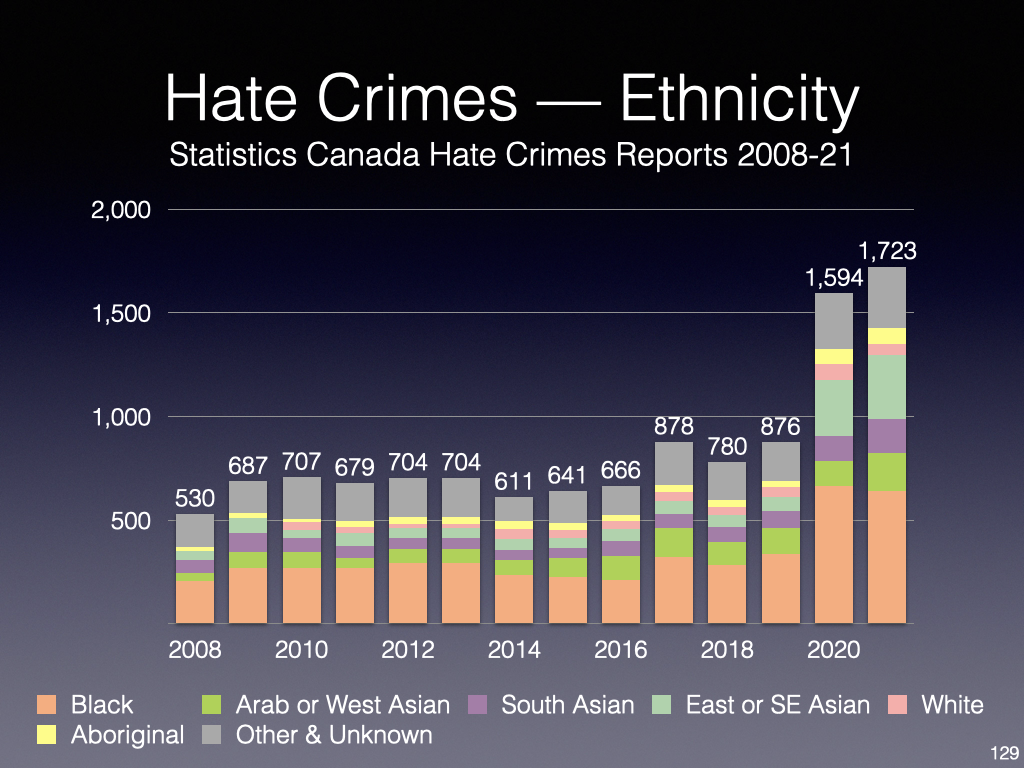
Record jump in LGBTQ, religious hate crimes cases reported to police, with men and boys main targets

Previously reported but richer data:

A new report shows a record jump in hate crimes against the LGBTQ, Muslim and Jewish communities, prompting calls for more support for victims of the abuse.

The analysis based on police reports also showed around half of Canadians committing hate crimes had been accused of other crimes before and after those incidents.

The Statistics Canada hate crimes report notes that in 2021 there was a 64-per-cent rise in crimes against members of the LGBTQ community and a 67-per-cent increase in incidents linked to a person’s religion.

A further analysis of these police cases from 2018 to 2021 showed investigators found that two-thirds of the victims were boys and men, most of whom didn’t know the suspect – unlike victims of other crimes.

Almost half of the hate crimes cases were “violent,” including assault, harassment and uttering threats.

The number of hate crimes reported by the police, including military police, rose by 27 per cent to 3,360 in 2021 from 2,646 incidents in 2020.

Mohammed Hashim, executive director of the Canadian Race Relations Foundation and chair of the RCMP’s hate crimes task force, said the numbers are “an underrepresentation of the actual problem of hate in Canada.”

“Most people do not report hate crimes to the police mainly because they don’t have faith that anything will come of it,” he said, adding the statistics for 2022 are likely to show an even greater increase.

The Statscan report says: “Police data on hate crimes reflect only the incidents that come to the attention of police, and are classified as hate crimes.”

Just over one in five of the incidents resulted in “the laying or recommendation of charges,” the Police-Reported Hate Crime report said.

The analysis delved into who was committing the crimes and found that a cohort of almost 3,000 people are committing repeated offences. Between 2012 and 2018, 2,872 people were accused of at least one hate crime.

Just under half of them had been accused of an incident reported to the police – which may not relate to hate crimes. Fifty-four per cent came into contact with police again within three years after their “initial hate crime violation.”

The Statscan findings, published Wednesday, said after three consecutive years of decline, there was a 67-per-cent increase in reports of hate crimes based on religion.

That included a 71-per-cent jump from 2020 of hate crimes targeting Muslims, a 47-per-cent increase in hate crimes targeting Jews and a 260-per-cent surge in attacks on Catholics.

There were 423 hate crimes reported because of sexual orientation, up from the previous peak in 2019 of 265.

Tyler Boyce, executive director of the Enchante network, which includes over more than LGBTQ organizations, said the statistics were an understatement of the amount of abuse gay and lesbian people experience, and more support was needed. He expressed concern that Statscan does not track abuse directed at transgender people.

Mr. Boyce blamed the far right for fuelling a record number of attacks on members of the LGBTQ community. 

“We are seeing a rise in online hate and people are feeling emboldened to take this from an online space to in-person,” Mr. Boyce said.

Ontario had just over half of all hate crimes directed at people on the basis of sexual orientation.

Unlike other crimes, a large proportion of violent hate attacks were committed by strangers. In 3 per cent of cases, victims were killed or very badly injured. 

Based on population, members of the Jewish community were the most targeted religious group with 145 incidents per 100,000 people, followed by Muslims who experienced eight hate crime incidents per 100,000. Catholics experienced one incident per 100,000 people in 2021.

Nicole Amiel, of the Centre for Israel and Jewish Affairs, said Canadian Jews were more than 10 times more likely than other religious minorities to report being the target of a hate crime.

Fatema Abdalla, of the National Council of Canadian Muslims, said many hate crimes directed at Muslims were not reported to the police, but the council has seen a rise in people calling them for support after being attacked or abused in public.

Source: Record jump in LGBTQ, religious hate crimes cases reported to police, with men and boys main targets

Black Torontonians ‘significantly’ more likely to face discrimination on regular basis, study finds

Of note:

Black people in Toronto are “significantly” more likely to face discrimination on a regular basis than white residents, according to a recent in-depth report on Torontonians’ day-to-day experience with microaggression and discrimination.

A research brief entitled Everyday Racism: Experiences of Discrimination in Torontoreleased Tuesday highlighted findings on discrimination pulled from the Toronto Social Capital Study published in November.

The first-of-its-kind report, led by the non-profit Toronto Foundation and Environics Institute for Survey Research, found that roughly 76 per cent of Black Torontonians experience racial discrimination at least a few times a month.

Source: Black Torontonians ‘significantly’ more likely to face discrimination on regular basis, study finds

ICYMI: We should be paying attention to foreign interference in our provincial elections

Of note. Also at municipal levels:

Alberta’s vote this spring will mark the first major provincial election after a series of news reports on intelligence that Beijing meddled in the most recent federal election. But recommendations that the province’s independent chief electoral officer made last year to bolster Alberta’s legal guards against the rapidly evolving challenge of disinformation, including from foreign actors, won’t be implemented in time for voting day on May 29.

Foreign interference hasn’t been a major concern in the province’s electoral process in the past. Becca Polak, a spokeswoman for Danielle Smith, said no issues have been brought to the Premier’s attention. Political parties using social media to battle among themselves is – at this moment – still probably a graver concern. A Global Affairs Canada report examining foreign interference in Alberta’s 2019 provincial election found evidence of co-ordinated inauthentic behaviour from social media accounts, but determined the majority of these accounts were likely not foreign.

But we should be paying attention. A big portion of Canadian governance takes place in the provinces and territories. And the question of whether they are prepared for a new world of borderless cyberthreats and other sophisticated tools employed by foreign governments should be considered in British Columbia, Ontario, Alberta and other provinces alongside fears about interference in federal elections.

The reports on interference in federal elections from The Globe and Mail and Global News have already intruded into provincial spheres. On Friday, a member of Ontario’s legislature, Vincent Ke, left the Progressive Conservative caucus after allegations in a Global News story that he was part of a Beijing-led effort to interfere with the 2019 federal election. Mr. Ke denies the report and says he will work to clear his name.

Except for Prince Edward Island, Alberta’s will be the next big election in Canada. In his December annual report, Alberta’s chief electoral officer noted weak spots in the province’s electoral laws, singling out the lack of power the province has to tackle misinformation and disinformation in election campaigns. Glen Resler noted that while federal election legislation has provisions related to foreign interference to fraudulently affect the outcome of an election, Alberta doesn’t have the same safeguards.

The report made a few specific recommendations to beef up Alberta’s Election Act, including specifically prohibiting any person or entity, including foreign persons and entities, from knowingly making false statements about the voting process – including voting and counting procedures – to disrupt the conduct of the election, or to undermine the legitimacy of the election or its results.

The annual report also noted how the province’s laws need to reflect the digital age. The Alberta law has a provision that allows the office of the chief electoral officer to remove non-compliant advertisements, including a physical sign. But it can’t compel social media platforms to remove content in a timely fashion.

The Globe’s reporting in recent weeks has focused on secret and top-secret Canadian Security Intelligence Service documents outlining how Chinese diplomats and their proxies backed the re-election of Justin Trudeau’s Liberals – but only to another minority government – in 2021, and worked to defeat Conservative politicians considered to be unfriendly to Beijing.

The CSIS documents outline how China spread falsehoods on social media and provided undeclared cash donations in the 2021 election. The documents also outline how Beijing directed Chinese students studying in Canada to work as campaign volunteers, and illegally returned portions of donations so donors were not out of pocket after claiming a tax receipt.

In an e-mail this week, Elections Alberta spokesperson Cora-Lee Conway said any efforts that threaten to compromise the integrity of democratic processes are of great concern to Elections Alberta. She noted that the office is in regular contact with a local CSIS office and the Canadian Centre for Cyber Security, the lead agency on federal response to cybersecurity events.

Alberta’s Justice Ministry indicated there won’t be any changes to Alberta’s Election Act coming before May, noting the legislative agenda for the rest of the legislature’s sitting is already laid out. Spokesperson Ethan Lecavalier-Kidney said the government is in the process of reviewing the chief electoral officer’s recommendations from December.

British Columbia and Ontario are provinces likely far away from elections. But B.C. is in the process of amending its laws to address online political campaigns and election advertising to match with current technologies. Recent reports from Elections BC have raised broad concerns about foreign interference, but the provincial attorney-general’s office says Elections BC has advised it that foreign interference has not been an issue in B.C. provincial elections.

In past years, Ontario’s chief electoral officer, Greg Essensa, has said it will be looking for cases of foreign interference. This week, Elections Ontario said in an e-mail it takes the integrity, security and accuracy of elections very seriously and works with security partners to monitor and review internal processes. In a response to a question about Mr. Ke, the office said it doesn’t comment on whether it has received a complaint or is investigating any matter.

There will be politicians and critics, whenever the topic of foreign interference in Canadian elections is raised, who say the very act of focusing on the issue will create distrust in the political processes we rely on.

But there is hope – to paraphrase a famous bit of Fitzgerald wisdom – that voters are able to hold two opposing ideas in mind at the same time, and still hold onto a democracy’s ability to function. For instance, although there were efforts to meddle in the 2021 federal election, those efforts did not affect the outcome of the vote, says a report based on the work of a panel of senior public servants. And a new Leger poll released this week shows the majority of Canadians want Ottawa to call an independent inquiry into foreign interference in the past two federal elections, but still feel the country’s electoral system is safe.

Most voters still trust in our political processes. For that to continue, politicians and public institutions must also say that foreign interference is possible and real, and show they are intent on stopping it.

source: We should be paying attention to foreign interference in our provincial elections

Amal Attar-Guzman: Diaspora communities in Canada are an incredible asset—if only we would take them seriously

The one point missing from this analysis is the divisions within the various diaspora communities. Members in most communities have diverse interests and viewpoints and thus the question of “who to take seriously” is not as straightforward as it may appear.

In the case of China, it appears the government was too cozy with Chinese Canadians who were more aligned with the Chinese regime than Chinese Canadians who were more independent:

China’s foreign interference in Canadian democracy has been the hot topic these past few weeks. The Conservatives and Bloc Québécois are demanding a public inquiry to investigate how the last two federal elections were compromised and who in the government knew what and when. 

This is not just a federal issue, either. In Ontario, the Progressive Conservative government has faced own its backlash, with allegations that PC MPP Vincent Ke served as a financial intermediary for the Chinese Communist Party (CCP) Toronto-area network.1

Canadians have strong feelings on the matter. A recent Angus Reid Institute poll finds that a plurality (40 percent) of Canadians now view China as a potential threat to Canadian interests, while over a quarter (26 percent) say that the Canadian government should proceed cautiously with Beijing. Only 12 percent of Canadians are favourable towards China.  

While the coverage of this story has been extensive and shows no signs of slowing down, one major element has been under-discussed in this affair: the impact on the Asian diaspora and other diaspora communities as a whole. 

Here in Canada, we love commending ourselves for having a pluralistic, open, and inclusive society where people from many parts of the world can live together peacefully and in harmony. Where diversity, famously, is our strength.

While I tend to agree with the premise, how does that shake out in practice? What’s the use of praising ourselves when government officials do not listen to diaspora communities when they are being harmed?

That has been the case in this current scandal, where warnings from the Chinese diaspora of potential foreign interference were not taken seriously. In fact, members of the community reported the issue of Chinese foreign interference as early as 2006. Instead, the Canadian political establishment, both Liberal and Conservative governments, mostly ignored them. 

Because of the severity of the scandal, there have finally been talks of officially setting up a publicly-available foreign influence registry, as outlined by Senate Bill S-237. This bill would require individuals or organizations that have ties with foreign governments to be officially registered,especially in the case where they seek to contact Canadian public officials. It would fall in line with what other allies have done, particularly in the U.S. and Australia

Many are apprehensive of this bill. There have been growing concerns that a foreign influence registry would be used to further incite anti-Asian sentiment in Canada, which has been prevalent in recent years. Over the course of the 2020 COVID-19 pandemic, there has been a 47 percent increase in racist incidents against the Asian community, according to a Chinese Canadian National Council Toronto Chapter and Project 1907 survey.

I am sympathetic to these concerns. Racism and xenophobia in times of crisis are not new here in Canada, and can at times be reflected by a political establishment. In fact, sadly, I have been on the other side of such treatment. Being half-Iraqi, I have experienced racist and xenophobic sentiments over the years following America’s invasion of Iraq 20 years ago, despite Canada not officially joining the war.2

But why did these sentiments persist? The answer is in large part because there was little to no national discussion on how these difficult situations impacted our communities, nor did the political establishment of the day care to hear our experiences or insights. And this didn’t just happen to my community. Ask any diaspora community and they’ll have similar stories. 

Dynamics in diaspora communities are complex. For those of you not part of a diaspora, let me paint a picture. Being a part of a diaspora community in Canada is to be living in two worlds. Not only do we operate on a daily basis within the larger local, regional, and national culture of the country that we immigrated or were born into. But many also retain strong communal connections with their respective diaspora community, either with other fellow community members or by maintaining professional, social, or familial ties back in their countries of origin. The WhatsApp groups that many of our older relatives are a part of are no joke. 

Additionally, people within diasporas have complicated relationships among themselves. Social, cultural, or political grievances are often uprooted and replanted in the soil of their new homes.

Diaspora communities are then often stuck between a rock and a hard place. On the one hand, given these ties to their countries of origin, diasporas can be threatened by malicious adversarial actors back from their country of origin. This has often been the case with the CCP targeting members of the Chinese-Canadian community.

On the other hand, entire diaspora communities in Canada get chastised by the larger adoptive community and painted as the malicious actors themselves. As a result, many can feel as though they are living in a no man’s land, alienated by both their home country and their adopted country.

But there is a major upside. Because diasporas live and operate in two worlds and are culturally versed, they can provide the essential knowledge and intelligence that can be used to serve and protect Canada and its interests. Diaspora communities are the ace in Canada’s card deck. Their wealth of knowledge is an underutilized resource that Canada can tap into, if only we would listen.

But instead of being taken seriously, diaspora communities tend to be viewed by larger Canadian society in one of two ways: childlike and ignorant or dangerous and distrustful. By placing us in either category and not factoring us into the conversation, we are not seen as living, breathing communities that impact Canadian society at large. Both our issues and, importantly, our insights are ignored.

Thankfully, these last few weeks may be the wake-up call we need. Diaspora communities from the Canadian Coalition for a Foreign Influence Registry (CCFIR) have called on the federal government to start a foreign influence registry that will serve and protect diaspora community members. Hopefully their calls do not go unheeded. Public Safety Minister Marco Mendicino announced that there will be public consultations on any foreign agent registry to broadly engage with all Canadians, including the Chinese diaspora and other affected communities.

Ultimately, not actively involving diaspora communities in our policymaking not only does a disservice to Canadian democracy, national security, and our institutions, it puts diaspora communities at risk. If a “Canadian is a Canadian is a Canadian,” then those in diaspora communities ready to participate in building this country must be both 1) protected from harmful foreign influence and 2) taken seriously as valuable contributors to our national project.

Would this entire mess have been avoided if prudent care was taken to seriously listen to marginalized members of the Chinese diaspora who were ringing early alarm bells about foreign interference? Maybe, maybe not. But we would be a lot further along in solving this problem than we are right now.

Source: Amal Attar-Guzman: Diaspora communities in Canada are an incredible asset—if only we would take them seriously

Cohen: The unspeakable silence of the Canadian Jewish establishment

Of note:

In its 75 years of nationhood, Israel has lived under a regime of unrelenting threat. Challenges to its security, unity and prosperity are as old as the country itself. Whatever the danger – invasion, war, terrorism, intifadas, boycotts, sanctions – it has come from beyond Israel’s borders.

No longer. The forces convulsing Israel over the past 10 weeks are made in Israel. They come from citizens protesting a religious, revolutionary government that wants to make the judiciary less independent, weakening the checks and balances that have protected minority rights. If Israel is in upheaval today, blame not marauding infidels, foreign armies or fifth columnists. Blame Israelis.

Oh, the irony. The power of its military, diplomacy and economy ensures Israel dominates the neighbourhood. As political scientist Steven A. Cook has noted, Israel has broadened relations with regional partners while ensuring Israel’s armed forces, brandishing nuclear weapons, are matchless. There is a mortal threat from Iran, yes. But Israel is less vulnerable than it was during the wars of 1948, 1956, 1967 and 1973, or any other time. “Israel is in a better strategic position than ever,” Mr. Cook argues. “And its sovereignty is beyond question.”

At home, though, Israel is roiling with insurrection. Its soul is under siege. Ehud Barak, the former prime minister, calls for “civil disobedience” if the new government passes its agenda; he says Benjamin Netanyahu’s right-wing coalition is using “the tools of democracy in order to destroy [Israel] from within.” From afar, the Jewish diaspora watches this unravelling with a mix of acquiescence, incredulity, resignation, helplessness, fear and anger.

Among Canada’s 400,000 or so Jews, the response is muted. Some have voiced their opposition to Mr. Netanyahu’s plans through the campaigns of progressive Jewish organizations. From more centrist Jewish groups: silence.

It has come to this: In Israel’s hour of crisis, as thousands fill the streets, protesting the assault on democracy and human rights, mainstream Jews in Canada are unseen and unheard. They have been orphaned by timid, tepid leadership out of step with their views. This is the unspeakable silence of the Canadian Jewish establishment.

The emblem of that establishment is the Centre for Israel and Jewish Affairs (CIJA). It calls itself the “advocacy agent” of the Jewish Federations of Canada, an umbrella of organizations providing social services and advancing Jewish interests.

CIJA initially called itself “the exclusive agent” of Canadian Jews. Now, more modestly, it “represents the diverse perspectives of more than 150,000 Jewish Canadians affiliated with their local Jewish Federation.” That claim is dubious. Is every one of these 150,000 individuals “affiliated” with a federation (presumably as donors or volunteers) duly represented by CIJA? How does CIJA know? And even if all were aligned with CIJA, this would still represent less than half of Canadian Jewry, suggesting that CIJA – for all its hopes and boasts – is far less relevant than it admits.

Then again, CIJA has overstated its stature since it was created in 2011, when it absorbed the Canadian Jewish Congress (CJC) and the Canada-Israel Committee. Discarding its “legacy name” like day-old bagels, CIJA dropped “Canadian” and added “Israel.” It insisted its restructuring had “the overwhelmingly support of the community.” Not necessarily. Bernie Farber, who was at Congress (as it was called) for most of his long, distinguished career in Jewish advocacy, calls it a hostile takeover of what was known as “the parliament of Canadian Jewry.”

For many Canadian Jews, the end of Congress was an affront, reflecting the agenda of wealthy Jews sympathetic to Stephen Harper’s Conservatives. For me, it was a loss. Congress was founded by my great uncle, Lyon Cohen, among others, in 1919. He was president until 1934, supported by my grandfather, Abraham Zebulon Cohen. Although at first the CJC did little beyond establishing the Jewish Immigrant Aid Society, Congress eventually became a spirited democratic voice led by prominent Jews in business, law, the clergy and the academy. Among them were Samuel Bronfman, Gunther Plaut, Reuven Bulka, Irving Abella, Dorothy Reitman and Irwin Cotler.

Prof. Abella, the late eminent historian, called it “a unique organization” with “no parallel anywhere else in the Jewish world.” It was a forum “where all the problems of Canadian Jewry could be debated,” including human rights, equity, immigration, free speech, social justice and interfaith dialogue. “No one doubted that when the CJC spoke, it spoke on behalf of all Canadian Jewry,” he said.

Today no one believes CIJA speaks for Canadian Jewry. It is not a parliament. Its officers are unelected. Its annual budget is secret. It is evasive (after pleasantly acknowledging my queries, none were answered.) The organization does admirable things, such as fighting antisemitism. It also champions Israel, about which, let it be said, its chief executive officer, Shimon Fogel, cannot utter a discouraging word.

Scour CIJA’s Twitter account, its news releases and Mr. Fogel’s interviews, and it’s hard to find a single criticism of the Netanyahu government (except, recently discovering intestinal fortitude, it denounced Israel’s hateful Finance Minister for urging the eradication of a Palestinian village.) CIJA presumably believes its subtlety and caution serves the community, whose views on the unrest in Israel have been unclear.

Now, though, we know more. A comprehensive poll by EKOS Research Associates finds that Canadian Jews overwhelmingly oppose changes to Israel’s high court and other proposed measures, such as banning gay pride parades and imposing gender segregation in public spaces. That is just one poll, commissioned by JSpaceCanada and the New Israel Fund of Canada (NIFC). Still, it provides “a fair baseline representation of Jewish community perspectives in issues of vital importance,” says Robert Brym, a sociologist at the University of Toronto who oversaw the survey.

If this is a correct reading of Jewish attitudes, CIJA is ignoring them, even as Mr. Fogel insists otherwise. “While marginal groups may heckle from the sidelines,” he told the Canadian Jewish News, “in fact, CIJA not only has the access but has used its privileged position to meet with senior Israeli leadership” in and out of government. Those recent meetings were preceded by other private interventions, he reported.

Mr. Fogel, who lacks the influence of the luminaries who ran Congress, suggests his quiet diplomacy is more effective than public pressure. His scorn for other Jewish voices – heckling from the sidelines – reflects an erosion of civility within the community. Relations are so fraught that CIJA has threatened, in writing, to sue the NIFC and JSpaceCanada for attributing statements to Mr. Fogel that he denies are his.

Mr. Farber, who was CEO of the CJC, says this level of rancour is unprecedented in Canada. “There were always differences, sometimes prickly, but it was always ‘Macy’s versus Gimbels.’ It was always kept within the community. There was an unwritten rule that we ought not air our dirty laundry in public. We kept things unzera, in Yiddish, ‘among ourselves.’”

Then, again, it’s understandable that some Jews are reluctant to speak out, even though Jews are acutely sensitive to injustice and have historically protested it everywhere, notably as leading participants in the U.S. civil rights movement. They were raised to revere Israel and to remember the Holocaust. They don’t want to give ammunition to antisemites. The rabbi of my synagogue, who presides over a large, conservative congregation, says that were he an Israeli, he would join the protests. From his pulpit, though, he argues Israel is “a liberal democracy” that will get by without his advice.

There are other explanations for this reticence. It may be our character, which is less assertive than Americans, Australians and Britons. It may be that shutting up is the price of access, be it in Ottawa (which has been less critical of Israel than other governments) or Jerusalem. It may be the absence of a lively Jewish press as a forum for liberal Zionist voices.

And what good, skeptics might ask, is rushing to the ramparts anyway? Do we think Jerusalem really cares? Actually, Mr. Netanyahu might listen to the diaspora and foreign governments, if they made enough noise – and some threats, too. Meanwhile, he pushes his illiberal project forward because he can.

It isn’t that there are no critics among prominent Canadian Jews. Former Supreme Court Justice Rosalie Abella has warned of the dangers to the independence of Israel’s judiciary. So has Mr. Cotler among about 175 jurists who have signed a petition. The NIFC and JSpaceCanada are rallying opposition and raising public awareness, vigorously and effectively, as are Canadian Friends of Peace Now. To them, CIJA and its silent partners are marginal while they are mainstream, and this is no time for nuance.

But where are other Jews – entrepreneurs, doctors, artists, professors? Where are the philanthropists declaring their alarm, as Charles Bronfman, the Canadian co-founder of Birthright, and other Jewish billionaires and foundations have in the U.S.? Where are rabbis as passionate as Micah Streiffer of Toronto, who says it is our obligation to speak up when Israel abandons basic values, a response that is the real expression “of our love”?

In 1965, a young Elie Wiesel visited the Soviet Union to observe the life of its three million Jews. That produced his haunting cri de coeurThe Jews of Silence. Curiously, he confessed that he was less concerned about Soviet Jews than the detachment of his American co-religionists, a lament that has an eerie contemporary resonance amid Israel’s moral crisis.

“What torments me most is not the silence of the Jews I met in Russia,” he wrote, “but the silence of the Jews I live among today.”

Andrew Cohen is a journalist and professor of journalism at Carleton University. His most recent book is Two Days in June: John F. Kennedy and the 48 Hours That Made History.

Source: Cohen: The unspeakable silence of the Canadian Jewish establishment