Boessenkool: Crossing the line

Good self- and broader reflections:

As I reflect on vile attack on five members of the beautiful Azfaal family — Salman, Madiha, Yumna, Talat and Fayez — I was initially deeply angered by how quick some were to use this vile, hate-motivated act of terrorism to confirm their political priors. 

And yet. 

The fact that the alleged attacker, Nathaniel Veltman, is a young Dutch blond boy who could well have come from my own religious community hit close to the heart. 

Now let me be clear. I apportion no blame for this act on Conservatives, religion, or even the Dutch privilege in which I assume Veltman, like me, grew up in. If guilty of this crime, Veltman is a hate-motivated terrorist who committed multiple murders. That would be on him. May the justice system rain down. 

And yet. 

My reflection called to mind times when, as a religious social conservative, I should have felt more uncomfortable with some of the things my fellow conservatives have said in recent years about terrorism, culture and religion. Times when we too easily crossed lines that conservatives — and religious conservatives in particular — should not have crossed.  

The line got crossed when some seemed to weigh their critique of a terrorist act based entirely on the motivation for that terrorist act. To put it another way, they became more interested in combatting terrorism motivated by some beliefs than terrorism motivated by other beliefs. Compare, for example, the disgustingly light-hearted condemnation of the far-right, neo-Nazi terrorist act in Charlottesville by the same populist U.S. president that proposed banning all Muslim immigration as part of an effort to prevent domestic terrorism. Or those who called for a “values test” to root out radical Islam one day — and then stood with a street preacher who flagrantly breaks the law the next. 

The line got crossed when we got more concerned with the actions of individuals within the institutions of our liberal capitalist democracy than the ideas underpinning those institutions. As a religious social conservative I hold freedom of religion extremely dear. In my world of competing rights, religious freedom comes out near the top. But that means holding expressions of other religions — like a turban, kirpan, hijab or burka — as dear as holding symbols of one’s own religion. Banning or restricting any of these things should make me deeply uncomfortable. Religious freedom should be religion blind. 

The same goes for religious practices. If something is a criminal act, call it a criminal act and treat it as such. If something is a part of one’s religious practice or tradition, leave it at that and leave it alone. Blurring the lines by referring to “barbaric cultural practices” crosses the line. The use of the word “cultural” kind of gives it away. 

The line got crossed when some tried to use the power of the state to impose their own religious views. Now let me be clear. I attend a Christian church — honestly, I need it more than most — and I hold my religious views as truth. I’d not be much of a religious person if I didn’t. I don’t go to a mosque, a synagogue, a temple, or a Richard Dawkins book club to practice my religion. Yet I want my public square to have room for all of these, and many more.  

The investigation into the horrible attack in London continues. If the early information is confirmed, it appears that Veltman alone is responsible for the hate-inspired terrorism of which he is accused.

But an act this vile, particularly when its perpetrated by a member of your own community also warrants deep reflection.  

I spent the afternoon writing down the lines I have crossed. I pray others do the same. 

Source: https://theline.substack.com/p/ken-boessenkool-crossing-the-line?utm_source=substack&utm_medium=email&utm_content=share&token=eyJ1c2VyX2lkIjoxMDcxOTUwNywicG9zdF9pZCI6MzczNzU5MTUsIl8iOiJ3SVY5SCIsImlhdCI6MTYyMzI1MjA1NSwiZXhwIjoxNjIzMjU1NjU1LCJpc3MiOiJwdWItNzAwMzIiLCJzdWIiOiJwb3N0LXJlYWN0aW9uIn0.VW8EnzY8EetTQ6xFCZuxZ1uSaKQIcC1pmRPzalJCcpc

ICYMI: Fortress Europe: As Islam Expands, Should the US Imitate the ‘Christian’ Continent

Interesting discussion among European evangelicals along with related issues:

Within three decades, Muslims may comprise 14 percent of Europe.

The face of the historically Christian continent, tallied at 5 percent Muslim in 2016, may dramatically change by 2050 if high migration patterns hold.

And as Muslim families have a birth rate one child higher than the rest of the continent, the Pew Research Center projects nearly 1 in 5 people will be Muslim in the United Kingdom (17%), France (18%), and Germany (20%). Sweden is projected to become 30 percent Muslim.

And Austria, with its 20 percent projection, is on guard. The majority-Catholic nation recently published an online Islam Map, to identify mosques and other centers of politicized religion.

According to European religion experts, however, one-third of European Muslims do not practice their faith.

Conversely, this suggests that two-thirds of Muslims believe in and practice Islam. Contrast this with the 22 percent of Western European Christians who attend church at least once monthly and the 27 percent who believe in God according to the Bible.

Could the fear of some European Christians be plausible: an eventual Eurabia?

Or is it Islamophobia to say so?

Or, to the contrary, should Americans look across the ocean and consider French separatism laws and Swiss burqa bans in pursuit of a shared secularism?

For concerned evangelicals, Bert de Ruiter has his own questions—about their own faith.

“If Islam is taking over Europe, is that a problem?” asked the European Evangelical Alliance’s consultant on Muslim-Christian relations. “Will God suddenly be in a panic?”

Muslims will not take over the continent, he believes, noting Pew’s other 2050 Muslim population estimates of 7 percent if “zero” migration and 11 percent if “medium” migration.

But more important is that under any scenario, God will be faithful to his church, says de Ruiter. Once chairman of a Dutch political party, he has a “passion for Muslims, to reach out with the love of Christ.”

Yet too many European Christians, he said, act instead like politicians. Worse, they betray the love of Christ for neighbor.

According to statistics collected in the 2019 European Islamophobia Report (EIR), 37 percent of Europeans have negative views of Muslims, while 29 percent would not feel comfortable working with Muslims. And in Denmark, 28 percent at least partially agreed with the idea that Muslims should be deported.

But again, flip the statistics, and substantial majorities treat Muslims just fine.

Farid Hafez, coeditor of the EIR report, said that among the main drivers of Islamophobia is propaganda pushed by far-right networks seeking to create a scapegoat. Amplified by politicians and aided by counterterrorism narratives, perception then creates the reality.

“The more hostility people go through, the more they feel attached to their religious community,” said Hafez, also a lecturer at the university of Salzburg in Austria. “But I don’t see the problem that others do; Muslims are a part of society.”

Labels like “no-go zones” and “parallel societies,” he said, reflect Europe’s inability to adopt an American mentality that accepts multiple identities. And the relationship with Muslims is not fixed but boils down to a collective choice.

“Austria once suffered the siege of Vienna, but it also allied with the Ottoman Empire,” said Hafez. “History provides many options for how to tell your story. So will we choose a narrative of cooperation or conflict?”

In his column for Evangelical Focus, an online news site focused on Europe, de Ruiter said there are many actors trying to shape the narrative.

Among them are majority-Muslim nations such as Turkey and Morocco that build mosques and supply imams. Transnational networks such as the Muslim Brotherhood and Sufi orders compete to gain adherents and to define Islam. Wahhabi preachers on the internet break down traditional lines of authority. And state-linked Muslim councils strive for integration within secular society.

Muslims came to Europe largely as invited migrant labor in the 1950s, following the destruction of World War II. Over time, they brought their families, married, and had children. Initially isolated because of language, increasingly they put their stamp on society, building mosques and opening schools.

A European society that once welcomed them began to grow uncomfortable.

“We invited guest workers,” said de Ruiter, quoting a frequent saying. “But it turned out they were actually people.”

People created in the image of God.

Therefore, the task for Christians, he recently wrote in an analysis for Evangelical Focus, is fourfold:

  • Research: Matthew 10 speaks of finding the worthy person in a village you come to. Likewise, Christians must learn the real situation of actual Muslims, not media-driven images.
  • Reflect: Psalm 139 invites God to search our hearts. Anti-Muslim prejudice is often unconsciously ingrained, and with humility Christians can repent and develop attitudes of compassion.
  • Relate: In 1 Thessalonians 2, Paul describes how he shared his life with those he was trying to reach. Christians must develop relationships with Muslims, in hope of also sharing the gospel.
  • Relax: In Psalm 46, the Lord reminds believers to “be still, and know that I am God.” Whatever changes happen in Europe are according to God’s sovereignty, and he will be exalted among the nations.

In America, Warren Larson adds a fifth R: represent.

“As Christians, we must speak up in defense of persecuted Muslims,” said the senior research fellow and professor at the Zwemer Center for Muslim Studies at Columbia International University.

“We must take the initiative through acts of kindness, warmth, and generosity to Muslims, in our midst and around the world.”

A former missionary to Pakistan, Larson said his life was spared when Muslims defended his family against a mob that believed America was conspiring to undermine Islam. Today, he highlights the genocide underway against the Uighur Muslims in China’s northwest Xinjiang province.

But Larson has noticed something curious in his mentorship of Chinese Christians. Many are unaware of the atrocities or, like their government, deny them altogether. Some of it may be fear, he said, as China uses sophisticated technology to surveil its diaspora around the world.

But there may also be a parallel to Islamophobia in Europe and the United States. Chinese Christians from the mainland, he has noticed, speak out in defense of Hong Kong but not Xinjiang.

“One missionary to the Uighurs even said China was only dealing with terrorism,” said Larson. “Is it possible that she, along with most Chinese, fears what the Uighurs might do?”

Citing ethnic violence and acts of terrorism in Xinjiang that began in 2009, the Chinese media campaign against the Uighurs has been relentless. The United Nations has recognized a similar, though not state-run, pattern against Muslims in Europe.

A European Commission Against Racism and Intolerance report found that in the Netherlands, media descriptions most frequently call Dutch people “average,” even “beautiful.” Muslims, however, are predominantly described as “radical” and “terrorist.”

And in Switzerland, a federal commission found that news reports on Muslims focused on their failure to integrate, while only 2 percent of media coverage was of their normal lives and successful examples of integration.

In a statement supporting the UN report on Islamophobia, issued in March, the World Evangelical Alliance praised its Swiss branch for condemning an arson attack on a mosque and contributing financially to its repair. Similar efforts at solidarity were praised in India, Sri Lanka, and the Central African Republic.

“We reaffirm the unique value of each and every member of the human family,” it stated. “We believe each one of us is created in the image of God.”

But of Muslims, said Asma Uddin, there is a different image.

“Many evangelicals view Islam as a satanic deception, fundamentally violent and evil,” said the Muslim author of The Politics of Vulnerability: How to Heal Muslim-Christian Relations in a Post-Christian America. “They then mistake standing up for Muslims as standing up for a religion they despise or distrust.”

Evangelical advocates she has worked with are devoted, she said, but “outliers.”

Nearly 2 in 3 white evangelicals (63%) said Islam encourages violence more than other faiths, according to a 2017 Pew survey. This was the highest level among religious groups.

But the issue is also partisan.

Over half (56%) of Republicans said there was at least a “fair” amount of extremism among US Muslims. Only 22 percent of Democrats said the same.

Since liberals are associated with defending the rights of Muslims, Uddin said, political tribalism leads many conservatives to dismiss the severity of discrimination.

The setting is different in Europe, according to Hafez.

While Muslims in the UK are well represented in academia and politics, they also represent a disproportionate 16 percent of the prison population. Germany continues to have issues integrating its large migrant community.

And France’s vision of secularism separates not just church and state but also religion and society. Combined with a lingering colonial superiority, Hafez ranks the nation as Europe’s worst for Muslim communities.

But Islamophobia, he emphasizes, is not about anti-Muslim cartoons. Neither is it the critique of Islam or the criticism of Muhammad. It is the construction of a scapegoat with a generalized identity, which is then excluded from the rights afforded to all.

Protestants in Europe, he said, often feel it also. In Austria, only since 1861 were they allowed to build a steeple. Today, many of them sympathize when Muslims want a minaret.

And similarly, many are troubled by the publication of the Islam Map.

Michael Chalupka, bishop of the Evangelical Lutheran Church of Austria, said he would not accept this for his own community, joining the calls to take it down.

“When you are weak, you stand by the weak,” said Hafez, a Muslim. “Jesus also stood with the weak, and in Europe, Muslims are among the weakest.”

De Ruiter finds greater solidarity with Muslims on moral issues than he does with the secular Dutch. And he too knows the pain of generalization. Preaching once in Russia, he was queried repeatedly not about his sermon but about Holland’s lax laws on drugs and prostitution.

The state, he told CT, has a biblical obligation to provide security, justice, and human rights. But the believer is to welcome the stranger and love the neighbor. If the Christian values that shaped Europe are taken advantage of, the Christian cannot retreat.

After all, Jesus was crucified.

For this message, de Ruiter is often accused angrily: “Don’t you care to preserve what your grandfathers built?”

But the values they cherish, he said, usually center around materialism, identity, and place in society. If they desire instead to reverse the losses suffered in a post-Christian society, there is a better way than fearmongering of Muslims.

That fight employs the weapons of the world, and must be rejected.

It will lose the gospel, for all.

“If we want things to change, Muslims will have to see something real in us,” said de Ruiter. “But they cannot if we shut the door.”
Source: Fortress Europe: As Islam Expands, Should the US Imitate the ‘Christian’ Continent? | News & Reporting

Austria sparks uproar with ‘Islam map’

Seems like an easy navigation tool for anti-Muslim extremists as would be an equivalent map of synagogues and Jewish associations for anti-Semites:

The Austrian government came under fire Thursday for a new “Islam map” showing the location of mosques and associations around the country, with religious groups saying it would stigmatize Austria’s Muslim population.Earlier, Integration Minister Susanne Raab unveiled an Internet website called the “National Map of Islam” with the names and locations of more than 600 mosques, associations and officials and their possible links abroad.But the interactive map — compiled in collaboration with the University of Vienna and the Documentation Center of Political Islam — alarmed many of Austria’s Muslims and the ruling center-right OeVP party’s coalition partner, the Greens, also distanced itself from it.
It “demonstrates the government’s manifest intent to stigmatize all Muslims as a potential danger,” said the IGGOe Muslim representative council in a statement.
The Green party’s spokeswoman for integration Faika El-Nagashi complained that “no Green minister or MP was involved or even told about it. The project mixes Muslims with Islamists and is the contrary to what integration policy should look like.”
Raab insisted that the map was not meant to “place Muslims in general under suspicion.”
The aim was “to fight political ideologies, not religion,” she said.
Chancellor Sebastian Kurz has regularly criticized what he calls “political Islam.”
“Imagine if a similar map was drawn up for Judaism or Christianity,” said Tarafa BagHajjati, the head of another Muslim organization, complaining that it equated terrorism with religion.
He pointed out that around eight percent of Austria’s overall population of 8.9 million were practicing Muslims and most of them had no links with such organizations.
“It’s worrying and I’m disappointed with the government for adopting far-right ideas,” he said.
Since an extremist attack left four people dead in Vienna last November — the first to be carried out in Austria — a rise has been reported in the number of incidents in verbal and physical attacks against Muslims in the country.
IGGOe complained that “racism against Muslims is growing.”

Source: Austria sparks uproar with ‘Islam map’

Who Gets to Wear a Headscarf? The Complicated History Behind France’s Latest Hijab Controversy

Of note:

The head of French President Emmanuel Macron’s political party withdrew support late last week for one of the party’s own candidates, Sarah Zemmahi, after she wore a headscarf in a campaign poster.

Stanislas Guerini, one of the co-founders of Macron’s centrist Republic on the Move party (LREM), took to Twitter to critique Zemmahi, an engineer who is running for her local council, for wearing her hijab, a religious head covering worn by some Muslim women, in a promotional image.

“Wearing ostentatious religious symbols on a campaign document is not compatible with the values of LREM,” Guerini wrote, after a prominent far-right politician shared the photo. “Either these candidates change their photo, or LREM will withdraw its support.”

While Zemmahi has not yet responded to Guerini’s statements, he received pushback from others in the party. LREM lawmaker Naima Moutchou defended Zemmahi on Twitter, calling Guerini’s criticism “discrimination,” while fellow LREM politician Caroline Janvier called out Guerini’s response in a scathing tweet.

“Undignified. Running after (far-right) votes will only allow their ideas to prevail. Enough is enough,” she wrote.

The conflict over one woman’s choice to cover her head comes in the wake of controversy surrounding an amendment passed by the French Senate last month that would ban girls under 18 from wearing the hijab in public. As part of a proposed “anti-separatism” bill, it was presented alongside amendments that would also prevent mothers from wearing hijabs on their children’s school trips and would ban the “burkini,” a full-body swimsuit.

While some French politicians have defended the amendment as a reinforcement of the country’s adherence to secularism, others have slammed it as yet another instance of part of an ugly strain of Islamophobia in the nation, which is home to the largest Muslim population in Western Europe—a population that has experienced increased discrimination in recent years, in the wake of terrorist attacks by Islamic extremists in recent years and the rise of far-right politics. One 2019 report found that 44.6% of the country considered Muslims a threat to French national identity, while a government survey from the same year listed that 42% of Muslims (other studies put the figure at 58%) reported experiencing discrimination due to their religion, a number that increased to 60% for women who wore a headscarf.

But understanding why the hijab is the site of so much controversy in France also requires understanding the deep history behind the debate.

While the proposed legislation still needs to be approved by the lower house of French Parliament before it can become a law, it’s already drawn significant backlash from many Muslim women around the world, who see the law as not only xenophobic and discriminatory, but an attack on their agency—a sentiment that has grown over the years as French politicians have argued that laws restricting religious symbolism are in service of women’s empowerment and public safety.On social media, the hashtag #HandsOffMyHijab has become a rallying cry to protest the amendment, started by Somali-Norwegian model Rawdah Mohamed, who used the phrase in a now-viral Instagram post to call out the potential ban. It’s since garnered support from the likes of U.S. congresswoman Ilhan Omar and Olympic fencer Ibtihaj Muhammad.

“How can you have a discussion about my identity, and not include me?” Mohamed told TIME. “I don’t think politicians are the ones who are supposed to define what it means to be a Muslim woman.”

France’s history with headscarves

Scholars trace France’s focus on Muslim head coverings and the women who wear them back to the country’s imperial past in North Africa and the Middle East—particularly in Algeria.

“Banning the hijab is about colonialism,” Alia Al-Saji, an associate professor of philosophy at McGill University, tells TIME. “French colonization of Muslim countries was often about controlling and managing populations that were of diverse religions… The hijab is a way of clearly showing that you are Muslim, which is colonially constructed as being opposed to colonialism. But it’s also a site of potential resistance.”

French colonization in Algeria began with an invasion in 1830 and was characterized by violent genocide, settler colonialism and a series of shifting laws called the “indigénat,” which, among other things, determined who could be a French citizen. Al-Saji notes that these laws were influential in emphasizing difference for the Muslim majority in Algeria; for example, while Jewish Algerian natives were recognized as French citizens in 1870 with the Cremieux Decree, Muslim Algerian natives were not eligible for French citizenship unless they renounced their religion and culture and adopted a French identity.

Inherent in the colonial attitude is the belief that one’s “civilization”—its language, its values and its practices—is an improvement on the lives of those who are colonized. This belief manifested itself drastically in the attitude toward Algerian Muslim women, who were seen as both oppressed and exotic. Under this mindset, their “liberation” could become the moral justification for imperialism’s violent casualties.

This dynamic is perhaps best illustrated during the Algerian War of Independence, when a series of public unveiling ceremonies were organized in 1958. During these ceremonies, many of which were arranged by the French army, Algerian women removed their haiks (traditional wraps worn by North African women) or had them removed by European women, before throwing them to the ground or burning them. Often, speeches were given afterwards in support of the French and the emancipation of Muslim women.

While these highly-publicized ceremonies were framed as spaces of empowerment for Muslim women, other accounts of this history tell a different story. In his book, Burning the Veil: The Algerian War and the ‘Emancipation’ of Muslim Women, 1954-1962, Neil MacMaster notes that some of the women who took part in these ceremonies were very poor, recruited from high schools or, in some cases, pressured to participate with threats to their safety and that of their families. In one harrowing case, when the army could not find a Muslim woman to lead the ceremony, they enlisted Monique Améziane, a young woman from a wealthy and pro-French family who had not previously worn a veil or heik, to speak—in exchange for sparing the life of her brother, whom they had already arrested and tortured.

The symbolic power of the veil during this time, however, was not only recognized by the French, but also by those fighting for Algerian liberation. In his essay Algeria Unveiled, Frantz Fanon makes the case that the veil can be a tool of anti-colonial resistance and a way of limiting access to oppressors, going so far as to call it a “bone of contention in a grandiose battle.”

During the war, the veil also became a literal tool of resistance. Some female freedom fighters for the National Liberation Front used haiks to conceal weapons and classified information; after this tactic was discovered, they used unveiling to their advantage, adopting European dress as a way to fly under the radar of the French.

How the veil has been reclaimed—and weaponized

Within France, at the intersection of gender, ethnic and religious identities, the Muslim veil or head covering took on new significance in the 20th century. Because of the popularity of orientalist art during this time, the veil already had stereotypes of the foreign and forbidden. But veiling was no longer just a physical marker of religious or cultural difference—it was also seen as an affront to assimilation, a visible symbol of resistance to colonization.

This meaning was intensified by the state’s staunch espousal of a unified French cultural and social identity, in opposition to multiculturalism. This belief can be traced all the way back to the French Revolution, which has also been credited with planting the seeds for laïcité, France’s principle of secularism. Although laïcitéoriginated in a 1905 law about the separation of church and state, it has been used in recent years as the driving force behind the anti-hijab policies.

In 2004, Muslim headscarves were among the array of religious symbols banned from being worn in French public schools. And in 2010, the country prohibited full-face veils like niqabs in public spaces like streets, parks and public transportation, becoming the first European country to enforce a nation-wide ban and even launching a government campaign that proudly stated, “the Republic is lived with an uncovered face.”

This sentiment took on a new irony at the start of the coronavirus pandemic in 2020 when France mandated mask-wearing in public spaces, while still banning Muslim face coverings.

“Muslim women who wear the hijab have always been on the receiving end of Islamophobia for their visible identity,” Nazma Khan, the founder of World Hijab Day, told TIME. “Simply put, the proposed hijab ban is a systematic vilification and discrimination against Muslim women in hijab.”

The Collective against Islamophobia in France, a non-profit that was forced by the French government to dissolve in 2020 in a move that Human Rights Watch called a “threat to basic human rights and liberties,” reported in 2019 that 70% of Islamophobic hate speech and acts in France were directed at women.

To advocates, the intense focus on a physical marker of otherness, along with the rhetoric touting women’s empowerment, can distract from what’s really at stake: what they see as France’s attempt to control citizens, as territorial residents were controlled in the past.

“If it was about giving Muslim women more agency, then in that case, you could let them or let all women wear whatever they wanted,” says Al-Saji. “But It’s actually about controlling what women wear and how they appear and what gets seen and that their bodies are seen, this kind of colonial male desire, that constructs Muslim women as trapped and pawns of their culture and needing to be unveiled.”

Source: Who Gets to Wear a Headscarf? The Complicated History Behind France’s Latest Hijab Controversy

Khan: In Quebec, an act of injustice receives no accountability

More good commentary:

Apr. 20 was a day marked by sharp contrasts in judicial verdicts relating to harm.

In Quebec Superior Court, Justice Marc-Andre Blanchard issued a ruling regarding Bill 21, Quebec’s “secularism” law, which bans the wearing of religious symbols for government employees deemed to be in a position of authority, such as judges, government lawyers, teachers and police officers. New hires must remove religious symbols, while those already employed with the government can keep their symbols and jobs; they cannot, however, get promoted or transferred.

And so systemic discrimination have been enshrined in law, in a province whose premier repeatedly denies the existence of systemic racism.

In contrast, we witnessed accountability for cruel behaviour in a Minnesota courtroom. There, a 12-member jury found former police officer Derek Chauvin guilty on three counts in the death of George Floyd. The sheer inhumanity of Mr. Chauvin’s actions – namely, kneeling on the neck of Mr. Floyd while he was prone, handcuffed and pleading for his life – was broadcast for all to see. Mr. Chauvin was held accountable for his actions, and now awaits sentencing for the three charges of which he has been found guilty. Elation was tempered with the knowledge that the fight against police brutality and systemic racism is far from over. U.S. President Joe Biden acknowledged as much, calling systemic racism “a stain on our nation’s soul.”

A life, to be sure, has not been snuffed out by Bill 21. But livelihoods are being waylaid all the same by systemic discrimination.

While Justice Blanchard affirmed the bulk of Quebec’s law, he struck down portions that applied to English school boards and the wearing of face coverings in the National Assembly. He also had harsh words for the bill: “There is no doubt that in this case the denial by Bill 21 of the rights guaranteed by the Charter has severe consequences for the persons concerned. Not only do these people feel ostracized and partially excluded from the Quebec public service, but in addition, some see their dreams become impossible while others find themselves stuck in their positions with no possibility of advancement or mobility. In addition, Bill 21 also sends the message to minority students wearing religious symbols that they must occupy a different place in society and that obviously the way of public education – at the level of preschool, primary and secondary – does not exist for them. On the other hand, the beneficial effects appear at least tenuous.”

Quebecers aspiring to one of these jobs now face a dilemma, Justice Blanchard added: “Either they act according to their soul and conscience – in this case their beliefs – or they work in the profession of their choice. It is easy to understand that this is a cruel consequence which dehumanizes those targeted.”

Nonetheless, such cruel dehumanization is legal because of the province’s deployment of the Charter’s notwithstanding clause.

Meanwhile, Quebec Justice Minister Simon Jolin-Barrette, the law’s architect, will appeal the ruling, stating, “There are not two Quebecs – there is only one.” This is rich coming from a man who has himself created two Quebecs: One where opportunity is available for all, and another where opportunities are limited because of a person’s religious belief and expression.

Let’s not forget that the majority of Quebeckers approve of Bill 21 – cruelty, dehumanization and systemic discrimination be damned. Is it any wonder that Quebec has been facing a shortage of teachers? Lost is the irony that today everyone must cover their face in government institutions, including in the National Assembly.

Federal leaders, conscious of the significant number of seats in Quebec, have reacted along differing lines. Green Party Leader Annamie Paul and NDP Leader Jagmeet Singh have each unequivocally opposed the law, while the Conservatives have thrown Quebec’s religious minorities under the bus, stating they will not challenge the law but assuring Canadians that they would never introduce a federal version of Bill 21. Prime Minister Justin Trudeau has been non-committal about intervening.

We must now take inspiration from the U.S., where activists have pushed for justice for Black lives and are now opposing new laws in Georgia that will affect voters of colour. We must publicize the systemic discrimination, dehumanization and cruelty of Bill 21 far and wide, and confer with activists about the best way forward to address discrimination enshrined in law.

Let Quebec explain Bill 21 to the world. After all, those who aspire to a more just society should remember the words of Martin Luther King Jr.: “The arc of the moral universe is long, but it bends toward justice.” It does not bend on its own.

Source: https://www.theglobeandmail.com/opinion/article-in-quebec-an-act-of-injustice-receives-no-accountability/

UK: How anti-Semitic and how Islamophobic are local politicians?

Interesting and revealing analysis. Suspect similar patterns between urban and rural areas in most countries:

In October 2020, the UK’s human rights watchdog found Labour to be ‘responsible for unlawful acts of harassment and discrimination’. Last year, the Muslim Council of Britain called for an enquiry into Islamophobia in the Conservative Party. Other critics have accused the latter of failing to tackle Islamophobia. The 2017 British Social Attitudes Survey showed that 33% of those who identify with the Conservative Party would describe themselves as somewhat racist, compared with 18% of those who identify with the Labour Party.

We set out to gather some evidence on the extent of bias by local politicians against their constituents, using a correspondence experiment. We sent ten thousand emails to councillors with a quick question, and randomised whether they came from a stereotypically Christian name (Harry or Sarah White), Jewish name (Levi or Shoshana Goldstein), or Muslim name (Mohammad or Zara Hussain). We kept the email short in order to minimise the burden placed on our busy objects of study.

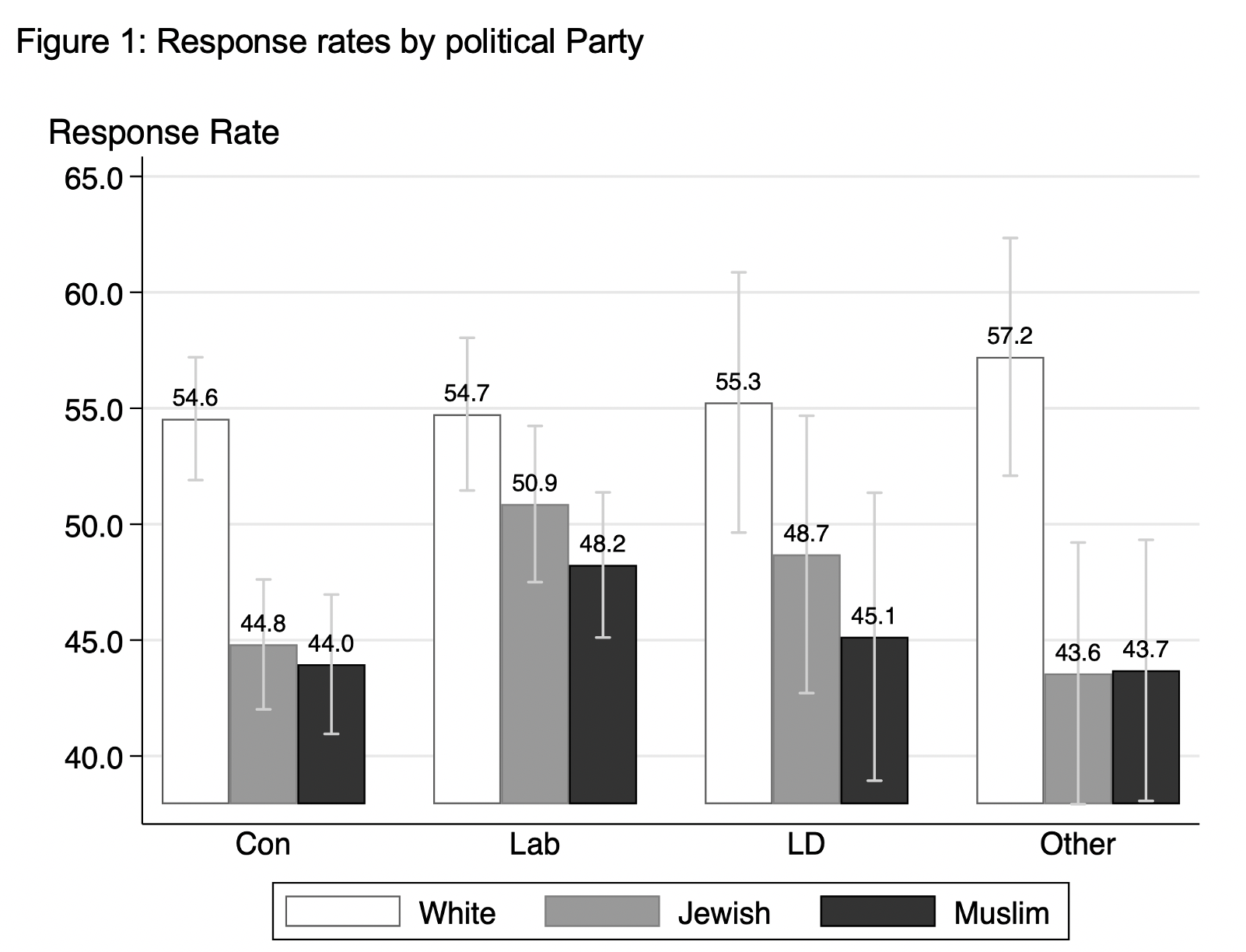
Response rates were six to seven percentage points lower to the Muslim and Jewish names – a clear evidence of bias. We don’t however see more bias against Jewish names by Labour councillors. Neither do we see more bias against Muslim names by Conservative councillors. Such discrimination in the provision of services based on race or religion is against UK law.  This form of discrimination by councillors may have substantive impacts for constituents. For example councillors set policy on access to the limited supply of social housing, policies which have been documented to disadvantage ethnic minorities.

Note: Response rates are estimated after removing council fixed effects, and standardising residuals to a response rate equal to the sample average of 55 percent for whites. Bars represent 95 percent confidence intervals.

In total we received 5,093 responses to 9,994 queries sent, for a 51% response rate. This is almost identical to the response rate found by a survey of real requests to councillors, in which 51% received a response within two weeks. Amongst those who responded to our queries, the median time to response was 12 hours, and the median length of responses was 228 words.

Compared to the male Christian name (Harry White), response rates to Jewish names are 5-6% points lower, and 6-9% points lower to Muslim names. Response rates are marginally higher to the female Christian name (Sarah) than to the male Christian name (Harry). Response rates are also higher to Zara Hussain than to Mohammad Hussain.

Name or Religion?

We randomise each councillor to receive one of two email scripts. The first email script makes a simple request in line with basic councillor responsibilities – ‘I have a question about local services and was wondering if you could tell me when your surgery is held?’. The second request explicitly indicates the religion of the emailer – ‘I’m  interested in organising a sponsored  walk in the local area to raise money for [Christian Aid/Islamic Relief/Global Jewish Relief]. Could you advise me if I need to get some kind of permit?’.

The two email scripts can be seen as different levels of intensity of the treatment. The response rate for white names to the first email was 61%, and 45% to the second email. Bias in response rates is similar across the two types of emails. This suggests that the discrimination occurs based on the name of the sender alone. Due to the high volume and low cognitive effort of checking emails, by not replying, councillors may be acting unconsciously when exposed to non-Christian/minority group names. Alternatively, councillors may simply be consciously discriminating against minority constituents, irrespective of their degree of self-identity. Because the identity of the sender is present in the email address itself, councillors might choose to not even open the emails from names associated with minority groups.

What explains the bias?

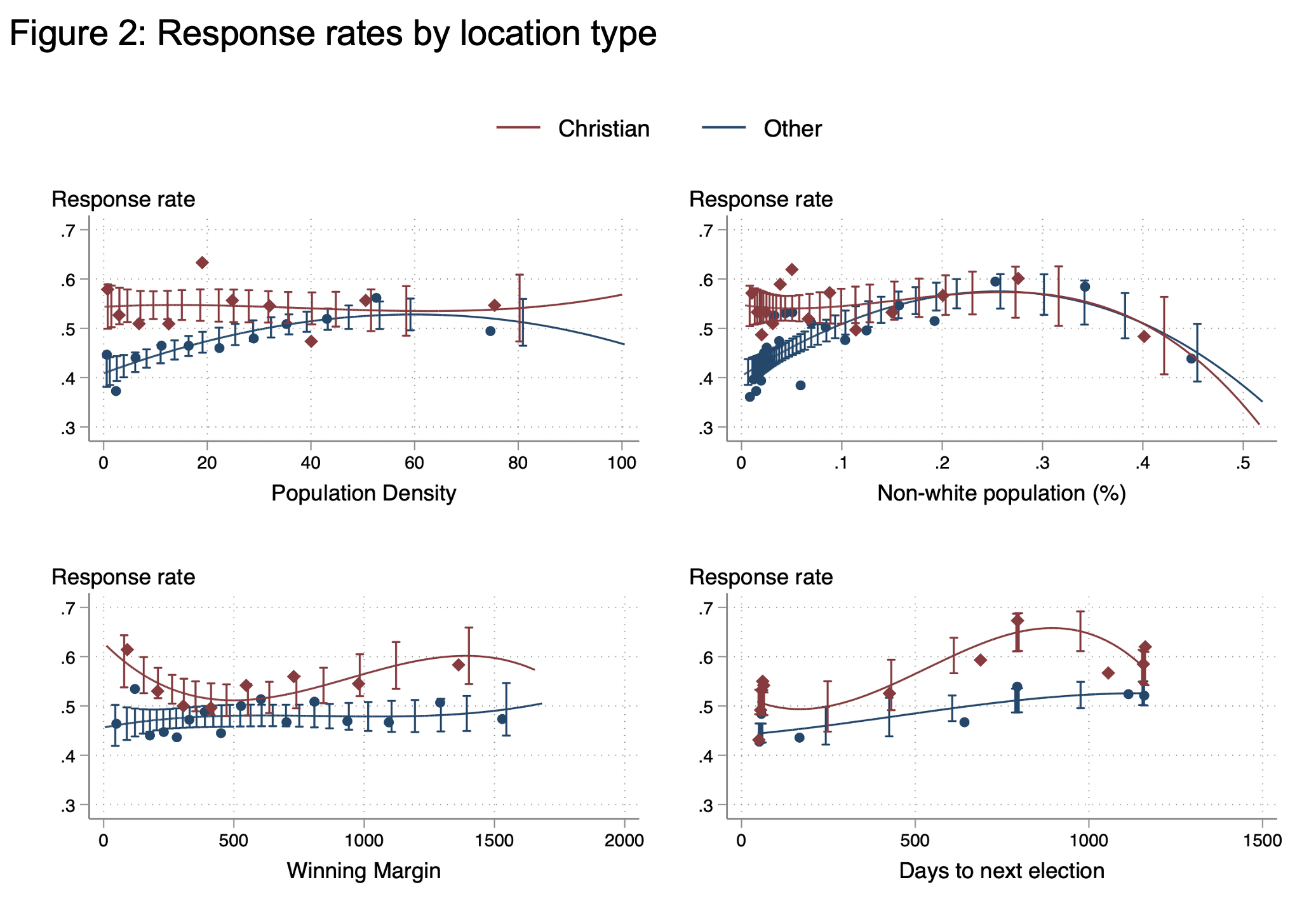
Bias in response rates is largest against Jewish and Muslim names in the least densely populated rural locations, with small non-white populations (Figure 2). One reason for this could be that councillors in white areas are more likely to be white themselves. On average we see much lower bias by councillors with names estimated to be Jewish or Muslim (though these estimates are imprecise due to the small number of such councillors). There may also be other differences in the selection of candidates with different levels of unobserved racial and religious bias in rural and urban areas. Alternatively, councillors may respond to political incentives and be less likely to respond to minorities in locations where minority groups are a small proportion of the electorate.

We test responses to electoral incentives directly by showing the relationship between response rates and two measures of competition – the margin of victory at the last election and the number of days until the next election. We see now less bias in close elections. Finally, lower bias could be attributed to the degree of ‘contact’ councillors have with different minority groups. Councillors in more diverse urban locations may show less discrimination through an erosion of prejudice as described by the contact hypothesis, though we are unable to test this hypothesis directly.

Note: The top-left figure shows a binned scatterplot of response rates against population density, by whether the sender name was Christian or non-Christian. The top-right figure shows response rates against the non-white population share. The bottom-left shows the response rate against the winning margin of the elected councillor at the last election. The bottom-right shows the response rate by the number of days until the next election. Fitted lines are polynomial regressions of order three, with bars showing 95 percent confidence intervals. Population density and non-white population shares are calculated at the ward (sub-council) level from 2011 census data. On average there are three councillors in each ward. Population density is expressed as residents per hectare.

Conclusion

We find evidence for bias from local politicians in response to requests for basic information from ‘Jewish’ or ‘Muslim’ constituents. Despite the media narrative of anti-Semitism in the Labour party and Islamophobia in the Conservative party, our results suggest that both parties are equally discriminatory to both minority groups. This discrimination seems to occur based on names alone, and is unchanged by the explicit identification of religious identity. These effects are largest in rural areas (with low population density) and with small non-white populations. Councillors in such areas may have fewer opportunities for positive interactions with minority groups.

This work demonstrates that even access to basic services are susceptible to forms of discrimination, and that minority group members may struggle to be heard through this process. Reducing councilor bias could be attempted through training designed to reduce implicit prejudice. The leader of the Labour Party has announced the party’s commitment to undergoing this type of training, though more research is needed into the effectiveness of such training. Future studies may benefit from further investigating the process through which politicians engage with their community, and identify ways in which to reduce these biases.

Lee Crawfurd and Ukasha Ramli measure the responsiveness of elected local representatives to requests from putative constituents from minority religious groups. They find that response rates are six to seven percentage points lower to stereotypically Muslim or Jewish names, with Labour and Conservative councillors both showing equal bias towards the two. Their results suggest that the bias may be implicit and that it is lower in more dense and diverse locations.

Source: How anti-Semitic and how Islamophobic are local politicians?

‘Institutionally racist’: NZ security agencies were Islamophobic and ignored right-wing threat – Muslim group

Of note. Valid and necessary of course to await the inquiry’s final report:

New Zealand’s security agencies were “institutionally racist and Islamophobic” and ignored the rising threat of right-wing extremism because it was instead focused on Muslim terrorism, a Kiwi Islamic organisation says.

The Federation of the Islamic Associations of New Zealand (FIANZ) yesterday publicly released its submission to the Royal Commission of Inquiry into the March 15 terror attacks.

It investigated how the New Zealand Intelligence Community [NZIC] didn’t foresee the threat of right-wing extremism despite rising attacks overseas and the Muslim community here feeling increasingly unsafe.

“We asked for help. We knew we were vulnerable to such an attack. We did not know who, when, what, where or how. But we knew,” the report said.

A team of researchers pored over a decade of media reports, speeches in Parliament, public addresses, online forums among other sources to establish how the threat had been ignored.

It concluded security organisations were institutionally racist, Islamophobic, incorrect and misled the public.

“We are not trying to generate any hate, we are just trying to give the facts as we see them. The problem is much deeper than that,” said Abdur Razzaq Khan, who chaired the federation’s submission to the Royal Commission.

The federation said Muslim communities were left “defenceless” because of “systemic failures” of diversity at the security organisations which failed to properly engage with Muslim communities.

The report pointed to numerous examples of the director-general of security Rebecca Kitteridge wrongly framed terrorism as a “Muslim issue” rather than seeing the community as potential victims.

Their submission included a speech from Kitteridge in 2016 at Victoria University where she said New Zealanders “can walk the streets free from fear” of events like Paris, Brussels, Ottawa, London and Sydney which were all perpetrated by Islamic radicals.

She did not mention the events of Oslo, Quebec, Pittsburg or Macerata which were orchestrated by right-wing extremists.

It was not until mid-2018 that agencies began assessing the threat of right-wing extremists, the report said.

But Khan said they did not blame any individual for the “failings”, or say that the NZIC was staffed by white supremacists or individuals with anti-Muslim bias.

“This is not the fault of any individual – this is the culture of Islamophobia.”

The NZSIS was extremely capable and if they had focused on finding right-wing extremism, they would have found the Christchurch terrorist.

“This rat would have easily been identified if they were looking – but they weren’t looking.

“They are very good, they searched out those Muslims who were searching out objectionable material and they prosecuted.”

The federation also found the Christchurch mosque attacks terrorist would never have been able to obtain a firearm if proper procedures were followed because two of his referees did not meet police criteria.

In order to avoid a terror attack happening again, the federation recommended criminalising hate crimes, denying right-wing extremism, establishing a Ministry of Super Diversity, improving how media portray Muslims, and better training for the police and security agencies.

The New Zealand Intelligence Community said it could not respond to specific claims until the Royal Commission’s report was released on December 8. The 800-page report has been presented to the Government.

Prime Minister Jacinda Ardern said she wanted the public to see the report before “launching into the discussion” on whether New Zealand’s security agencies had failed.

Source: ‘Institutionally racist’: NZ security agencies were Islamophobic and ignored right-wing threat – Muslim group

There’s a social pandemic poisoning Europe: hatred of Muslims

Of note:

Rarely does the EU act so swiftly. Less than four months since the killing of George Floyd in police custody and the Black Lives Matter campaign that spilled into Europe and galvanised continent-wide protests, the EU is appointing its first ever anti-racism coordinator.This brilliant idea will make little sense, however, if anti-Muslim hatred is not part of their portfolio. Because instead of building a “truly anti-racist union”, as the president of the European commission, Ursula von der Leyen, would wish, we have so far built an anti-Muslim one.

Prejudice against Muslims exists in every corner of Europe. Not only do we collectively devalue and discriminate against Europeans who follow Islam, but the incidence of violence against Muslims is increasing.

We have known since the refugee and migration crisis of 2015 and the jihadist terrorist attacks in France, Spain and Germany that Muslims suffer from an exceptionally bad reputation in our societies. In 2019, research conducted for the Bertelsmann Stiftung’s Religion Monitor yet again confirmed widespread mistrust towards Muslims across Europe. In Germany and Switzerland, every second respondent said they perceived Islam as a threat. In the UK, two in five share this perception. In Spain and France, about 60% think Islam is incompatible with the “west”. In Austria, one in three doesn’t want to have Muslim neighbours.

Source: There’s a social pandemic poisoning Europe: hatred of Muslims

Before we hurl insults around about ‘transphobes’ let’s be clear about what we mean

Definitions can be helpful but can also be divisive as we have seen the shift from the IHRA antisemitism working definition to one that has been adopted by governments and institutions:

When anti-semitism still appeared to be the Labour membership’s most glaring problem with intra-party prejudice and related mudslinging, great importance attached to definitions. What might seem to some members a perfectly allowable comment on the Israeli state might to others, using the International Holocaust Remembrance Alliance (IHRA) definition of antisemitism, be manifestly hateful and targeted.

The party’s adoption of that definition was itself disputed. Labour took on the IHRA definition in 2016, then argued about adopting its examples of antisemitic behaviour. As ugly as this difficulty with internationally agreed terminology might look from outside, the interest in precise wording represented some common ground. On the definition of antisemitism, Labour’s factions were at least able to communicate.

More recently, the party has adopted a working definition of Islamophobia advanced by the all-party parliamentary group on British Muslims (after consultation with more than 750 British Muslim organisations, 80 academics and 50 MPs). The group’s co-chair Wes Streeting dismissed objections that free speech would suffer. “While our definition cannot prevent false-flag accusations of Islamophobia to shut down reasonable debate and discussion, it does not enable such accusations. In fact, it makes it easier to deal with such behaviour,” he said. “Our definition provides a framework for helping organisations to assess, understand and tackle real hatred, prejudice and discrimination.”

There could hardly be a better case for another considered definition – after a week in which its meaning has been both stretched and contested – of what should be understood by transphobia. Unless we want to leave that job to the courts. Is it allowed, for instance, to satirise self-ID, as in the case of Harry Miller? Yes, says Mr Justice Knowles. And in a passage that might have been inspired by Labour’s pledges: “Some… are readily willing to label those with different viewpoints as ‘transphobic’ or as displaying ‘hatred’ when they are not.”

There are obvious implications for the unprecedented debates prompted by a proposed reform to the Gender Recognition Act, facilitating gender self-identification (ID). Can it be damagingly transphobic – if Miller is not – for people to meet and discuss the possible implications for women-only spaces and safeguarding? Should people be able to meet, without fear of abusive crowds, to share concerns about early gender dysphoria diagnosis/affirmation? Is it actionably bigoted – unlike Miller – to question the fairness of male-bodied athletes competing in women’s elite sport?

Tragedies deepen Jewish-Muslim bonds to fight hate crimes

Of note:

Muslim groups helped raise hundreds of thousands of dollars to help Pittsburgh’s Tree of Life synagogue recover after a gunman killed 11 people there, one year ago this week. The Jewish congregation mounted its own fundraiser for New Zealand’s Muslims after a white supremacist shooter killed 51 people at two mosques there in March.

Such outreach between Jews and Muslims often draws widespread attention only in the immediate wake of tragedy. But as both faiths grapple with a rise in reported hate crimes and fears within their communities of being attacked for their beliefs, Jews and Muslims are forging bonds that rely on shared personal values to help combat anti-Semitism and Islamophobia.

For Sheryl Olitzky, 63, the “aha moment” that inspired her focus on Jewish-Muslim connections came almost a decade ago on a trip to Poland, when she asked a guide why she saw no locals in the head-covering garb of devout members of either faith.

Olitzky, who was married at Tree of Life synagogue, recalled being stunned by the exclusionary response she heard and telling herself that “I could not change history, but I could rewrite it by changing the future” and working to prevent further episodes of discrimination against Jews and Muslims.

When the grandmother of seven returned home to New Jersey, however, it took several months for her to realize that, despite living in an area with “a fairly substantial number of Muslims and Jews,” she had no Muslim friends.

“I said, ‘I believe ignorance is a primary driver of hate, and it’s time, if I want to make change that I get to know Muslim women’,” Olitzky said.

When Olitzky was introduced to Atiya Aftab, a Muslim attorney and adjunct professor at Rutgers University, their partnership took off as the nonprofit Sisterhood of Salaam Shalom. What began as a meeting of six Muslim and six Jewish women at Atfab’s home now counts more than 170 chapters in 32 states and Canada, according to Olitzky.

The Sisterhood devotes much of its attention to education and shared experiences that can deepen ties between its members, with its fourth annual trip this year taking dozens of Muslim and Jewish women and teenage girls to Germany and Poland. But a vow to fight hate crimes that target their respective communities is also woven into the group’s foundation, with a “rise and respond” primer for speaking out against anti-Semitism and Islamophobia released this year .

Other members of the two faiths have created formal alliances as well. The Muslim-Jewish Advisory Council was established by the American Jewish Committee and the Islamic Society of North America in the first days after President Donald Trump’s 2016 election — following a campaign where Trump repeatedly stoked public fears of Muslims.

MJAC is co-chaired by two business executives, one Jewish and one Muslim. The group opened regional affiliates after a 2017 spike in reported hate crimes that included the death of Heather Heyer, killed while demonstrating against a white supremacist rally in Charlottesville, Virginia.

AJC Director of U.S. Muslim-Jewish Relations Ari Gordon said that some themes common in episodes of anti-Semitism and Islamophobia are “definitely linked.” The same man who allegedly attacked a synagogue in Poway, Calif., this spring was also linked to a fire set at a nearby California mosque, Gordon pointed out.

Hate crimes reported to the FBI have risen for three years running, according to official statistics, with Jews and Muslims ranking as the top two targets of religiously motivated incidents. But underreporting is seen as a significant obstacle to effective tracking of the problem. Heyer’s death, for example, was not included in the federal database although the man who drove his car into the crowd where she stood pleaded guilty to hate crimes charges.

MJAC has championed bipartisan legislation in Congress designed to improve the tracking of hate crimes — but its work has stayed in that domestic policy lane, steering clear of U.S. policy toward the Israel-Palestine conflict that has been a longtime divider of Jews and Muslims.

“We don’t put that issue on the side because it’s not important; quite the opposite,” Gordon said, adding that MJAC aims to demonstrate that the two faiths “can work together for mutual benefit and build trust despite this disagreement.”

Wa’el Alzayat, CEO of the Muslim advocacy group Emgage Action, and Halie Soifer, executive director of the Jewish Democratic Council of America, took a similar approach when they co-authored a columnafter the New Zealand mosque attacks that described their faiths as battling the “common enemy” of white supremacist violence. The duo first got to know each other as colleagues on the staff of Samantha Power, who served as U.S. ambassador to the United Nations under former President Barack Obama.

“We can work together on issues that unite us, and that doesn’t mean we have to agree on every issue,” Soifer said. Alzayat, also a member of MJAC, agreed that the alignment to discuss their faiths’ struggles against hate crimes does not mean “you let go of your principles.”

If the two communities can successfully find that “common ground,” Alzayat said, “over time, the really difficult stuff becomes easier to talk about.”

The partnerships between Muslim and Jewish groups have extended beyond battling hate crimes. AJC held an event last week to show support for the majority-Muslim Syrian Kurds as they grapple with the fallout from Trump’s decision to withdraw troops from the country’s northeast and Turkey’s subsequent attacks on Kurdish-held territory.

But even when it comes to the unifying issue of preventing hate crimes against their respective faiths, not every Muslim-Jewish partnership agrees on how publicly to discuss Trump’s role in the problem. Alzayat and Soifer used their op-ed to label Trump “a symbol of rising Islamophobia, anti-Semitism and other forms of racial and religious intolerance,” and Olitzky also said she views Trump’s muddled rhetoric about white nationalists as having “given permission for them to come out” further into the open.

MJAC, for its part, takes a more positive approach toward an administration whose support it needs to get further hate crimes legislation passed into law under Trump. The president signed a bipartisan bill strengthening penalties for threats against religiously affiliated institutions into law last fall. Gordon praised the Justice Department’s work on anti-Semitism and said that the group would not pull back on “criticism where we think it’s due.”

Source: Tragedies deepen Jewish-Muslim bonds to fight hate crimes