Parkin: Spot the backlash [DEI]

More interesting analysis that bucks some of the commentary:

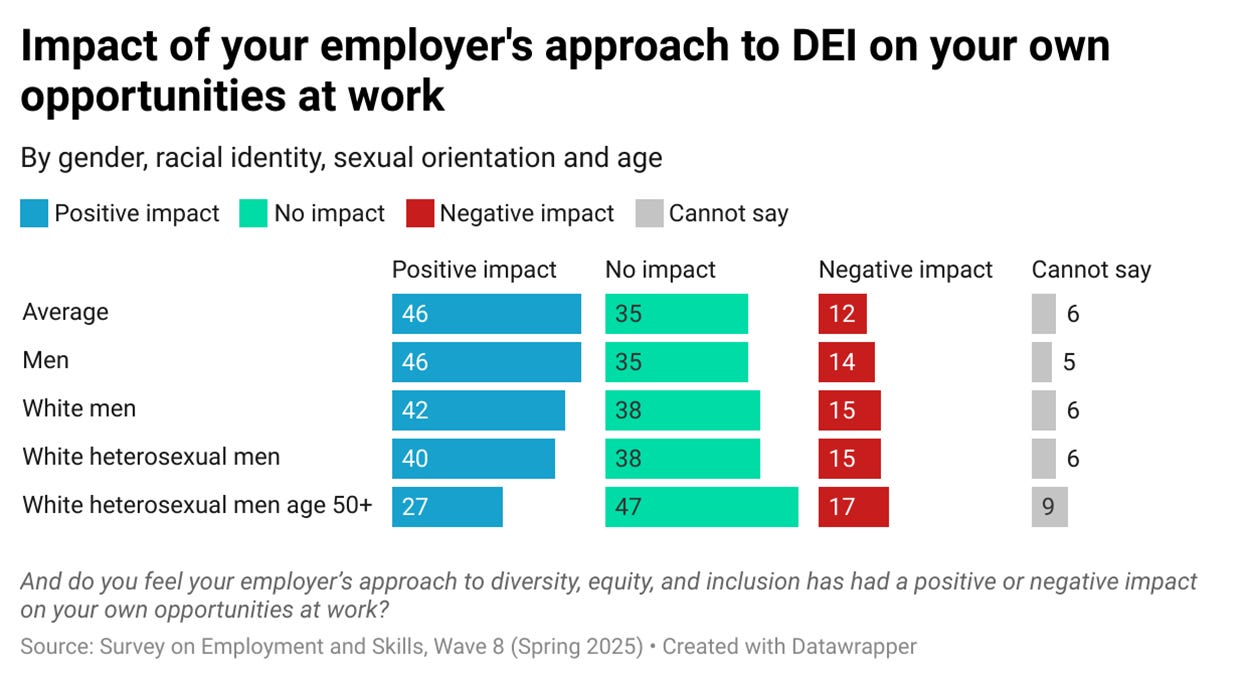
…But maybe we’re not looking closely enough. Thanks to the support of our survey partners at the Diversity Institute and the Future Skills Centre, the survey sample allows us to narrow the focus. Follow along in the chart below, which starts with the responses for employed adults in general, but then zeroes in on gender, racial identity, sexual orientation and age.2

Can you see the backlash taking shape? No, me neither.

Certainly, opinions are influenced by age. Older people are less likely to say that they’ve been positively affected by DEI policies (this holds true for older people in general, not just older white men). But opinions mostly shift to the neutral position (no impact). The proportion of white, heterosexual men age 50 and older who say their own opportunities have suffered as a result of DEI is only five percentage points higher than the average.

Source: Spot the backlash

Jamie Sarkonak: Carney’s budget is more subtle on wokeness, but the agenda is still strong

Noting the change but discounting the extent:

Tuesday’s budget wasn’t like those of the high Trudeau years, encrusted with identity politics at every turn. But the spirit of the old regime lives on under Prime Minister Mark Carney, who has opted for a deficit of $78.3 billion along with the continuation of social justice programs and diversity mandates.

This year, one-time “investments” are numerous. The federal anti-racism secretariat — the entity that spurred a government-wide clampdown on forced diversity and hiring quotas in Ottawa in 2021, in response to the Black Lives Matter movement — is getting $2 million in 2025-26, and nothing else after that. The Canadian Heritage program for DEI in sport is getting $8 million in 2025-26, and, again, nothing afterwards.

Even better, the Liberals are spending $28 million over the next two years on Canadian Heritage’s Digital Citizen Initiative, which has been around for years now. It could arguably be called a propaganda program, as it essentially involves funding government-aligned influencers to dispel “disinformation” and researchers to track “anti-Liberal” media, among other things. This budget claims that the funding tap will shut off in 2027 … but we’ll see about that.

The National Film Board, which restricts non-Indigenous individuals from using archive footage for commercial purposes, is getting a $4 million bonus next year. Federal museums, which have been slammed with diversity mandates in the Liberal era, will get $12 million.

Identity-based business funding is back, as well. The federal women’s entrepreneurship program is supposed to get $39 million next year, with nothing to come after. Black entrepreneurs, meanwhile, were told in September that they were getting another $189 million over the next five years for race-based business funding (this wasn’t written into the budget documents, however).

How many of these programs will actually end in a year or two, it’s hard to say. It’s easy for the government change its mind next budget season — better, even, because doing this helps keep the projected deficit lower….

Perhaps most disappointing of all is the continued existence of Women and Gender Equality Canada, which will be getting $500 million over the years 2026 to 2030. The department exists to funnel government money to Liberal-aligned social justice organizations and create new crises relating to menstruation, among other things, and really doesn’t have a point in an age where gender equality has largely been achieved.

Regardless of any spending cuts, the core philosophy of the Liberal government has remained the same since 2015: spend on the mosaic model of culture; prioritize supports on the basis of identity and privilege. Under Carney, it’s no different.

Source: Jamie Sarkonak: Carney’s budget is more subtle on wokeness, but the agenda is still strong

Jamie Sarkonak: Liberal diversity mandates must end if we’re to solve the judge shortage

Not sure if there is real evidence for the assertion “focus on diversity necessarily comes at the expense of excellence” and citing one example rather than a broader sample does not cut it. The shortages assertion may or may not be true, as the government has a record in many areas of not meeting targets and levels:

…This tends to involve standard-bending because the pool of bench-eligible senior lawyers is going to be more white and more male than the country as a whole. The senior tiers of any profession reflect the demographics of students in professional schools 40 years ago, not today. While excellent candidates can be found from all walks of life, the Liberal focus on diversity necessarily comes at the expense of excellence. And because the Liberals are obsessed with maintaining an acceptable ratio of white male to “diverse” appointees, we can infer that they’d rather leave some seats empty until a correct number of diverse judges can be put forward at the same time. Shortages ensue….

Source: Jamie Sarkonak: Liberal diversity mandates must end if we’re to solve the judge shortage

CBC hired 84 percent racialized, Indigenous, or disabled while having job vacancies for top talent: Internal report

Telling that the commentary only mentions the overall diversity numbers for context at the bottom of the article, highlighting the representation gaps that CBC like other organizations are trying to address:

The CBC far exceeded its “equity representation” target in the last fiscal year, with 84.1 percent of new hires being “Indigenous Peoples, persons with disabilities, and racialized people,” according to the public broadcaster’s new corporate report. In the “reflecting contemporary Canada” subsection, the report shows the CBC had aimed for 65 percent of new hires to fall within the three groups, but surpassed it by 19 percentage points.

Some employment lawyers believe the CBC’s fixation on race and disabilities in its hiring process is limiting the broadcaster from accurately reflecting the Canadian population, and could fall into hiring discrimination.

“Moving away from merit-based hiring is a disaster no matter what the makeup of your organization is,” said Puneet Tiwari, a Toronto-based employment lawyer. “If an employer wants a more diverse workplace, it should be an equal opportunity employer, but still hire based on merit. As an Indo-Canadian whose grandparents came here in the 60s, I’ve seen more representation across all media outlets.”

CBC hiring doesn’t appear to reflect the overall ethnic demographics of the country. Canada’s most recent census data from 2021 showed that approximately 4.9 percent of Canadians were Indigenous, 26.5 were visible minorities (with 67.4 percent being white), and 27 percent had disabilities. The country’s demographics and population has dramatically changed in the last four years through immigration, however, increasing from 38.1 million in 2021 to 41.7 million in 2025.

…Out of CBC’s total workforce as of June 2025, employees self-identifying as Indigenous were 2.1 percent, 11.3 percent were persons with disabilities, and 20.7 were visible minorities….

Source: CBC hired 84 percent racialized, Indigenous, or disabled while having job vacancies for top talent: Internal report

Most Canadian workers support equity efforts despite some backlash: report

Of note. Not clear from the article if any significant variations by types and sectors of employment:

A majority of Canadian workers say they view equity, diversity and inclusion favourably, according to a new report, even in the face of some backlash. 

The report from the Future Skills Centre and researchers at the Diversity Institute at Toronto Metropolitan University found that 54 per cent of Canadian workers view EDI favourably, while 27 per cent were neutral, and 16 per cent viewed it negatively. The survey was conducted by Environics Institute.

Workplace EDI initiatives in Canada and the U.S. have faced “intensifying scrutiny and backlash” amid policy shifts in the U.S., which have had spillover effects in Canada, the report said.

“Most Canadians do not view it (EDI) as a matter of political correctness or wokeness. They view it as an important foundation of Canadian values and culture,” said Wendy Cukier, one of the report’s authors and a professor of entrepreneurship and innovation at Toronto Metropolitan University.

“Increasingly, we’re seeing evidence that most businesses and non-profits and government organizations recognize that it’s fundamental to their success, particularly in times of disruptions.”  

In January, U.S. President Donald Trump signed an executive order putting a stop to diversity, equity and inclusion programs across the U.S. government.

Some companies have scaled back equity-related efforts as well, the report said, highlighting moves by Meta, Amazon and Target in the U.S. In Canada, the authors highlighted changes Shopify Inc. made by disbanding its dedicated diversity team and law firm McCarthy Tétrault pausing a specialized hiring program for Black and Indigenous law students. …

Source: Most Canadian workers support equity efforts despite some backlash: report

Fewer Canadian companies disclosing DEI records, study finds

Of interest:

Fewer Canadian public companies are trumpeting their records on diversity, equity and inclusion, though many are quietly pressing ahead with the initiatives despite the DEI backlash in the United States, a study by a national law firm has found.

U.S. President Donald Trump signed a number of executive orders aimed at stamping out the practice of promoting diversity in workplaces, saying hiring and promotion should be done solely on merit. These actions could be influencing Canadian companies to pull back on reporting data, Osler, Hoskin & Harcourt LLP said in its annual diversity disclosure report.

The shift halts a years-long trend of increasing reporting for metrics such as the percentages of women on boards of directors and executive teams, the report said. 

The report found the percentage of female directors among Toronto Stock Exchange-listed companies increased, rising above 30 per cent of board seats for the first time to 30.5 per cent. But the rate of increase fell to 0.7 percentage points from midyear 2024, the slowest in the 11 years Osler has conducted the study.

Despite reduced public disclosure, institutional investors still demand this information from companies in their portfolios, and many corporations see maintaining DEI programs as key to attracting top talent they will require as demographics change, said John Valley, chair of Osler’s corporate governance practice and co-author of the report.

Source: Fewer Canadian companies disclosing DEI records, study finds

DEI is ‘illiberal, anti-merit,’ says analyst as Poilievre pushes to end government DEI programs

The echo chambers reinforce each other. While some measures of merit are objective, character measures are more challenging. And of course the irony given that much of this discourse comes from South of the border, where merit and character are sorely lacking among many politicians and political appointees:

Bringing an end to diversity, equity and inclusion initiatives within Canada’s government, as proposed by Pierre Poilievre, would allow people to be chosen for roles based on merit and character, says the founder of a Canadian think tank.

It goes to the basic question of what kind of society you want and what governments should be doing. Governments should not have bureaucracies whose job it is to discriminate based on skin colour, ethnicity, gender,” Mark Milke told National Post.

Milke is the president of Aristotle Foundation for Public Policy, which is dedicated to renewing a common-sense approach to public discourse and policy.

He said diversity, in general, within Canada “adds to the potential for greater understanding, for greater economic growth.” But used within the context of DEI, it can lead to restrictions of Canadian identity based on skin colour.

Milke’s comments come after the Conservative leader urged Canadians to show support in shuttering such programs within the government by signing a petition. Poilievre said he wants to “restore the merit principle” in a post on X….

Source: DEI is ‘illiberal, anti-merit,’ says analyst as Poilievre pushes to end government DEI programs

Delacourt: Pierre Poilievre says he’d stand up to Donald Trump while taking a page from his playbook

Along with the anti-DEI petition:

…On the Friday before the long weekend, Poilievre also endorsed what another Conservative MP, Michelle Rempel Garner, was preaching — an end to birthright citizenship. Or, as Poilievre called it in another post, “birth tourism.”

Again, there’s an echo from one of Trump’s first executive orders on taking office.

“The privilege of United States citizenship is a priceless and profound gift,” the order states, going on to explain that citizenship would not be conferred to any child born in that country to a mother or father not lawfully present in the U.S. or there on a temporary basis.

“Canadian citizenship is a honour and privilege, and it must always be treated as such,” Poilievre said in an Oct. 10 post on X, formerly Twitter.

Neither of these seemingly Trump-inspired initiatives by the Conservatives are scourges in Canada. Fewer than 1,500 of the nearly 400,000 children born in Canada in 2024 were born to mothers whose residence was outside Canada. Railing against diversity, equity and inclusion may get some politicians votes, but it can also play into backlash against immigrants — which the Conservatives always hasten to point out, they’d never do….

Source: Pierre Poilievre says he’d stand up to Donald Trump while taking a page from his playbook

CPC Petition: DEI spending and government waste needs to DIE

Virtue signalling for their base and fundraising as a party petition, not one to be tabled in the House of Commons:

Whereas the Liberals are wasting millions of taxpayer dollars on bloated Diversity Equity and Inclusion (DEI) programs;

Whereas the Liberal government has wasted $1.049 billion on DEI bureaucracy while Canadians struggle to make ends meet;

Whereas research funding must reward the best ideas – not identity checkboxes;

Whereas by tying research funding to identity politics, the Liberals are undermining academic freedom, silencing dissenting voices, and eroding trust in Canadian institutions;

Whereas this Liberal government is out of touch, wasting billions on bureaucracy and ideological projects while Canadians face the highest cost of living in decades.

Therefore, we the undersigned support the Conservative plan to restore fiscal discipline, end the billion-dollar DEI bureaucracies, and put taxpayer dollars into services Canadians actually need.

    Source: DEI spending and government waste needs to DIE, Star article Diversity, equity and inclusion are coming under scrutiny — and Pierre Poilievre is ready to push the conversation

    Browne: After 20 years working in Canada’s cultural sector, I can finally speak out without fear

    Good long read and reminder of some of the excesses in the cultural (and other) sectors:

    …I believe I was a progressive type. I wanted to be inclusive. I wanted to help people who had a difficult time – for one reason or another – get started in the cultural world or be recognized so they felt equal and worthy to others in the community. I tried to reach out to diverse communities not comfortable with traditional institutions, and … a long list of other well-meaning ambitions. Maybe I was a Christian trying to make the world a better place, but I’d never say that. Then I realized I was always going to be wrong, somehow. Remaining silent was safe for me and the organizations where I was employed. And I did even when there were people who were clearly paying for the sins of their ancestors or unintended consequences beyond their control, including having graduated from a prestigious university. I should have spoken up.

    While I learned to say nothing out loud, I continued to have transgressive thoughts. In one training session, we began by confiding to the group what our pronouns were. Instead of he and him I wanted to insist on “sir” or “Mr. Browne” as monikers. (This is how my generation used to address older people they respected.) Needless to say, I didn’t blurt this out.

    The cultural world is full of enforcers in 2025: art schools, universities, arts associations and, most brutal and rigid, provincial and federal funders. All conspire to instill proper thinking. If you’ve applied for government grants you know that culture money is a not so subtle animator of social policy objectives. If you want government money, you twist your art to fit their agenda. Much of what is produced in this manner alienates and produces cynicism, not just for a mainstream audience but for complicit culture workers.

    Maybe the culture world needs an existential crisis to push us from so-called Canada to patriotism. One that moves culture from an exclusionary ideology that needs to keep finding people and ideas to disenfranchise or to be superior to … to what I’m not sure. Unsettling ideas are the raw cultural edge artists used to embrace; few sought the safety of consensus. This volatile, uncensored realm, not managed by academics or bureaucrats, can perhaps once again offer the possibility of revelation. 

    Maybe a new generation of curators and administrators will better separate art from advocacy. In my postretirement life, I’m returning to my teenage ambition to be an artist. I have such old-fashioned ideas about art I’m likely not going to provoke anyone, but I’d hope I’m encouraged by whomever runs museums to do just this.

    Kelvin Browne is a former vice-president at the Royal Ontario Museum and the former Executive Director and CEO of the Gardiner Museum

    Source: After 20 years working in Canada’s cultural sector, I can finally speak out without fear