The far-right Alternative for Germany party on Sunday celebrated a strong showing in the former Communist East, more than doubling its support in a state election held two weeks after an attack on a synagogue that some tied to the party’s use of hateful language.
The party won 23.5 percent of the vote in Thuringia, according to preliminary returns, up from 10.6 percent in 2014. That left it in second place, behind the Left Party but ahead of Chancellor Angela Merkel’s conservatives.
The party, known by its German initials AfD, has no hope of governing, since all the other parties have ruled out cooperating with it. But its strong showing is likely to reverberate in other ways. The election outcome could further strengthen the power of Björn Höcke, the party’s leader in Thuringia and its most notorious figure.
Juan Hernandez-Villafuerte’s parents identified as Christian, so he didn’t understand why, by family tradition, they abstained from pork, washed their hands thoroughly before and after meals and covered the mirrors in the home after someone died.
“You had to do it, but you never knew why,” he says at age 41. “I wasn’t aware of my Sephardic heritage at (any) point, even though I knew there was something different about us.”
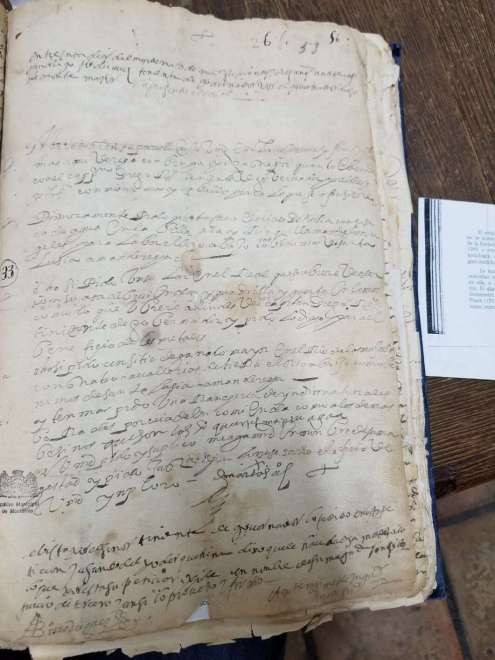
Before immigrating to Canada in 2012, he grew up in northeastern Mexico. His mother suspected they might have Jewish roots, so this fall, he left his home in Montreal and spent most of his vacation in the municipal archives of Mexico City. He found police and church records, as well as a yellowish paper — a property record from the year 1610 — bearing the name of his great-great-great-great-great-great-great-great-great-great-great grandfather.
“I was actually able to touch it,” he says. “I always wanted to know who I was.”
He was prompted to begin his research after the Spanish Parliament unanimously passed a law in 2015 to grant citizenship to the descendants of Sephardic Jews, meaning Jews with Iberian roots. The deadline for applications passed at the end of September, at which point the Ministry of Justice said it had received more than 130,000 applications, of which approximately 6,000 had been approved.
Spain’s initiative is part of a trend across Europe to repatriate Jewish families who faced persecution. Beginning in the 1300s, Sephardic Jews were forcibly converted to Catholicism, and during the Spanish Inquisition beginning the 1400s, the converts were investigated under suspicion that they may be continuing to practice judaism. Some historians estimate 2,000 converts were burned alive, while others faced different punishments, and after the Inquisition was established, an estimated 100,000 remaining Jews were expelled. Portugal also enacted a similar citizenship law in 2015, and countries including Germany, Austria and Poland have been granting citizenship to the descendants of Jews persecuted in the lead up to the Holocaust and during the Holocaust.
Spain’s initiative has led people to discover their family identities, but many of them have spent $6,000 on the application process, and the program is politically and economically charged. While some people commend Spain’s gesture as a way to rectify historical violence — or at least a way to secure a passport to the European Union — critics point out the expense of the application and question the country’s motives.
“They took everything from us — our identity, our possessions, any property that we had,” says Maria Apodaca, a Sephardic Jew who lives in Albuquerque, NM. “I don’t have $6,000 a pop to do this, and I don’t see how it would benefit me,” she says. “I was planted in the United States, and in the United States I’ll stay.”
Applicants do not need to be practicing Jews, but they do need to prove Sephardic heritage with evidence such as census documents and records of birth, baptism, marriage and death. Applicants must have these records translated by a translator recognized by the Spanish government, and they must travel to Spain to sign with a Spanish notary.
“It’s almost like a huge, many, many months-long scavenger hunt,” says Daniel Romano, a lawyer in Montreal who applied for citizenship with his wife. In his legal profession, he recently worked on an immigration case of a Venezuelan refugee, and he says her refugee claim was “100 times more simple” than his Spanish citizenship application.
Romano has always identified as a Sephardic Jew, and he had a sense of duty to accept the Spanish government’s offer of reconciliation. “It’s odd, but I felt the need to reciprocate. They cannot make amends through our mutual ancestors … if the descendants do not take up the offer,” he says.
Some applicants have sought rabbis to vouch for their heritage. Shlomo Gabay, the rabbi at Beth Hamidrash, a Sephardic synagogue in Vancouver, says he received eight or more requests per month to write letters for Spanish citizenship applications. The requests came mainly from South Americans, Mexicans and the occasional Canadian, with some people showing him original scripts from the time of the Inquisition.
“People really, really took this seriously,” says Gabay.
Though not subject to the Inquisition, Jews who refused to convert or leave Spain were called heretics and could be burned to death on a stake.Henry Duff Linton (1815-1899)/Creative Commons
In Britain, some Jews have seen repatriation programs as a ticket to work, study and travel in the European Union after Brexit. Ben Shapiro, a 26-year-old man who works at an interfaith charity in London, considered applying for Spanish citizenship but instead applied for German citizenship because the process was easier given that his relative was already applying, and it achieves the same access to the E.U.
“There’s definitely a lot of Jewish people that feel like their Spanish or Sephardic expression of Judaism is important to them, so being validated by Spain is something that’s pleasing,” says Shapiro, “but I think also Brexit is just having a big (impact on) young, liberal European-liking people who don’t want to give that up if they don’t have to.”
Spain could be taking this measure as an effort to boost its population and economy. The country’s fertility rate is far below replacement level at 1.3 children per woman, and its population is predicted to decline by 9.4 million between 2000 and 2050, according to the United Nations Population Division in 2000. The country has introduced pro-natal policies to encourage Spaniards to have more children and has accepted increasing numbers of refugees. Since applicants for the Jewish repatriation program must pass a language and citizenship test — and in many cases must hire a lawyer and genealogist to help with their claim — the initiative could attract migrants of affluence, as could repatriation programs elsewhere in Europe.
“There’s a sense certainly toward the Jews of some sort of historical debt, some sort of reckoning,” says Howard Adelman, an associate professor of history at Queen’s University, specializing in Jewish history, “but if I can be more cynical, I think there’s also an element of an attempt to bring people with assets and affluence to the countries and also to offset some of the refugees that are arriving at these countries.”
An original land grant from 1610 given to Marcos Alonso de la Garza in northeastern Mexico. His descendant, Juan Hernandez-Villafuerte, searched for the document to prove his Sephardic Jewish heritage.Juan Hernandez-Villafuerte
He notes that Muslims also endured forcible conversion in Spain, and in the 1600s, he says, hundreds of thousands of converts, known as Moriscos, were expelled. Yet, “no country has it on the table to talk about repatriating Muslims.”
Adelman says some Jews are disillusioned by antisemitism during the Trump administration, while some Jews are leaving Israel due to its unstable democracy.
“Many of them are having an awakening that they have to have another place to go, and I think that Israel used to be that escape hatch, but now Israel is in as much chaos as the United States,” he says.
Applications for Spanish citizenship surged at the time of Donald Trump’s election, says Schelly Talalay Dardashti, who works with the Spanish Citizenship Committee of the Jewish Federation of New Mexico, which received 50 to 75 calls per day before the deadline from people inquiring about Spanish citizenship. Some applicants have showed up at her office and cried, she says, having observed family customs all their lives but never having understood that the customs were Jewish.
“That is a bombshell that goes off in someone’s head. That is a real identity crisis,” she says. “Citizenship is like getting this badge: yes, we are who we are.”
When Dardashti meets with people, she asks them to write down family customs related to death, food and even cleaning the home, but many applicants get DNA testing and hire genealogists to help their claim.
Dennis Maez, a genealogist in New Mexico, was so overwhelmed with requests from Sephardic applicants that he had to put on hold his day job, running businesses that sell cars and cattle. He researched family trees for approximately 250 applicants, tracing some families back as far as the year 910.
As the deadline approached, he was “absolutely burnt out,” he says. “I would just work tremendous hours putting the (genealogies) together. I just finally had to quit.”
In Montreal, Hernandez-Villafuerte did his genealogy research himself. Even if his application is approved, he never intends to live in Spain.
“I think this is something I had to do for my ancestors,” he says. “They went through a lot of pain. They were expelled from their land … To me, it’s not about, What I can do with that citizenship? It’s more about restoring something that I love, or we loved, hundreds of years ago.”
Muslim groups helped raise hundreds of thousands of dollars to help Pittsburgh’s Tree of Life synagogue recover after a gunman killed 11 people there, one year ago this week. The Jewish congregation mounted its own fundraiser for New Zealand’s Muslims after a white supremacist shooter killed 51 people at two mosques there in March.
Such outreach between Jews and Muslims often draws widespread attention only in the immediate wake of tragedy. But as both faiths grapple with a rise in reported hate crimes and fears within their communities of being attacked for their beliefs, Jews and Muslims are forging bonds that rely on shared personal values to help combat anti-Semitism and Islamophobia.
For Sheryl Olitzky, 63, the “aha moment” that inspired her focus on Jewish-Muslim connections came almost a decade ago on a trip to Poland, when she asked a guide why she saw no locals in the head-covering garb of devout members of either faith.
Olitzky, who was married at Tree of Life synagogue, recalled being stunned by the exclusionary response she heard and telling herself that “I could not change history, but I could rewrite it by changing the future” and working to prevent further episodes of discrimination against Jews and Muslims.
When the grandmother of seven returned home to New Jersey, however, it took several months for her to realize that, despite living in an area with “a fairly substantial number of Muslims and Jews,” she had no Muslim friends.
“I said, ‘I believe ignorance is a primary driver of hate, and it’s time, if I want to make change that I get to know Muslim women’,” Olitzky said.
When Olitzky was introduced to Atiya Aftab, a Muslim attorney and adjunct professor at Rutgers University, their partnership took off as the nonprofit Sisterhood of Salaam Shalom. What began as a meeting of six Muslim and six Jewish women at Atfab’s home now counts more than 170 chapters in 32 states and Canada, according to Olitzky.
The Sisterhood devotes much of its attention to education and shared experiences that can deepen ties between its members, with its fourth annual trip this year taking dozens of Muslim and Jewish women and teenage girls to Germany and Poland. But a vow to fight hate crimes that target their respective communities is also woven into the group’s foundation, with a “rise and respond” primer for speaking out against anti-Semitism and Islamophobia released this year .
Other members of the two faiths have created formal alliances as well. The Muslim-Jewish Advisory Council was established by the American Jewish Committee and the Islamic Society of North America in the first days after President Donald Trump’s 2016 election — following a campaign where Trump repeatedly stoked public fears of Muslims.
MJAC is co-chaired by two business executives, one Jewish and one Muslim. The group opened regional affiliates after a 2017 spike in reported hate crimes that included the death of Heather Heyer, killed while demonstrating against a white supremacist rally in Charlottesville, Virginia.
AJC Director of U.S. Muslim-Jewish Relations Ari Gordon said that some themes common in episodes of anti-Semitism and Islamophobia are “definitely linked.” The same man who allegedly attacked a synagogue in Poway, Calif., this spring was also linked to a fire set at a nearby California mosque, Gordon pointed out.
Hate crimes reported to the FBI have risen for three years running, according to official statistics, with Jews and Muslims ranking as the top two targets of religiously motivated incidents. But underreporting is seen as a significant obstacle to effective tracking of the problem. Heyer’s death, for example, was not included in the federal database although the man who drove his car into the crowd where she stood pleaded guilty to hate crimes charges.
MJAC has championed bipartisan legislation in Congress designed to improve the tracking of hate crimes — but its work has stayed in that domestic policy lane, steering clear of U.S. policy toward the Israel-Palestine conflict that has been a longtime divider of Jews and Muslims.
“We don’t put that issue on the side because it’s not important; quite the opposite,” Gordon said, adding that MJAC aims to demonstrate that the two faiths “can work together for mutual benefit and build trust despite this disagreement.”
Wa’el Alzayat, CEO of the Muslim advocacy group Emgage Action, and Halie Soifer, executive director of the Jewish Democratic Council of America, took a similar approach when they co-authored a columnafter the New Zealand mosque attacks that described their faiths as battling the “common enemy” of white supremacist violence. The duo first got to know each other as colleagues on the staff of Samantha Power, who served as U.S. ambassador to the United Nations under former President Barack Obama.
“We can work together on issues that unite us, and that doesn’t mean we have to agree on every issue,” Soifer said. Alzayat, also a member of MJAC, agreed that the alignment to discuss their faiths’ struggles against hate crimes does not mean “you let go of your principles.”
If the two communities can successfully find that “common ground,” Alzayat said, “over time, the really difficult stuff becomes easier to talk about.”
The partnerships between Muslim and Jewish groups have extended beyond battling hate crimes. AJC held an event last week to show support for the majority-Muslim Syrian Kurds as they grapple with the fallout from Trump’s decision to withdraw troops from the country’s northeast and Turkey’s subsequent attacks on Kurdish-held territory.
But even when it comes to the unifying issue of preventing hate crimes against their respective faiths, not every Muslim-Jewish partnership agrees on how publicly to discuss Trump’s role in the problem. Alzayat and Soifer used their op-ed to label Trump “a symbol of rising Islamophobia, anti-Semitism and other forms of racial and religious intolerance,” and Olitzky also said she views Trump’s muddled rhetoric about white nationalists as having “given permission for them to come out” further into the open.
MJAC, for its part, takes a more positive approach toward an administration whose support it needs to get further hate crimes legislation passed into law under Trump. The president signed a bipartisan bill strengthening penalties for threats against religiously affiliated institutions into law last fall. Gordon praised the Justice Department’s work on anti-Semitism and said that the group would not pull back on “criticism where we think it’s due.”
Slowly, many would say too slowly, Germany is waking up to the threat of far right terrorism. How could it not after a gunman attacked a synagogue in the eastern city of Halle on Yom Kippur, the holiest day in the Jewish calendar? Unable to enter, he killed a woman on the street and a man in a kebab shop.
The shooter’s “manifesto” was a typical anti-Semitic screed, but his mother’s words, in their way, were more chilling. She told the German magazine Der Spiegel that her son “didn’t have anything against Jews in that sense. He had something against the people who stand behind financial power.”
Unfortunately, such parsing of definitions is not unique to the moms of murderers. Violent hate crimes that stop short of fatalities occur on an almost daily basis in this country, but are rarely reported or prosecuted.
In the past week alone, three right-wing extremists walked through the streets of Doebeln wearing orange jackets that said “Safe Zone,” chanting far right slogans and claiming to hunt “foreigners.” Right-wing extremist strategy is to make out that a “foreign threat,” that is, immigrants, has made streets unsafe, and that the German state has lost control of order, so it’s up to quasi-nazis to defend the streets and their country. Thus the “safe zone” reference.
In Mannheim, a 62-year-old man was arrested after shouting racist abuse at people on the train. (He was first told to leave because he didn’t have a ticket.) In Halle, someone uploaded a video of a man on the bus slurring abuse and talking about “gassing” people.
A few hours after the terror attack in Halle, police in the western city of Bonn reported that shots were fired through the window of an immigrant asylum home. The suspects drove off.
For the far right, such attacks small and large serve to instill fear in the targeted group, to drive a wedge between that group and the rest of society and thus fuel the extremists’ prophesied “war of cultures,” as Matthias Quent writes in his book Deutschland Rechts Aussen, or “The German Far Right.” And by failing to provide victims of hate crimes with justice, or declining to acknowledge that they are what they are, Germany’s democratic institutions perpetuate these aims.
In the aftermath of Halle, some measures have been announced. At a press conference, German Interior Minister Horst Seehofer said security measures at synagogues across the country would be improved.
But the government’s anti-Semitism commissioner, Felix Klein, thinks that’s not enough. Speaking on ZDF television the day after the attack, he demanded that judges be allowed to recognize and give tougher sentences to anti-Semitic hate crimes. Right now the relevant law speaks of “contemptuous” motives.
“The attack began with a man wearing a shirt emblazoned with the image of Horst Wessel, a Nazi shot in 1930 and portrayed as a martyr by Josef Goebbels. ”
“I have not had one case where anti-Semitism was clearly named as the motive for a crime,” says Christina Büttner from “ezra,” an organization in Thuringia, where victims of violent hate crimes can get counselling and legal advice.
Thuringia is an eastern German state and home to the far-right AfD, Alternative für Deutschland, hardliner Bjoern Hoecke, who has called the Holocaust memorial in Berlin a “monument of shame” and said that schools should highlight German suffering in World War Two
In 2014, a group of right-wing extremists beat up six people at an art exhibition in Erfurt, a city in Thuringia. The attack began with a man wearing a shirt emblazoned with the image of Horst Wessel, a Nazi shot in 1930 and portrayed as a martyr by Josef Goebbels. That man started making anti-Semitic slurs to visitors before he was joined by seven other men who shouted “Sieg Heil.” At their court hearing, the consensus appeared to be that the offenders were “drunk and looking for a fight,” says Büttner. The anti-Semitic slurs were “brushed aside.” The fact that one of them had the face of an SS officer tattooed on his calf was only added to the case file after he appeared at proceedings in short pants.
“There are education gaps about anti-Semitism among officials, state prosecutors and judges,” says Büttner. “One cannot assume that highly educated people in Germany know what anti-Semitism is.”
According to official figures, such as they are, anti-Semitic and racist hate crimes—including online hate speech and the use of Nazi symbols—increased almost 20 percent in Germany last year. In most cases, the offender was judged to have a far right background. Büttner says her organization has dealt with one case where the offender had a Muslim background, but when it comes to violent anti-Semitic attacks, right-wing extremists “are in the majority.”
When confronted with the case of a person who may have been a victim of a violent hate crime, the police in the state of Saxony-Anhalt, where Halle is located, have been told to refer victims to independent advisory services like ezra. The legal advice of these NGOs can be useful, for example, if police refuse to provide a translator to a victim who doesn’t speak German.
“In Halle, this works very well,” says a counselor for the organization Mobile Operberatung. “But in other parts of the state, it may be that the police don’t recognize the cases or that they don’t know what they are supposed to do.”
Independent advisory services for hate crimes—mostly present in eastern Germany—record a much higher number of violent attacks than the authorities. Last year, they estimated that an average number of five people a day were attacked.
“Last year, they estimated that an average number of five people a day were attacked.”
Even more hate crimes go completely unrecorded. “Our statistics are the tip of the iceberg,” Büttner says.
In Germany, the individual police officer asked to register an assault decides whether it is a hate crime or not. Judith Porath, who counsels victims of violent hate crimes in the eastern state of Brandenburg, says that the people who come to her center often decide not to go to the police. Some worry about revenge. Others distrust the authorities. “People feel that they are not being believed, that they are being treated as the offenders,” she says.
Sometimes, a person who is targeted repeatedly by hate crimes will think there is no point in going to the police if they are still waiting for the legal proceedings against a different assailant from three years ago. One reason that proceedings are so slow is that there is a significant shortage of judges and state prosecutors in Germany.
In cases of far right violence, according to Porath, a common strategy that her organization has encountered is for gangs to first ambush a person who is alone, then accuse that person of assault. The culprits can back each other up in court. If the victim has no witnesses, the case either is dropped or the victim ends up being charged.
The fact that there are more hate crimes could be interpreted by the organized extremist movement as a sign the population is “leaning toward their ideology” and shares their definition of “enemies,” Daniel Koehler, director of the Institute on Radicalization and De-Radicalization Studies, tells The Daily Beast.
There are some signs that the German law enforcement’s sensitivity may be improving. In the ZDF interview, Felix Klein said that one reason the number of officially recorded anti-Semitic hate crimes last year increased was because more people are now going to the police.
In Halle, the number of violent attacks recorded by the Mobile Operberatung actually decreased in the past year. But in the neighboring state of Saxony, NGOs recorded a 38 percent increase in violent attacks—not least because of a series of assaults fuelled by the racist riots in Chemnitz last August.
In the wake of those riots, four restaurants were attacked, including the Jewish restaurant Shalom and the Persian restaurant Safran. These properties were destroyed, swastikas were painted on the glass and one owner was in the hospital for eight days. The state police took over the cases, citing the likelihood of a xenophobic motive. No suspects were found.
“To some extent, the affected did not feel like they were being taken seriously,” says Anna Pöhl, a counselor for victims of hate crimes in Chemnitz. This was in part because of the manner in which police investigated the attacks, for example by checking for ties to organized crime or asking whether the offenders had perhaps been shouting something in Arabic or Russian–this after being told that they’d given a Hitler salute and shouted “Sieg Heil.”
This September, the far right Alternative für Deutschland party became the second strongest party in Saxony and Brandenburg. Now, Judith Porath says “The AfD tries to discredit us, they are constantly making inquiries about us.” Other political parties have defended the NGO, she said, so far.
Chancellor Angela Merkel made a veiled attack on the far-right Alternative for Germany (AfD) party on the 29th anniversary of German reunification on Thursday, saying economic grievances in the east were no excuse for racism.
German Chancellor Angela Merkel poses with Mayor of Kiel Ulf Kampfer and President of the German Federal Council Daniel Gunther during the celebrations to mark the 29th anniversary of the country’s reunification, in the northern city of Kiel, Germany, October 3, 2019. REUTERS/Morris Mac Matzen
In a speech marking the anniversary, Merkel cited a government-commissioned report that found economic discrepancies between the eastern and western parts of Germany and which said people in the east feel like second-class citizens.
But she said this was no justification for verbal attacks on foreigners under the guise of free speech, and that such attacks threatened democracy in Germany. Shortly after she spoke, about 600 people took part in a far-right rally in Berlin, with some carrying German flags and waving anti-Islam placards.
Merkel did not mention the anti-migrant AfD by name but it has stronger support in eastern parts of Germany and made big gains in elections in two eastern regions last month.
“It should never be the case that disappointment with politics, however significant, be accepted as a legitimate reason to marginalise, threaten or attack others because of their skin color, religion, sex, or sexual orientation,” Merkel said in the northern city of Kiel.
“The values of our constitution must guide each and every debate in our country,” she said. “In concrete terms this means, ‘Yes’ to open debate, ‘Yes’ to tough demands from politics, ‘No’ to intolerance, ‘No’ to marginalisation, ‘No’ to hate and anti-Semitism, ‘No’ to living at the expense of the weak and minorities.”
RISE OF AfD
Merkel’s conservatives and their Social Democrat (SPD) coalition partners have accused the AfD, the largest opposition party in parliament, of legitimizing a language of hate that spurs violence.
They have said the AfD manipulates the grievances of eastern Germans – about lower wages and pensions, an exodus of young people, plans to phase out coal and the challenge of integrating a record influx of refugees – to make political gains through populism.
The AfD, which entered parliament two years ago in elections that were shaped by disquiet over Merkel’s decision in 2015 to welcome almost 1 million migrants, says it has always distanced itself from violent, far-right extremists.
The deadly shooting of a pro-immigration conservative politician in June and a rise in anti-Semitism have fueled debate about the anti-immigrant speeches of some AfD leaders.
The party has about 10% support in western regions and is polling at around 14% nationally.
The report cited by Merkel showed east Germany’s economic strength has risen to 75% of the west German level from 43% in 1990. Employment is at a high in the east and wages there are 84% of those in the west, it showed.
The report found that less than 40% say reunification was worth it and less than half are happy with democracy in Germany.
“A lot has been achieved in the past 29 years. In the west as well as in the east, people are all in all happier with their lives than at any other moment since reunification. But we also know that this is not the whole truth,” Merkel said.
“We must all learn to understand why reunification for many people in eastern states is not only a positive experience.”
Justin Trudeau admet que son équipe a tenté de trouver une solution pour maintenir la candidature de Hassan Guillet dans Saint-Léonard-Saint-Michel. Elle a finalement été révoquée après que le B’nai Brith eut révélé des déclarations passées jugées « antisémites » du candidat.
« Dans toute situation, on essaie toujours de créer des façons de rassembler les gens et non de les diviser. Mais quand il est devenu évident que les propos étaient inacceptables, il a fallu qu’on lui demande de quitter », a déclaré M. Trudeau, lundi, en marge d’une annonce à Waterloo, en Ontario.
Il y a cependant un flou quant au moment où le PLC a été mis au courant de ces déclarations. M. Trudeau, qui s’exprimait pour la première fois à ce sujet, n’a pas souhaité éclaircir le mystère.
L’organisation B’nai Brith dit avoir porté à l’attention du parti, à la fin du mois d’août, d’anciennes déclarations que M. Guillet aurait faites sur les médias sociaux. Selon le groupe, ces déclarations sont « troublantes, antisémites et anti-israéliennes ».
Dans un des commentaires, daté du 8 juillet 2017, et retransmis par le B’nai Brith, M. Guillet salue la libération, « après neuf mois dans une prison de la Palestine occupée », du militant Raed Salah qu’il qualifie de « résistant » et de « djihadiste ».
B’nai Brith pointe également du doigt une entrevue donnée par M. Guillet à Radio-Canada International, en espagnol, en décembre 2017, où il commente la décision du président américain Donald Trump de reconnaître Jérusalem comme la capitale d’Israël.
M. Guillet dit dans cette entrevue que le gendre de M. Trump, Jared Kushner, « un juif ultra-orthodoxe et un intégriste, pro-Israël », prône la politique « Israel first ».
Le 30 août, le PLC publiait un communiqué de presse pour révoquer la candidature de M. Guillet.
« Si ces déclarations pouvaient être considérées offensantes à certains de mes concitoyens de confession juive, je m’en excuse », a-t-il alors affirmé dans une déclaration qui semblait avoir été préparée pour calmer le jeu et demeurer candidat du PLC.
Lors d’une conférence de presse, quelques jours plus tard, le principal intéressé a déclaré qu’il avait été « trahi » par l’entourage de Justin Trudeau, qui était au courant de ses affirmations controversées.
M. Guillet a aussi affirmé que le parti avait commencé à travailler sur un « plan d’action », dès le début du mois d’août, pour démontrer l’appui de membres de la communauté juive à sa candidature.
En mai, M. Guillet a obtenu l’investiture libérale dans la circonscription montréalaise de Saint-Léonard-Saint-Michel, traditionnellement représentée par un candidat d’origine italienne, après une chaude lutte.
Le PLC a finalement annoncé la semaine dernière que la nouvelle candidate est la conseillère municipale Patricia Lattanzio, qui était arrivée en deuxième place à la course à l’investiture.
Cela n’a pas empêché les conservateurs — qui ont eux-mêmes eu à gérer des problèmes avec des candidats au sein de leurs propres troupes — d’attaquer les libéraux au sujet de M. Guillet dans les derniers jours.
Ils considèrent que l’ancien candidat a tenu « d’horribles propos antisémites et anti-Israël » et ont accusé le PLC de vouloir balayer les propos de M. Guillet sous le tapis avec « une stratégie de relations publiques ».
Widely covered and unclear exactly how his comments made it through the vetting process given that they were likely to be uncovered by B’nai Brith and others. And intriguing if Liberals were working on defensive media lines (which could be developed):
Ousted Liberal candidate Hassan Guillet admits to posting online about a Hamas-aligned activist, but says the party was well aware of his comments and were even working on a public relations plan before they withdrew his nomination.
Last week, the Liberal Party dumped Guillet as a candidate in Quebec after a Jewish human rights group accused him of making a number of anti-Semitic and anti-Israel statements.
In a statement posted to its website Friday, B’nai Brith Canada alleges Guillett congratulated a Hamas-aligned activist, Raed Salah, upon his release from a “prison of occupied Palestine” and prayed that he would one day succeed in liberating “all of Palestine.” The group said he described Salah as “frontier-fighter.”
The group also said it found a since-deleted Facebook post from 2016 in which Guillet allegedly wrote “the Zionists control American politics.”
The group said it reached out to the Liberal Party more than a week ago to make it aware of their allegations against him. The Conservative Party also called for his withdrawal.
Later that day, the Liberal Party said Guillet’s “insensitive comments” don’t align with the party’s values and revoked his candidacy in the riding of Saint-Léonard—Saint-Michel.
Guillet held a press conference in the riding on Wednesday, sitting shoulder-to-shoulder with supporters. He said the party was aware of the contents of his Facebook page since at least Aug. 8 and already had discussed an action plan that involved reaching out to the Jewish community.
Guillet, a member of the Council of Quebec Imams who gained national attention after delivering a speech in Quebec City honouring victims of the Quebec mosque shooting, said he did congratulate Salah after he was released from prison because he had protested the closure of a Jerusalem mosque, but insisted he wasn’t aware of his background.
Liberals say decision is final
“The party either knew or should have known what it contained. Why, then, if these words were so problematic, why was my candidacy … accepted?” he said. “One is entitled to ask the question, was it incompetence or bad faith?
“I am not anti-Semitic. On the contrary, I campaigned and I will always campaign against all forms of racism, including Islamophobia and anti-Semitism.”
Guillet said a member of the Liberal Party approached him Friday and said he could resign for personal reasons — or the party would withdraw its support.
The Liberal Party isn’t changing its mind.
“Following an internal review, the Liberal Party of Canada took the appropriate steps to remove Mr. Guillet as the Liberal candidate for the riding of Saint-Léonard—Saint-Michel. That decision is final,” said party spokesperson Parker Lund in an email Wednesday.
Neither is B’nai Brith Canada.
“Today’s press conference only confirms our position that Hassan Guillet is not fit to carry the Liberal Party banner,” said Michael Mostyn, the group’s chief executive officer.
“We are satisfied with our role in exposing his anti-Semitic statements, and disappointed that he spurned an opportunity to retract them.”
Embarrassing that the candidate vetting process did not discover these earlier statements.
Suspect an Italian-Canadian may now be the Liberal candidate given the complaints by some Italian-Canadians in the riding that a non-Italian-Canadian won the nomination:
The Liberals have dumped a candidate in Quebec after B’nai Brith Canada accused Hassan Guillet of making a number of anti-Semitic and anti-Israel statements.
“The insensitive comments made by Hassan Guillet are not aligned with the values of the Liberal Party of Canada,” the party said in a media statement.
“Following a thorough internal review process that has been ongoing for a few weeks, the Liberal Party of Canada has made the decision to revoke the candidacy of Mr. Guillet for the riding of Saint—Léonard Saint—Michel in this fall’s election.”
Guillet, a member of the Council of Quebec Imams, gained national attention after delivering a speech in Quebec City honouring victims of the Quebec mosque shooting.
In a statement on its website, B’nai Brith Canada said Guillett praised a Hamas-aligned activist, Raed Salah, and had a history of making anti-Semitic comments on social media. The group said it reached out to the Liberal Party more than a week ago to make it aware of their allegations against him.
In a post on his Facebook account earlier today, Conservative Leader Andrew Scheer called on Prime Minister Justin Trudeau to “do the right thing, immediately condemn these anti-Semitic comments, and fire this candidate.
“Anti-Semitism is unfortunately all too real in Canada and threatens the safety and security of Jewish Canadians. As political leaders, we need to speak out and condemn it at every opportunity.”
In a statement issued Thursday — before being dropped as a candidate — Guillet apologized for some of his past comments regarding the Middle East, without repeating the comments or detailing what they were.
“If these statements could be considered offensive to some of my fellow citizens of Jewish faith, I apologize. My intention was not to offend anyone. The lack of sensitivity of these statements does not reflect my personality or my way of being,” he said in French.
“Since then I have evolved. Everyone who knows me, personally or through my works, knows that I am against hate, racism, anti-Semitism and violence regardless of the identity of the perpetrators or victims.”
World War II began 80 years ago this Sunday after Nazi Germany and the Soviet Union signed a “nonaggression” pact that was, in fact, a mutual aggression pact. Adolf Hitler invaded Poland on Sept. 1, 1939. Russia’s invasion of Poland, no less murderous, followed two weeks later.
On Nov. 3 of that year, Joseph Goebbels, the propaganda minister, gave Hitler a report of his trip to Poland. “Above all, my description of the Jewish problem gets [Hitler’s] full approval,” he wrote in his diary. “The Jew is a waste product. It is a clinical issue more than a social one.”
For several years many commentators, including me, have written about the parallels between the prewar era and the present.
There’s the rise of dictatorial regimes intent on avenging past geopolitical humiliations and redrawing borders: Germany, Italy, Japan and Russia then; China, Iran and Russia now.
Police in Peel Region have confirmed they are investigating a local Polish-language news outlet following a complaint from B’nai Brith Canada about anti-Semitic content.
The force’s Equity and Inclusion Bureau is “also aware” of the complaint, said spokesperson Const. Heather Cannon.
B’nai Brith laid the complaint after discovering “frequent anti-Semitic and hateful material” in Goniec, a news outlet based in Mississauga, Ont., that publishes a weekly newspaper with a circulation of about 1,000, and maintains a website and YouTube channel.
According to B’nai Brith, the paper has accused “Jews and Zionists” of having “terrorism in their blood,” and has urged readers to “stand up to the Jews,” in response to their attempts to “destroy” Poland.
In a series of “incendiary” articles, the outlet “warns repeatedly of Jewish control over the Polish government through ‘puppet politicians’ in the United States who favour ‘rewriting history’ in the interest of the Israeli government,” B’nai Brith said in an Aug. 15 statement.
Authors on the website have also stated that Jews are “playing their old game” of trying to interfere in various governments, while calling the actions of Jewish organizations “racist” and “satanic,” the Jewish advocacy group alleged.
“We are appalled by the blatant Jew-hatred peddled by this publication,” said Michael Mostyn, B’nai Brith’s CEO. “While there is room for disagreement over policies in modern Polish-Jewish relations, the anti-Semitic content that we are seeing is truly beyond the pale.”
Among other examples B’nai Brith cited was a photograph of Hasidic Jews juxtaposed with the U.S. Capitol building, followed by allegations that Congress is controlled by Jewish forces, as well as a headline saying, You Use WhatsApp – Jews Are Spying on You.
Goniec has also described a film documenting the 1941 anti-Jewish massacre in the Polish town of Jedwabne as “false propaganda of the ‘Holocaust enterprise’ in a plot to initiate reparations for Jewish property that was lost or stolen during the Second World War,” B’nai Brith charged.
Andrzej Kumor, the paper’s editor-in-chief and sole employee, called B’nai Brith’s accusations “unfounded” and said he will co-operate with police.
“I have nothing to hide,” Kumor told The CJN via email. “I was never hateful towards Jews or any other community. I see politics as a power play of different interests. I love the debate and I think that the debate is a cornerstone of (a) free, democratic society.”
He defended the material cited by B’nai Brith.
The headline about Jews spying, for example, “is about the security hole found in WhatsApp, which was exploited by (an) Israeli group with connections to … state security services,” Kumor explained, asking, “Is the headline, ‘The Russians are spying on us’ anti-Russian?”
He said the commentary titled Zionists Have Terrorism in Their Blood (not “Jews,” he noted) is about paramilitary groups in pre-state Israel – the Irgun, Haganah and the so-called Stern Gang – and “the smart political use of terrorism by Jews fighting for their country after the Second World War.”
As for the July 1941 pogrom in Jedwabne, “this crime should be investigated to the very end … to find out how many people died, and other circumstances,” Kumor said.
Several sources agree that at least 340 Jews were murdered in the pogrom, 300 of whom were locked in a barn that was set on fire.
Peter Jassem, past chair of the Polish-Jewish Heritage Foundation of Canada’s Toronto chapter, said it was brought to his attention “on numerous occasions” that Kumor was publishing “anti-Semitic content for years, sometimes explicitly, sometimes as innuendo regularly present in numerous articles written by him and his contributors.”
As for B’nai Brith’s translations, “everything seems to be accurate,” said Jassem. However, the title of one video cited by B’nai Brith “does not mean that Zionists have terrorism in their blood, but rather that they are guilty of terrorism,” Jassem explained. “But when you listen to the video, (Kumor) does say this: ‘Jews or Zionists have terrorism in their blood.’ ” Later in the same video, Kumor says, “It is said that Jews simply invented modern terrorism,” according to Jassem.
He added that both in this article and in an interview Kumor gave to an online Polish television station that Jassem views as anti-Semitic,” Kumor “seems to showhimself as a martyr and a freedom fighter whose mission is to uncover the truth and to defend freedom of speech. He blames Jewish conspiracy for this action against him.”